Business & Professional Ethics
for Directors, Executives &
Accountants, 8e
Leonard J. Brooks and Paul Dunn
Cengage Learning, Boston, MA, 2018
Chapter 4 – Practical Ethical Decision Making
Chapter Questions and Case Solutions
Chapter Questions…………………………………………………………2
Case Solutions………………………………………………………………5
P a g e | 2
Business & Professional Ethics for Directors, Executives & Accountants, 8e
Chapter Questions
1. Why should directors, executives, and accountants understand consequentialism, deontology, and
virtue ethics?
Directors, executives and accountants frequently encounter problems requiring decisions where
the right action is not covered in law or a company’s code, or where the code is being created or
2. Before the recent financial scandals and governance reforms, few corporate leaders were selected
for their “virtues” other than their ability to make profits. Has this changed, and if so, why?
Yes. With the recent revision and stiffening of governance requirements, directors are now
3. Is it wise for a decision maker to take into account more than profit when making decisions that
have a significant social impact? Why?
Yes. An organization needs the support of its primary stakeholders to attain its strategic
4. If a framework for ethical decision making is to be employed, why is it essential to incorporate all
four considerations of well-offness, fairness, individual rights and duties, and virtues expected?
It is possible for a set of stakeholders to be better off as a whole, but the proposed action may
5. Is the modified 5-question approach to ethical decision making superior to the modified moral
standards or modified Pastin approach?
Not really. The superior approach for a specific problem depends on the nature of the impacts
P a g e | 3
Business & Professional Ethics for Directors, Executives & Accountants, 8e
6. Under what circumstances would it be best to use each of the following frameworks: the
philosophical set of consequentialism, deontology, and virtue ethics; the modified 5-question; the
modified moral standards; and the modified Pastin approach?
The traditional philosophical approaches – consequentialism, deontology, and virtue ethics – are
time-honored approaches that have been refined into the modified 5-question; the modified
7. How would you convince a CEO not to treat the environment as a cost-free commons?
Depending on the person involved, they may be responsive to: altruism, the avoidance of big
fines (corporate & personal) or jail; or to arguments that under-pricing the use of the
8. How can a decision to down-size be made as ethically as possible by treating everyone equally?
Equal treatment (laying off by seniority or age or?) may not be fair to those who can least
withstand it. I would advise building in an appeals mechanism to any downsizing process to
9. From a virtue ethics perspective, why would it be logical to put in place a manufacturing process
beyond legal requirements?
A manufacturing process that protected the environment or the workers involved would
P a g e | 4
10. List the companies that have faced ethical tragedies due the following failings in their ethical
culture:
a. Lack of ethical leadership: Livent, Enron, WorldCom, Tyco, Adelphia, Siemens, Parmalat,
Goldman Sachs, Hollinger/Ravelston, Valeant Pharmaceuticals, VW (emissions cheating)
11. Give an example of behavior that might be unethical even though ‘‘everyone is doing it’’.
• Mechanics telling customers they need new tires before they really do.
• Cell phone companies selling warrantee programs on the basis that they provide for every
P a g e | 5
Business & Professional Ethics for Directors, Executives & Accountants, 8e
Illustrative Applications
1. Dealing with Disappointed Apple iPhone Customers (See Chapter 4, pages 213–
215)
2. Bribery or Opportunity in China (See Chapter 4, pages 215-217)
Case Solutions
5. Concussions in the NFL? (Chapter 4, page 224)
What this case has to offer
Concussions are imperiling NFL players and the game of football as we know it. The ethicality of the
Teaching suggestions
The case provides an example of how a corporation’s culture of secrecy can be used to defend business
as usual while harming stakeholders and benefiting others. Motivated by fear of big business losses, a
P a g e | 6
Business & Professional Ethics for Directors, Executives & Accountants, 8e
Discussion of ethical issues
1. Is the NFL’s stance on controlling the harm of concussions ethical?
That the NFL moved slowly on changes that can reduce concussions; that it had a culture of
denial and secrecy in order to preserve the big business of the NFL for its owners: no, it is not
ethical, because it lacks fairness, integrity, and transparency. Changes to the game have
2. Should the NFL have moved earlier on the concussion problem? If so, when and how?
Yes, signals that concussions presented significant harm for players have been evident for some
time. In 1994, when the NFL first began studying the problem, a virtuous organization would
3. If the concussion problem had been analysed using virtue ethics, what would the analysis have
included and concluded?
“[V]irtue ethics is concerned with the motivating aspects of moral character demonstrated by
decision makers.” (Chapter 4)
The analysis would have included an examination of the decision maker—the NFL—and virtues
P a g e | 7
Business & Professional Ethics for Directors, Executives & Accountants, 8e
• Integrity and transparency: The doctor co-chairs of the NFL’s concussion committee
from 2007 resigned in 2009 so that new members—“independent sources of expertise
and experience in the field of head injuries…”—could be hired. (Associated Press 2009)
• Sincerity and duplicity: When the NFL formed its “the Mild Traumatic Brain Injury
[MTBI] committee” in 1994, it appointed as chair a doctor with no brain science
experience (Ezell 2013), so the formation of the committee seems to lack sincerity.
4. Should the NFL continue to play football? Consider consequences, impacts on rights, and virtue
ethics in your answer.
Likely Consequences of Accepting the Long-Term Effects of Concussions: While health-wise,
perhaps the NFL should not continue, it will continue, because it is big business with great
Impacts on rights: To compensate for health risks, players’ salaries might go even higher;
survivor benefits might increase; and players’ contracts will likely contain clauses about
Virtue Ethics: The NFL, given the above paragraph, might say that it is demonstrating the virtues
of honesty (by admitting to the long-term effects of concussions), compassion and fairness (by
P a g e | 8
Useful Articles, Links, and Videos
“T.B.”. “Why the Japanese are no longer on top in sumo wrestling.” (March 17, 2015). Economist.
Associated Press (November 24, 2009). “Goodell announces two resignations.” ESPN.
Belson, Ken (September 12, 2014). “Brain Trauma to Affect One in Three Players, N.F.L. Agrees.” New
Ezell, Lauren (October 8, 2013). “Timeline: The NFL’s Concussion Crisis.” Frontline.
Mangels, John. (January 15, 2012). “NFL efforts to reduce concussions.” Cleveland.com.
Reuter, Tim. (October 18, 2013). “Americans Don’t Like Big Business? Tell That To The NFL.” Forbes.
P a g e | 9
Business & Professional Ethics for Directors, Executives & Accountants, 8e
6. BP’s Gulf Oil Spill Costs (Chapter 4, page 225)
What this case has to offer
This case discusses the potential consequences of BP’s oil spill in the Gulf of Mexico. The costs derived
from the spill could reach $80 billion, according to a Reuters’ estimate, or they could be around $40
This case is related to the following two other cases in the text:
• BP’s Corporate Culture (Chapter 7), discussing the systemic problems with the company’s values;
and,
Teaching suggestions
I start discussing this case by asking students to put together a list of all potential costs that BP could
face after the oil spill. Then I ask students to rank each item in the list by degree of uncertainty involved
Discussion of ethical issues
1. What are the costs to other stakeholders in society beyond those that Reuters included? How
would these costs be estimated?
The case describes the Reuter’s estimates. BP’s 2011 Annual Report describes the company’s
calculation of the financial consequences of the oil spill (p. 38)
P a g e | 10
Business & Professional Ethics for Directors, Executives & Accountants, 8e
BP has provided for all liabilities that can be estimated reliably at this time, including fines
and penalties under the Clean Water Act (CWA). The total amounts that will ultimately be
paid by BP in relation to all obligations relating to the incident are subject to significant
uncertainty.
Other costs, not included in the Reuter’s estimates may be:
• Reduction in sales due to the loss of reputation across all the company’s brands;
2. Has the cost of lost reputation been included by Reuters? If not, how could it be estimated?
The cost of lost reputation has been partially included by Reuters, as “Added regulatory scrutiny
3. Since there are so many uncertainties involved in analyses such as Reuters presented, are analyses
like this useful? Why or why not?
There is a high degree of uncertainty in the Reuters’ estimates; however, as soon as the reader
P a g e | 11
Business & Professional Ethics for Directors, Executives & Accountants, 8e
BP’s 2011 Annual Report describes the potential effects of loss of reputation (p. 27):
“Moreover, the Gulf of Mexico oil spill has damaged BP’s reputation, which may have a
long-term impact on the group’s ability to access new opportunities, both in the US and
4. Calculate the discounted value of BP’s estimated lost production for an appropriate time horizon
using reasonable assumptions for discount rate and price of a barrel of oil. Justify your assumptions.
In order to determine the present value of lost production, it is necessary to determine the
following four items:
1. Expected total annual production of the well in number of barrels:
According to the “Final Report on the Investigation of the Macondo Well Blowout”
prepared by The Deepwater Horizon Study Group (DHSG) in 2011 the size of the well’s
From the total reserves, BP was entitled to 65% of the production (p. 103):
“The Macondo well was a joint venture including BP (65%), Anandarko (25%), and MOEX
Offshore 2007 (10%). As the major shareholder, BP was the operator, in charge of
P a g e | 12
Business & Professional Ethics for Directors, Executives & Accountants, 8e
2. Number of years that the well was expected to be producing
It is difficult to estimate the number of years the well will be producing. Assume that the
3. Future oil prices
An estimate of future oil prices is provided in BP’s 2011 Annual Report. These estimates are
4. Discount rate
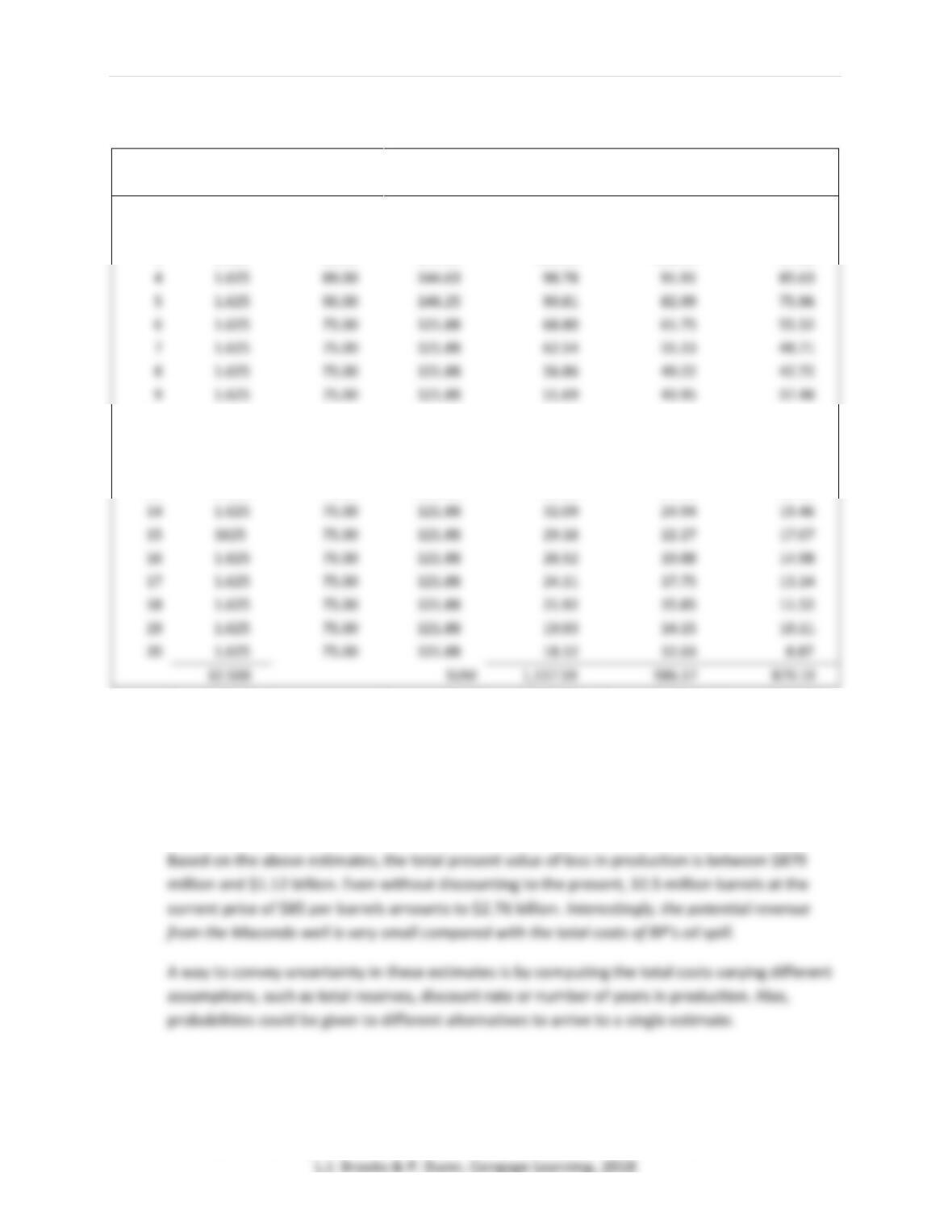
There are several ways to determine a relevant discount rate. The first alternative is to use
the discount rate that BP itself uses for valuing its business subsidiaries for purposes of
A second alternative is to use the 10% discount rate used in preparing the estimates disclosed in
the “Supplementary information on oil and gas” disclosures on the BP’s 2011 Annual Report (p.
244-248). This is the same rate that Reuters used to prepare their estimates.
P a g e | 13
Business & Professional Ethics for Directors, Executives & Accountants, 8e
Year
Barrels
Price
Cash Flow
PV
PV
PV
(in mill.)
per Barrel
(in mill.)
(Rate 10%)
(Rate 12%)
(Rate 14%)
1
1.625
85.00
138.13
125.57
123.33
121.16
2
1.625
88.00
143.00
118.18
114.00
110.03
3
1.625
89.00
144.63
108.66
102.94
97.62
4
1.625
89.00
144.63
98.78
91.91
85.63
5
1.625
90.00
146.25
90.81
82.99
75.96
6
1.625
75.00
121.88
68.80
61.75
55.52
7
1.625
75.00
121.88
62.54
55.13
48.71
9
1.625
75.00
121.88
51.69
43.95
37.48
10
1.625
75.00
121.88
46.99
39.24
32.88
11
1.625
75.00
121.88
42.72
35.04
28.84
12
1.625
75.00
121.88
38.83
31.28
25.30
13
1.625
75.00
121.88
35.30
27.93
22.19
14
1.625
75.00
121.88
32.09
24.94
19.46
15
1625
75.00
121.88
29.18
22.27
17.07
16
1.625
75.00
121.88
26.52
19.88
14.98
17
1.625
75.00
121.88
24.11
17.75
13.14
18
1.625
75.00
121.88
21.92
15.85
11.52
19
1.625
75.00
121.88
19.93
14.15
10.11
20
1.625
75.00
121.88
18.12
12.63
8.87
1,117.59
986.17
879.19
Present values of future cash flows in the last three columns are calculated using the equation:
PV = CASH FLOWSt / (1 + DISCOUNT RATE)n
In the above equation, n is the number of years in the future after which the cash flows will be
received, and t is the cash flows in each year.
P a g e | 14
Business & Professional Ethics for Directors, Executives & Accountants, 8e
5. Why were BP’s early estimates so low? After all, as Reuters reports – BP had experience with two
other recent cases.
BP’s cost estimates are limited by the GAAP definitions of contingent liabilities. The $40 billion
Moreover, the following items are not contingent liabilities under GAAP:
• Added regulatory scrutiny – 10% of operating costs
BP’s 2011 Annual Report describes the uncertainty related to the company’s estimates as one of
the company’s main risk factors (p. 27):
“The Gulf of Mexico oil spill has had and could continue to have a material adverse impact
on BP. There is significant uncertainty in the extent and timing of costs and liabilities relating
We recognized charges totaling $40.9 billion in 2010 as a result of the Incident. The total
amounts that will ultimately be paid by BP in relation to all obligations relating to the
Incident are subject to significant uncertainty and the ultimate exposure and cost to BP will
be dependent on many factors. Furthermore, the amount of claims that become payable by
P a g e | 15
Useful Articles, Links, and Videos
British Petroleum. Annual Report. 2011.
Deepwater Horizon Study Group (DHSG) (2011). “Final Report on the Investigation of the Macondo Well
P a g e | 16
Business & Professional Ethics for Directors, Executives & Accountants, 8e
7. Tylenol Recalls (2010): It’s Still About Reputation (Chapter 4, pages 228-231)
What this case has to offer
Johnson & Johnson (J & J) enjoyed a halo effect for many decades after their iconic precautionary recall
Teaching suggestions
I ask students whether companies that act ethically in one significant instance will always continue doing
so, and if so, why not? A good way to answer this question is discussing the J & J decision in 1982 and
Discussion of ethical issues
1. Who was really to blame for the lax procedures found?
Although the U.S. FDA is partially responsible for not acting faster and tougher on J & J, it is the
“[i]nternal control is a process, effected by an entity’s board of directors, management and
other personnel. This process is designed to provide reasonable assurance regarding the
achievement of objectives in effectiveness and efficiency of operations, reliability of
financial reporting, and compliance with applicable laws and regulations.
• Internal control is a process. It is a means to an end, not an end in itself.
2. How should this situation be remedied?
A number of things have to change within the company:
P a g e | 17
Business & Professional Ethics for Directors, Executives & Accountants, 8e
• Management needs to change its attitude towards internal control, including their views
on product safety and quality. The company should not try to downplay the possible
• The company should establish a strong foundation for monitoring of internal controls,
including:
o Support from top management (part of what is known as “tone at the top”);
It is not easy to remediate severe internal control weaknesses. It takes a cultural shift,
managerial time, and significant economic resources. From the pure cost-benefit perspective,
the company has already suffered significant economic losses as a result of the drug recall. The
problems that motivated the 2009 and 2010 drug recalls did not cause any serious health issues,
but without major changes the situation could happen again and possibly be worse.
3. How could the job done by the FDA be improved?
In this case, the FDA failed to act quickly against the company. It also appears that the warnings
from the Agency were not strong enough or did not come with tough enough penalties. For
P a g e | 18
Business & Professional Ethics for Directors, Executives & Accountants, 8e
Within 15 working days of receipt of this letter, please notify this office in writing of the specific
steps that you have taken to correct violations. Include an explanation of each step being taken
to prevent the recurrence of violations, as well as copies of related documentation. If you
cannot complete corrective action within 15 working days, state the reason for the delay and
the time within which you will complete the correction.”
4. J & J had lived under a positive halo due to their earlier recall of tainted capsules of Tylenol. Why
did J & J people behave differently, almost 30 years later?
There could be several reasons behind the change in the company’s response:
• Lack of ethical leadership and clarity about the importance of product safety as a
fundamental value for the company.
P a g e | 19
Business & Professional Ethics for Directors, Executives & Accountants, 8e
5. How would the total cost of this debacle be estimated?
There are direct and indirect costs for the company. The most obvious direct costs are:
• Litigation;
On top of those direct costs, indirect costs may be very large, including:
• Reduction in sales due to the loss of reputation across all the company’s brands;
Articles, Links, and Videos
COSO Definition of Internal Control, “Internal Control – Integrated Framework, 1992, later revised, see
Business & Professional Ethics for Directors, Executives & Accountants, 8e
8. Vioxx Decisions – Were They Ethical? (Chapter 4, pages 231-233)
What this case has to offer
This case offers the opportunity to apply ethical decision making approaches during their examination of
some of the potential ethical issues related to Vioxx’ approval, marketing, and the decision to leave it on
Teaching suggestions
There are many examples of the dangers of ignoring evidence of hazardous products or processes too
long (Ford’s Pinto, Firestone tires, Union Carbide Bhopal, and Dow Corning’s silicone breast implant, to
name a few) and Vioxx may be another of these. Students need to understand the dynamics facing
Discussion of Ethical Issues
1. Utilizing the information provided and available from web sources, use the ethical decision-making
techniques discussed in the chapter to form an opinion about whether Merck’s decisions regarding
Vioxx were ethical. Show your analysis.
Analysis of Some Ethical Issues
Here we use a hybrid analysis of the Philosophical Approach and the Stakeholder Impact