P a g e | 21
Business & Professional Ethics for Directors, Executives & Accountants, 8e
Identification and prioritization of the stakeholders, and their respective interests (well-offness,
rights, fairness), does not appear to have included patients and their respective families as top
priority. Merck’s decision making process appears to have been less than comprehensiveness.
Were the consequences of Merck’s decision beneficial to its stakeholders?
Consequentialism view holds that whether an act is morally right depends only on the
consequences of that act or of something related to that act. It is difficult to argue that any of
Merck’s stakeholders are better off and have benefited in the long term. In the short run, Vioxx’
sales helped increase Merck’s revenues, benefited stockholders and management, as well as
benefiting some patients. Through their short term vision, Merck’s management fell into ethical
P a g e | 22
Business & Professional Ethics for Directors, Executives & Accountants, 8e
Furthermore, Merck had ample opportunity to withdraw Vioxx from the market (between 1999-
Were Merck’s decisions legal? Were Merck’s decisions fair, just, or right?
Merck’s VIGOR data (1, 2) showed that Vioxx could cause death in some patients. Should Merck
have withdrawn Vioxx from the market sooner that it did? If it is determined that Vioxx directly
contributed to any death, and that Merck knowingly omitted certain data from its regulatory
Company profits clearly benefited some of the stakeholders. But many others suffered. Merck
may contend that despite all transpired events the net benefit to society as a whole was worth
the risks. The fact that Vioxx had serious adverse effects might have come into the risk-benefit
analysis at Merck. As a result, some people were expected to develop complications or die.
Did Merck’s decisions demonstrate expected virtues?
As a pharmaceutical company Merck’s reputation and public image had been built over many
years. This reputation entailed implicit virtues of reliability, trustworthiness, compassion, caring,
P a g e | 23
Business & Professional Ethics for Directors, Executives & Accountants, 8e
Summary
In its decision-making process, Merck failed to identify and prioritize all stakeholders, and to
address their respective interests and rights. By marketing Vioxx, not only did Merck appear to
We found the following text on Merck’s website. “We believe our emphasis on ethics benefits
our business. It motivates our people, and helps to inspire confidence and trust among doctors
who prescribe our medicines as well as regulators who approve them. We care deeply about the
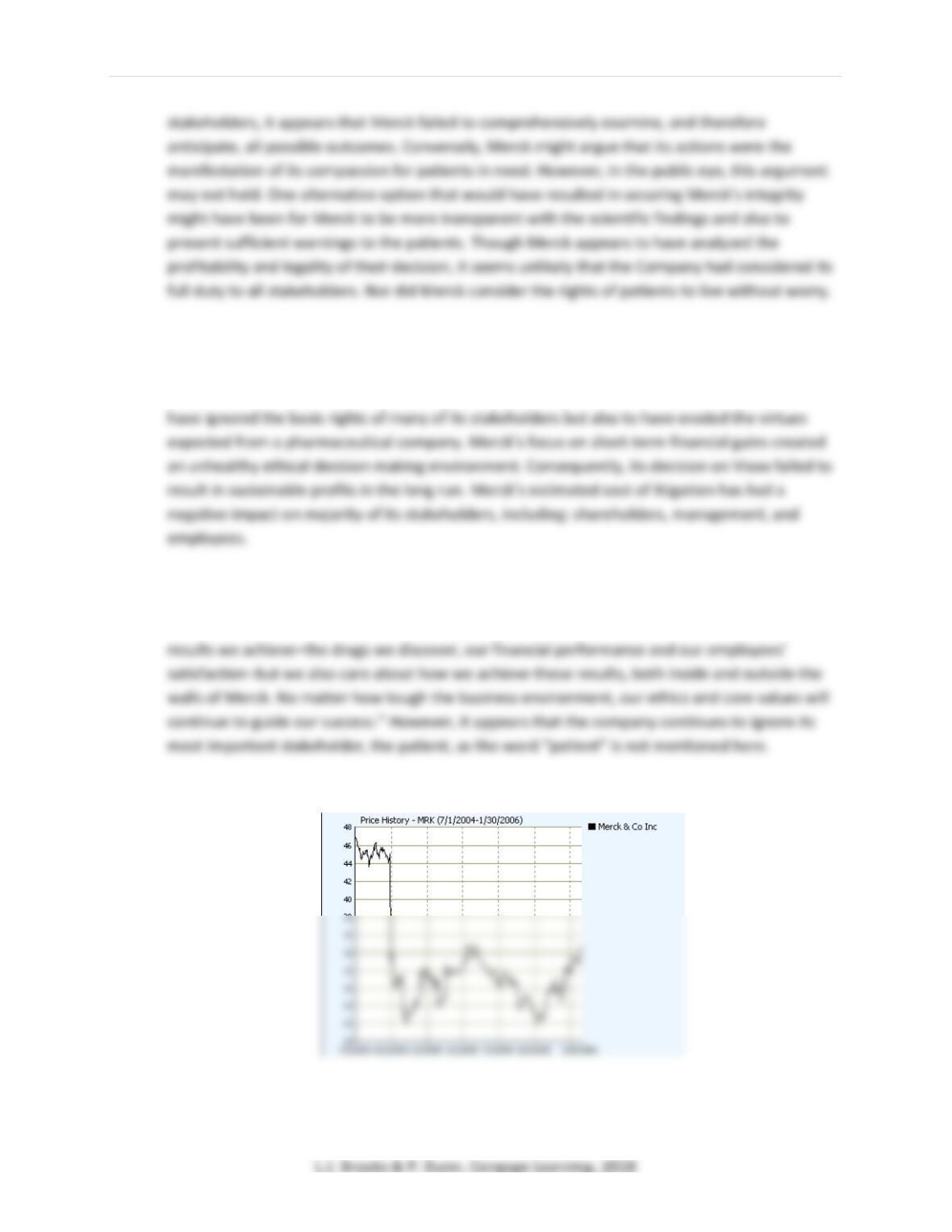
Exhibit 2: Performance of Merck’s stock following withdrawal of Vioxx from the market
P a g e | 24
Business & Professional Ethics for Directors, Executives & Accountants, 8e
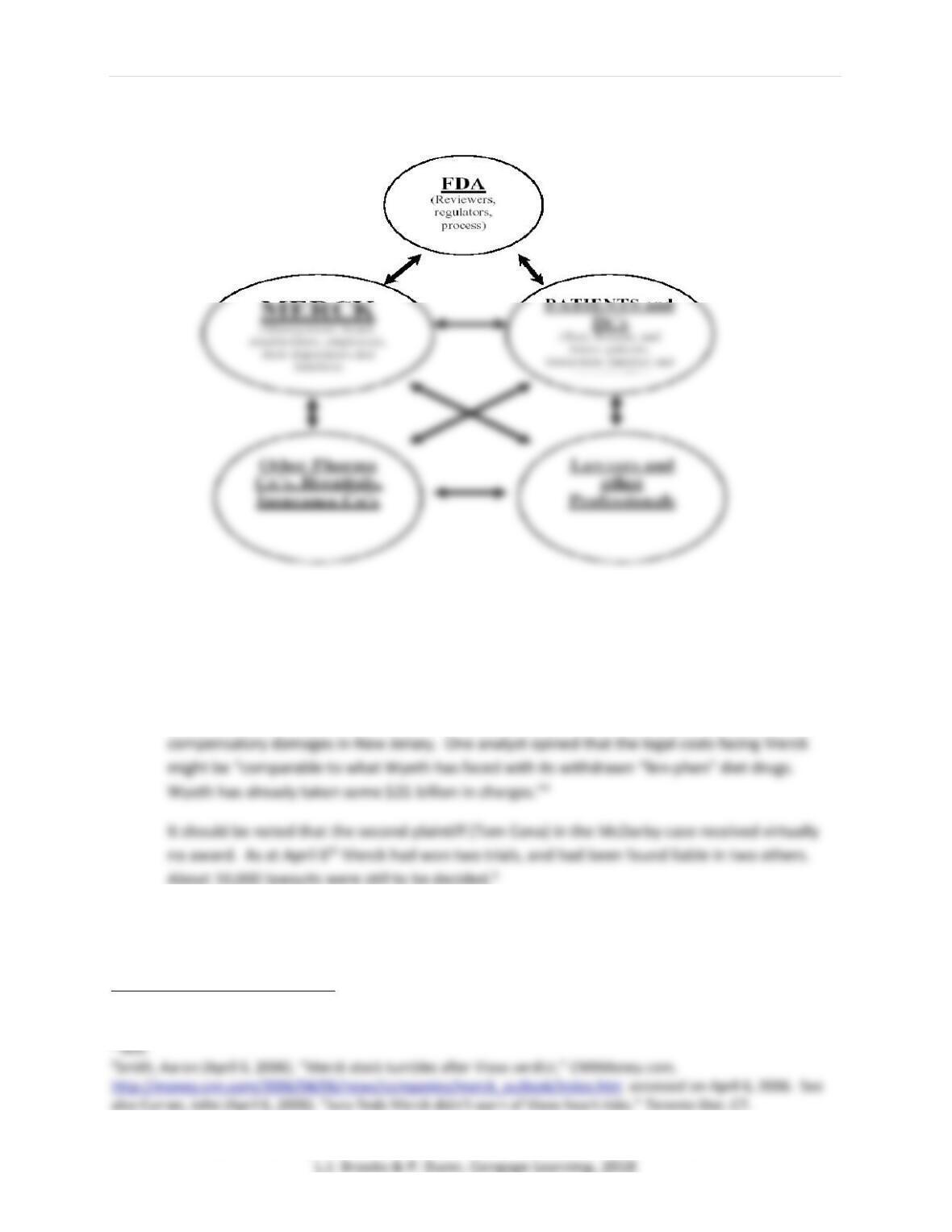
Exhibit 3: Merck’s stakeholders and their respective relationships
In addition to Rahbar Rahimpour’s analysis, the students should appreciate the nature and
structure of the court decisions that were appearing. At the early stage (May 2006), several
decisions appeared. On April 12, 2006, a jury in New Jersey awarded John McDarby, a 77-year-
old $4.5 million in compensatory damages and $9 million in punitive damages2 because “Vioxx
had been a significant contributing factor to his heart attack and that Merck failed to warn
adequately of the drug’s risks.”3 Punitive damage awards are capped at 5 times the
2. In order to protect the public more fully, what should the FDA do given the Vioxx lessons?
2Driver, Anna (April 12, 2006). “Merck’s cost in Vioxx case increased to $13.5 million.” Toronto Star, E6.
3 Ibid.
4 Ibid.
P a g e | 25
Business & Professional Ethics for Directors, Executives & Accountants, 8e
The FDA could consider:
• Requiring immediate notification by manufacturers and/or researchers of serious side
effects
• Immediate follow-up on such serious side effects
Update/Subsequent Events
February 28, 2008 – In settlement of lawsuits in Federal, California, New Jersey and Texas courts, Merck
obligated to pay $4.85 billion to 44,000 eligible U.S. claimants, see Official Vioxx Settlement (a website
Useful Articles, Links, and Videos
John S. Martin Jr. (September 5, 2006). Report of the Honorable Judge John S. Martin Jr. to the Special
Committee of the Board of Directors of Merck & Company, Inc concerning the conduct of senior
Although the panel is focused on legal aspects of the settlement the panel raises some ethical
concerns associated with the settlement.
“Merk Agrees To Vioxx Payout” CBS News Video November 9, 2007
Winstein, Keith & David Armstrong (March 11, 2009). “Top Pain Scientist Fabricated Data in Studies,

P a g e | 26
Business & Professional Ethics for Directors, Executives & Accountants, 8e
P a g e | 27
Business & Professional Ethics for Directors, Executives & Accountants, 8e
9. Just Do It – Make the Numbers! (Chapter 4, pages 233-234)
What this case has to offer
This mini-case conveys the scenario that has been acted out in countless CFO or CEO offices. It offers
the opportunity to consider – while using an ethical decision making (EDM) framework – the:
• pressures and motivations that can come to bear on the CEO and CFO,
A most interesting aspect of the EDM discussion is the opportunity to reveal the value of adding
deontological and virtue ethics perspectives to the basic consequential or utilitarian framework that
Teaching suggestions
Although the case can be taken up by the instructor, it would be helpful for a group of students to
present their case solution to the class. The presentation could then be critiqued by other groups of
Discussion of Ethical Issues
1. What should Ron consider in making his decision?
Ron, the CFO, should employ a full EDM analysis before making his decision – but rarely would
P a g e | 28
Business & Professional Ethics for Directors, Executives & Accountants, 8e
Here are some thoughts on the bulleted items listed above:
• pressures and motivations that can come to bear on the CEO and CFO,
o incentives (greed), fear of losing one’s job, reputation erosion
• consequences of manipulation on all the stakeholders,
o see Illustrative Case
• professional accounting stance on manipulations, and why,
o code of conduct discussion, professionalism, reputation concern, lessons for other
manipulation cases
• lessons learned from earlier manipulation cases, including: Enron, WorldCom, Waste
Management, Sunbeam, Adelphia, Tyco, Nortel, HealthSouth, Parmalat, and Royal Ahold.
o Enron – off-statement deals, sham transactions
I would conclude with a discussion of the importance of deontology (duty, respect for rights,
and fairness) and the demonstration of the virtue expected of senior company officials and the

P a g e | 29
Business & Professional Ethics for Directors, Executives & Accountants, 8e
related director oversight. While it is easy to argue that a utilitarian analysis may indicate no
significant net harm from an action, an assessment of fair treatment among stakeholders is not
P a g e | 30
Business & Professional Ethics for Directors, Executives & Accountants, 8e
10. Smokers Are Good for the Economy – Really (Chapter 4, pages 234-235)
What this case has to offer
The Smokers are Good case offers the opportunity for students to appreciate that:
• Cost-benefit analyses (CBA) are useful, but they are susceptible to many flaws:
o Prices/costs are hard to find exactly, and rarely are equivalent to the value of specific items
Teaching suggestions
I would recommend getting the students involved in the case by asking:
• How many smoke now?
Then, to get at the issues of the case:
• Why do people smoke?
Discussion of ethical issues
1. What does an ethical analysis add to Viscusi`s actuarial analysis?
Using a stakeholder impact analysis framework, an ethical analysis:
• Identifies all the relevant stakeholder groups affected by the activity
P a g e | 31
2. Would an ethical analysis change the conclusion reached? Why?
In this case, the product (cigarettes and cigars) is abnormal in that the nicotine included in it
produces an addiction in the smoker, so it is difficult for a smoker to quit. Since the level of
P a g e | 32
Business & Professional Ethics for Directors, Executives & Accountants, 8e
11. Ford Pinto (Chapter 4, pages 236-237)
What this case has to offer
The Pinto Case has become an icon in business ethics. It affords the opportunity to stress the
importance of:
• Using a framework for decision making which considers both financial and non-
Specifically, the case affords the opportunity to explore the following issues, among others, in a business
context:
• Can/should a price be put on life?
• Why was the cost-benefit analysis deficient?
o Estimates of lawsuit settlements
Teaching suggestions
My approach to the Pinto Case depends on whether I use it to start a class on ethical decision making
(EDM) frameworks, or to cement the framework issues that I have taught at the beginning of the class.
P a g e | 33
Business & Professional Ethics for Directors, Executives & Accountants, 8e
Discussion of ethical issues
1. Was the decision not to install the rubber bladder appropriate? Use the 5 question/box framework
to support your analysis.
The five question framework suggests the identification and ranking of stakeholders and then
employs the following challenges to proposed actions – in this case with the results indicated:
Is the proposed action profitable?
Is the proposed action legal?
Yes. But it is interesting to note that the Ford engineers knew that the Pinto would not pass
Is the proposed action fair?
No, certainly not to the people who died or were burned or to their families, provided it is
decided that the product carried inherent risks which were greater than was reasonable for
P a g e | 34
Business & Professional Ethics for Directors, Executives & Accountants, 8e
Is the proposed action right?
No. It clearly offends the right to life, and to health, particularly if the abnormal
Is the proposed decision sustainable development or/?
In this case, the issue of sustainable development doesn’t appear to be as important other
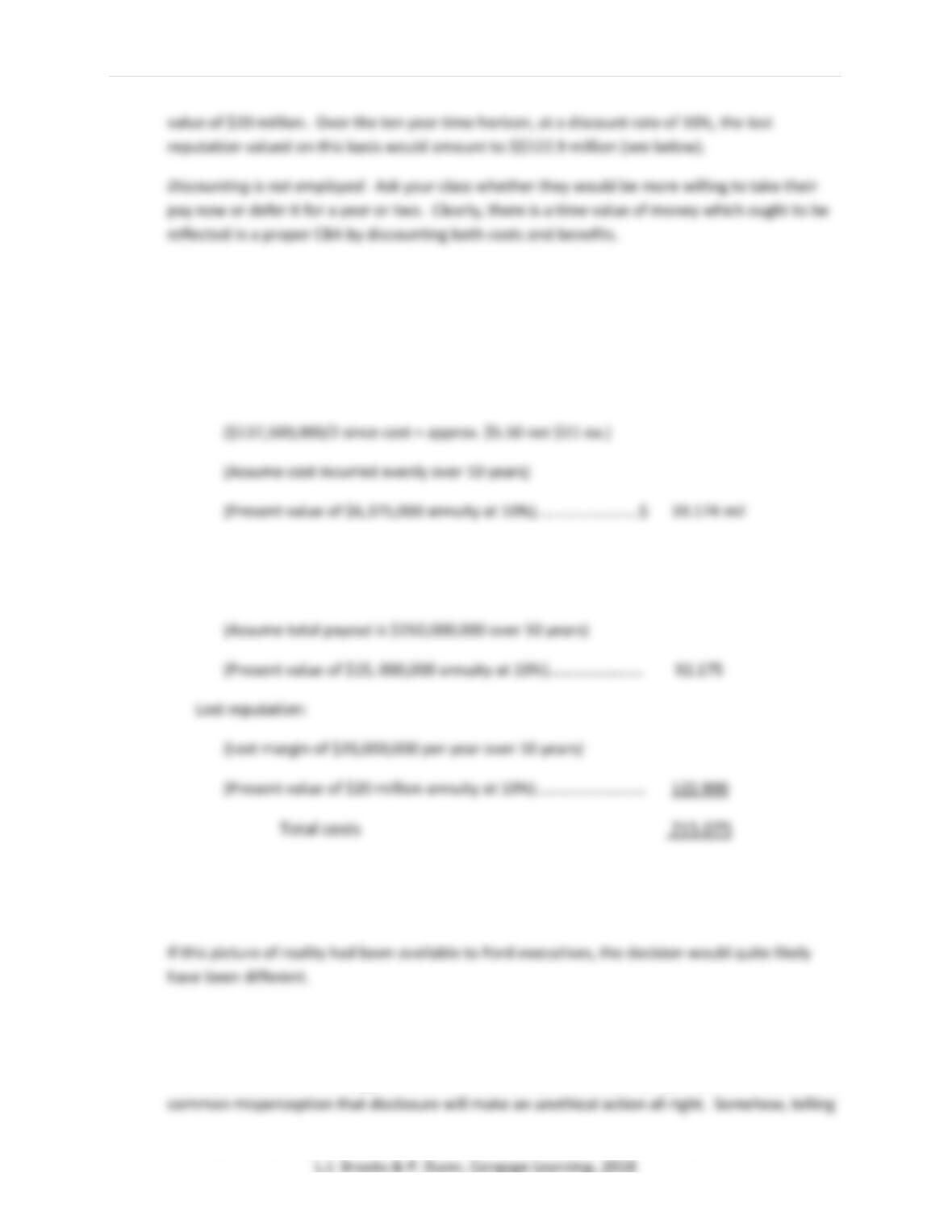
2. What faults can you identify in Ford’s cost-benefit analysis?
The most frequent observations made in response to this question are: how can anyone put a
value on a human life, settlement costs look low, Ford’s reputation suffered but this not valued,
and there is no discounting of future cash flows. Here are some comments on each.
Cost estimates look to low: True, but with hindsight everything is clearer. In fact, the total
claims paid out ultimately was approx. $150 million. In the US judges are elected and, when the
public learned more about the case it became outraged at Ford’s conduct and the settlements
skyrocketed. This is a pattern that has recurred since.
P a g e | 35
Business & Professional Ethics for Directors, Executives & Accountants, 8e
Correcting for these flaws, a recast CBA might look like that set out below:
Cost-Benefit Analysis of not installing the gas tank gasket:
Benefits of:
Installation and material costs:
Costs of :
Burn deaths, injuries, vehicles, and legal costs:
Net benefits-costs ($175.001)
Note: The income tax consequences of these cash flows have not be taken into account.
3. Should Ford have given its Pinto customers the option to have the rubber bladder installed during
production for, say $20?
The impracticality of this suggestion is obvious, but it provides a jumping off point to discuss the
P a g e | 36
Business & Professional Ethics for Directors, Executives & Accountants, 8e
Useful Articles, Links, and Videos
Dowie, Mark (September/October 1977). “Pinto Madness.” Mother Jones,
12. Kardell Paper (Chapter 4, pages 237-239)
What this case has to offer
The Kardell Paper Co. Case involves decisions around the necessity to introduce a very expensive
“closed-loop” pollution control system in a pulp mill. This provides an excellent opportunity to:
• Introduce and illustrate the stakeholder analysis approach as it deals with financial and non-
financial issues with impacts in both the long and short term.
• Get the students to grapple with the need for decisions based on partial or uncertain
Teaching suggestions
I use the Kardell Co. Case either after developing the 5-question/box Approach (5QA) with the students,
or after developing the Moral Standards Approach (MSA) and the Pastin Approach (PA) as well. I start
the discussion with a short scene-setting statement which raises the reality of the case setting – actually
it is an embellished real case with changed names, and with sonox really being dioxin, a suspected
carcinogen produces in the pulp making process. Then I ask the following questions, in order:
1. Who are the stakeholders here and what are their interests?
2. What are the major issues and how are the interests of each stakeholder group affected by
P a g e | 38
Business & Professional Ethics for Directors, Executives & Accountants, 8e
Discussion of ethical issues
1. Who are the stakeholders involved and what are their interests?
The discussion of stakeholders and their interests produces the expected list except that usually
neither Jack, the technician who discovered the potential problem and who is most concerned
2. Which stakeholders and interests are the most important? Why?
The ranking of stakeholders interests can be done after or in conjunction with the identification
of the major decisions to be taken. Provided sonox is considered a health risk, the usual
ordering of concerns by the public would be: life, health, quality of life, financial. I usually find
P a g e | 39
Business & Professional Ethics for Directors, Executives & Accountants, 8e
What decisions ought to be considered? What facts/analyses would we like to have?: Obviously
the decision of whether to shut down and install the closed-loop system is before the board.
However, the class should realize that there are a number of variants which should be
investigated, time permitting, with the ultimate decision depending on more information. For
instance:
• Is sonox really a problem?
As a result, an alternate decision would be to defer the closed-loop decision and seek more info
on one or more of the above. In the interim, several decisions arise:
• Should the community be informed of the possible health risks? When?
3. What was wrong with the quality of the board of directors’ debate?
At this point, it is easy to see that the board was not sufficiently representative of the
stakeholders to meaningfully present and understand the important issues facing the company.
P a g e | 40
Business & Professional Ethics for Directors, Executives & Accountants, 8e
4. What is the downside if the right decision is not made? Consider economic factors and also what
Jack might do.
Jack might blow the whistle if he thinks that the wrong decision is made or if the process is
suppressed or if too much delay is involved. This would (did) involve regulatory sanction