Chapter 04 – Adjustments, Financial Statements, and the Quality of Earnings
4-1
CHAPTER 4
ADJUSTMENTS, FINANCIAL STATEMENTS,
AND THE QUALITY OF EARNINGS
Learning Objectives and Related Assignment Materials
Learning Objectives
Mini-
Exercises
Exercises
Problems
Alternate
Problems
Compre-
hensive
Problems
Cases
and
Projects
balance sheet
accounts.
4-1 Explain the
purpose of
adjustments and
analyze the
1, 2, 3, 4,
5, 6, 7
1, 2, 3,
4, 5, 6,
7, 8, 9,
10, 11,
1, 2, 3, 4,
5, 6, 7
1, 2, 3,
4, 5, 6,
7
1, 2
4, 5,
6, 7,
8, 9,
10
4-2 Present an
income statement
8, 9, 10,
11
5, 6,
13, 17,
7
7
1, 2
1, 2,
3, 4,
4-3 Compute and
interpret the total
asset turnover
ratio.
12
19
6
6
1, 2
1, 2,
3, 8,
10
4-4 Explain the
closing process.
13
2, 12,
22
6, 7
6, 7
1, 2
1, 2, 5
Synopsis of Chapter Revisions
Focus Company: Chipotle Mexican Grill
• Chapter 4 builds on Chapters 2 and 3 by explaining and illustrating end-of-period adjustments,
Chapter 04 – Adjustments, Financial Statements, and the Quality of Earnings
4-2
corporations and individuals for violations involving false or misleading financial statements and
disclosures.
• Highlighted GUIDED HELP feature provides free access to step-by-step video instruction on
recording adjusting entries, as well as a Guided Help on recording a closing entry.
• New General Ledger Problem designations for a few exercises and problems that also may be
completed manually.
Chapter 04 – Adjustments, Financial Statements, and the Quality of Earnings
4-3
PowerPoint Slides
Learning Objectives
PowerPoint® Slides
4-1 Explain the purpose of adjustments and analyze the adjustments
necessary at the end of the period to update revenues and expenses
4-4 through 4-25
Chapter Take-Aways
4-1 Explain the purpose of adjustments and analyze the adjustments necessary at the end of the
period to update revenues and expenses and related balance sheet accounts.
Adjusting entries are necessary at the end of the accounting period to measure income properly,
correct errors, and provide for adequate valuation of balance sheet accounts. There are four types:
• Deferred revenues – previously recorded liabilities created when cash was received before being
4-2 Present an income statement with earnings per share, a statement of stockholders’ equity, and a
balance sheet.
Adjusted account balances are used in preparing the following financial statements:
• Income Statement: Revenues – Expenses = Net Income (including earnings per share, computed
Chapter 04 – Adjustments, Financial Statements, and the Quality of Earnings
4-4
Chapter Take-Aways, continued
4-3 Compute and interpret the total asset turnover ratio.
The total asset turnover ratio [Net Sales (or Operating Revenues) ÷ Average Total Assets] measures
4-4 Explain the closing process.
Temporary accounts (revenues, expenses, gains, and losses) are closed to a zero balance at the end of
Key Ratio
Total asset turnover measures sales generated per dollar of assets. A high or rising ratio suggests that the
company is managing its assets more efficiently. It is computed as follows:
Finding Financial Information
BALANCE SHEET
INCOME STATEMENT
Current Assets
Accrued revenues
include:
Interest receivable
Current Liabilities
Accrued expenses
include:
Interest payable
Revenues
Increased by adjusting entries
Expenses
STATEMENT OF CASH FLOWS
NOTES
Adjusting Entries Do Not Affect Cash
In Various Notes
(if not on the balance sheet)
Details of accrued expenses payable
Interest paid and income taxes paid
Chapter 04 – Adjustments, Financial Statements, and the Quality of Earnings
4-5
Chapter Outline
Teaching Notes
LO 4-1 Explain the purpose of adjustments and analyze the adjustments necessary at the end of
the period to update revenues and expenses and related balance sheet accounts.
I. Adjusting Revenues and Expenses
for the next cycle
2. At the end of the accounting period, adjustments record
A. Accounting Cycle – process followed by entities to analyze
and record transactions, adjust the records at the end of the
period, prepare financial statements, and prepare the records
Illustrated in Exhibit 4.1
the balance sheet accounts for reporting purposes
B. Purposes of Adjustments
1. Accounting systems are designed to record most recurring
daily transactions
2. As cash is received or paid, it is recorded
3. Cash is not always received in the period in which the
4. Solution to the problem created by differences in timing
the end of the period
4. Companies wait until the end of the accounting period to
adjust their accounts; adjusting daily would be very costly
and time-consuming
5. Adjusting entries are required every time a company
wants to prepare financial statements for external users
C. Types of Adjustments – each of the four types of adjustments
involves two entries:
Illustrated in Exhibit 4.2
1. One for the cash receipt or payment
2. One for recording the revenue or expense in the proper
period through the adjusting entry
Chapter 04 – Adjustments, Financial Statements, and the Quality of Earnings
4-6
D. Adjustment Process
Illustrated in Exhibit 4.3
Use Supplemental
Enrichment Activity #1
1. In analyzing adjustments at the end of the period, there
are three steps:
a. Step 1: Ask: Was revenue earned or an expense
incurred that is not yet recorded?
Use Supplemental
Enrichment Activity #2
b. Step 2: Ask: Was the related cash received or paid in
the past or will it be received or paid in the future?
i. If cash was received in the past (creating a
deferred revenue [liability] account in the past) →
Reduce the liability account that was recorded
c. Cash is never included in the adjusting entry, because
it was recorded already in the past or will be recorded
in the future.
d. Step 3: Compute the amount of revenue earned or
expense incurred. Sometimes the amount:
i. Is given or known
ii. Must be computed
iii. Must be estimated
2. Deferred Revenues
a. When a customer pays for goods or services before the
company delivers them, the company records the
amount of cash received in a deferred (or unearned)
revenue account
c. Recognition of (recording) the revenue is postponed
(deferred) until the company meets its obligation
Chapter 04 – Adjustments, Financial Statements, and the Quality of Earnings
4-7
Sales Revenue (R, SE) +52
d. AJE 1 – Chipotle received cash last period from
customers purchasing gift cards and recorded an
Unadjusted trial balance is
set forth in Exhibit 4.4
3. Accrued Revenues
has not yet been received
Interest Receivable (A) +1 = Interest Revenue (R, SE)
+1
a. AJE 2 – Investments owned by Chipotle earned $1 in
additional interest revenue for the quarter, but the cash
4. Deferred Expenses
a. Assets represent resources with probable future
benefits to the company
b. Many assets are used over time to generate revenues;
these assets are deferred expenses
hand of $24 = Supplies used of $366
–366
Chapter 04 – Adjustments, Financial Statements, and the Quality of Earnings
4-8
dr Rent Expense (+E, –SE)
e. AJE 4 – The Prepaid Expenses account includes:
• $72 paid at the beginning of the quarter for rental of
facilities at $18 per month
dr Insurance Expense (+E, –SE)
24
dr Advertising Expense (+E, –SE)
4
cr Prepaid Expenses ( A)
82
Assets = Liabilities + Stockholders’ Equity
Prepaid Expense (A) –82 = Rent Expense (E, SE) –54
amount that has been used is accumulated in a
contra-account – an account that is directly linked
to another account, but with an opposite balance
• Contra account is designated with an X in front
of the type of account to which it is related
• Since assets have debit balances, Accumulated
Depreciation has a credit balance
account
Chapter 04 – Adjustments, Financial Statements, and the Quality of Earnings
4-9
per year (or $31 per quarter).
g. AJE 5 – Chipotle estimates depreciation to be $124
5. Accrued Expenses
a. Numerous expenses are incurred in the current period
without being paid for until the next period
will be paid in the next quarter
b. These accrued expenses accumulate (accrue) over time
but are not recognized until the end of the period in an
Expense (E, SE) – 67
No change = Interest Payable (L) + 1 + Interest
d. AJE 7 – Chipotle had a balance of $78 in long-term
notes payable from prior years and borrowed an
additional $2 at the beginning of the quarter.
There are two components when borrowing (or
Chapter 04 – Adjustments, Financial Statements, and the Quality of Earnings
4-10
0 = Utilities Payable (L) +15 + Utilities Expense (E,
Refer students to Pause for
No change = Income Taxes Payable (L) + 101 +
Refer students to Guided
e. AJE 8 – Chipotle received a utility bill for $15 for
usage during the quarter; the bill will be paid next
6. Note that the Cash account was never adjusted. The cash
has already been received or paid by the end of the period
or will be received or paid in the next period.
See A Question of Ethics
feature “Adjustments and
Incentives”
7. In addition, each adjusting entry always included one
income statement account and one balance sheet account.
LO 4-2 Present an income statement with earnings per share, a statement of stockholders’ equity,
and a balance sheet.
II. Preparing Financial Statements
Interconnections are
A. Interconnections
illustrated (using the
1. Balance sheet accounts are considered permanent,
indicating that they retain their balances from the end of
one period to the beginning of the next.
accounting equation) in this
section of the chapter
3. Revenues minus expenses = net income (assuming it is
5. Stockholders’ Equity is a component of the Balance Sheet
2 Revenue, expense, gain, and loss accounts
B. Trial Balance Spreadsheet
Illustrated in Exhibit 4.5
1. To update Chipotle’s trial balance to reflect the
adjustments, a trial balance spreadsheet is prepared
2. The spreadsheet as three sets of debit-credit columns:
3. Total debits equal the total credits in each set
Chapter 04 – Adjustments, Financial Statements, and the Quality of Earnings
C. Income Statement
it is the only ratio required to be disclosed on the
statement or in the notes to the statements
2. EPS = Net income ÷ Average Number of Shares of
1. Earnings (EPS) ratio is reported on the income statement;
D. Statement of Stockholders’ Equity
2. Dividends declared and an additional stock issuance are
also included in the statement
1. The final total from the income statement, net income, is
E. Balance Sheet
Use Supplemental
1. The ending balances for Contributed Capital and Retained
Earnings from the statement of stockholders’ equity are
included on the balance sheet that follows.
Enrichment Activity #3
3. Assets are listed in order of liquidity, and liabilities are
See Focus on Cash Flows
Operations, Net Income, and
2. The contra-asset account, Accumulated Depreciation, is
LO 4-3 Compute and interpret the total asset turnover ratio.
B. Total Asset Turnover Ratio
1. Total Asset Turnover Ratio = Net Sales (or Operating)
Revenues ÷ Average Total Assets
Use Supplemental
Enrichment Activity #4
2. Average Total Assets = (Beginning Total Assets +
Ending Total Assets) ÷ 2
4. Over time or compared to competitors, the higher the
noncurrent assets
6. In a well-run business, creditors expect the ratio to
fluctuate due to seasonal upswings and downturns
3. Ratio measures how effective management is in using
Chapter 04 – Adjustments, Financial Statements, and the Quality of Earnings
4-12
7. While the total asset turnover ratio may decrease due to
seasonal fluctuations, a declining ratio may also be
caused by changes in corporate policies leading to a rising
level of assets
LO 4-4 Explain the closing process.
III. Closing the Books
A. End of the Accounting Cycle
1. Asset, liability, and stockholders’ equity accounts
c. These accounts are not reduced to a zero balance at the
a. The ending balance in each of these accounts becomes
2. Revenue, expense, gain, and loss accounts
3. Closing the books – the final step in the accounting cycle
a. The closing entry has two purposes:
i. To transfer the balances in the temporary accounts
(income statement accounts) to Retained Earnings
i. Temporary accounts with credit balances (revenues
Refer students to Pause for
Refer students to Guided
ii. To establish a zero balance in each of the
B. Post-Closing Trial Balance
2. The ending balance in Retained Earnings now is up-to–
carried forward as the beginning balance for the next
period
1. After the closing process is complete, all income
statement accounts have a zero balance; these accounts
are then ready for recording revenues and expenses in the
Use Supplemental
Enrichment Activity #5
Chapter 04 – Adjustments, Financial Statements, and the Quality of Earnings
4-13
Supplemental Enrichment Activities
Note: These activities would be suitable for individual or group activities.
1. Handout 4-1
Use Handout 4-1 for an in-class activity designed to review transaction analysis (preparation of
2. Handout 4-2
If you used Handout 4-1, use Handout 4-2 for an in-class activity designed to review the preparation
3. Handout 4-3
If you used Handout 4-2, use Handout 4-3 for an in-class activity designed to review the preparation
4. Handout 4-4
If you used Handout 4-3, use Handout 4-4 for an in-class activity designed to review the calculation
5. Handout 4-5
If you used Handout 4-3, use Handout 4-5 for an in-class activity designed to review the preparation
Chapter 04 – Adjustments, Financial Statements, and the Quality of Earnings
4-14
HANDOUT 4 – 1
ADJUSTING ENTRIES AND
POSTING TO T-ACCOUNTS
Prepare the required adjusting journal entry for each situation as of December 31 of the current year. See
the last page for the unadjusted account balances shown in T-accounts.
(a) Suppose Deana’s had received a $1,800 shipment of supplies in September of the current year. When
counting the supplies on December 31 of the current year, Deana’s found only $800 worth of supplies
on hand.
Debit and credit the accounts affected.
Dec. 31
(b) Suppose Deana’s had paid $12,000 for six months’ rent on November 1 of the current year. As of
December, 31 of the current year, two months’ (November & December) prepaid rent has expired.
Debit and credit the accounts affected.
Dec. 31
(c) Suppose Deana’s had paid $6,000 for one year’s insurance on June 1 of the current year.
Debit and credit the accounts affected.
Dec. 31
Chapter 04 – Adjustments, Financial Statements, and the Quality of Earnings
4-15
HANDOUT 4 – 1, continued
(d) The company had acquired equipment costing $40,000 on January 1 of the current year. Suppose that
the depreciation on this equipment was calculated to be $2,000 for the current year.
Debit and credit the accounts affected.
(e) On December 1 of the current year, the company had sold $500 in gift certificates for decorating
services to a customer. On December 31 of the current year, the accountant received an envelope
containing $400 worth of redeemed gift certificates, not yet recorded in the company’s books.
Debit and credit the accounts affected.
Dec. 31
(f) Investments owned by the company earned $1,200 in additional interest revenue for the year; the cash
will be received in January.
Debit and credit the accounts affected.
Dec. 31
=
+
Chapter 04 – Adjustments, Financial Statements, and the Quality of Earnings
4-16
HANDOUT 4 – 1, continued
(g) The company borrowed using a note payable from the bank for $30,000 on January 1 of the current
year, due with all interest on June 30 of the following year. The note payable requires 10% interest.
Debit and credit the accounts affected.
Dec. 31
(h) The company calculated its income taxes as $26,110 for the current year ended December 31.
Debit and credit the accounts affected.
Dec. 31
(i) On December 15 of the current year, the company declared a $750 dividend, payable January 15 of the
following year.
Debit and credit the accounts affected.
Dec. 31
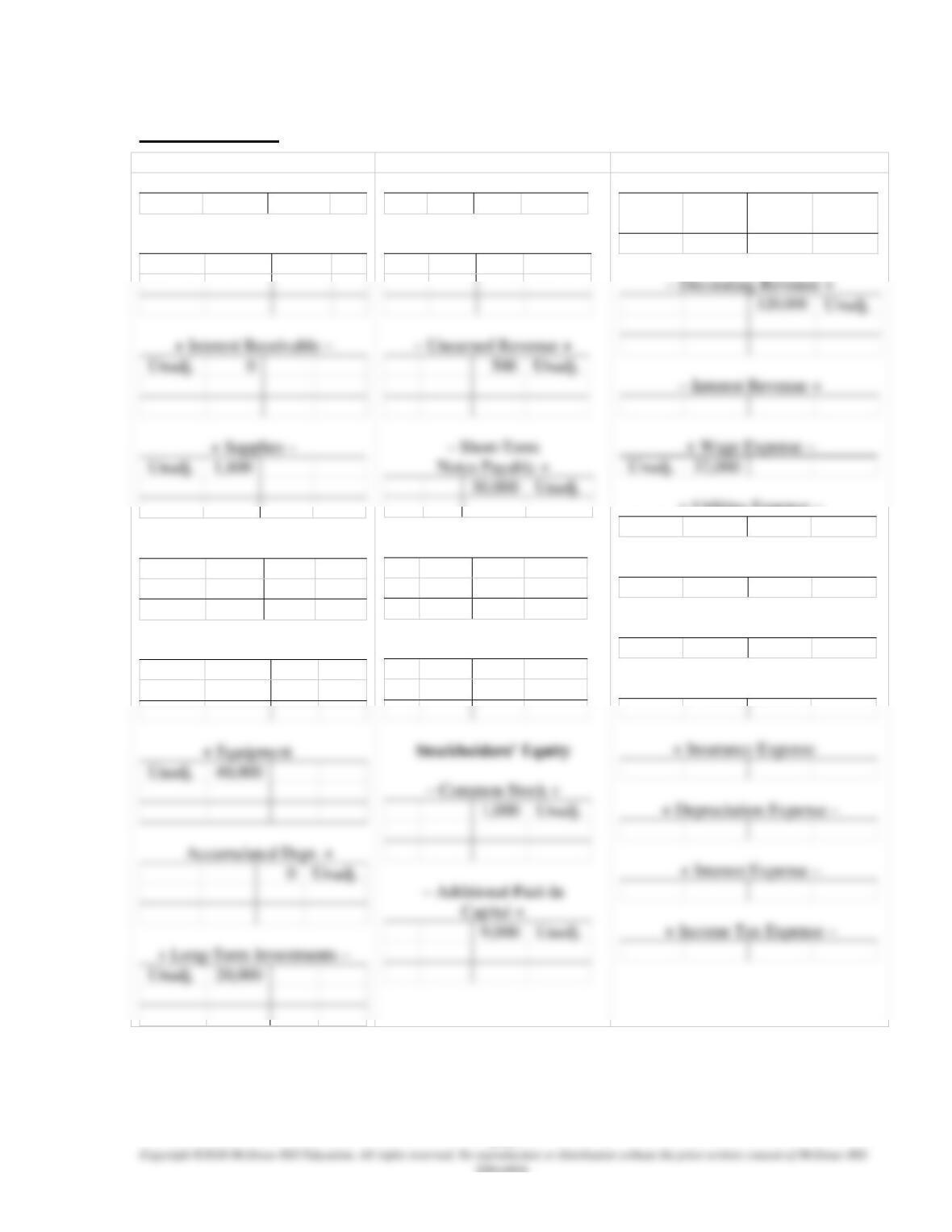
Chapter 04 – Adjustments, Financial Statements, and the Quality of Earnings
4-17
HANDOUT 4 – 1, continued
Assets
Liabilities
Stockholders’ Equity, continued
+ Cash –
Unadj.
43,450
+ Accounts Receivable –
Unadj.
4,000
Unadj.
Unadj.
1,800
Unadj.
30,000
Unadj.
Unadj.
Unadj.
+ Prepaid Insurance –
Unadj.
6,000
+ Prepaid Rent –
Unadj.
12,000
Unadj.
40,000
0
Unadj.
Unadj.
20,000
1,000
Unadj.
9,000
Unadj.
– Accounts Payable +
250
Unadj.
– Dividend Payable +
0
Unadj.
– Interest Payable +
0
Unadj.
– Income Taxes Payable +
0
Unadj.
– Retained Earnings +
0
Unadj.
+ Utilities Expense –
Unadj.
1,000
+ Telephone Expense –
Unadj.
500
+ Supplies Expense –
+ Rent Expense –
Chapter 04 – Adjustments, Financial Statements, and the Quality of Earnings
4-18
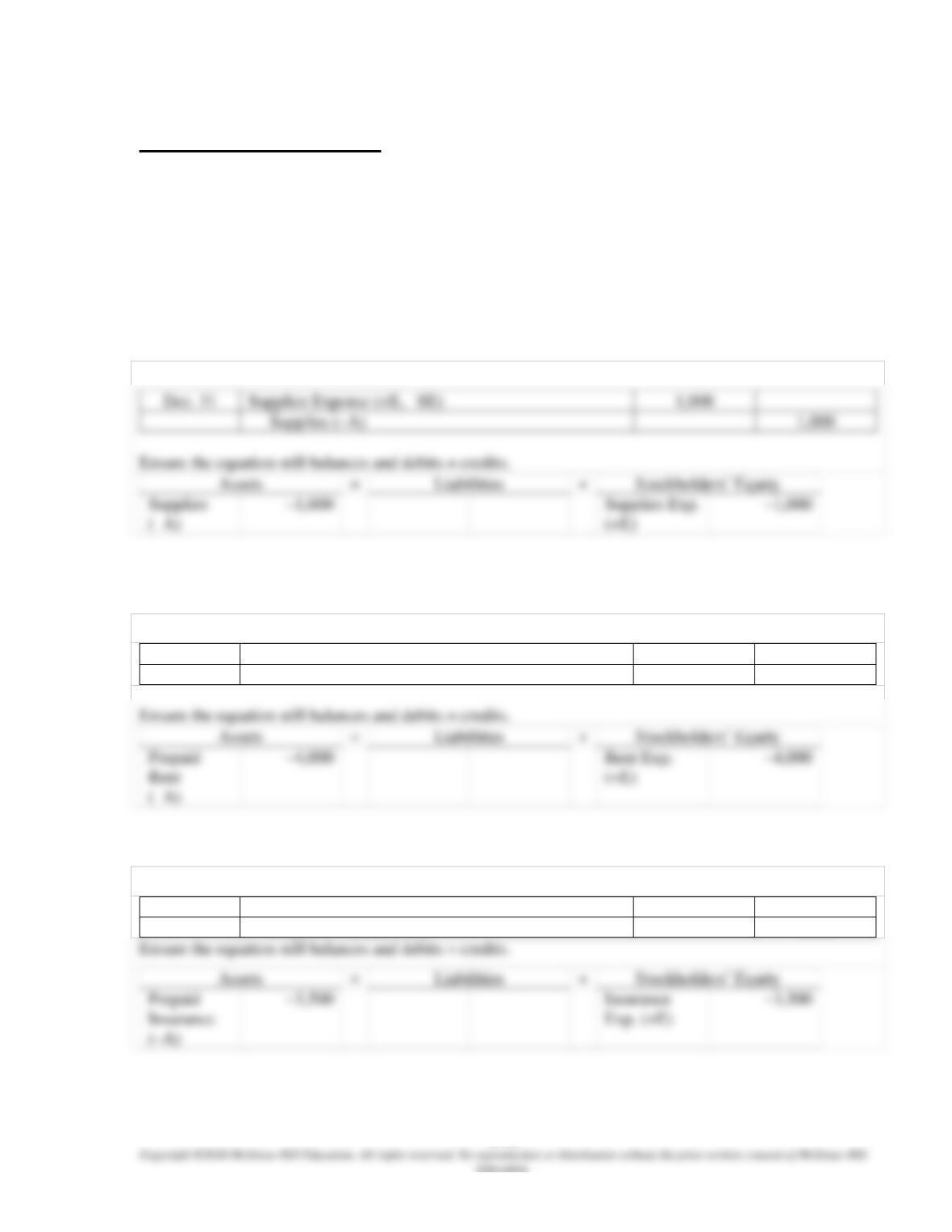
HANDOUT 4 – 1 SOLUTION
ADJUSTING ENTRIES AND
POSTING TO T-ACCOUNTS
Prepare the required adjusting journal entry for each situation as of December 31 of the current year. See
the last page for the unadjusted account balances shown in T-accounts.
(a) Suppose Deana’s had received a $1,800 shipment of supplies in September of the current year. When
counting the supplies on December 31 of the current year, Deana’s found only $800 worth of supplies
on hand.
Debit and credit the accounts affected.
Supplies Expense (+E, –SE)
1,000
Supplies (–A)
1,000
Ensure the equation still balances and debits = credits.
=
+
(b) Suppose Deana’s had paid $12,000 for six months’ rent on November 1 of the current year. As of
December, 31 of the current year, two months’ (November & December) prepaid rent has expired.
Debit and credit the accounts affected.
Dec. 31
Rent Expense (+E, –SE)
4,000
Prepaid Rent (–A)
4,000
Ensure the equation still balances and debits = credits.
=
+
(c) Suppose Deana’s had paid $6,000 for one year’s insurance on June 1 of the current year.
Debit and credit the accounts affected.
Dec. 31
Insurance Expense (+E, –SE)
3,500
Prepaid Insurance (–A)
3,500
Ensure the equation still balances and debits = credits.
=
+