SOLUTIONS TO PROBLEMS
PROBLEM 4.1
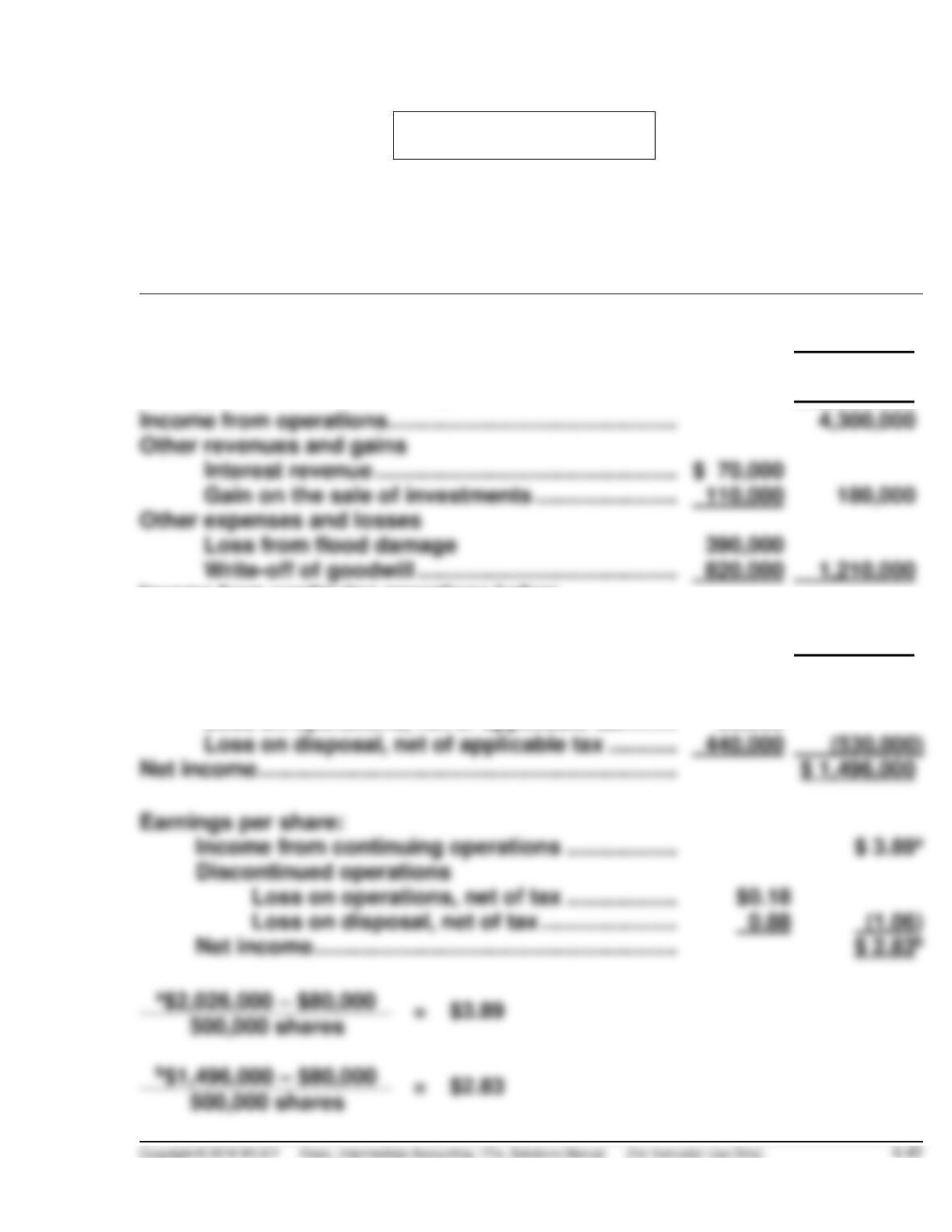
DICKINSON COMPANY
Income Statement
For the Year Ended December 31, 2020
Sales revenue ……………………………………………………….
$25,000,000
Cost of goods sold ………………………………………………….
16,000,000
Gross profit …………………………………………………………….
9,000,000
Selling and administrative expenses ………………………..
4,700,000
Income from operations…………………………………………..
4,300,000
Other revenues and gains
Interest revenue …………………………………………….
Other expenses and losses
Write-off of goodwill ………………………………………
1,210,000
Income from continuing operations before
income tax ……………………………………………………….………….
3,270,000
Income tax ……………………………………………………………..
1,244,000
Income from continuing operations …………………………
2,026,000
Discontinued operations
Loss on operations, net of applicable tax ………..
90,000
Loss on disposal, net of applicable tax …………..
(530,000)
PROBLEM 4.1 (Continued)
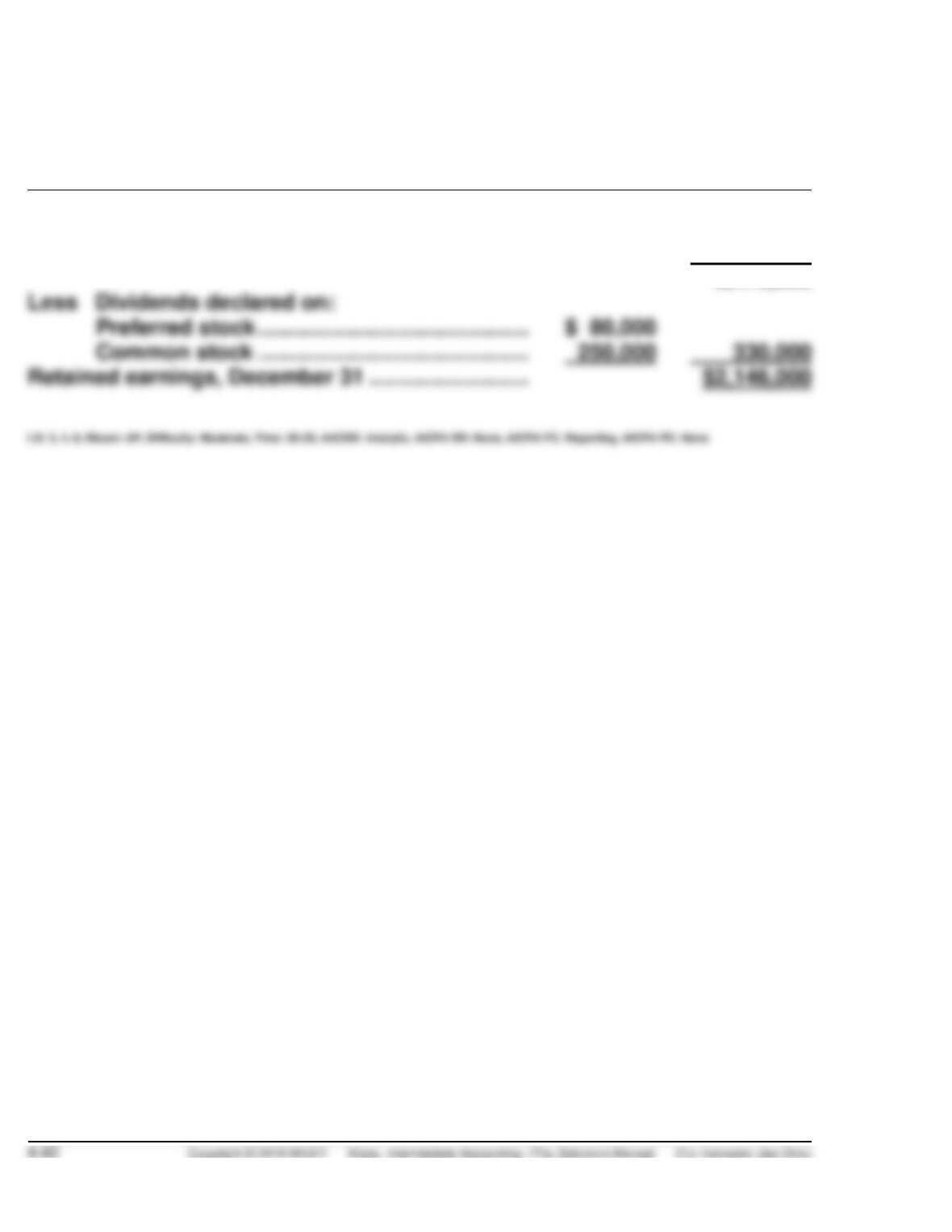
DICKINSON COMPANY
Retained Earnings Statement
For the Year Ended December 31, 2020
Retained earnings, January 1 …………………………..
$ 980,000
Add: Net income …………………………………………..
1,496,000
2,476,000
Less Dividends declared on:
330,000
PROBLEM 4.2
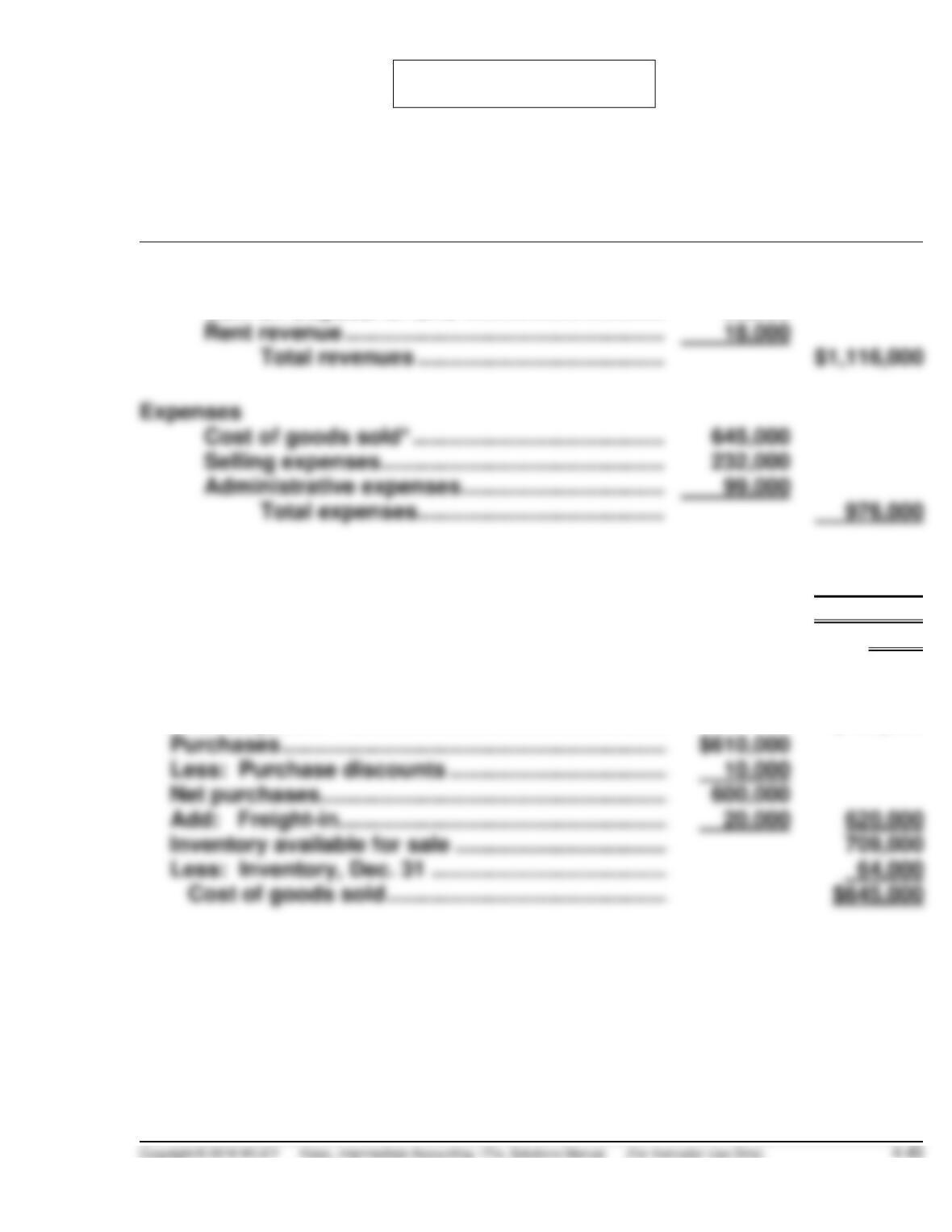
THOMPSON CORPORATION
Income Statement
For the Year Ended December 31, 2020
Revenues
Net sales ($1,100,000 – $14,500 – $17,500) …..
$1,068,000
Gain on disposal of land …………………………...
30,000
Rent revenue …………………………………………….
Expenses
Cost of goods sold* …………………………………..
Selling expenses …………………………..…………..
Administrative expenses …………………………...
Total expenses ………………………………….
976,000
Income before income tax …………………………………..
140,000
Income tax ………………………………………………..
53,900
Net income …………………………………………………………
$ 86,100
Earnings per share ($86,100 ÷ 30,000) ………………….
$2.87
*Cost of goods sold: Can be verified as follows:
Inventory, Jan. 1 ………………………………………………
$ 89,000
Less: Purchase discounts ……………………………….
Net purchases………………………………………………….
620,000
Inventory available for sale ………………………………
709,000
Less: Inventory, Dec. 31 ………………………………….
PROBLEM 4.2 (Continued)
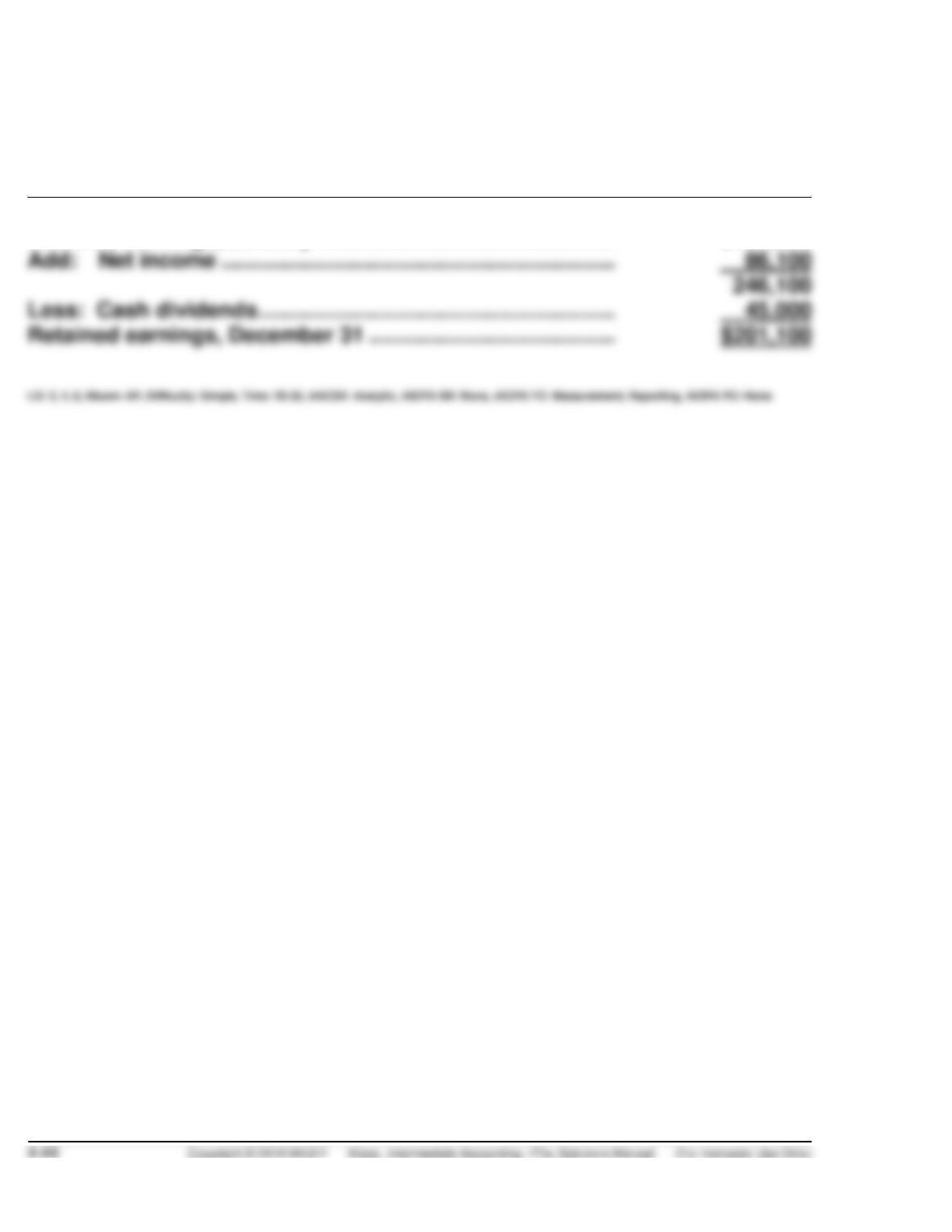
THOMPSON CORPORATION
Retained Earnings Statement
For the Year Ended December 31, 2020
Retained earnings, January 1 …………………………………………
$160,000
Less: Cash dividends ……………………………………………………
45,000
PROBLEM 4.3
MAHER INC.
Income Statement (Partial)
For the Year Ended December 31, 2020
Income from continuing operations
before income tax ……………………………………………….
$748,500(a)
Income tax …………………………………………………..
Income from continuing operations ……………………….
Net income ……………………………………………………….
Per share of common stock:
Income from continuing operations
($555,150 ÷ 120,000)
$4.63*
Discontinued operations, net of tax ………………
(0.67)*
Net income ($474,650 ÷ 120,000)……………………
$3.96
*Rounded
(a)Computation of income from cont. operations before taxes:
As previously stated …………………………………………
Loss on sale of securities …………………………………
As restated………………………………………………………….
PROBLEM 4.3 (Continued)
(b)Computation of income tax:
Income from continuing operations before taxes ……….
$748,500
Nontaxable income (gain on life insurance) ……………….
(104,000)
Taxable income………………………………………………………..
Tax rate …………………………………………………………………..
PROBLEM 4.4
(a) TWAIN CORPORATION
Income Statement
For the Year Ended June 30, 2020
Sales
Sales revenue ……………………………………………………..
$1,578,500
Less: Sales discounts …………………………..
$31,150
Sales returns and allowances …………………….
Net sales ……………………………………………………….
Cost of goods sold …………………………..……………………….
896,770
Gross profit ……………………………………………………….
Operating Expenses
Selling expenses
Sales commissions …………………………..
97,600
Salaries and wages expense …………………………..
56,260
Travel expense ………………………………………………..
Delivery expense ……………………………………………..
21,400
Entertainment expense …………………………..
14,820
Telephone and Internet expense ……………………….
Maintenance and repairs expense …………………….
Depreciation expense …………………………..
Bad debt expense…………………………………………….
Administrative Expenses
Maintenance and repairs expense …………
9,130
Property tax expense …………………………..
7,320
Depreciation expense …………………………..
Telephone and Internet expense ……………
2,820
PROBLEM 4.4 (Continued)
Other Revenues and Gains
Dividend revenue …………………………..…………
38,000
Other Expenses and Losses
Interest expense ……………………………………….
Income before income tax …………………………….
Income tax expense ………………………………….
TWAIN CORPORATION
Retained Earnings Statement
For the Year Ended June 30, 2020
Retained earnings, July 1, 2019, as reported …………..
$337,000
Retained earnings, July 1, 2019, as adjusted ………….
Less:
Correction of depreciation understatement,
PROBLEM 4.4 (Continued)
(b) TWAIN CORPORATION
Income Statement
For the Year Ended June 30, 2020
Revenues
Net sales ……………………………………………………….
$1,485,050
Dividend revenue ………………………………………………..
38,000
Expenses
Cost of goods sold ………………………………………………
Selling expenses …………………………………………………
Administrative expenses ……………………………………..
Interest expense ………………………………………………….
18,000
Total expenses ……………………………………………
Income before income tax ……………………………………………..
Income tax ……………………………………………………….
102,000
TWAIN CORPORATION
Retained Earnings Statement
For the Year Ended June 30, 2020
Retained earnings, July 1, 2019, as reported …………….
$337,000
Retained earnings, July 1, 2019 as adjusted …………….
Add: Net income …………………………..……………………….
Less:
Dividends declared on preferred stock …………..
Dividends declared on common stock ……………
Correction of depreciation understatement,
PROBLEM 4.5
1. The usual but infrequently occurring charge of $8,500,000 should be
disclosed separately, assuming it is material. This charge is shown
2. The loss on sale of equipment of $6,000,000 should be reported as an
3. The adjustment required for correction of an error is inappropriately
labeled. It also should not be reported in the retained earnings
statement. Changes in estimate should be handled in current and
4. Earnings per share should be reported on the face of the income
statement and not in the notes to the financial statements. Because
PROBLEM 4.6
(a) ACADIAN CORP.
Retained Earnings Statement
For the Year Ended December 31, 2020
Retained earnings, January 1, as reported …………………………..
$257,600
Correction of error from prior period (net of tax) ………………………..
25,400
Retained earnings, January 1, as adjusted …………………………..
Add: Net income …………………………………………………………………….
Less: Cash dividends declared …………………………………………………
32,000
*$52,300 = ($84,500 + $41,200 + $21,600 – $35,000 – $60,000)
(b) 1. Gain on sale of investments—body of income statement. This gain
should not be shown net of tax on the income statement.
2. Refund on litigation with government—body of income statement,
PROBLEM 4.7
WADE CORP.
Income Statement (Partial)
For the Year Ended December 31, 2020
Income from continuing operations
before income tax ………………………………
$1,200,000*
Income tax ……………………………………
228,000**
Discontinued operations
Net income ……………………………………………
Per share of common stock:
Income from continuing operations
($972,000 ÷ 150,000) ……………………………………………….
$6.48
Discontinued operations, net of tax …………………………….
(1.03)
Net income ($818,100 ÷ 150,000) …………………………………
$5.45
*Computation of income from continuing operations
before income tax:
As previously stated
$1,210,000
Loss on sale of equipment [$40,000 – ($80,000 – $30,000)]
TIME AND PURPOSE OF CONCEPTS FOR ANALYSIS
CA 4.1 (Time 20–25 minutes)
Purpose—to provide the student with the opportunity to comment on deficiencies in an income
CA 4.2 (Time 20–25 minutes)
Purpose—to provide the student an illustration of how earnings can be managed. The case allows
CA 4.3 (Time 15–20 minutes)
Purpose—to provide the student an illustration of how earnings can be managed by how losses are
CA 4.4 (Time 30–35 minutes)
Purpose—to provide the student with an unstructured case to comment on the reporting of discontinued
CA 4.5 (Time 30–40 minutes)
Purpose—to provide the student with the opportunity to comment on deficiencies in an income
CA 4.6 (Time 20–25 minutes)
Purpose—to provide the student with a variety of situations involving classification of special items. This
situations are described. A good comprehensive case for discussing the presentation of special items.
CA 4.7 (Time 10–15 minutes)
SOLUTIONS TO CONCEPTS FOR ANALYSIS
CA 4.1
The deficiencies of O’Malley Corporation’s income statement are as follows:
1. The heading is inappropriate. The heading should include the period of time for which the income
statement is presented.
2. Gain on recovery of insurance proceeds is properly classified in a single-step income statement.
5. Loss on obsolescence of inventories is properly classified in a single step income statement.
CA 4.2
(a) Earnings management is often defined as the planned timing of revenues, expenses, gains and
losses to smooth out bumps in earnings. In most cases, earnings management is used to increase
income in the current year at the expense of income in future years. For example, companies
CA 4.2 (Continued)
(c) Appropriate Accounting
2017
2018
2019
2020
2021
Income before warranty expense
$43,000
$43,000
Warranty expense
5,000
5,000
CA 4.3
(a) The ethical issues involved are integrity and honesty in financial reporting, full disclosure,
accountant’s professionalism, and job security for Charlie.
CA 4.4
(a) It appears that the sale of the Casino Knights Division would qualify as a discontinued operation.
The operation of gambling facilities appears to meet the criteria for discontinued operations for
Simpson Corp. and, therefore, the accounting requirements related to discontinued operations
CA 4.5
The income statement of Walters Corporation contains the following weaknesses in classification and
disclosure:
1. Sales taxes. Sales taxes have been erroneously included in both gross sales and cost of goods
sold on the income statement of Walters Corporation. Failure to deduct these taxes directly from
2. Purchase discounts. Purchase discounts should not be treated as revenue by being lumped with
other revenues such as dividends and interest. A purchase discount is more logically a reduction
3. Recoveries of accounts written off in prior years. These collections should be credited to the
4. Delivery expense. Although delivery expense (sometimes referred to as freight-out) is an
expense of selling and is therefore reported properly in the statement, freight-in is an inventoriable
5. Loss on discontinued styles. This type of loss, though often substantial, should not be treated
6. Loss on sale of marketable securities. This item should be reported as a separate component
of income from continuing operations as an “Other expense or loss.”
7. Loss on sale of warehouse. This type of item does not get special treatment, even if the loss is
the direct result of a major casualty, an expropriation, or a prohibition under a newly enacted law
8. Federal Income taxes. The provision for federal income taxes and intraperiod tax allocation are
not presented in the income statement. This omission implies that the federal income tax is a
distribution of net income instead of an operating expense and a determinant of net income. This
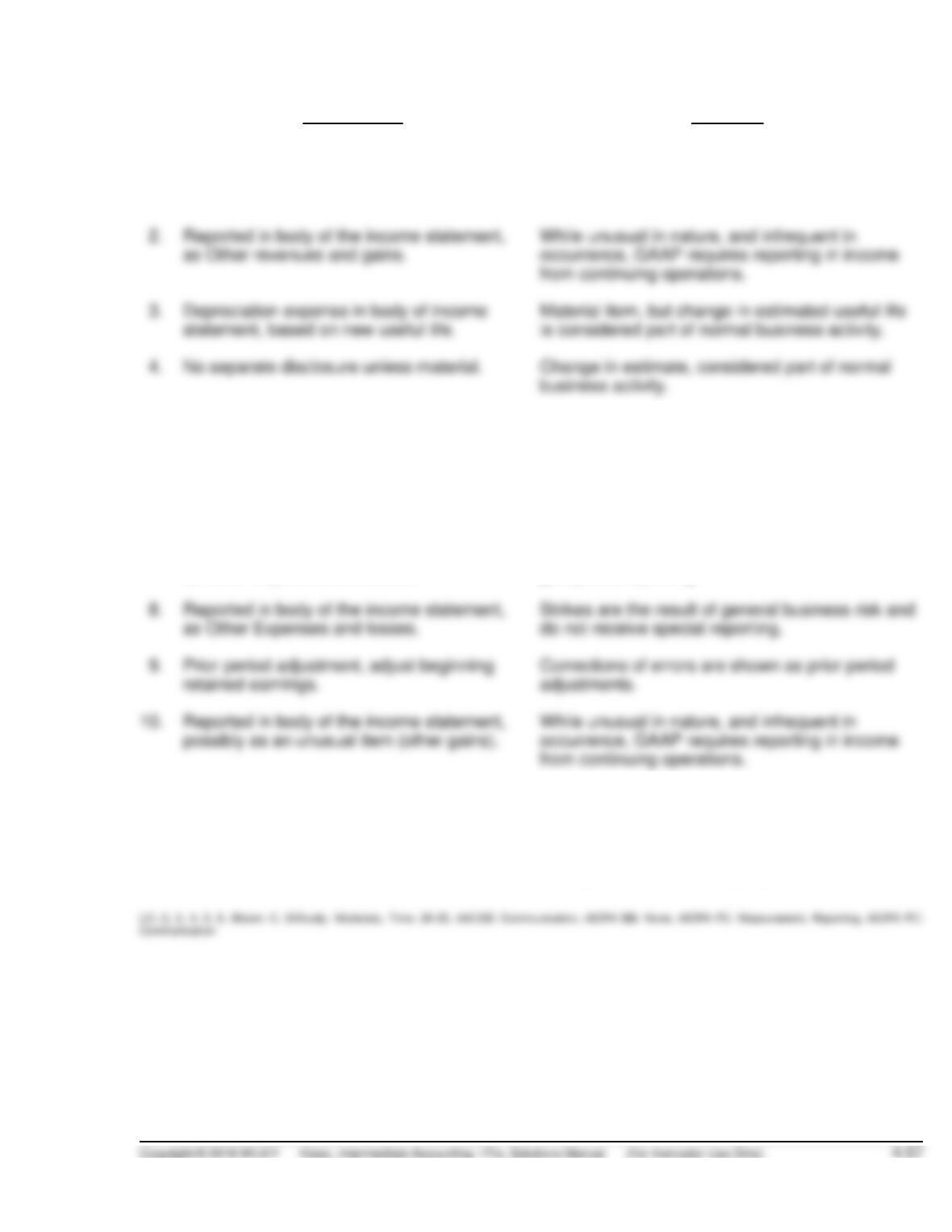
CA 4.6
Classification
Rationale
1.
No disclosure.
2.
Reported in body of the income statement,
as Other revenues and gains.
While unusual in nature, and infrequent in
occurrence, GAAP requires reporting in income
from continuing operations.
3.
Depreciation expense in body of income
statement, based on new useful life.
Material item, but change in estimated useful life
is considered part of normal business activity.
Error has “reversed out”; that is, subsequent
income statement compensated for the error.
However, prior year income statements should
be restated if the amount of the error is material.
5.
Reported in body of the income statement,
possibly as an unusual item.
Sale does not meet criteria for the disposal of a
component of the business.
6.
Adjustment to the beginning balance of
retained earnings.
A change in inventory methods is a change in
accounting principle and prior periods are
adjusted.
7.
Reported in body of the income statement,
as Other Expenses and losses.
9.
Prior period adjustment, adjust beginning
retained earnings.
Corrections of errors are shown as prior period
adjustments.
Reported in body of the income statement,
possibly as an unusual item (other gains).
While unusual in nature, and infrequent in
occurrence, GAAP requires reporting in income
from continuing operations.
Loss on preparation of such proposals does not
get special reporting.
11.
Discontinued operations section.
Division’s assets, results of operations, and
activities are clearly distinguishable physically,
operationally, and for financial reporting
purposes. As indicated the charge reflects a
strategic shift for the company.
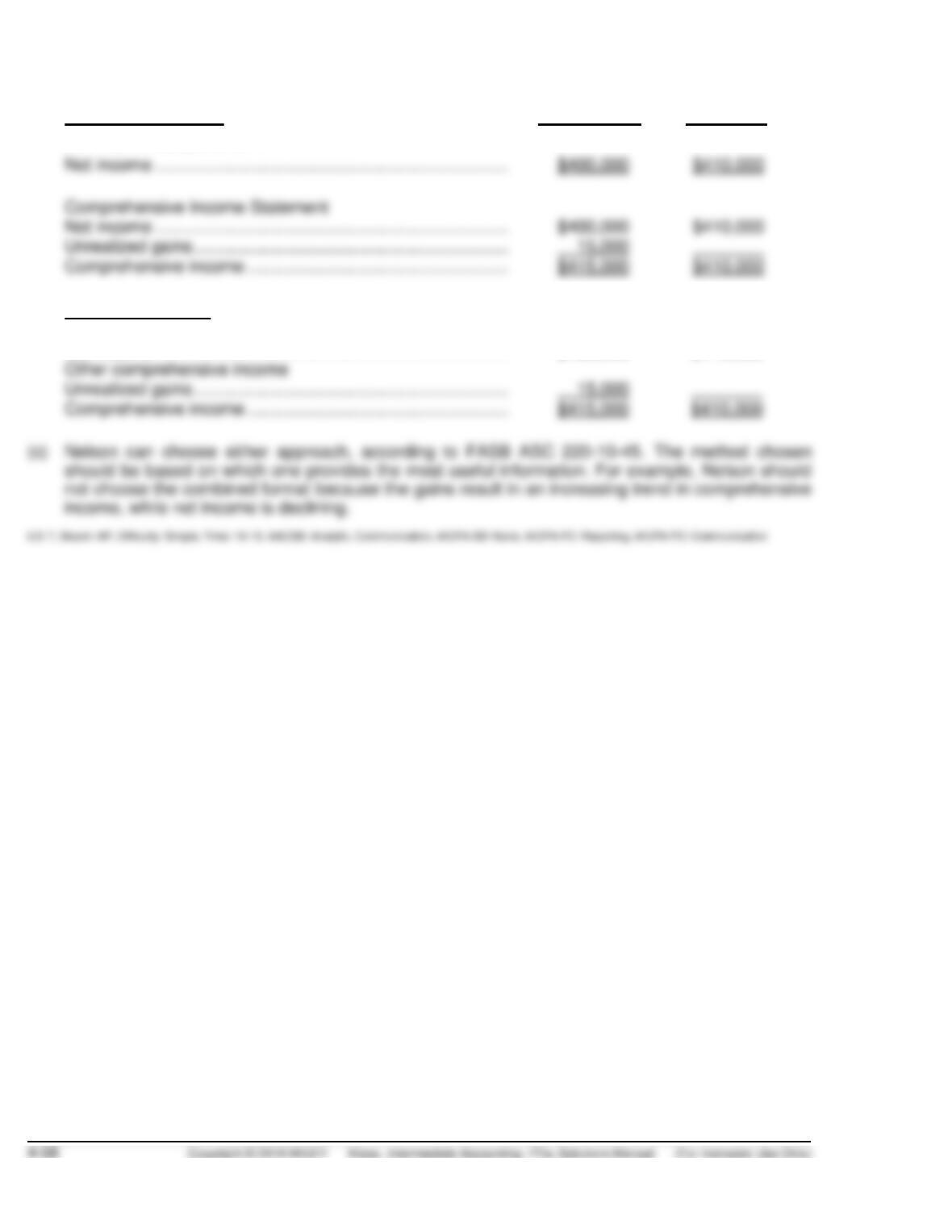
CA 4.7
(a) Separate Statement
Current Year
Prior Year
. . . income components . . .
Comprehensive Income Statement
Net income ………………………………………………………………….
Unrealized gains ……………………………………………………….….
15,000
(b) Combined Format
. . . income components . . .
Net income …………………………………………………………………..
$400,000
$410,000
Other comprehensive income
Unrealized gains ……………………………………………………….…..
15,000