Chapter 4
Comparative Accounting: The Americas and Asia
Discussion Questions
1. Public and private sector bodies are involved in regulating and enforcing financial reporting
in the United States. The Financial Accounting Standards Board is a private sector body that
determines U.S. generally accepted accounting principles. The Securities and Exchange
Commission has the authority to determine U.S. GAAP for publicly held companies, but
defers to the FASB. The FASB and SEC have a close working relationship that ensures that
FASB standards are acceptable to the SEC. The SEC enforces financial reporting rules for
publicly held companies. It actively reviews the filings that companies make. Auditors are the
enforcers for nonpublicly held companies.
Accounting standards in Mexico are issued by the Council for Research and Development of
Financial Information Standards (CINIF), an independent public-private sector body
Japanese accounting standards are set by a private sector body, the Accounting Standards
Board of Japan. The establishment of the ASBJ is a recent development in Japan. Before,
accounting standard setting was a government activity. Enforcement of financial reporting
effectively rests with auditors. The stock exchange is regulated by the Financial Services
Agency, a government body. However, it is unclear how proactive the FSA is in monitoring
financial reporting by Japanese companies.
Accounting standard setting is a government activity in China. The China Accounting
The Institute of Chartered Accountants in India, a private sector professional body, develops
accounting standards in India. The Securities and Exchange Board of India, an agency of the
Ministry of Finance, regulates India’s 22 stock exchanges and is responsible for enforcing
financial reporting rules. However, it is unclear how proactive the board is in monitoring
financial reporting by Indian companies.
Overall, the five countries vary in terms of private versus public sector responsibility for
regulating and enforcing financial reporting. Enforcement is questionable in several
2. The United States and India are common law countries that have fair presentation oriented
financial reporting. Mexico also has fair presentation oriented financial reporting because of
U.S. influence. Japan is a code law country and its accounting has traditionally been
3. The auditor oversight bodies discussed in this chapter are:
a. United States—Public Company Accounting Oversight Board
b. Japan—Certified Public Accountant and Auditing Oversight Board
4. U.K. standards (Chapter 3) and IFRS (Chapter 8) are said to reflect principles-based
standards, whereas U.S. standards (this chapter) are said to be rules-based. Generally
speaking, principles-based standards set forth broad objectives and fundamentals and require
5. The United Kingdom and the United States both follow fair presentation accounting,
reflecting economic substance rather than legal form. Both the U.K. “true and fair” and the
6. Examples cited in the chapter that Mexican companies are becoming less secretive include (a)
Mexican companies are listing on U.S. stock exchanges and feeling the disclosure
7. The bursting of the Japanese bubble economy in the 1990s prompted a review of Japanese
financial reporting standards. It became clear that many accounting practices hid how badly
many Japanese companies were actually doing. The accounting “big bang” was designed to
make the financial condition of Japanese companies more transparent and bring Japanese
a. Requiring listed companies to report a statement of cash flows.
8. Full and complete disclosure of reliable, evenhanded information is necessary to develop a
fair and efficient stock market. The “Anglo–Saxon” model of accounting (discussed in
Chapter 2), emphasizing a fair presentation of financial condition and results, and
emphasizing stewardship, also fosters the development of a fair and efficient stock market.
Countries with this accounting orientation (such as the United States and United Kingdom)
have active, fair, and efficient stock markets. There is also a legal structure and an effective
enforcement of laws and accounting disclosures to make it all work.
China is developing accounting standards with the stock market orientation discussed above.
So China is on the right track here—the standards themselves will support the development
9. The chapter mentions a number of examples where Chinese accounting standards are
consistent with world class practices. A selective list of the more important ones are the
following:
a. Comparative, consolidated financial statements including a balance sheet, income
statement, cash flow statement, and notes.
10. The British influence on accounting in India is clear. India has a common law legal system
and fair presentation accounting that accompanies it. Like Britain, financial statements must
Exercises
1. United States
a. Financial Accounting Standards Board
b. Securities and Exchange Commission
Mexico
a. The Council for Research and Development of Financial Information Standards.
2. At the time of writing, the following organizations were linked to IFAC’s Web site:
United States
a. American Institute of Certified Public Accountants
3. The question asked for five expressions, terms, or short phrases unfamiliar or unusual in the
student’s home country. Taking the United States as the home country, here are ten:
a. Triangular legal system—a description of accounting regulation in Japan consisting of
the interacting Company Law, Securities and Exchange Law, and Corporate Income Tax
Law.
b. Socialist market economy—used in China to describe its planned economy with market
adaptations.
c. Land and industrial property rights—still owned by the Chinese government, private
4. The most important financial accounting practice or principle at variance with international
norms is probably the following:
United States—LIFO. Driven by tax law considerations, no other country uses LIFO to the
extent found in the United States. LIFO reduces reported earnings. Because older, lower costs
of inventory are shown on the balance sheet, the debt-to–asset ratio will be higher. Companies
using LIFO must report so-called LIFO reserves that enable an analyst to convert LIFO
amounts to FIFO amounts.
Mexico—Inflation accounting whenever the cumulative three-year inflation rate equals or
exceeds 26 percent. Most countries in the world value assets and related expenses at
Japan—Declining balance method for depreciation. Most companies use straight-line.
Assuming that the company is continually investing in fixed assets, depreciation will be
5. A comparison of the countries in Exhibit 4-5 reveals few differences among the United
States, Mexico, and China. Thus, all three countries can claim that their GAAP are
comparably oriented toward equity investors. However, of the three countries, the United
6.
a. The two major areas of difference are asset valuation and accounting for goodwill. In
the United Kingdom, assets may be valued at historical cost, current cost, or a mixture
of the two. When fixed assets are revalued, depreciation and amortization must be
calculated using the revalued amounts. Only historical cost is allowed in the United
b. Research has documented that U.S. GAAP earnings are systematically more
conservative than U.K. GAAP earnings (see, for example, P. Weetman and S.J. Gray,
“International Financial Analysis and Comparative Corporate Performance: The Impact
of U.K. versus U.S. Accounting Principles on Earnings,” Journal of International
7. The chapter identifies the following major changes that have occurred since the Japanese “big
bang”:
a. Large companies must prepare consolidated financial statements, not just listed ones.
b. Listed companies must report a statement of cash flows.
8. The chapter identifies the following major changes that have occurred in Chinese accounting
since the 1990s:
a. The ASBE issued in 2006 represent a comprehensive set of Chinese accounting standards
that are substantially in line with IFRS.
b. The ASBE issued in 2006 also contains auditing standards similar to International
9.
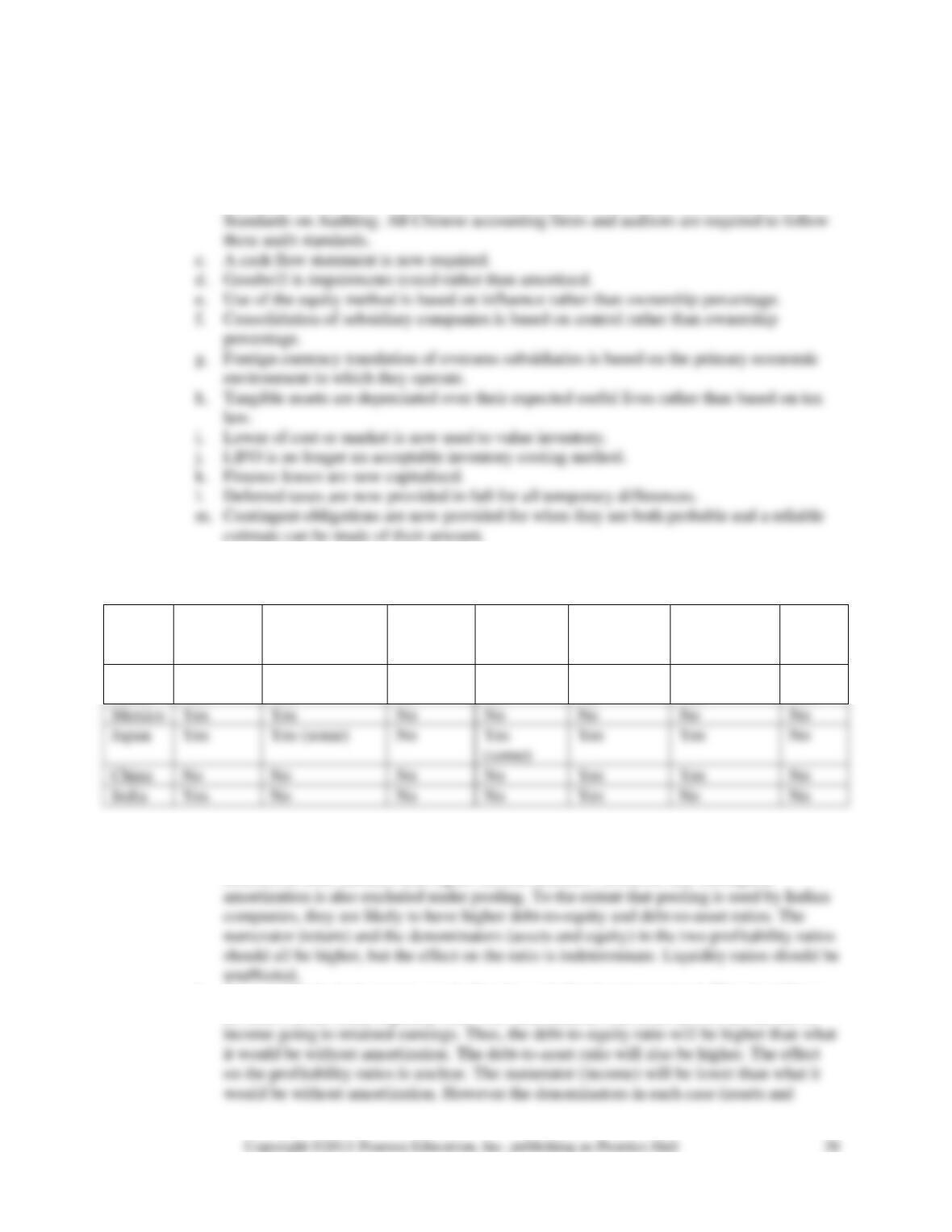
Account-
ing
profession
Users/Preparers
Organized
Labor
Tax
Authorities
Commercial
Law
Securities
Commissions
Stock
Market
United
States
Yes
Yes
No
No
No
Yes
Yes
Japan
Yes
Yes (some)
Yes
Yes
Yes
China
No
No
No
No
Yes
Yes
No
10. a. India allows pooling, whereas the others do not. Pooling usually results in lower
noncurrent asset amounts and higher income amounts. Goodwill and subsequent
b. Japan and India both require goodwill to be capitalized and amortized. This should have
no effect on the either liquidity ratio. The amortization will result in a lower amount of
c. The equity method is used in all five countries, so there is no effect on comparative
ratios.
d. Price-level adjusted accounting is practiced in Mexico whenever the three-year
cumulative inflation rate equals or exceeds 26 percent, and Indian companies may
e. Depreciation in Japan is tax-influenced, which is normally higher than economics-based
depreciation. This will reduce income and lower the profitability ratios. The more rapid
write-off of fixed assets will cause lower total asset values. Thus, the debt-to–asset ratio
should be higher. The debt-to-equity ratio and both liquidity ratios should be unaffected.
f. LIFO is used in the United States. Companies using LIFO should have lower income, so
g. Probable losses are accrued in all five countries, so there is no effect on comparative
ratios.
i. Deferred taxes are accrued in all five countries, so there is no effect on comparative
ratios.
j. Some opportunity for income smoothing exists in India. Income smoothing has an
indeterminate effect on income in any given year. Therefore it is not possible to know
Case 4-1 Standing on Principles
1. Principles-based standards set forth broad objectives and fundamentals and require
professional judgment for their implementation. They are more flexible than rules-based
standards. Rules-based standards are more specific in their requirements and have more
detailed implementation guidance than principles-based standards. Many accountants believe
2. The main reason why U.S. GAAP has evolved into a rules-based approach is the litigiousness
of U.S. society. Following detailed rules is easier to defend in court than professional
3. To make principles-based standards effective in the United States, there would need to be a
change in ethos—not only among preparers and auditors, but also among regulators and users
of financial statements. A principles-based approach requires a strong commitment from
4. In your authors’ opinion, there is no unequivocal answer to whether investors and analysts are
better served by rules-based or principles-based accounting standards. There are advantages
and disadvantages to each approach. The nature of society, including how the legal system
Case 4-2 Casino Capital
1. The conditions necessary to develop a stock market in an emerging economy include the
following:
a. Accounting that emphasizes fair presentation.
b. Full and complete disclosure of reliable, evenhanded information about companies’
2. As discussed in the chapter, China has adopted accounting standards consistent with IFRS. In
other words, China’s standards are focused on fair presentation. However, from the chapter
and the case it is clear that few of the other conditions enumerated above are present in
China. The case says that balance sheets of Chinese companies are a “joke,” that “numbers
4. Reforms include resolving the problems noted above. Students can be expected to concentrate
on accounting training, accounting standard setting, and rules, laws, and regulations aimed at
enforcement. One recommendation is a comprehensive training program to develop
accounting expertise. Corporate accounting and auditing expertise need to be improved, and