State Board of Accountancy Guidance
The Texas State Board of Public Accountancy provides some advice to licensed CPAs
worth sharing. If a Texas CPA wants to advertise her CPA firm on Linkedin, Twitter, and
Facebook, they must comply with all relevant rules and regulations.
Under Board Rule 501.82, “self-laudatory statements that are not based on verifiable
facts” are not acceptable. Although the Board has the authority to recognize
specializations in the practice of public accounting, it currently does not do so. See
15. You have decided to leave your CPA firm. Using the AICPA rules as a guide,
answer the following questions: (1) Can you post some negative comments about
your former employer on Twitter? (2) Can you call your former clients and tell
them that you are leaving? (3) Can you take their files with you when you go?
(1) Posting negative comments about your former employer on Twitter will get back to
the former employer. It is not a professional way to act but it is not specifically prohibited
by the rules, although it might constitute an “Act Discreditable” to the profession. From
The Categorical Imperative provides sound ethical guidance. Ask students to put
themselves in the position of their ex-employer, who has built up the practice, albeit
perhaps with your help as an employee. How would you feel if your employee left and
‘poached’ some of your clients?
Ethical Obligations and Decision Making in Accounting, 4/e 16
(3) The files you create at the firm are considered work product and working papers; they
belong to the firm. If you take the files, particularly your clients’ files, it would theft of
firm’s property.
State Board of Accountancy Guidance
Under the rules of the Texas State Board of Public Accountancy, a CPA may contact
clients and make them aware of the fact that she is leaving her firm (and providing them
with contact information after she leaves the firm). Board Rule 501.82(e) addresses
16. You previously worked for the Department of Revenue, a governmental agency
in your town. You cut all ties with the agency after you left two years ago to start
your own tax accounting business. One day you receive a call from the agency
asking you to conduct a tax audit of taxpayers in the town. You do not conduct a
financial statement audit of any of these clients. Assume the proposed
arrangement is to pay you 25 percent of additional amounts collected following
your audits of property tax returns plus 50 percent of all first-year tax penalties.
What ethical issues exist for you in deciding whether to accept the engagement?
Would you accept it? Explain.
All professional services must be performed with integrity, objectivity, due care, and a
healthy dose of professional skepticism. This would include doing tax audits for an
organization such as the Department of Revenue. That said, the following guidance is
useful for CPAs who find themselves in such a position.
17. You were engaged to file the 2015 individual and corporate tax returns for a
client. The client provided her records and other tax information on March 1,
2016, to help prepare the 2015 tax return. Your client paid you $12,000 in
advance to prepare those returns. On April 1 after repeated requests to return
her records, you informed the client that her tax returns for 2015 would be
completed by April 15, and all of the records would be returned at that time.
However, you failed to complete the return. The client paid another accountant
$15,000 to complete the returns after the deadline and incurred tax penalties. Do
you believe that you violated any of the rules of conduct in the AICPA Code? Did
you violate any ethical standards beyond the Code? Explain.
This is a violation of records request and discreditable acts. The CPA did not
communicate clearly with the client on meeting or setting deadlines and completing the
work in a timely manner. Acts discreditable include not responding within a reasonable
amount of time to repeated requests and not returning the client’s records when
18. In January 2008, it was discovered that William Borchard, who handled due
diligence for clients of PwC interested in mergers and acquisitions, divulged
controversial plans to Gregory Raben, an auditor at the firm, and Raben used the
information to buy stock ahead of a series of corporate takeovers. The SEC found
the two guilty of insider trading, a violation of the law. Assume none of the clients
were audit clients. What are the ethical issues involved in engaging in such
transactions? Were any of the AICPA rules of conduct violated? Explain.
Confidentiality was violated. Raben and Borchard violated PwC’s rules on keeping client
information strictly confidential and ignored their duties to their employer and its clients.
The SEC investigated and found the two former employees of PwC were guilty of insider
Ethical Obligations and Decision Making in Accounting, 4/e 18
19. Assume that the CPA firm of Packers & Vikings audits Chi Bears Systems. The
controller of Chi Bears, a CPA, happens to be a tax expert. During the current
tax season, Packers & Vikings gets far behind in reviewing processed tax returns.
It does not want to approach clients and ask permission to file for an extension to
the April 15 deadline so the firm approaches the controller and offers him a
temporary position as a consultant for the tax season. Was it ethical for the firm
to make the offer? Would it be ethically acceptable for the controller to accept
the position? Explain.
Independence comes from the root word “depend,” which means need, count on, or rely
on. Hiring our client’s employee to work for us, especially if we need him makes us
dependent on him, and creates a mutual self-interest threat to objectivity and
independence. Will we point out problems with the tax work and risk alienating the
controller? In this kind of situation, we might fear irritating him both as an audit client or
influence on his work for us and vice versa.
20. Assume you are the senior in charge of the audit of a client in New York who
offers you two tickets to the Super Bowl between the New York Giants and the
Ethical Obligations and Decision Making in Accounting, 4/e 19
Denver Broncos. The opportunity to see the Manning brothers square off against
each other is appealing. How would you decide whether to accept the tickets for
the game?
Accepting gifts from a client raises questions of appearance and influence. First, one
must ask what the value of the gift is; and is the client expecting something in return for
the gift. If there is no immediate expectation in return for the gift, will the gift have
lasting influence? How does the gift affect the appearance of independence? Super Bowl
tickets have huge value because they sell for high amounts; this super bowl is reasonably
the only one in a lifetime to have more than market value for the fan of the Manning
Ethical Obligations and Decision Making in Accounting, 4/e 20
21. In recent years the move by accounting firms to offshore tax and consulting work
has grown and expanded into audit work. What are the ethical concerns that
might be raised about the practice of electronically transmitting audit
information to offshore centers like those in India that provide accounting
professionals to audit U.S. corporations’ financial statements?
If the firm is convinced the Indians are competent and can be relied upon, the firm must
not deceive the clients, nor risk the client’s confidentiality. It certainly is possible to send
data back and forth to India with sufficient security. Many clients will consent to Indian
sub-contracting if they are told the truth and share the fee savings. If the clients are
deceived that Americans are doing the work, the firm may pay a devastating price in
Ethical Obligations and Decision Making in Accounting, 4/e 21
The Revised AICPA Code addresses these issues. The “Use of a Third-Party Service
Provider” (Section 1.150.040) identifies the Integrity and Objectivity Rule (1.100.001),
the General Standards Rule (1.300.040), and the Confidential Client Information Rule
(1.700.001) as specifically relevant to assess ethical obligations. The following rules
apply:
• Before disclosing confidential client information to a third-party service provider,
enter into a contractual agreement to maintain the confidentiality of the
22. According to SOX rules that mandate auditor rotation, the lead audit partner on
an engagement is prohibited from providing those services for a client for greater
than five consecutive years. The purpose of the rule is to encourage professional
skepticism. Discuss the costs and benefits of auditor rotation as you see it. Do you
think audit firms should be rotated periodically?
As mandated by Section 203 of the Sarbanes-Oxley Act, the SEC’s independence rules
now provide that an accounting firm will not be independent if either the lead audit
partner or the concurring partner perform audit services for more than five consecutive
fiscal years of an audit client. The rules also require a five-year “time-out” period before
a partner may return to a particular audit engagement.
Ethical Obligations and Decision Making in Accounting, 4/e 22
matters affecting the company’s financial statements or who maintains regular contact
with management and the audit committee of the audit client.
Audit partners also include all partners who provide more than 10 hours of audit services
during a fiscal year to the parent public company, or lead partners on the audit of the
company’s subsidiaries whose assets or revenues account for 20% or more of the
company’s consolidated assets or revenues. The definition of audit partner excludes
“specialty” partners who consult on technical or industry-specific issues, the lead partners
on subsidiaries below the 20% threshold and partners assigned to “national office” duties
who may be consulted on specific accounting issues related to an audit client.
In the end, a cost-benefit analysis of whether mandatory rotation is a good idea would be
helpful.
An interesting research survey of audit engagement partners of public firms to determine
their perceptions of costs and benefits of partner rotation and how rotation impacts audit
quality and their quality of life suggests mandatory rotation may be a bad idea.10 The
survey addresses how firms mitigate the negative effects of rotation and how changes in
Extended Discussion
The PCAOB has been eager to establish a new rule requiring mandatory rotation of
specific audit firms, claiming that their inspections found “hundreds of audit failures” and
suggested that management influence over auditors may have led to “eroded public
confidence in audits.” However, the PCAOB could not overcome the opposition of the
audit and financial executive communities. PCAOB chairman James Doty told the SEC
The PCAOB encountered fierce resistance to the mandatory auditor rotation idea, which
never got beyond the concept release stage. It would have required U.S. public companies
to change auditors every few years. Even the House of Representatives got in on the act
in 2013, passing a bill that would have amended the Sarbanes-Oxley Act to prohibit the
PCAOB from requiring companies to “use specific auditors or require the use of different
auditors on a rotating basis.”
Senior finance executives loudly urged the PCAOB to abandon thoughts of requiring
corporations to switch their accounting firms regularly. More than 684 letters poured into
the PCAOB commenting on the concept release. About 24 percent of them were signed
by CFOs, and many others were from chief accounting officers, controllers and audit–
committee chairs.
The rotation debate has always centered on a key question: what would make for more
effective audits, a fresh pair of eyes (a new accounting firm) or deep — but perhaps
compromised — knowledge about the ins and outs of a complex company?
Ethical Obligations and Decision Making in Accounting, 4/e 24
23. In August 2008, EY agreed to pay more than $2.9 million to the SEC to settle
charges that it violated ethics rules by co-producing a series of audio CDs with a
man who was also a director at three of EY’s audit clients. According to the SEC,
EY collaborated with Mark C. Thompson between 2002 and 2004 to produce a
series of audio CDs called The Ernst & Young Thought Leaders Series. Thompson
served on the boards at several of EY’s clients during the period when the CDs
were produced. What threats to independence existed in the relationship between
EY and Thompson? From an ethical perspective, would it have mattered if it was
not an audit client but one for whom advisory services only were performed?
This situation is very similar to the PeopleSoft case in the chapter. The situation violated
independence in fact and appearance when EY audited the clients for which Thompson
served as a director. EY’s business relationships with Thompson created a mutuality of
24. On May 20, 2014, the SEC settled an investigation of James T. Adams, the former
chief risk officer at Deloitte, for causing violations of the auditor independence
rules. It seems that Adams accepted tens of thousands of casino markers while he
was the advisory partner on a Deloitte casino gaming client. Review the facts of
the case and explain how Adams’s actions compromised his independence under
the AICPA Code.
On May 20, 2014, Adams agreed to settle civil charges alleging he violated rules
governing auditor independence. He agreed to be suspended for two years from
SEC rules generally require auditors to refrain from conduct that could impede their
independence as objective watchdogs, such as owning the stock of a client company or
offering non-audit services to an audit client. In this case, the SEC said Adams opened a
line of credit at a casino that was run by an audit client, and that he concealed his casino
markers from Deloitte and another Deloitte partner.
25. Is accounting a trustworthy profession? How would you know whether it is or is
not?
The accounting profession is typically rated quite high for ethical standards and practices.
The public interest ideal underlies the high ranking. Clients come to trust their
accountants and auditors because of the close relationship between top managers and the
financial results. While managers may disagree on accounting issues with their auditors,
they do come to respect their fierce sense of independence and trustworthiness.
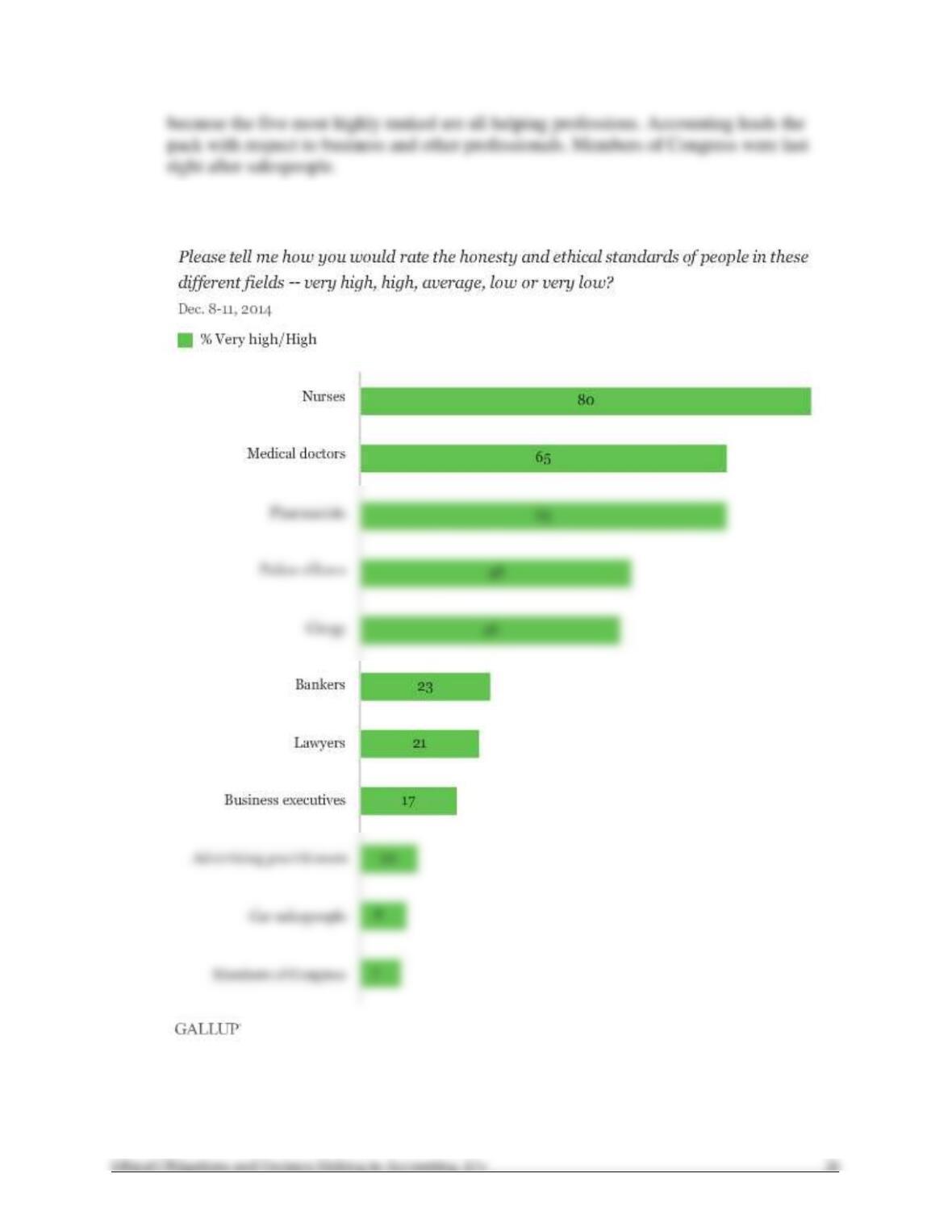
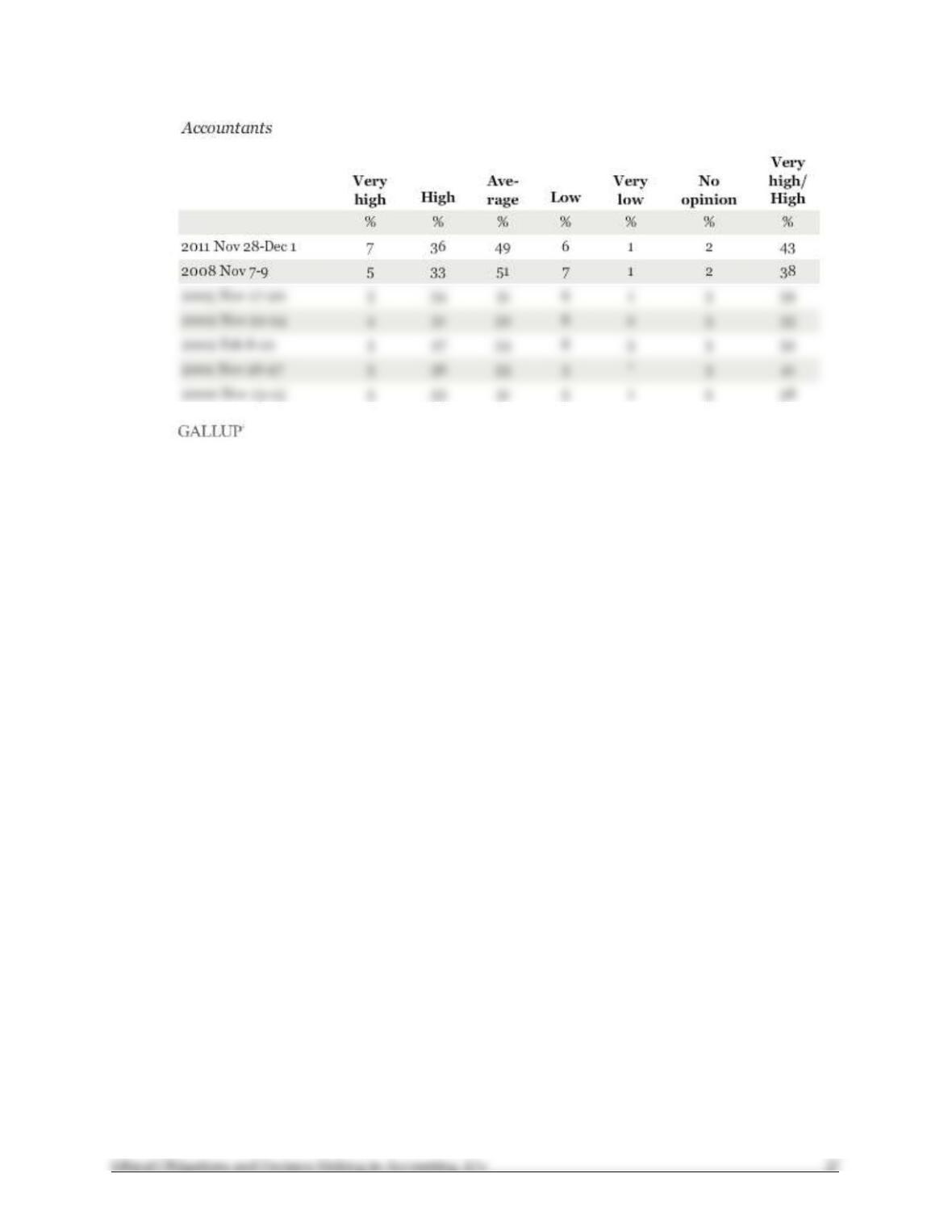
Gallup Poll — Honesty/Ethics in Professions
Please tell me how you would rate the honesty and ethical standards of people in these
different fields — very high, high, average, low, or very low?