CHAPTER 18 (FIN MAN); CHAPTER 4 (MAN) Activity-Based Costing
Ex. 18–17 (FIN MAN); Ex. 4–17 (MAN)
The selling and administrative expenses should not be allocated on the basis of relative
sales dollars. The two product lines have very different attributes. The commercial
product is relatively inexpensive to sell, while the home product has a number of
additional costs associated with it. As a result, allocating selling and administrative
expenses using sales volumes would allocate too much selling and administrative
Ex. 18–18 (FIN MAN); Ex. 4–18 (MAN)
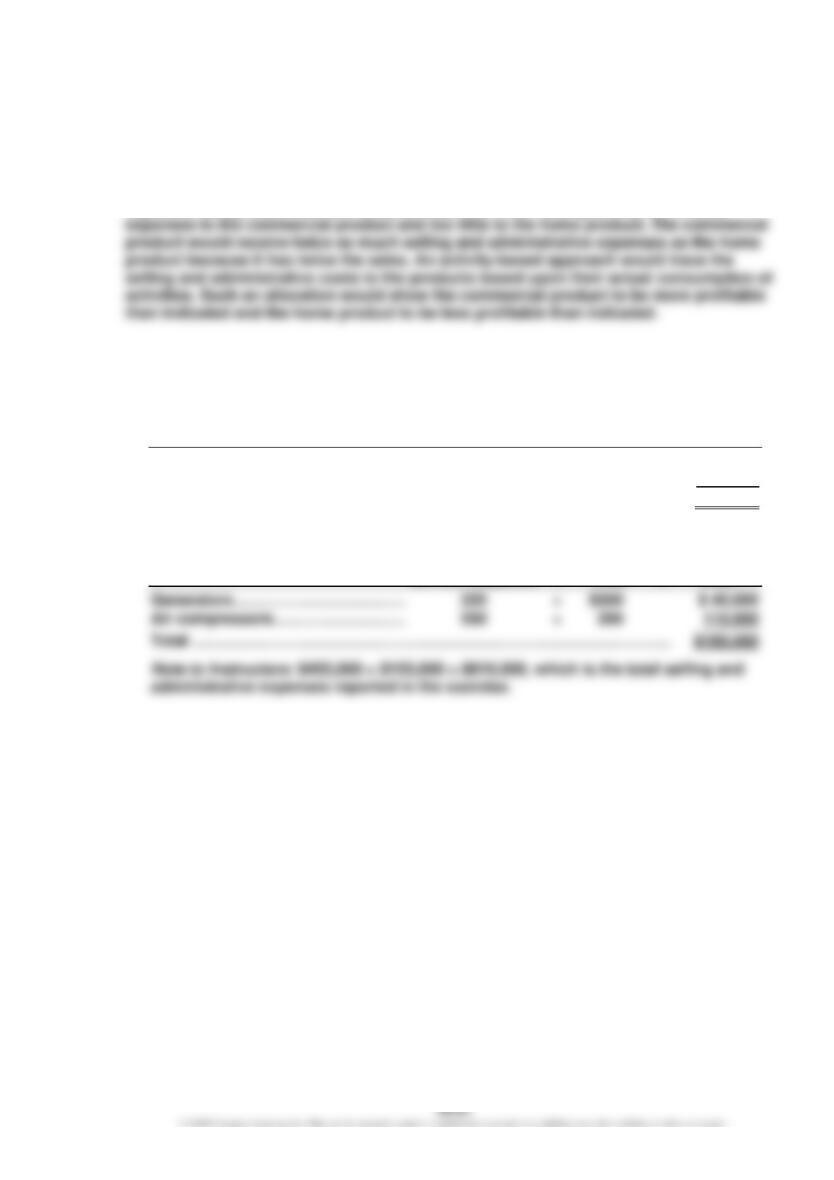
a. Sales order processing activities:
Number of
Sales Orders
×
Activity
Rate
=
Activity
Cost
Generators ………………………………………….
3,000
×
$65
$195,000
Air compressors …………………………..
4,000
×
65
260,000
Total ………………………………………………………………………………………………..
$455,000
Post-sale customer service activities:
Number of
Service Requests
Air compressors …………………………..
×
Activity
Activity
CHAPTER 18 (FIN MAN); CHAPTER 4 (MAN) Activity-Based Costing
Ex. 18–18 (FIN MAN); Ex. 4–18 (MAN) (Concluded)
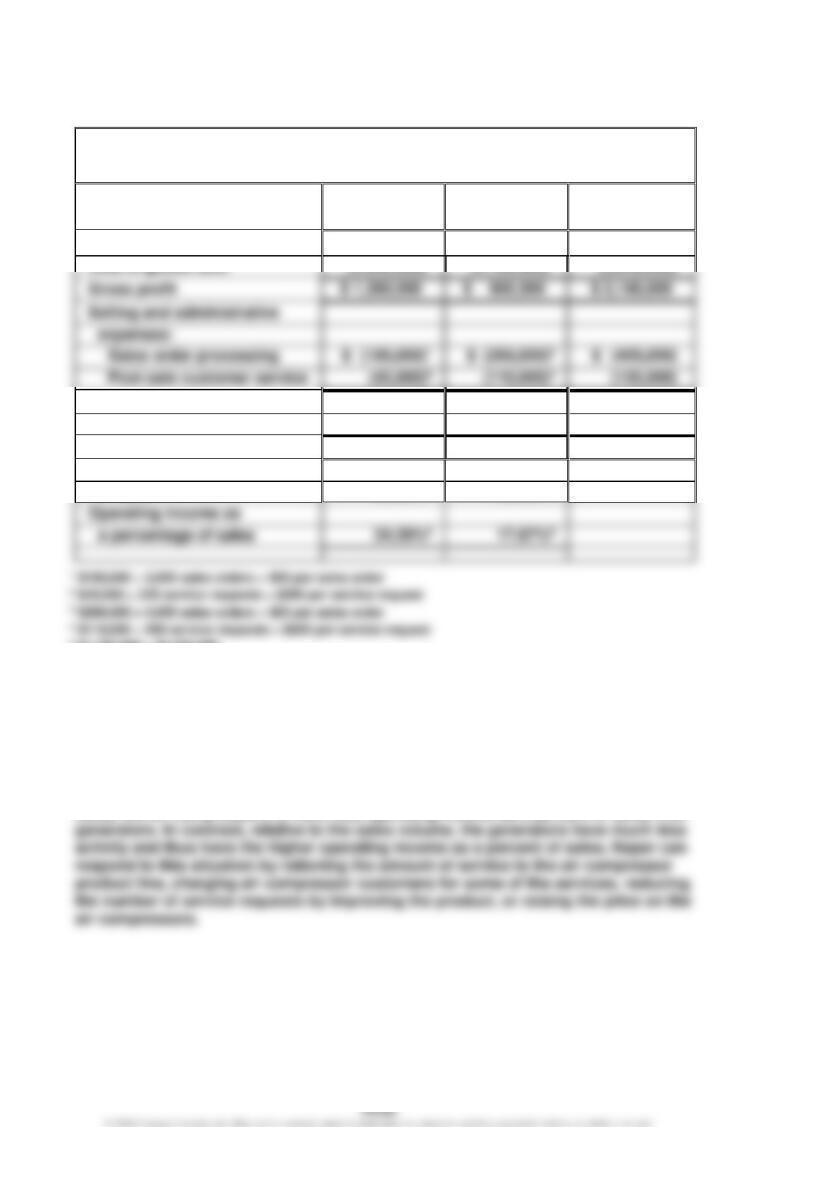
b.
Naper Inc.
Product Profitability Report
For the Year Ended December 31
Generators
Air
Compressors
Total
Revenues
$ 4,200,000
$ 3,000,000
$ 7,200,000
Cost of goods sold
Gross profit
$ 1,260,000
$ 2,160,000
Total selling and
administrative expenses
$ (240,000)
$ (370,000)
$ (610,000)
Operating income
$ 1,020,000
$ 530,000
$ 1,550,000
Gross profit as a percentage
of sales
30.00%5
30.00%7
5 $1,260,000 ÷ $4,200,000
6 $1,020,000 ÷ $4,200,000
7 $900,000 ÷ $3,000,000
8 $530,000 ÷ $3,000,000
c. The complete product profitability report provides much greater insight than did the
original report. The air compressors have the lower operating income to sales
percentage because the product is a heavy user of Naper’s sales and service
activities. The air compressors are ordered in small quantities (hence a high number
of sales orders) and have a high amount of post-sale service. All of these factors
CHAPTER 18 (FIN MAN); CHAPTER 4 (MAN) Activity-Based Costing
Ex. 18–19 (FIN MAN); Ex. 4–19 (MAN)
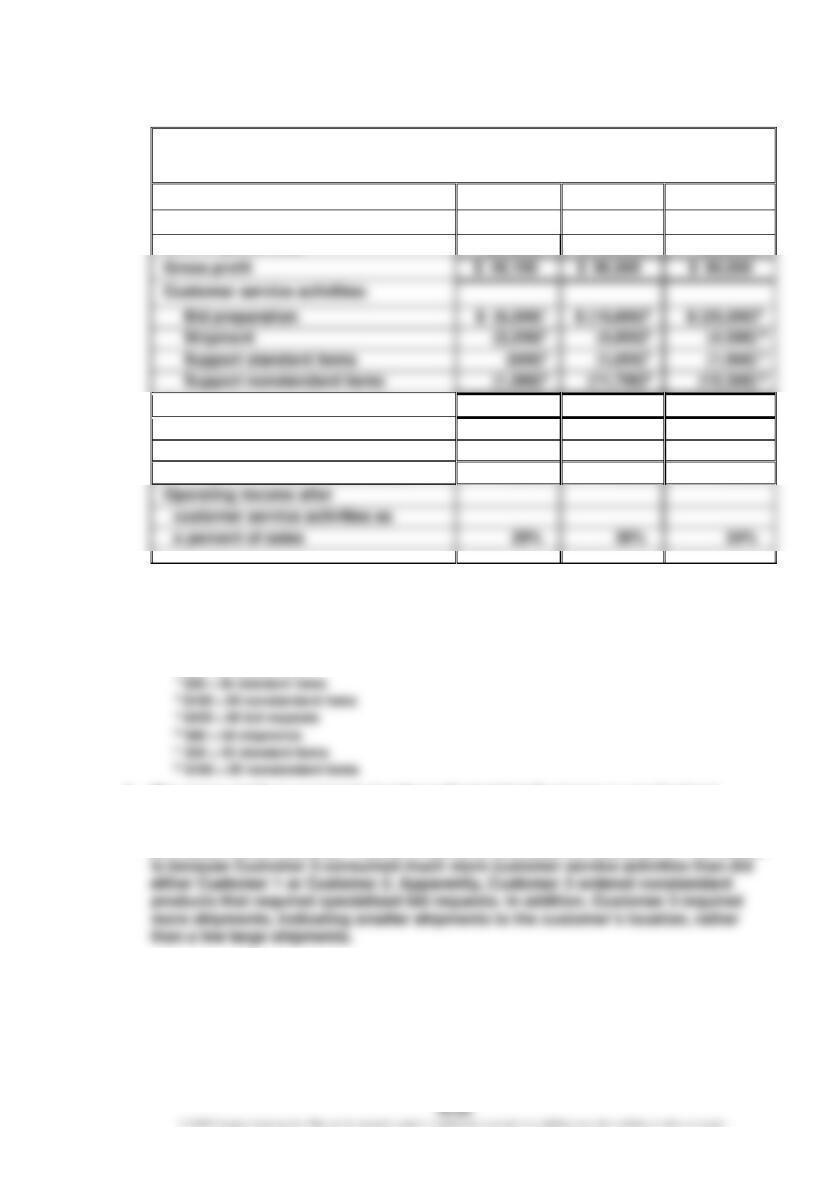
a.
Metroid Electric
Customer Profitability Report
For the Year Ended December 31, 20Y8
Customer 1
Customer 2
Customer 3
Revenue
$130,000
$ 210,000
$180,000
Gross profit
Cost of goods sold
(81,900)
(113,400)
(90,000)
Total customer service activities
$ (10,230)
$ (34,500)
$ (46,560)
Operating income after
customer service activities
$ 37,870
$ 62,100
$ 43,440
Gross profit as a percent of sales
37%
46%
50%
Operating income after
customer service activities as
1 $420 × 15 bid requests
2 $90 × 25 shipments
3 $30 × 20 standard items
4 $180 × 6 nonstandard items
5 $420 × 40 bid requests
6 $90 × 55 shipments
b. The gross profit as a percent of sales indicated that Customer 1 was the least
profitable, while Customer 3 was the most profitable. After deducting the activity
costs associated with customer service activities, Customer 3 became the least
CHAPTER 18 (FIN MAN); CHAPTER 4 (MAN) Activity-Based Costing
Ex. 18–20 (FIN MAN); Ex. 4–20 (MAN)
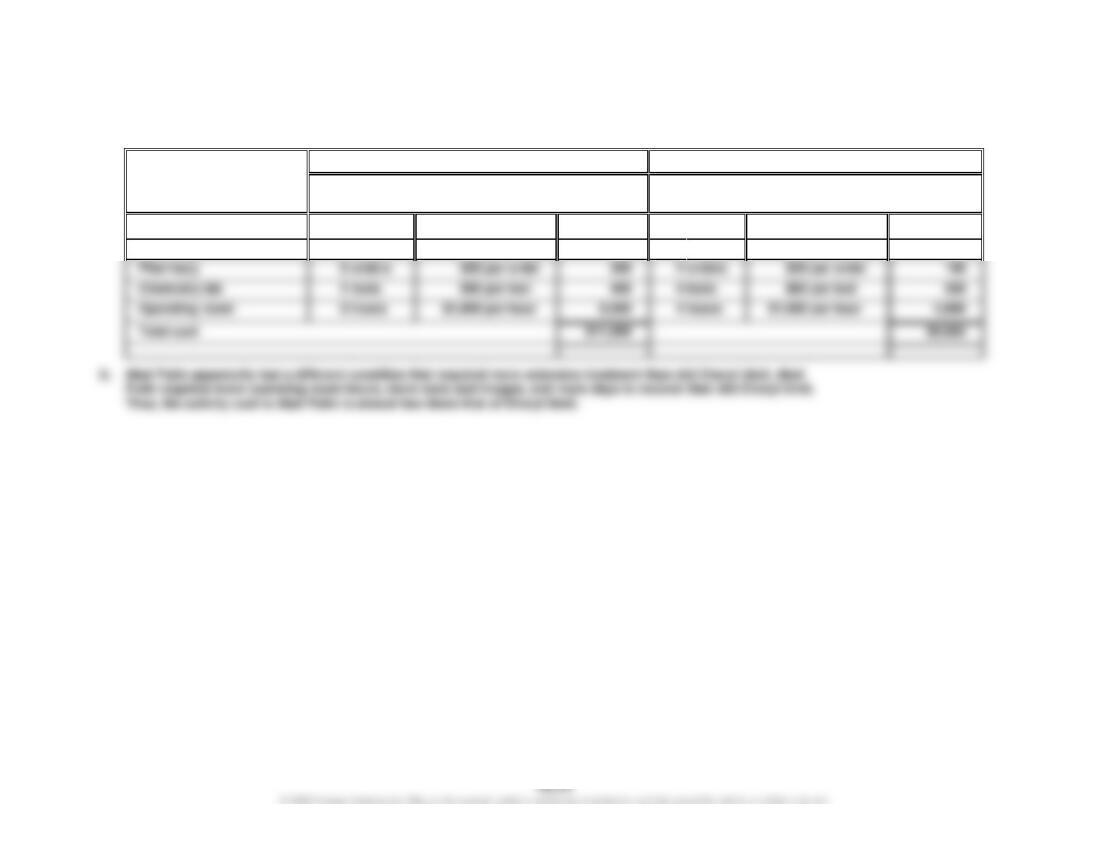
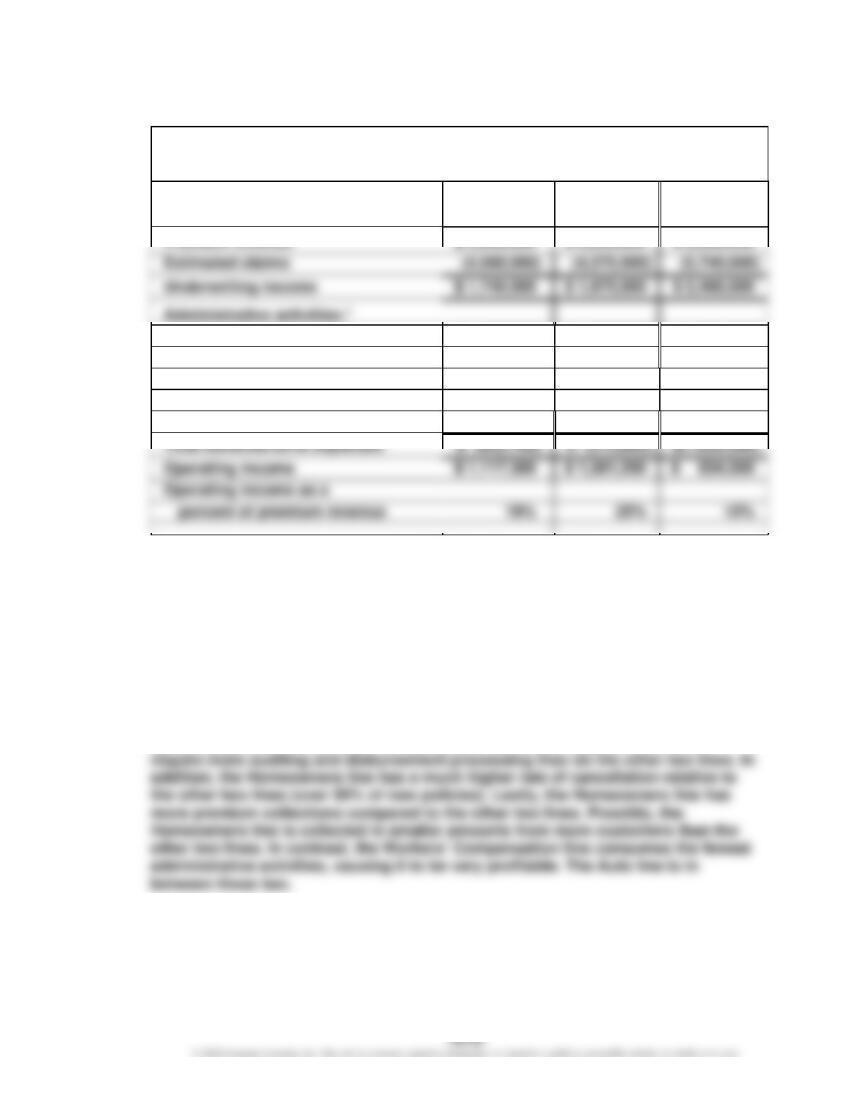
a.
Activity
Abel Putin
Cheryl Umit
Activity
Usage
×
Activity
Rate
=
Activity
Cost
Activity
Usage
×
Activity
Rate
=
Activity
Cost
Room and meals
6
days
$240
per day
$ 1,440
4
days
$240
per day
$ 960
Radiology
4
images
$215
per image
860
3
images
$215
per image
645
Pharmacy
6
orders
per order
300
2
orders
per order
100
Chemistry lab
5
tests
per test
400
4
tests
per test
320
Operating room
8
hours
per hour
4
hours
per hour
Total cost
CHAPTER 18 (FIN MAN); CHAPTER 4 (MAN) Activity-Based Costing
Ex. 18–21 (FIN MAN); Ex. 4–21 (MAN)
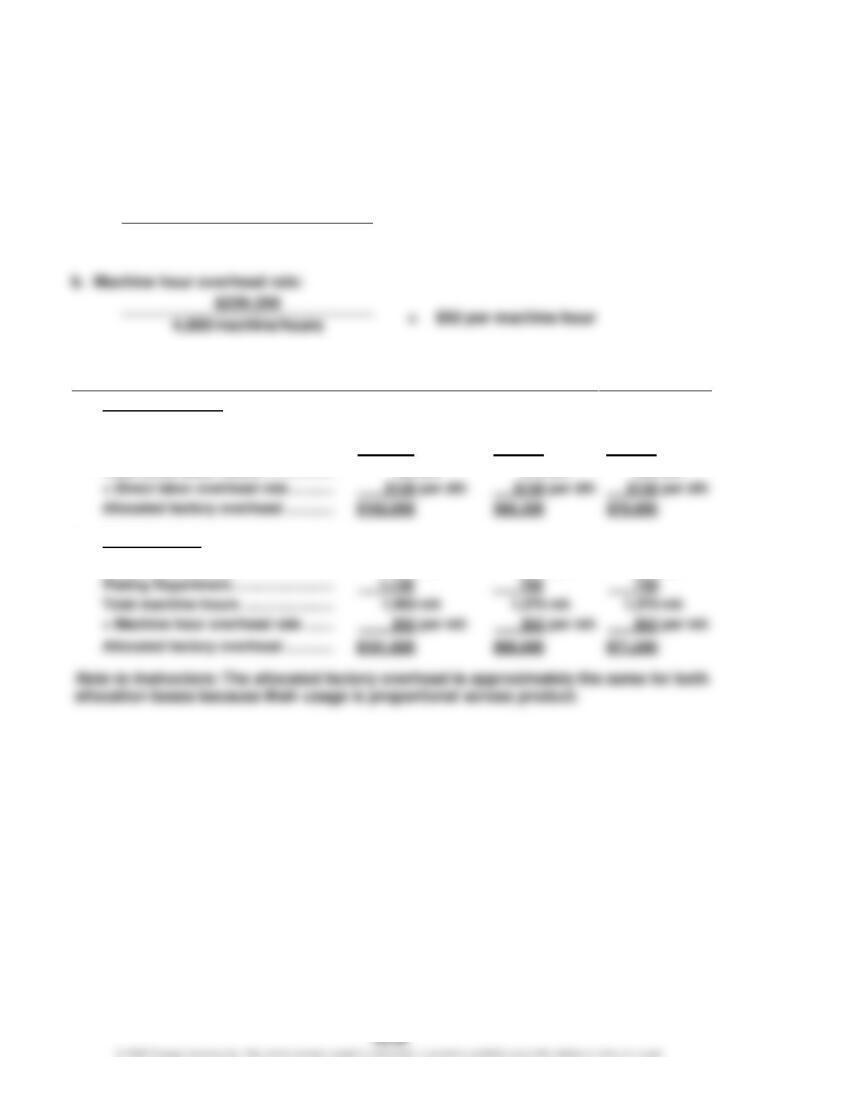
a.
Bounce Back Insurance Company
Product Profitability Report
For the Year Ended December 31
Auto
Workers’
Comp.
Homeowners
New policy processing
$ (146,300)
$ (154,000)
$ (451,000)
Cancellation processing
(88,200)
(54,000)
(396,000)
Claim audits
(128,700)
(36,300)
(313,500)
Claim disbursements processing
(47,000)
(22,000)
(85,000)
Premium collection processing
(212,500)
(47,500)
(380,000)
* The activity costs are determined by multiplying the activity rate by the activity-base usage quantity.
For example, the administrative activity costs for the Auto line are as follows:
$146,300 = 1,330 new policies × $110 per new policy
$88,200 = 490 cancellations × $180 per cancellation
$128,700 = 390 audits × $330 per claim audit
$47,000 = 470 disbursements × $100 per disbursement
$212,500 = 8,500 premiums collected × $25 per premium collected
All three insurance lines have the same percentage of underwriting income to
premium revenue (30%). The differences among the insurance lines are in the way
they consume administrative activities. For example, the Homeowners insurance
line has the least profitability due to its high use of administrative activities.
Specifically, the Homeowners line has smaller and more frequent claims that
CHAPTER 18 (FIN MAN); CHAPTER 4 (MAN) Activity-Based Costing
PROBLEMS
Prob. 18–1A (FIN MAN); Prob. 4–1A (MAN)
1.
a.
Direct labor overhead rate:
$239,200
1,840 direct labor hours
=
$130 per direct labor hour
2.
Automobile
Bumpers
Valve
Covers
Wheels
a.
Direct labor hours:
Stamping Department ……………………..
590 dlh
310 dlh
350 dlh
Plating Department ………………………….
195
200
195
× Direct labor overhead rate …………….
$130 per dlh
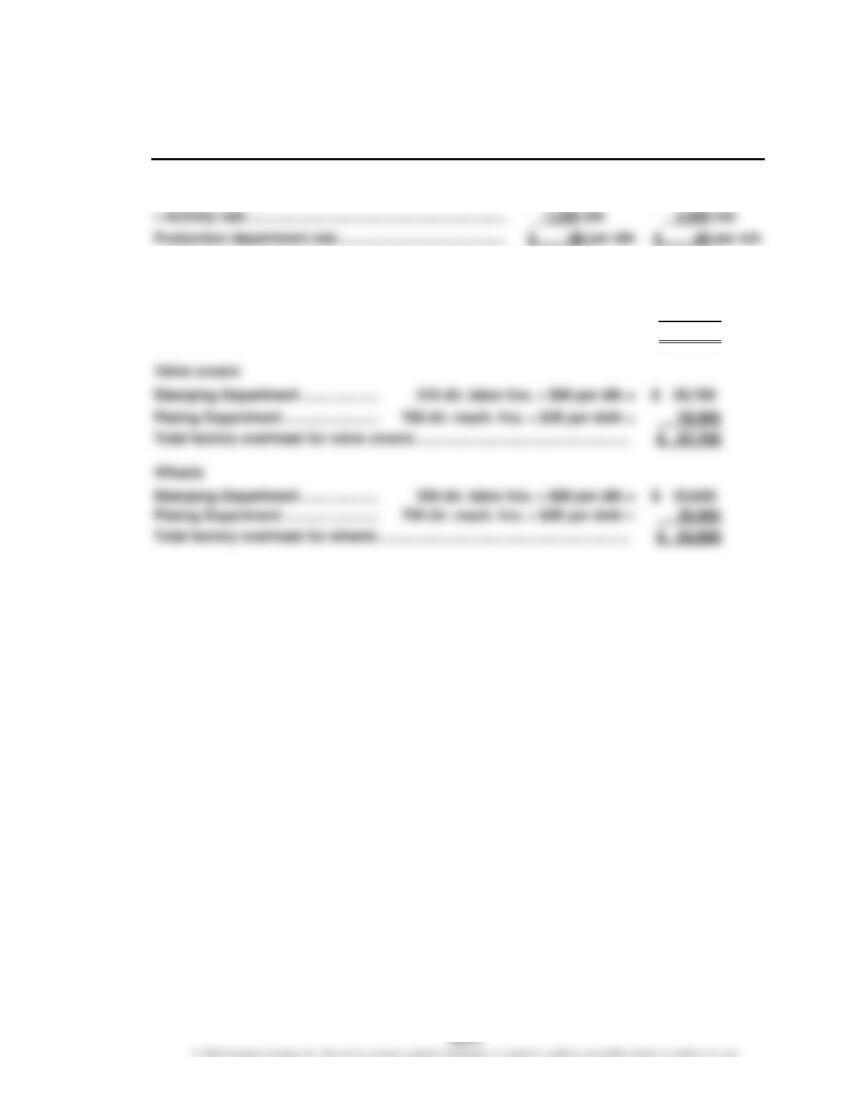
b.
Machine hours:
Stamping Department ……………………..
810 mh
570 mh
620 mh
Plating Department ………………………….
CHAPTER 18 (FIN MAN); CHAPTER 4 (MAN) Activity-Based Costing
Prob. 18–2A (FIN MAN); Prob. 4–2A (MAN)
1.
Stamping
Dept.
Plating
Dept.
Production department factory
overhead totals …………………………………………………….
$120,000
$104,000
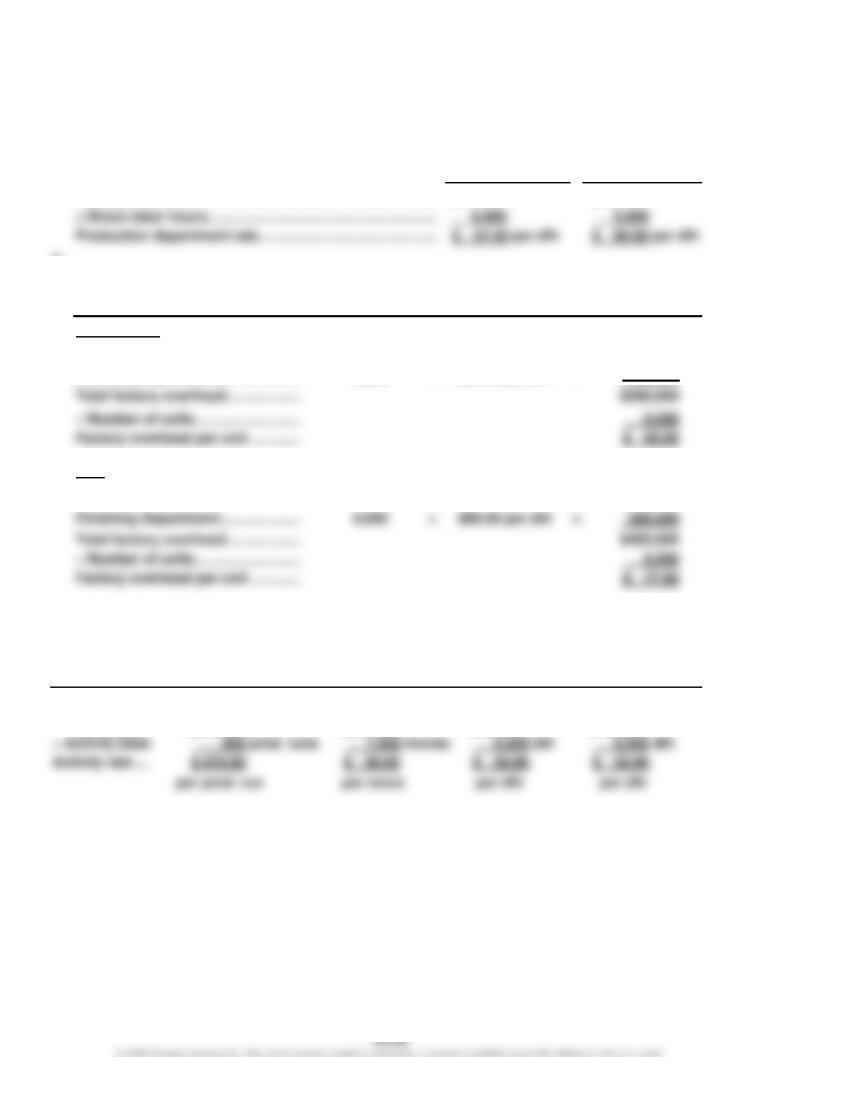
2.
Automobile bumpers
Stamping Department ………………..
590 dir. labor hrs. × $96 per dlh =
$ 56,640
Plating Department ……………………
1,150 dir. mach. hrs. × $40 per dmh =
46,000
Total factory overhead for bumpers ……………………………………………………..
$ 102,640
Valve covers
Plating Department ……………………
30,000
CHAPTER 18 (FIN MAN); CHAPTER 4 (MAN) Activity-Based Costing
Prob. 18–3A (FIN MAN); Prob. 4–3A (MAN)
1.
Production department rates:
Cutting
Department
Finishing
Department
÷ Direct labor hours …………………………………………………..
Production department rate ………………………………………
Factory overhead ………………………………………………………
$315,000
$540,000
2.
Direct
Labor Hours
×
Production
Department
Rate
=
Factory
Overhead
Snowboards:
Cutting Department ……………………
4,000
×
$52.50 per dlh
=
$210,000
Factory overhead per unit ………….
Finishing Department …………………
2,000
×
$90.00 per dlh
=
180,000
Skis:
Cutting Department ……………………
2,000
×
$52.50 per dlh
=
$105,000
Total factory overhead ……………….
$465,000
÷ Number of units ………………………
3.
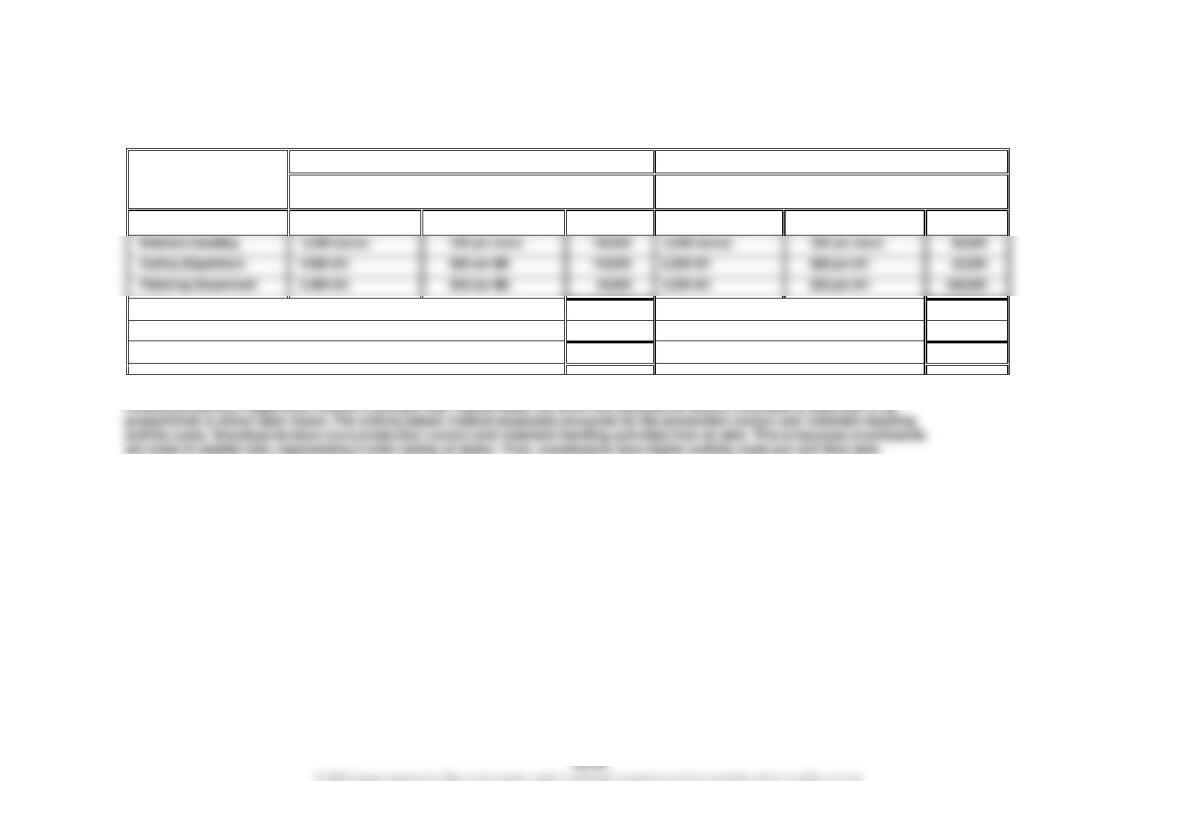
Activity-based rates:
Production
Control
Materials
Handling
Cutting
Department
Finishing
Department
Factory
overhead ..
$237,000
$270,000
$156,000
$192,000
CHAPTER 18 (FIN MAN); CHAPTER 4 (MAN) Activity-Based Costing
Prob. 18-3A (FIN MAN); Prob. 4-3A (MAN) (Concluded)
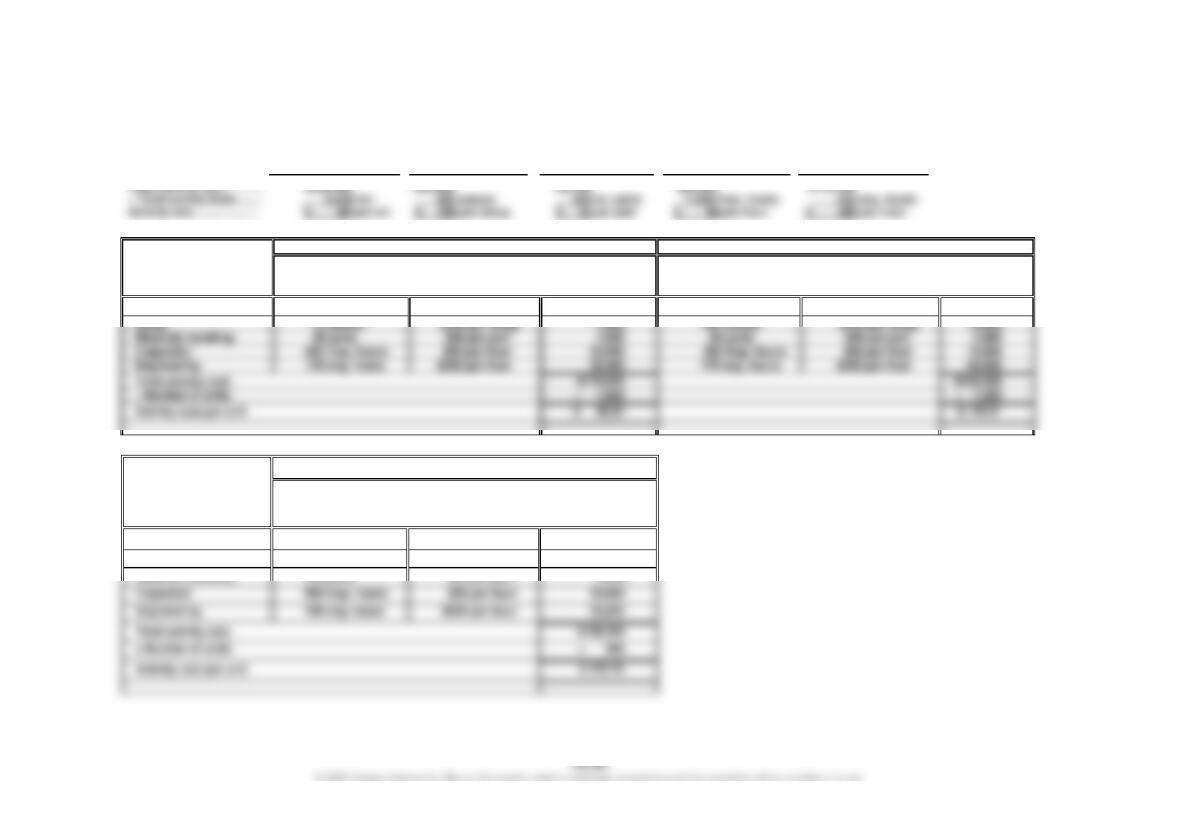
4.
Activity
Snowboards
Skis
Activity
Usage
×
Activity
Rate
=
Activity
Cost
Activity
Usage
×
Activity
Rate
=
Activity
Cost
Production control
430 prod, runs
$474 per prod, run
$203,820
70 prod, runs
$474 per prod, run
$ 33,180
Total
$551,820
$303,180
÷ Number of units
÷ 6,000
÷ 6,000
Activity cost per unit
$ 91.97
$ 50.53
5. The activity-based overhead allocation reveals that snowboards consume more factory overhead on a per-unit basis than do skis. The
CHAPTER 18 (FIN MAN); CHAPTER 4 (MAN) Activity-Based Costing
Prob. 18-4A (FIN MAN); Prob. 4-4A (MAN)
1.
Production
Setup
Materials
Handling
Inspection
Engineering
$55,000
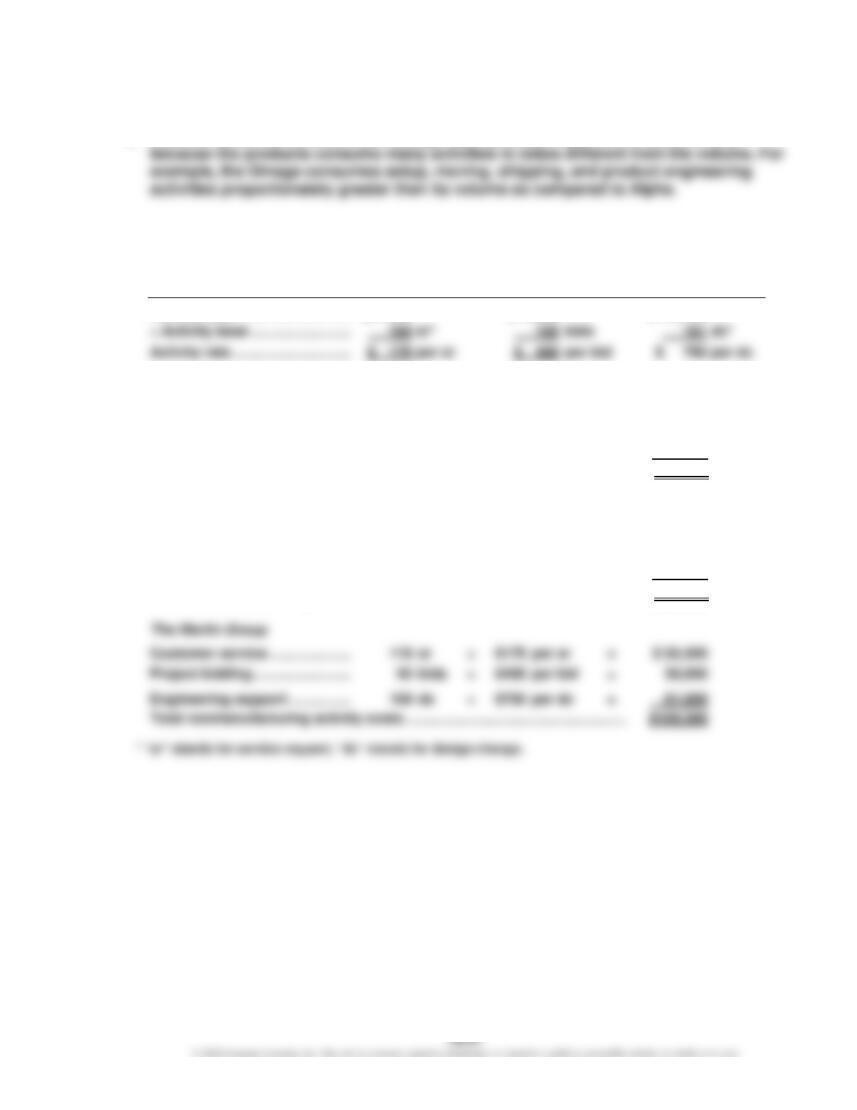
2.
Activity
Alpha
Beta
Activity-
Base
Usage
×
Activity
Rate
=
Activity
Cost
Activity-
Base
Usage
×
Activity
Rate
=
Activity
Cost
Production
1,440 mh
$80 per mh
$115,200
1,080 mh
$80 per mh
$ 86,400
Setup
165 setups
$30 per part
Inspection
20,000
300 insp. hours
Engineering
35,000
$280 per hour
$179,650
$169,300
Activity
Omega
Activity-
Base
Usage
×
Activity
Rate
=
Activity
Cost
Production
720
mh
$80
per mh
$ 57,600
Setup
310
setups
$100
per setup
31,000
Inspection
500
insp. hours
per hour
25,000
CHAPTER 18 (FIN MAN); CHAPTER 4 (MAN) Activity-Based Costing
Prob. 18–4A (FIN MAN); Prob. 4–4A (MAN) (Concluded)
3. The unit costs are different even though each product requires 0.8 machine hour
Prob. 18–5A (FIN MAN); Prob. 4–5A (MAN)
1.
Customer
Service
Project
Bidding
Engineering
Support
Activity cost …………………………
$31,500
$74,000
$120,750
2.
Gough Industries
Customer service …………………
36
sr
×
$175
per sr
=
$ 6,300
Project bidding …………………….
50
bids
×
$400
per bid
=
20,000
Engineering support …………….
18
dc
×
$750
per dc
=
13,500
Total nonmanufacturing activity costs …………………………..…………………….
$ 39,800
Breen Inc.
Customer service …………………
28
sr
×
$175
per sr
=
$ 4,900
Project bidding …………………….
40
bids
×
$400
per bid
=
16,000
Engineering support …………….
35
dc
×
$750
per dc
=
26,250
Total nonmanufacturing activity costs …………………………..…………………….
$ 47,150
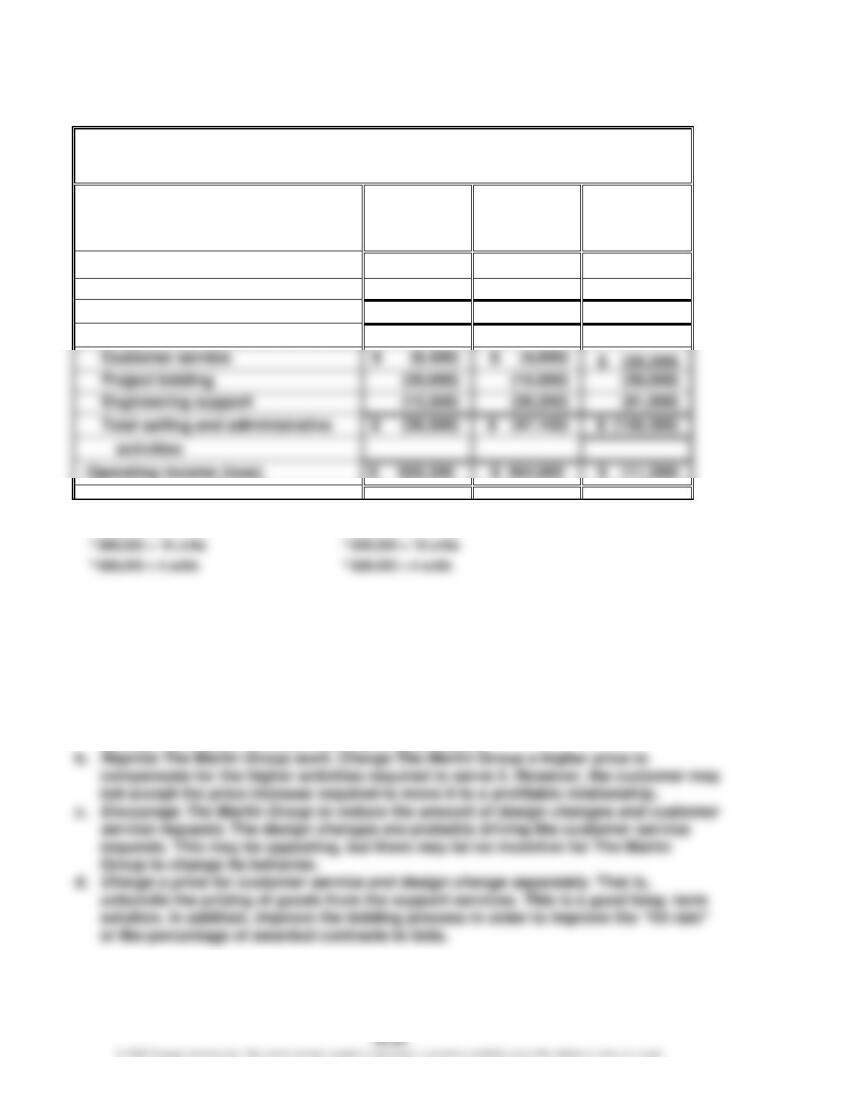
The Martin Group
Engineering support …………….
×
$750
per dc
=
CHAPTER 18 (FIN MAN); CHAPTER 4 (MAN) Activity-Based Costing
Prob. 18–5A (FIN MAN); Prob. 4–5A (MAN) (Concluded)
3.
Arctic Air Inc.
Customer Profitability Report
For the Year Ended December 31
Gough
Industries
Breen Inc.
The
Martin Group
Revenues
$1,800,0001
$ 960,0002
$ 240,0003
Cost of goods sold
(840,000)4
(448,000)5
(112,000)6
Gross profit
$ 960,000
$ 512,000
$ 128,000
Selling and administrative activities:
1 $60,000 × 30 units
4 $28,000 × 30 units
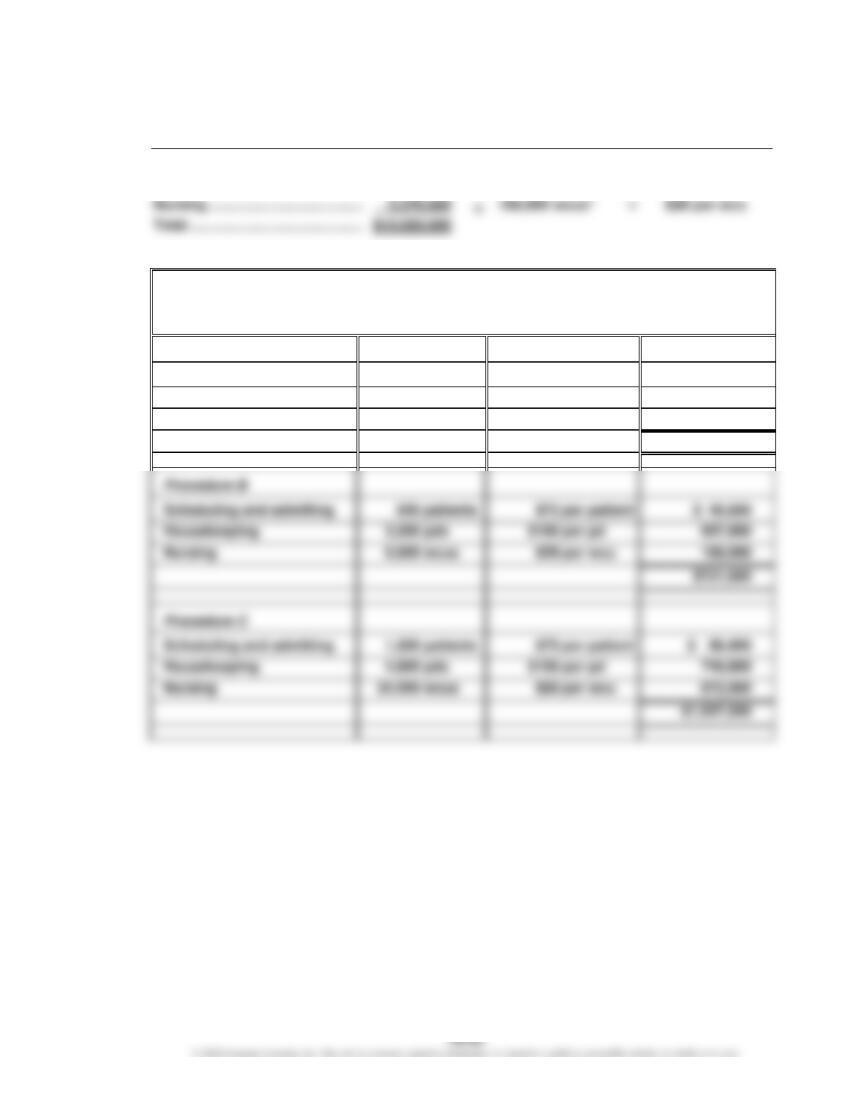
4. The Martin Group is unprofitable, while the other two customers have acceptable
margins. This is because The Martin Group requires many customer service, project
bidding, and design change activities. For example, The Martin Group awards
contracts on only 4.2% of the bid efforts (4 contracts ÷ 95 bids); it requests a large
amount of service; and it requires extensive design change effort. The company’s
options include:
a. Stop bidding The Martin Group projects. This does not necessarily mean that all
the costs can be avoided. The costs only will be eliminated if the reduced
activity translates into lower headcount (dismissals).
CHAPTER 18 (FIN MAN); CHAPTER 4 (MAN) Activity-Based Costing
Prob. 18–6A (FIN MAN); Prob. 4–6A (MAN)
1.
Activity
Activity Cost
÷
Activity Base
=
Activity Rate
Scheduling and admitting ………
$ 432,000
÷
6,000
patients
=
$72
per patient
Housekeeping ………………………..
4,212,000
÷
27,000
pds*
=
$156
per pd
Nursing ………………………………….
÷
wcus*
=
$28
per wcu
* “pd” stands for patient day; “wcu” stands for weighted care unit
2.
Activity
Activity
Usage
×
Activity
Rate
=
Total Activity
Cost by
Procedure
Procedure A
Scheduling and admitting
280
patients
$72
per patient
$ 20,160
Housekeeping
1,680
pds
$156
per pd
262,080
Nursing
19,200
wcus
$28
per wcu
537,600
$819,840
Housekeeping
3,250
pds
$156
per pd
507,000
Housekeeping
4,800
pds
$156
per pd
748,800
CHAPTER 18 (FIN MAN); CHAPTER 4 (MAN) Activity-Based Costing
Prob. 18–6A (FIN MAN); Prob. 4–6A (MAN) (Concluded)
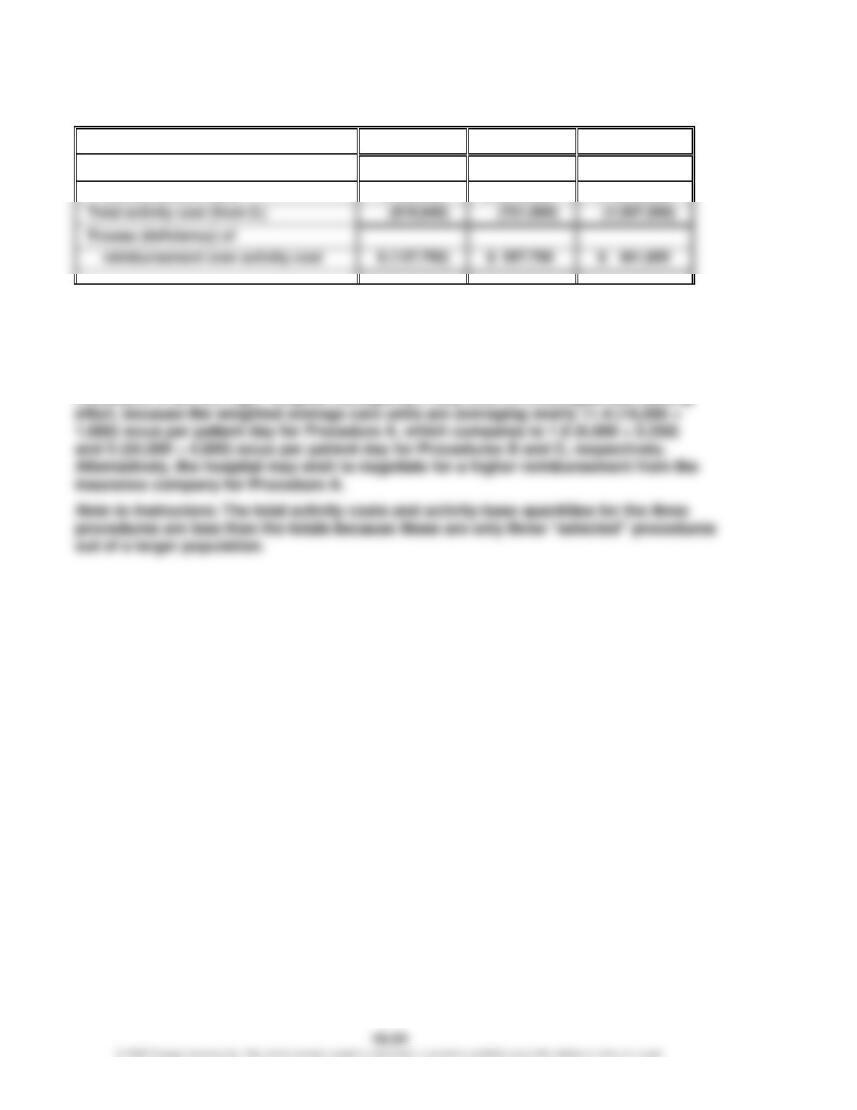
3.
Procedure A
Procedure B
Procedure C
Reimbursement (patient days ×
reimbursement rate)*
$ 682,080
$1,319,500
$ 1,948,800
* 1,680 patient days × $406 per patient day = $682,080
3,250 patient days × $406 per patient day = $1,319,500
4,800 patient days × $406 per patient day = $1,948,800
4. Procedure A requires more activity cost than is being reimbursed by the insurance
company. As a result, the hospital may wish to determine if the costs of providing