Chapter 4
Process Costing
Solutions to Questions
4-1 A process costing system should be
used in situations where a homogeneous
product is produced on a continuous basis in
large quantities.
4-2 Job-order and processing costing are
similar in the following ways:
1. Job-order costing and process costing have
the same basic purposes—to assign
materials, labor, and overhead cost to
products and to provide a mechanism for
computing unit product costs.
2. Both systems use the same basic
manufacturing accounts.
3. Costs flow through the accounts in basically
the same way in both systems.
4-5 The journal entry to record the transfer
of work in process from the Mixing Department
to the Firing Department is:
Work in Process, Firing ……..
XXXX
Work in Process, Mixing.
XXXX
4-6 The costs that might be added in the
Firing Department include: (1) costs transferred
in from the Mixing Department; (2) materials
costs added in the Firing Department; (3) labor
costs added in the Firing Department; and (4)
overhead costs added in the Firing Department.
4-7 Under the weighted-average method,
equivalent units of production consist of units
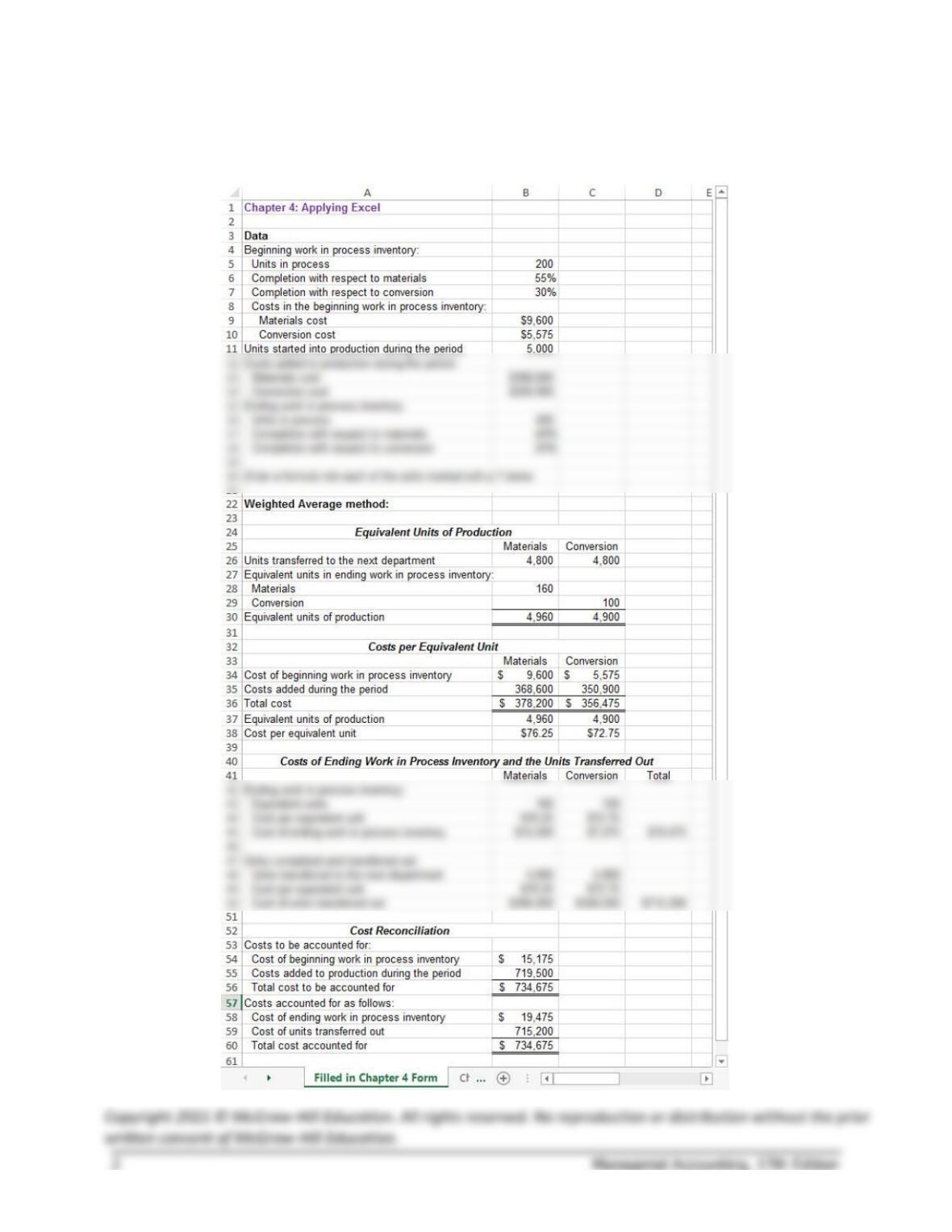
Chapter 4: Applying Excel
The completed worksheet is shown below.
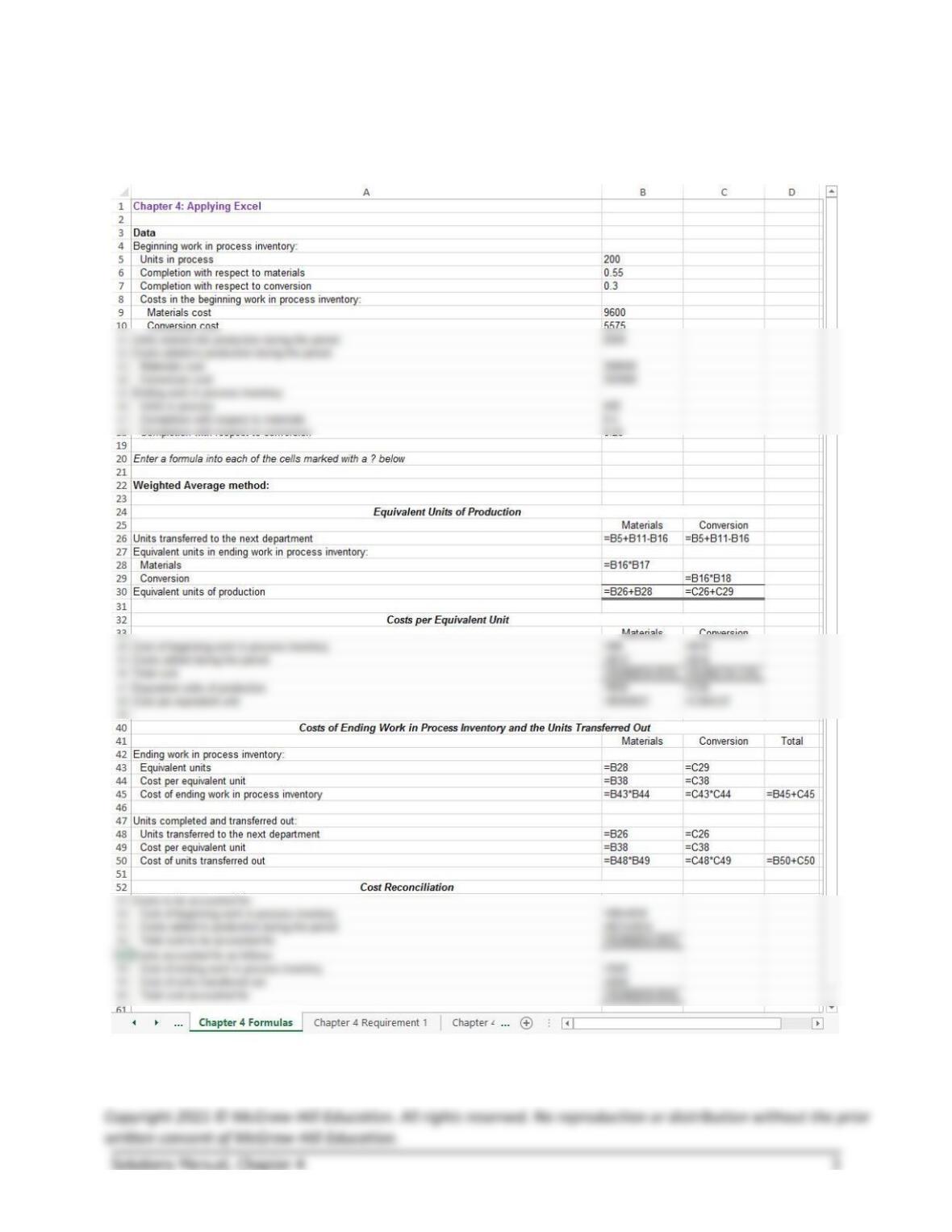
Chapter 4: Applying Excel (continued)
The completed worksheet, with formulas displayed, is shown below.
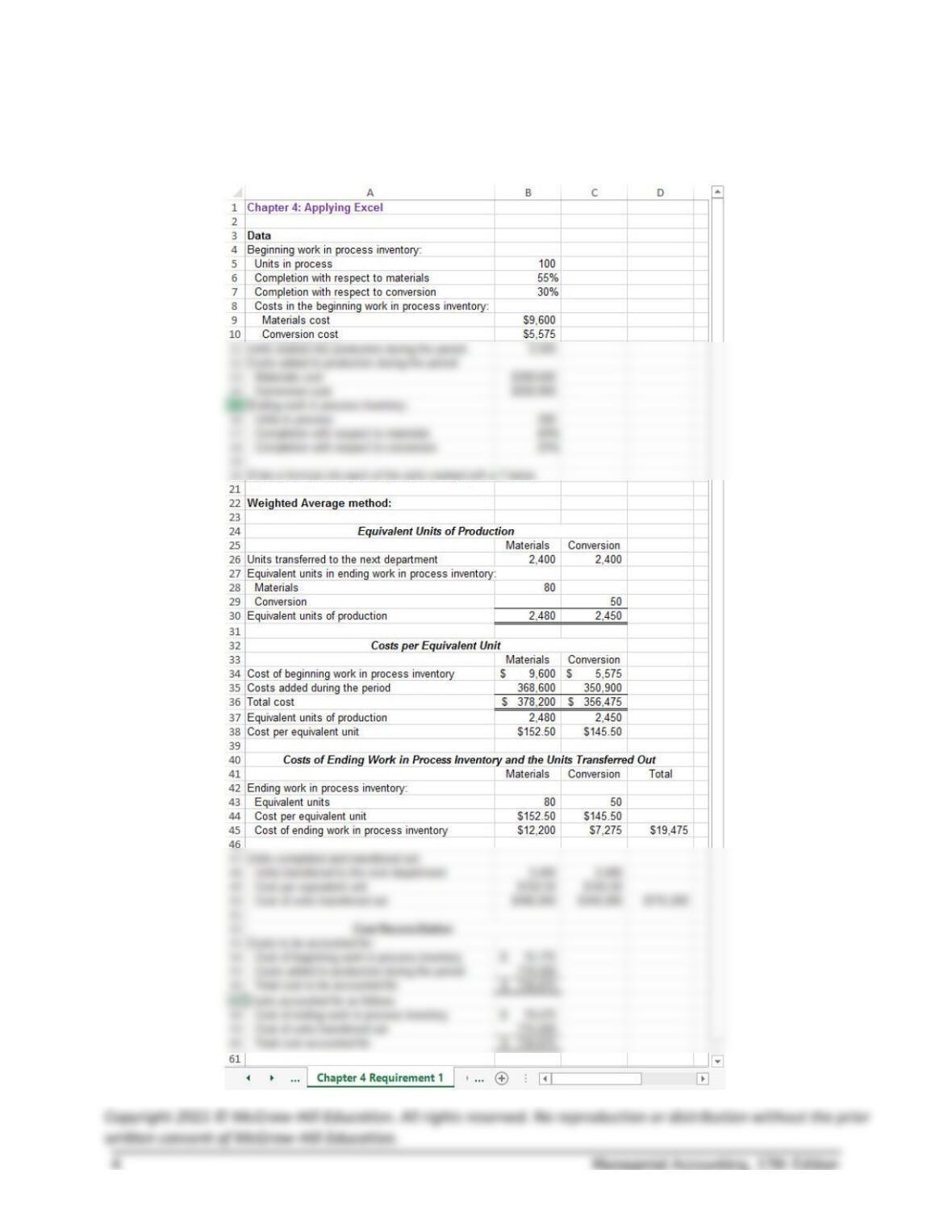
Chapter 4: Applying Excel (continued)
1. When the units are changed, the worksheet changes as shown below:
Chapter 4: Applying Excel (continued)
All of the amounts involving units were cut in half. The units in
beginning work in process inventory were reduced from 200 units to
100 units; the units started into production during the period were
reduced from 5,000 units to 2,500 units; and the units in ending work in
process inventory were reduced from 400 units to 200 units. All of the
Chapter 4: Applying Excel (continued)
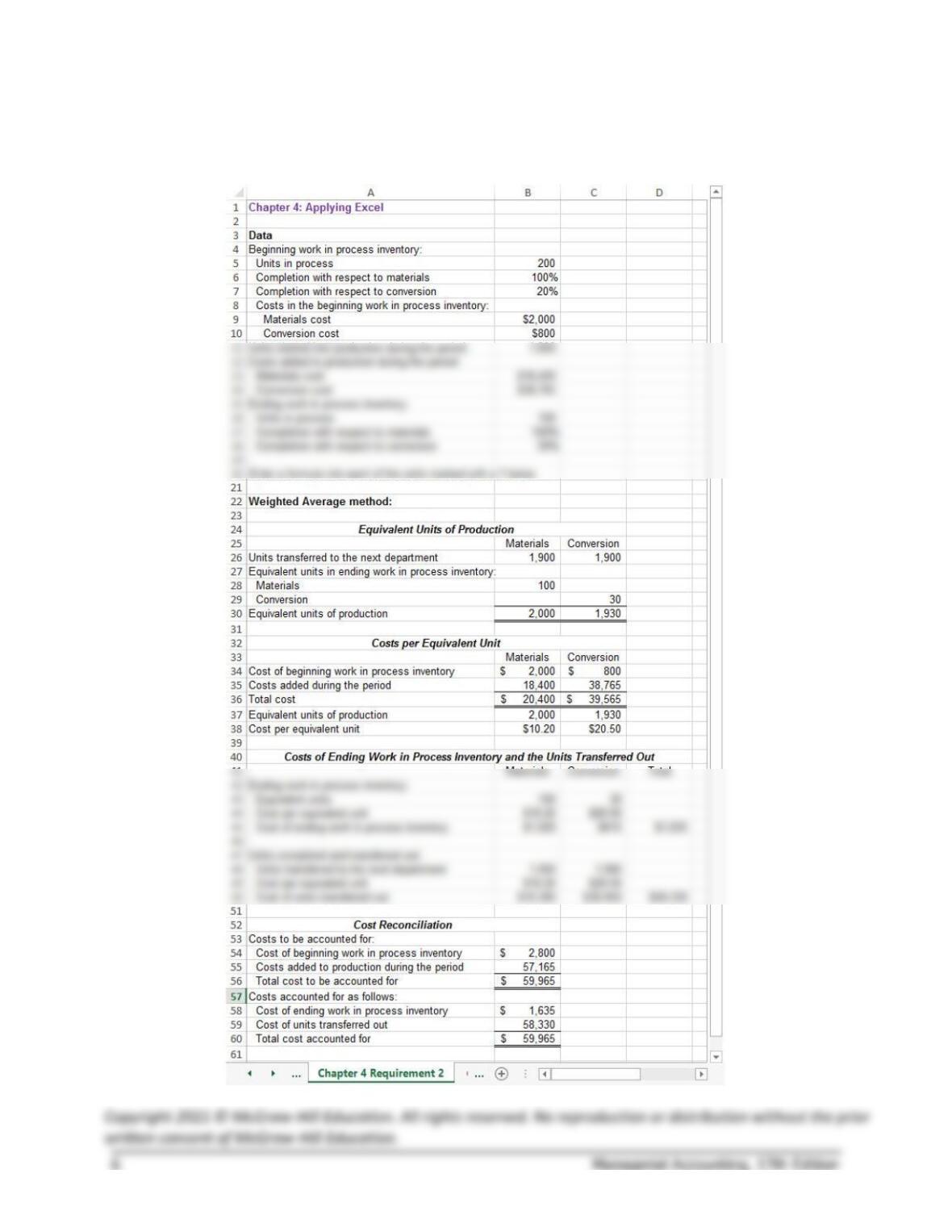
2. With all of the changes in the data, the worksheet should look like:

The cost of the units transferred out is $58,330.

Chapter 4: Applying Excel (continued)
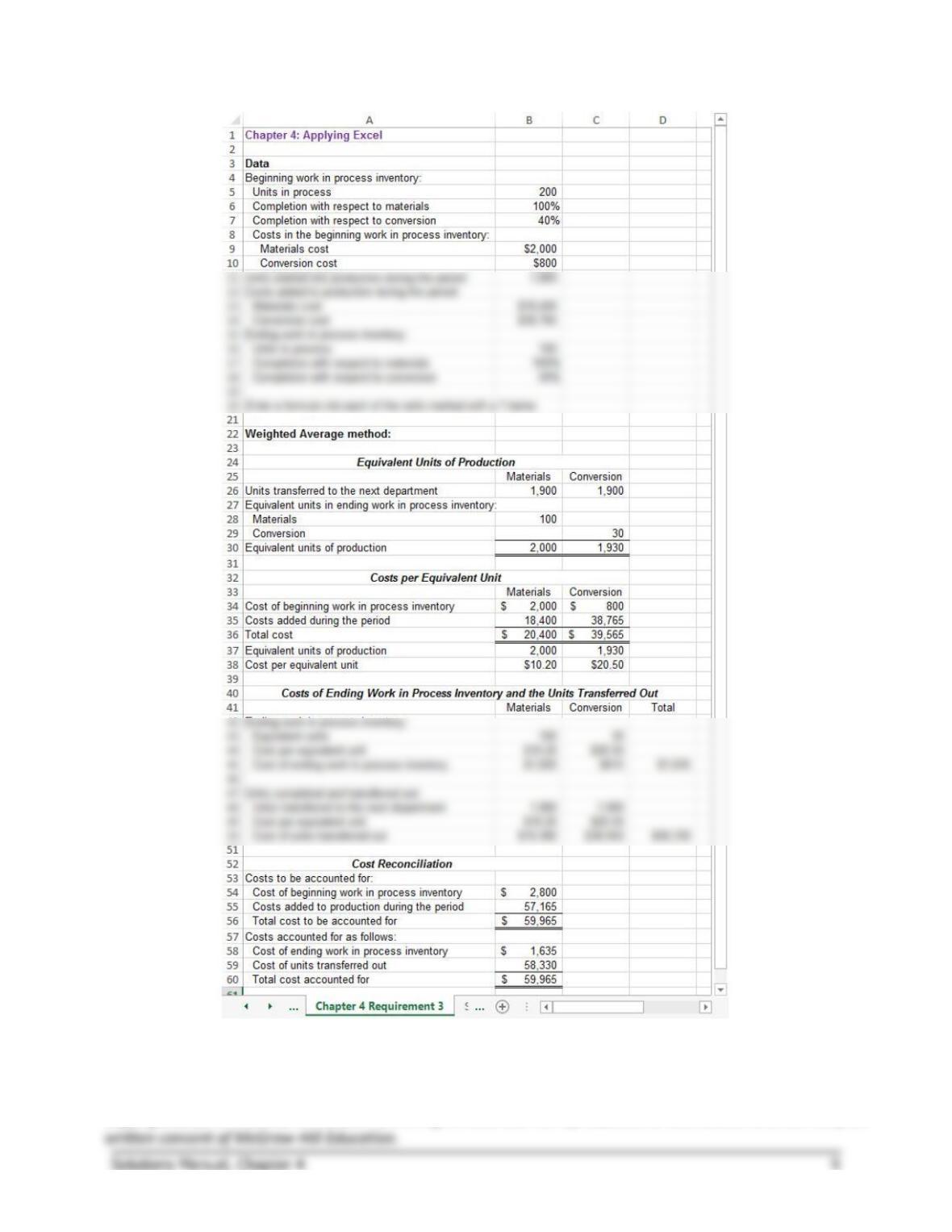
3. Changing the percentage completion with respect to conversion for
beginning inventory from 20% to 40% results in:
Copyright 2021 © McGraw-Hill Education. All rights reserved. No reproduction or distribution without the prior
Chapter 4: Applying Excel (continued)
The cost per equivalent unit for conversion is not affected by the
increase in the percentage completion of the beginning inventory. In
fact, nothing else on the worksheet is affected except this one amount.
This is a consequence of using the weighted-average method. If the
The Foundational 15
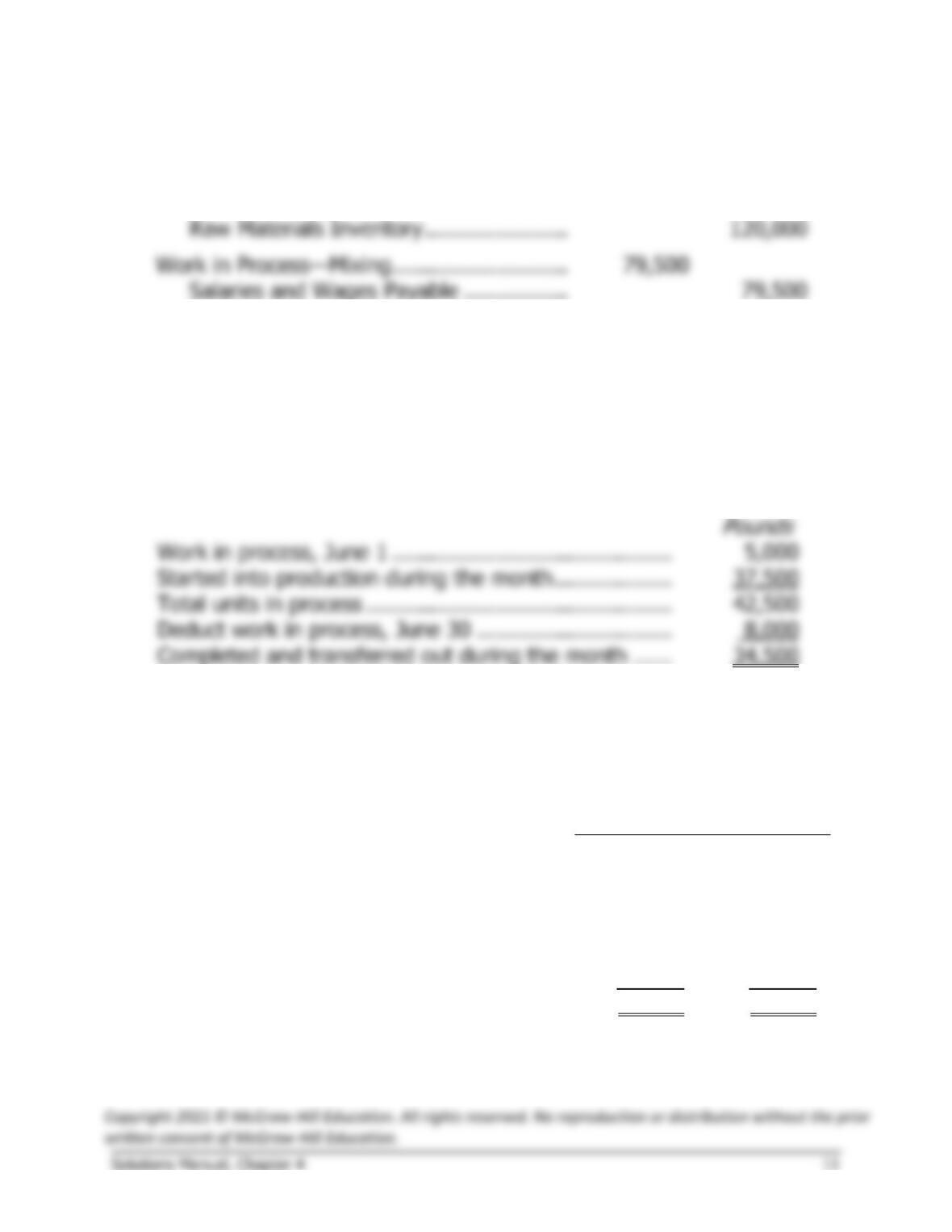
1. The journal entries would be recorded as follows:
Work in Process—Mixing ………………………
120,000
Raw Materials Inventory ………………….
Work in Process—Mixing ………………………
Salaries and Wages Payable …………….
79,500
2. The journal entry would be recorded as follows:
Work in Process—Mixing ………………………
97,000
Manufacturing Overhead …………………
97,000
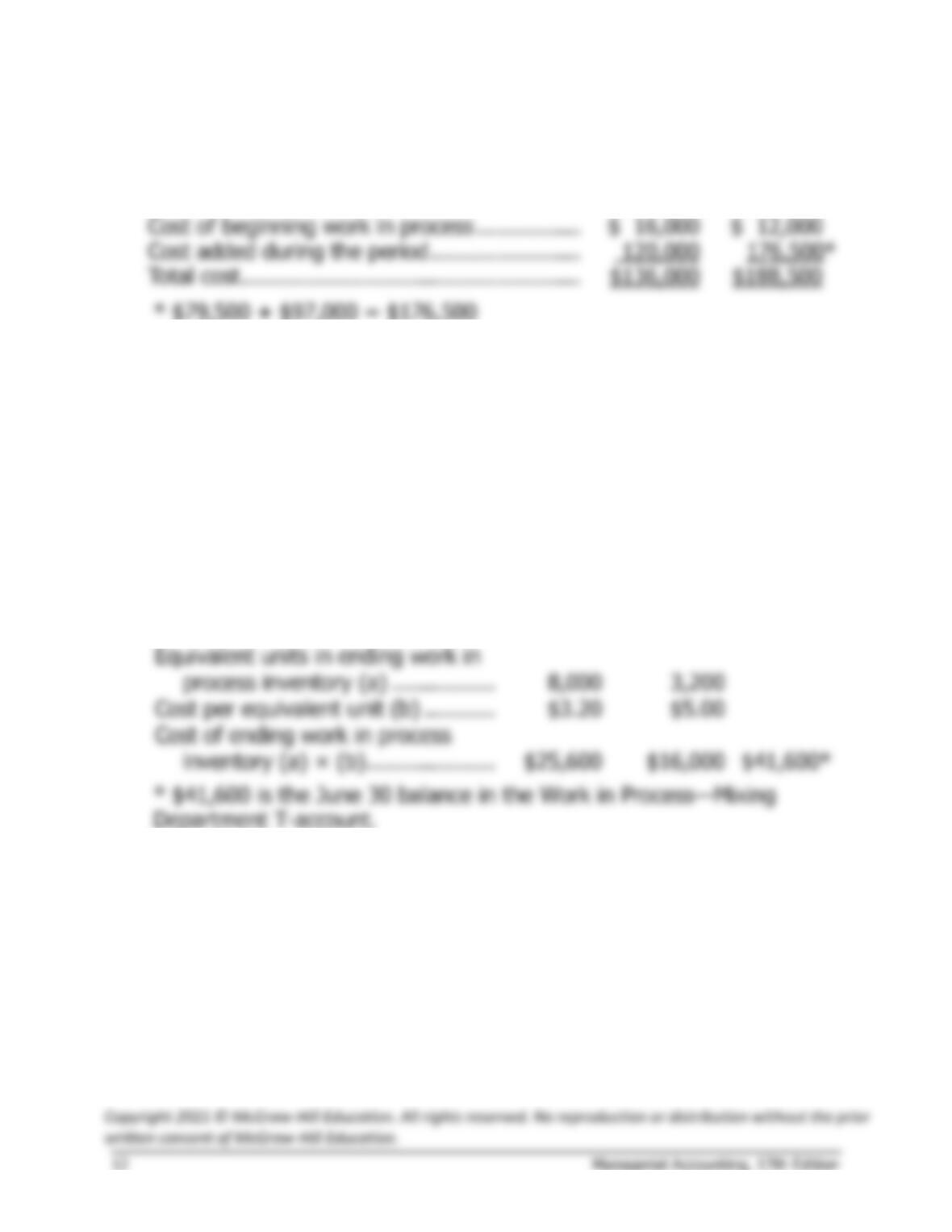
3. The “units completed and transferred to finished goods” is computed
as follows:
Started into production during the month ………………
37,500
Total units in process ………………………………………..
42,500
Deduct work in process, June 30 …………………………
Completed and transferred out during the month ……
4. and 5.
The equivalent units of production for materials and conversion are
computed as follows:
Equivalent Units
Materials
Conversion
Units transferred out ………………………..
34,500
34,500
Equivalent units in ending work in
process inventory:
8,000 units × 100% ……………………….
8,000
8,000 units × 40% …………………………
3,200
Equivalent units of production ……………..
42,500
37,700
The Foundational 15 (continued)
6. and 7.
Materials
Conversion
8. and 9.
The cost per equivalent unit for materials and conversion is computed
as follows:
Total cost (a) …………………………………………
$136,000
$188,500
Equivalent units of production (b) ………………
42,500
37,700
Cost per equivalent unit (a) ÷ (b) ……………….
$3.20
$5.00
10. and 11.
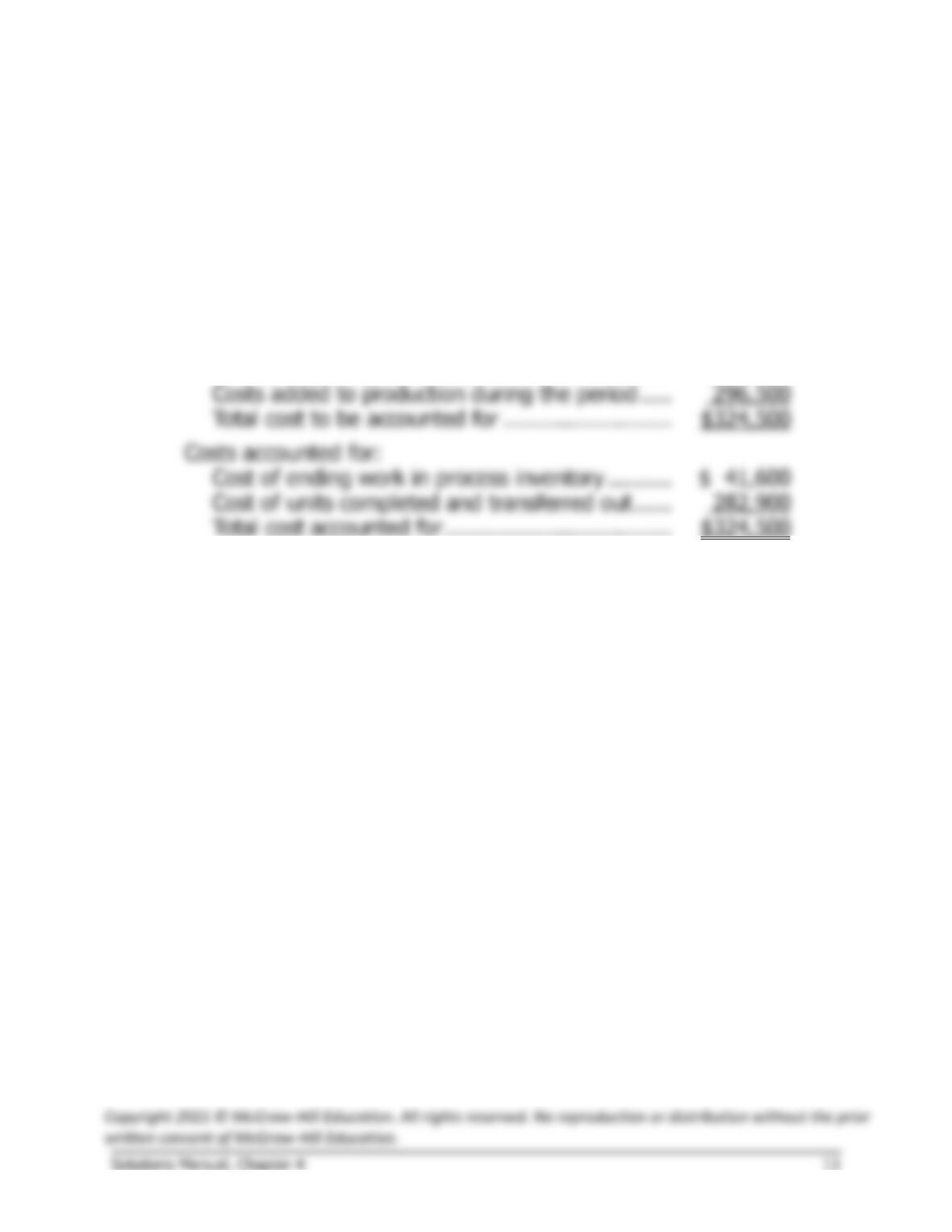
The cost of ending work in process inventory is computed as follows:
Materials
Conversion
Total
Cost per equivalent unit (b) ………..
$5.00
Cost of ending work in process
inventory (a) × (b)………………..
$41,600*
12. and 13.
The costs transferred to finished goods are computed as follows:
Materials
Conversion
Total
Units transferred out (a) ……………
34,500
34,500
Cost per equivalent unit (b) ……….
$3.20
$5.00
Cost of units transferred to
finished goods (a) × (b) ………..
$110,400
$172,500
$282,900
The Foundational 15 (continued)
14. The journal entry to record the transfer of costs from Work in
Process—Mixing to Finished Goods would be recorded as follows:
Finished Goods…………………………………….. 282,900
Work in Process—Mixing ………………….. 282,900
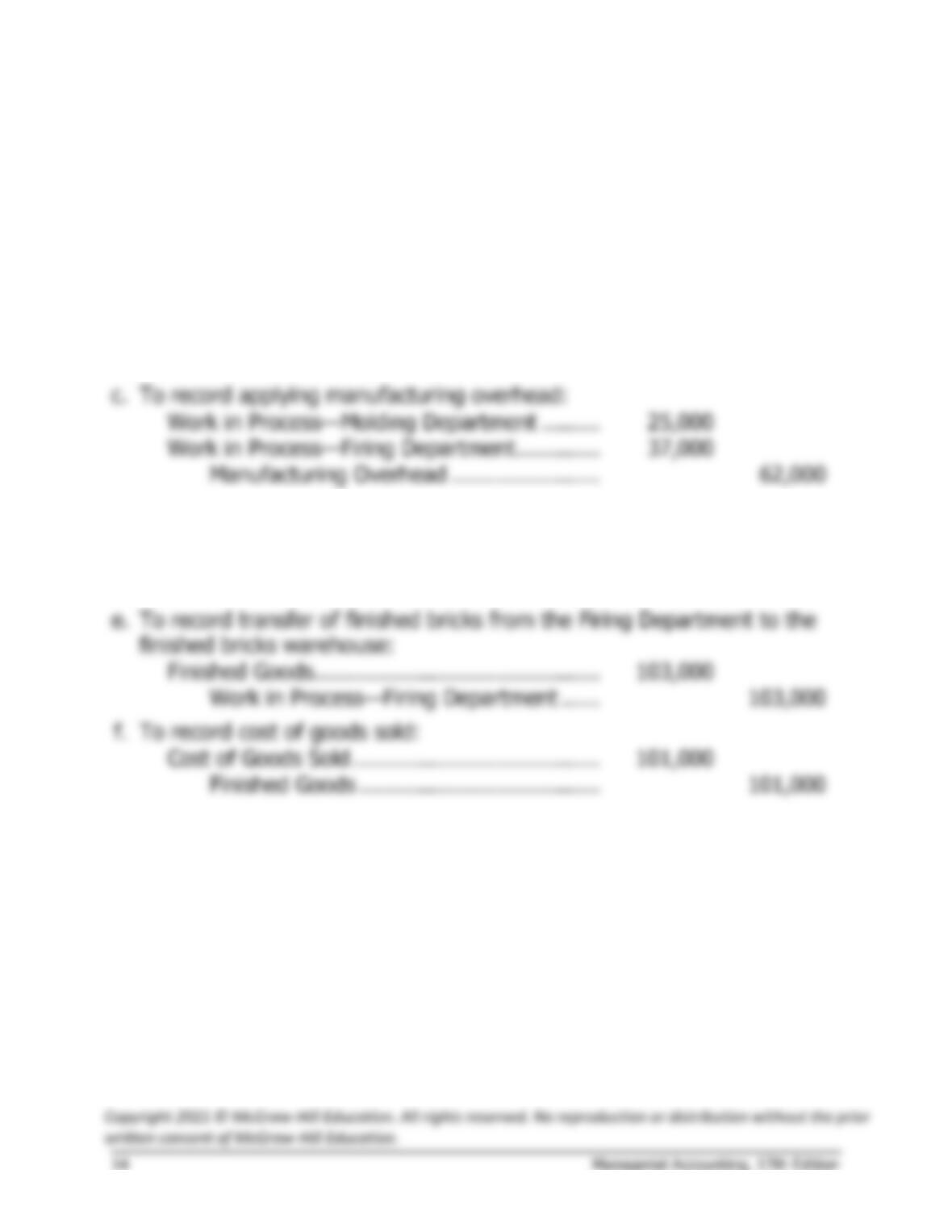
15. The total cost to be accounted for and the total cost accounted for is:
Costs to be accounted for:
Cost of beginning work in process inventory……
$ 28,000
Costs added to production during the period …..
Cost of ending work in process inventory ……….
$ 41,600
Total cost accounted for ……………………………..
Exercise 4-1 (20 minutes)
a. To record raw materials used in production:
Work in Process—Molding Department ……… 23,000
Work in Process—Firing Department …………. 8,000
Raw Materials ………………………………… 31,000
b. To record direct labor costs incurred:
Work in Process—Molding Department ……… 12,000
Work in Process—Firing Department …………. 7,000
Salaries and Wages Payable ……………… 19,000
d. To record transfer of unfired, molded bricks from the Molding
Department to the Firing Department:
Work in Process—Firing Department …………. 57,000
Work in Process—Molding Department … 57,000
Exercise 4-2 (10 minutes)
Weighted-Average Method
Equivalent Units of
Production
Materials
Conversion
Units transferred out ………………….
190,000
190,000
Equivalent units in ending work in
process inventory:
Equivalent units of production ……..
202,000
196,000
Exercise 4-3 (10 minutes)
Weighted-Average Method
Materials
Labor
Overhead
Cost of beginning work in process
inventory …………………………..…
$ 18,000
$ 5,500
$ 27,500
Cost added during the period ………
238,900
80,300
401,500
Total cost (a) …………………………..
$256,900
$85,800
$429,000
Equivalent units of production (b) ..
35,000
33,000
33,000
Cost per equivalent unit (a) ÷ (b) ..
$7.34
$2.60
$13.00
Total
Labor ………………………………………………….
Overhead …………………………………………….
13.00
Total cost per equivalent unit ……………………
Exercise 4-4 (10 minutes)
1.
Materials
Conversion
Total
Ending work in process inventory:
Equivalent units ………………………
2,000
800
Cost per equivalent unit ……………
$13.86
$4.43
Cost of ending work in process
inventory …………………………..
$27,720
$3,544
$31,264
2.
Materials
Conversion
Total
Units completed and transferred out:
20,100
20,100
Cost per equivalent unit ……………
$13.86
$4.43
Cost of units transferred out ………
$278,586
$367,629
Exercise 4-5 (10 minutes)
Baking Department
Cost Reconciliation
Costs to be accounted for:
Cost of beginning work in process inventory ..
$ 3,570
Costs added to production during the period .
43,120
Total cost to be accounted for …………………..
$46,690
Costs accounted for as follows:
Cost of ending work in process inventory …….
$ 2,860
Cost of units completed and transferred out ..
*
Total cost accounted for ………………………….
*The cost of units completed and transferred out can be deduced as
follows:
Cost of beginning Costs added Cost of ending Cost of units
work in process + to production =work in process + completed and
inventory during the period inventory transferred out
Cost of
$3,570 + $43,120 = $2,860 +
units
completed and
transferred out
Cost of units
completed and = $3,570 + $43,120 – $2,860
transferred out
Exercise 4-6 (10 minutes)
Weighted-Average Method
1.
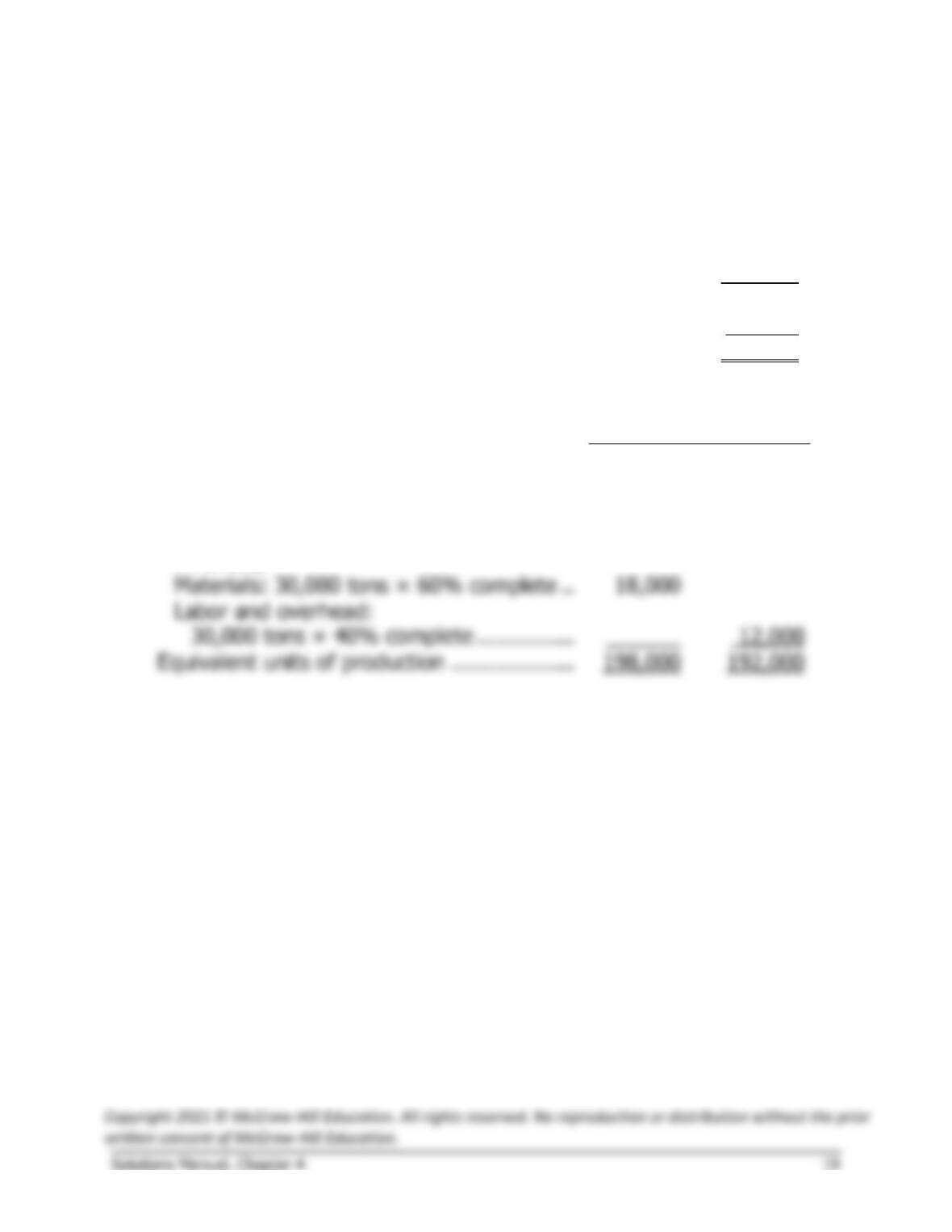
Tons of Pulp
Work in process, June 1 …………………………………….
20,000
Started into production during the month ………………
190,000
Total tons in process …………………………………………
210,000
Deduct work in process, June 30 …………………………
30,000
Completed and transferred out during the month ……
180,000
2.
Equivalent Units of
Production
Materials
Labor and
Overhead
Units transferred out …………………………...
180,000
180,000
Equivalent units in ending work in process
inventory:
Equivalent units of production ……………….
Exercise 4-7 (10 minutes)
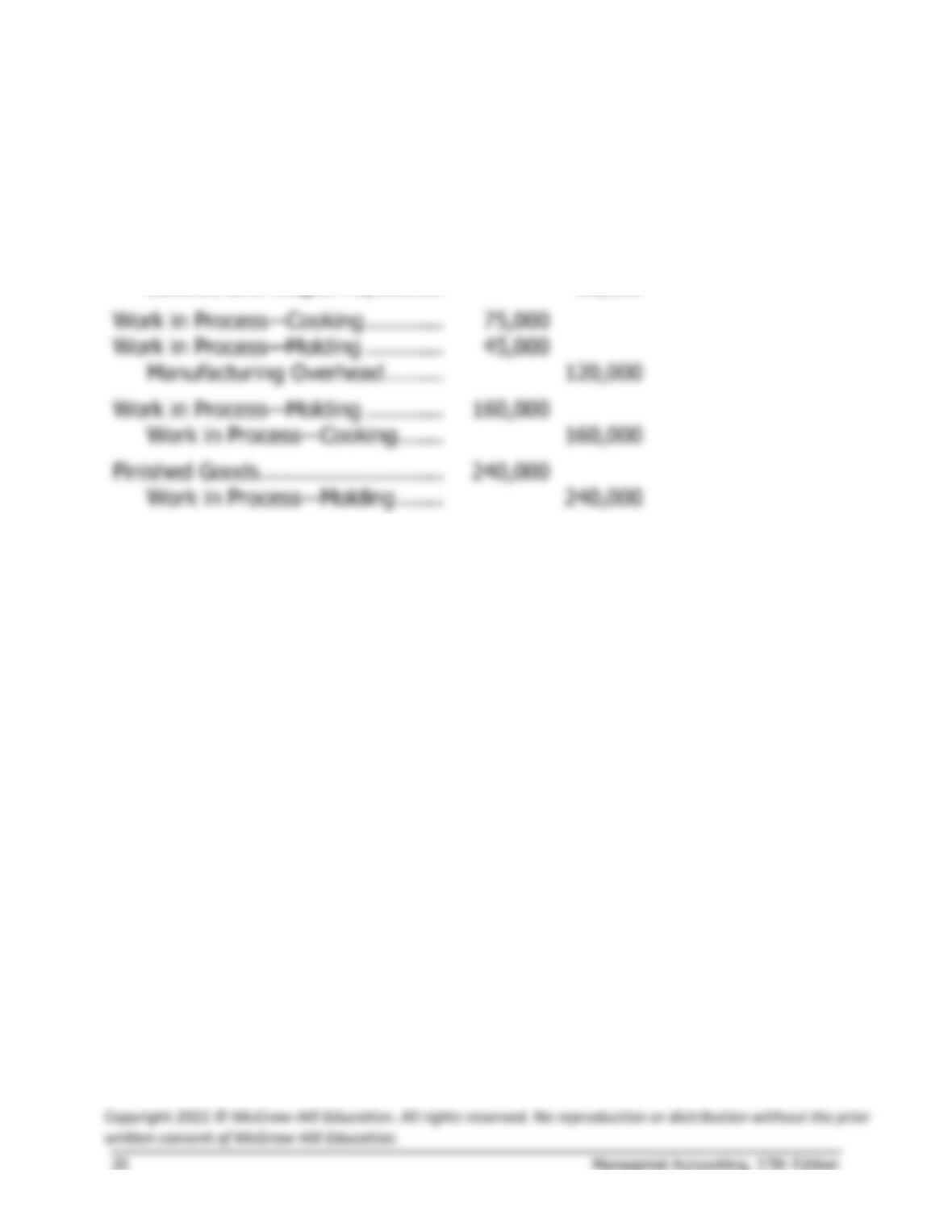
Work in Process—Cooking …………
42,000
Raw Materials Inventory ………
42,000
Work in Process—Cooking …………
50,000
Work in Process—Molding …………
36,000
Salaries and Wages Payable ….
86,000
Work in Process—Cooking …………
75,000
Manufacturing Overhead ………
Work in Process—Molding …………
Work in Process—Cooking …….
Finished Goods ……………………….
Work in Process—Molding …….