Exercise 4.21
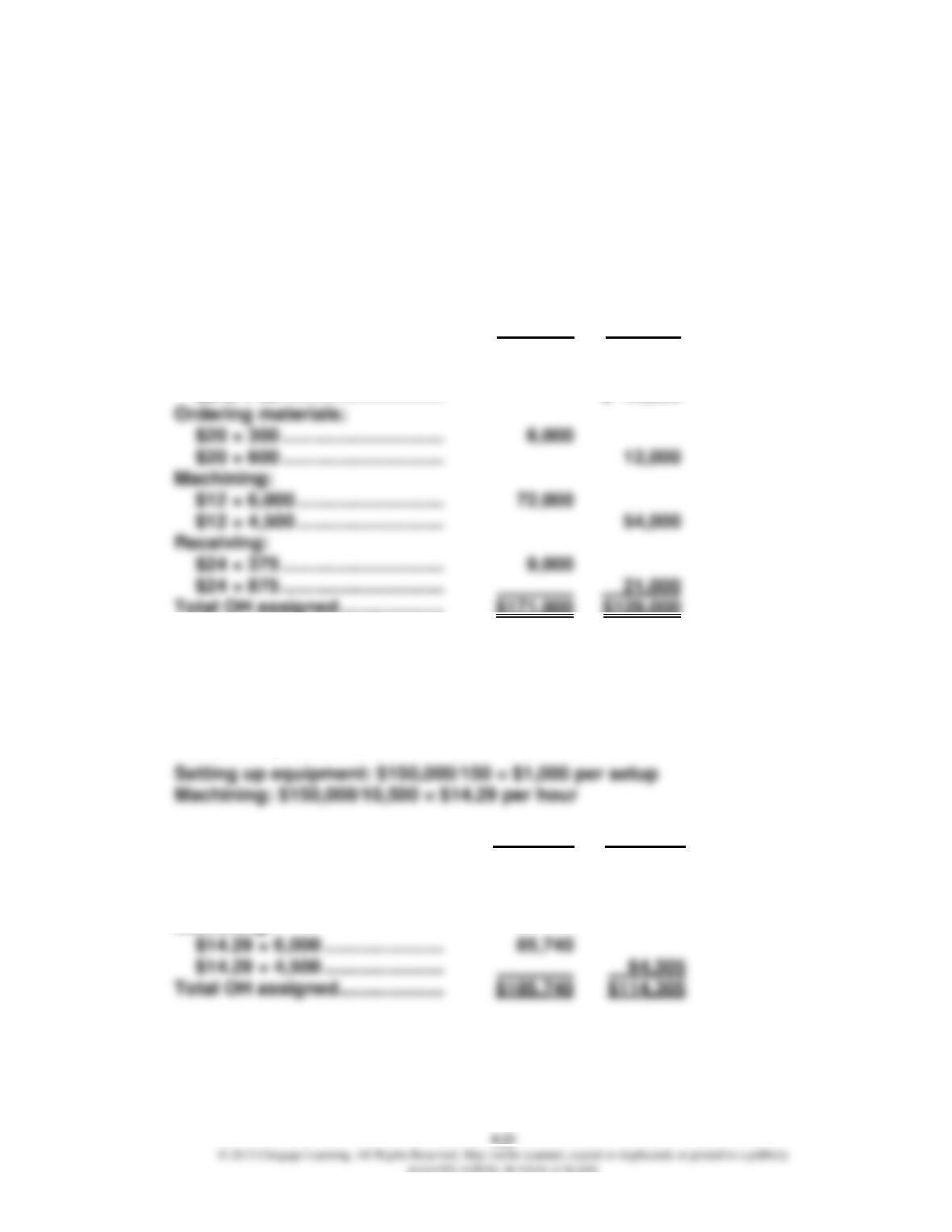
1. Activity rates:
Setting up equipment = $126,000/150 = $840 per setup
Ordering materials = $18,000/900 = $20 per order
Machining = $126,000/10,500 = $12 per machine hour
Receiving = $30,000/1,250 = $24 per receiving hour
Overhead cost assignment:
Model X Model Y
Setting up equipment:
$840 × 100 ……………………….. $ 84,000
$840 × 50 …………………………. $ 42,000
Total OH assigned ……………….. $171,000 $129,000
2. New cost pools:
Setting up equipment: $126,000 + [($126,000/$252,000) × $48,000] = $150,000
Machining: $126,000 + [($126,000/$252,000) × $48,000] = $150,000
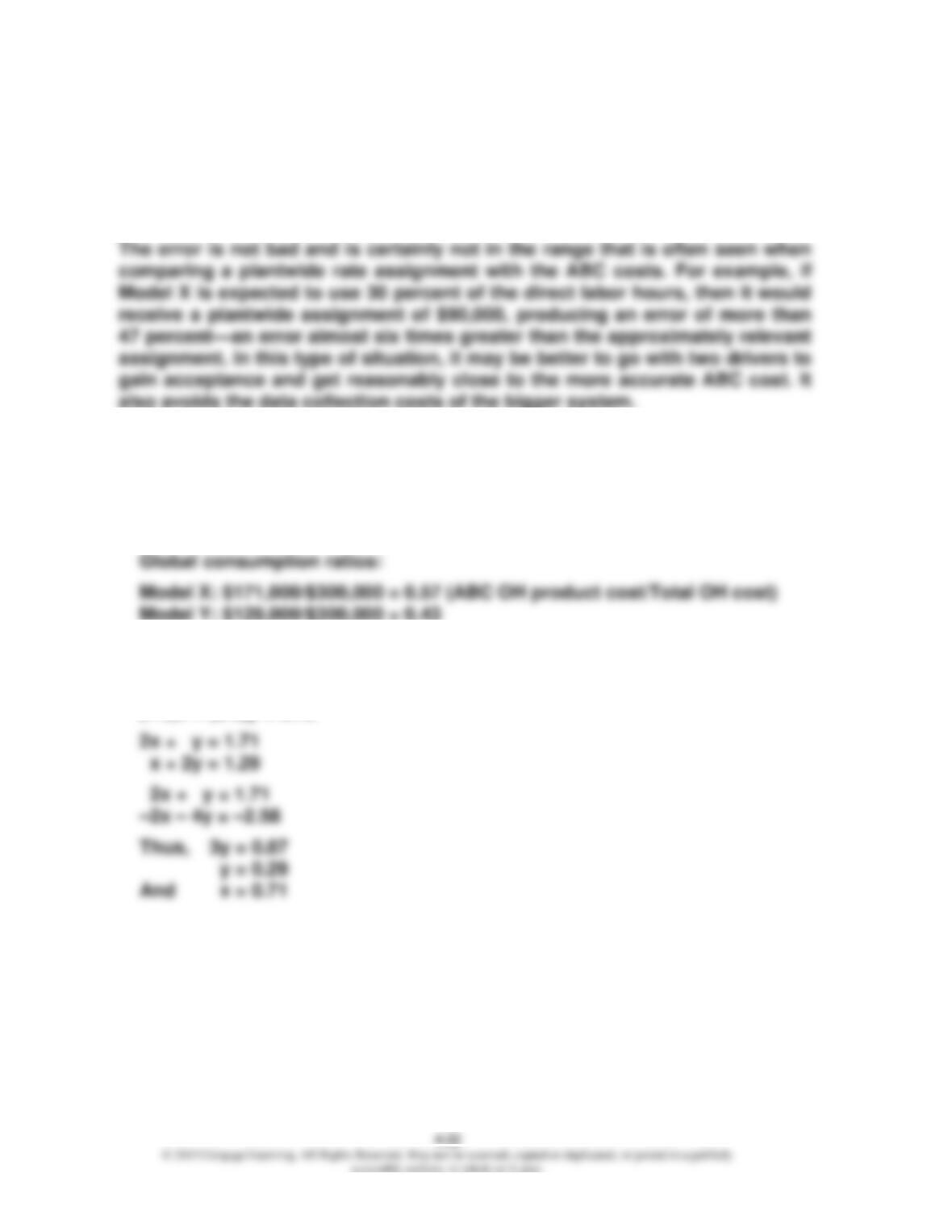
New activity rates:
Model X Model Y
Setting up equipment:
$1,000 × 100 …………………….. $100,000
$1,000 × 50 ………………………. $ 50,000
Machining:
Exercise 4.21 (Concluded)
3. Percentage error:
Model X: ($185,740 – $171,000)/$171,000 = 0.086 (8.6%)
Model Y: ($114,305 – $129,000)/$129,000 = –0.114 (–11.4%)
Exercise 4.22
1. First, calculate the ABC assignments (see the solution to Requirement 1,
Exercise 4–21).
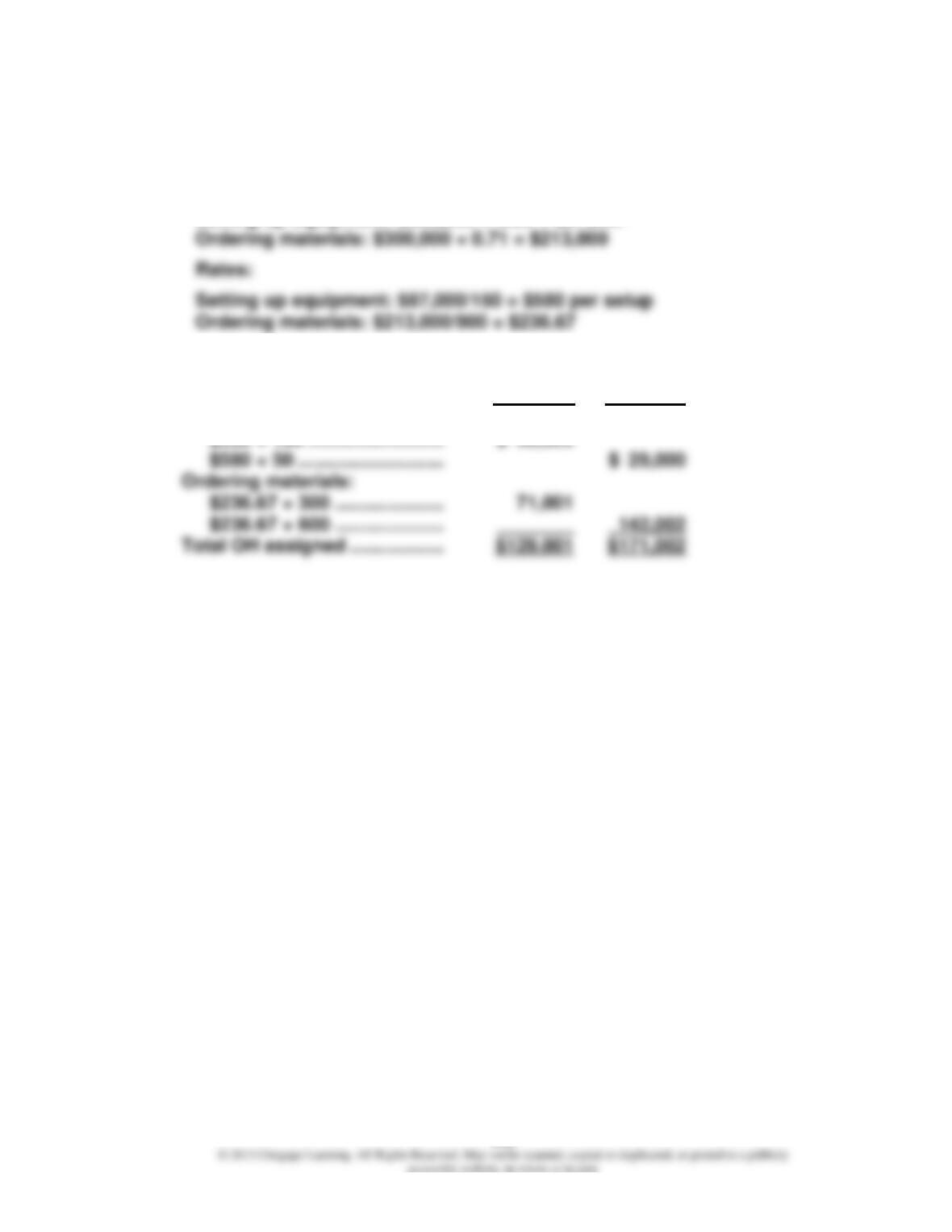
2. Form two simultaneous equations:
(2/3)x + (1/3)y = 0.57
(1/3)x + (2/3)y = 0.43
4-23
Exercise 4.22 (Concluded)
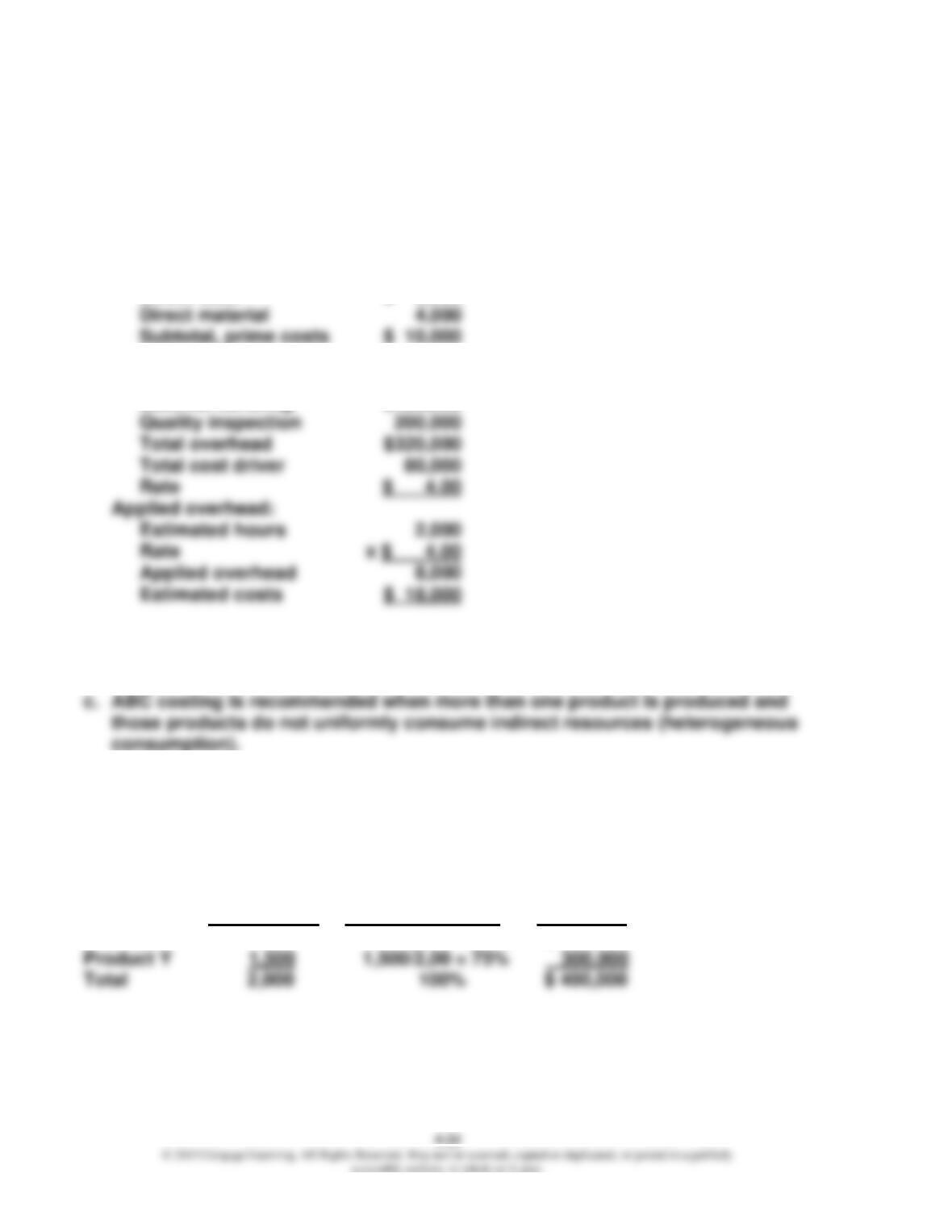
These are allocation rates used to assign the overhead costs to the two activities:
Setting up equipment: $300,000 × 0.29 = $87,000
The product cost using the two activity drivers with these assigned activity costs:
Model X Model Y
Setting up equipment:
$580 × 100 …………………….. $ 58,000
CPA-TYPE EXERCISES
Exercise 4.23
d. The estimated product cost is equal to the sum of prime costs and applied
overhead or 18,000.
Prime costs are the sum of direct labor and direct material:
Direct labor $ 6,000
Applied overhead is equal to the overhead rate times the estimated hours:
Computations of rate – total overhead:
Material handling $120,000
Exercise 4.24
Exercise 4-25
a. The setup hours are used because neither quantity produced nor direct manu-
facturing hours are activities. The calculation is as follows:
Setup Hours % of Setup Hours Allocation
Product X 500 500/2,000 = 25% $ 100,000
4-25
Exercise 4.26
Exercise 4.27
a. Using machine hours assigns five times more of the setup and inspection
costs to the regular mowers relative to the deluxe mowers. Yet, when com-
4-26
PROBLEMS
Problem 4.28
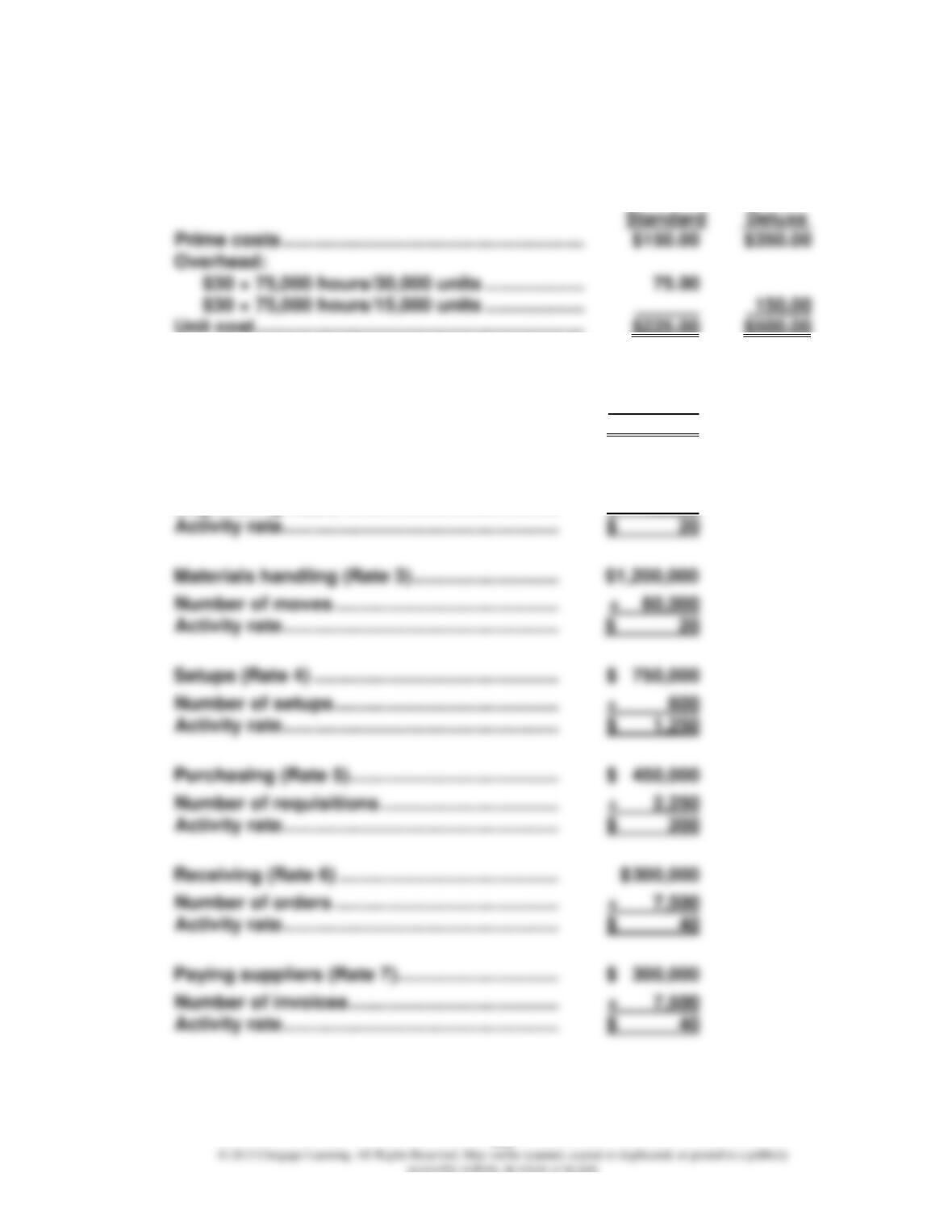
1. Rate = $1,536,000/768,000 = $2 per direct labor hour
2. Department 1 = $384,000/640,000 = $0.60 per direct labor hour
3. Total applied overhead = $ 1,605,120 (from Requirement 2)
4. Cost of Goods Sold …………………………………….. 26,880
Overhead Control ……………………………….. 26,880
4-27
Problem 4.29
1. Plantwide rate = $4,500,000/150,000
= $30 per direct labor hour
2. Maintenance (Rate 1) ………………………………. $ 600,000
Maintenance hours …………………………………. ÷ 30,000
Activity rate …………………………………………….. $ 20
Engineering support (Rate 2) …………………… $ 900,000
Engineering hours ………………………………….. ÷ 45,000
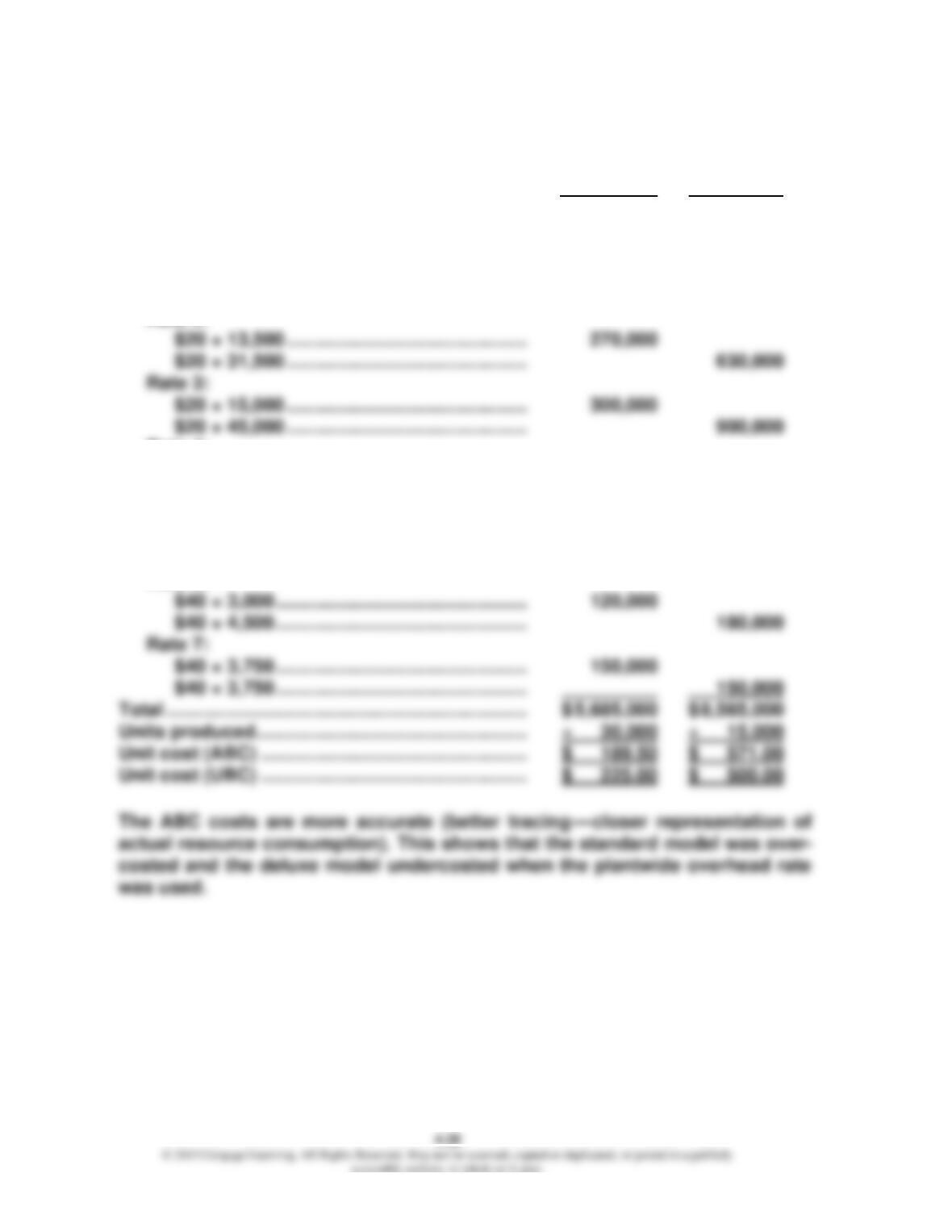
Problem 4.29 (Concluded)
Unit cost:
Standard Deluxe
Prime costs …………………………………………………. $ 4,500,000 $ 5,250,000
Overhead:
Rate 1:
$20 × 6,000 ………………………………………… 120,000
$20 × 24,000 ………………………………………. 480,000
Rate 2:
Rate 4:
$1,250 × 60 ………………………………………… 75,000
$1,250 × 540 ………………………………………. 675,000
Rate 5:
$200 × 750 …………………………………………. 150,000
$200 × 1,500 ………………………………………. 300,000
Rate 6:
Problem 4.30
1. Daily rate = $9,900,000/22,500 = $440 per day
2. Activity rates:
Rate 1: Lodging and feeding: $3,300,000/22,500 = $146.67* per patient day
3. Daily rates by patient type:
High severity:
Rate 1: $146.67 × 7,500 ………………….. $ 1,100,025
Rate 2: $70 × 15,000 ………………………. 1,050,000
Rate 3: $20 × 135,000 …………………….. 2,700,000
4-30
Problem 4.30 (Concluded)
4. First, we would need to determine if treatment defines more than one product,
just as patient severity defined different products for daily care. There proba-
bly is a similar classification for bypass surgery—defined by things such as
5. The results for this problem clearly indicate that ABC can be useful for ser-
vice industries. Service organizations have multiple products and product
Problem 4.31
1. Activity rates:
Providing ATM service: $100,000/200,000 = $0.50 per transaction
4-31
Problem 4.31 (Continued)
2. Product costing:
$0.50 × 180,000 …………… $ 90,000
$0.40 × 2,000,000 ………… 800,000
$0.40 × 300,000 …………… 120,000
Issuing statements:
$1.60 × 50,000 …………….. 80,000
$0.60 × 350,000 …………… 210,000
$0.60 × 160,000 …………… 96,000
Total cost ……………………….. $ 1,580,000 $214,000 $466,000
3. The revenues received are the interest earned plus the service charges (4% ×
average balance + $60 per year, where appropriate). The expenses are the
interest paid plus the activity charges computed in Requirement 2 [2% ×
average balance (where appropriate) plus $52.67]. The profitability of each
category is computed below for the average balance of each category:
Account Categories
Average balance …………. $ 400 $ 750 $ 2,000 $ 5,000
Revenues …………………… $ 76.00 $ 90.00 $ 80.00 $ 200.00
4-32
Problem 4.31 (Concluded)
Accounts with a balance between $1,000 and $2,767 are not profitable. Since
the increase in dollar volume came from this category, the decision to modify
Problem 4.32
1. Overhead rate = $6,990,000/272,500 = $25.65* per direct labor hour
Overhead assignment:
Part 127: $25.65 × 250,000/500,000 = $12.83* per unit