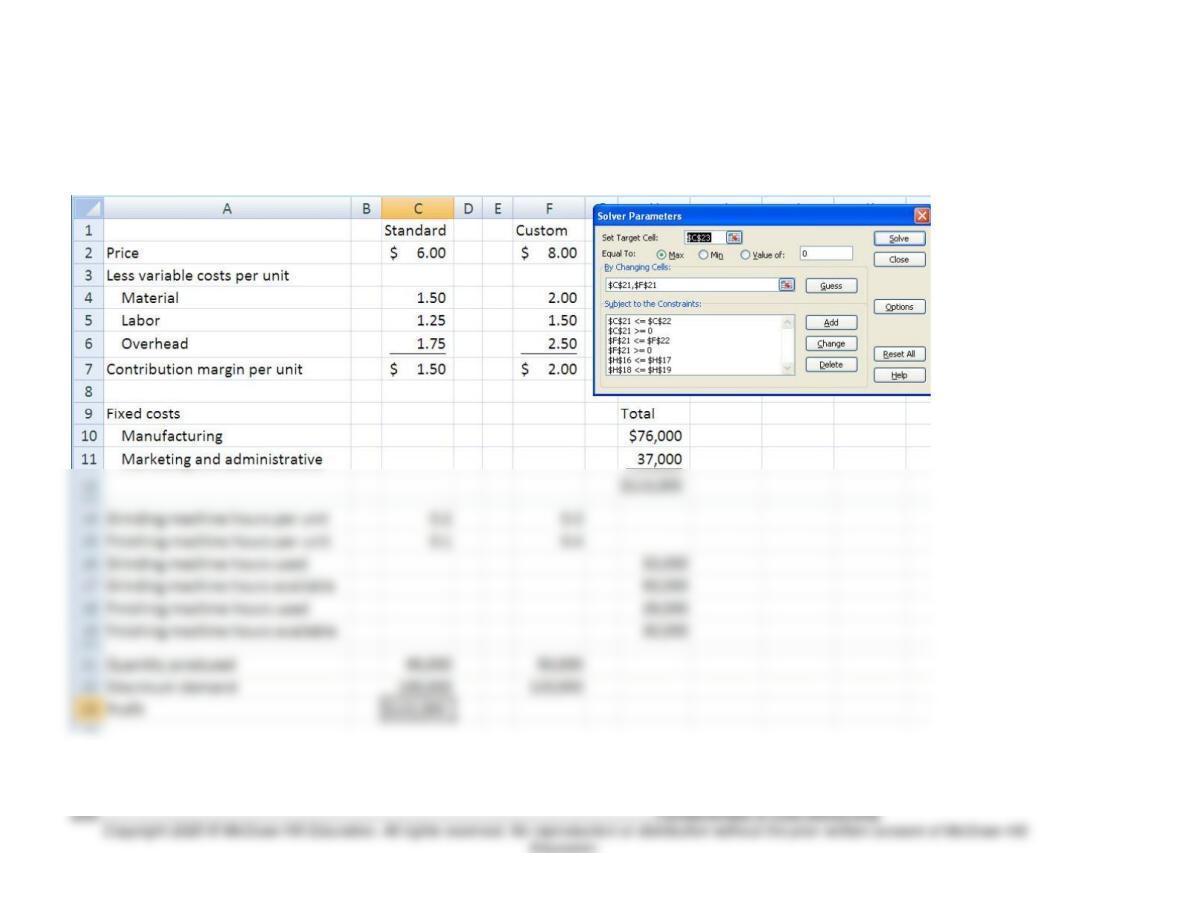
4-74. (continued)
(i) Setup of Excel Solver:
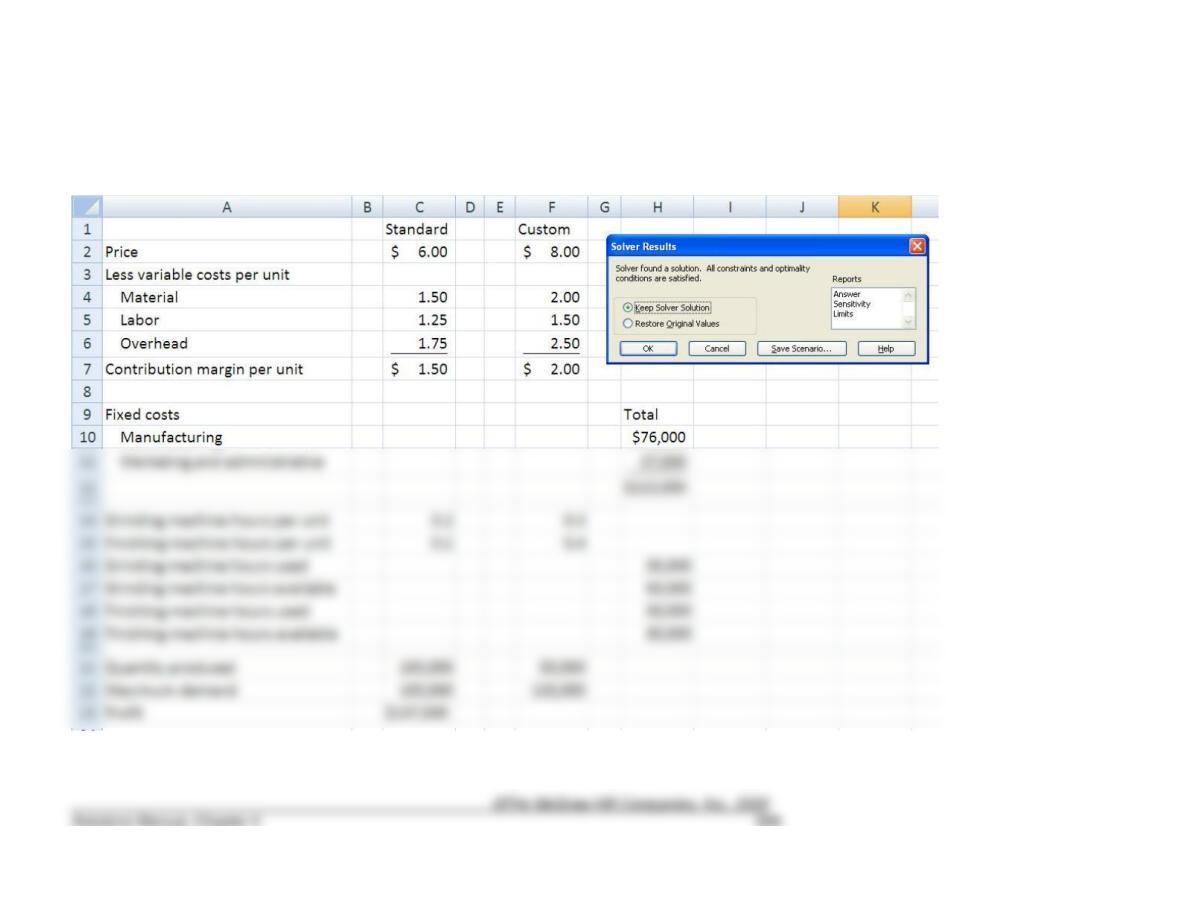
4-74. (continued)
(ii) Solution to problem:
4-75. (30 min.) Theory of Constraints: Clarke Corporation.
a. 300,000 units of X-1, 48,000 units of X-2, and 20,000 units of X-3.
Because the machine is a bottleneck, we calculate the contribution margin per hour on
the machine for each of the products:
X-1
X-2
X-3
Price ……………………………………………….
$100
$200
$400
Variable cost …………………………………….
Contribution margin per unit ……………….
$160
Contribution margin per machine hour …
Based on the contribution margins per hour, Clarke should produce all X–1’s (to
maximum demand), then X-3’s, and finally X–2’s.
Production
Capacity Used
(machine-hours)
Capacity Available
(machine-hours)
No production ..
500,000
(Given)
(= 300,000 1.0)
200,000
20,000 X-3 …….
(= 20,000 4.0)
120,000
48,000 X-2 …….
(= 48,000 2.5)
– 0 –
d. 755,000 machine hours. At the maximum demands for each product, the total
machine hours used are:
(300,000 1.0 + 150,000 2.5 + 20,000 4.0) = 755,000.
4-76. (30 min.) Theory of Constraints: Clarke Corporation.
a. $2,960,000.
First, solve for the optimal production schedule as in Problem 4-75. Because the
machine is a bottleneck, we calculate the contribution margin per hour on the machine
for each of the products:
X-1
X-2
X-3
Price ………………………………………………..
$100
$200
$400
Variable cost …………………………………….
50
120
240
Contribution margin per unit ………………..
$50
$80
$160
Machine hours per unit ………………………
1.0
1.6
4.0
Contribution margin per machine hour ….
$50
$50
$40
No production ..
500,000
(Given)
300,000 X-1 …..
300,000
(= 300,000 1.0)
200,000
(= 500,000 – 300,000)
(= 125,000 1.6)
– 0 –
(= 200,000 – 200,000)
OR
Production
Capacity Used
(machine-hours)
Capacity Available
(machine-hours)
No production ..
500,000
(Given)
150,000 X-2 …..
240,000
(= 150,000 1.6)
260,000
(= 500,000 – 240,000)
260,000 X-1 …..
260,000
(= 260,000 1.0)
– 0 –
(= 260,000 – 260,000)
4-76. (continued)
b. $320,000.
Solving for the optimal production schedule as in part a, we have:
X-1
X-2
X-3
Price ……………………………………………….
$100.00
$200.00
$400.00
Variable cost …………………………………….
50.00
120.00
240.00
Contribution margin per unit ……………….
$50.00
$80.00
$160.00
Machine hours per unit ………………………
1.0
2.5
3.5
Contribution margin per machine hour …
$50.00
$32.00
$45.71
Based on the contribution margins per hour, Clarke should produce all X-1’s (to
maximum demand), then X-3’s, and finally X–2’s, if there is capacity available.
Production
Capacity Used
(machine-hours)
Capacity Available
(machine-hours)
No production ..
500,000
(Given)
(= 300,000 1.0)
20,000 X-3 …….
(= 20,000 3.5)
(= 52,000 2.5)
– 0 –
.
4-77. (30 min.) The Effect of Cost Structure on Predatory Pricing: American
Airlines.
a The relation between variable cost and price is important in a predatory pricing case
because there is no rational economic reason for setting price below variable cost (and
losing money on each unit sold) other than to capture market share from a competitor.
Because pricing below variable cost cannot continue indefinitely, the company will
ultimately have to increase the price.
4-78. (120 min.) Make versus Buy: Liquid Chemical Company.
NOTE: Working this case requires knowledge of how to calculate discounted cash
flows.
a The four alternatives are:
• Alternative A: It is the “status quo,” i.e., Liquid Chemical Co. will continue making the
containers and performing maintenance.
b. The incremental cash flow analyses were conducted assuming a five-year time
horizon. The detailed cash flow analyses for Alternatives A, B, C, and D as well as
more detailed information on the calculations are shown on pages 218-225 below.
General considerations for the incremental cash flows are provided below.
• All cash flows occur at the end of the year.
• The last day of Year 0 is when the decision on the alternatives is made. It can also be
considered the first day of Year 1.
• The company has an after-tax cost of capital of 10% per year and uses an income tax
rate of 40% for decisions like this.
4-78. (continued)
Alternative A
Alternative B
Alternative C
Alternative D
Make
Containers;
Perform
Maintenance
Make
Containers; Buy
Maintenance
Buy Containers;
Perform
Maintenance
Buy Containers;
Buy
Maintenance
c. Although Alternative C seems to be the more attractive, its net present value is not
significantly different from the net present values of Alternatives A and D. This situation
requires a careful examination of facts and assumptions made. A brief discussion of
some points that should be reevaluated, as well as additional information that should
be taken into account, is presented below.
Administrative Overhead: A proportion of general administrative overhead is allocated
to the container department. Is this cost proportional to the number of employees in the
container department? Apparently the answer is yes, and in this case it is not the best
estimate because it is not considering the real administrative resources consumed by
the container department.
4-78. (continued)
Incremental Cash Flow – Alternative A
Make Containers and Perform Maintenance
Year of Operation
0
1
2
3
4
5
Buy GHL
$(240,000)
Tax savings on purchase (40%)
$96,000
Cash flow on purchase
$(144,000)
Other materials
$(500,000)
$(500,000)
$(500,000)
$(500,000)
$(500,000)
Labor: Supervisor
(50,000)
(50,000)
(50,000)
(50,000)
(50,000)
Labor: Workers
(450,000)
(450,000)
(450,000)
(450,000)
(450,000)
Rent: Warehouse
(85,000)
(85,000)
(85,000)
(85,000)
(85,000)
Maintenance
(36,000)
(36,000)
(36,000)
(36,000)
(36,000)
Other expenses
(157,500)
(157,500)
(157,500)
(157,500)
(157,500)
Manager’s salary
(80,000)
(80,000)
(80,000)
(80,000)
(80,000)
Total costs
Tax savings (40%)
Cash flow due to costs
$(815,100)
$(815,100)
$(815,100)
$(815,100)
$(815,100)
Tax effects of depreciation
60,000
60,000
60,000
60,000
Tax effect of GHL costs
Total cash flow
$(675,100)
$(675,100)
$(675,100)
$(675,100)
$(959,100)
Discount rate factor (10%)
1.0000
Present value
$(613,727)
$(557,934)
$(507,213)
$(461,102)
$(595,526)
4-78. (continued)
Considerations (Alternative A):
• Under this alternative, GHL consumption is 40 tons per year. At the end of Year 4 the GHL stock is zero, and a
purchase of 40 tons is necessary. At that time, the price will be $6,000 per ton.
• There is no cash outflow due to GHL consumption from Year 1 to Year 4, just “accounting” expenses because the
product is in stock. Due to these GHL expenses, there is tax savings of $80,000 per year (= 40 tons $5,000/ton
X 40%) from Year 1 to Year 4.
4-78. (continued)
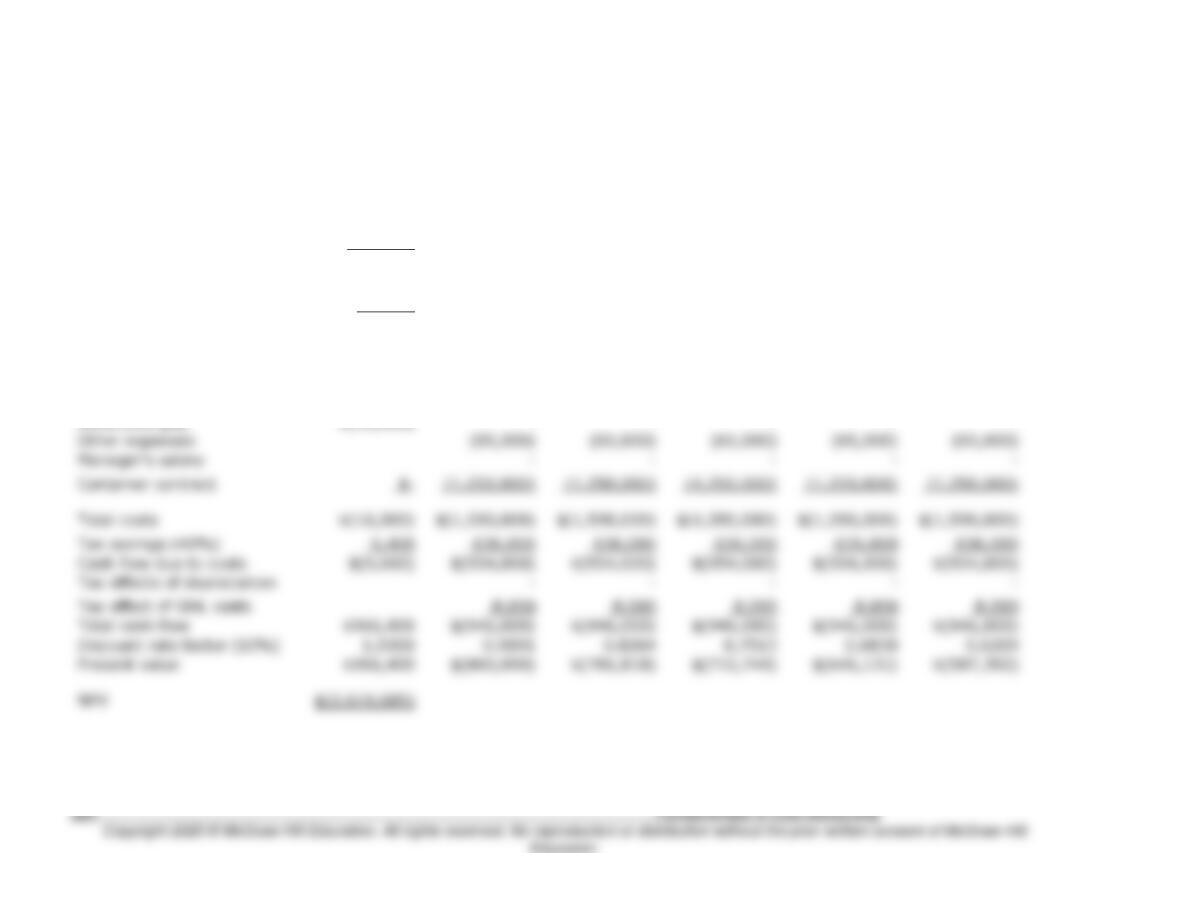
Incremental Cash Flow – Alternative B
Make Containers and Buy Maintenance
Year of Operation
0
1
2
3
4
5
Buy GHL
$(120,000)
Tax savings on purchase (40%)
$48,000
Cash flow on purchase
$(72,000)
Other materials
$(450,000)
$(450,000)
$(450,000)
$(450,000)
$(450,000)
Labor: Supervisor
(50,000)
(50,000)
(50,000)
(50,000)
(50,000)
Labor: Workers
(360,000)
(360,000)
(360,000)
(360,000)
(360,000)
Rent: Warehouse
(85,000)
(85,000)
(85,000)
(85,000)
(85,000)
Maintenance
(36,000)
(36,000)
(36,000)
(36,000)
(36,000)
Other expenses
(92,500)
(92,500)
(92,500)
(92,500)
(92,500)
Manager’s salary
(80,000)
(80,000)
(80,000)
(80,000)
(80,000)
Maintenance contract
Total costs
$(1,528,500)
$(1,528,500)
$(1,528,500)
$(1,528,500)
$(1,528,500)
Tax savings (40%)
611,400
611,400
611,400
611,400
611,400
Cash flow due to costs
$(917,100)
$(917,100)
$(917,100)
$(917,100)
$(917,100)
Tax effects of depreciation
60,000
60,000
60,000
60,000
Tax effect of GHL costs
Total cash flow
$(785,100)
$(785,100)
$(785,100)
$(785,100)
$(957,100)
Discount rate factor (10%)
Present value
$(713,727)
$(648,843)
$(589,857)
$(536,234)
$(594,284)
4-78. (continued)
Considerations (Alternative B):
• Under this alternative, GHL consumption is 36 tons per year (= 40 90%). At the end of Year 4 the GHL stock is
16 tons, and a purchase of 20 tons is necessary. At that time, the price will be $6,000 per ton.
• Due to lower GHL consumption, during Year 5 there is still an “accounting” expense of $80,000 (= 16 tons
$5,000/ton). It will generate tax savings of $32,000 (= $80,000 40%) at Year 5.
4-78. (continued)
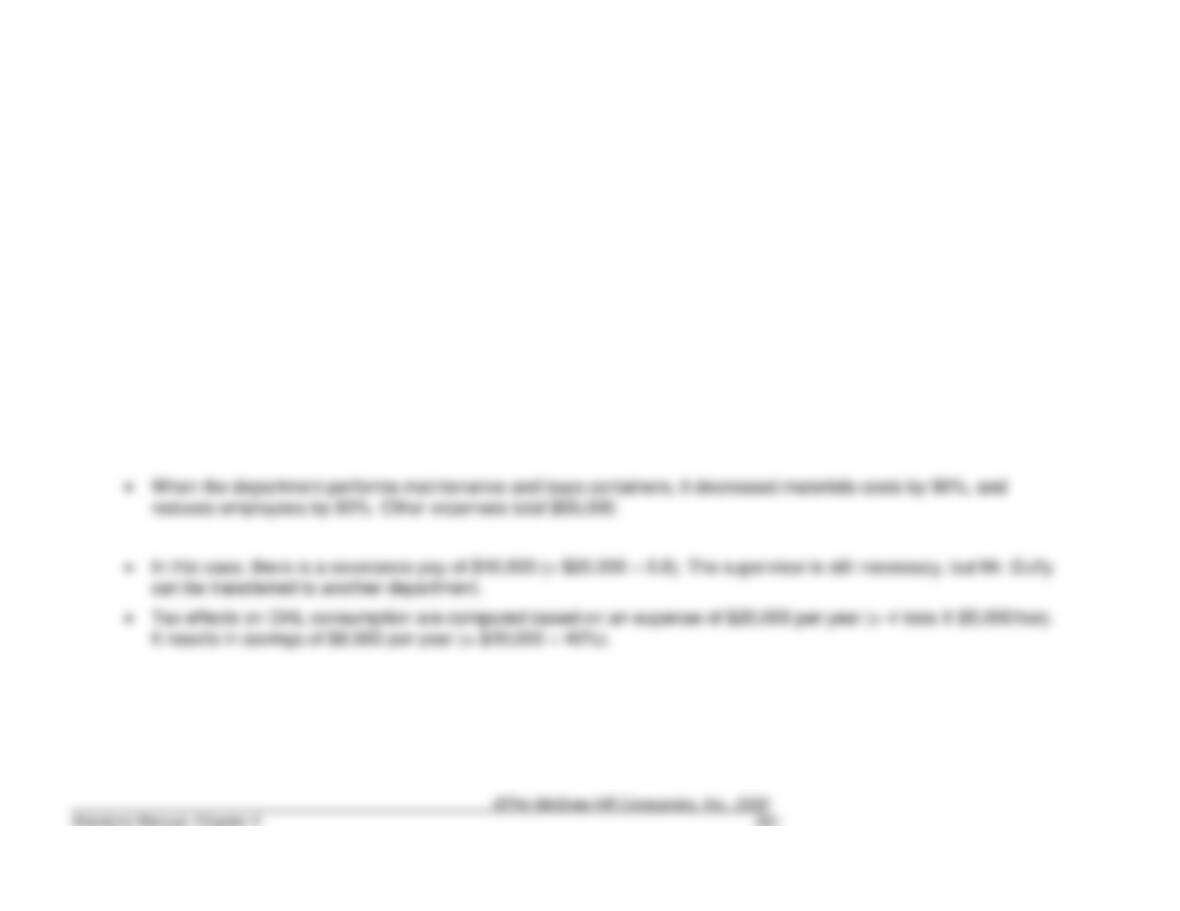
Incremental Cash Flow – Alternative C
Buy Containers and Perform Maintenance
Year of Operation
0
1
2
3
4
5
Sell machinery
$200,000
Tax savings on sale (40%)
160,000
Cash flow on sale
$360,000
Sell GHL
$560,000
Tax savings on sale (40%)
56,000
Cash flow on sale
$616,000
Other materials
$(50,000)
$(50,000)
$(50,000)
$(50,000)
$(50,000)
Labor: Supervisor
(50,000)
(50,000)
(50,000)
(50,000)
(50,000)
Labor: Workers
(90,000)
(90,000)
(90,000)
(90,000)
(90,000)
Rent: Warehouse
(85,000)
(85,000)
(85,000)
(85,000)
(85,000)
Severance pay
$(16,000)
Other expenses
(65,000)
(65,000)
(65,000)
(65,000)
(65,000)
Manager’s salary
Container contract
Total costs
$(16,000)
Tax savings (40%)
636,000
636,000
636,000
636,000
636,000
Cash flow due to costs
$(9,600)
Tax effects of depreciation
Tax effect of GHL costs
Total cash flow
$966,400
Discount rate factor (10%)
1.0000
0.9091
0.8264
0.7513
0.6830
0.6209
Present value
$966,400
4-78. (continued)
Considerations (Alternative C):
• Under this alternative, GHL consumption is 4 tons per year (40 10%), or 20 tons over five years. Therefore,
Liquid Chemical can sell 140 tons (= 160 – 20) at the end of Year 0 at $4,000 per ton.
Market Price = $560,000; Loss on Sale = $140,000
Book Value = $700,000 ; Tax Savings on Sale = $ 56,000
• Machinery is not necessary for maintenance, and can also be sold at the end of Year 0.
Market Price = $200,000 ; Loss on Sale = $400,000
Book Value = $600,000 ; Tax Savings on Sale = $160,000
4-78. (continued)
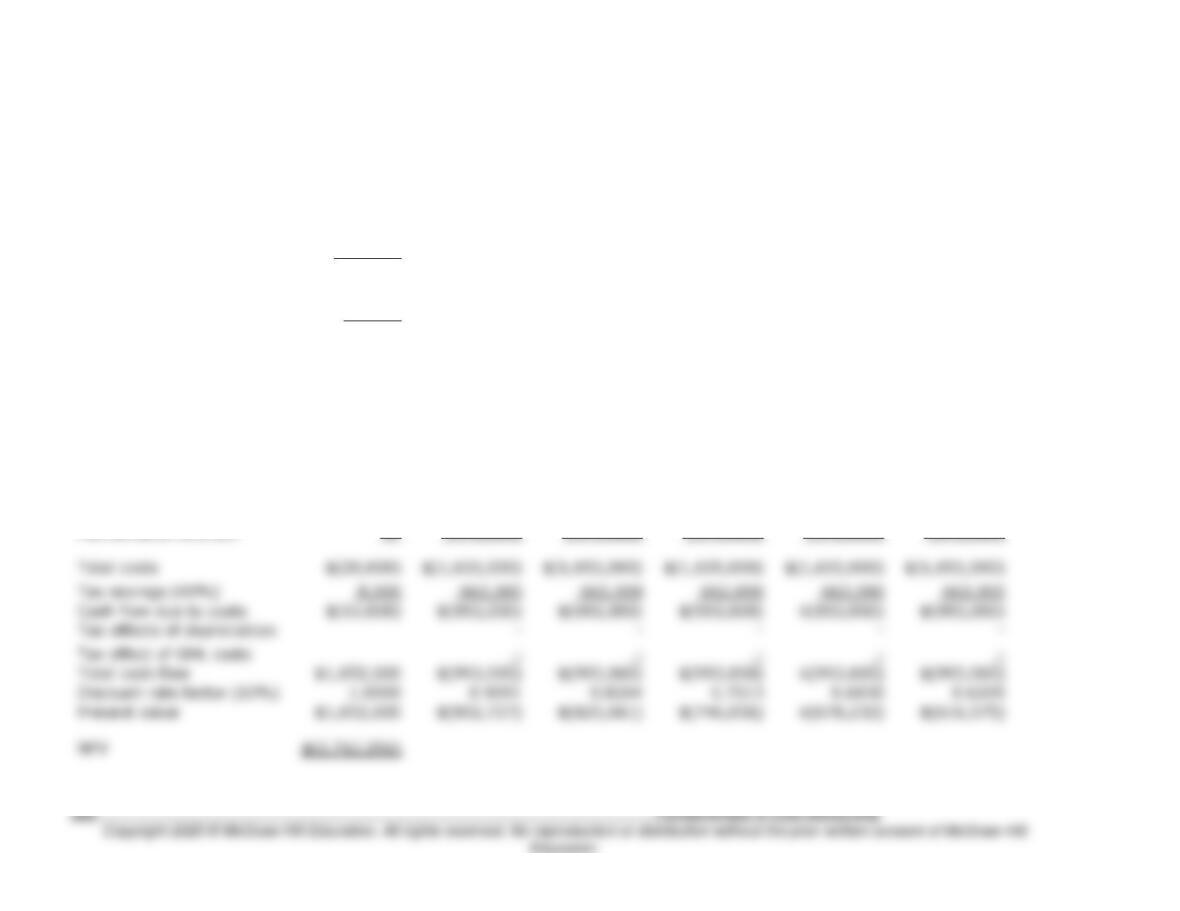
Incremental Cash Flow – Alternative D
Buy Containers and Buy Maintenance
Year of Operation
0
1
2
3
4
5
Sell machinery
$200,000
Tax savings on sale
160,000
Cash flow on sale
$360,000
Sell GHL
$640,000
Tax savings on sale (40%)
64,000
Cash flow on sale
$704,000
Other materials
$-
$-
$-
$-
$-
Labor: Supervisor
–
–
–
–
–
Labor: Workers
–
–
–
–
–
Rent: Warehouse
–
–
–
–
–
Severance pay
$(20,000)
–
–
–
–
–
Pension
(30,000)
(30,000)
(30,000)
(30,000)
(30,000)
Other expenses
–
–
–
–
–
Manager’s salary
–
–
–
–
–
Container contract
(1,250,000)
(1,250,000)
(1,250,000)
(1,250,000)
(1,250,000)
Maintenance contract
$-
(375,000)
(375,000)
(375,000)
(375,000)
(375,000)
Total costs
Tax savings (40%)
662,000
662,000
662,000
662,000
662,000
Cash flow due to costs
$(12,000)
Tax effects of depreciation
–
–
–
–
–
Tax effect of GHL costs
–
–
–
–
–
Total cash flow
Discount rate factor (10%)
1.0000
0.9091
0.8264
0.7513
0.6830
0.6209
Present value
4-78. (continued)
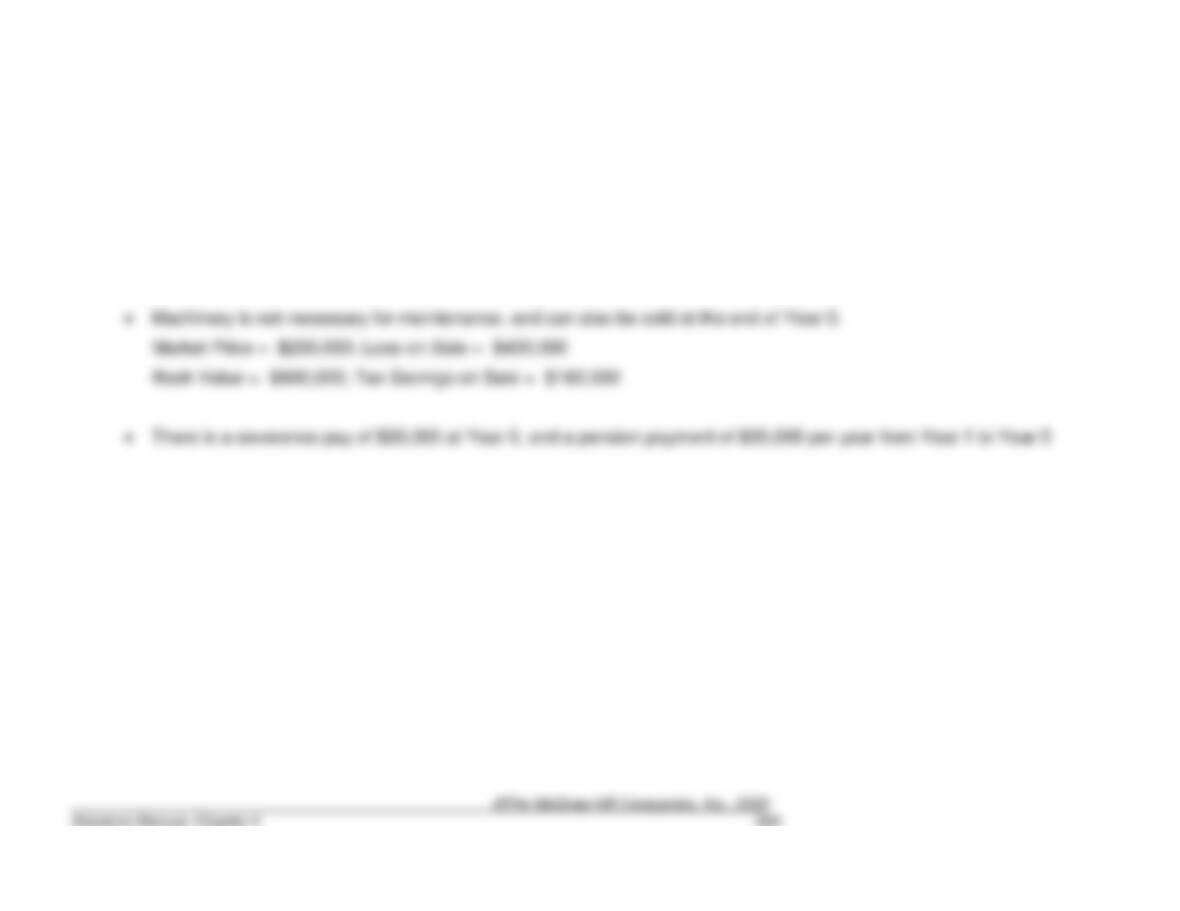
Considerations (Alternative D):
• Under this alternative, there is no GHL consumption. Therefore, Liquid Chemical can sell 160 tons at the end of
Year 0 at $4,000 per ton.
Market Price = $640,000 ; Loss on Sale = $160,000
Book Value = $800,000 ; Tax Savings on Sale = $64,000