Chapter 4
Cost-Volume-Profit Analysis
QUESTIONS
1. A mixed cost is a cost that has a fixed cost component and a variable cost
2. Discretionary fixed costs are those fixed costs that management can easily change
4. Rent and insurance expenses are examples of fixed costs.
5. Salespersons are paid a base salary plus commissions. The base amount is fixed
6. With account analysis, managers use judgment to classify costs as either fixed or
8. The contribution margin is equal to the sales minus variable costs. The contribution
9. It would not be appropriate to focus on weighted average contribution margin per
10. Companies that have relatively higher fixed costs are said to have higher operating
leverage. Thus, a software company with a large investment in research and
Jiambalvo Managerial Accounting
4-2
EXERCISES
E1. [LO 3]
a. As sales declines, variable costs will be reduced as well. Fixed costs, however,
will remain constant. If a large portion of costs in the cost structure are fixed, the
b. John can turn fixed costs into variable costs by outsourcing. As an example, he
E2. [LO 2]
Oakland Hills Golf Course is more likely to focus on contribution margin per unit in
E3. [LO 2]
Cost per pound = $4
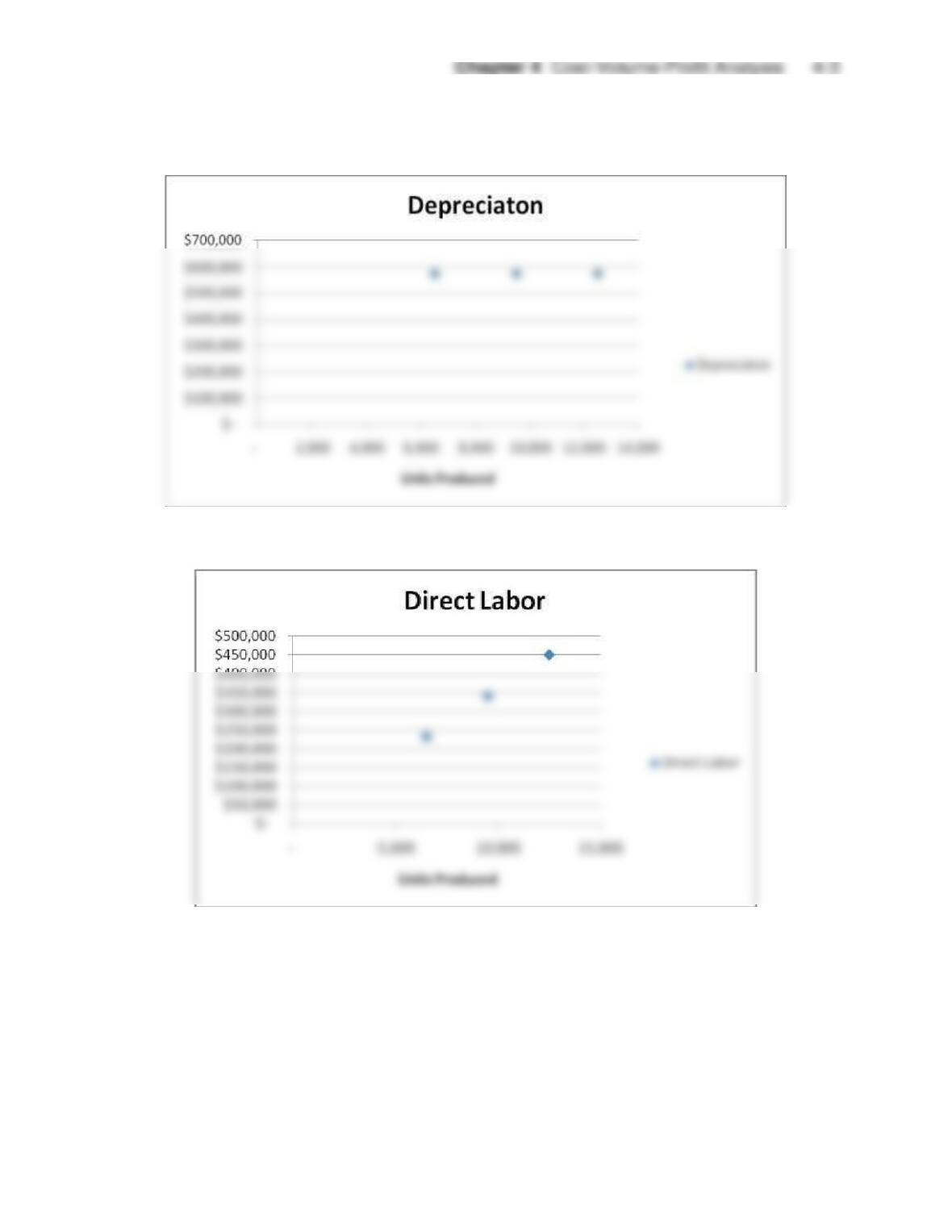
E4. [LO 1]
Depreciation appears to be a fixed cost.
Direct labor appears to be a variable cost.
Jiambalvo Managerial Accounting
4-4
E5. [LO 1]
E6. [LO 1 and Appendix]
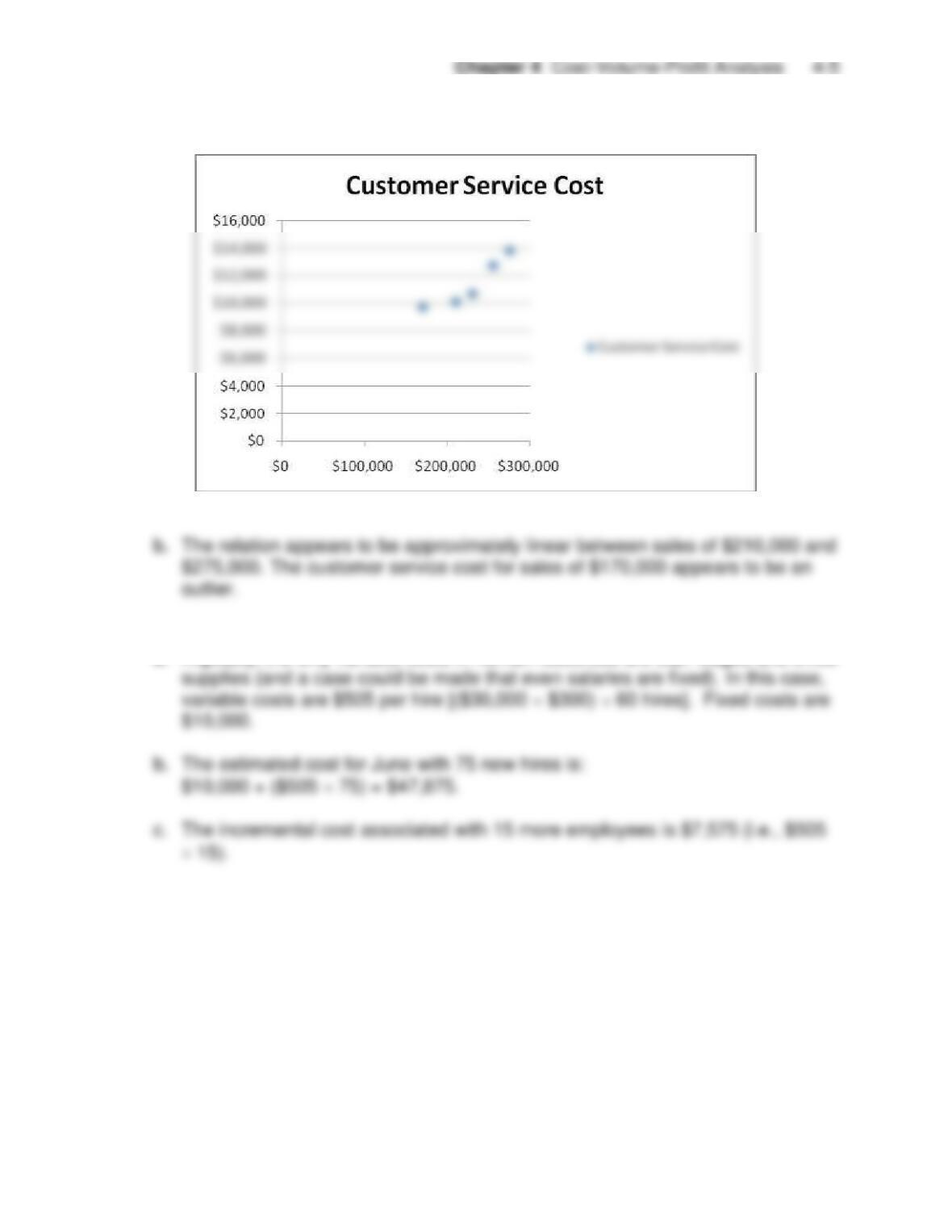
a. The highest level of activity is sales of 35,000 tickets with cost of $240,000. The
lowest level of activity is sales of 19,000 tickets with cost of $160,000.
E7. [LO 1]
a.
Sales
E8. [LO 1]
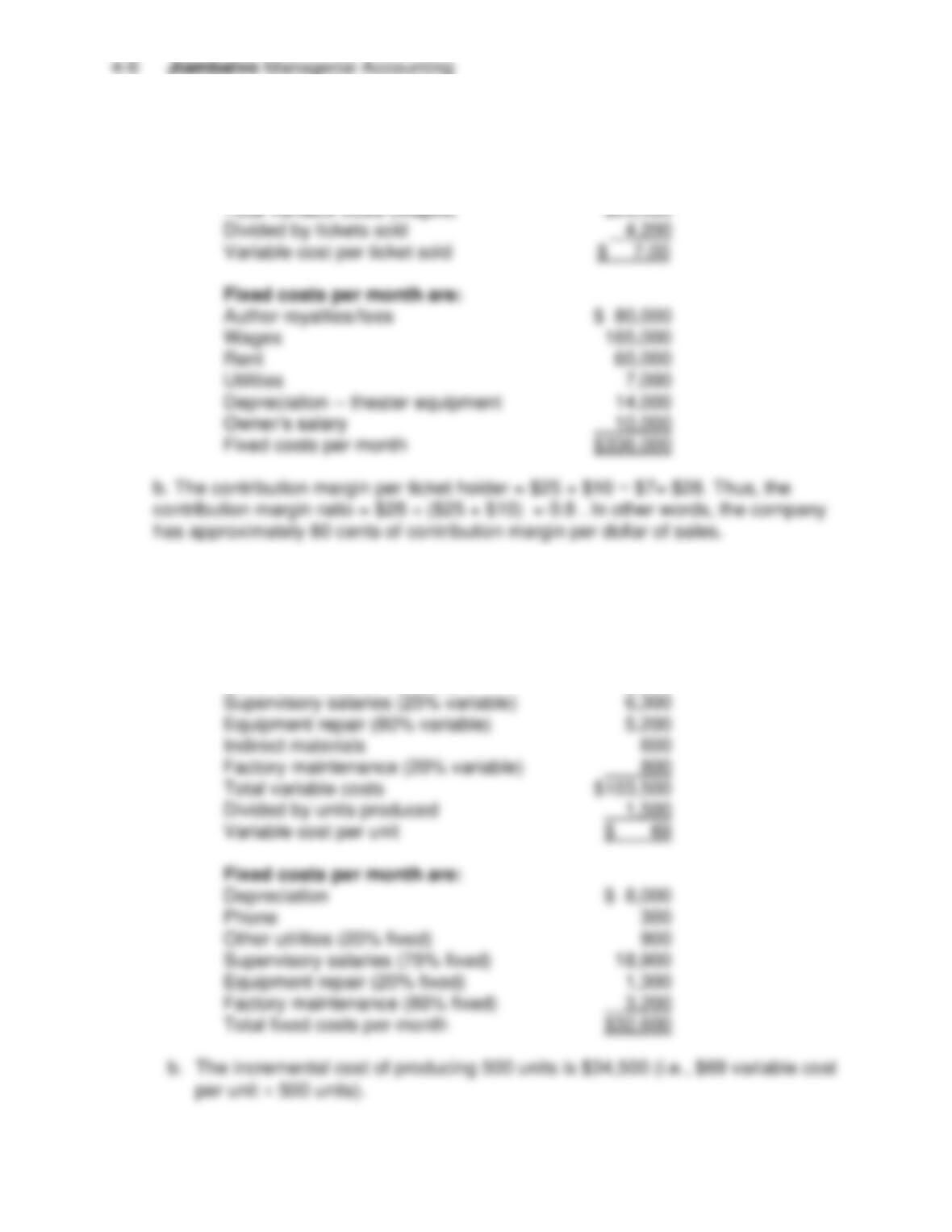
a. Arguably, the only variable costs in human resources are staff wages and office
E9. [LO 1, 2]
a. The only variable cost is food and beverages. Thus, variable costs per ticket
sold are:
E10. [LO 1]
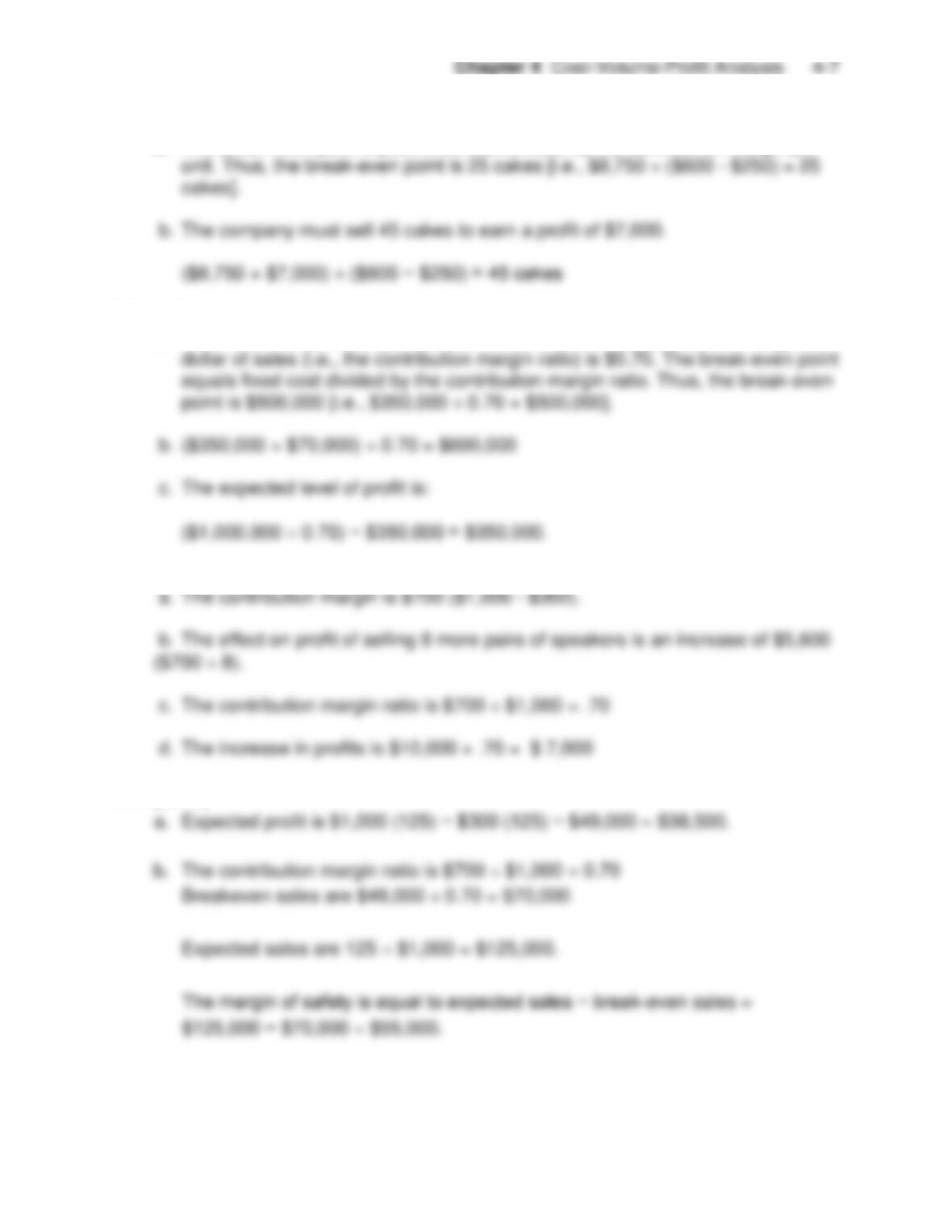
a. Variable costs are:
Material $ 63,000
Direct labor 24,000
Other utilities (80% variable) 3,600
E11. [LO 2]
a. The break-even point equals fixed cost divided by the contribution margin per
E12. [LO 2]
a. Given that variable cost per dollar of sales is $0.30, the contribution margin per
E13. [LO 2]
E14. [LO 2]
Jiambalvo Managerial Accounting
4-8
E15. [LO 2]
E16. [LO 2]
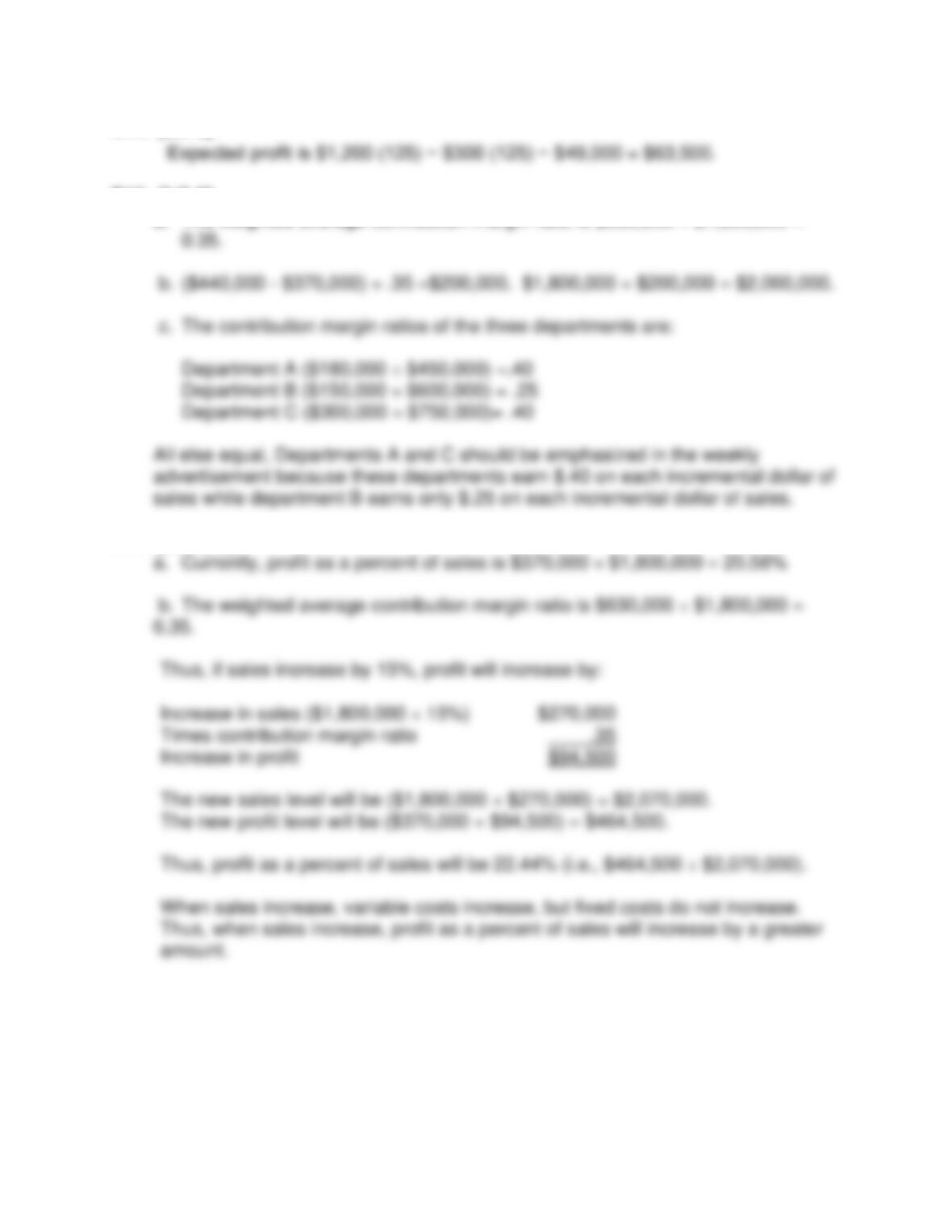
a. The weighted average contribution margin ratio is $630,000 ÷ $1,800,000 =
E17. [LO 2, 3]
E18. [LO 3]
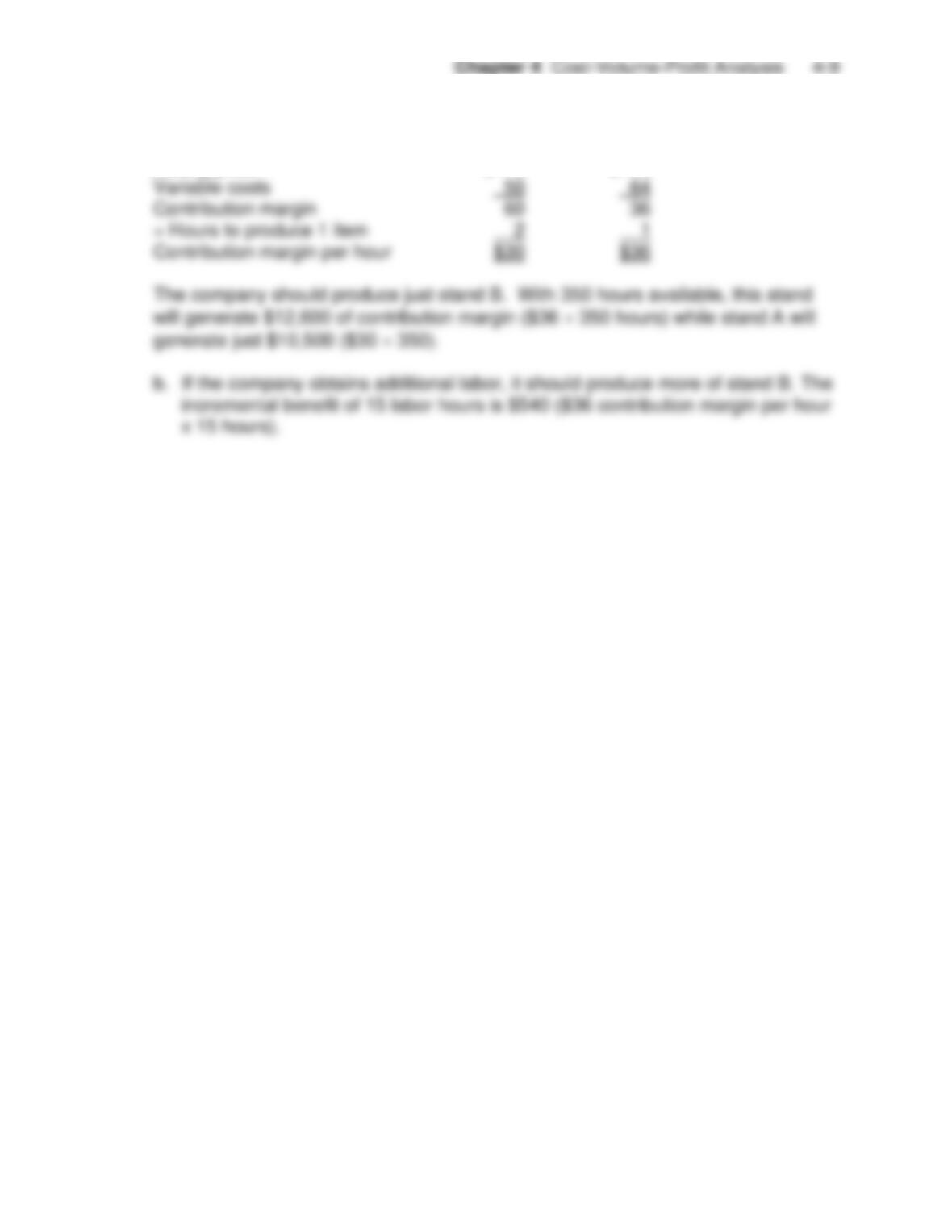
a. Stand A Stand B
Selling price $110 $100
Jiambalvo Managerial Accounting
4-10
PROBLEMS
P1. [LO 1]
a. Depreciation of the building—fixed
b. Salaries of restaurant staff—mixed (a minimum number is required in slow
P2. [LO 1, 2]
a. Variable costs
Component costs $71,000
Supplies 2,500
Fixed costs
Rent $2,300
P3. [LO 1, 2]
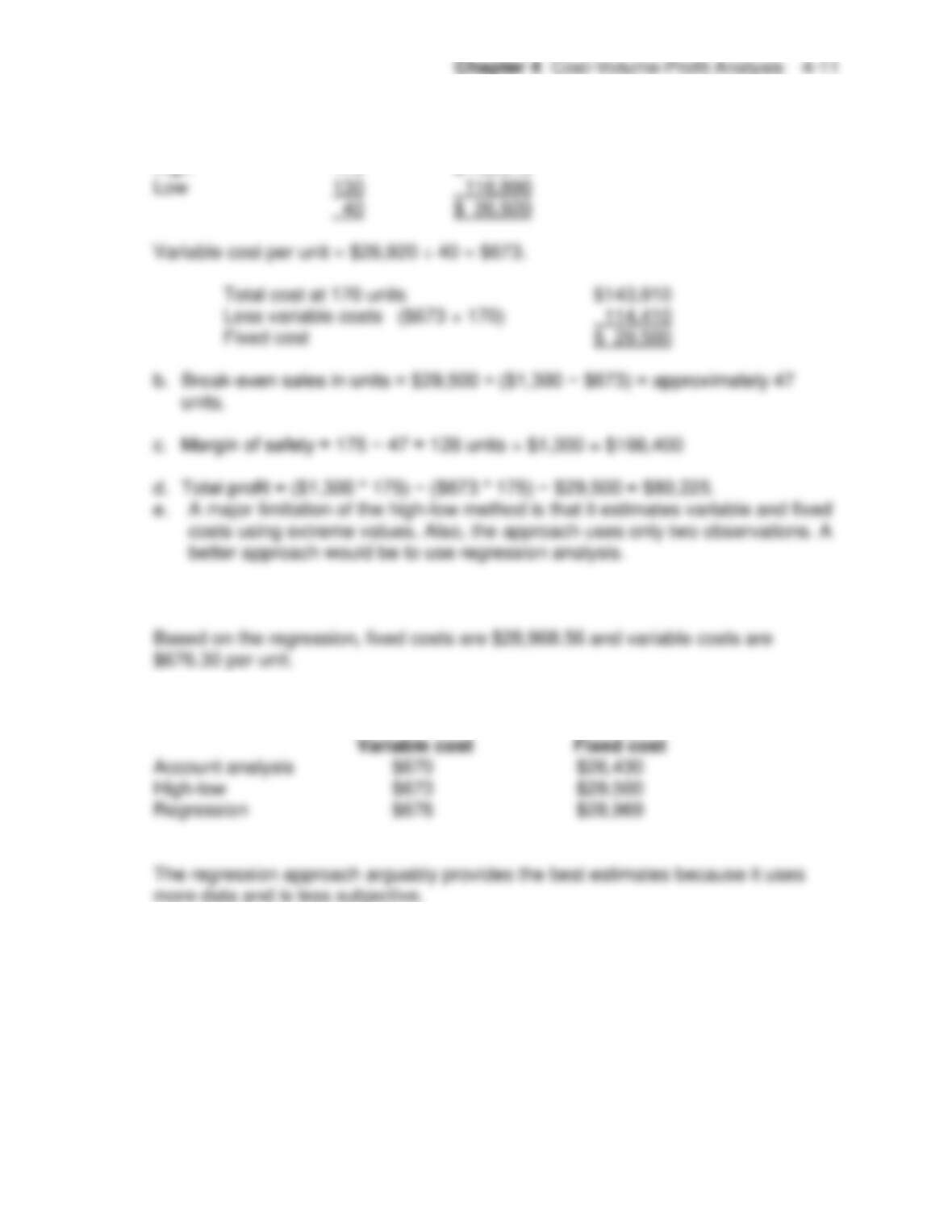
a. Production Cost
High 170 $143,910
P4. [LO 1, Appendix]
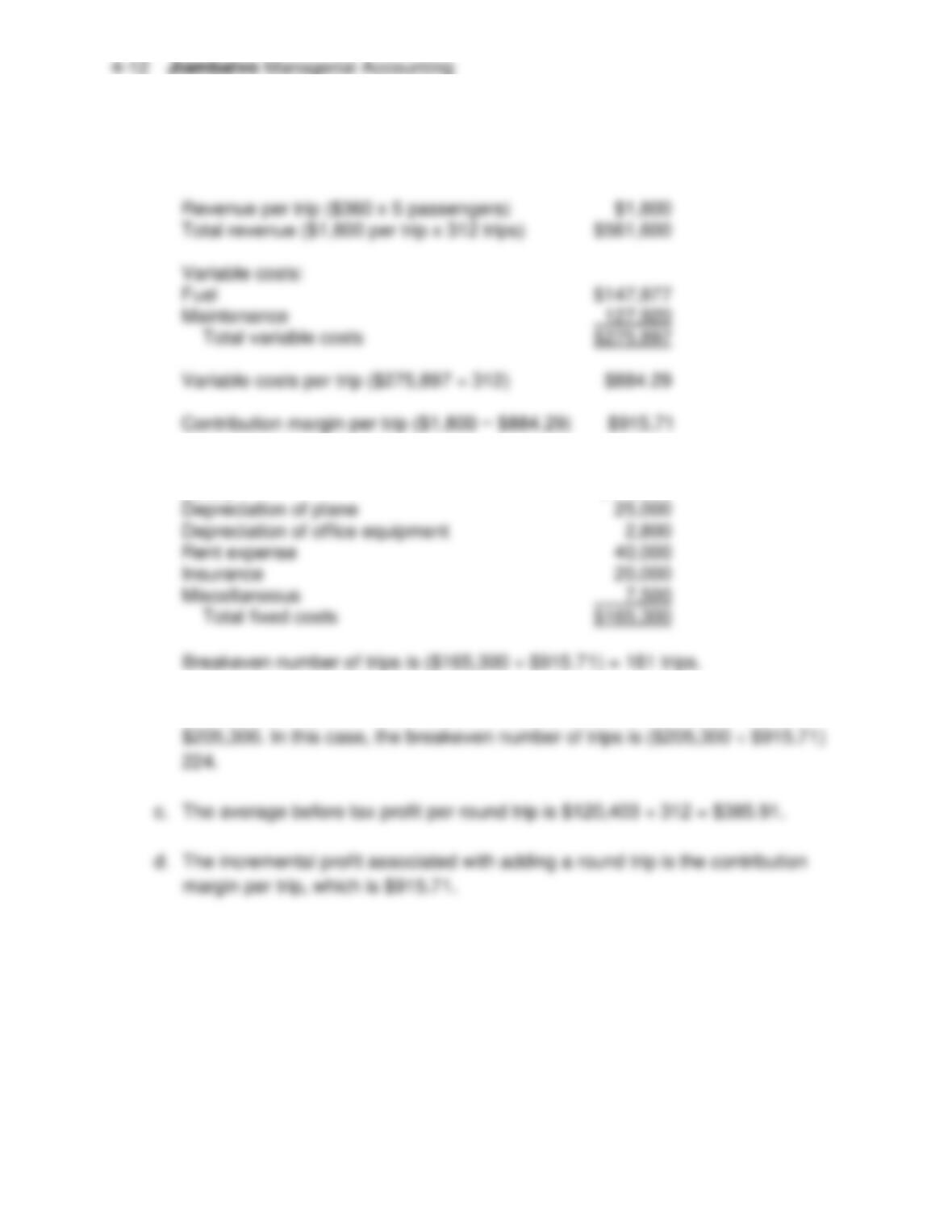
b. Comparison of estimates:
P5. [LO 2]
a. Number of trips
(6 per week × 52 weeks) 312
Fixed costs:
Salary $ 70,000
b. If Michael draws a salary of $110,000, fixed costs will increase by $40,000 to
P6. [LO 1, 2]
a. Account Analysis
Fixed cost per month (April data)
Day manager salary $ 4,500
b. High-Low Method
P7. [LO 1, 2]
a. Income will only be proportional to sales if all costs are variable. That
Jiambalvo Managerial Accounting
4-14
P8. [LO 1, 2]
Sales
$1,600,000
$1,700,000
$1,800,000
$1,900,000
$2,000,000
Less cost of
components
960,000
1,016,000
1,064,000
1,112,000
1,160,000
Gross margin
640,000
684,000
736,000
788,000
840,000
P9. [LO 1]
a. Production costs:
($112,978 − $83,007) ÷ (138 – 97) = $731 variable cost per unit
b. Sales (1,650 units × $900) $1,485,000
Less:
280,000
280,000
280,000
280,000
Operating profit
Staff bonuses
120,300
Profit before taxes
P10. [LO 1, 2]
a. The high point is July with 310 loans and $55,725 in costs; the low point is
February with 170 loans and $48,550 in costs. To find the variable cost per
loan processed:
Variable cost per loan = Change in cost ÷ Change in loans
b. Contribution margin per loan = $500 – $51.25 = $448.75