CHAPTER 4
Accrual Accounting Concepts
Learning Objectives
1. Explain the revenue recognition principle and the expense recognition principle.
2. Differentiate between the cash basis and the accrual basis of accounting.
3. Explain why adjusting entries are needed, and identify the major types of adjusting entries.
4. Prepare adjusting entries for deferrals.
5. Prepare adjusting entries for accruals.
Summary of Questions by Learning Objectives and
Bloom’s Taxonomy
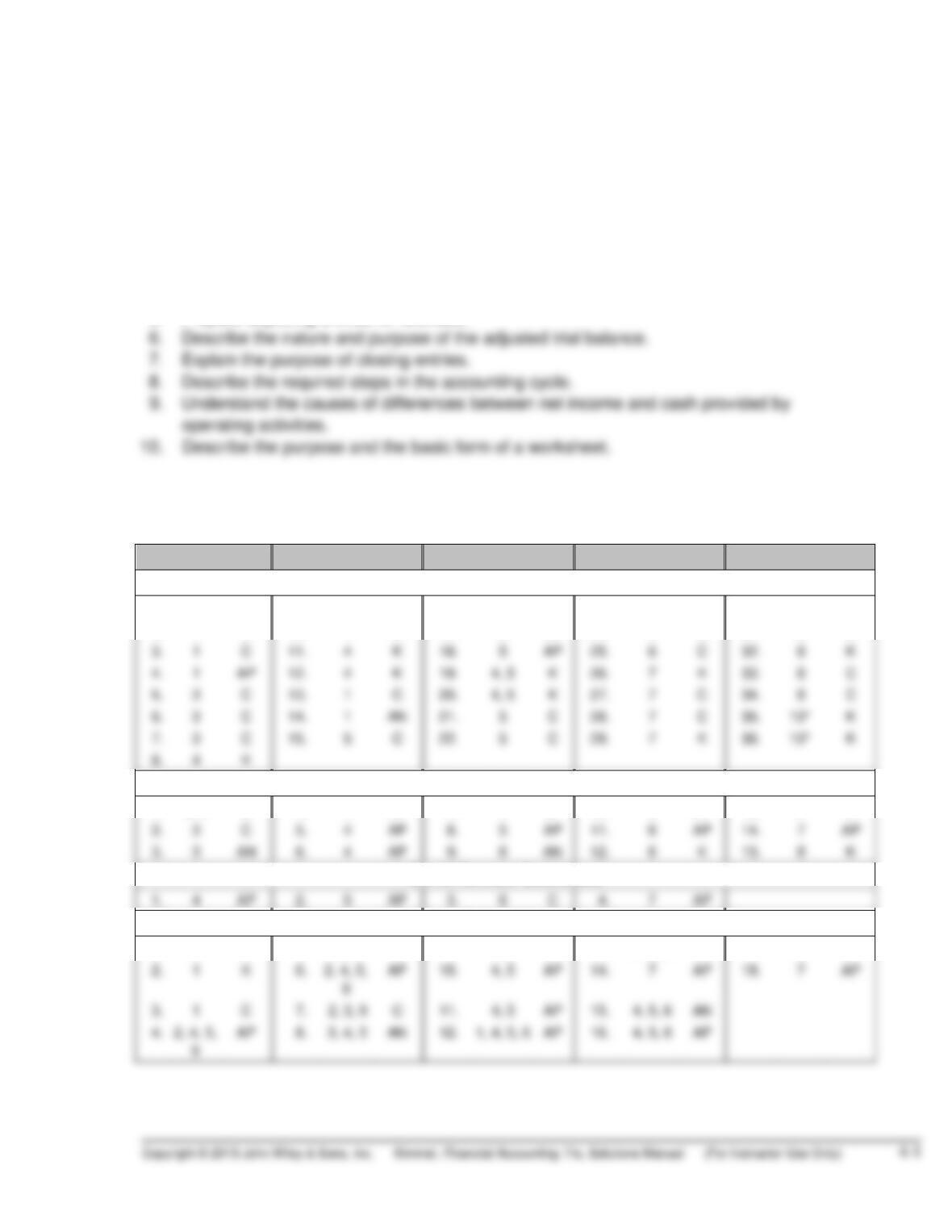
Item LO BT Item LO BT Item LO BT Item LO BT Item LO BT
Questions
1. 1 C 9. 4 C 16. 5 K 23. 6 C 30. 7 K
2. 1 K 10. 4 C 17. 5 AN 24. 2 C 31. 8 K
Brief Exercises
1. 2, 9 C 4. 4 AP 7. 4 AP 10. 6 AP 13. 7 K
Do It! Review Exercises
Exercises
1. 1 C 5. 2, 9 AP 9. 4, 5 AP 13. 1, 4, 5, 6 AN 17. 6 AP
Summary of Questions by Learning Objectives and Bloom’s Taxonomy
(Continued)
Problems: Set A
1. 2, 4,9 AP 3. 4, 5, 6, 7 AP 5. 4, 5 AP 7. 4, 5, 6 AP 8. 4, 5, 6, 7, 8 AP
ASSIGNMENT CHARACTERISTICS TABLE
Problem
Number
Description
Difficulty
Level
Time
Allotted (min.)
1A Record transactions on accrual basis; convert revenue to
cash receipts.
Simple 20–30
2A Prepare adjusting entries, post to ledger accounts, and
prepare adjusted trial balance.
Simple 40–50
1B Record transactions on accrual basis; convert revenue to
cash receipts.
Simple 20–30
2B Prepare adjusting entries, post to ledger accounts, and
prepare an adjusted trial balance.
Simple 40–50
3B Prepare adjusting entries, adjusted trial balance, and
financial statements.
Simple 50–60
4B Prepare adjusting entries and financial statements;
identify accounts to be closed.
Moderate 40–50
ANSWERS TO QUESTIONS
1. (a) Under the periodicity assumption, an accountant is required to determine the effect of
each accounting transaction on a specific accounting period.
2. The two generally accepted accounting principles that pertain to adjusting the accounts are:
The revenue recognition principle, which states that revenue should be recognized in the
3. The law firm should recognize the revenue in April. The revenue recognition principle
4. Expenses of $4,700 should be deducted from the revenues in April. Under the expense
5. No, adjusting entries are required by the revenue and expense recognition principles.
6. The financial information in a trial balance may not be up-to-date because:
7. The two categories of adjusting entries are deferrals and accruals. Deferrals consist of
8. In a prepaid expense adjusting entry, expenses are debited and assets are credited.
9. No. Depreciation is the process of allocating the cost of an asset to expense over its useful
10. Depreciation expense is an expense account whose normal balance is a debit. This
account shows the cost that has expired during the current accounting period.
11. Equipment ……………………………………………………………………… $15,000
Questions Chapter 4 (Continued)
14. This promotion plan sounds like a bad idea for two reasons:
(1) GAAP requires that the sale of a gift card be recorded as Unearned Sales Revenue (a
liability) rather than Sales Revenue. Revenue recognition is delayed until the gift card
15. An asset is debited and a revenue is credited.
18. The entry is:
Jan. 9 Salaries and Wages Expense …………………………………. 5,100
19. (a) Accrued revenues. (d) Accrued expenses or prepaid expenses.
20. (a) Salaries and Wages Payable. (d) Supplies Expense.
21. Disagree. An adjusting entry affects only one balance sheet account and one income
statement account.
22. Tootsie Roll reports Accounts Receivable. This suggests that it records revenue when it
has delivered goods, even though it hasn’t received payment. If it used a cash basis it
25. The amount shown in the adjusted trial balance column for an account equals the account
balance in the ledger after adjusting entries have been journalized and posted.
Questions Chapter 4 (Continued)
26. (1) (Dr) Individual revenue accounts and (Cr) Income Summary.
27. Financial information is used by managers to direct and evaluate a company’s
performance. The sooner such information is made available; the sooner changes can be
28. Income Summary is a temporary account that is used in the closing process. The account
is debited for expenses and credited for revenues. The difference, either net income or net
loss, is then closed to Retained Earnings.
29. The post-closing trial balance contains only balance sheet accounts. Its purpose is to prove the
Quality of earnings indicates the level of full and transparent information that a company
provides to users of financial statements.
34. Examples of ways a company can manage earnings include the following.
Use of “one-time” items to prop up earnings numbers. A company may decide to sell
Recording improper adjusting entries. Some adjusting entries require estimates and
judgment to properly recognize revenue and match expenses. By recognizing revenue
*35. The worksheet is a working paper designed to make it easier to prepare adjusting entries
and financial statements.
SOLUTIONS TO BRIEF EXERCISES
BRIEF EXERCISE 4-1
Cash Net Income
(a)
(b)
$
–
100
0
$0
–20
BRIEF EXERCISE 4-2
(a) Prepaid Insurance—to recognize insurance expired during the
period.
BRIEF EXERCISE 4-3
Item
(1)
Type of Adjustment
(2)
Accounts Before Adjustment
(a) Prepaid Expenses
A
ssets Overstated
Expenses Understated
A
BRIEF EXERCISE 4-4
Dec. 31 Supplies Expense …………………………………….. 7,700
Supplies ……………………………………………. 7,700
Supplies Supplies Expense
BRIEF EXERCISE 4-5
Dec. 31 Depreciation Expense ……………………………….. 2,750
Depreciation Expense
A
ccumulated Depreciation
—
Equipment
12/31 2,750 12/31 2,750
Balance Sheet:
BRIEF EXERCISE 4-6
July 1 Prepaid Insurance …………………………………….. 12,400
Cash ………………………………………………….. 12,400
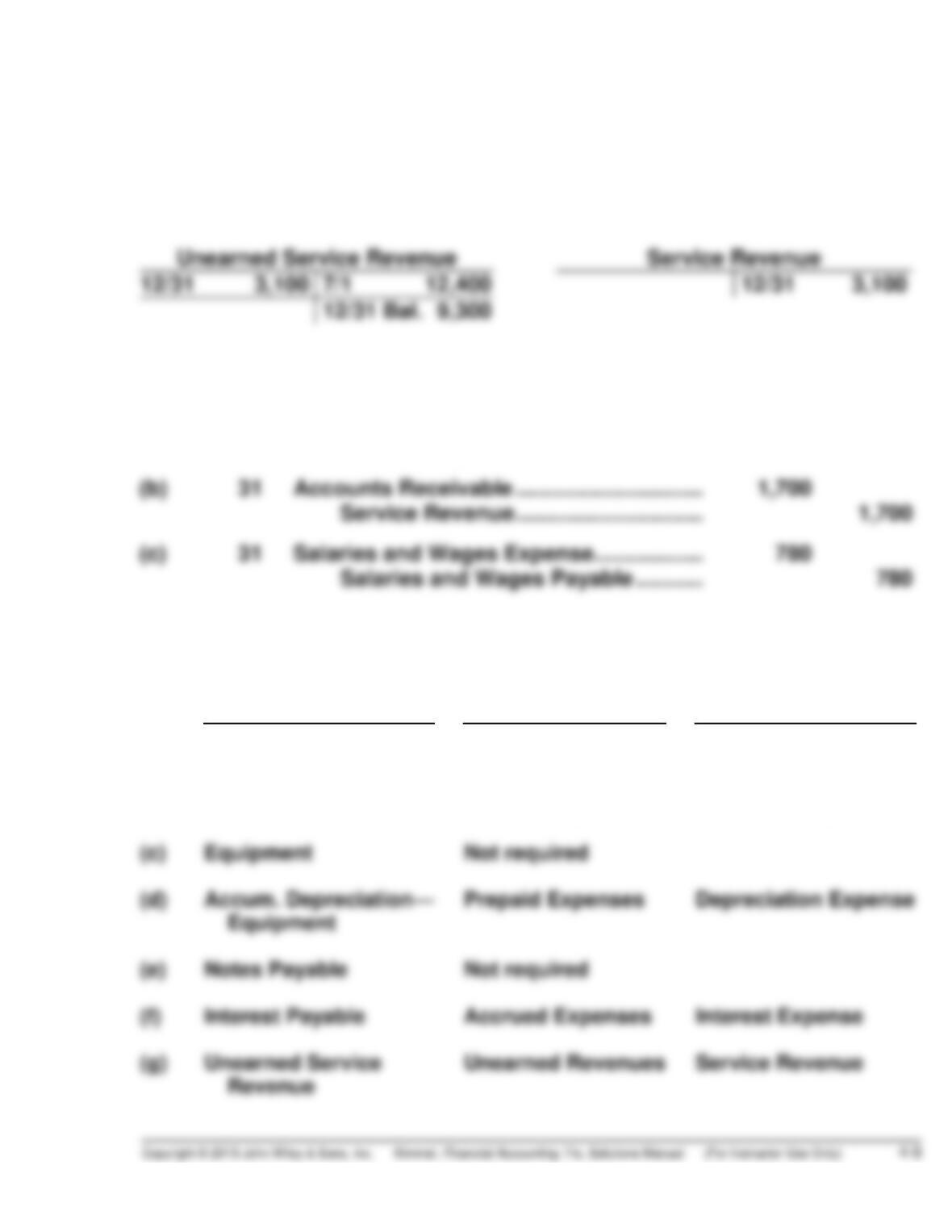
BRIEF EXERCISE 4-7
July 1 Cash ………………………………………………………… 12,400
Unearned Service Revenue ………………… 12,400
Dec. 31 Unearned Service Revenue ………………………. 3,100
Service Revenue ($12,400 X 6/24) ……….. 3,100
BRIEF EXERCISE 4-8
(a) Dec. 31 Interest Expense ……………………………….. 300
Interest Payable ………………………….. 300
BRIEF EXERCISE 4-9
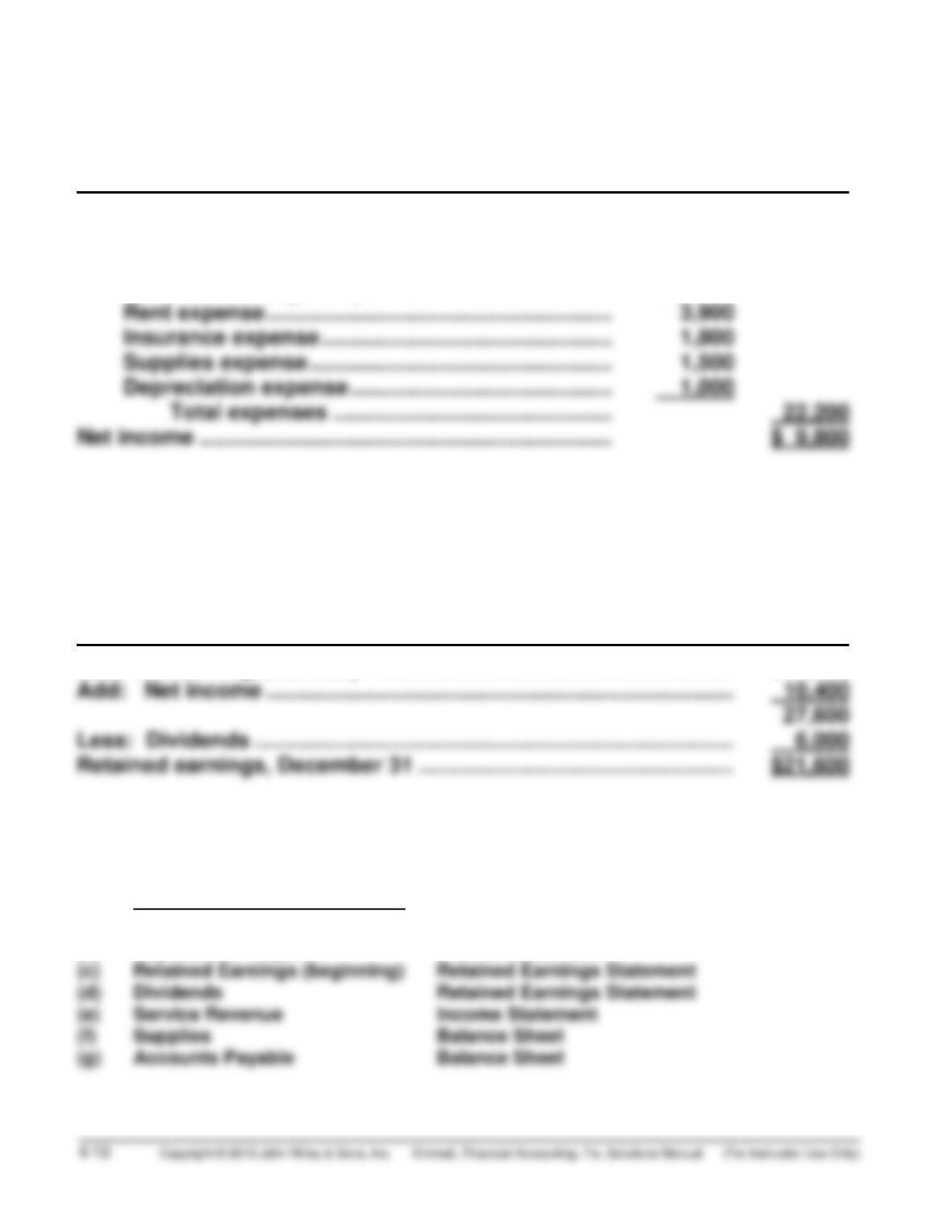
Account
(1)
Type of Adjustment
(2)
Related Account
(a) Accounts Receivable
A
ccrued Revenues Service Revenue
(b) Prepaid Insurance Prepaid Expenses Insurance Expense
—
A
BRIEF EXERCISE 4-10
RAVINE CORPORATION
Income Statement
For the Year Ended December 31, 2014
Revenues
Service revenue …………………………………………….. $32,000
Expenses
Salaries and wages expense ………………………….. $14,000
BRIEF EXERCISE 4-11
RAVINE CORPORATION
Retained Earnings Statement
For the Year Ended December 31, 2014
Retained earnings, January 1 …………………………………………………. $17,200
BRIEF EXERCISE 4-12
Account
(a)
(b)
Accumulated Depreciation
Depreciation Expense
Balance Sheet
Income Statement
BRIEF EXERCISE 4-13
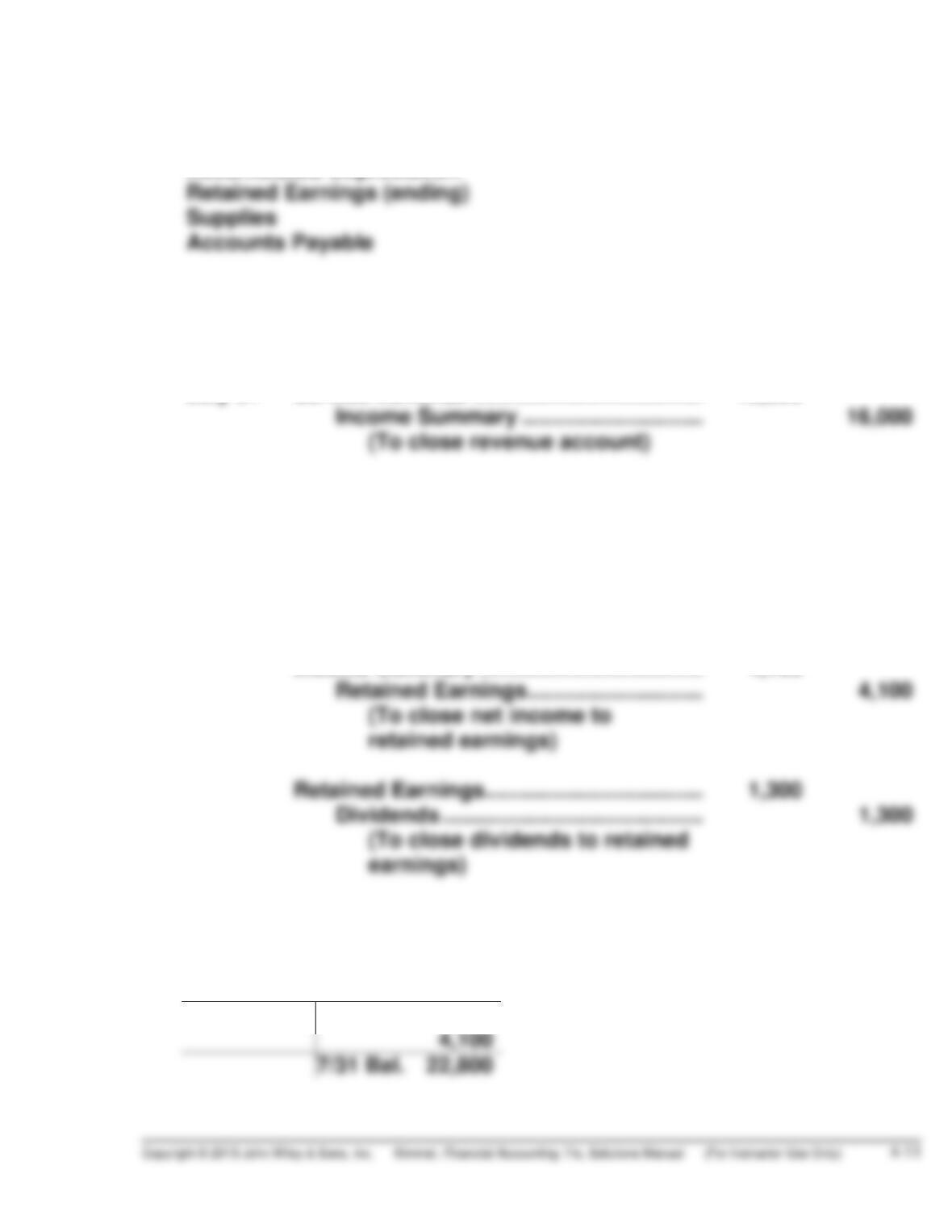
The accounts that will appear in the post-closing trial balance are:
Accumulated Depreciation
BRIEF EXERCISE 4-14
(a) Closing Entries
July 31 Service Revenue ……………………………….. 16,000
Income Summary ………………………………. 11,900
Salaries and Wages Expense ……….. 8,400
Maintenance and Repairs
Expense …………………………………… 2,500
Income Tax Expense ……………………. 1,000
(To close expense accounts)
Income Summary ………………………………. 4,100
(b)
Retained Earnings
1,300 7/1 Bal. 20,000
BRIEF EXERCISE 4-15
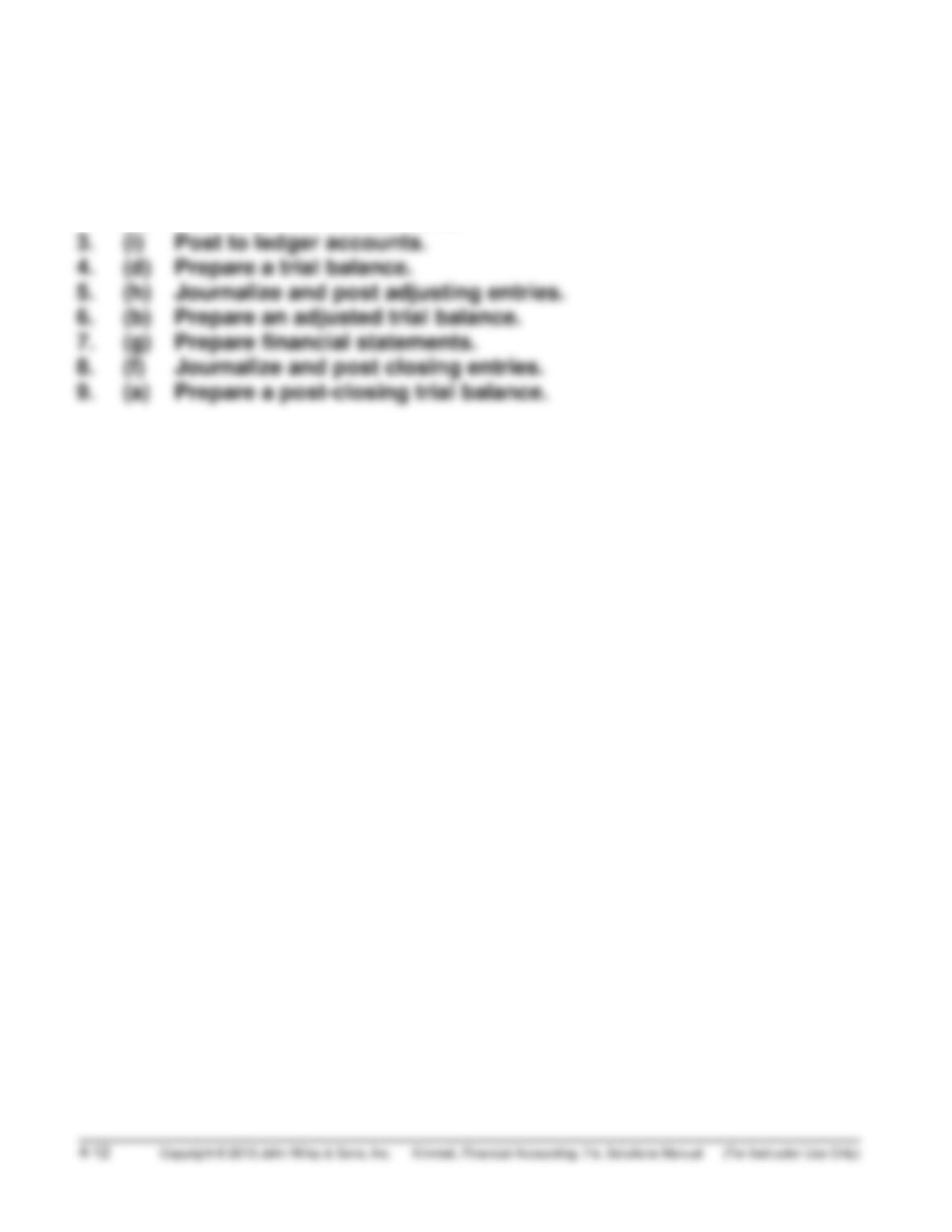
The proper sequencing of the required steps in the accounting cycle is
as follows:
1. (c) Analyze business transactions.
2. (e) Journalize the transactions.
SOLUTIONS TO DO IT! REVIEW EXERCISES
DO IT! 4-1
1. Insurance Expense ……………………………………………….. 300
2. Supplies Expense …………………………………………………. 1,600
Supplies …………………………………………………………. 1,600
(To record supplies used)
3. Depreciation Expense …………………………………………… 200
DO IT! 4-2
1. Salaries and Wages Expense ………………………………… 1,100
Salaries and Wages Payable ……………………………. 1,100
(To record accrued salaries)
2. Interest Expense ($20,000 X .09 X 1/12) ………………….. 150
DO IT! 4-3
Income statement: Service Revenue, Utilities Expense
Balance sheet: Accounts Receivable, Accumulated Depreciation,
Notes Payable, Common Stock.
DO IT! 4-4
Dec. 31 Income Summary ……………………………………………… 36,000
Dec. 31 Retained Earnings ……………………………………………. 22,000
SOLUTIONS TO EXERCISES
EXERCISE 4-1
The revenue recognition principle requires that companies recognize
revenue in the accounting period in which the performance obligation
is satisfied.
(a) Since the sales effort is not complete until the flight actually
(b) Sales revenue should be recognized at the time of delivery.
EXERCISE 4-2
(a) 8. Going concern assumption.
(b) 1. Economic entity assumption.
EXERCISE 4-3
(a) Revenue recognition principle.
EXERCISE 4-4
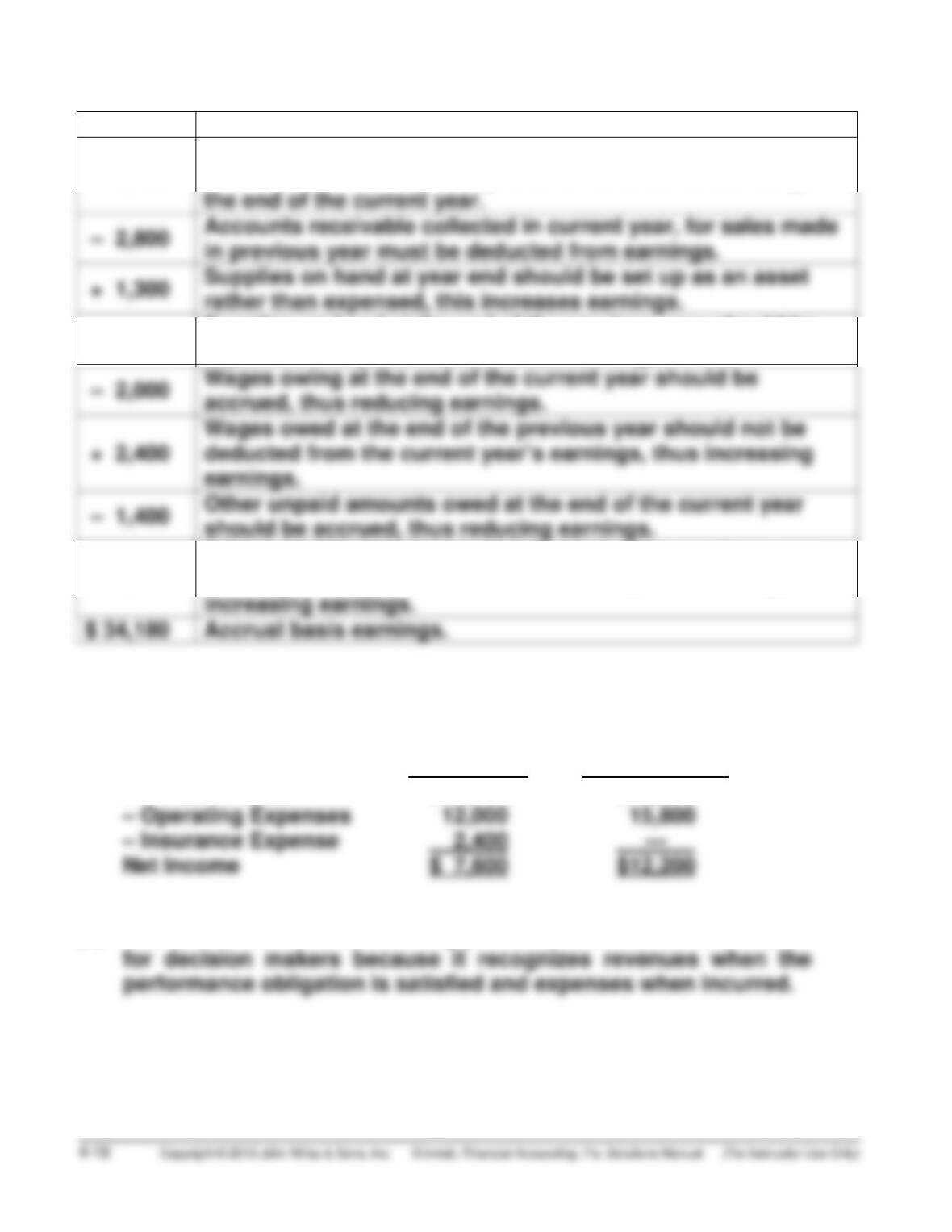
$ 33,640 Cash basis earnings.
+ 3,400
Accounts receivable arise from sales that have been made,
thus revenue must be recognized for balance outstanding at
– 1,460 Supplies on hand at the end of the previous year should be
expensed this year, this decreases earnings.
+ 1,100
Other unpaid amounts owed at the end of the previous year
should not be deducted from the current year’s earnings, thus
EXERCISE 4-5
(a) Cash Basis
A
ccrual Basis
Service Revenue
$22,000
$28,000
(b) The accrual basis of accounting provides more useful information
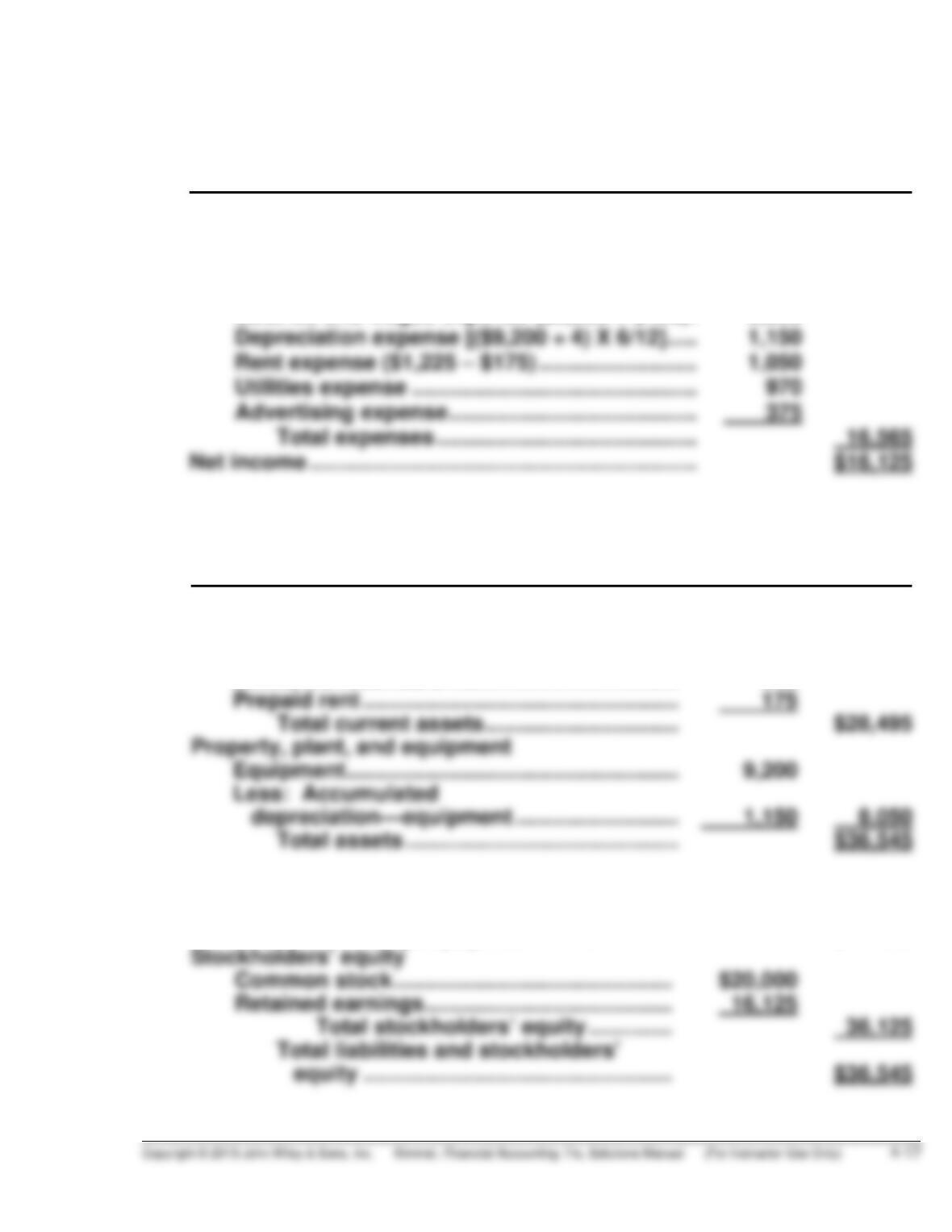
EXERCISE 4-6
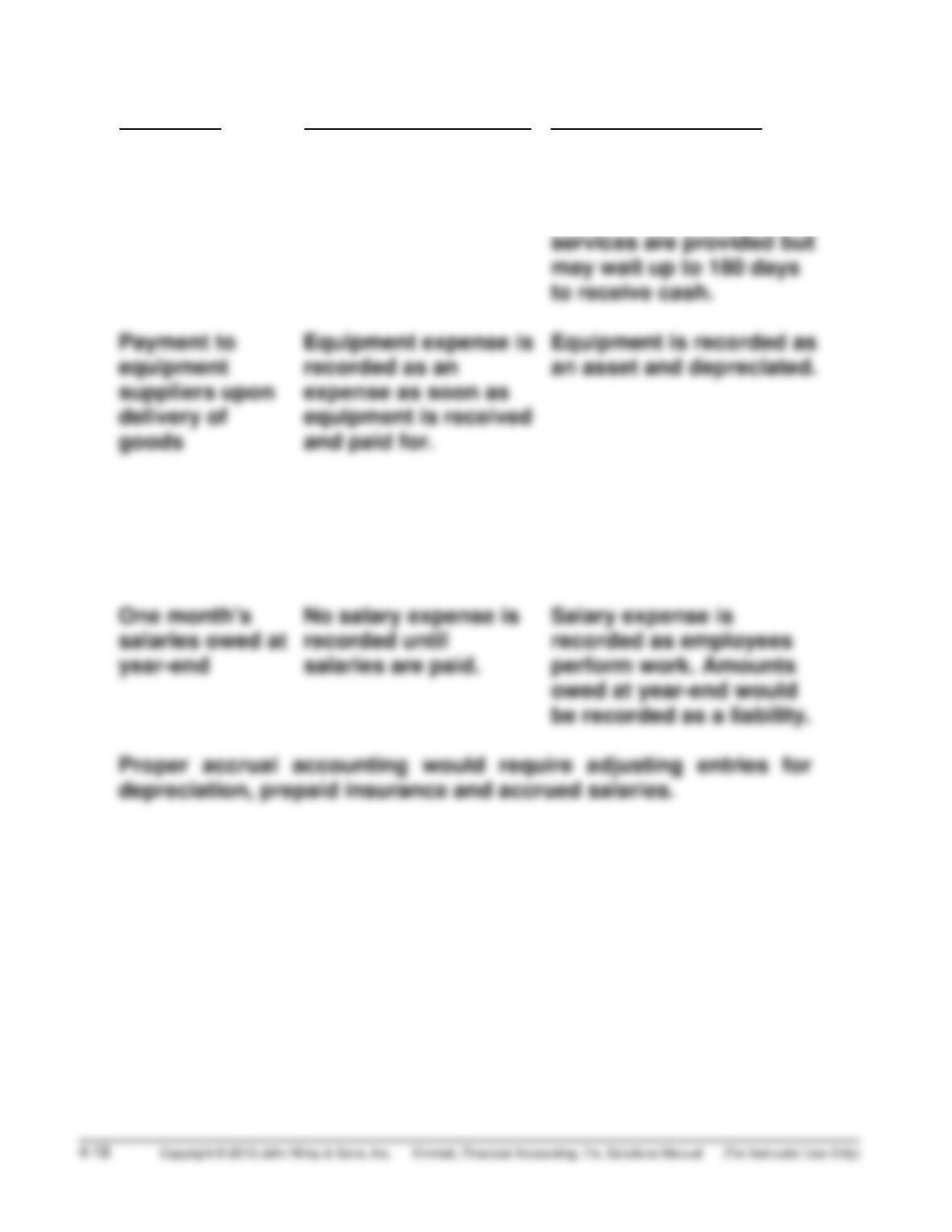
(a) KAFFEN COMPANY
Income Statement
For the Six Months Ended April 30, 2014
Revenues
Service revenue ($32,150 + $540) ……………….. $32,690
Expenses
Income tax expense …………………………………… $10,000
Salaries and wages expense ($2,600 + $420) . 3,020
(b) KAFFEN COMPANY
Balance Sheet
April 30, 2014
Assets
Current Assets
Cash ………………………………………………………. $27,780
Accounts receivable ……………………………….. 540
Liabilities and Stockholders’ Equity
Current Liabilities
Salaries and wages payable …………………… $ 420
EXERCISE 4-7
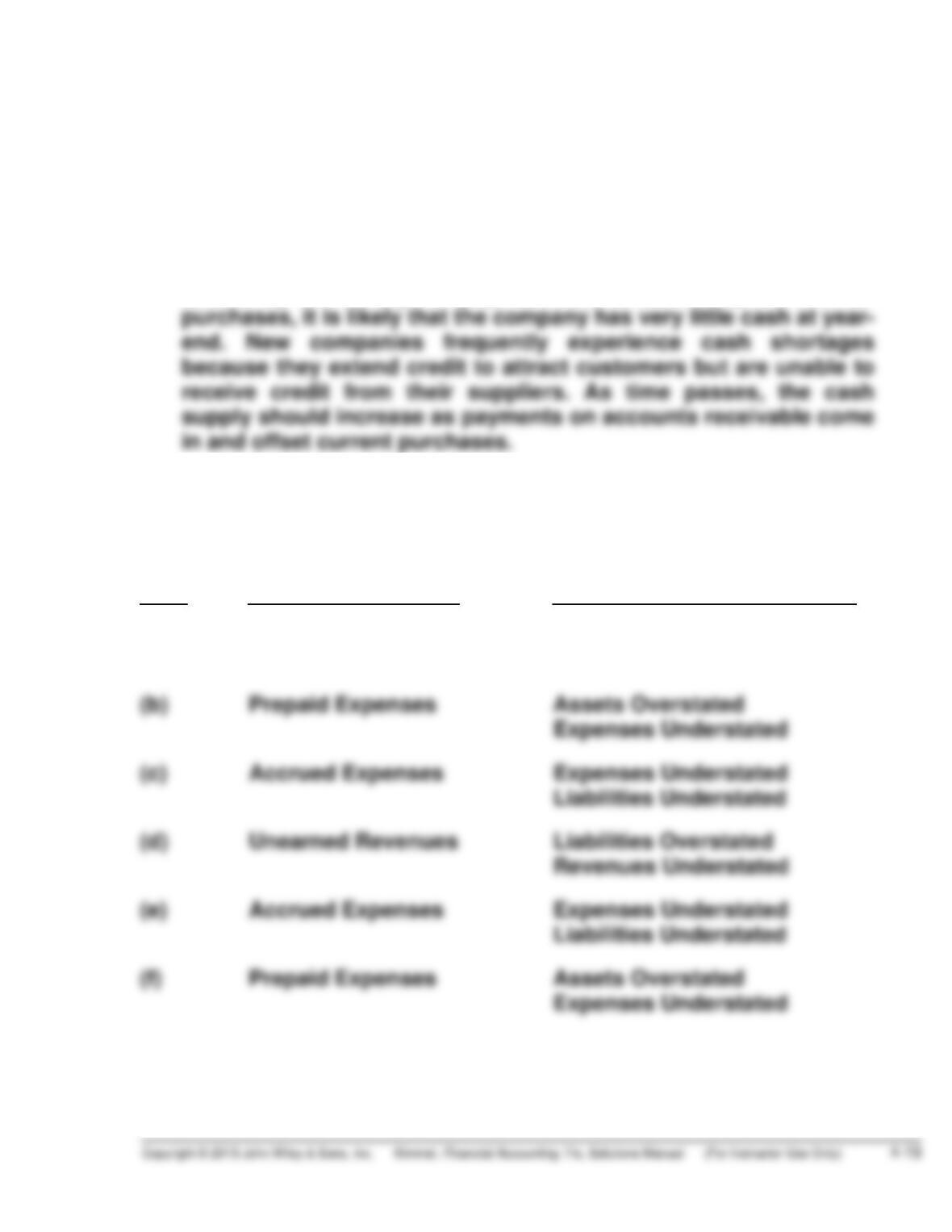
(a) Event Cash Accounting
A
ccrual Accounting
180-day
financing for
customers
Revenue is recorded
as cash is received.
Revenue is recorded as it
is earned. VidGam
records revenue (and a
receivable) as soon as
Prepayment for
2 years of
insurance
coverage
Insurance expense is
recorded as soon as
payment is made.
Prepayment is recorded
as an asset and
recognized as an
expense as time passes.
EXERCISE 4-7 (Continued)
(b) Accrual accounting rules require that revenue be recognized as a
company performs services and expenses be matched with the
revenue they help produce. Receipt or payment of cash does not
influence the calculation of net income.
VidGam has provided many services during the year and thus has
positive net income. Since VidGam allowed its largest customers
to take up to 180 days to pay, but was forced to pay cash for all
EXERCISE 4-8
Item
(1)
Type of Adjustment
(2)
Accounts Before Adjustment
(a) Accrued Revenues
A
ssets Understated
Revenues Understated
A
A
EXERCISE 4-9
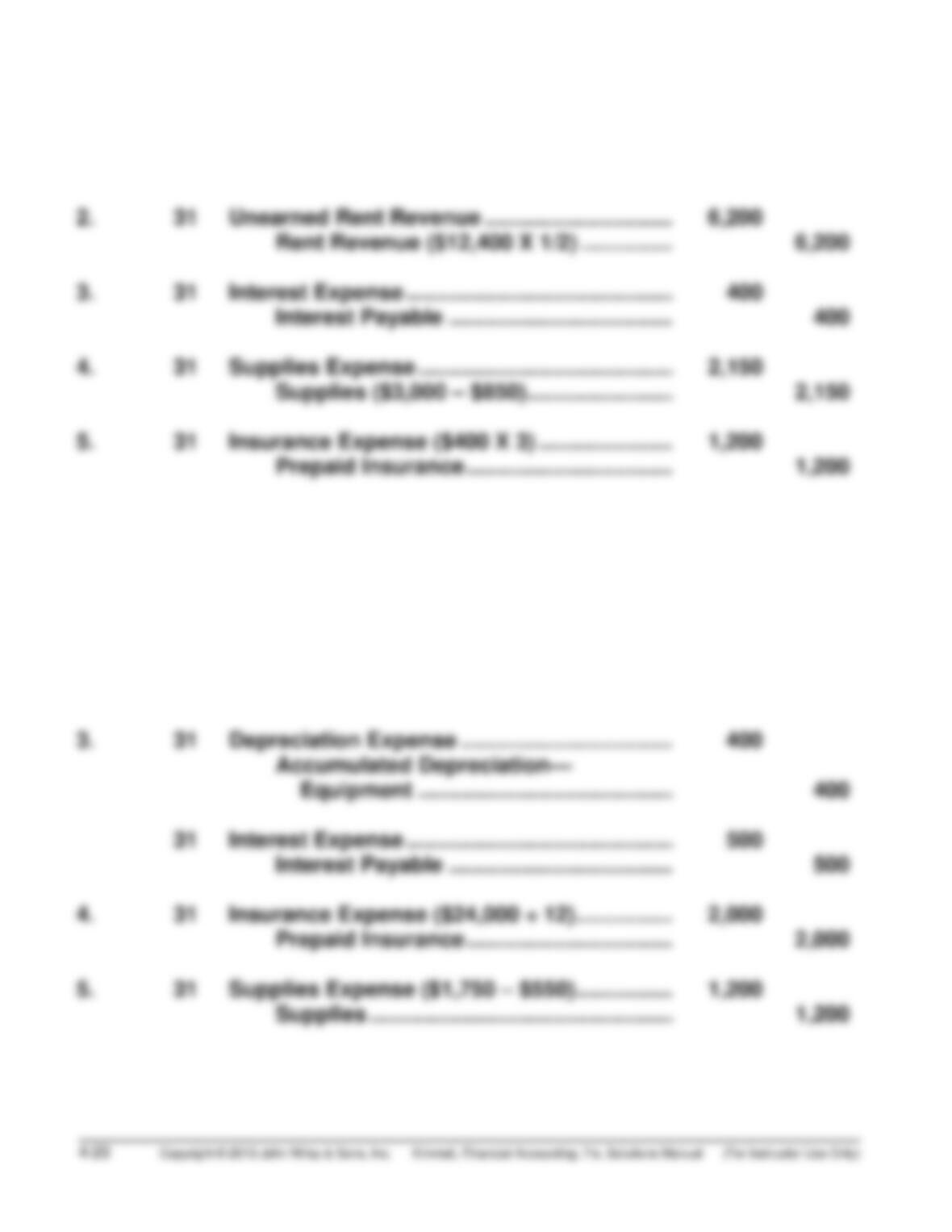
1. Mar. 31 Depreciation Expense ($280 X 3) …………….. 840
Accumulated Depreciation—
Equipment …………………………………… 840
EXERCISE 4-10
1. Jan. 31 Accounts Receivable ………………………………. 760
Service Revenue ……………………………… 760
2. 31 Utilities Expense …………………………………….. 450
Accounts Payable ……………………………. 450