CHAPTER 18 (FIN MAN); CHAPTER 4 (MAN) Activity-Based Costing
Prob. 18–1B (FIN MAN); Prob. 4–1B (MAN)
1.
a.
Direct labor overhead rate:
$299,700
1,620 direct labor hours
=
$185 per direct labor hour
2.
Whole Milk
Skim Milk
Cream
a.
Direct labor hours:
Blending Department ………………..
260
dlh
245
dlh
215
dlh
Packing Department …………………
470
300
130
Total direct labor hours …………….
730
dlh
545
dlh
345
dlh
× Direct labor overhead
rate ………………………………………..
$185
per dlh
$185
per dlh
$185
per dlh
Allocated factory overhead ……….
$135,050
$100,825
$63,825
Blending Department ………………..
650
710
260
Total machine hours …………………
425
rate ………………………………………..
$111
per mh
$111
per mh
$111
per mh
CHAPTER 18 (FIN MAN); CHAPTER 4 (MAN) Activity-Based Costing
Prob. 18–2B (FIN MAN); Prob. 4–2B (MAN)
1.
Blending
Dept.
Packing
Dept.
Production department factory
÷ Activity base ………………………………………………………..
overhead totals …………………………………………………….
$178,200
$121,500
2.
Whole milk
Blending Department ………………….
650 dir. mach. hrs. × $110 per dmh =
$ 71,500
Packing Department …………………..
470 dir. labor hrs. × $135 per dlh =
63,450
Total factory overhead for whole milk ………………………………………………………
$134,950
Blending Department ………………….
710 dir. mach. hrs. × $110 per dmh =
CHAPTER 18 (FIN MAN); CHAPTER 4 (MAN) Activity-Based Costing
Prob. 18–3B (FIN MAN); Prob. 4–3B (MAN)
1.
Production department rates:
Subassembly
Department
Final Assembly
Department
Factory overhead …………………………………….
$420,000
$294,000
2.
Direct Labor
Hours
×
Production
Department
Rate
=
Factory
Overhead
Receivers:
Subassembly Department ……
875
×
$300 per dlh
=
$262,500
Final Assembly Department …
525
×
$210 per dlh
=
110,250
Total factory overhead …………
$372,750
÷ Number of units ………………..
7,000
Factory overhead per unit ……
$ 53.25
Loudspeakers:
Subassembly Department ……
per dlh
$157,500
Final Assembly Department …
per dlh
Total factory overhead …………
Factory overhead per unit ……
3.
Activity-based rates:
Setup
Quality Control
Subassembly
Department
Final Assembly
Department
Factory
overhead …..
$138,600
$261,800
$198,800
$114,800
CHAPTER 18 (FIN MAN); CHAPTER 4 (MAN) Activity-Based Costing
Prob. 18-3B (FIN MAN); Prob. 4-3B (MAN) (Concluded)
4.
Activity
Receivers
Loudspeakers
Activity
Usage
×
Activity
Rate
=
Activity
Cost
Activity
Usage
×
Activity
Rate
=
Activity
Cost
Setup
80
setups
$346.50
per setup
$ 27,720
320
setups
$346.50
per setup
$110,880
Total
$248,570
$465,430
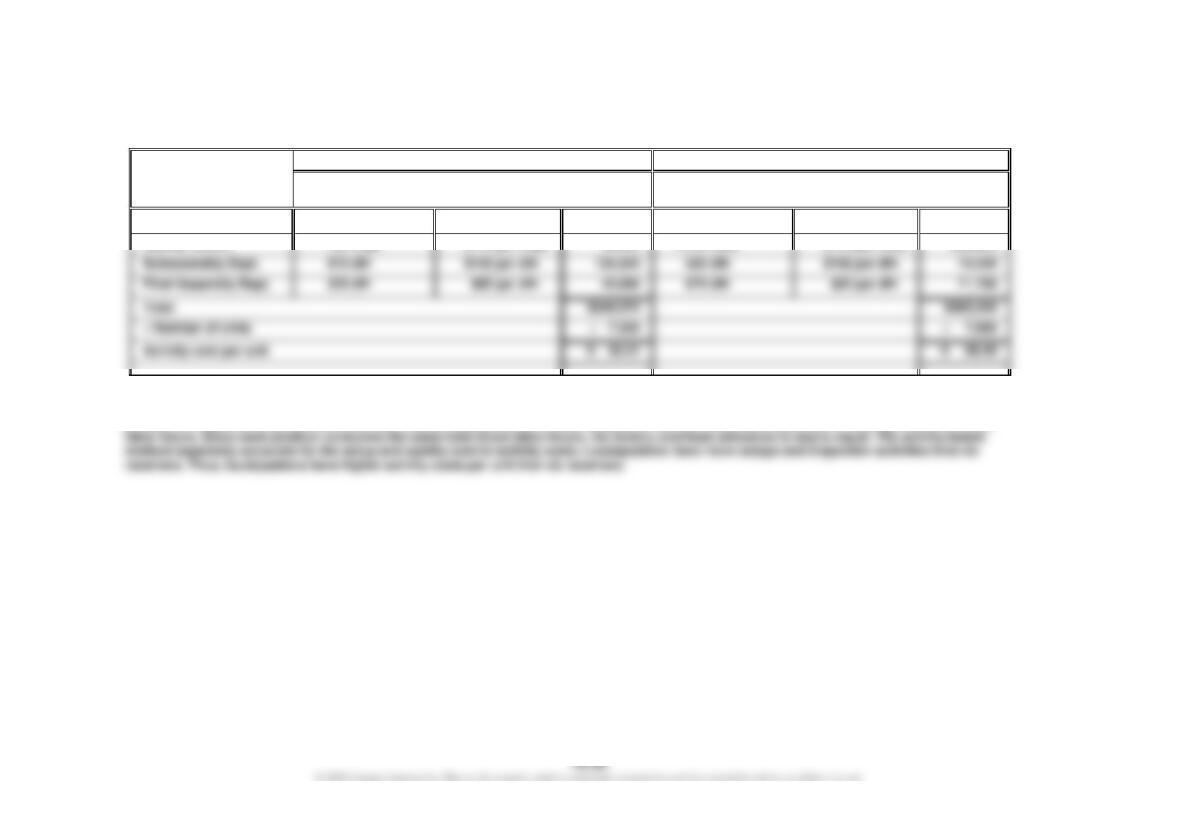
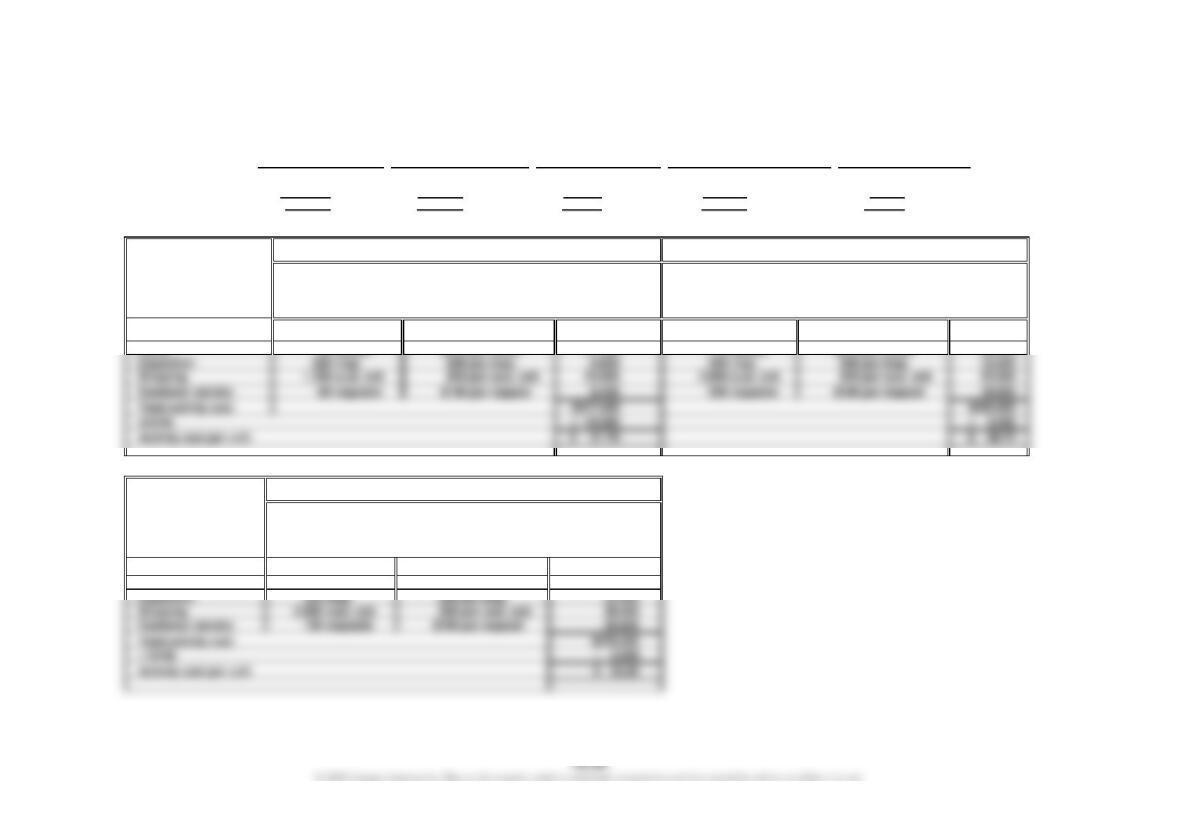
5. The activity-based overhead allocation reveals that loudspeakers are more costly on a per-unit basis than are the receivers. The multiple
production department rate method determines that the per-unit factory overhead is nearly the same for the two products. The multiple
production department factory overhead rate method distorts the unit costs because all factory overhead is assumed to be proportional to direct
CHAPTER 18 (FIN MAN); CHAPTER 4 (MAN) Activity-Based Costing
Prob. 18-4B (FIN MAN); Prob. 4-4B (MAN)
1.
Production
Setup
Inspection
Shipping
Customer Service
Total activity cost………
$500,000
$144,000
$44,000
$115,000
$84,000
÷ Total activity base …..
10,000
mh
450
setups
1,100
insp.
5,750
cust. ord.
600
req.
Activity rate ………………
$ 50
per mh
$ 320
per setup
$ 40
per insp.
$ 20
per cust. ord.
$ 140
per req.
2.
Activity
White Sugar
Brown Sugar
Activity-
Base
Usage
×
Activity
Rate
=
Activity
Cost
Activity-
Base
Usage
×
Activity
Rate
=
Activity
Cost
Production
5,000
mh
$50
per mh
$250,000
2,500
mh
$50
per mh
$125,000
Setup
setups
per setup
27,200
setups
$320
per setup
Inspection
insp.
per insp.
insp.
$40
per insp.
requests
per request
requests
$140
per request
÷Units
Activity
Powdered Sugar
Activity-
Base
Usage
×
Activity
Rate
=
Activity
Cost
Production
2,500
mh
$50
per mh
$125,000
Setup
195
setups
$320
per setup
62,400
Inspection
550
insp.
$40
per insp.
22,000
Shipping
2,000
cust. ord.
$20
per cust. ord.
40,000
190
requests
$140
per request
26,600
$276,000
CHAPTER 18 (FIN MAN); CHAPTER 4 (MAN) Activity-Based Costing
Prob. 18–4B (FIN MAN); Prob. 4–4B (MAN) (Concluded)
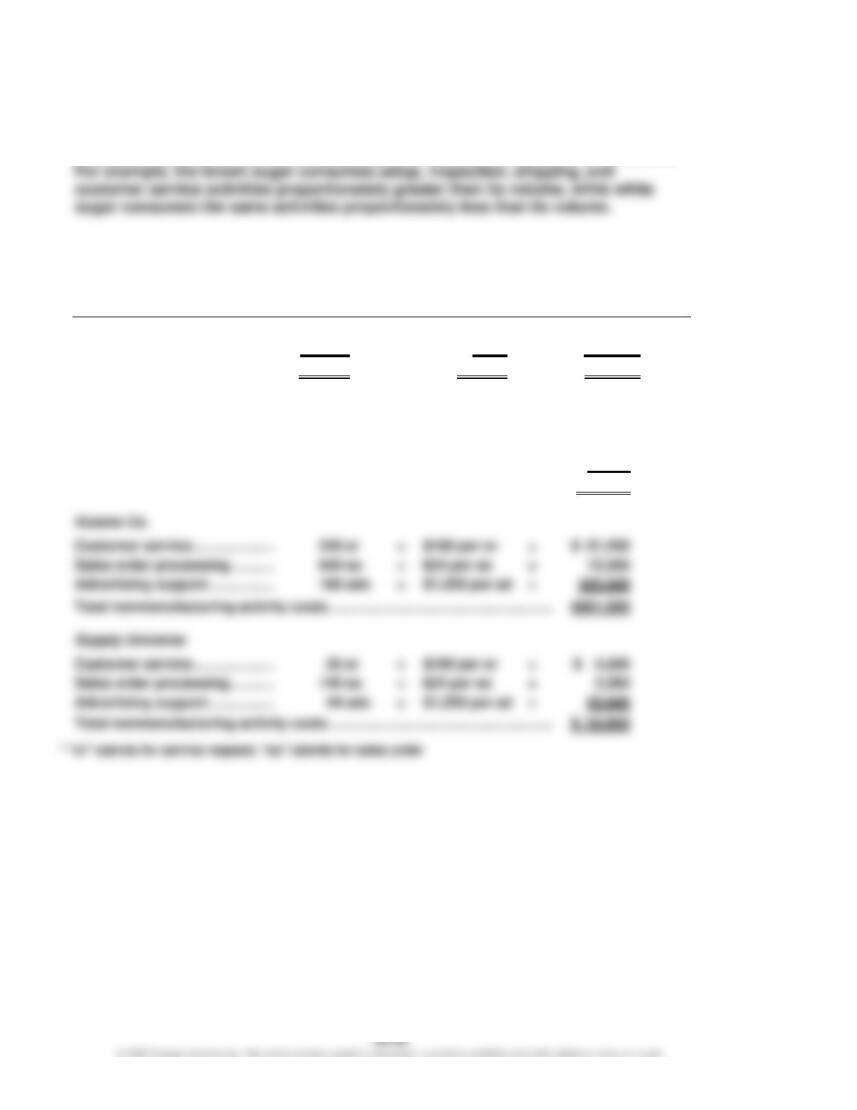
3. The unit costs are different even though each product requires 0.5 machine hour
because the products consume many activities in ratios different from the volume.
Prob. 18–5B (FIN MAN); Prob. 4–5B (MAN)
1.
Customer
Service
Sales Order
Processing
Advertising
Support
Activity cost pool …………………
$76,860
$25,920
$311,250
÷ Activity base ……………………..
427
sr*
1,080
so*
249
ads
Activity rate …………………………
$ 180
per sr
$ 24
per so
$ 1,250
per ad
2.
The Warehouse
Customer service …………………
62
sr
×
$180 per sr
=
$ 11,160
Sales order processing ………..
300
so
×
$24 per so
=
7,200
Advertising support ……………..
25
ads
×
$1,250 per ad
=
31,250
Total nonmanufacturing activity costs ………………………………………………….
$ 49,610
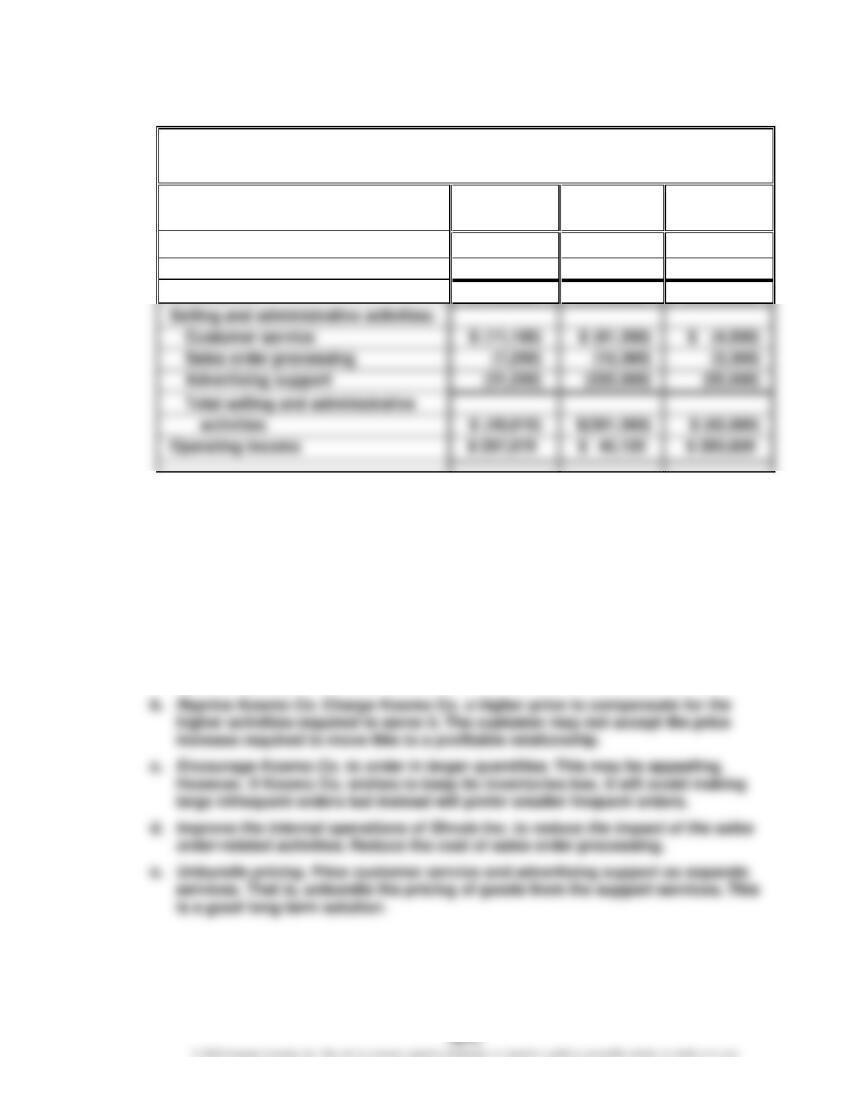
Kosmo Co.
Customer service …………………
340
sr
×
$180 per sr
=
Sales order processing ………..
640
so
×
$24 per so
=
Supply Universe
Customer service …………………
25
sr
×
$180 per sr
=
Sales order processing ………..
140
so
×
$24 per so
=
3,360
Advertising support ……………..
44
ads
×
$1,250 per ad
=
55,000
Total nonmanufacturing activity costs ………………………………………………….
CHAPTER 18 (FIN MAN); CHAPTER 4 (MAN) Activity-Based Costing
Prob. 18–5B (FIN MAN); Prob. 4–5B (MAN) (Concluded)
3.
Shrute Inc.
Customer Profitability Report
For the Year Ended December 31
The
Warehouse
Kosmo Co.
Supply
Universe
Revenues
$ 899,1001
$ 899,100
$ 899,100
Cost of goods sold
(552,420)2
(552,420)
(552,420)
Gross profit
$ 346,680
$ 346,680
$ 346,680
Selling and administrative activities:
(225,000)
1 $1,110 × 810 units
2 $682 × 810 units
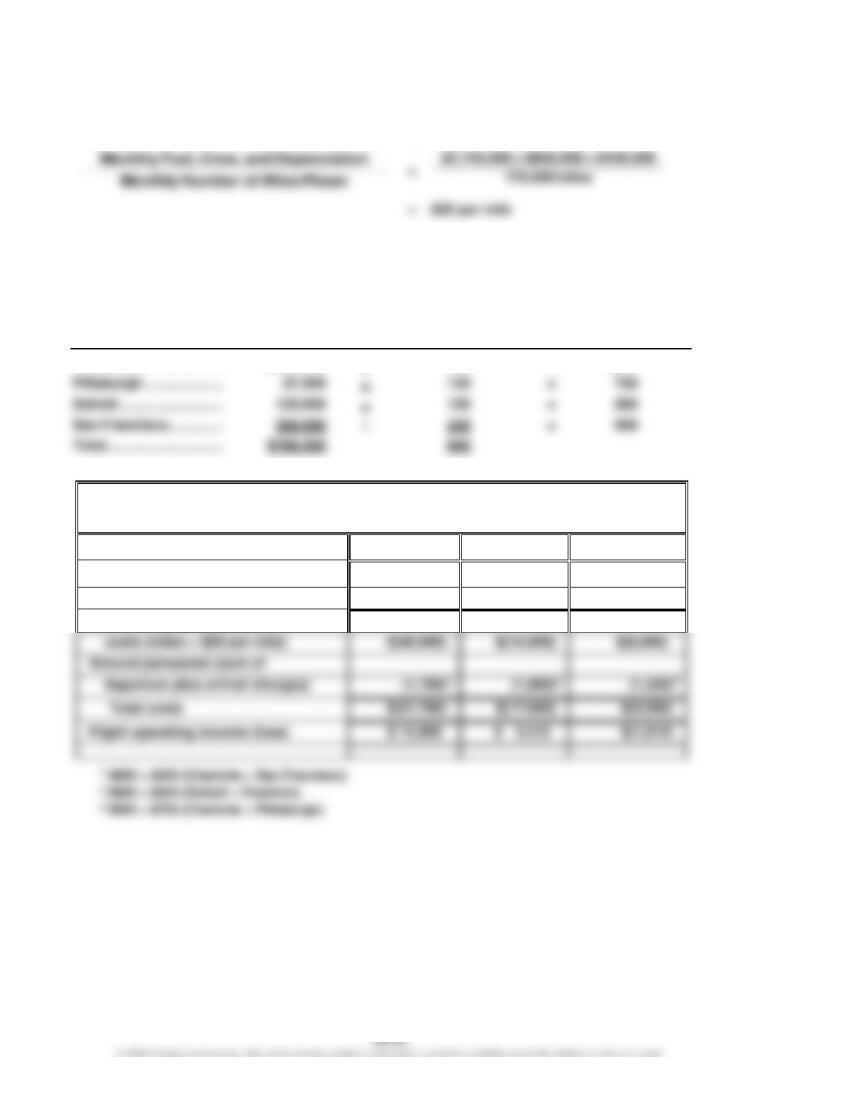
4. Kosmo Co. has low profitability, while the other two customers have acceptable
margins. This is because Kosmo Co. requires many customer services, sales order
processing, and advertising support activities. For example, Kosmo Co. orders
frequently in small order sizes, which increases the sales order processing costs; it
requests a large amount of service; and it requires extensive promotional support.
The company’s options include:
a. Drop Kosmo Co. This does not necessarily mean that all the costs can be
avoided. The costs will only be eliminated if the reduced activity translates into
lower spending.
CHAPTER 18 (FIN MAN); CHAPTER 4 (MAN) Activity-Based Costing
Prob. 18–6B (FIN MAN); Prob. 4–6B (MAN)
1. The depreciation and maintenance cost per mile is calculated as follows:*
*Ground personnel costs are not included. They are allocated separately below.
2.
Terminal City
Monthly
Ground
Personnel
Cost per City
÷
Number of
Arrivals/Departures
=
Arrival/Departure
Rate per City
÷
÷
Detroit ………………………
÷
150
=
Charlotte …………………..
$256,000
320
=
$800
3.
Blue Star Airline
Flight Profitability Report
For Three Representative Flights
Flight 101
Flight 102
Flight 103
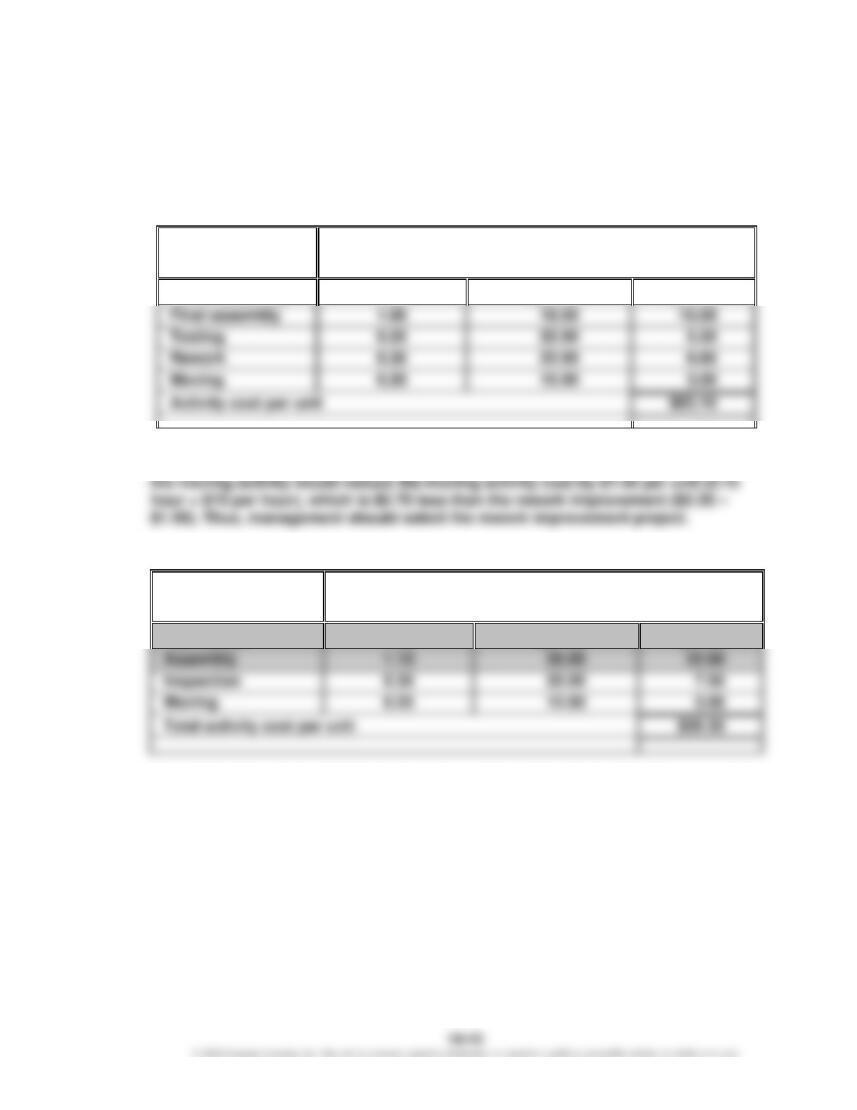
Passenger revenue
(passengers × ticket price)
$ 55,600
$ 22,075
$ 7,640
Fuel, crew, and depreciation
CHAPTER 18 (FIN MAN); CHAPTER 4 (MAN) Activity-Based Costing
MAKE A DECISION
MAD 18–1 (FIN MAN); MAD 4–1 (MAN)
a. The average rework per unit will be improved by one-quarter, or 25%. Thus,
the new average rework time will be reduced from 0.40 to 0.30 hour [0.40 × (1
– 0.25)].
Activity
Activity-Base
Usage
(hrs. per unit)
×
Activity
Rate per Hour
=
Activity
Cost
Motor assembly
1.50
$20.00
$30.00
Moving
0.20
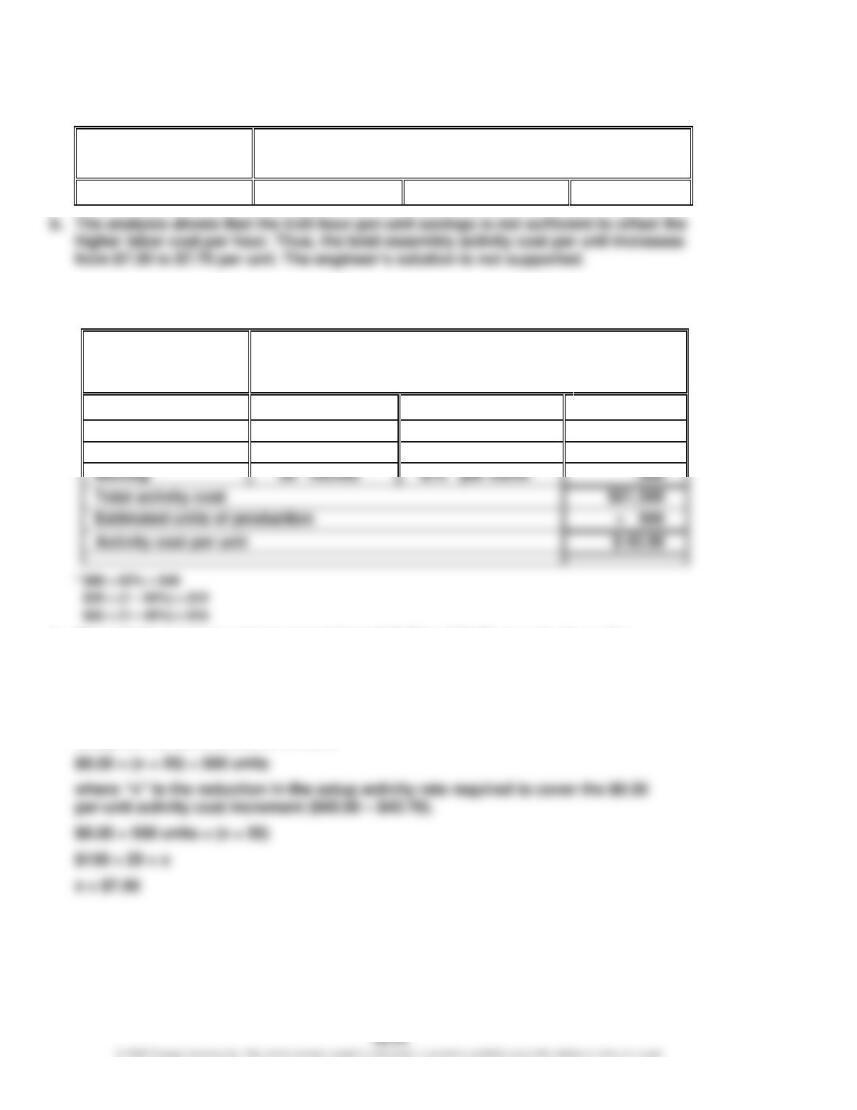
b. The rework improvement reduces the cost per unit by $2.20 ($65.30 – $63.10),
which meets management’s $2.00 per unit cost improvement objective. Halving
MAD 18–2 (FIN MAN); MAD 4–2 (MAN)
a.
Activity
Activity-Base
Usage
(hrs. per unit)
×
Activity
Rate per Hour
=
Activity Cost
Inspection
0.30
Fabrication
1.00
$24.00
$24.00
The shaded areas are impacted by the proposed change. Fabrication increases to
1.0 hour per unit, while Assembly declines to 1.10 hours per unit.
b. Yes, the proposed improvement plan appears to provide a $2.00 per unit cost
savings ($58.50 – $56.50).
CHAPTER 18 (FIN MAN); CHAPTER 4 (MAN) Activity-Based Costing
MAD 18–3 (FIN MAN); MAD 4–3 (MAN)
a.
Activity
Activity-Base
Usage
(hrs. per unit)
×
Activity Rate
per Hour (S-3)
=
Activity Cost
Assembly
0.35
$22.00
$7.70
MAD 18–4 (FIN MAN); MAD 4–4 (MAN)
a.
Activity
Activity-Base
Usage
×
Activity Rate*
=
Activity Cost
Fabrication
250
dlh
$80
per dlh
$20,000
Setup
20
setups
$48
per setup
960
Production control
20
prod. runs
$12
per prod. run
240
Moving
20
moves
$15
per move
300
Estimated units of production
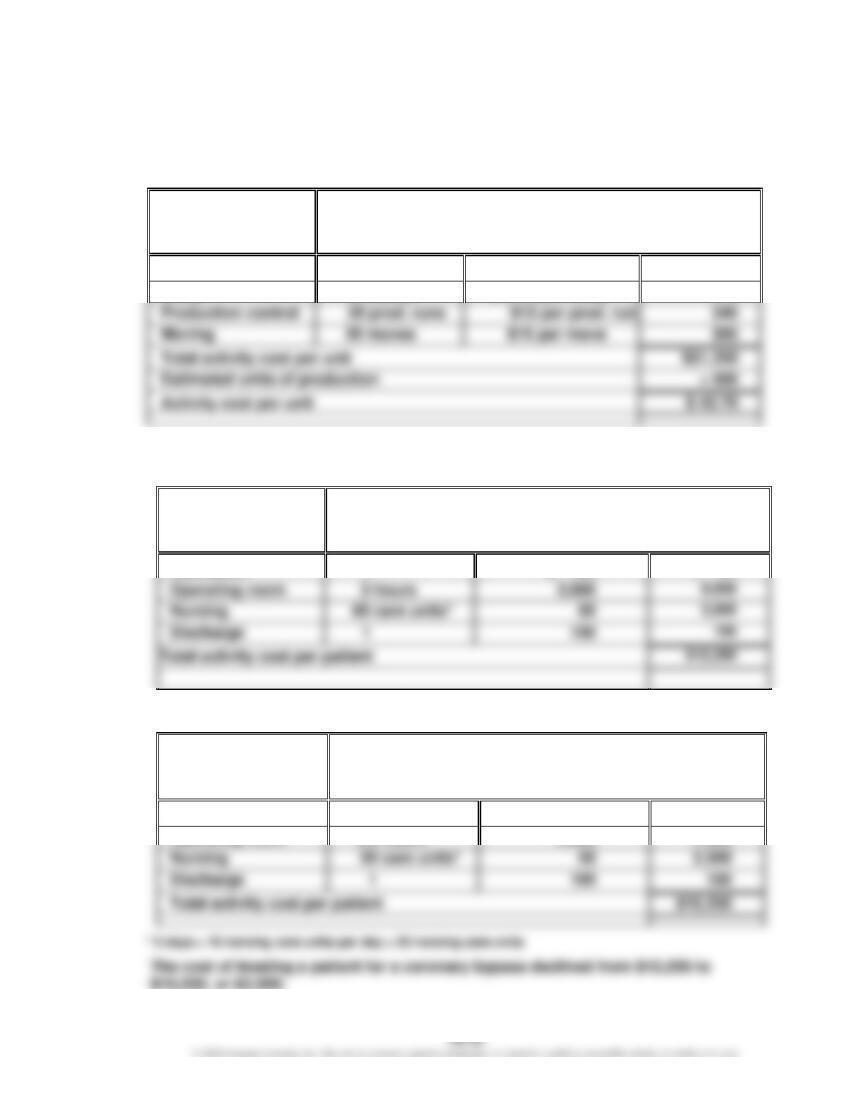
b. The activity cost per unit increased from $42.70 to $43.00 per unit; thus, the
improvements increased the activity cost per unit. Further changes would be required
in order for the proposed plan to be cost neutral.
c. The activity cost per setup would need to decline in order for the revised activity cost
per unit to remain unchanged from the base scenario. The revised activity cost per
setup can be determined as follows:
CHAPTER 18 (FIN MAN); CHAPTER 4 (MAN) Activity-Based Costing
MAD 18–4 (FIN MAN); MAD 4–4 (MAN) (Concluded)
Thus, the setup rate would need to decline another $7.50, to $40.50, in order for the
activity cost per unit to remain unchanged under the new scenario. This is verified as
follows:
Activity
Activity-Base
Usage
×
Activity Rate*
=
Activity Cost
Fabrication
250 dlh
$80 per dlh
$20,000
Setup
20 setups
$40.50 per setup
810
MAD 18–5 (FIN MAN); MAD 4–5 (MAN)
a.
Activity
Activity-Base
Usage
(per patient)
×
Activity Rate
=
Activity Cost
Nursing
Discharge
$ 150
* 6 days × 10 nursing care units per day = 60 nursing care units
b.
Activity
Activity-Base
Usage
(per patient)
×
Activity Rate
=
Activity Cost
Admission
1
$ 150
$ 150
Nursing
50 care units*
Discharge
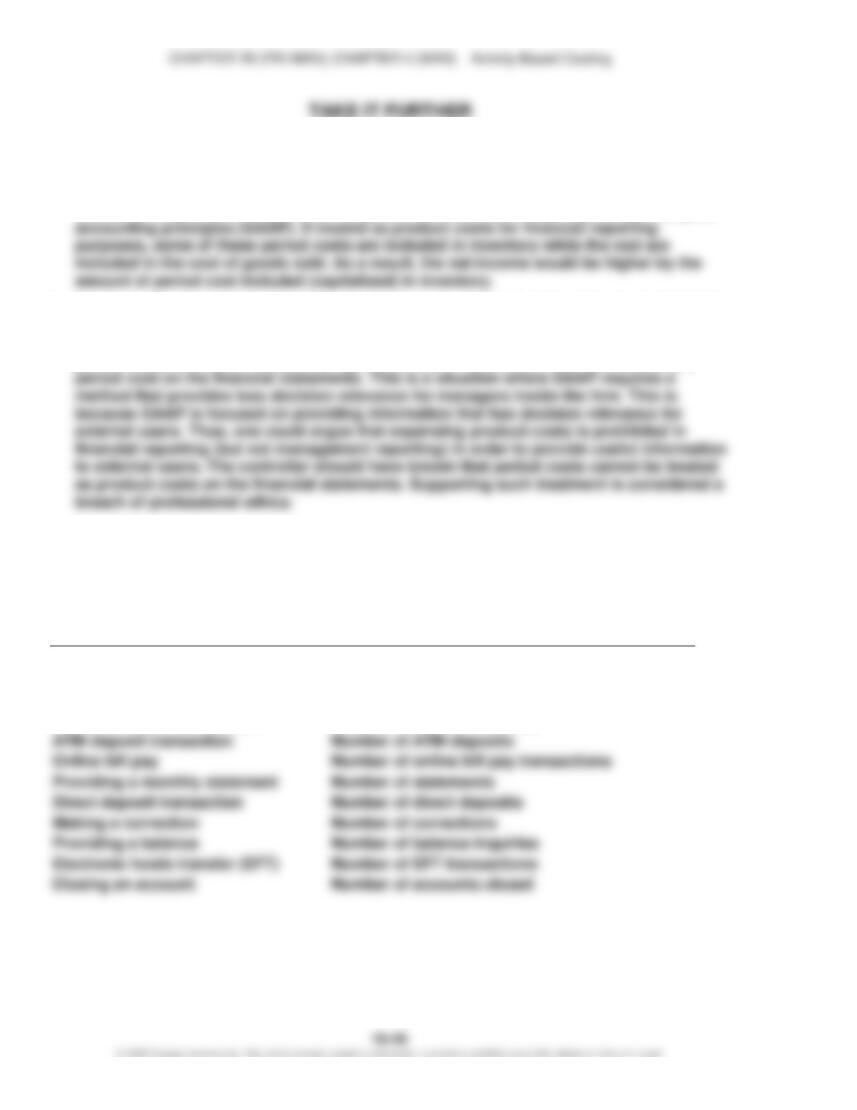
$10,250, or $2,000.
TIF 18–1 (FIN MAN); TIF 4–1 (MAN)
a. The net income is larger because the controller took period costs and treated them as
product costs for financial reporting purposes. All of the post-manufacturing costs
should be treated as an expense in the period incurred according to generally accepted
b. The controller is not behaving ethically, because the financial statements do not present
fairly the results of operations according to GAAP. The new activity-based costing
information may be very useful for internal decision making, but the post-manufacturing
period costs cannot be included as a product cost. These costs must be treated as a
TIF 18–2 (FIN MAN); TIF 4–2 (MAN)
Answers will vary depending on the company selected. A potential solution for a company in
the banking industry follows.
Activity
Activity Base
Opening an account
Number of accounts opened
Teller deposit transaction
Number of teller deposits
Teller withdrawal transaction
Number of teller withdrawals
ATM withdrawal transaction
Number of ATM withdrawals
Online bill pay
Number of online bill pay transactions
Providing a monthly statement
Number of statements
Providing a balance
Number of balance inquiries
Electronic funds transfer (EFT)
Number of EFT transactions
TIF 18–3 (FIN MAN); TIF 4–3 (MAN)
a.
Home Theater
Speakers
Wireless
Speakers
Wireless
Headphones
Gross profit as a percentage of sales
30%
40%
10%
Operating income as a
percentage of sales
(10)%
30%
2%
b. Memo
To: Management of New Wave Sounds Inc.
From: Controller
Re: Product Strategy Recommendations
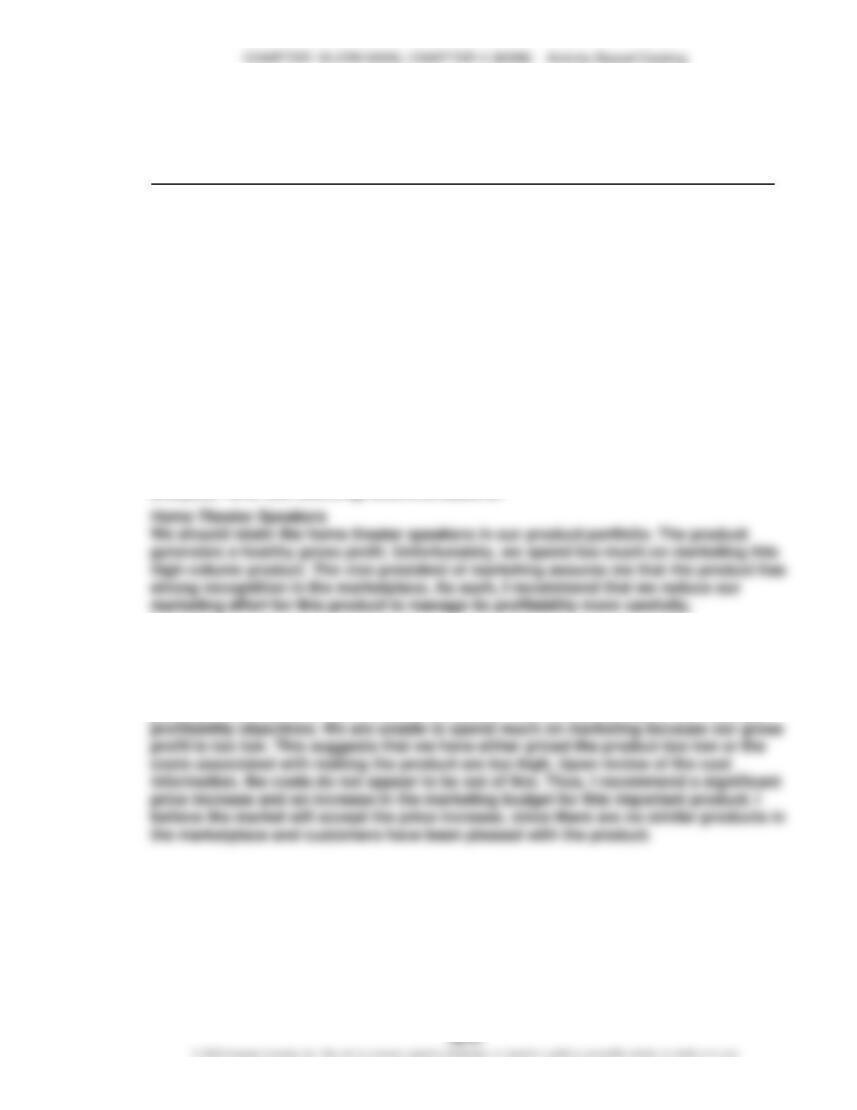
The product profitability report provided indicates that our product lines provide varying
degrees of profitability. By far, our most profitable product line is wireless speakers. The
home theater speakers provide a healthy gross profit. However, our marketing costs
associated with this product line exceed our gross profit. As a result, the product line is
unprofitable as a whole. The wireless headphones, on the other hand, have a very weak
gross profit. Consequently, the product line is just barely profitable. Based on this
Wireless Speakers
Wireless speakers provide both a healthy gross profit and return on sales.
Wireless Headphones
Wireless headphones are one of our “up–and-comers.” No other competitor has a similar
product. Thus, we have the market to ourselves. Yet, this product does not meet our
CHAPTER 18 (FIN MAN); CHAPTER 4 (MAN) Activity-Based Costing
CERTIFIED MANAGEMENT ACCOUNTANT (CMA®)
EXAMINATION QUESTIONS (ADAPTED)
1.
b.
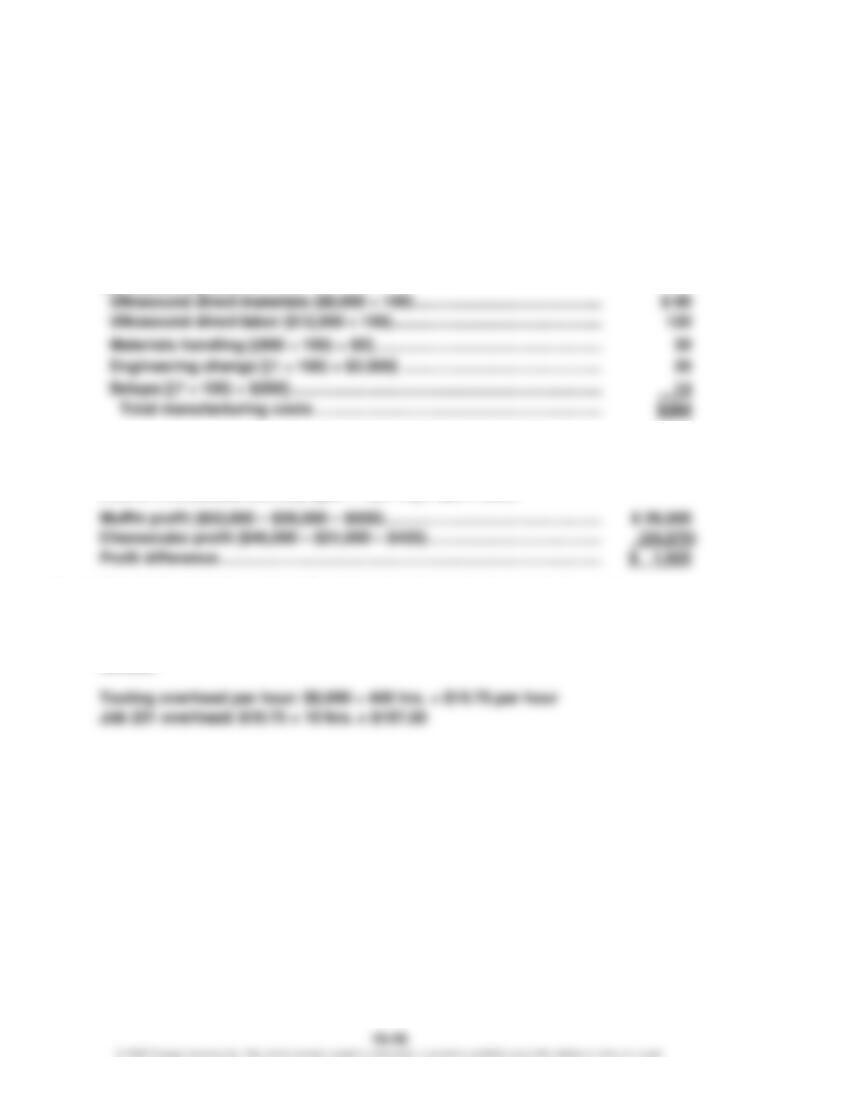
Using activity-based costing, the cost to manufacture one ultrasound
machine is $264, determined as follows:
Cost per engineering change: $6,000 ÷ (2 + 1) = $2,000
Materials handling per part: $5,000 ÷ (400 + 600) = $5
Cost per product setup: $3,000 ÷ (8 + 7) = $200
Manufacturing costs:
2.
c.
The muffins are $1,925 more profitable, determined as follows:
Cost of muffin delivery: [(150 × 10) ÷ 60] × $20 = $500
Muffin profit ($53,000 – $26,000 – $500) …………………………………………..
Cheesecake profit ($46,000 – $21,000 – $425) ………………………………….
Cost of cheesecake delivery: [(85 × 15) ÷ 60] × $20 = $425
3.
d.
Only in the situation where all overhead costs were expensed, e.g., zero
inventory balances, would the reported net income be the same.
4.
b.
The Tooling Department overhead applied to Job 231 is $197.50, determined as
Tooling overhead per hour: $8,690 ÷ 440 hrs. = $19.75 per hour
Job 231 overhead: $19.75 × 10 hrs. = $197.50