Chapter 4
4.1 The statement of cash flows is a useful document because it is the only
4.2 Cash includes cash and highly liquid short-term marketable securities, called
cash equivalents.
Operating activities include delivering or producing goods for sale and
4.3 The direct method shows cash collections from customers, interest and
dividends collected, other operating cash receipts, cash paid to suppliers and
4.4 The cash flow statement helps investors, creditors and other users determine
the following about a firm:
• Its ability to generate cash flows in the future
4.5 (a) I (g) F
(b) F (h) I
4.6 (a) O (g) O
(b) O (h) F
4.7 (a) L (f) H
(b) H (g) L
4.8 (a) Outflow, F (f) Outflow, F
(b) Inflow, I (g) Outflow, I
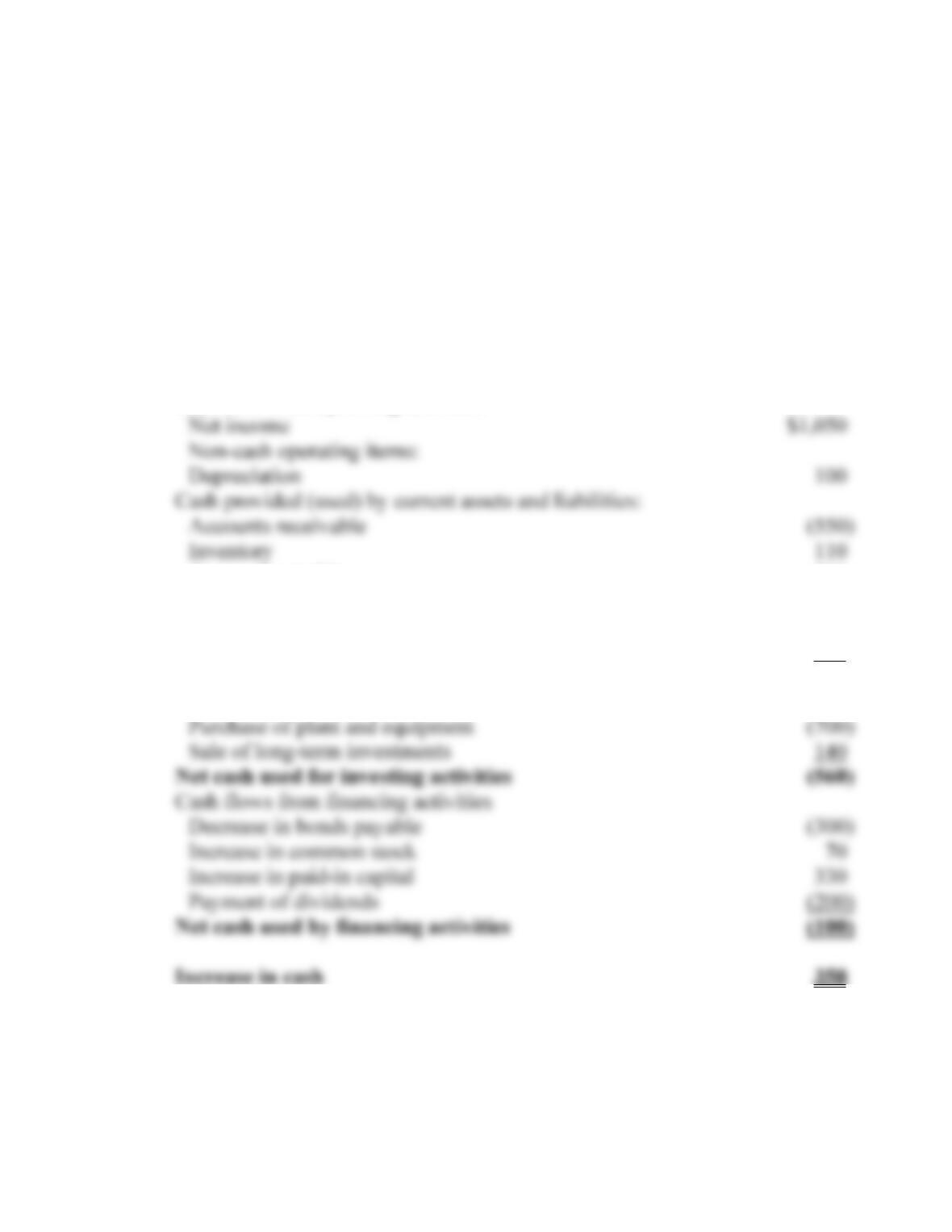
4.9 (a)
Beginning retained
earnings
+
Net income
–
Dividends
=
Ending retained
earnings
$3,600
+
$1,050
–
$200
=
$4,450
(b)
Dragoon Enterprises
Statement of Cash Flows
For Year Ending December 31, 2015
Cash flow from operating activities
Accounts payable
300
Accrued wages payable
(100)
Interest payable
(50)
Income taxes payable
150
Net cash provided by operating activities
1,010
Cash flows from investing activities
Purchase of plant and equipment
)
Sale of long-term investments
140
Net cash used for investing activities
)
Cash flows from financing activities
Increase in common stock
Increase in paid-in capital
330
Net cash used by financing activities
)
Increase in cash
Net income
Non-cash operating items:
Depreciation
100
Cash provided (used) by current assets and liabilities:
Inventory
110
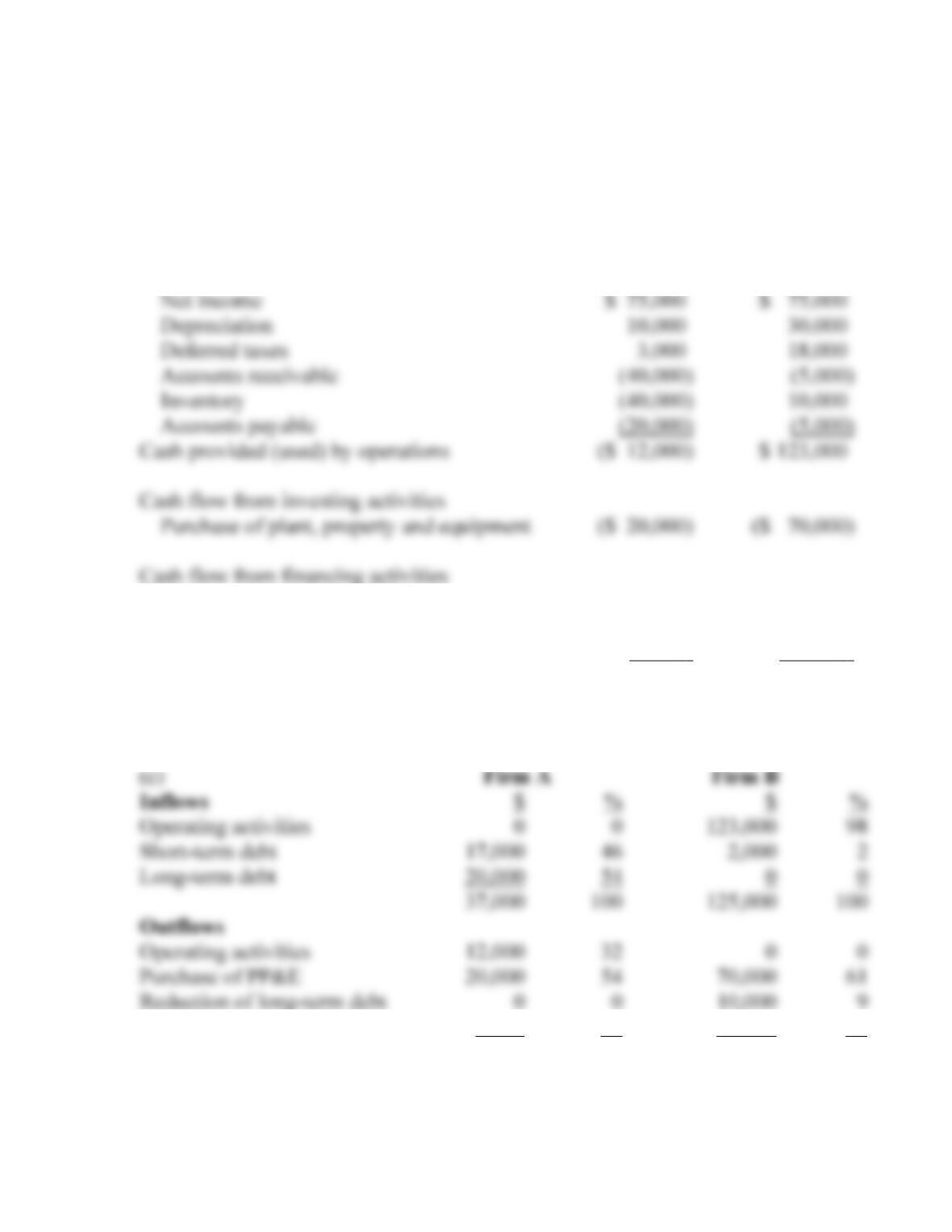
4.10 (a) Net income – Change in retained earnings = Dividends
Firm A $75,000 – $70,000 = $ 5,000
Firm B $75,000 – $40,000 = $35,000
(b)
Firm A
Firm B
Cash flow from operating activities
Short-term debt
$
17,000
$
2,000
Long-term debt
20,000
(10,000
)
Dividends paid
(5,000
)
(35,000
)
Net cash flow from financing activities
$
32,000
($
43,000
)
Change in cash
$
0
$
10,000
Inflows
$
Operating activities
Short-term debt
17,000
46
Long-term debt
20,000
54
Outflows
Operating activities
12,000
32
Purchase of PP&E
20,000
54
70,000
61
Reduction of long-term debt
Dividends paid
5,000
14
35,000
30
37,000
100
115,000
100
Change in cash
0
10,000
Net income
$
75,000
$
75,000
Depreciation
10,000
30,000
Deferred taxes
18,000
Accounts receivable
)
)
Inventory
)
10,000
Accounts payable
)
)
Cash provided (used) by operations
12,000
)
$
Cash flow from investing activities
Purchase of plant, property and equipment
20,000
)
($
70,000
)
Cash flow from financing activities
Both firms reported net income of $75,000, but, in reality, they had an entirely
different operating performance, because Firm B had a strong positive operating
4.11
AddieMae, Inc.
Statement of Cash Flows
For Year Ended December 31, 2016
Cash flow from operating activities
Net income
$ 6,200
Depreciation
500
Cash provided by (used for) current assets and liabilities
Accounts receivable
(500
)
Inventory
)
Accounts payable
800
Income taxes payable
300
Cash flows from investing activities
Purchase of plant and equipment
(700
)
Purchase of long-term investments
(300
)
Net cash used by investing activities
(
$ 1,000
)
Cash flows from financing activities
Additions to long-term debt
200
Analysis
Inflows
$
%
Operating activities
500
15
AddieMae, Inc. generated far less cash from operating activities compared to net
income due primarily to growth in inventories, receivables. Accounts payable and
accrued expenses have also grown to support the increase in current assets. The
firm may be expanding as evidenced by the increase in capital assets.
The expansion is being supported by long-term debt and a significant sale of
common stock.
Outflows
$
%
Purchase of property and equipment
700
70
4.12
(a) Cash provided by operations in 2015 is considerably less than net income.
The major reason is the $288.2 million increase in accounts receivable. Inventory
also increased substantially ($159.4 million) but the growth in inventory was
(b)
2015
2014
Inflows
$
%
$
%
Operations
24,525
8.2
177,387
78.1
Investment activities
14,408
4.8
0
0
Short-term borrowings
125,248
19.9
Add. to long-term borrowings
135,249
299,430
100.0
227,064
100.0
Outflows
Add. to plant and equipment
94,176
21.2
Investment activities
Purchase of treasury stock
45,854
Dividends
49,290
Repay long-term borrowings
0
250,564
56.9
189,320
100.0
440,261
100.0
Change in cash
110,110
(213,197)
In 2014 Techno generated most of its cash (78%) internally through operations.
About 20% came from short-term borrowings, apparently to finance working
capital. As the result of a strong operating cash flow and a large cash account
balance ($291 million) Techno was able to expand plant and equipment while
4.13 What follows is a sample article. The article should include the following
key points: 1) cash flow from operations is different from net income; 2) a brief
explanation of why the two measurements differ; and 3) cash is what is needed to
stay afloat. A good basis for the article is the example of the “Nocash
Corporation” in Chapter 4.
To get through this patch, the company may have to borrow to cover the cash
shortage, which will require future cash for debt service. If the company doesn’t
turn things around, the problems will compound, leading to potential disaster.
4.14 There is no solution presented here as the students will be choosing a variety
of companies.
4.15 (a) Advantages of large cash balances are that:
• companies can survive economic recessions;
(b) Disadvantages of large cash balances are that:
• cash may be earning little or no return;
to invest in new growth and hire new employees.
(c) Students answers will vary depending on information located at the time they
do research. In 2014, firms with the largest cash and liquid balances were: Apple,
Microsoft, Google and Verizon. Other notable information about Apple at this time
Case
4.1 (a)
Intel
Statement of Cash Flows Summary Analysis
(dollars in millions)
2013
2012
2011
Inflows:
$
%
$
%
$
%
Operations
20,776
45
18,884
36
20,963
35
Proceeds from sales of shares
1,588
4
2,111
4
2,045
4
Effect of exchange rate
0
0
0
0
5
0
Total Inflows
45,992
100
52,086
100
61,038
100
Outflows:
Additions to PPE
10,711
22
11,027
23
10,764
18
Acquisitions, net of cash
925
2
638
1
8,721
Purchase of investments
29,211
25,586
22,544
Origination of loans receivable
200
0
216
0
0
440
1
475
1
1
technology and patents
0
815
2
66
0
Decrease in short-term debt
0
0
0
0
0
Repurchase of common stock
2,440
5
5,110
14,340
23
Payments of dividends
4,479
9
4,350
9
4,127
7
Other financing
314
1
328
1
10
0
Effect of exchange rate
9
0
3
0
0
0
Total Outflows
48,796
100
48,673
100
61,471
100
Change in cash
(2,804)
3,413
(433)
Maturities/sales of invest.
22,947
46
31,876
Collections of loan receivables
132
0
149
0
0
Proceeds from sales of IM Flash
0
0
1
0
0
Return of equity method invest.
0
137
0
0
Proceeds from divestitures
0
0
0
0
50
0
Other investing activities
326
1
1
1
Increase in short-term debt
0
0
0
0
Proceeds from gov’t grants
0
0
0
Excess tax benefit
0
142
0
0
Issuance of long-term debt
0
0
12
8
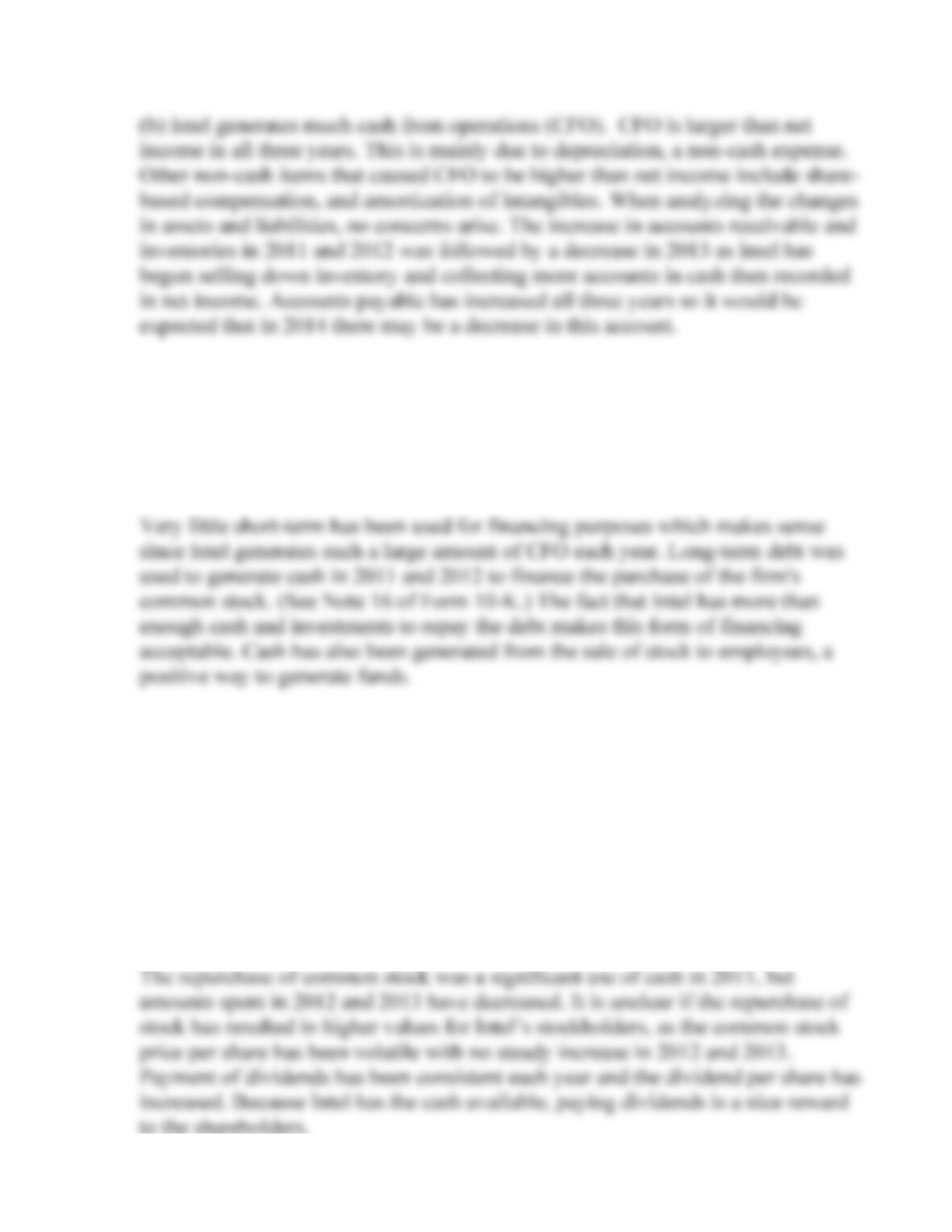
The relatively low percentage of cash flow from operations is explained by the
purchases and ultimate maturities of investments. In all three years between 82%
and 95% of cash has been generated from operations or maturities of investments.
Investments have most likely been purchased from cash that was originally
generated from operations.
The majority of cash is used to purchase available-for-sale investments and trading
assets. Given Intel’s significant generation of CFO each year, it is appropriate to
invest excess cash so a return is received until the firm has need for the excess
funds. It is noteworthy that the dollar amounts have increased over the past three
years. Intel continues to invest yearly in new property, plant and equipment which
is an expected expenditure for this type of firm since Intel should be updating and
replacing plant and equipment as new products are developed. It is also good that
Intel is pursuing acquisitions to diversify into areas other than semiconductors with
the changing computing environment. In 2011 McAfee was acquired.