Wild, Shaw, Financial & Managerial Accounting, 8e Solutions Manual: Chapter 4
Chapter 4
Accounting for Merchandising
Operations
QUESTIONS
1. Merchandising companies report Merchandise Inventory on the balance sheet,
service companies do not. Also, merchandising companies report both Sales (of
goods) and Cost of Goods Sold on the income statement, while service companies
do not.
2. Additional accounts of a merchandising company likely include Merchandise
Inventory, Sales (of goods), Cost of Goods Sold, Sales Discounts, and Sales Returns
and Allowances (and possibly Delivery Expense). Others might include Allowance
for Sales Discounts, Sales Refund Payable, and Inventory Returns Estimated.
3. A company can have a net loss if its expenses (absent cost of goods sold) are
greater than its gross profit from sales of merchandise.
4. A cash discount can be offered to encourage customers to promptly pay. This
provides cash more quickly to the seller and avoids the costs of additional
collection activities. Of course, the seller must perform a costs vs. benefits analysis
on the merits and terms of any cash discount offered to customers.
5. For a perpetual inventory system, inventory shrinkage is determined by taking a
physical count of the inventory available at the end of a period and comparing that
amount with the amount recorded in the Merchandise Inventory account.
6. Cash discounts are granted in return for early payment and reduce the amount paid
below the negotiated price. Cash discounts are recorded in the accounting records
(as a reduction of Merchandise Inventory). Trade discounts are deducted from the
list or catalog price to determine the purchase (negotiated) price. Trade discounts
are not recorded in the accounting records.
10. The single-step income statement format presents cost of goods sold and expenses
in one list, totals the list, and subtracts the total from net sales in one step. The
multiple-step format presents intermediate totals, including gross profit (the
difference between net sales and cost of goods sold) and sub-categories of
expenses (often by key activities).
11. Apple calls its inventory account “Inventories.” A detailed calculation of cost of
goods sold (cost of sales) is not presented by Apple.
12. Google titles its cost of goods sold account as “Cost of revenues.”
QUICK STUDIES
Quick Study 4-1 (10 minutes)
1. G. Merchandise inventory 5. H. Purchases discount
2. B. Credit period 6. F. Gross profit
Quick Study 4-2 (5 minutes)
Quick Study 4-3 (15 minutes)
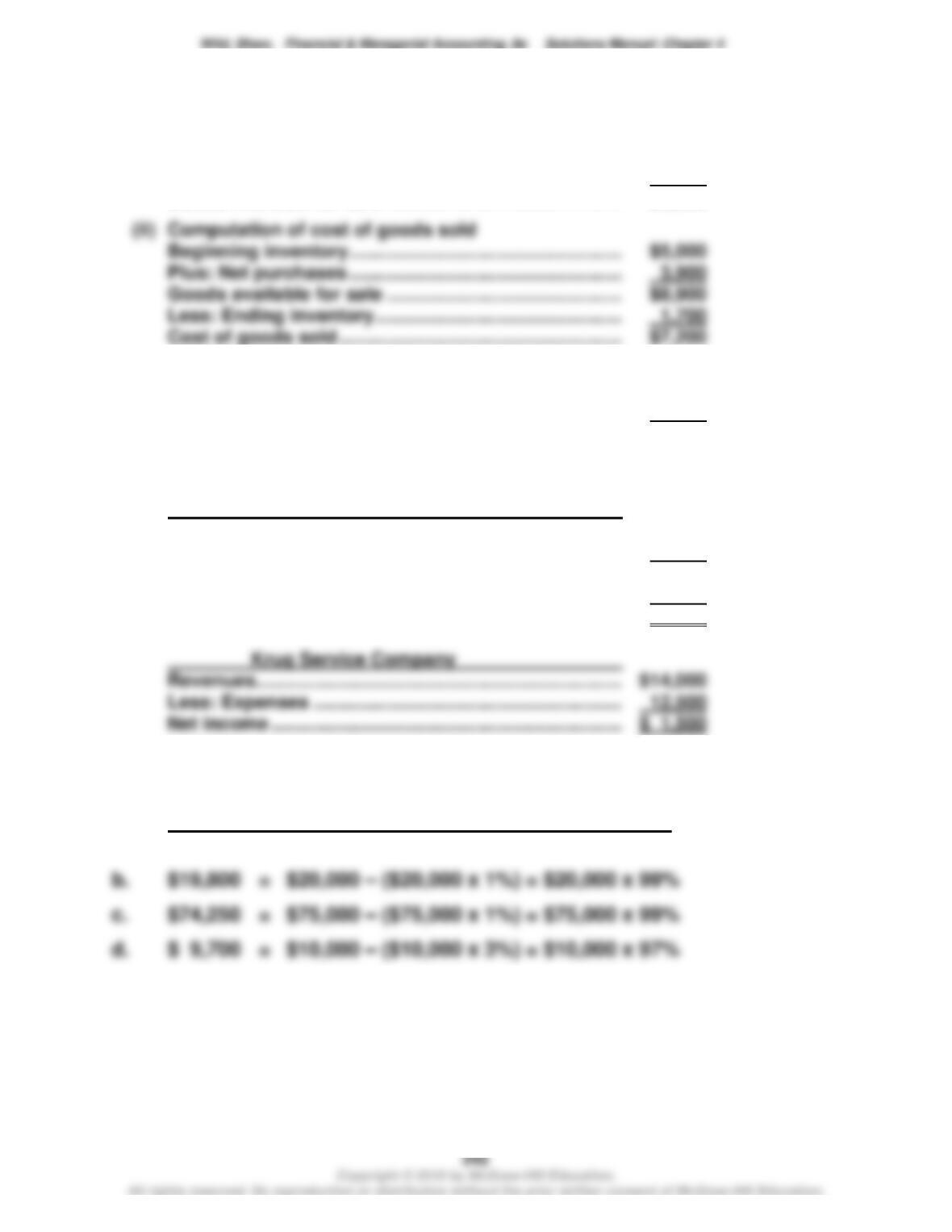
a. (i) Computation of goods available for sale
Beginning inventory ……………………………………………. $5,000
Plus: Net purchases ……………………………………………. 3,900
Goods available for sale ……………………………………… $8,900
(iii) Computation of gross profit
Net sales …………………………………………………………….. $9,500
Less: Cost of goods sold (see ii) …………………………. 7,200
Gross profit ………………………………………………………… $2,300
b. Computation of net income
Kleiner Merchandising Company
Net sales …………………………………………………………….. $9,500
Less: Cost of goods sold (see ii) …………………………. 7,200
Gross profit ………………………………………………………… $2,300
Less: Expenses ………………………………………………….. 1,450
Net income …………………………………………………………. $ 850
Quick Study 4-4 (15 minutes)
Payment Computations
a. $ 4,900 = $ 5,000 – ($ 5,000 x 2%) = $ 5,000 x 98%
Quick Study 4-5 (15 minutes)
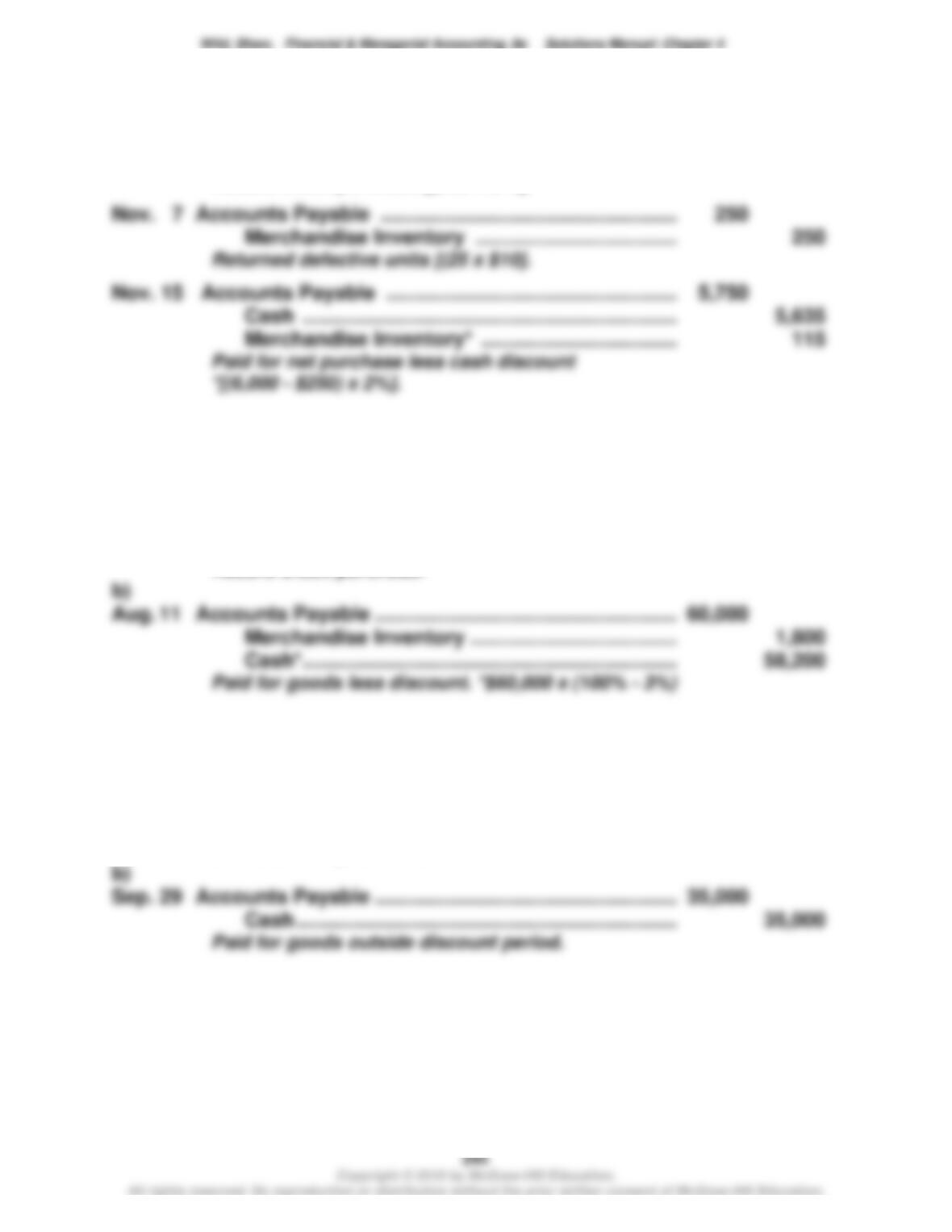
Nov. 5 Merchandise Inventory ……………………………………… 6,000
Accounts Payable ……………………………………… 6,000
Record credit purchase [(600 x $10].
Quick Study 4-6 (10 minutes)
a)
Aug. 1 Merchandise Inventory …………………………..………….. 60,000
Accounts Payable ………………………………………. 60,000
Quick Study 4-7 (10 minutes)
a)
Sep. 15 Merchandise Inventory ………………………………………. 35,000
Accounts Payable ………………………………………. 35,000
Record credit purchase.
Quick Study 4-8 (15 minutes)
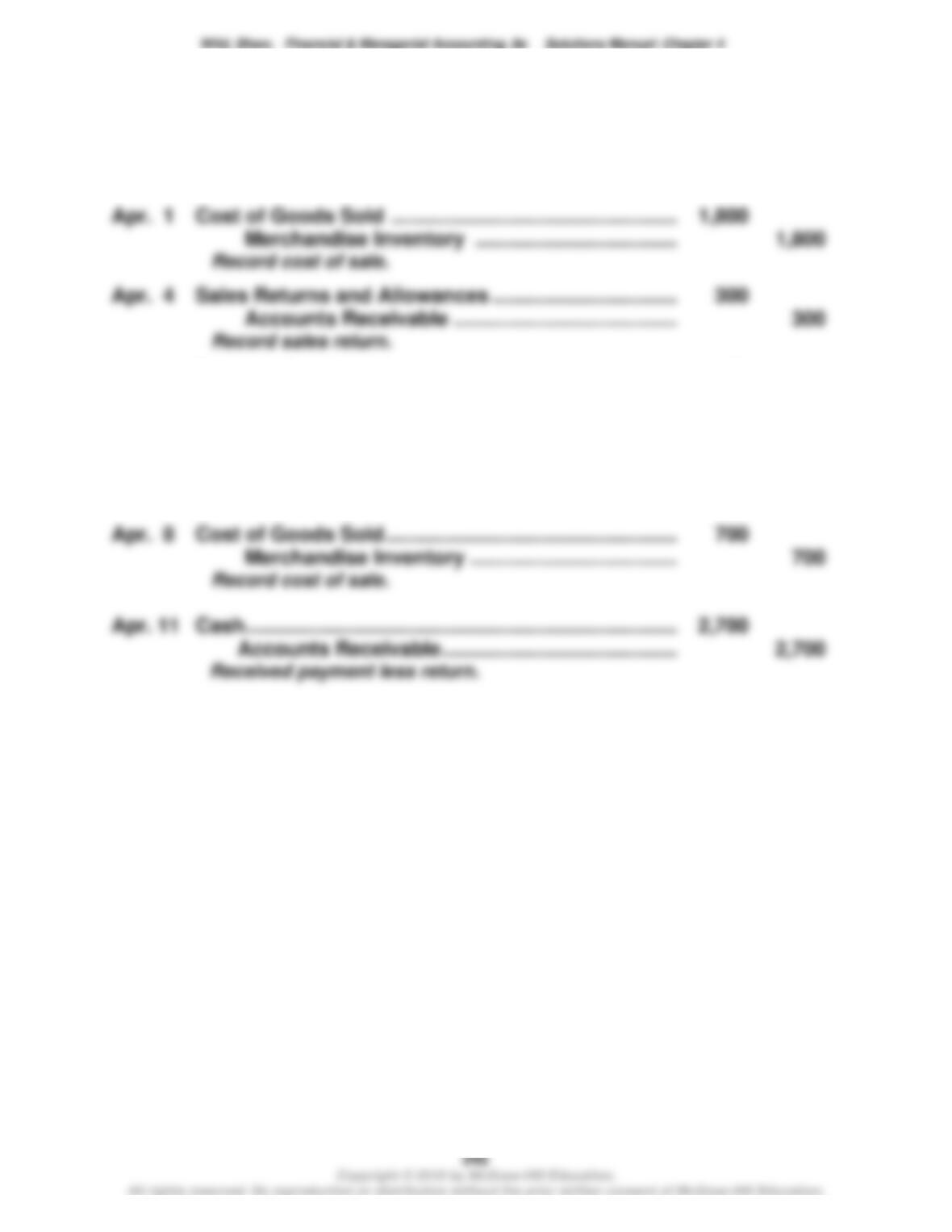
Apr. 1 Accounts Receivable ………………………………………… 3,000
Sales …………………………………………………………. 3,000
Record sale of goods.
Apr. 4 Merchandise Inventory ………………………………………. 180
Cost of Goods Sold ……………………………………. 180
Returned goods to inventory.
Apr. 8 Accounts Receivable ………………………………………… 1,000
Sales …………………………………………………………. 1,000
Record sale of goods.
Quick Study 4-9 (10 minutes)
July 31 Cost of Goods Sold …………………………………………… 1,900
Merchandise Inventory ………………………………. 1,900
Adjust for shrinkage based on
physical count [$37,800 – $35,900].
Quick Study 4-10 (10 minutes)
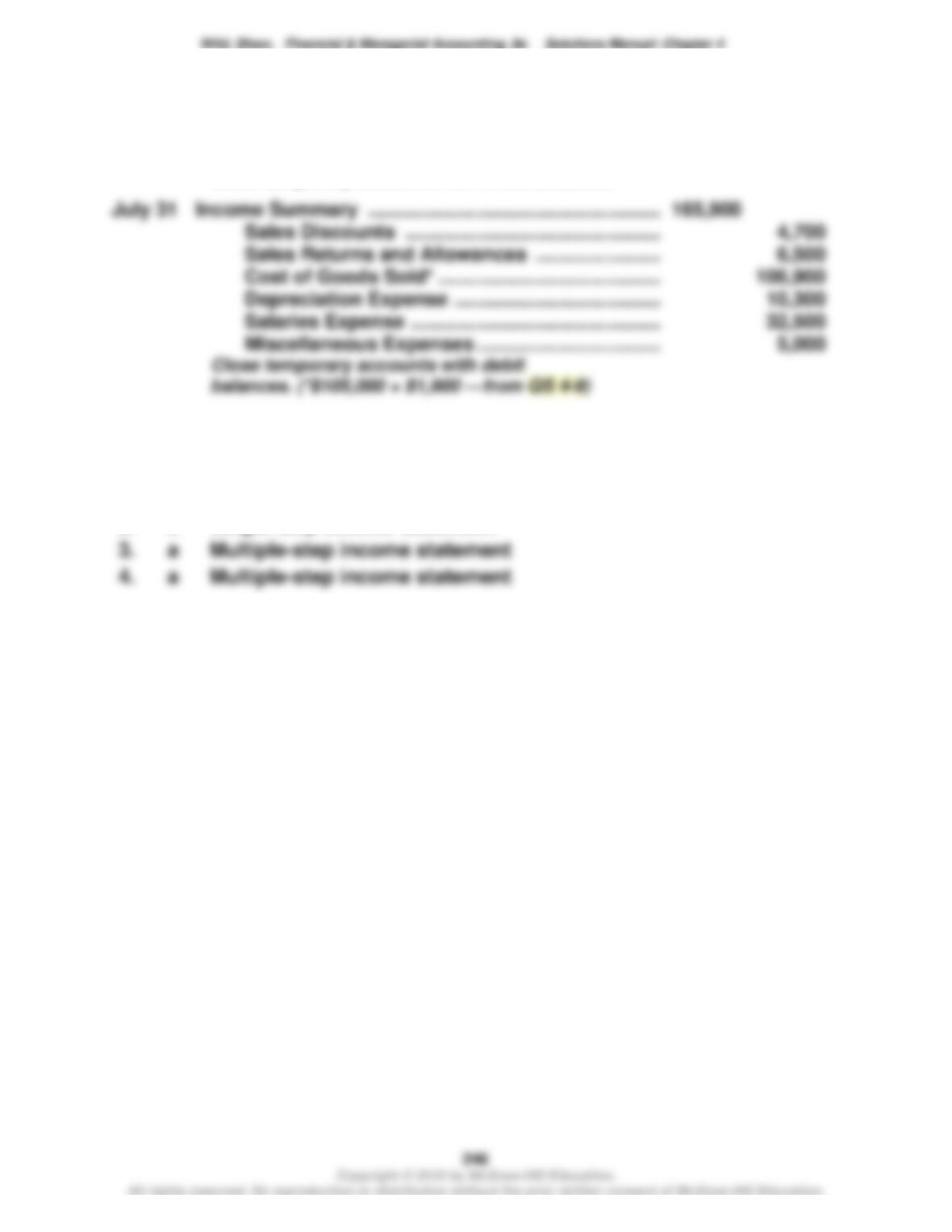
July 31 Sales ………………………………………………………………… 160,200
Income Summary ………………………………………. 160,200
Close temporary accounts with credit balances.
Quick Study 4-11 (10 minutes)
1. a Multiple-step income statement
2. b Single-step income statement
Quick Study 4-12 (20 minutes)
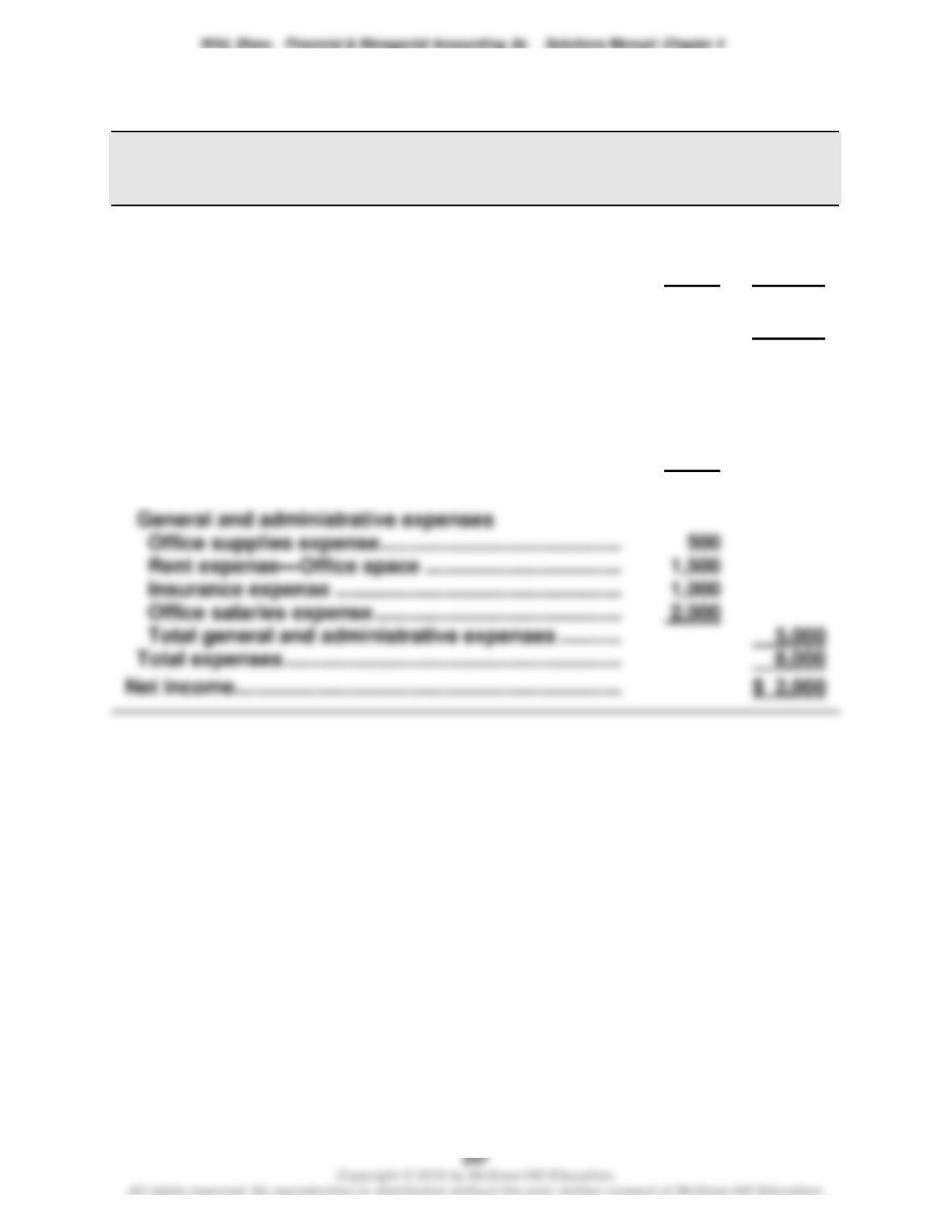
Save-the-Earth Co.
Income Statement
For Year Ended December 31
Sales ……………………………………………………………………. $20,000
Less: Sales discounts ………………………………………….. $750
Sales returns and allowances …………………….. 250 1,000
Net sales ……………………………………………………………… 19,000
Cost of goods sold ………………………………………………. 9,000
Gross profit …………………………………………………………. 10,000
Expenses
Selling expenses
Sales staff salaries …………………………………………… 2,500
Advertising expense …………………………..…………….. 500
Total selling expenses ……………………………………… 3,000
Quick Study 4-13 (20 minutes)
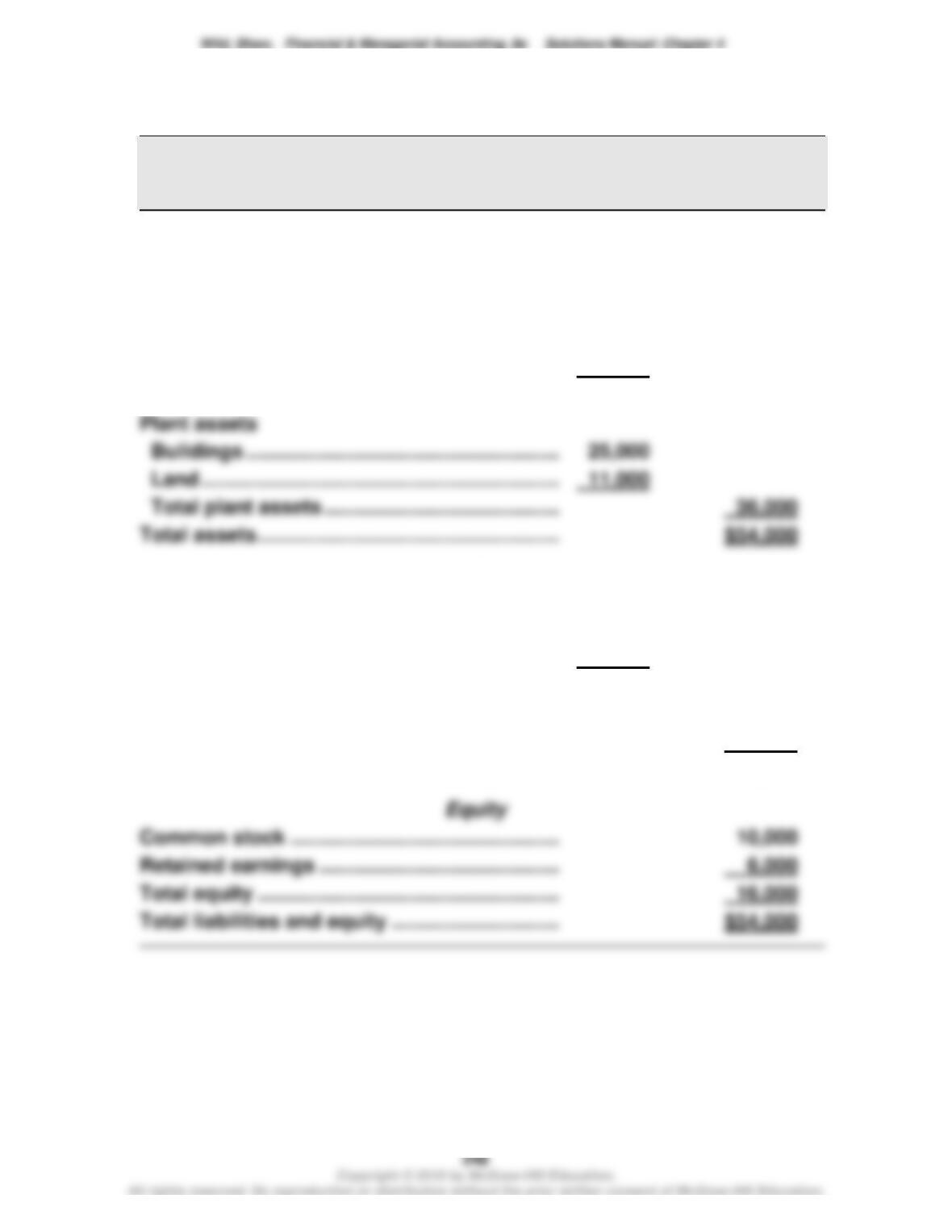
Clear Water Co.
Balance Sheet
December 31
Assets
Current assets
Cash ………………………………………………………. $ 8,000
Accounts receivable ………………………………. 2,000
Merchandise inventory …………………………... 7,000
Office supplies ……………………………………….. 1,000
Total current assets ……………………………….. $18,000
Liabilities
Current liabilities
Accounts payable …………………………………… $ 5,000
Wages payable ………………………………………. 3,000
Total current liabilities ……………………………. $ 8,000
Long-term liabilities
Notes payable ………………………………………… 30,000
Total liabilities …………………………………………. 38,000
Quick Study 4-14 (10 minutes)
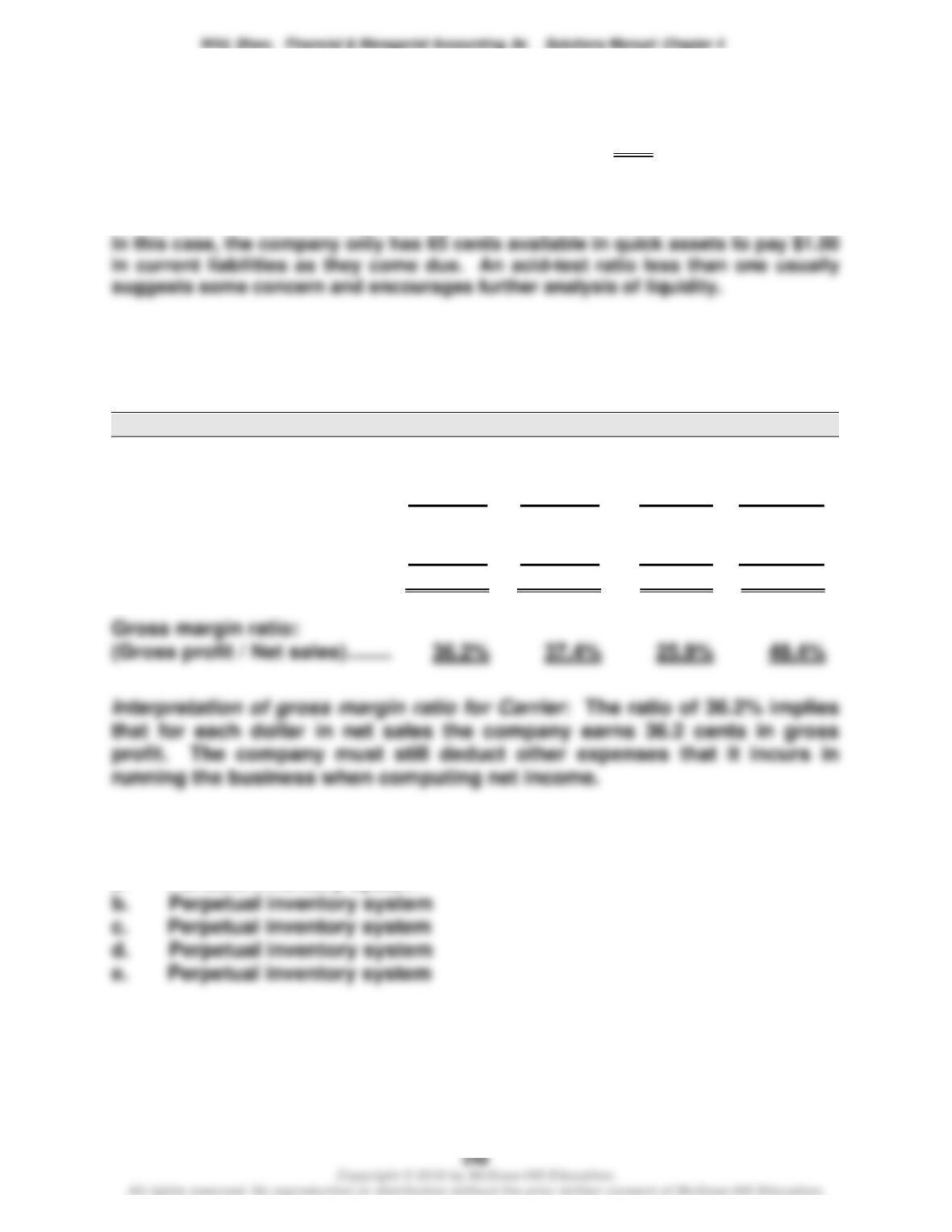
Acid-test ratio = ($1,490 + $2,800) / ($5,750 + $850) = 0.65
Explanation of acid-test ratio: The acid-test ratio is used to evaluate (reflect on)
the liquidity of a company. It helps in determining whether a company will be
able to meet its current obligations as they come due with its most liquid assets.
Quick Study 4-15 (10 minutes)
Carrier
Lennox
Trane
York
Sales ……………………………………..
$150,000
$550,000
$38,700
$255,700
Sales discounts ……………………..
(5,000)
(17,500)
(600)
(4,800)
Sales returns and allowances …….
(20,000)
(6,000)
(5,100)
(900)
Net sales ………………………………..
125,000
526,500
33,000
250,000
Cost of goods sold …………………
(79,750)
(329,589)
(24,453)
(126,500)
Gross profit …………………………..
$ 45,250
$196,911
$ 8,547
$123,500
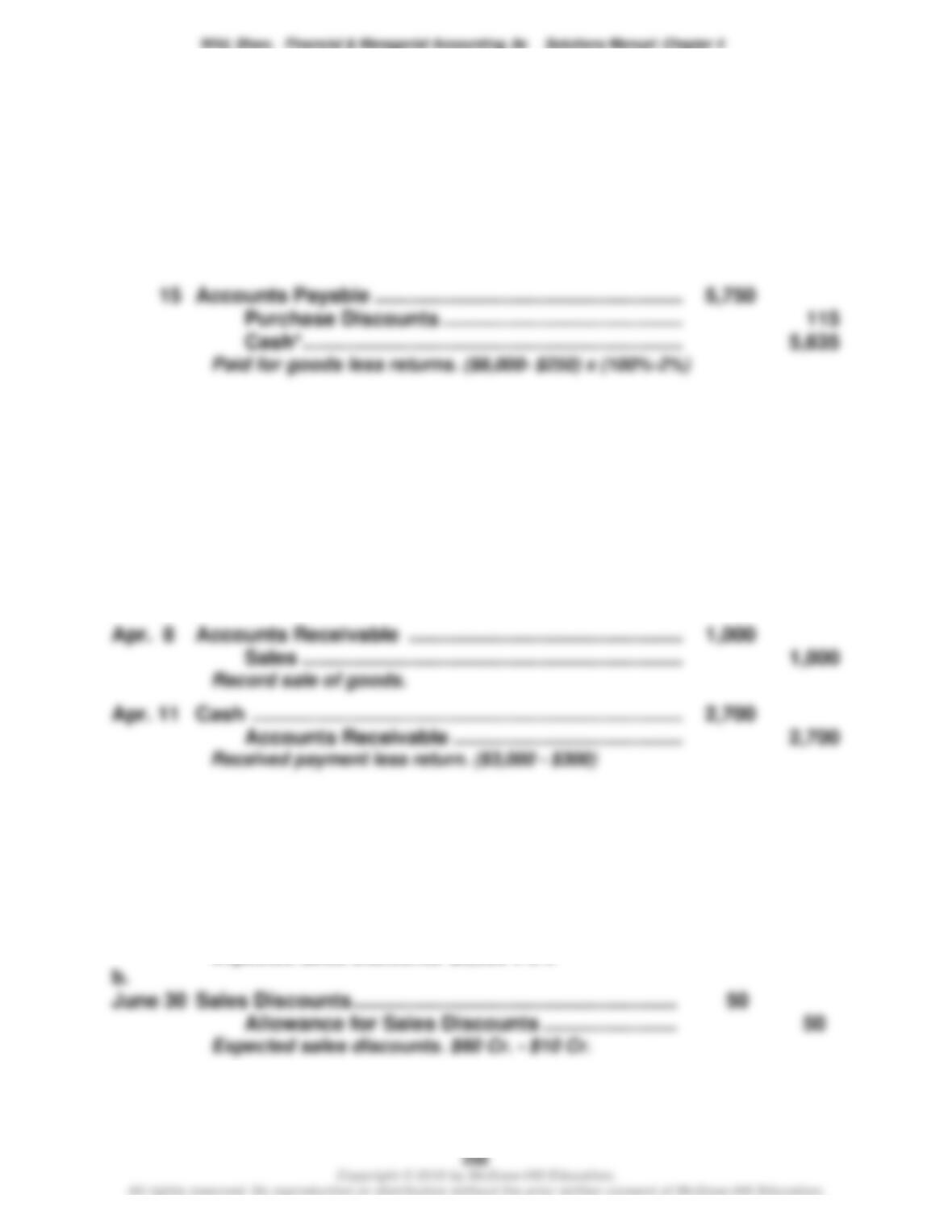
Quick Study 4-16A (5 minutes)
Quick Study 4-17A (10 minutes) PERIODIC & GROSS
Nov. 5 Purchases ………………………………………………………….. 6,000
Accounts Payable ……………………………………….. 6,000
Record credit purchase. (600 units x $10)
7 Accounts Payable ………………………………………………. 250
Purchases Returns & Allowances ……………….. 250
Returned defective units. (25 units x $10)
Quick Study 4-18A (10 minutes) PERIODIC & GROSS
Apr. 1 Accounts Receivable …………………………………………. 3,000
Sales ………………………………………………………….. 3,000
Record sale of goods.
Apr. 4 Sales Returns and Allowances ……………………………. 300
Accounts Receivable ………………………………….. 300
Record sales return.
Quick Study 4-19B (10 minutes)
a.
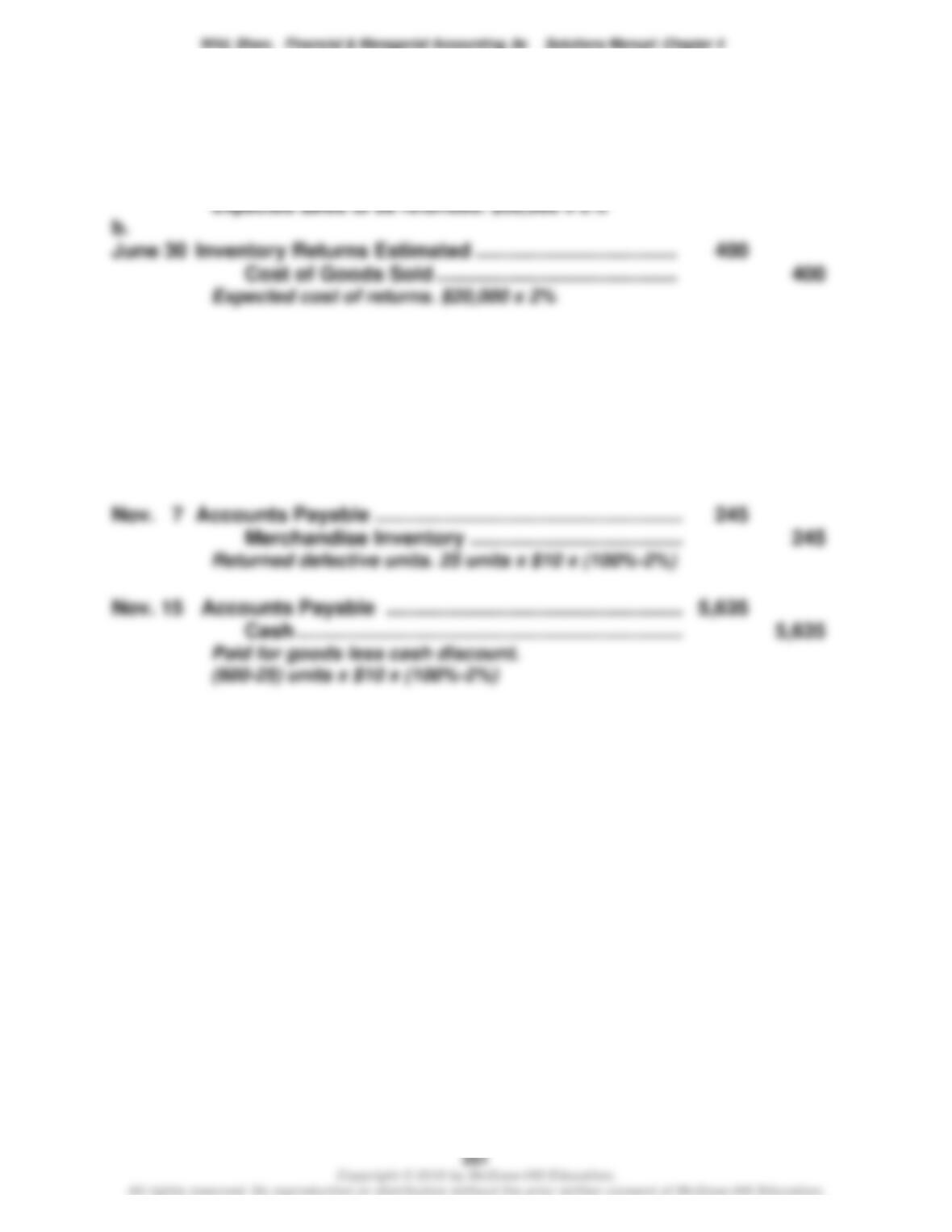
June 30 Sales Discounts …………………………………………………. 60
Allowance for Sales Discounts …………………… 60
Quick Study 4-20B (10 minutes)
a.
June 30 Sales Returns and Allowances …………………………... 1,000
Sales Refund Payable ………………………………… 1,000
Quick Study 4-21C (10 minutes) NET & PERPETUAL
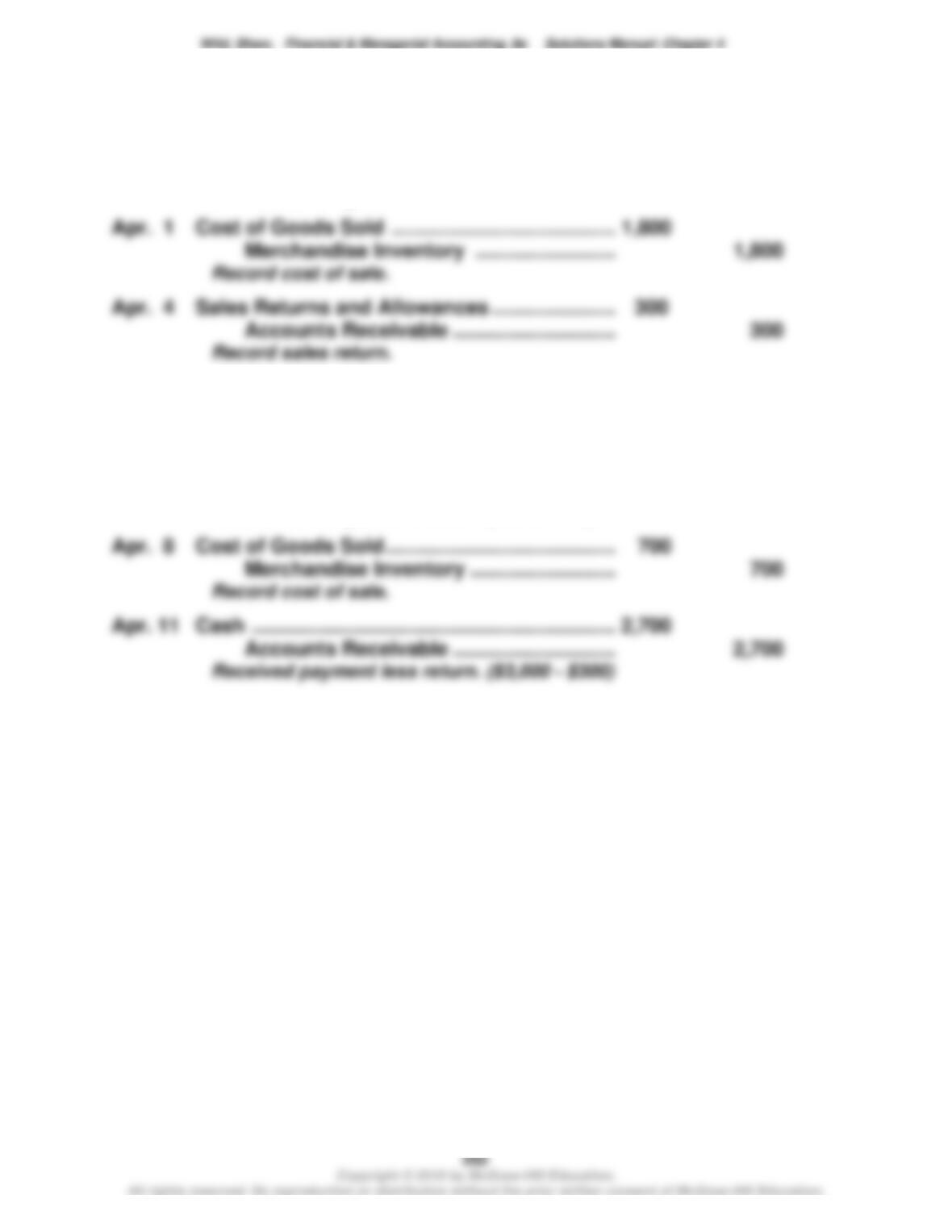
Nov. 5 Merchandise Inventory ………………………………………. 5,880
Accounts Payable ………………………………………. 5,880
Record credit purchase. 600 units x $10 x (100%-2%)
Quick Study 4-22C (10 minutes) NET & PERPETUAL
Apr. 1 Accounts Receivable ………………………………. 3,000
Sales ……………………………………………….. 3,000
Record sale of goods.
Apr. 4 Merchandise Inventory …………………………….. 180
Cost of Goods Sold ………………………….. 180
Returned goods to inventory.
Apr. 8 Accounts Receivable ………………………………. 990
Sales ……………………………………………….. 990
Record sale of goods. $1,000 x [100% – 1%]
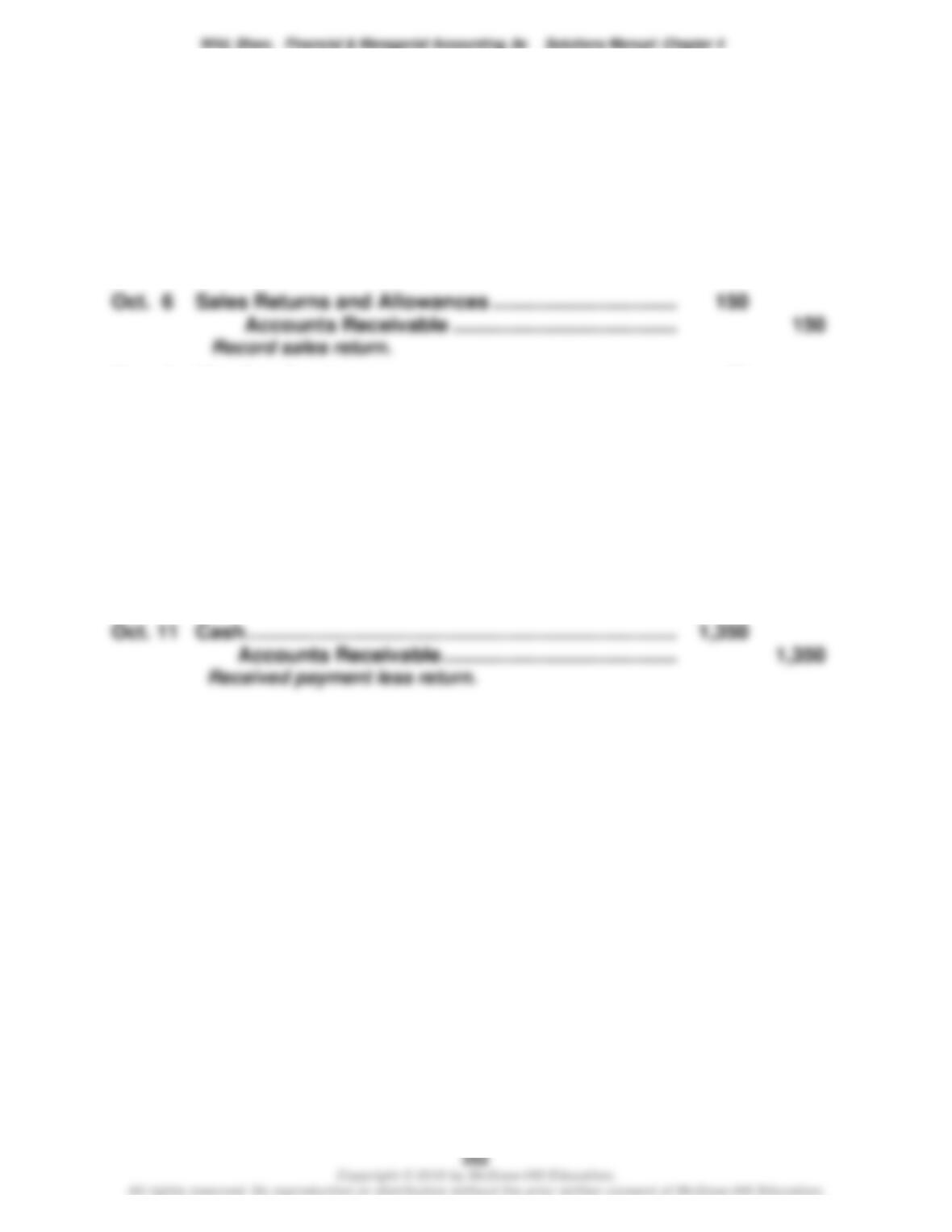
Quick Study 4-23 (15 minutes)
Oct. 1 Accounts Receivable ………………………………………… 1,500
Sales …………………………………………………………. 1,500
Record sale of goods.
Oct. 1 Cost of Goods Sold …………………………………………… 900
Merchandise Inventory ……………………………… 900
Record cost of sale.
Oct. 6 Merchandise Inventory ………………………………………. 90
Cost of Goods Sold ……………………………………. 90
Returned goods to inventory.
Oct. 9 Accounts Receivable ………………………………………… 700
Sales …………………………………………………………. 700
Record sale of goods.
Oct. 9 Cost of Goods Sold …………………………..……………….. 450
Merchandise Inventory ………………………………. 450
Record cost of sale.
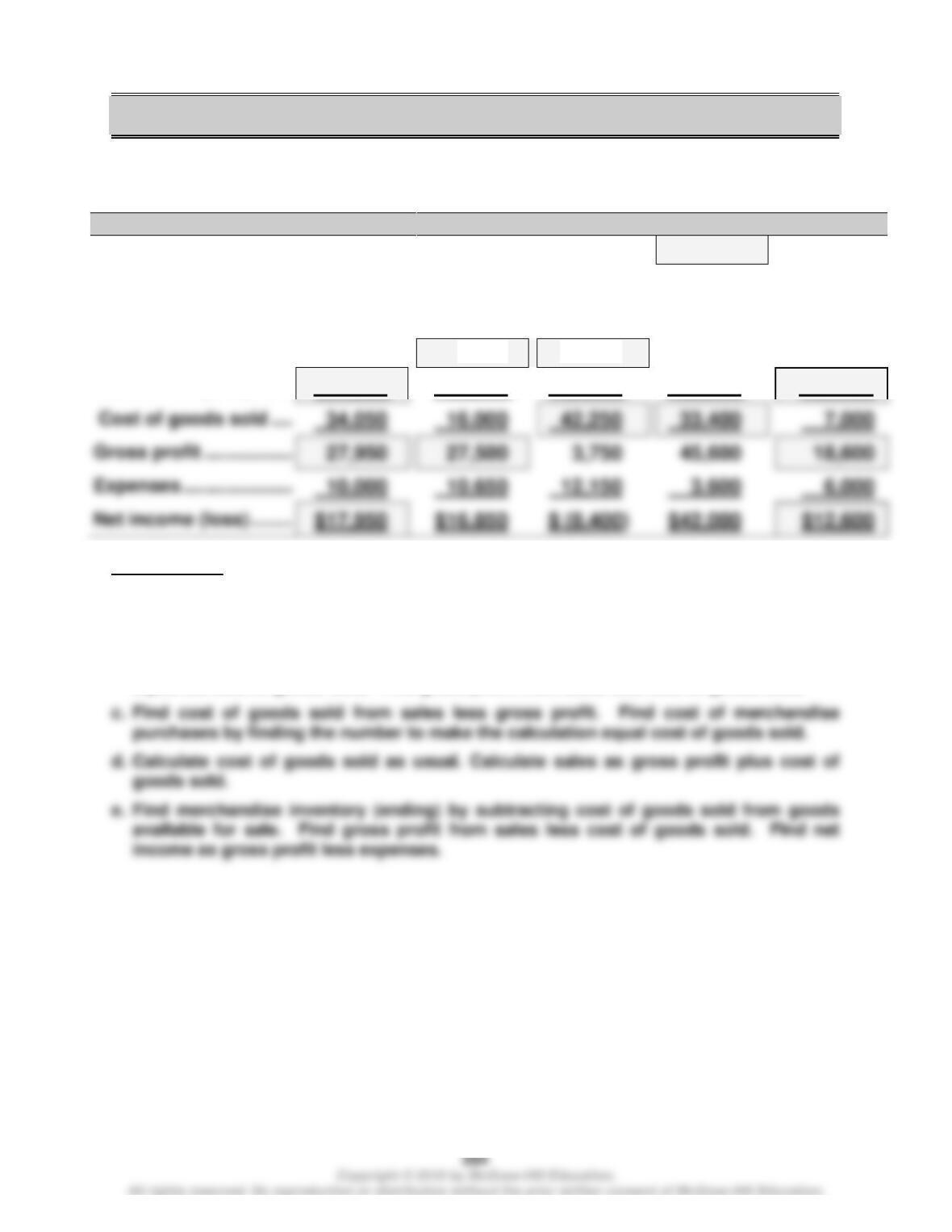
Wild, Shaw, Financial & Managerial Accounting, 8e Solutions Manual: Chapter 4
EXERCISES
Exercise 4-1 (30 minutes)
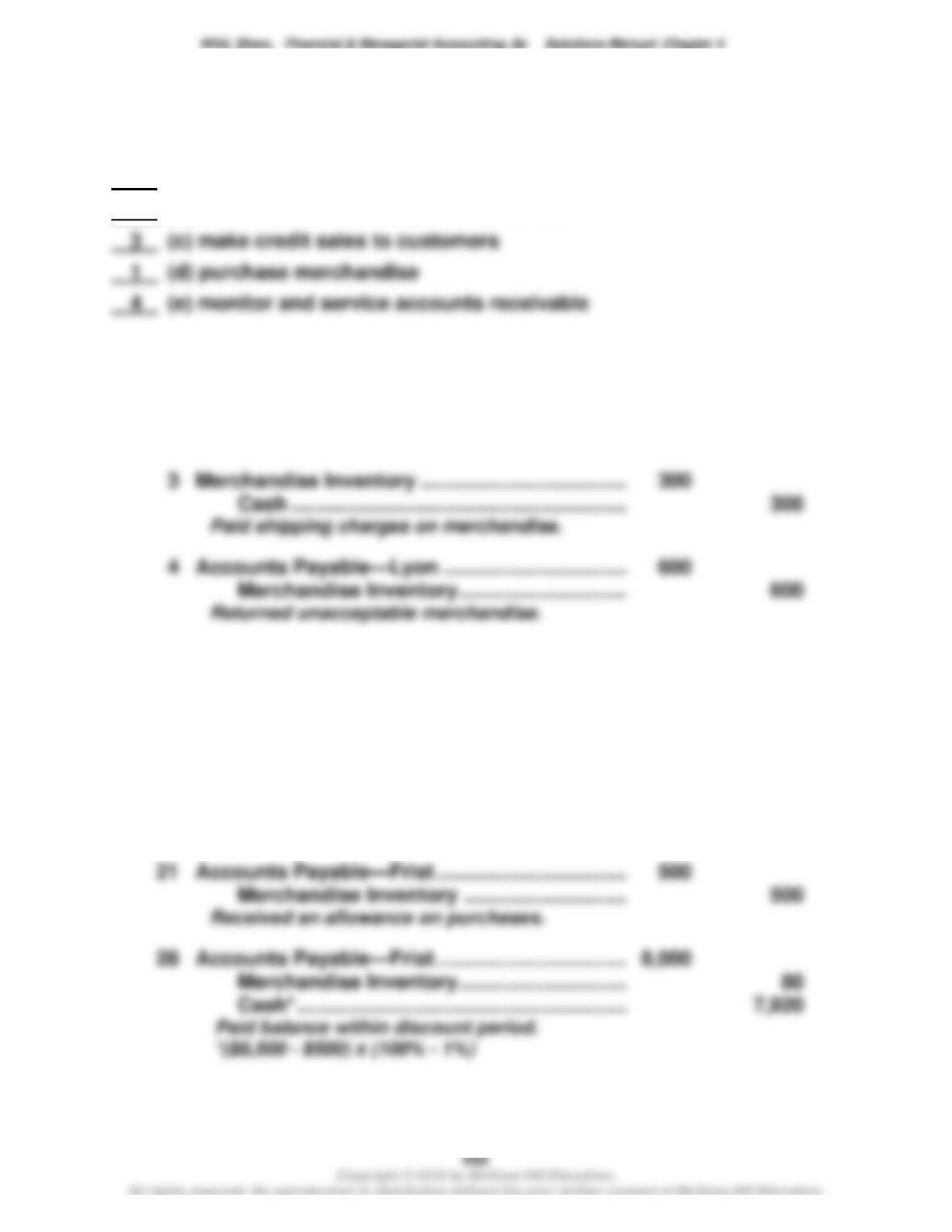
Note: The original missing numbers are blocked and shaded.
(a)
(b)
(c)
(d)
(e)
Sales ……………………….
$62,000
$43,500
$46,000
$79,000
$25,600
Cost of goods sold
Merch. inv. (beg.) …….
8,000
17,050
7,500
8,000
4,560
Total cost of merch.
purchases ……………..
38,000
1,950
43,750
32,000
6,600
Merch. inv. (end.) …….
(11,950)
(3,000)
(9,000)
(6,600)
(4,160)
Cost of goods sold ….
42,250
33,400
Gross profit ……………..
Explanations:
a. Find merchandise inventory (ending) by subtracting cost of goods sold from goods
available for sale. Find gross profit as the difference between the sales and cost of
goods sold. Find net income as the gross profit less the expenses.
b. Find total cost of merchandise purchases by finding the number that makes the total
equal the cost of goods sold. Find gross profit from sales less cost of goods sold.
Exercise 4-2 (10 minutes)
Operating cycle of a merchandiser with credit sales follows (chronological):
2 (a) prepare merchandise for sale
5 (b) collect cash from customers on account
Exercise 4-3 (30 minutes)
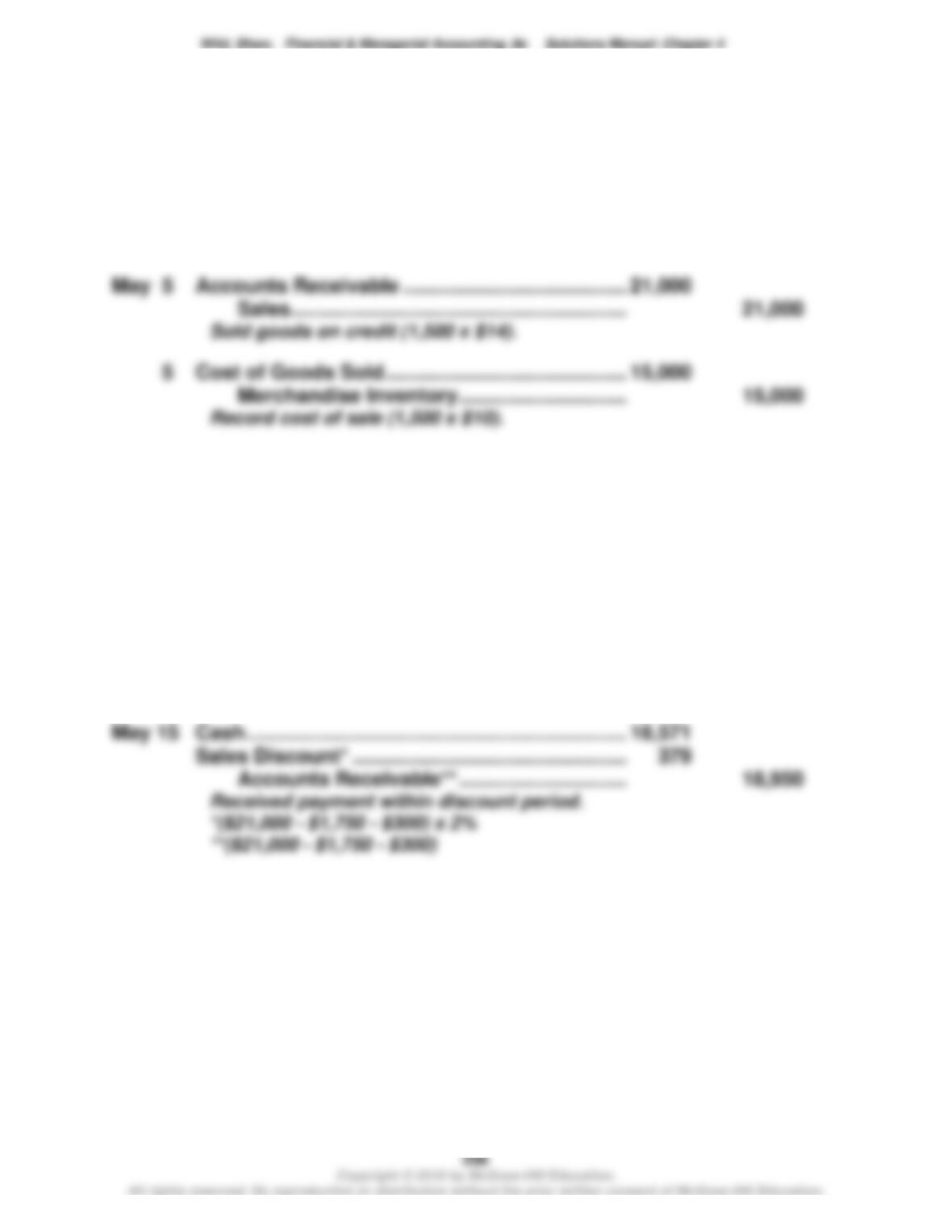
Apr. 2 Merchandise Inventory ………………………………. 4,600
Accounts Payable—Lyon …………………….. 4,600
Purchased merchandise on credit.
17 Accounts Payable—Lyon …………………………... 4,000
Merchandise Inventory ………………………… 80
Cash* ………………………………………………….. 3,920
Paid within discount period less returns.
*($4,600 – $600) x (100% – 2%)
18 Merchandise Inventory ……………………………… 8,500
Accounts Payable—Frist …………………….. 8,500
Purchased merchandise on credit.
Exercise 4-4 (30 minutes)
SELLER—Allied
May 3 Merchandise Inventory ………………………………. 20,000
Cash …………………………………………………… 20,000
Purchased goods (2,000 x $10).
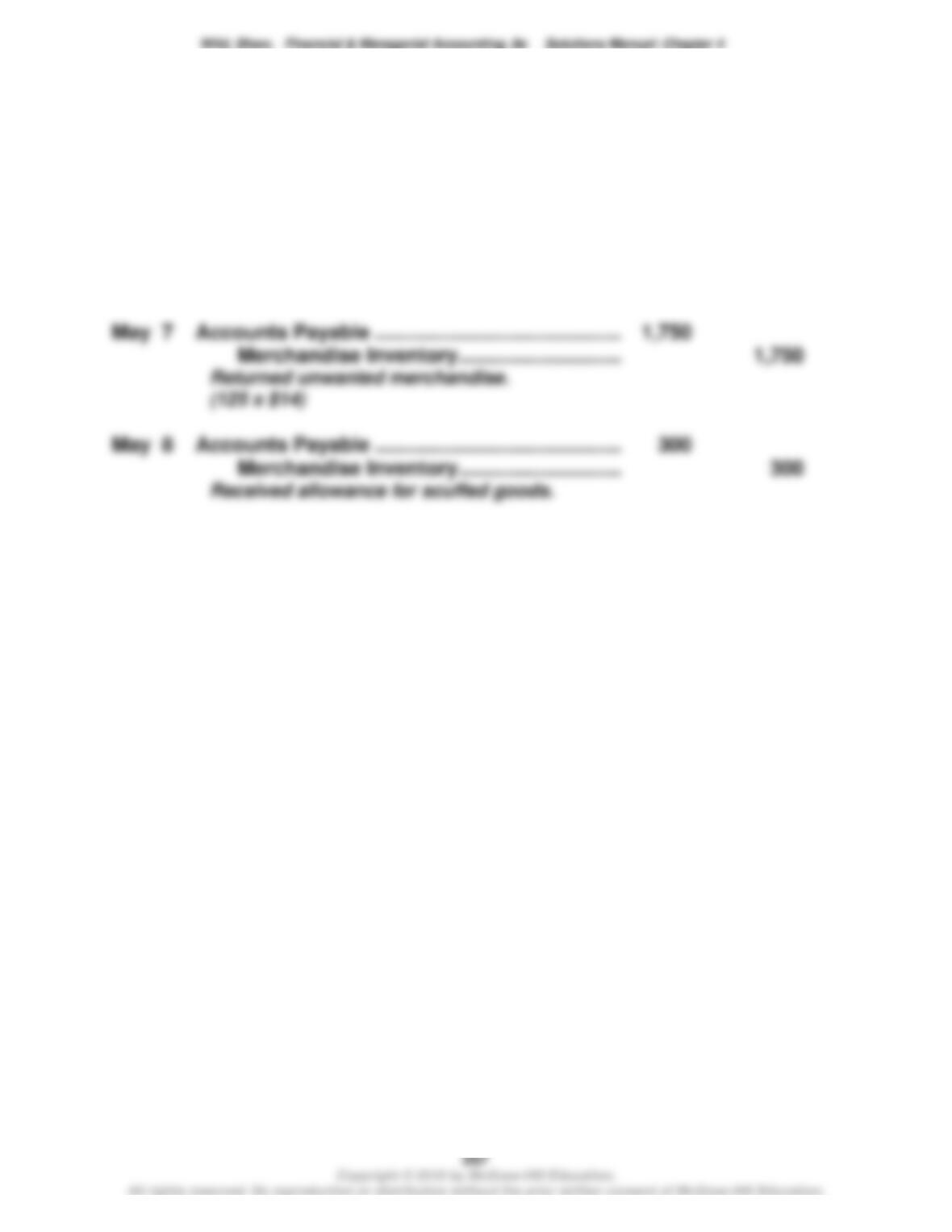
May 7 Sales Returns and Allowances …………………… 1,750
Accounts Receivable …………………………... 1,750
Accepted returns (125 x $14).
7 Merchandise Inventory ………………………………. 1,250
Cost of Goods Sold …………………………….. 1,250
Returned goods to inventory (125 x $10).
May 8 Sales Returns and Allowances …………………… 300
Accounts Receivable …………………………... 300
Allowance for scuffed items.
Exercise 4-5 (15 minutes)
BUYER—Macy
May 3 No entry for buyer.
May 5 Merchandise Inventory ……………………………… 21,000
Accounts Payable ………………………………. 21,000
Purchased merchandise on credit.
May 15 Accounts Payable* ……………………………………. 18,950
Merchandise Inventory** …………………….. 379
Cash ………………………………………………….. 18,571
Paid for May 5 purchase less R&A.
* ($21,000 – $1,750 – $300)
**($21,000 – $1,750 – $300) x 2%
Exercise 4-6 (30 minutes)
1. BUYER– Santa Fe
a) Credit Purchase
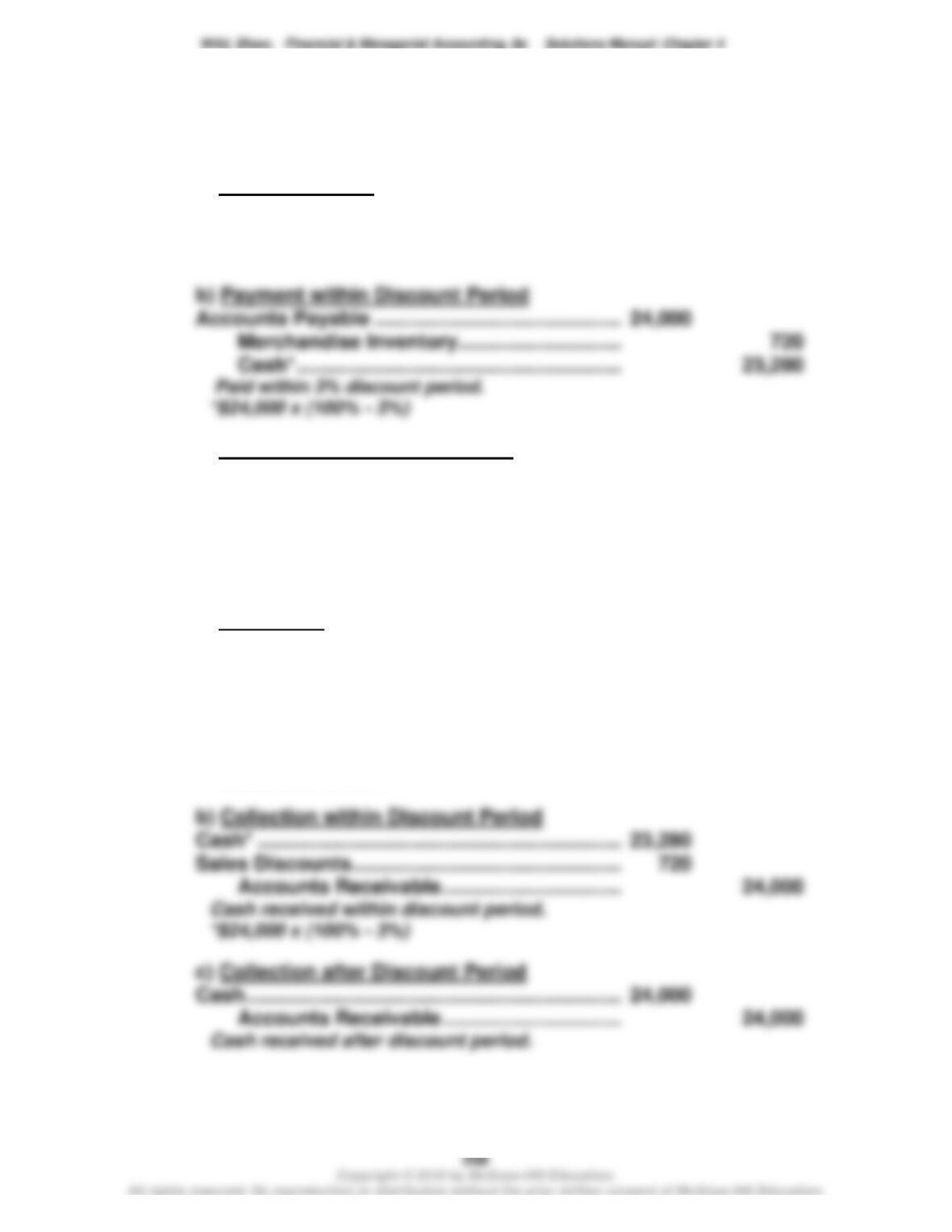
Merchandise Inventory ……………………………… 24,000
Accounts Payable ………………………………. 24,000
Purchased merchandise on credit.
c) Payment after Discount Period
Accounts Payable …………………………………….. 24,000
Cash ………………………………………………….. 24,000
Paid after 3% discount period.
2. SELLER – Mesa
a) Credit Sale
Accounts Receivable ………………………………… 24,000
Sales ………………………………………………….. 24,000
Sold merchandise on account.
Cost of Goods Sold ………………………………….. 16,000
Merchandise Inventory ………………………. 16,000
Record cost of sale.
Exercise 4-7 (25 minutes)
1. Entries for Sydney (BUYER):
May 11 Merchandise Inventory ……………………………. 40,000
Accounts Payable ……………………………… 40,000
Purchased goods.
11 Merchandise Inventory ……………………………. 345
Cash …………………………………………………. 345
Paid shipping charges on purchased goods.
2. Entries for Troy (SELLER):
May 11 Accounts Receivable ……………………………….. 40,000
Sales …………………………………………………. 40,000
Sold goods.
11 Cost of Goods Sold ………………………………….. 30,000
Merchandise Inventory ………………………. 30,000
Record cost of sale.
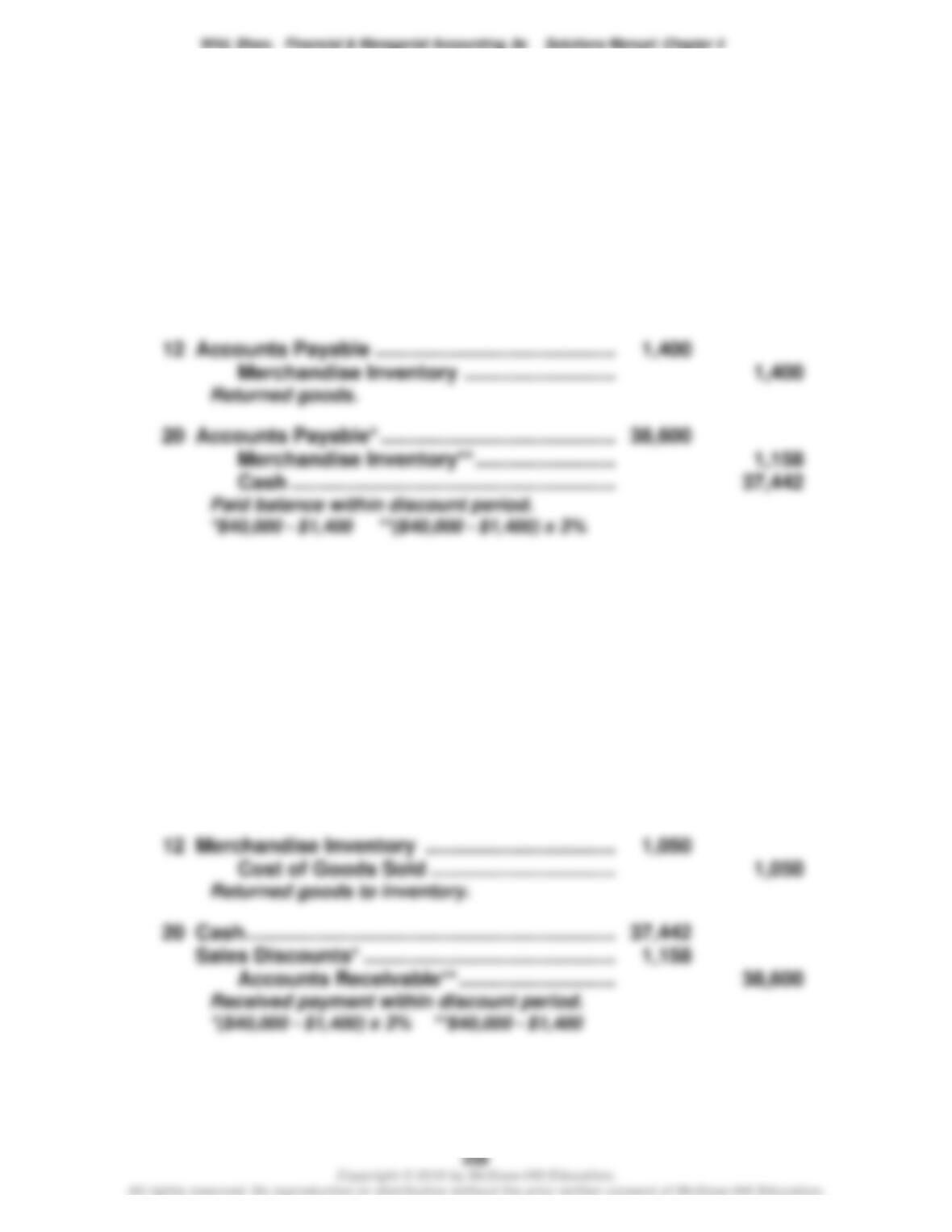
12 Sales Returns and Allowances …………………. 1,400
Accounts Receivable …………………………. 1,400
Accepted returns.
Exercise 4-8 (30 minutes)
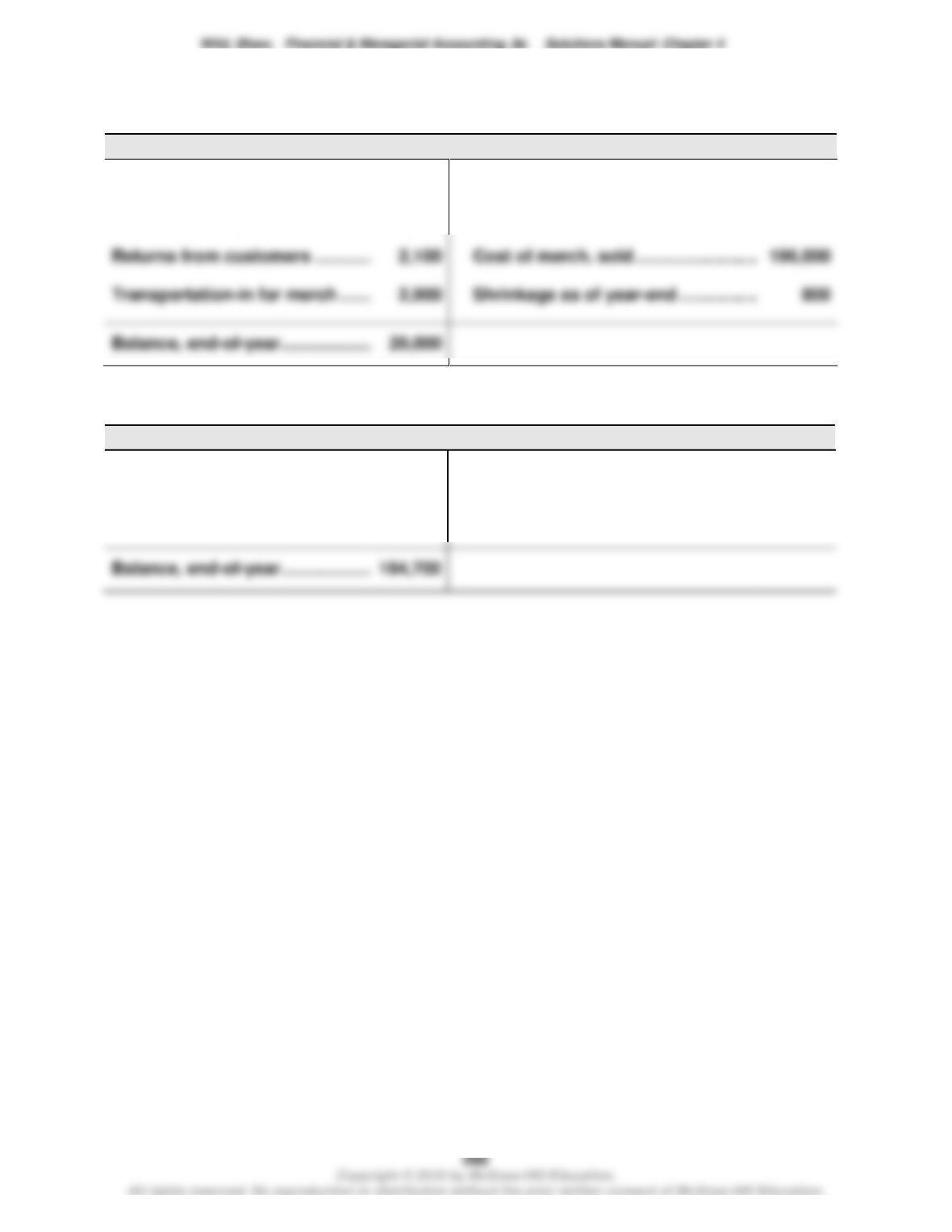
Merchandise Inventory
Balance, beginning-year ………….
25,000
Discounts received on merch …………………………..
1,700
Cost of merch. purchases ……….
192,500
Returns to and allow. on merch …………………………..
4,000
Cost of Goods Sold
Cost of merch. sold ………………..
Inventory shrinkage at
year-end (adjusting entry) ……..
196,000
800
Returns from customers and
restored to inventory …………………………..
2,100