CHAPTER 4
Activity-Based Costing
ASSIGNMENT CLASSIFICATION TABLE
Learning Objectives
Questions
Brief
Exercises
Do It!
Exercises
A
Problems
*1. Discuss the difference
between traditional costing
and activity-based costing.
1, 2, 3, 4, 5
1, 2
1
1, 2, 3, 4, 5,
10, 11
1A, 3A,
4A, 5A
*2. Apply activity-based
costing to a manufacturer.
6, 7, 9, 10,
11, 12
3, 4, 5, 6, 7
2
1, 3, 4, 5, 6,
7, 8, 9, 10,
11
1A, 2A, 3A,
4A, 5A
*3. Explain the benefits and
limitations of activity-based
costing.
8, 13, 14, 15,
16, 17, 19
8, 9, 10, 11,
12
3
9, 10, 11, 12,
13, 16
1A, 5A
*4. Apply activity-based
costing to service
9, 12
4
ASSIGNMENT CHARACTERISTICS TABLE
Problem
Number
Description
Difficulty
Level
Time
Allotted (min.)
1A
Assign overhead using traditional costing and ABC;
compute unit costs; classify activities as value- or
non-value-added.
Moderate
35–45
2A
Assign overhead to products using ABC and evaluate
decision.
Moderate
25–35
Assign overhead costs using traditional costing and ABC;
Moderate
35–45
5A
Assign overhead costs to services using traditional
Moderate
35–45
BLOOM’ S TAXONOMY TABLE
Correlation Chart between Bloom’s Taxonomy, Learning Objectives and End–of-Chapter Exercises and Problems
Learning Objective
Knowledge
Comprehension
Application
Analysis
Synthesis
Evaluation
*1. Discuss the difference
between traditional costing and
activity-based costing.
Q4-1
Q4-2
Q4-3
Q4-4
Q4-5
DI4-1
BE4-1
BE4-2
E4-1
E4-2
E4–10
E4–11
P4–1A
E4-3
E4-4
E4-5
P4–3A
P4–4A
P4–5A
*2. Apply activity-based costing to
a manufacturer.
Q4-6
Q4-7
Q4-9
Q4–10
Q4–11
Q4–12
BE4-3
BE4-4
BE4-5
BE4-6
BE4-7
DI4-2
E4-1
E4-9
E4–10
E4–11
P4–1A
P4–2A
E4-3
E4-4
E4-5
E4-6
E4-7
E4-8
P4–3A
P4–4A
P4–5A
**3. Explain the benefits and
limitations of activity-based
costing.
Q4-8
Q4–13
Q4–14
A4–15
Q4–16
Q4–17
Q4–19
DI4-3
BE4-11
BE4-12
E4-9
E4–10
E4–11
P4–1A
BE4-8
BE4-9
BE4–10
E4–12
E4–13
E4–16
P4–5A
*4. Apply activity-based costing to
service industries.
Q4–18
BE4-12
DI4-4
E4–14
E4–15
E4–17
BE4-9
P4–5A
*5. Explain just-in-time (JIT)
processing.
Q4–20
Broadening Your Perspective
BYP4-2
BYP4-3
BYP4-6
BYP4-1
BYP4-4
BYP4-7
BYP4-2
BYP4-5
ANSWERS TO QUESTIONS
1. Direct labor is a valid basis for allocating overhead when: (a) direct labor constitutes a significant
part of total product cost, and (b) there is a high correlation between direct labor and changes in
the amount of overhead costs.
2. The amount of direct labor in many industries has greatly decreased, due to advances in
computerized systems, technological innovation, global competition and automation.
3. In many automated manufacturing environments, machine hours is a more relevant basis on
which to allocate overhead.
4. Under a traditional volume-based costing system where overhead cost is allocated on the basis
of units of output, the high-volume product will undoubtedly absorb more overhead than the low-
volume product.
5. The principal differences are:
7. The four steps involved in developing an ABC system are:
1. Identify and classify the major activities involved in the manufacture of specific products, and
allocate manufacturing overhead costs to appropriate cost pools.
2. Identify the cost driver that has a strong correlation to the costs accumulated in the cost pool.
3. Compute the overhead rate for each cost driver.
4. Assign manufacturing overhead costs for each cost pool to products, using the overhead
rates (cost per driver).
Questions Chapter 4 (Continued)
11. A cost driver is accurate and appropriate if it measures the actual consumption of the activity in
manufacturing a product or rendering a service and the data relating to the cost driver is available
and easily obtained.
12. The formula for assigning activity cost pools to products is:
Activity-based overhead rate X Expected use of cost drivers per product
13. The primary benefit of ABC is more accurate product costing. This results from using more cost
pools and enhanced control over overhead costs, and leads to better management decisions.
16. Basic ABC has been enhanced by identifying activities as value-added and non-value-added.
17. Identifying non-value-added activities highlights for managers the activities that should be
reduced or eliminated because they are not essential and they add no value to the product.
18. The overall objective of ABC in service firms is no different than for manufacturing companies;
that is, improved costing of services rendered (by job, service, contract, or customer). The
general approach to costing is the same—analyze operations, identify activities, assign overhead
costs to activity cost pools, and identify and use cost drivers to assign the cost pools to the
services.
SOLUTIONS TO BRIEF EXERCISES
BRIEF EXERCISE 4-1
(a)
Estimated annual overhead costs
= Predetermined overhead rate
Expected annual operating activity
(b)
92,000 direct labor hours X $9.75 = $897,000 overhead applied
BRIEF EXERCISE 4-2
Under ABC, overhead costs are shifted from the high-volume products to
the low-volume products. This shift results in more accurate costing for
two reasons:
1. Low-volume products often require more special handling, such
as more machine setups and inspections, than high-volume
As a result, for Finney, one of the products (Product RX3) may have been low
volume and therefore may have more overhead costs assigned to it under
an ABC system.
= $9.75 per direct labor hour
BRIEF EXERCISE 4-3
An appropriate cost driver for each activity is:
Activity
Cost Driver
Materials handling
Machine setups
Factory machine maintenance
Factory supervision
Quality control
Number of requisitions
Number of setups
Machine hours used
Number of employees
Number of inspections
BRIEF EXERCISE 4-4
(a) Number of parts or assemblies
(b) Number of setups
(c) Number of employees
BRIEF EXERCISE 4-5
Machining
$375,000 ÷ 25,000 = $15 per machine hour
$ 87,500 ÷ 1,750 = $50 per inspection
Machine setups
$150,000 ÷ 2,500 = $60 per setup
BRIEF EXERCISE 4-6
Activity Cost Pool
Estimated
Overhead
÷
Expected Use of
Cost Drivers per Activity
=
Activity-Based
Overhead Rates
Wrapping and packing
Designing
Sizing and cutting
$ 450,000
4,000,000
10,000 designer hours
160,000 machine hours
$45.00 per designer hour
$25.00 per machine hour
BRIEF EXERCISE 4-7
Activity Cost Pool
Estimated
Overhead
÷
Expected Use of
Cost Drivers per Activity
=
Activity-Based
Overhead Rates
Ordering and receiving
$ 84,000
12,000 orders
$7.00 per order
Cost Drivers
X
Overhead
Rates
=
Total Overhead
Applied
11,000 orders
$7.00
$ 77,000
BRIEF EXERCISE 4-8
Value-added
(a)
(b)
(c)
Non-value-added
Value-added
Non-value-added
BRIEF EXERCISE 4-9
Value-added Activities
Hours
(1)
Designing and drafting
3.0
Non-value-added Activities
Hours
(2)
Staff meetings
1
BRIEF EXERCISE 4-10
(a) Batch- or unit-level
(b) Unit-level
(c) Unit-level
(d) Batch- or unit-level
BRIEF EXERCISE 4-11
(a) Facility-level
(b) Unit-level
(c) Product-level
BRIEF EXERCISE 4-12
(a)
Initial concept formation
$40,000
= $2,000 per project change
20
= $2 per square foot
Construction oversight
= $1,000 per month
(b)
Initial concept formation—product-level
Design—unit-level
Construction oversight—batch-level
SOLUTIONS TO DO IT! REVIEW EXERCISES
DO IT! 4-1
(a) True
(b) False
DO IT! 4-2
(a) Computations of activity-based overhead rates per cost driver:
Activity Cost
Pools
Estimated
Overhead
Expected Use of Cost
Drivers per Activity
Activity-Based
Overhead Rates
5,000 machine hours
30,000
500 orders
(b) Assignment of each activity’s overhead cost to products using ABC:
BC113
AD908
Expected
Use of Cost
Expected Use of
Activity-Based
(c) Computation of overhead cost per unit:
BC113
AD908
Total costs assigned
(a)
$41,000
$115,000
Total units produced
(b)

DO IT! 4-2 (Continued)
(d) These computations show that the total overhead assigned to Product
AD908 is more than two and a half times that assigned to BC113. On a
DO IT! 4-3
(a) unit-level
(b) product-level
DO IT! 4-4
(a) The activity based overhead rates would be:
Estimated
Overhead
Expected Use of
Cost Driver
Per Activity
Activity-Based
Overhead Rate
=
Loading and
unloading
$ 90,000
90,000
$1.00 per piece
Travel
$450,000
$0.75 per mile
Logistics
$ 75,000
3,000
$25 per hour
SOLUTIONS TO EXERCISES
EXERCISE 4-1
(a)
Estimated overhead
= Predetermined overhead rate
Direct labor costs
(b)
Activity cost pools
Cost drivers
Estimated overhead
Machining
Machine hours
$140,000
Machine setup
Set up hours
100,000
Activity-based overhead rates
Machining:
Machine setup:
(c)
Traditional costing
Standard
Custom
$50,000 X 160%
$80,000
$100,000 X 160%
$160,000
$80,000
$160,000
Activity-based costing
Machining:
1,000 X $70
1,000 X $70
Machine setup:
100 X $200
400 X $200
$50,000 + $100,000
EXERCISE 4-2
(a)
Traditional costing system
Product 540X
Product 137Y
Product 249S
Sales
$180,000
$160,000
$70,000
(b)
Activity-based costing system
Product 540X
Product 137Y
Product 249S
Sales
$180,000
$160,000
$70,000
(c)
Product 540X:
($130,000 – $125,000) ÷ $125,000 = 4.00%
Product 137Y
($125,000 – $110,000) ÷ $110,000 = 13.64%
(d)
These costs are similar probably because the cost drivers are
EXERCISE 4-3
(a)
Activity cost pools
Cost drivers
Estimated overhead
Cutting
Machine hours
$360,000
Design
Number of setups
585,000
(b)
Estimated overhead
=
$945,000
= $2.10 per direct labor hour
Direct labors hours
450,000
Wool
Cotton
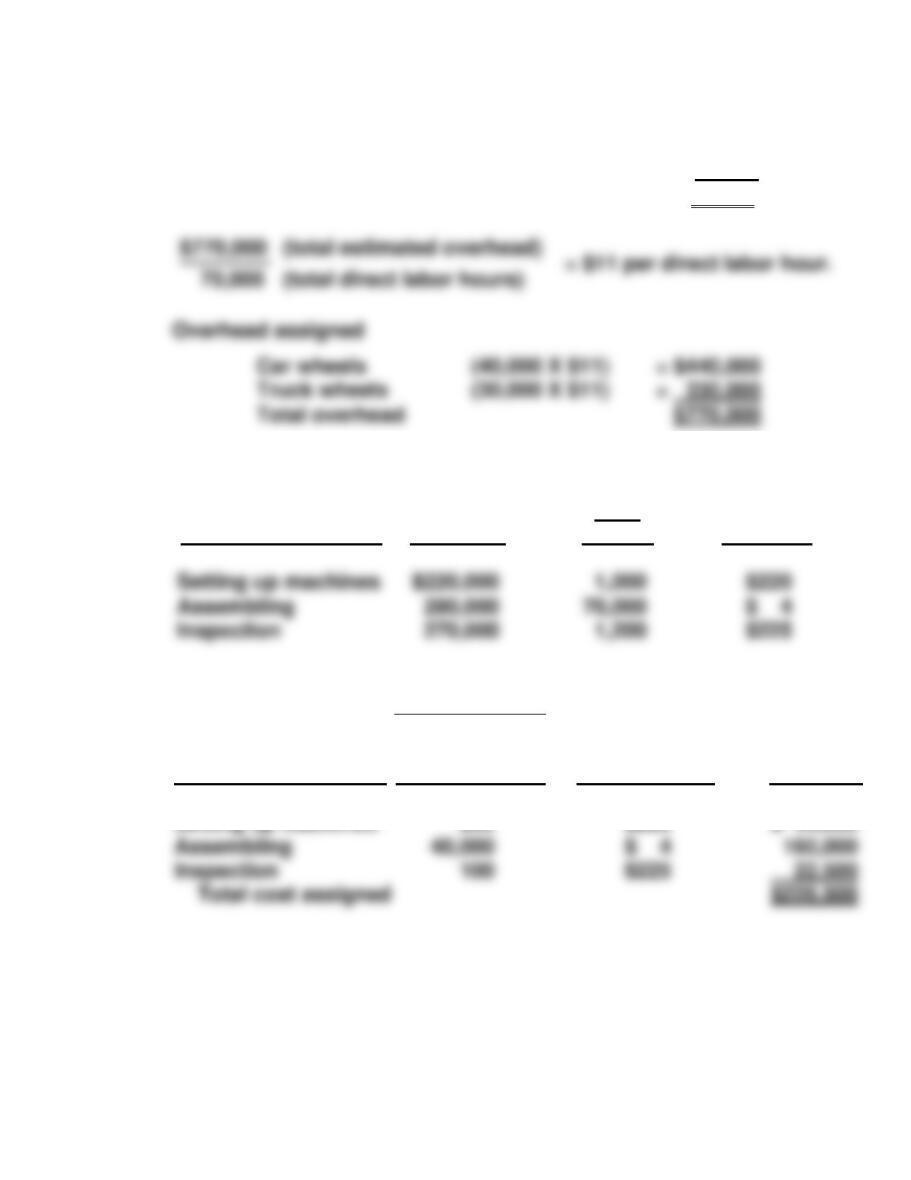
Traditional costing
The wool product line is allocated $97,500 ($570,000 – $472,500) more
overhead cost when an activity-based costing system is used. As a result,
the cotton product line is allocated $97,500 ($472,500 – $375,000) less.
Activity-based costing
Cutting
Design
EXERCISE 4-4
(a)
Direct labor hours for car wheels
(40,000 X 1)
= 40,000
Direct labor hours for truck wheels
(10,000 X 3)
= 30,000
Total direct labor hours
70,000
(b)
Activity Cost Pool
Estimated
Overhead
÷
Expected
Use of
Cost
Drivers
=
ABC
Overhead
Rate
Assembling
(c)
Car Wheels
Activity Cost Pools
Expected Use
of Cost Driver
per Product
X
Activity-Based
Overhead
Rates
=
Cost
Assigned
Total overhead
EXERCISE 4-4 (Continued)
(c)
Truck Wheels
Activity Cost Pools
Expected use
of Cost Driver
per Product
X
Activity-
Based
Overhead
Rates
=
Cost
Assigned
Setting up machines
800
$220
$176,000
(d) Assuming that the cost drivers are a reasonable representation of
what is occurring in the two product lines, it seems appropriate to
EXERCISE 4-5
(a) Traditional costing:
$260,000 ÷ 2,500 (800 + 1,700) hours
= $104 per direct labor hour
EXERCISE 4-5 (Continued)
(b) Activity-based costing:
(1) Material handling costs
$160,000 ÷ 500 (300 + 200) moves = $320 per move
(2) Purchasing activity costs
$100,000 ÷ 800 (450 + 350) orders = $125 per order
(c) The total amount of overhead allocated to each unit of the two products
under the two allocation approaches is:
Traditional
Costing
Activity-Based
Costing
Mobile safe
Walk-in safe
$ 416
$3,536
** $761.25**
$ 2,155**
EXERCISE 4-6
Budgeted Costs
Activity Cost Pool
Cost Driver
Engineering design
Engineering prototypes
Engineering
Engineering hours
Machine hours
EXERCISE 4-7
The following cost drivers might be used to assign overhead:
Gallons of juice
1.
2.
3.
Labor hours
Labor hours
Labor hours
9.
10.
11.
Gallons of wine or months of aging
Number of bottles
Number of bottles
Depreciation, machinery
Electricity, machinery
Machinery
Machine hours
Electricity, plant lighting
EXERCISE 4-8
1. Number of engineering change orders; hours of designing
2. Number of orders processed
3. Number of parts in stock
4. Weight of material; number of boxes or cartons
EXERCISE 4-9
(a) The overhead rates are:
Activity Cost Pools
Estimated
Overhead
÷
Expected Use
of Cost Drivers
per Activity
=
Activity-Based
Overhead Rates
Machine setups
Materials handling
$40,000
1,000
$40
(b) The assignment of the overhead costs to products is as follows:
Instruments
Gauges
Cost
Assigned
Cost Driver
Number
Cost
Number
Cost
Requisitions ($40)
Machine setups ($43)
Inspections ($55)
Total costs
assigned (a)
400
200
200
$16,000
8,600
11,000
$35,600
600
300
400
$24,000
12,900
22,000
$58,900
$40,000
21,500
33,000
$94,500
EXERCISE 4-9 (Continued)
(c) MEMO
To: President, Air United, Inc.
From: Student
Re: Benefits of activity-based costing (ABC)
ABC focuses on the activities performed in producing a product.
Overhead costs are assigned to products based on cost drivers that
measure the activities performed on the product.
EXERCISE 4-10
(a) (1) Traditional product costing system:
(2) Activity-based costing system:
Activity Cost Pools
Cost Drivers
Used
X
Activity-
Based
Overhead
Rates
=
Overhead Cost
Assigned
Credit and collection
Sales commissions
Advertising—TV
$900,000
250
$.05
$300
$ 45,000
75,000
(b) As compared to ABC, traditional costing grossly undercosts the selling
EXERCISE 4-11
(a) 1. Traditional product costing system:
2. Activity-based costing system:
Activity Cost Pools
Cost Drivers
Used
X
Activity-
Based
Overhead
Rate
=
Overhead Cost
Assigned
Inspections of material received
6,000
$ .90
$ 5,400
(b) As compared to ABC, the traditional costing system undercosts the
quality-control overhead cost assigned to the low-calorie breakfast line
(c) All three activities, as quality-control related activities, are non-value-
added activities.
EXERCISE 4-12
Activity Cost Pools
Activity Level
Facility-level
Engineering
Machinery
Machine setup
Product-level
Unit-level
Batch-level
EXERCISE 4-13
1. Facility-level activity
2. Product-level activity
3. Batch-level activity
4. Product-level activity
EXERCISE 4-14
(a)
Activity Cost Pools
Estimated Overhead
÷
Expected use
of Cost Drivers
=
ABC Overhead Rates
Scheduling and travel
$85,000
1,250
$ 68.00
Setup time
$90,000
600
$150.00
$60,000
Commercial
Activity Cost Pools
Expected use of Cost
Drivers per Product
X
ABC Overhead Rates
=
Cost Assigned
Scheduling and travel
750
$ 68.00
$ 51,000
Setup time
$ .15
15,000
Total assigned costs
Residential
Activity Cost Pools
Expected use of Cost
Drivers per Product
X
ABC Overhead Rates
=
Cost Assigned
Scheduling and travel
500
$ 68.00
$ 34,000
Setup time
250
Total assigned costs
EXERCISE 4-14 (Continued)
(b)
Commercial
Residential
Revenues
$300,000
$480,000
Direct material costs
$ 30,000
$ 50,000
(c) Assuming that the cost drivers are a reasonable representation of
what is occurring in the two product lines, it seems appropriate to
EXERCISE 4-15
The following activities might be identified at Snap Prints Company from
your analysis of its operations and a discussion with the owner-manager,
Terry Morton.
1. Hiring and training personnel
2. Purchasing supplies and materials
Operating income (loss)
EXERCISE 4-16
Value-Added Activities
Hours
Writing contracts and letters
Taking depositions
1.5
1.0
Non-Value-Added Activities
Hours
Attending staff meetings
Doing research
0.5
1.0
Questionable Classifications
Writing contracts is value-added; writing letters may be value-added if
related to a specific case or it may be non-value-added if it is billing a client
EXERCISE 4-17
(a) The predetermined overhead rate under traditional costing would be:
(b) The amount of overhead allocated to the average residential job
would be:
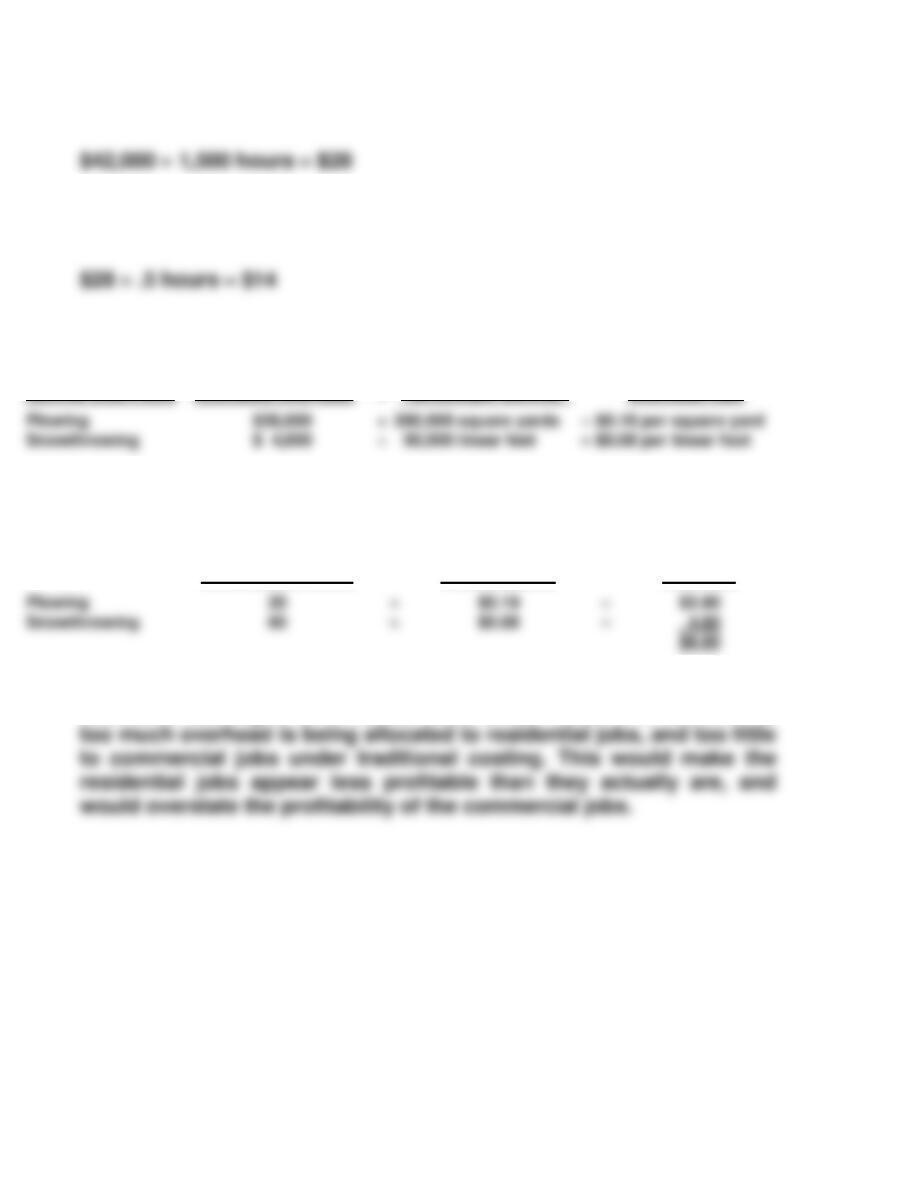
(c) The activity-based overhead rates for each cost pool would be
Activity Cost Pools
Estimated Overhead
Expected Use of Cost
Drivers per Activity
Activity Based
Overhead Rate
Plowing
$0.19 per square yard
Snowthrowing
$0.08 per linear foot
(d) The amount of overhead allocated to the average residential job under
activity based costing would be:
Expected use of
Cost Driver Per Job
Activity Based
Overhead Rate
=
Cost
Allocated
Plowing
Snowthrowing
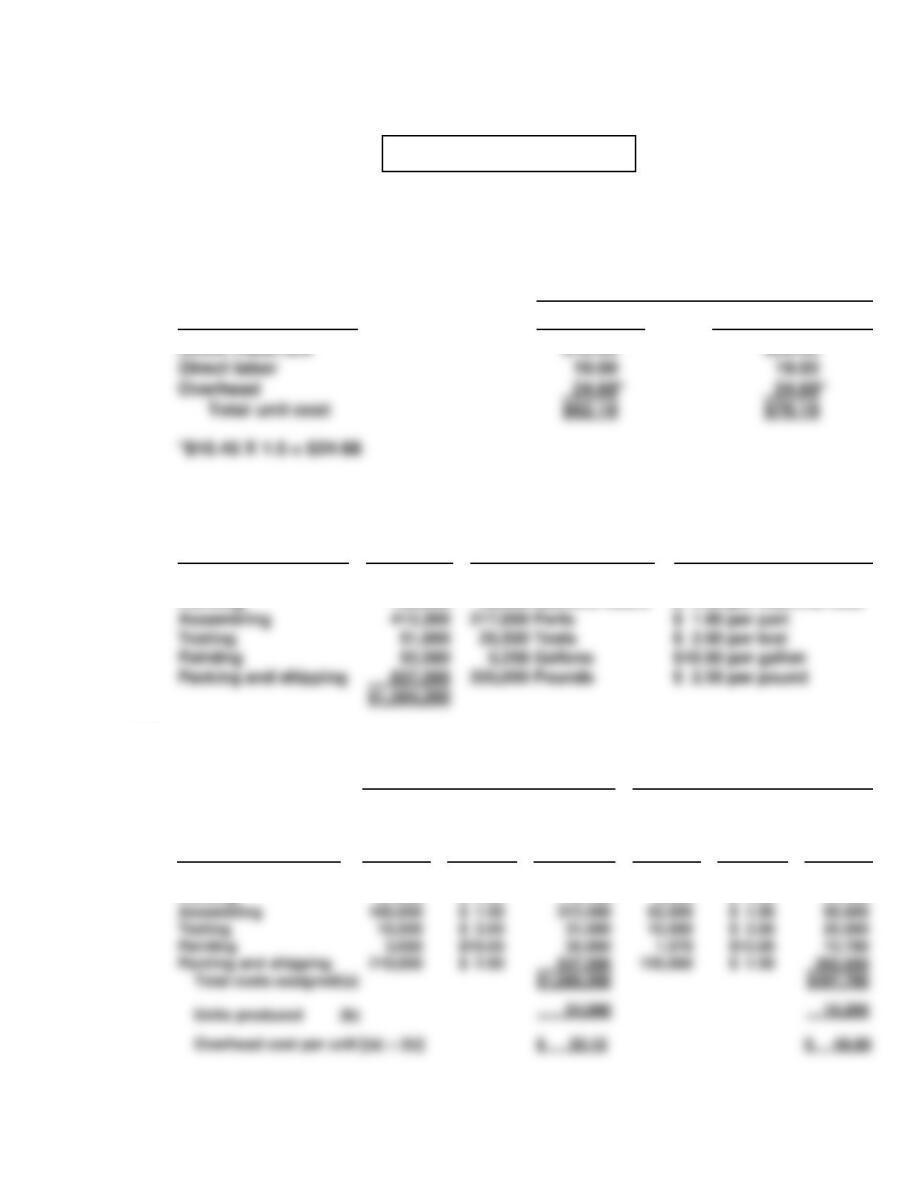
(e) The amount of overhead allocated to the average residential job under
traditional costing is $14, versus $8.60 under ABC. This means that
SOLUTIONS TO PROBLEMS
PROBLEM 4-1A
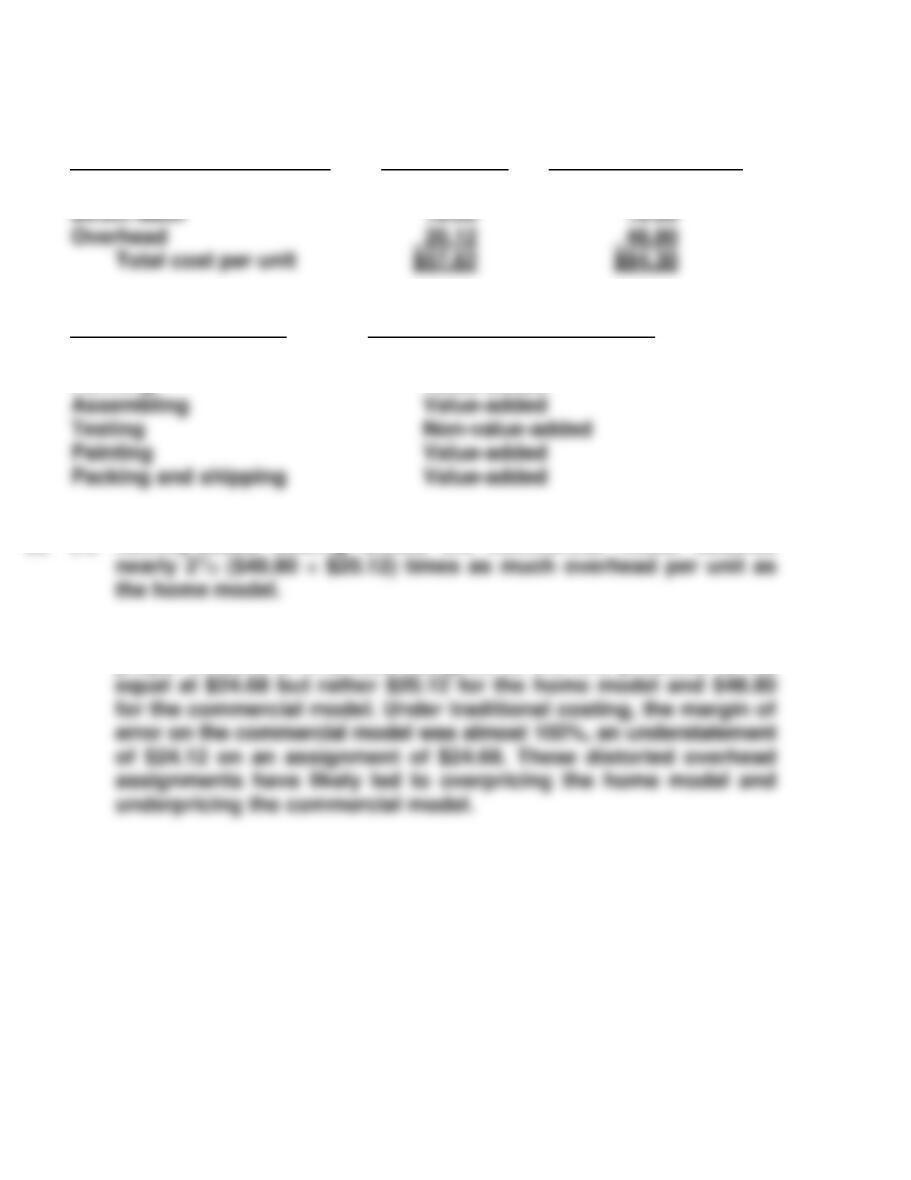
(a) Computation of unit costs—traditional costing.
Products
Manufacturing Costs
Home Model
Commercial Model
(b)
Activity Cost Pool
Estimated
Overhead
÷
Expected
Use of Cost Drivers
=
Activity-Based
Overhead Rate
Receiving
Forming
$ 80,400
150,500
335,000 Pounds
35,000 Machine hours
$ .24 per pound
$ 4.30 per machine hour
(c)
Home Model
Commercial Model
Activity Cost Pool
Expected
Use of
Drivers
X
Activity-
Based
Overhead
Rates
=
Cost
Assigned
Expected
Use of
Drivers
X
Activity-
Based
Overhead
Rates
=
Cost
Assigned
Receiving
Forming
215,000
27,000
$ .24
$ 4.30
$ 51,600
116,100
120,000
8,000
$ .24
$ 4.30
$ 28,800
34,400
Total unit cost
PROBLEM 4-1A (Continued)
(d)
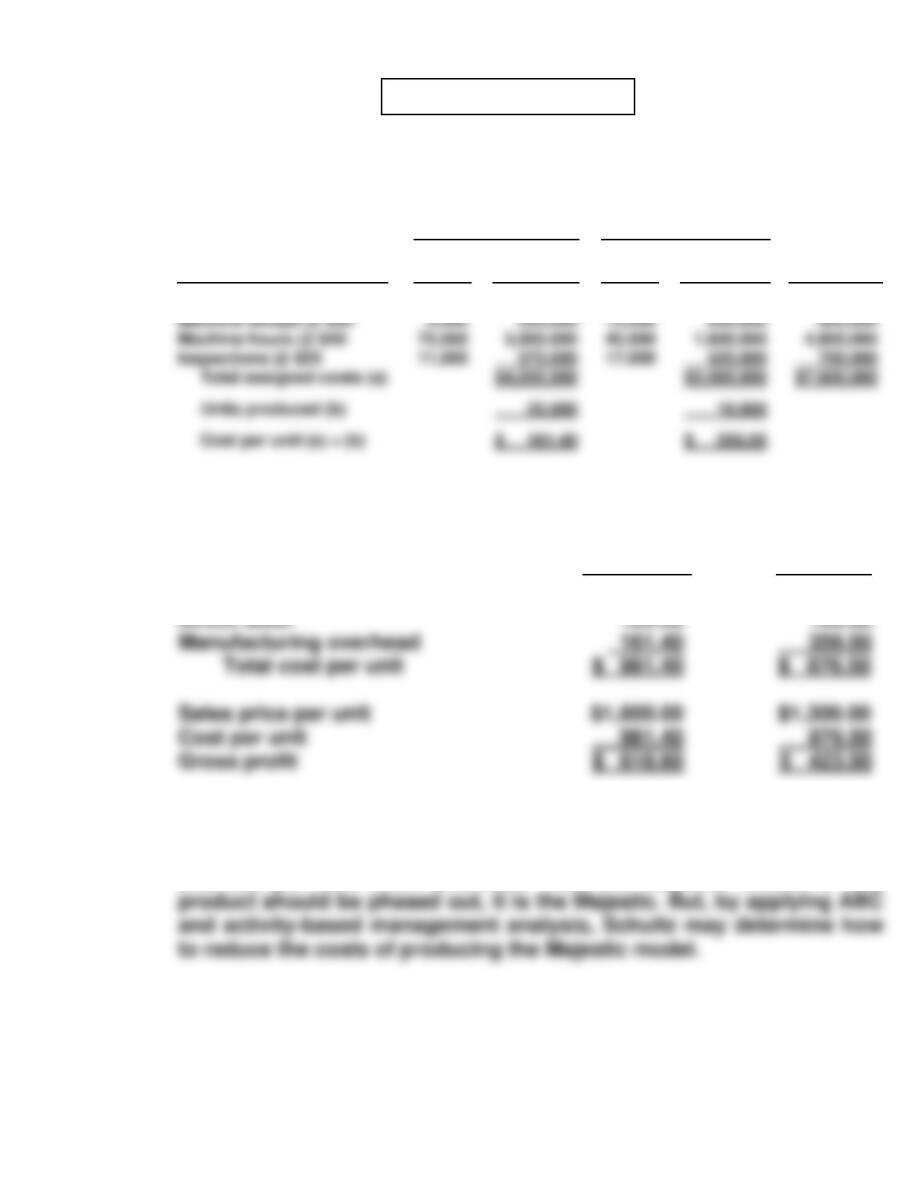
ABC Manufacturing Costs
Home Model
Commercial Model
Direct materials
$18.50
$26.50
(e)
Activity
Value- vs. Non-Value-Added
Assembling
Packing and shipping
Receiving
Forming
Non-value-added
Value-added
(f) (1) Activity-based costing shows the commercial model absorbs
(2) The comparison of ABC and traditional costing shows that the
proper amount of overhead assigned to the two products is not
Total cost per unit
PROBLEM 4-2A
(a) The allocation of total manufacturing overhead using activity-based
costing is as follows:
Royale
Majestic
Overhead Rate
Drivers
Used
Cost
Assigned
Drivers
Used
Cost
Assigned
Total
Overhead
Purchase orders @ $30
17,000
$ 510,000
23,000
$ 690,000
$1,200,000
(b) The cost per unit and gross profit of each model under ABC costing
were:
Royale
Majestic
Direct materials
$ 700.00
$ 420.00
(c) Management’s future plans for the two television models are not
sound. Under ABC costing, the Royale model is $195.10 ($618.60 –
$423.50) per unit more profitable than the Majestic model. If any
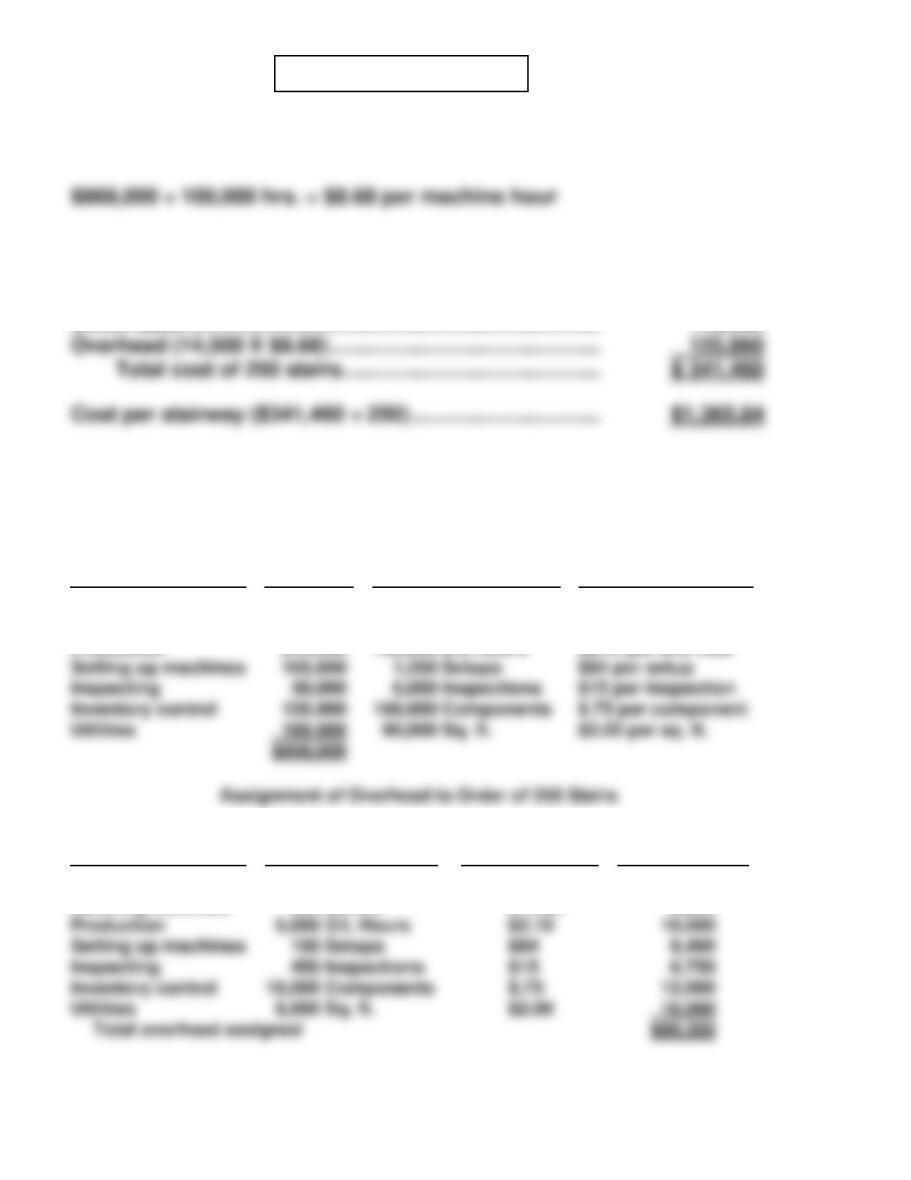
PROBLEM 4-3A
(a) Predetermined overhead rate using machine hours:
(b) Manufacturing cost per stairway under traditional costing:
Direct materials ……………………………………………………… $ 103,600
Direct labor ……………………………………………………………. 112,000
(c) Manufacturing cost per stairway under activity-based costing:
Computation of Activity-Based Overhead Rates
Activity Cost Pools
Estimated
Overhead
÷
Expected Use of Cost
Drivers per Activity
=
Activity-Based
Overhead Rate
180,000
Purchasing
Handling materials
Production
$ 75,000
82,000
210,000
600 Orders
8,000 Moves
100,000 D/L Hours
$125 per order
$10.25 per move
$2.10 per D/L hour
Activity Cost Pools
Expected Use of
Cost Drivers
X
Activity-Based
Overhead Rates
=
Cost Assigned
8,000 Sq. ft.
Purchasing
Handling materials
60 Orders
800 Moves
$125
$10.25
$ 7,500
8,200
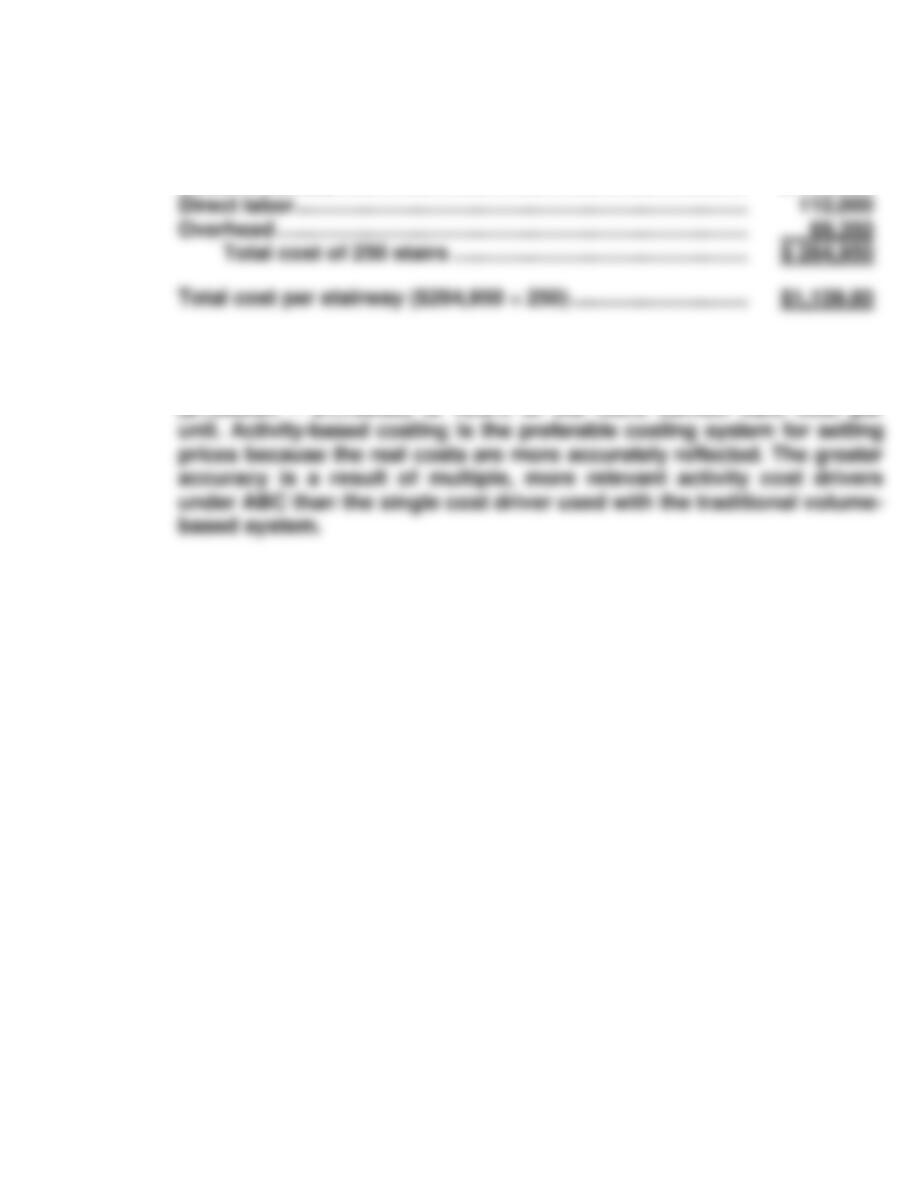
PROBLEM 4-3A (Continued)
Total manufacturing cost per stairway under ABC:
Direct materials ……………………………………………………………. $ 103,600
(d) The difference between the traditional cost and the activity–based cost
per unit, $1,365.84 versus $1,139.80, is not great in amount but $226.04
($1,365.84 – $1,139.80) is 19.8% of the more correct ABC cost per
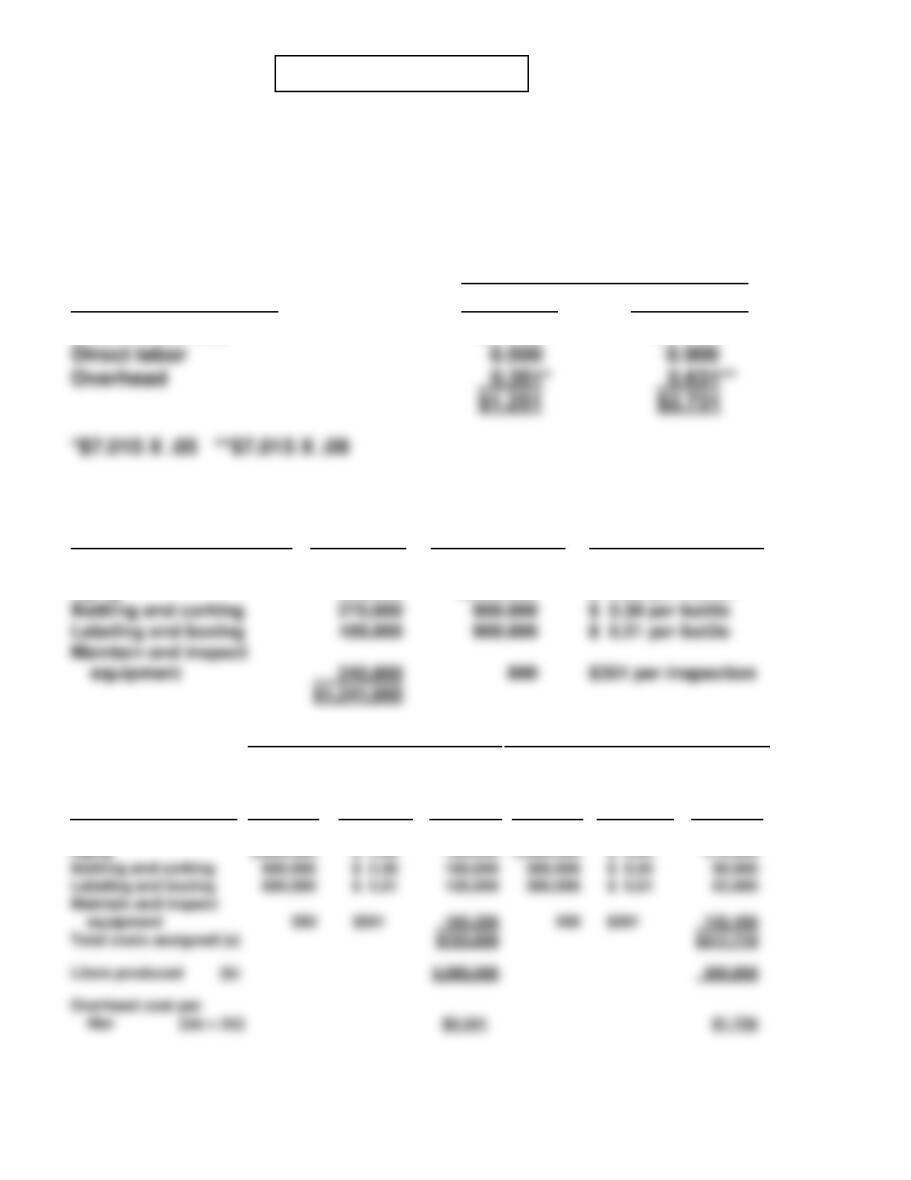
PROBLEM 4-4A
(a) Computation of unit costs—traditional costing
Overhead cost per direct labor hour is $1,241,660 ÷ (150,000 + 27,000) =
$7.015
Products
Manufacturing Costs
CoolDay
LiteMist
Direct materials
$0.400
$1.200
(b)
Activity Cost Pools
Estimated
Overhead
÷
Expected Use
of Cost Drivers
=
Activity-Based
Overhead Rates
equipment
Grape processing
Aging
$ 145,860
396,000
6,600
6,600,000
$22.10 per cart
$ 0.06 per month
(c)
CoolDay
LiteMist
Activity Cost Pools
Expected
Use of
Cost
Drivers
X
Activity-
Based
Overhead
Rates
=
Cost
Assigned
Expected
Use of
Cost
Drivers
X
Activity-
Based
Overhead
Rates
=
Cost
Assigned
Grape processing
6,000
$22.10
$132,600
600
$22.10
$ 13,260
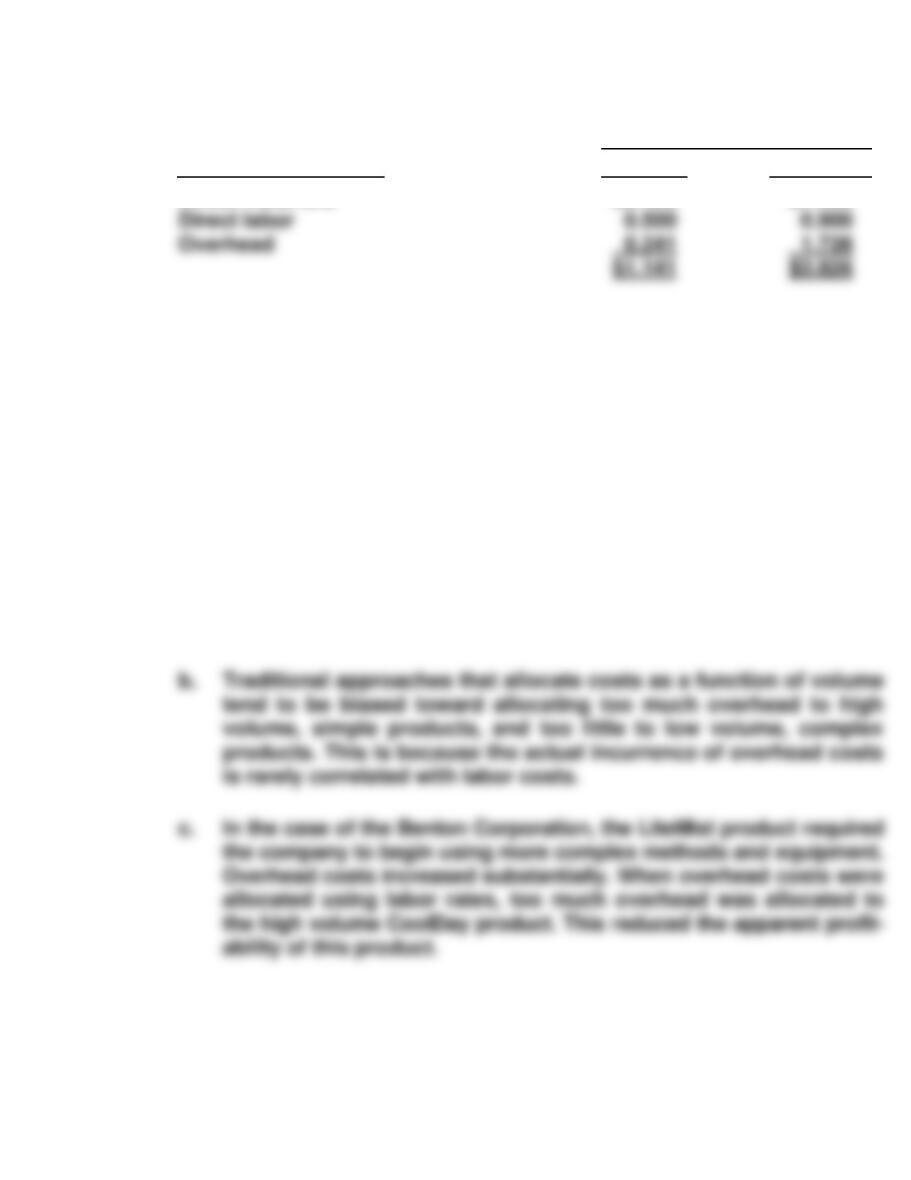
PROBLEM 4-4A (Continued)
(d)
Products
Manufacturing Costs
CoolDay
LiteMist
Direct materials
$0.400
$1.200
(e) To: Mr. Jack Eller
From: Student
Subject: Product costs using traditional approach versus ABC
The memorandum covers the following points:
a. ABC allocates overhead costs as a function of each product’s use
of cost drivers. Thus, ABC results in overhead allocation that
more closely approximates each product’s generation of overhead
costs.
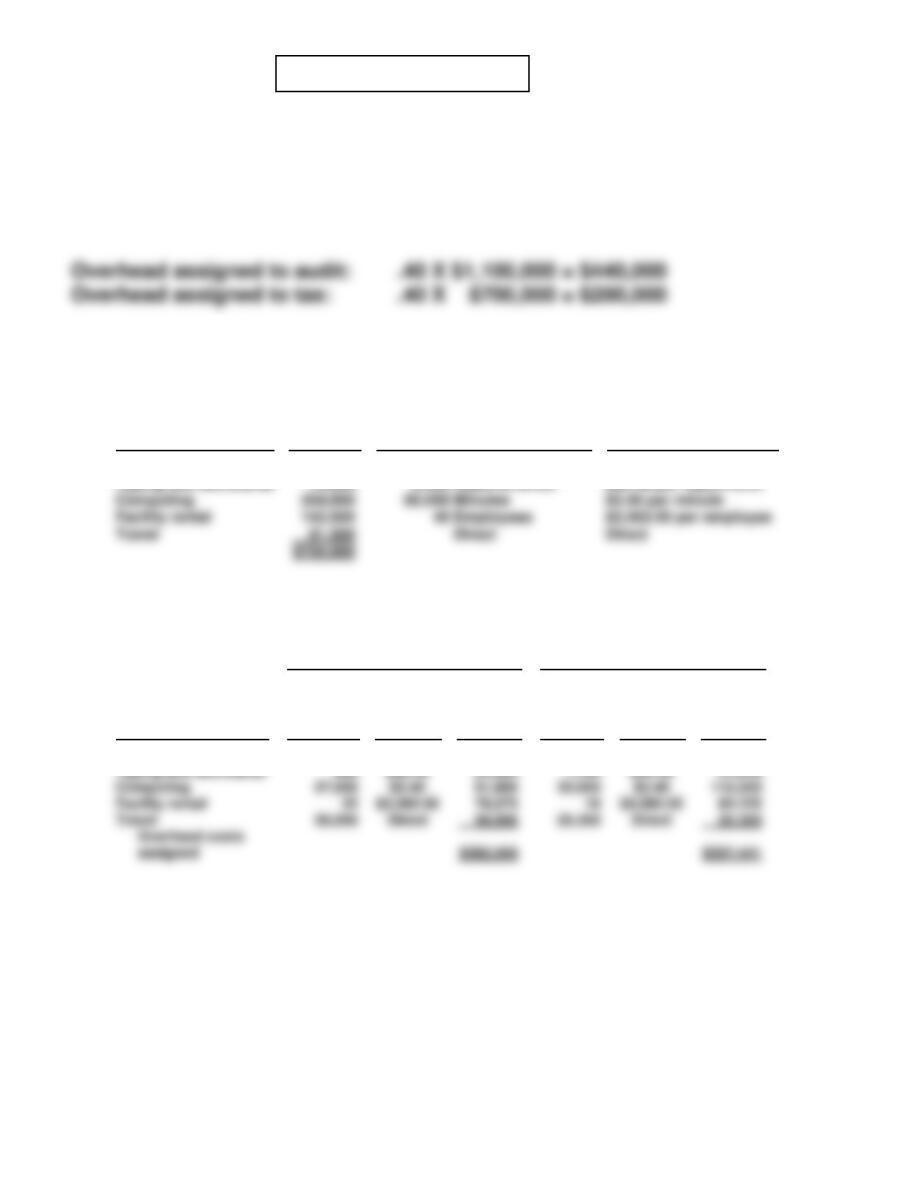
PROBLEM 4-5A
(a) Computation of assigned overhead under traditional costing (“direct
labor dollars” appears in the first line of the schedule of overhead data):
Predetermined overhead rate X direct labor dollars
(b) (1) Computation of activity-based overhead rates:
Activity Cost Pools
Estimated
Overhead
÷
Expected Use of
Cost Drivers per Activity
=
Activity-Based
Overhead Rates
Employee training
$216,000
$1,800,000 Direct labor dollars
$.12 per DL dollar
(2) Assignment of overhead to audit and tax services:
Audit
Tax
Activity Cost Pools
Expected
Use of
Cost
Driver
X
Activity-
Based
Overhead
Rate
=
Cost
Assigned
Expected
Use of
Cost
Driver
X
Activity-
Based
Overhead
Rate
=
Cost
Assigned
Employee training
$1,100,000
$.12
$132,000
$700,000
$.12
$ 84,000
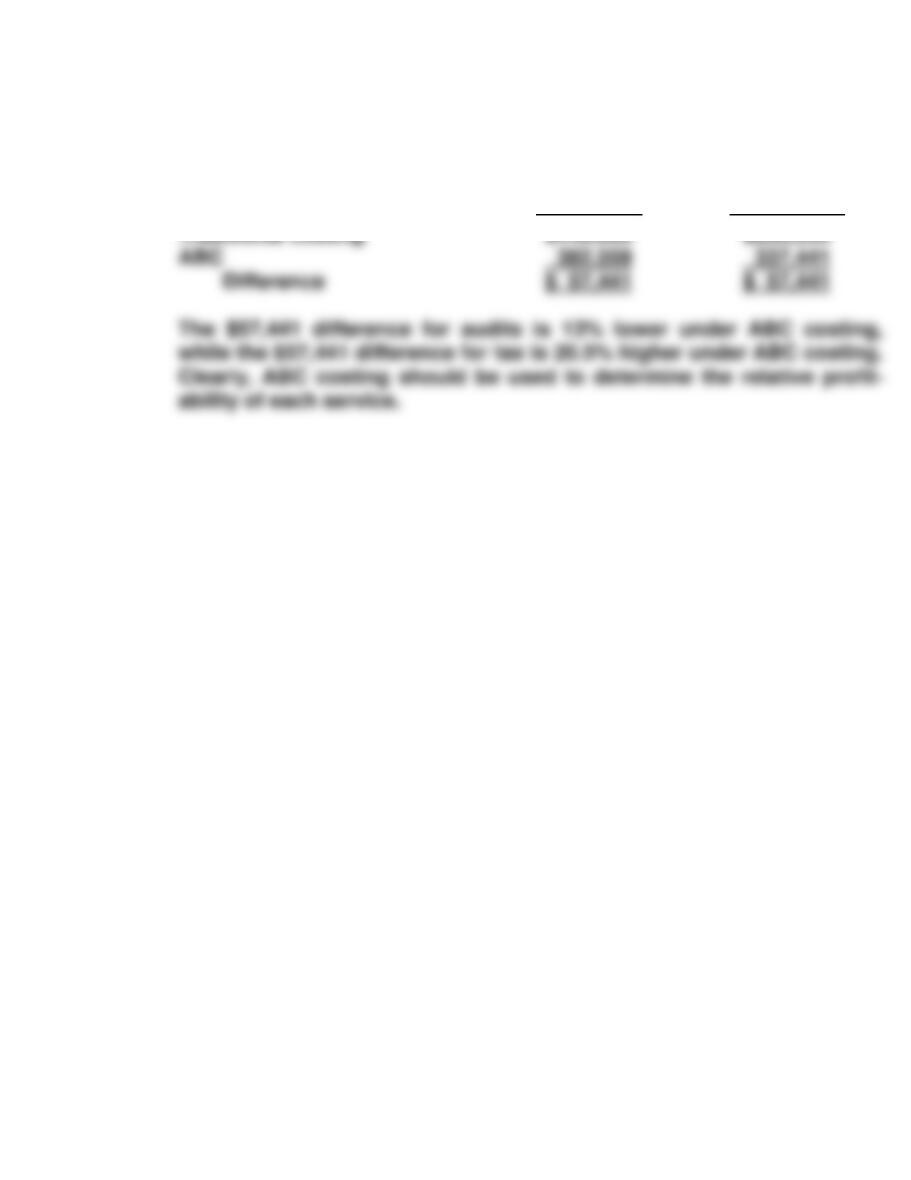
PROBLEM 4-5A (Continued)
(c) Overhead is assigned to the two service lines as follows:
Audit
Tax
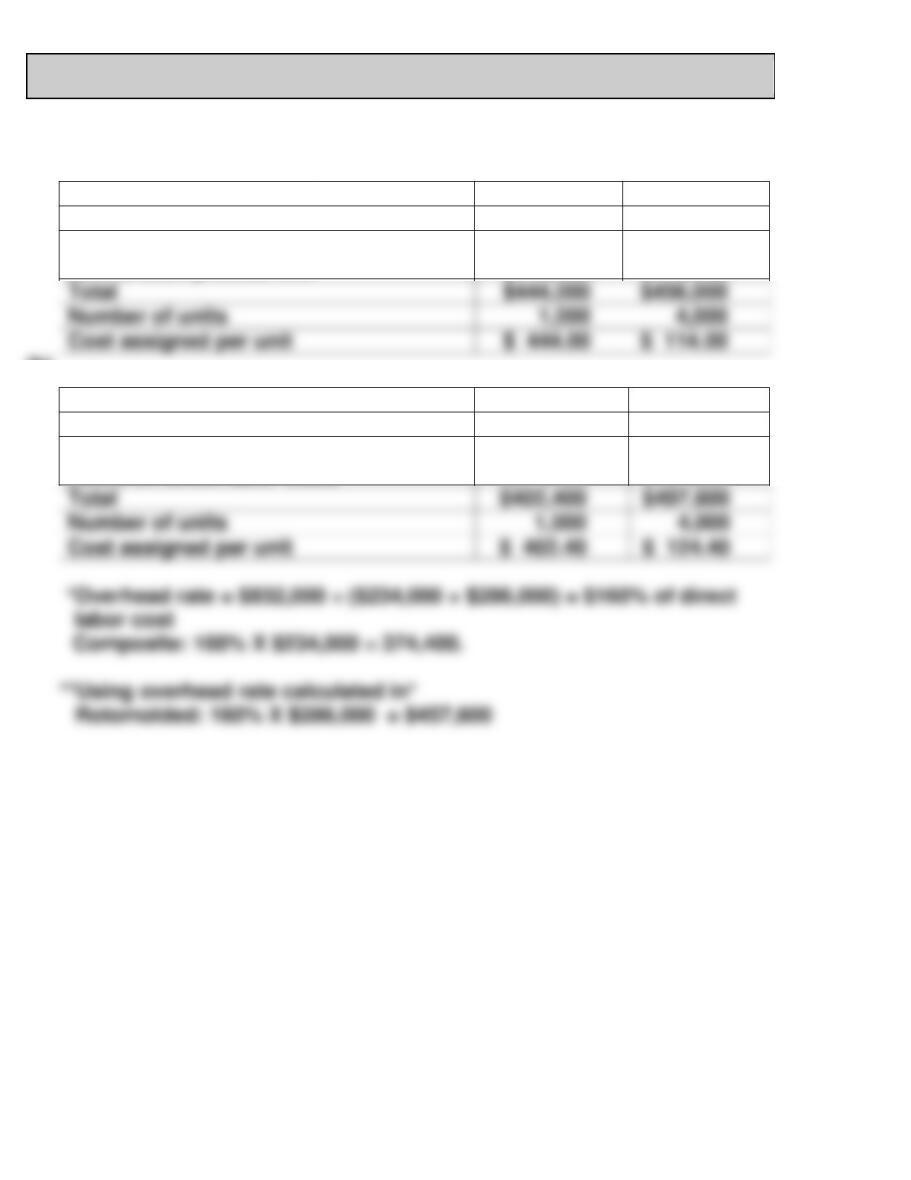
CD4 CURRENT DESIGNS
(a)
Composite
Rotomolded
Directly assigned
$ 28,000
$ 40,000
Remaining amount ($832,000) allocated
50% to each product line
$416,000
$416,000
(b)
Composite
Rotomolded
Directly assigned
$ 28,000
$ 40,000
Remaining amount ($832,000) allocated
based on direct labor costs
$374,400*
$457,600**
Total
$402,400
$497,600
Number of units
Cost assigned per unit
$ 402.40
$ 124.40
Total
Number of units
Cost assigned per unit
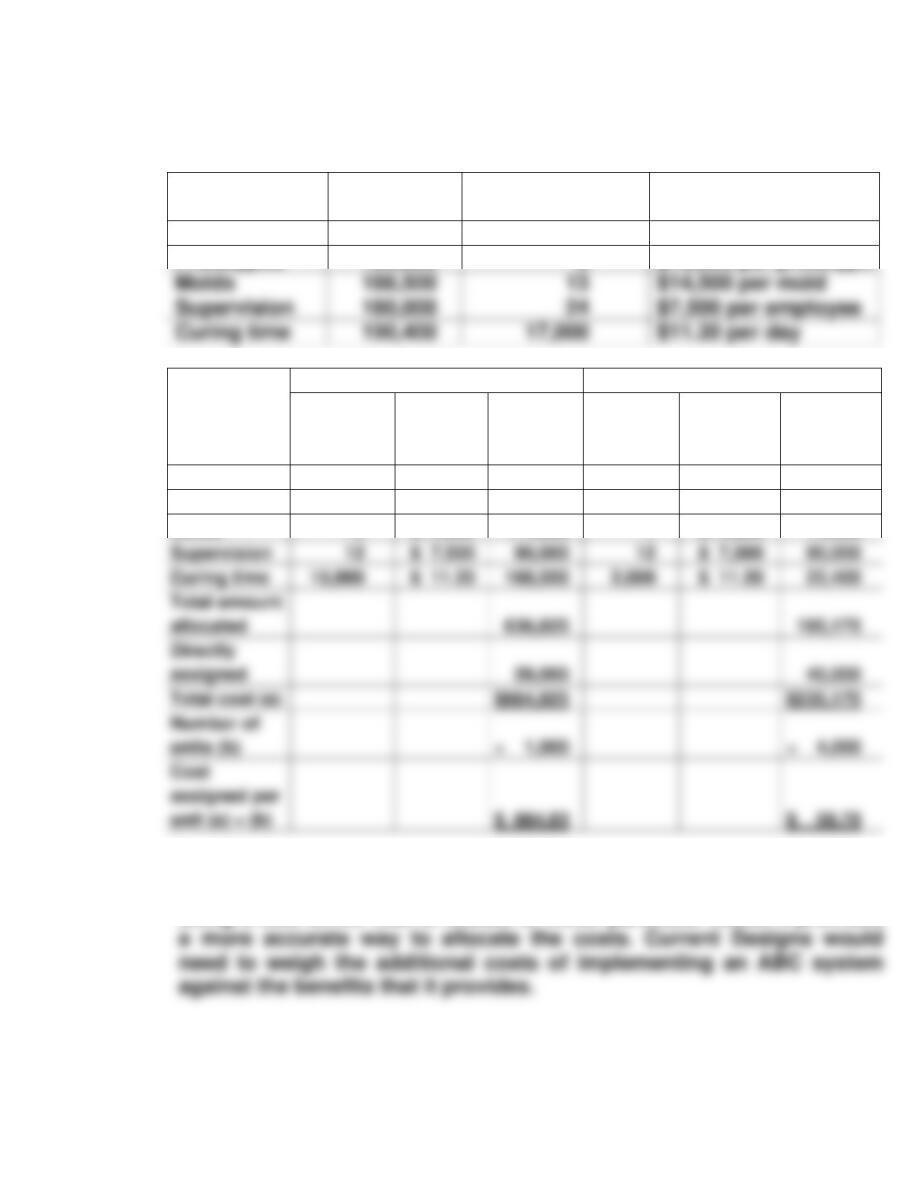
CD4 (Continued)
(c)
Activity Cost
Pools
Estimated
Overhead
Expected Use of
Cost Drivers
Activity-Based
Overhead Rates
Design
$121,100
4
$30,275 per model
Prototypes
152,000
8
$19,000 per prototype
Activity Cost
Pool
Composite
Rotomolded
Expected
Use of
Drivers
Overhead
Rates
Cost
Assigned
Expected
Use of
Drivers
Overhead
Rates
Cost
Assigned
Design
3
$30,275
$ 90,825
1
$30,275
$ 30,275
Prototypes
6
$19,000
114,000
2
$19,000
38,000
Molds
12
$14,500
174,000
1
$14,500
14,500
Supervision
90,000
90,000
168,000
22,400
allocated
195,175
assigned
28,000
40,000
$664,825
$235,175
÷ 1,000
÷ 4,000
(d) Activity-based costing assigns significantly more costs to the composite
kayaks. Since the cost is divided into pools and each pool is allocated
using a cost driver that is related to those particular costs, it provides
Molds
$14,500 per mold
Supervision
180,000
$7,500 per employee
Curing time
$11.20 per day
BYP 4-1 DECISION-MAKING ACROSS THE ORGANIZATION
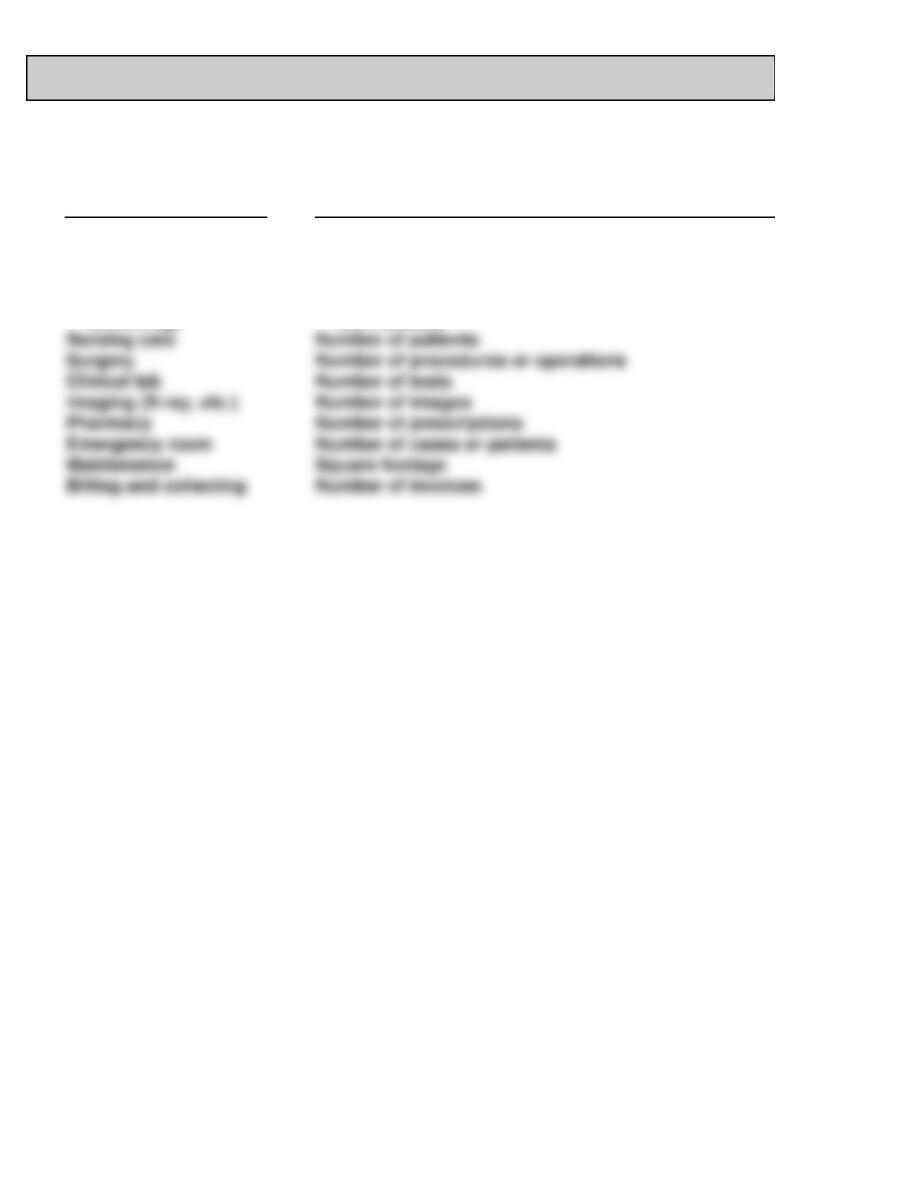
The following activities and cost drivers might be submitted:
(a) Activities
(b) Cost Drivers
Laundering
Housekeeping
Dietary
Computing information
technology
Pounds of linen
Square footage; number of beds
Number of meals
Minutes of computer usage; or number of
work stations
BYP 4-2 MANAGERIAL ANALYSIS
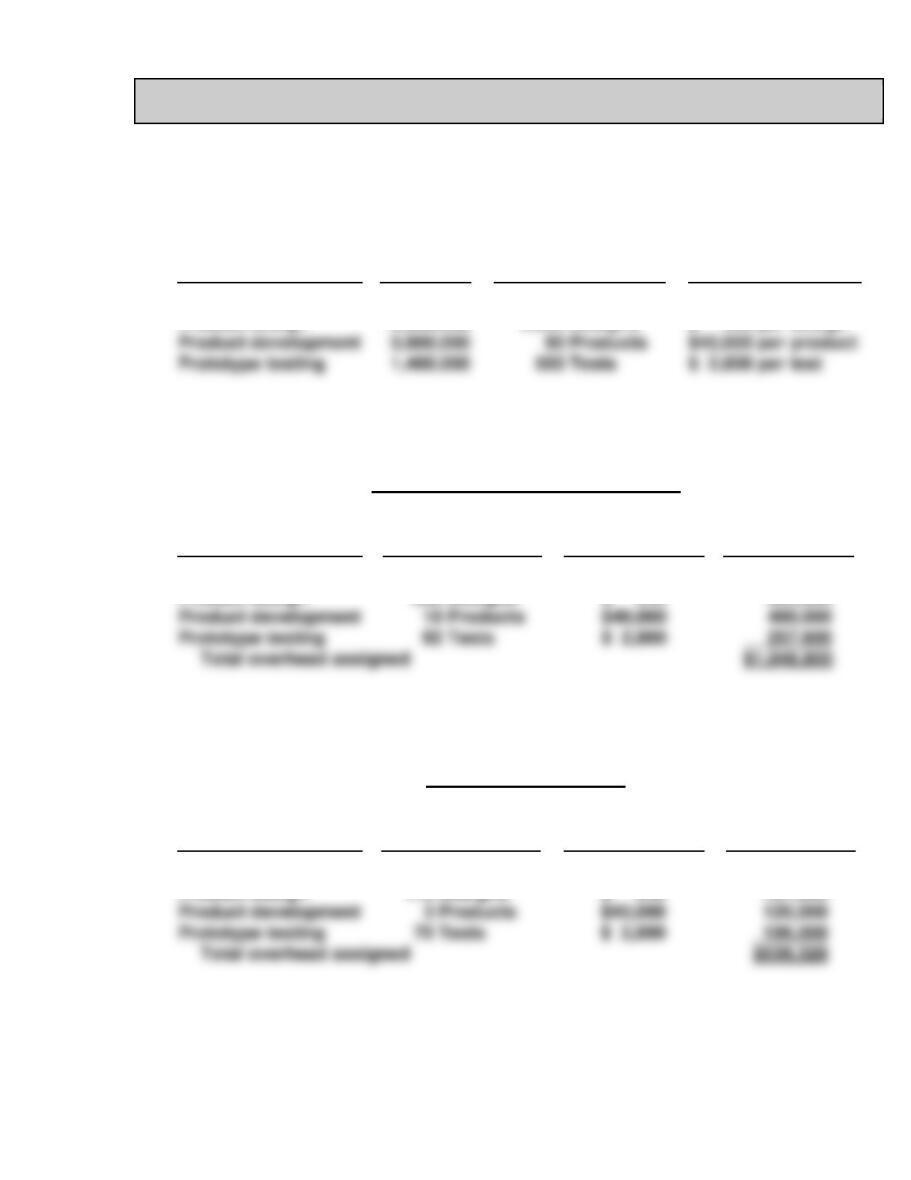
(a) Computation of activity-based overhead rate:
Activity Cost Pools
Total
Estimated
Overhead
÷
Expected Use of
Cost Drivers
Per Activity
=
Activity-Based
Overhead Rates
Market analysis
Product design
$1,050,000
2,350,000
15,000 Hours
2,500 Designs
$ 70 per hour
$ 940 per design
(b) Charges to in-house manufacturing department:
In-House Manufacturing Department
Activity Cost Pools
Cost Drivers Used
X
Activity-Based
Overhead Rates
=
Cost Assigned
Market analysis
Product design
1,800 Hours
280 Designs
$ 70
$ 940
$ 126,000
263,200
(c) Charges to outside R & D contractor:
Outside Contract Costs
Activity Cost Pools
Cost Drivers Used
X
Activity-Based
Overhead Rates
=
Cost Assigned
$ 2,800
Market analysis
Product design
800 Hours
178 Designs
$ 70
$ 940
$ 56,000
167,320

BYP 4-2 (Continued)
(d) Activity-based costing permits the company to identify its R&D costs
by the activities that cause the costs; that is, ABC allows closer
scrutiny of the causes for cost incurrences; hence, greater control. By
BYP 4-3 REAL-WORLD FOCUS
(a) Some of the benefits of ABC for the financial services industry include:
Identification of the most profitable customers
More accurate product and service pricing
(b) Three things that the company’s original costing method did not take
into account were:
(1) The same servicing and administrative expenses were applied
equally to all accounts, including fixed and adjustable rate
(c) Some of the cost drivers used under the new approach were:
Average number of accounts that were at least 60 days delinquent.
BYP 4-4 REAL-WORLD FOCUS
(a) According to the authors, “ABC loses power in large-scale operations,
and can be difficult to implement and maintain.” They suggest, though,
that ABC should not be abandoned but, rather, improved because it
provides many potential benefits.
(b) One way to estimate practical capacity is to simply use a rule of thumb,
such as practical capacity is 80 to 85% of theoretical capacity. The
authors suggest that estimates for people be put at the lower end of
(c) After practical capacity is determined in terms of total time available,
the cost per unit of time is determined by dividing the total cost of that
capacity by the total capacity in units of time. This results in a cost per
BYP 4-4 (Continued)
(d) One of the primary benefits of the report provided by “ABC, the Time–
Driven Way” is that it highlights the difference between capacity
supplied and capacity used. This enables management to evaluate its
effectiveness in its use of the company’s resources and to evaluate
decisions regarding increasing or decreasing capacity.
BYP 4-5 ETHICS CASE
(a) The stakeholders (parties affected by Curtis’s and Ed’s actions) in this
case are:
• Curtis as cost accountant.
• Ed and all personnel employed in the production of the Supercut
Model of lawn tractor.
(b) The objective of cost accounting is to provide useful, accurate informa–
tion for decision making by managers. Ed is coercing Curtis to
(c) Curtis is a management accountant employed by Hi-Power Mower
Company. His first job responsibility is to his employer to: (1) communi-
BYP 4-6 ALL ABOUT YOU
(a) The three main tools for time management for students are:
Term calendar—records quizzes, exams, project due dates and other
major events.
(b) Studies show that students are most inclined to waste time during the
morning and afternoon. Your brain is best prepared for learning during
day-light hours. Therefore, it is important to schedule your time so that
you tackle your most difficult topics during daylight hours.

BYP 4-7 CONSIDERING YOUR COSTS AND BENEFITS
Discussion guide: In part, the response to this question depends on how
broadly you apply the term “value–added activity” when looking at one’s life.
For example, some value-added activities relate to goals and objectives for
school and work. It is important to try to manage your time effectively to
maximize your chance of achieving these objectives. But it is also important
to identify the other things in life that are important. These would include