Student Name:
Class:
Labor cost Wage rate Labor hours
Model per unit per hour per unit
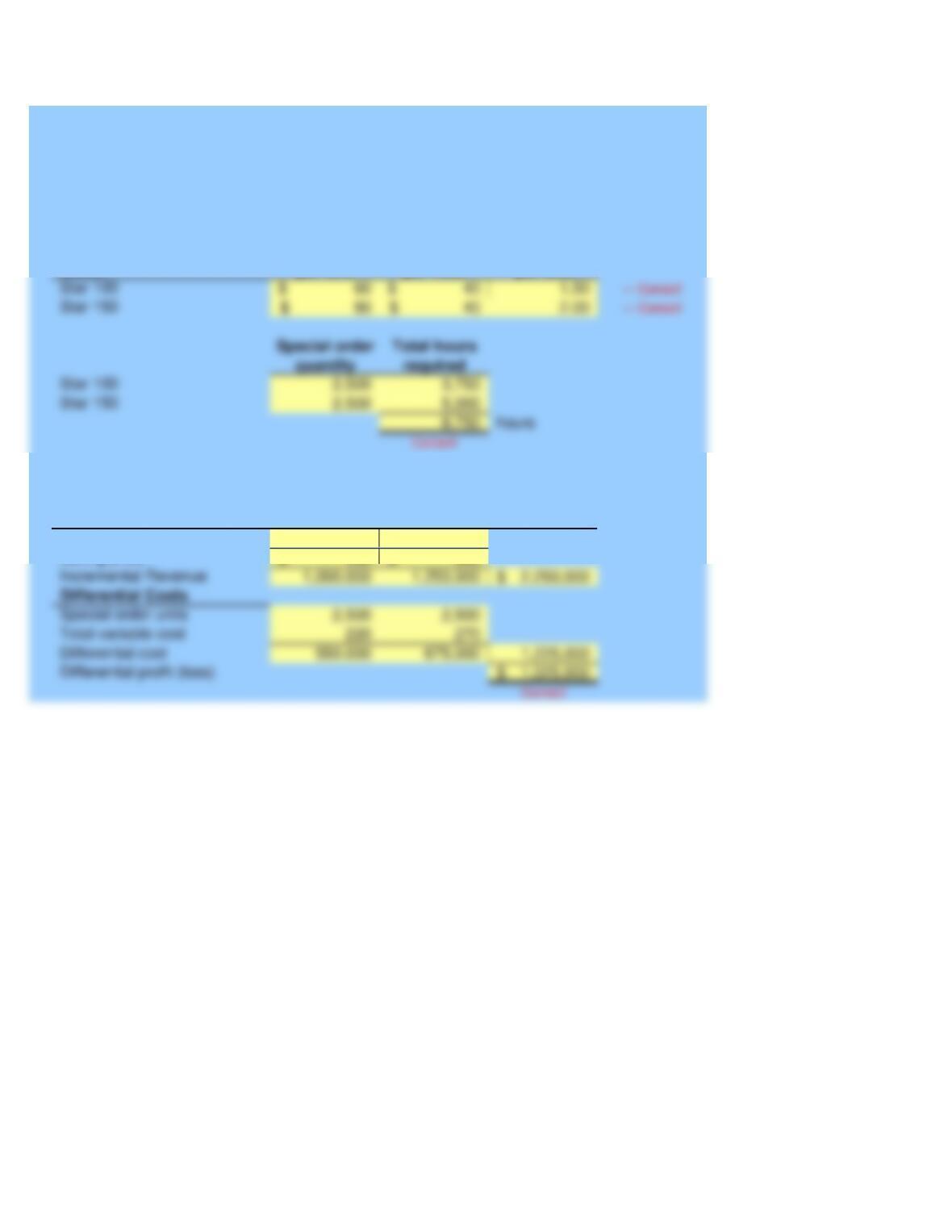
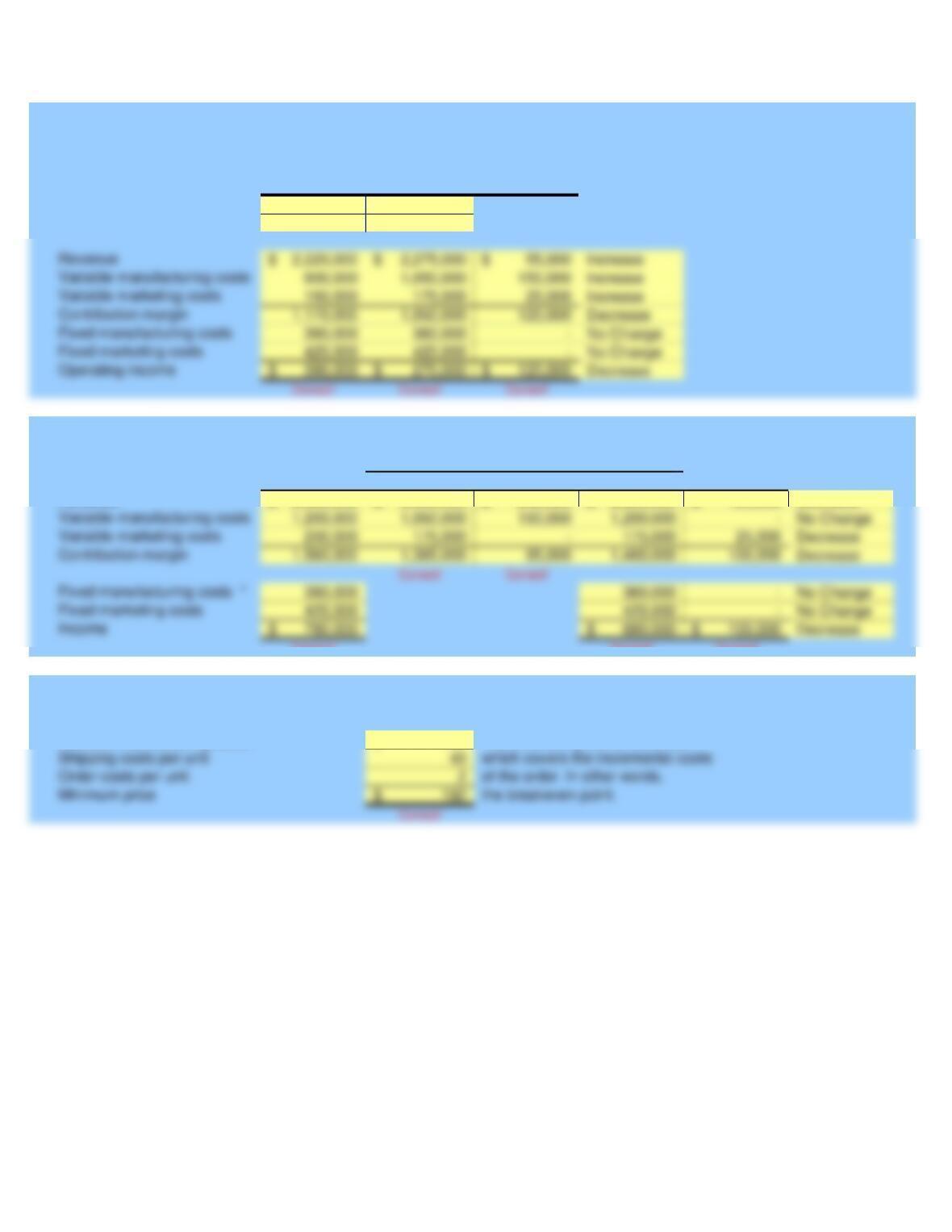
Incremental profit (loss) on special order:
Star 100 Star 150 Total
Differential Costs
Total variable cost
Special order units
Incremental Revenue
Differential cost
Differential profit (loss)
2,500 2,500
400$ 500$
Differential Revenues
Special order units
Selling price
Problem 04-52
McGraw-Hill/Irwin
Instructor
Enter data in the shaded areas
Requirement a:
Labor hours required for special order:
UNTER COMPONENTS
Star 100
Star 150
Star 150
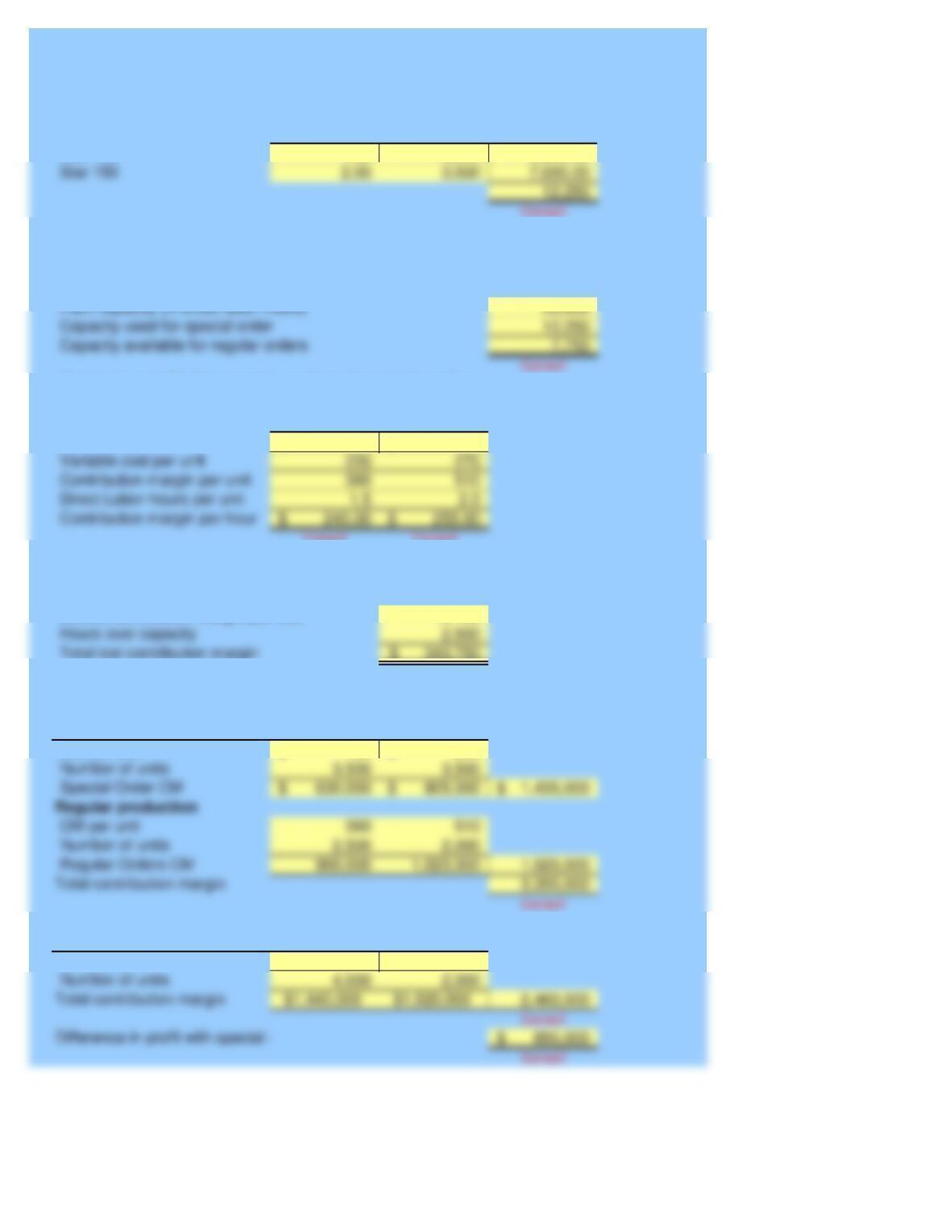
Labor hours
special order
Total
per unit quantity Hours
1.50 3,500 5,250.00
Capacity available for regular orders
Capacity used for special order
Plant capacity (in direct labor-hours)
Star 100 Star 150
Direct Labor-hours per unit
Contribution margin per hour
Contribution margin per unit
Variable cost per unit
580$ 780$
Hours over capacity
Total lost contribution margin
Correct! Correct!
137.50
343,750$
Star 100 Star 150
Regular production
Regular Orders CM
Number of units
CM per unit
Special Order CM
Number of units
180$ 230$
Star 100 Star 150
Number of units
$360 $510
Lowest contribution margin per hour
CM per unit
Regular production
Special Order
CM per unit
If labor hours for 3,500 units exceed capacity, production will need to
be reduced on the product with the lowest contribution margin.
Labor hours required for special order:
Requirement b.
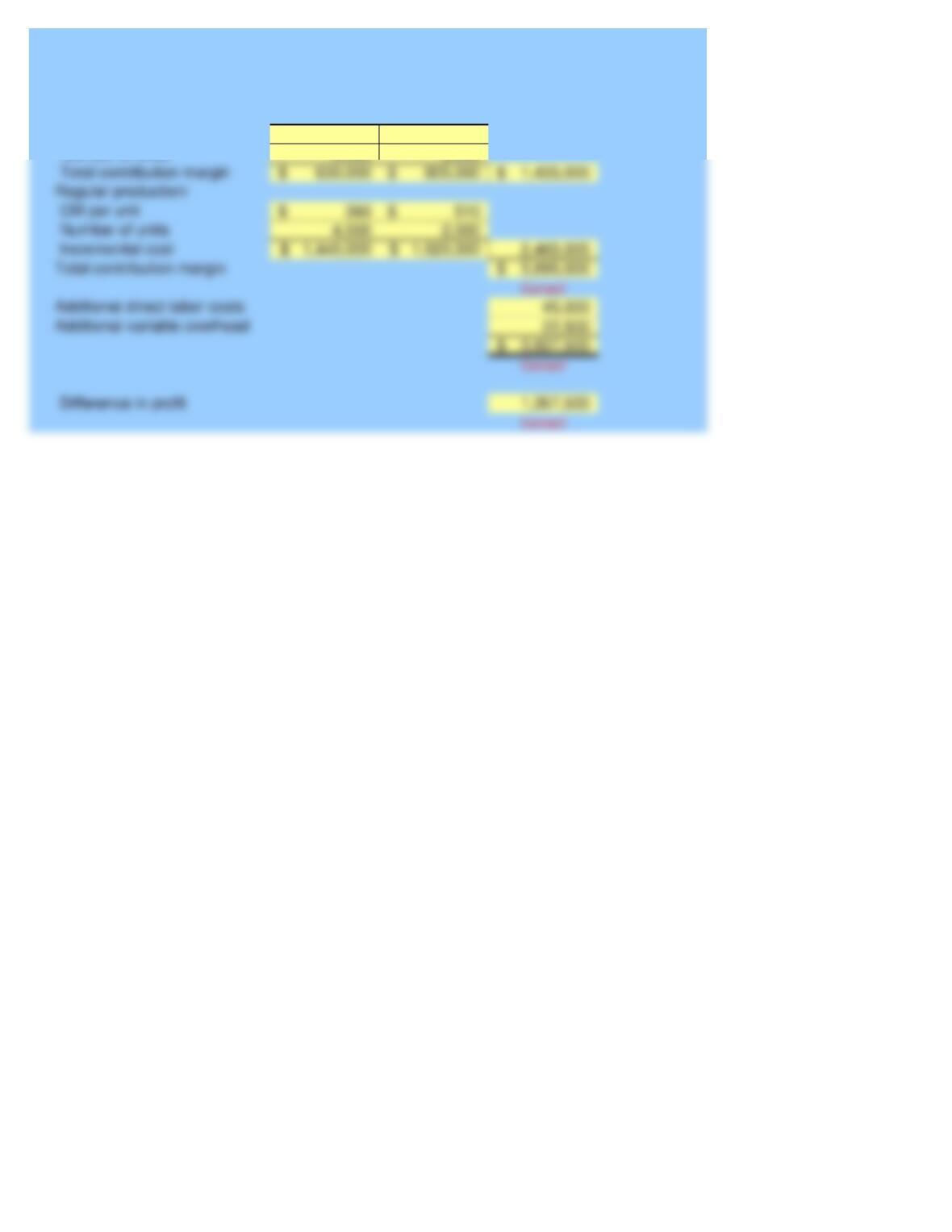
Total contribution margin with the special order:
Compute contribution margin per hour for regular orders:
Compute contribution margin lost from regular sales:
Star 100
Revenue per unit
Star 150
Star 100 Star 150
180$ 230$
3,500 3,500
Special Order:
Compute the total contribution margin with the special order:
Requirement c.
Number of units
CM per unit
Additional variable overhead
Additional direct-labor costs
Regular production:
Total contribution margin
Total contribution margin
Incremental cost
Number of units
CM per unit
Star Star
100 150
130$ 150$
60 80
40$
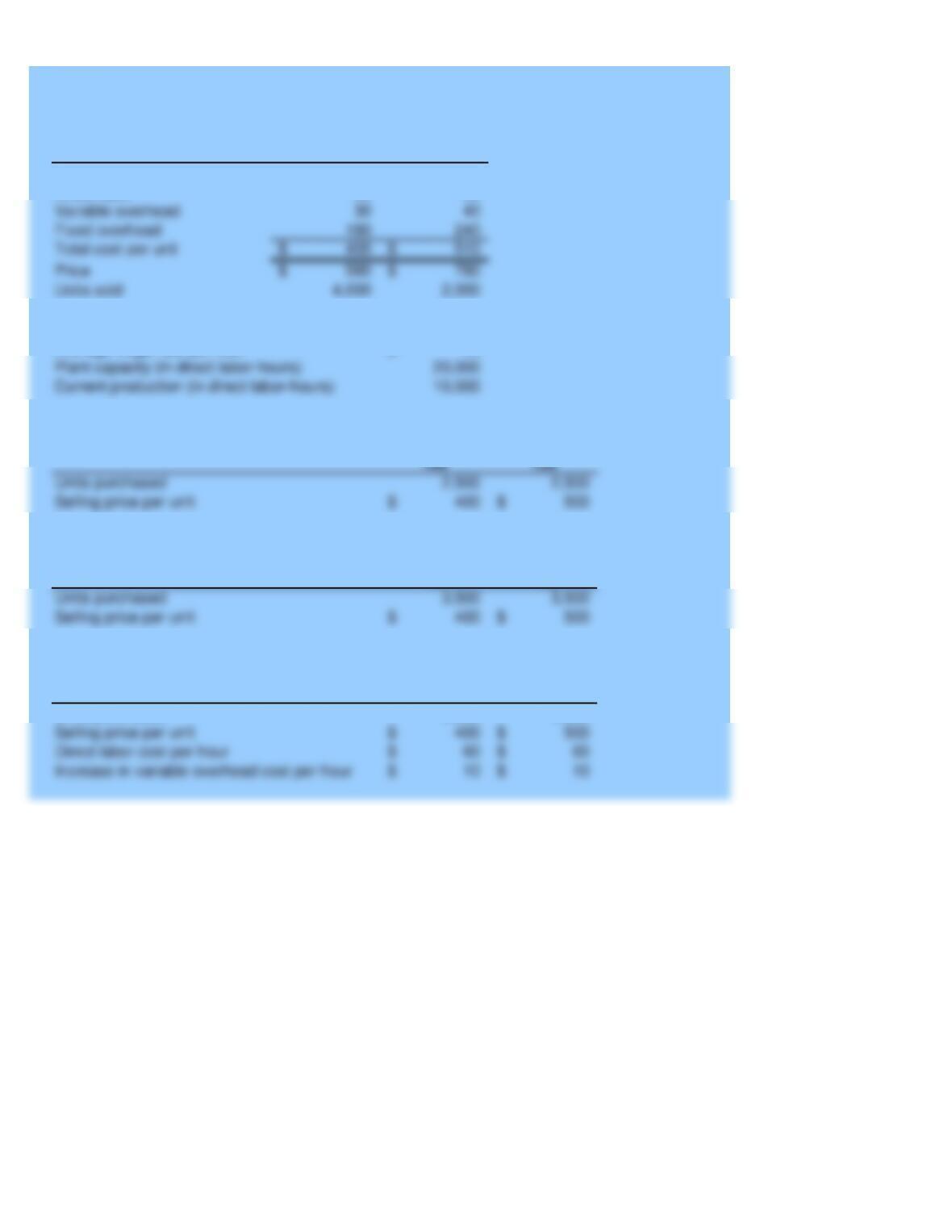
Current production (in direct labor-hours)
Plant capacity (in direct labor-hours)
Star Star
100 150
2,500 2,500
Units purchased
Selling price per unit
Star Star
100 150
3,500 3,500
Units purchased
Selling price per unit
Star Star
100 150
3,500 3,500
Increase in variable overhead cost per hour
Selling price per unit
Direct labor cost per hour
Direct materials
Direct labor
Given Data P04-52:
Units purchased
Requirement c. Information:
Requirement b. Information:
Requirement a. Information:
Additional Information: Variable overhead varies with quantity of direct labor-hours.
Costs per unit
UNTER COMPONENTS
Average wage rate per hour
Variable overhead
Fixed overhead
Units sold
Student Name:
Class:
Before Price After Price
Reduction Reduction Impact
370$ 325$
6,000 7,000
Without
Government
Contract Regular Government Total Impact
Variable marketing costs
Contribution margin
Variable manufacturing costs
Fixed manufacturing costs *
Fixed marketing costs
Income
2,960,000$ 2,590,000$ 245,000$ 2,835,000$ 125,000$ Decrease
Shipping costs per unit
Order costs per unit
Minimum price
which covers the incremental costs
of the order. In other words,
the breakeven point.
Correct! Correct! Correct!
150$
Quantity
Requirement a.
Instructor
McGraw-Hill/Irwin
DAVIS KITCHEN SUPPLY
Problem 04-56
Sales price
Requirement b.
With Government Contract
Revenue
Compute minimum price:
Requirement c.
The minimum price is that price
Variable manufacturing costs
Revenue
Variable manufacturing costs
Operating income
Variable marketing costs
Contribution margin
Fixed manufacturing costs
Fixed marketing costs
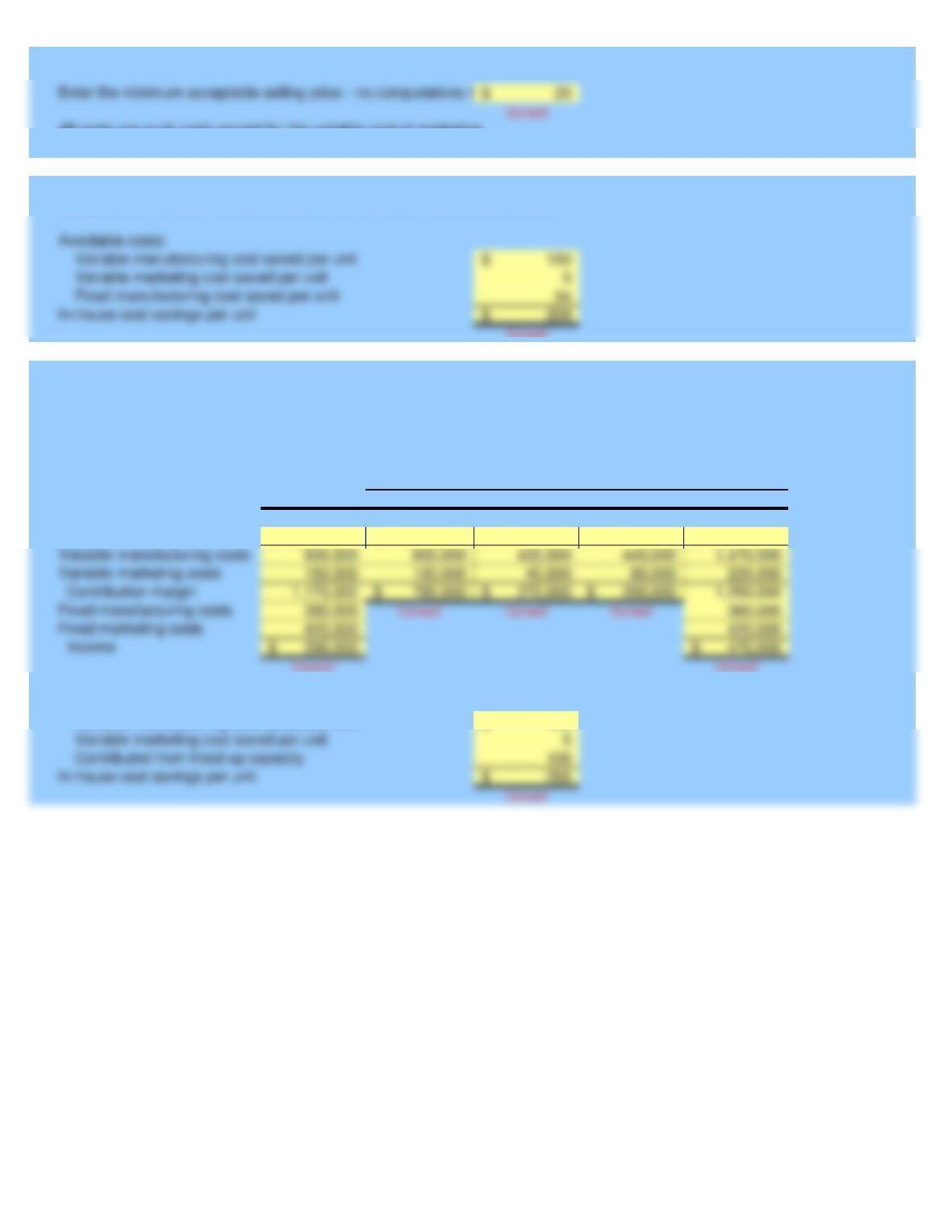
Enter the minimum acceptable selling price – no computations necessary
Correct!
6,000 regular
Stoves
Produced
In-house Regular (In)
Regular (Out)
Modified Total
Income
Variable manufacturing costs
Variable marketing costs
Contribution margin
Fixed manufacturing costs
Fixed marketing costs
2,220,000$ 1,480,000$ 740,000$ 720,000$ 2,940,000$
Variable marketing cost saved per unit
Contributed from freed-up capacity
In-house cost savings per unit
150$
Requirement d.
Contract 2,000 Regular Stoves
Computation of maximum price for outside contractor:
Requirement f.
Avoidable costs:
Variable manufacturing cost saved per unit
Revenue
All costs are sunk costs except for the variable cost of marketing.
Requirement e.
Computation of price that is equivalent to in-house cost of production:
Variable manufacturing cost saved per unit
Variable marketing cost saved per unit
Fixed manufacturing cost saved per unit
In-house cost savings per unit
Avoidable costs:
6,000
370$
7,000
325.00$
?
?
Change in monthly sales
Change in monthly costs
?
1,000
?
?
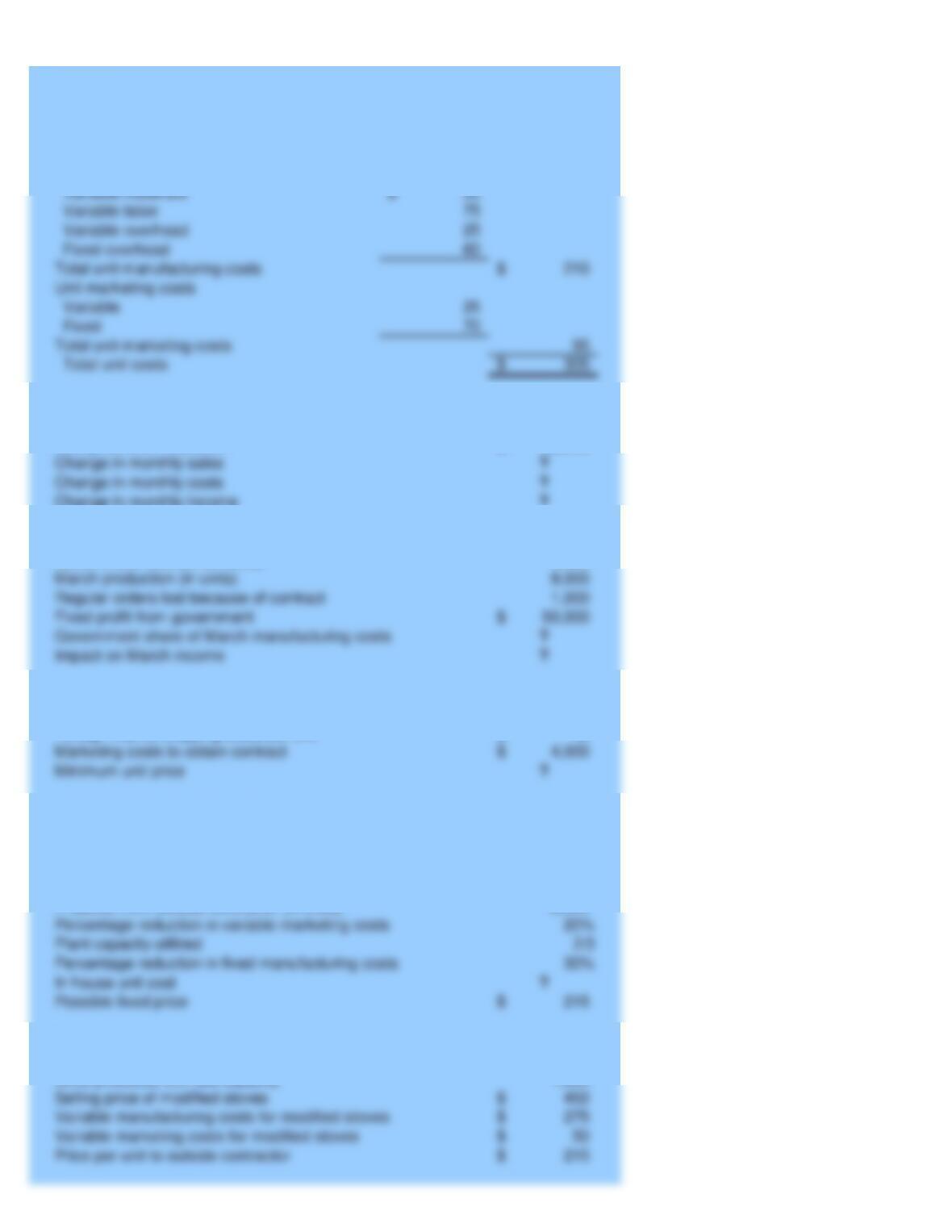
March production (in units)
Regular orders lost because of contract
Fixed profit from government
Government share of March manufacturing costs
Impact on March income
2,000
?
Marketing costs to obtain contract
Minimum unit price
40$
460
?
2,000
?
Percentage reduction in variable marketing costs
Plant capacity utilized
Percentage reduction in fixed manufacturing costs
In house unit cost
Possible fixed price
Selling price of modified stoves
Variable manufacturing costs for modified stoves
Variable marketing costs for modified stoves
Price per unit to outside contractor
1,600
Units manufactured per month
Unit manufacturing costs
New price after reduction
Regular selling price per unit
Requirement f. information:
Minimum acceptable selling price per unit
Requirement b. information:
Requirement c. information:
Requirement d. information:
Change in monthly income
Government contract (in units)
Foreign market order (in units)
Given Data P04-56:
Requirement a. information:
Increase in volume (in units)
DAVIS KITCHEN SUPPLY
Foreign market shipping costs per unit
Number of obsolete units in inventory
Requirement e. information:
Proposal from outside contractor (in units)
Use information from requirement e. plus:
Units produced with idle capacity
Variable materials
Variable overhead
Variable labor
Total unit marketing costs
Fixed
Variable
Unit marketing costs
Total unit manufacturing costs
Fixed overhead
Student Name:
Class:
Basic Classic Formal
600,000$ 640,000$ 5,700,000$
Correct!
Basic Classic Formal
60,000$ 116,000$ 570,000$
Total demand
Contribution margin per unit
Hours allowed per unit
Contribution margin per labor hour
Correct! Correct! Correct!
Classic «- Correct!
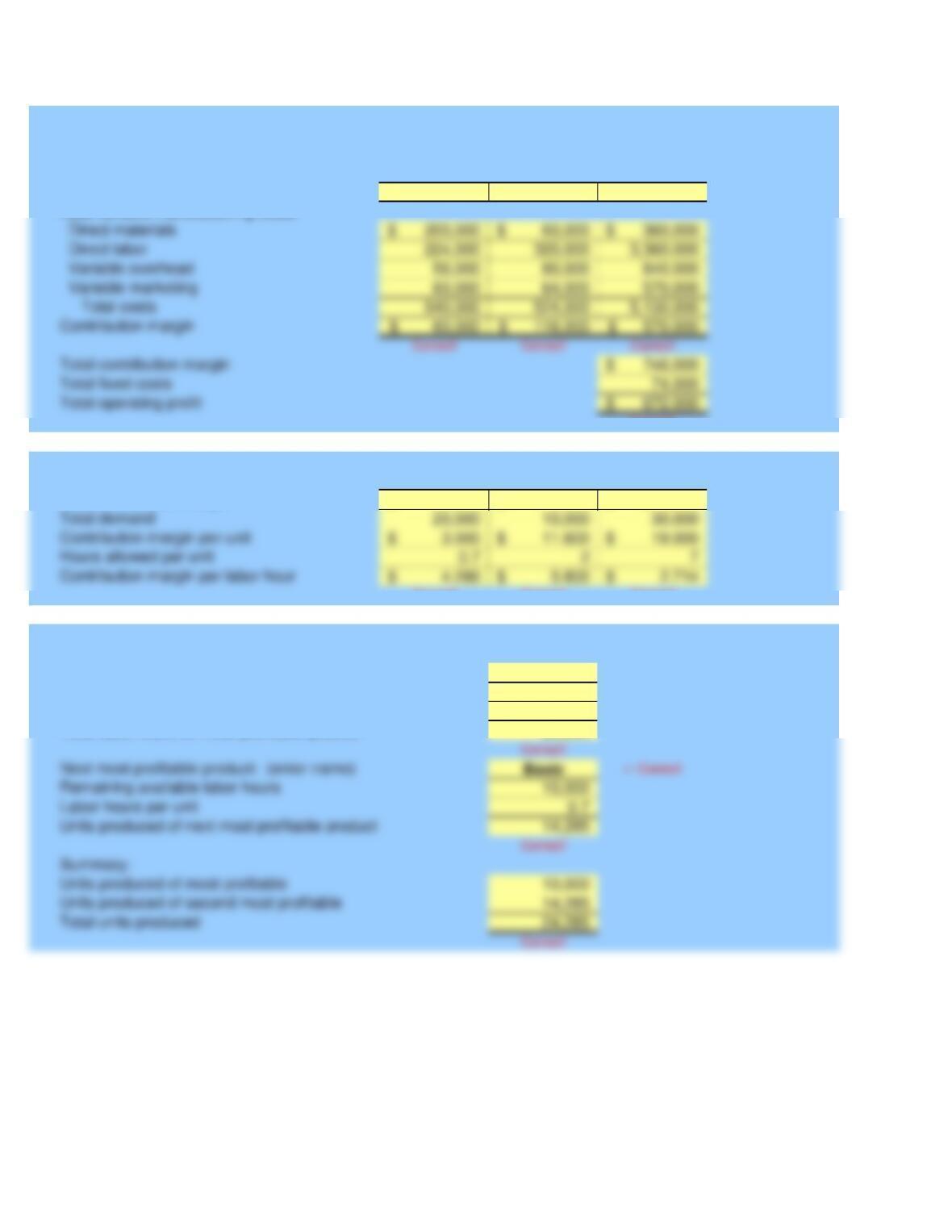
Next most profitable product: (enter name)
Remaining available labor hours
Labor hours per unit
Units produced of next most profitable product
Units produced of most profitable
Total units produced
10,000
2
20,000
AUSTIN ENTERPRISES
Problem 04-62
McGraw-Hill/Irwin
Instructor
Requirement c:
Requirement b:
Requirement a:
Total revenue
Less variable manufacturing costs:
Total contribution margin
Most profitable product per labor hour: (enter name):
Units produced to meet demand
Labor hours per unit
Total labor hours for most profitable product
60,000$ 116,000$ 570,000$
Direct materials
Direct labor
Variable overhead
Variable marketing
Total costs
Contribution margin
Total contribution margin
Total operating profit
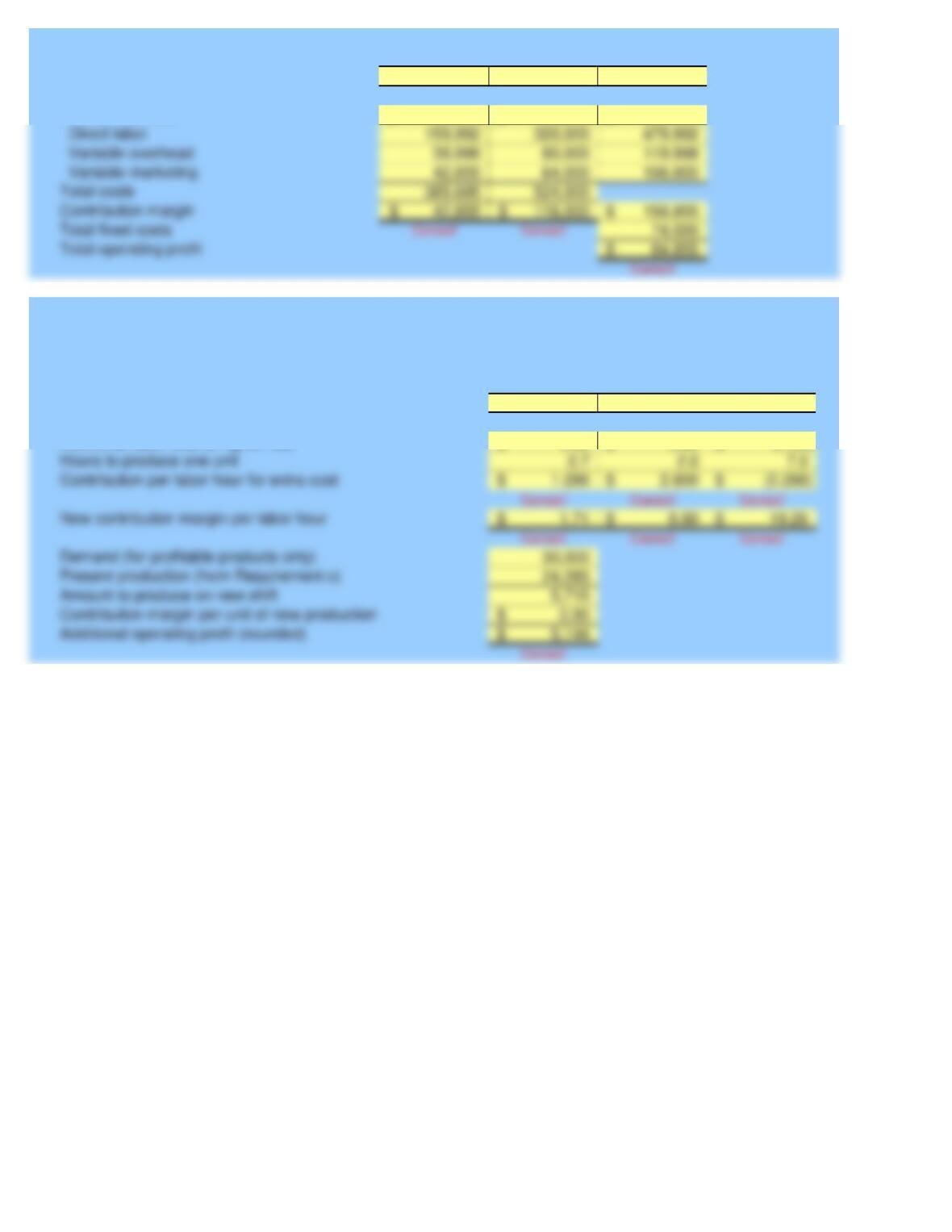
Basic Classic Total
428,550$ 640,000$ 1,068,550$
142,850$ 60,000$ 202,850$
Basic Classic Formal
Hours to produce one unit
Contribution per labor hour for extra cost
New contribution margin per labor hour
Demand (for profitable products only)
Present production (from Requirement c)
Amount to produce on new shift
Contribution margin per unit of new production
Additional operating profit (rounded)
3.00$ 11.60$ 19.00$
Correct! Correct! Correct!
0.90$ 5.60$ (2.00)$
Decision to add shift to product more Basic and/or Formal
Requirement e:
Requirement d:
Total revenue
Less variable manufacturing costs:
Direct materials
Contribution margin per unit
Additional labor cost at higher rate
Direct labor
Variable overhead
Variable marketing
Total costs
Contribution margin
Total fixed costs
Total operating profit
Basic Classic Formal
30$ 64$ 190$
20,000 10,000 30,000
0.5 0.3 0.6
0.7 2.0 7.0
Input requirement per unit
Maximum annual demand (units)
Sales price
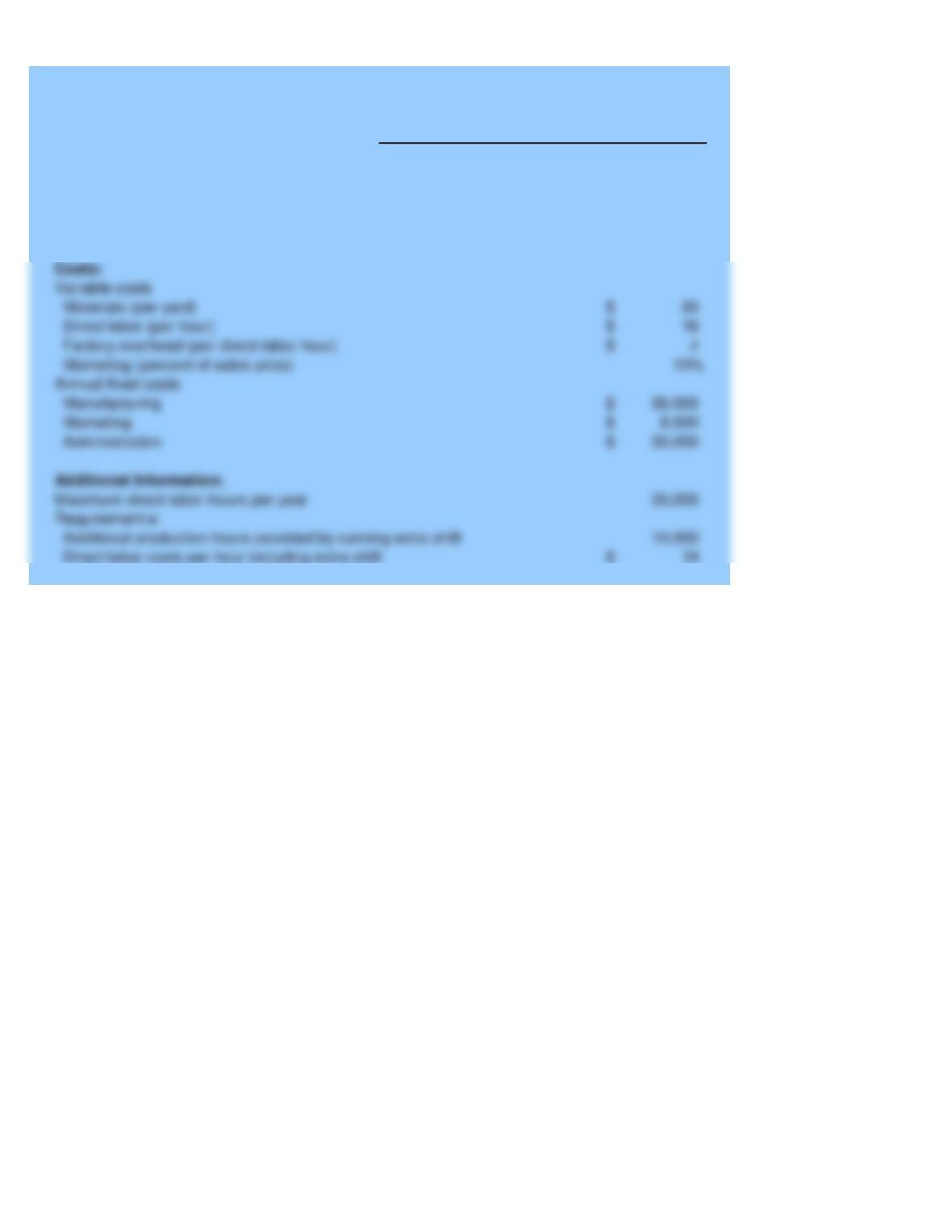
Given Data P04-62:
AUSTIN ENTERPRISES
Direct labor (hours)
Direct material (yards)
Product information:
Manufacturing
Marketing
Factory overhead (per direct-labor hour)
Marketing (percent of sales price)
Variable costs
Materials (per yard)
Direct labor (per hour)
Administration
Direct labor costs per hour including extra shift
Additional production hours provided by running extra shift
Requirement e:
Maximum direct labor-hours per year
Additional Information: