John J. Wild, Financial Accounting: Information for Decisions, 8th Edition
4-1
CHAPTER 4
REPORTING AND ANALYZING MERCHANDISING
OPERATIONS
Related Assignment Materials
Student Learning Objectives
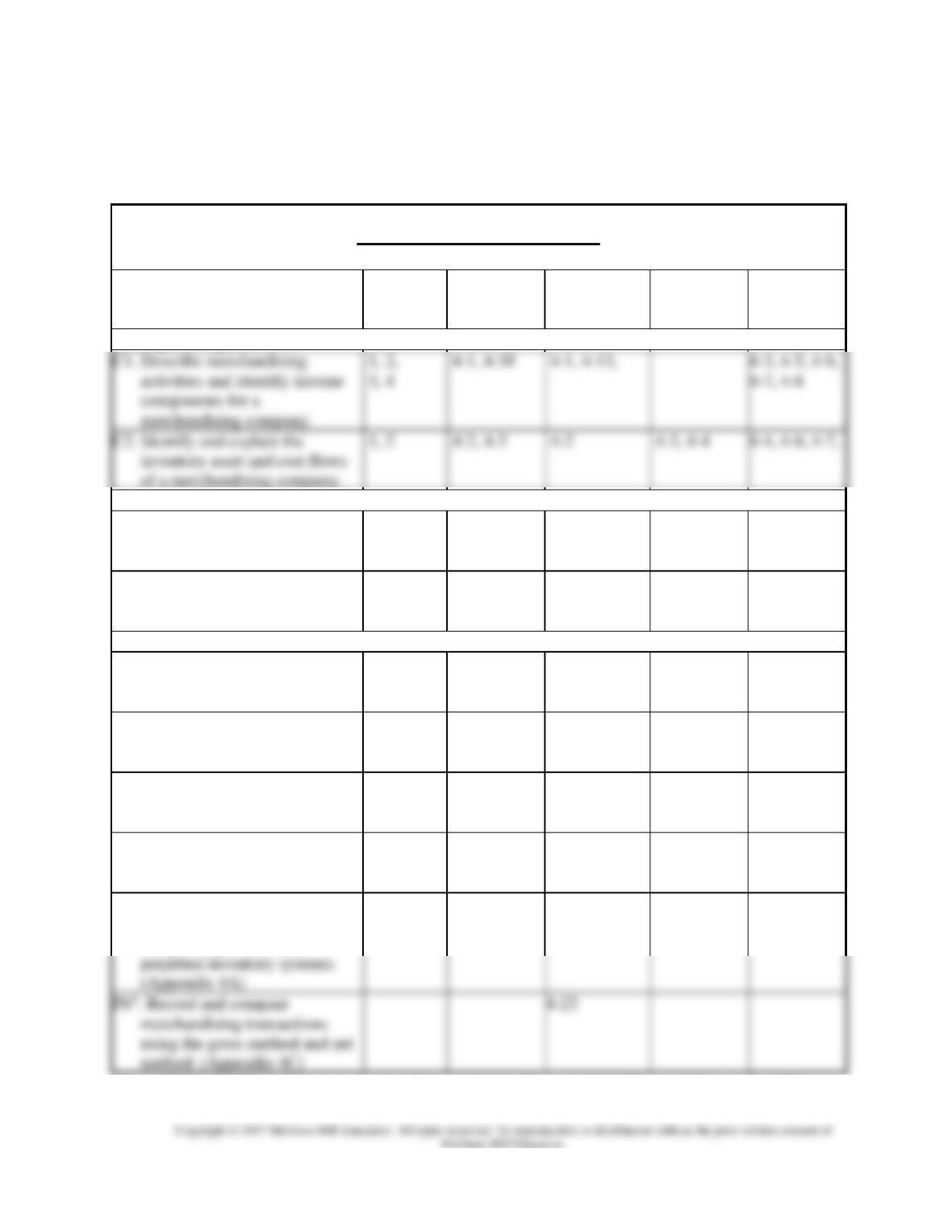
Questions
Quick
Studies*
Exercises*
Problems*
Beyond the
Numbers
Conceptual objectives:
components for a
merchandising company.
C2. Identify and explain the
of a merchandising company.
1, 2
4-2, 4-3
4-2
4-3, 4-4
4-4, 4-6, 4-7,
Analytical objectives:
A1. Compute the acid-test ratio and
explain its use to assess
liquidity.
4-14, 4-15
4-15, 4-17
4-5, GL4-3
4-1
A2. Compute the gross margin ratio
and explain its use to assess
profitability.
4-16
4-5, GL4-3
4-2, 4-5, 4-9,
Procedural objectives:
P1. Analyze and record transactions
for merchandise purchases
using a perpetual system.
6, 7,
8, 9,
14, 15
4-4, 4-5, 4-6,
4-7
4-3, 4-5, 4-6,
4-7, 4-8, 4-9,
4-10
4-1, 4-2,
SP 4, GL4-1,
GL4-2
P2. Analyze and record transactions
for merchandise sales using a
perpetual system.
5, 7
8, 9
4-8
4-4, 4-6, 4-7,
4-8, 4-9
4-1, 4-2,
SP 4, GL4-1,
GL4-2
4-3
P3. Prepare adjustments and close
accounts for a merchandising
company.
4-9, 4-10,
4-11, 4-12
4-10, 4-11,
4-12, 4-13,
4-4, 4-5, 4-6,
SP 4, GL4-3
4-4
P4. Define and prepare multiple-
step and single-step income
statements.
2, 3,
10, 11, 12,
13, 14
4-13
4-14, 4-21,
4-3, 4-5,
SP 4, GL4-3
4-7, 4-9
perpetual inventory systems.
using the gross method and net
method. (Appendix 4C)
P5A. Record and compare
merchandising transactions
using both periodic and
4-16,
4-17
4-18, 4-19,
4-20, 4-22
4-4
*See additional information on next page that pertains to these quick studies, exercises and problems.
John J. Wild, Financial Accounting: Information for Decisions, 8th Edition
4-2
Additional Information on Related Assignment Material
Connect
Available on the instructor’s course-specific website) repeats all numerical Quick Studies, all Exercises
and Problems Set A. Connect also provides algorithmic versions for Quick Study, Exercises and
Problems. It allows instructors to monitor, promote, and assess student learning. It can be used in
practice, homework, or exam mode.
Connect Insight
The Serial Problem for Success Systems continues in this chapter.
General Ledger
New to 8e are General Ledger problems that offer students the ability to see how transactions post from the general
journal all the way through the financial statements. General Ledger (GL) questions provide auto-grading in the
same intelligent design as our end–of-chapter content. Critical thinking and analysis components are added to each
GL problem to ensure understanding of the entire process.
Excel Simulations
Synopsis of Chapter Revisions
• NEW opener—Chipotle
• Added T-account to Exhibit 4.4 to aid student understanding.
• Enhanced explanation, including entries, for cash and credit purchases.
• Simplified purchase returns illustration.
• Enhanced explanation to section on transportation costs.
• New column added to Exhibit 4.7 on ‘who owns’ goods in transit.
• Sales entries reflect new revenue recognition rules.
John J. Wild, Financial Accounting: Information for Decisions, 8th Edition
4-3
Chapter Outline
Notes
I. Merchandising Activities
A. Merchandise consists of products, also called goods, which a
company acquires to resell to customers. Merchandisers can be
either wholesalers (those that buy from manufacturers or other
wholesalers and sell to retailers or other wholesalers) or retailers
(those that buy from wholesalers or manufacturers and sell to
consumers).
C. Reporting Inventory for a Merchandiser
A merchandiser’s balance sheet is the same as service businesses
with the exception of one additional current asset called:
1. Merchandise Inventory, or Inventory, refers to products a
company owns and intends to sell.
2. The cost of this asset includes the cost incurred to buy the
goods, ship them to the store, and make them ready for sale.
E. Inventory Systems
Two alternative inventory systems that can be used to collect
information about the cost of goods sold and the inventory (cost of
goods available) are:
1. Perpetual inventory system which continually updates
accounting records for merchandising transactions—
specifically, those records of inventory available for sale and
inventory sold. Technological advances and competitive
John J. Wild, Financial Accounting: Information for Decisions, 8th Edition
4-4
Chapter Outline
Notes
II. Accounting for Merchandise Purchases
The invoice serves as a source document for this event.
A Purchases without Cash Discounts.
1. Entry to record purchase: debit Inventory, credit Cash or
Accounts Payable.
discounts are not entered into accounts.
B. Purchases with Cash Discounts.
1. Credit terms describe cash discounts offered to purchasers by
seller for payment within a specified period of time called the
discount period.
2. Cash Discounts- granted by the seller to encourage buyers to
pay the amount they owe earlier. Buyers view cash discounts
as purchase discounts and sellers view them as sales discounts.
C. Purchases with Returns and Allowances.
1. Purchase returns refers to merchandise a buyer acquires but
then returns to the seller.
2. Purchase allowance is a reduction in the cost of defective
merchandise that a buyer acquires.
D. Purchases and Transportation Costs
The point at which ownership is transferred (called FOB or free on
board) determines who is responsible for paying any freight costs
and/or bearing any loss. Two alternative points of title transfer
are:
John J. Wild, Financial Accounting: Information for Decisions, 8th Edition
4-5
Chapter Outline
Notes
1. FOB shipping point—title transfers at shipping point and
buyer bears any loss and pays shipping costs.
2. FOB destination—title transfers at destination and seller bears
any loss and pays shipping costs.
a. Operating expense for seller
a. Increases cost of merchandise (cost principle)
E. Purchases and their Itemized Costs.
The net cost of purchased merchandise according to the cost
principle is recorded in the Inventory account. (Inventory is
debited (increased) for invoice and transportation costs, and
credited (decreased) for returns, allowances, and purchase
III. Accounting for Merchandise Sales
A. Sales without Cash Discounts. Each sale of merchandise
transaction involves two parts (resulting in two journal entries; the
revenue entry and the cost entry.
1. Recognize revenue—debit Accounts Receivable (or cash),
credit Sales (both for the invoice amount).
2. Recognize cost—debit Cost of Goods Sold, credit Inventory
(both for the cost of the inventory sold).
B. Sales with Cash Discounts
Cash discounts awarded to customers for payment within the
discount period. Recorded upon collection for sale.
1. Collection after discount period—Debit Cash, Credit Accounts
Receivable (full invoice amount).
C. Sales With Returns and Allowances
price).
1. Sales returns—merchandise that a customer returned to the
seller after a sale.
John J. Wild, Financial Accounting: Information for Decisions, 8th Edition
4-6
Chapter Outline
Notes
3. Entry: debit Sales Returns and Allowances and credit
Accounts Receivable; additional entry to restore cost of
returned goods to inventory if merchandise is returned and it is
salable: debit Inventory, credit Cost of Goods Sold.
IV. Completing the Accounting Cycle
A. Adjusting Entries for Merchandisers
Generally same as discussed in chapter 4 for a service business
with an additional adjustment needed to update inventory to reflect
any loss of merchandise referred to as shrinkage.
1. Inventory Shrinkage Adjusting Entry determined by
comparing a physical count of the inventory with recorded
quantities.
4. Adjusting entry: debit Sales Discounts, credit Allowance for
Sales Discounts (contra asset account reported on the balance
sheet as a reduction to Accounts receivable.)
5. Expected Returns and Allowances – Adjusting Entries. New
revenue recognition rules require sellers to estimate sales
returns and allowances in the period of the sale.
a. Revenue Side for Expected R&A. Seller sets up a Sales
Refund Payable account current liability reflecting amount
expected to be refunded to customers which is only updated
John J. Wild, Financial Accounting: Information for Decisions, 8th Edition
4-7
Chapter Outline
Notes
allowances, and cost of goods sold). Debit balance accounts are
1. Income Statement includes the cost of goods sold and gross
profit. Also, net sales is affected by discounts, returns, and
allowances and delivery expense as an additional possible
expense.
V. Financial Statement Formats—GAAP does not require any specific
format. Common formats:
A. Multiple-Step Income Statement—shows details of net sales and
other costs and expenses. Has three main parts:
1. Gross profit—net sales less cost of goods sold.
2. Income from operations—gross profit less operating expenses
(classified into selling and general & administrative).
3. Net income—Income from operations adjusted for
nonoperating items.
income.
VI. Global View—Compares U.S. GAAP to IFRS
A. Accounting for Merchandise Purchases and Sales—both systems
are identical in and account as illustrated in this chapter.
B. Income Statement Presentation—IFRS tends to use the term profit
whereas U.S. GAAP tends to use net income. Presentation is
similar through cost of goods sold, followed by these differences:
C. Balance Sheet Presentation—same as discussed in chapter 2 & 3.
1. Expense presentation—IFRS requires separate disclosures for
financing expenses, income tax, and some other special items.
John J. Wild, Financial Accounting: Information for Decisions, 8th Edition
4-8
Chapter Outline
Notes
1. Used to assess the company‘s liquidity or ability to pay its
current debts. Differs from current ratio in that it is based on
quick assets (which excludes less liquid current assets such as
inventory and prepaid expenses) rather than all current assets.
VIII. Periodic Inventory System (Appendix 4A)—textbook shows
comparison of periodic and perpetual in this appendix.
A. A periodic inventory system records merchandise acquisitions,
discounts and returns in temporary accounts (Purchases, Purchase
Returns, Purchases Discounts) rather than the merchandise
inventory account.
VIV. Work Sheet—Perpetual System (Appendix 4B)
A work sheet may be used for preparing financial statements of a
merchandiser which differs slightly from the work sheet used in
Chapter 3. The following accounts are included on a work sheet of a
Merchandiser under the perpetual system: Merchandise inventory,
Sales, Sales returns and allowances, Sales discounts, and Cost of goods
Sold.
VV. Recording Transactions Under the Net Method
A. Initially records invoices at net of any cash discount amount.
Inventory is debited for net amount when initially record.
Discounts not taken are debited to a Discounts Lost expense
account reported on the income statement.
B. Perpetual Inventory System
1. Purchases – debit inventory and credit accounts payable for
net amount.
John J. Wild, Financial Accounting: Information for Decisions, 8th Edition
4-9
Chapter Outline
6. If cash received after discount period, debit cash, credit
interest revenue and credit accounts receivable.
C. Periodic Inventory System
1. Purchases – debit purchases and credit accounts payable for
net amount.
Notes
John J. Wild, Financial Accounting: Information for Decisions, 8th Edition
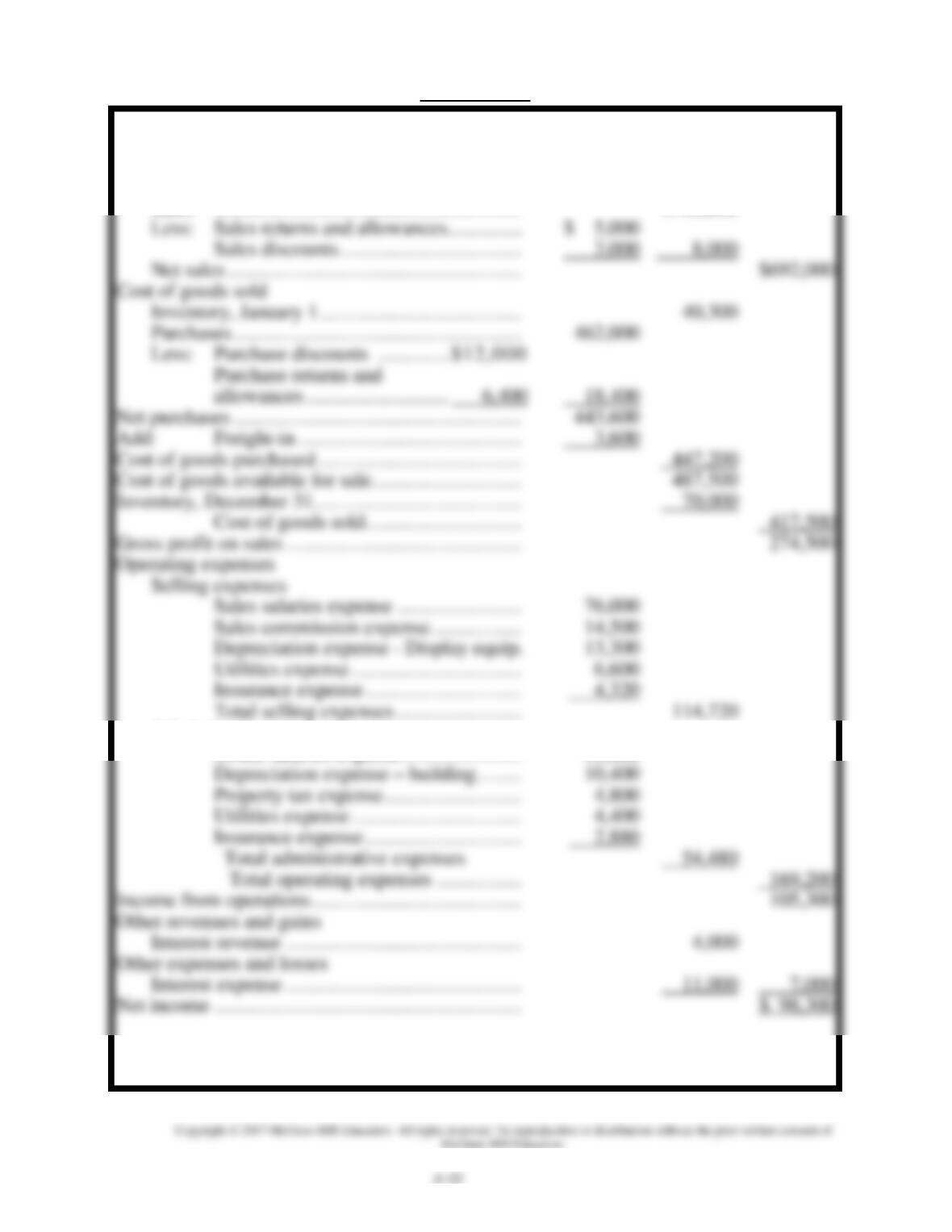
VISUAL #4-1
THE OUTDOOR STORE
Income Statement
For the Year Ended December 31, 20xx
Sales revenues
Sales ………………………………………..
$700,000
Less: Sales returns and allowances. …………..
Sales discounts ……………………….
8,000
Net sales ………………………………………
$692,000
Inventory, January 1 ………………………….
Purchases ……………………………………..
Less: Purchase discounts ……….. $12,000
Purchase returns and
allowances ………………………. 6,400
447,200
70,000
Cost of goods sold ……………………
417,500
Selling expenses
Sales salaries expense ……………….
Sales commission expense …………..
Depreciation expense – Display equip.
Utilities expense ……………………..
6,600
Insurance expense ……………………
Total selling expenses ……………….
Administrative expenses
Office salaries expense ………………
32,000
Depreciation expense – building …….
Property tax expense …………………
4,800
Utilities expense ……………………..
4,400
Insurance expense ……………………
Total administrative expenses
54,480
Total operating expenses ………….
169,200
Interest revenue ………………………………
Interest expense ………………………………
11,000
7,000
$ 98,300

John J. Wild, Financial Accounting: Information for Decisions, 8th Edition
4-11