CHAPTER 4
SOLUTIONS TO EXERCISES—SET B
EXERCISE 4-1B
(a)
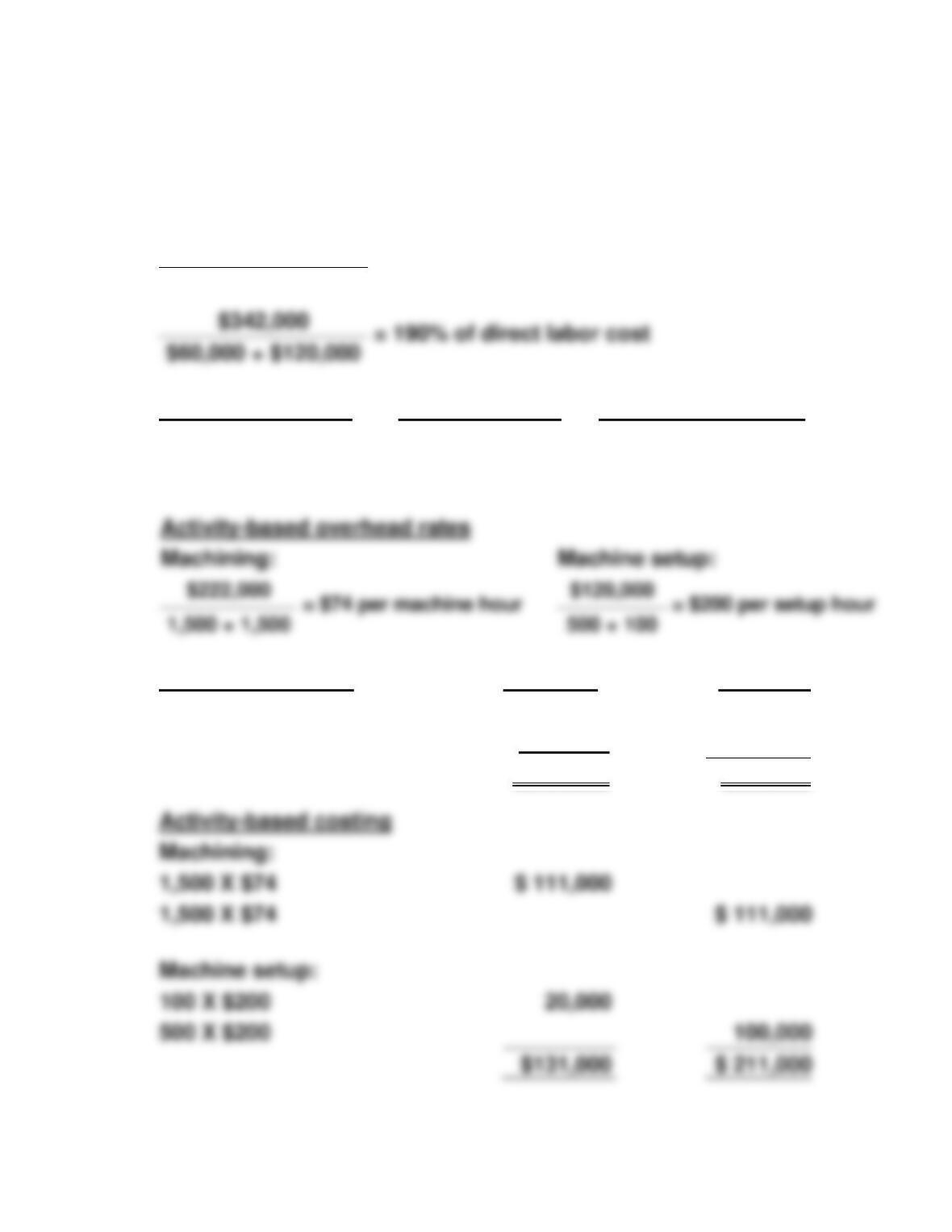
Estimated overhead
= Predetermined overhead rate
Direct labor costs
(b)
Activity cost pools
Cost drivers
Estimated overhead
Machining
Machine hours
$222,000
Machine setup
Set up hours
120,000
Activity-based overhead rates
Machining:
Machine setup:
(c)
Traditional costing
Standard
Custom
$60,000 X 190%
$ 114,000
$120,000 X 190%
$228,000
$ 114,000
$228,000
Activity-based costing
Machining:
1,500 X $74
1,500 X $74
Machine setup:
100 X $200
500 X $200
EXERCISE 4-2B
(a)
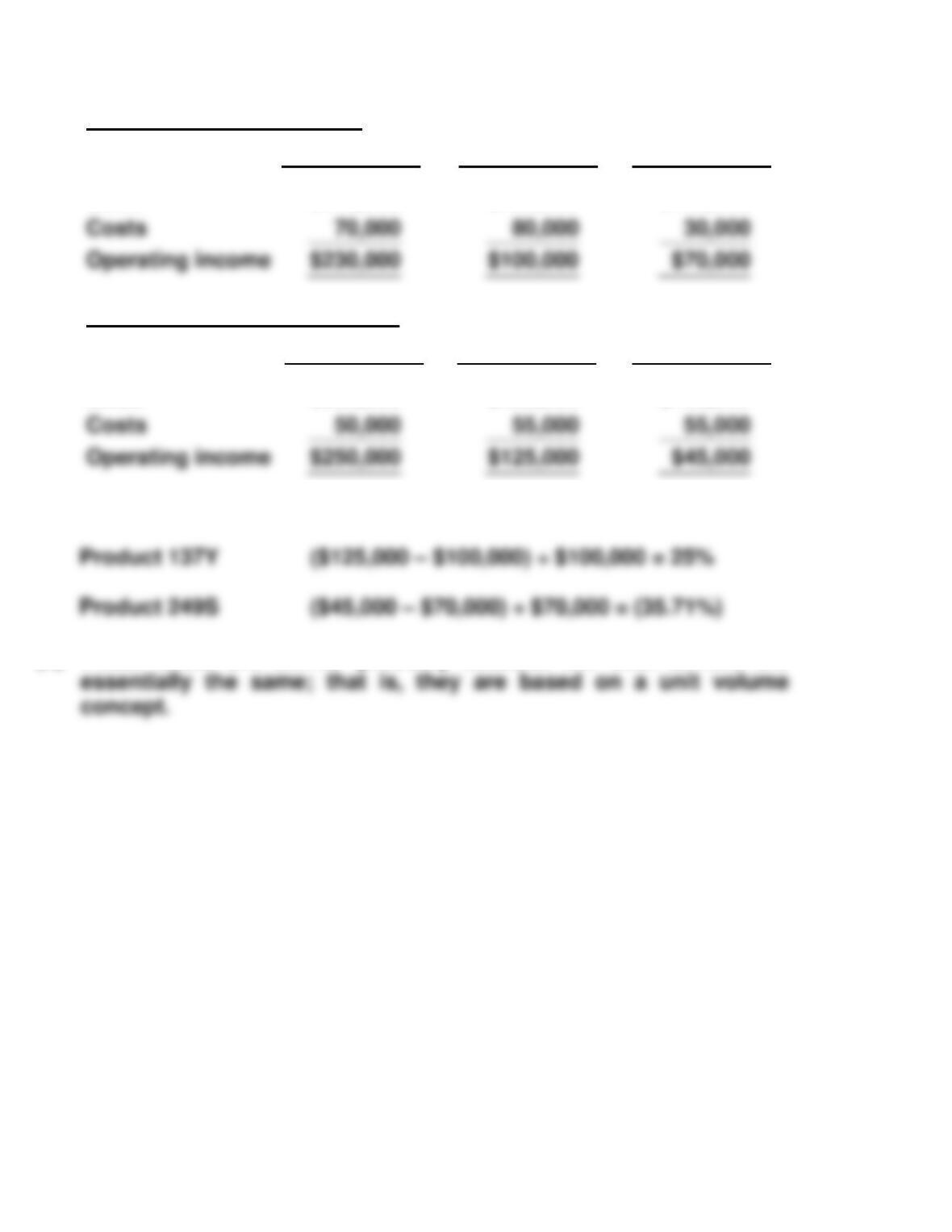
Traditional costing system
Product 440X
Product 137Y
Product 249S
Sales
$300,000
$180,000
$100,000
(b)
Activity-based costing system
Product 440X
Product 137Y
Product 249S
Sales
$300,000
$180,000
$100,000
Operating income
$125,000
(c)
Product 440X:
($250,000 – $230,000) ÷ $230,000 = 8.70%
Product 249S
($45,000 – $70,000) ÷ $70,000 = (35.71%)
(d)
These costs are similar probably because the cost drivers are
Operating income
$100,000
EXERCISE 4-3B
(a)
Activity cost pools
Cost drivers
Estimated overhead
Cutting
Machine hours
$500,000
Design
Number of setups
540,000
Wool
Cotton
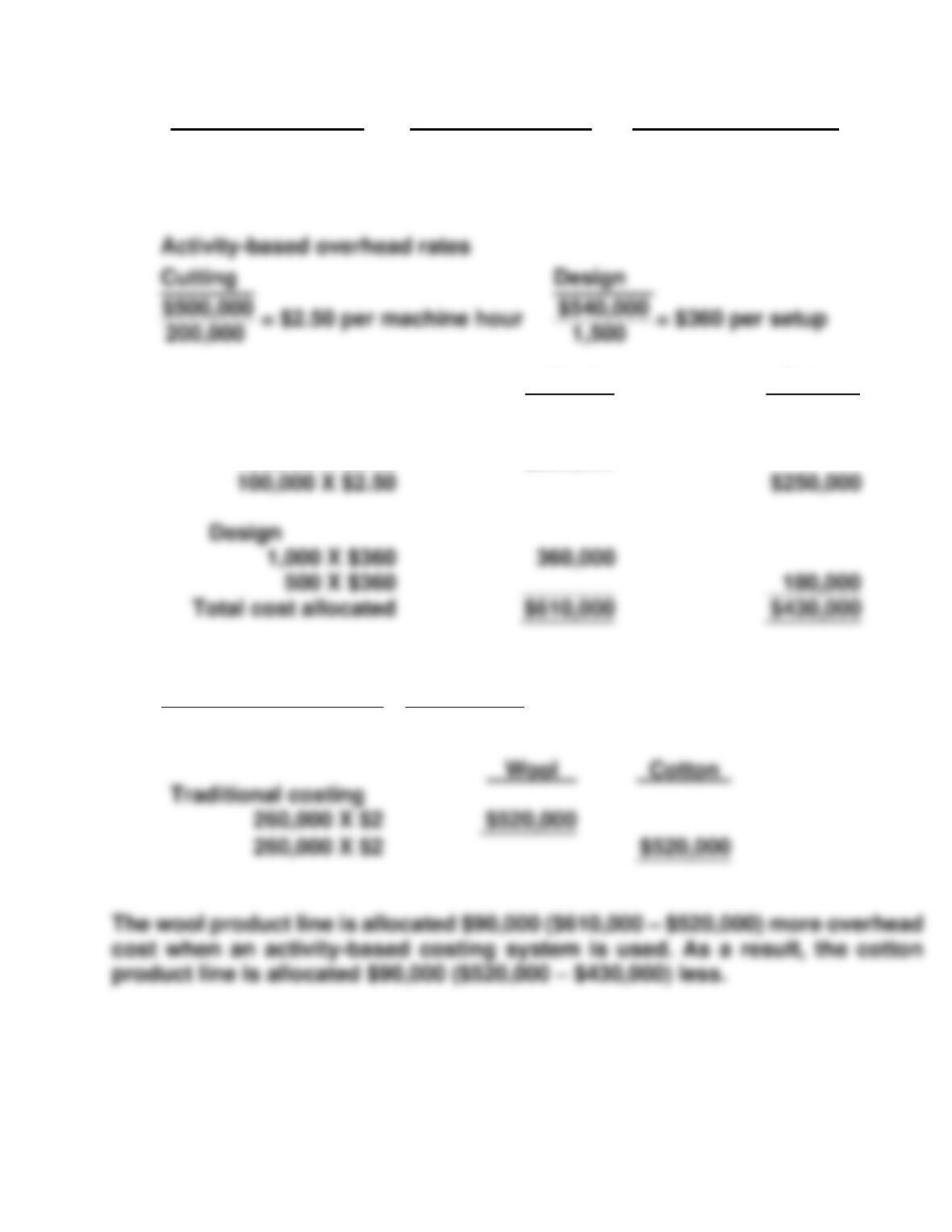
Activity-based costing
Cutting
100,000 X $2.50
$250,000
Design
(b)
Estimated
overhead
=
$1,040,000
= $2 per direct labor hour
Direct labors hours
520,000
Traditional costing
EXERCISE 4-4B
(a)
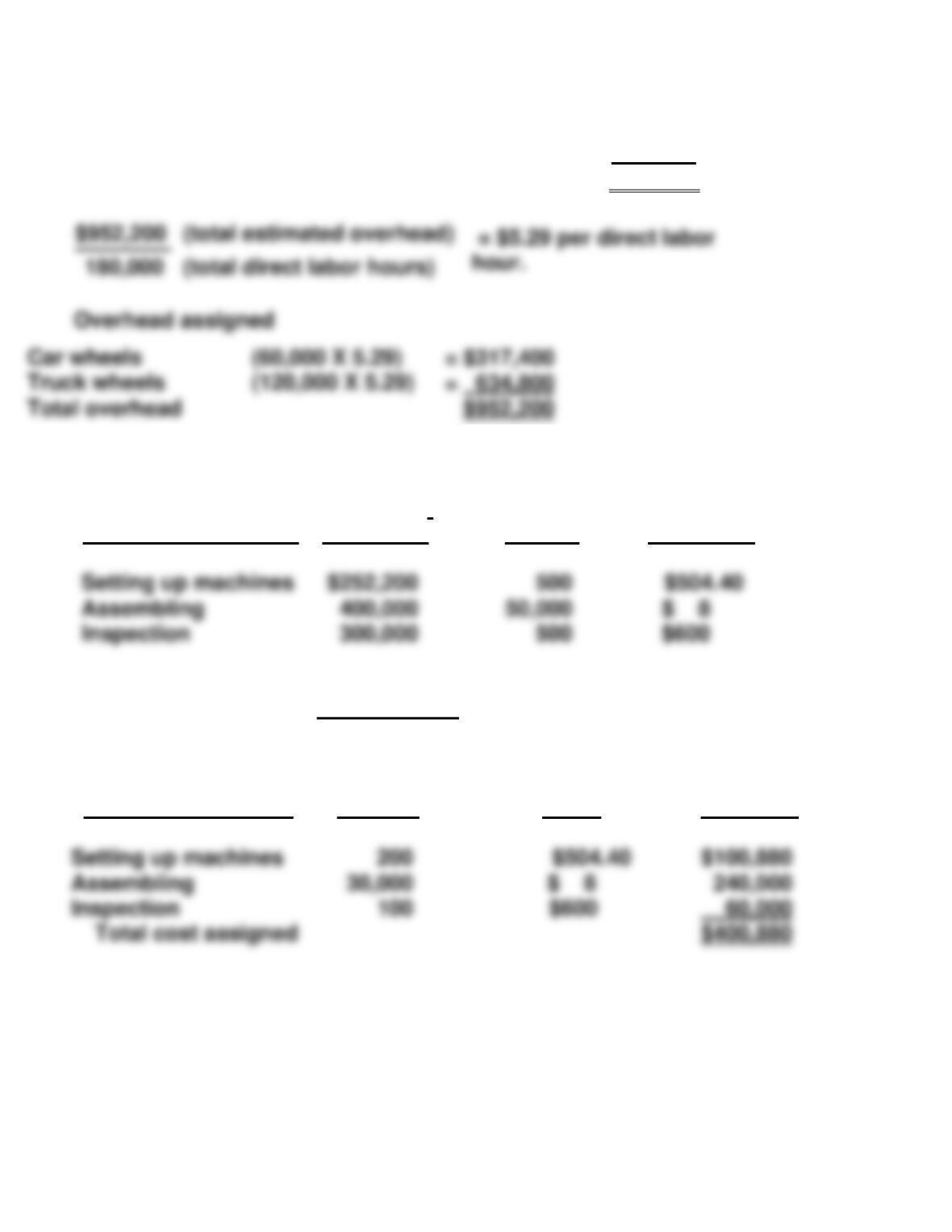
Direct labor hours for car wheels
(30,000 X 2)
= 60,000
Direct labor hours for truck wheels
(20,000 X 6)
= 120,000
Total direct labor hours
180,000
(b)
Activity Cost Pools
Estimated
Overhead
÷
Expected
Use of
Cost
Drivers
=
ABC
Overhead
Rate
Assembling
Inspection
(c)
Car Wheels
Activity Cost Pools
Expected Use
of Cost
Driver per
Product
X
Activity-Based
Overhead
Rates
=
Cost
Assigned
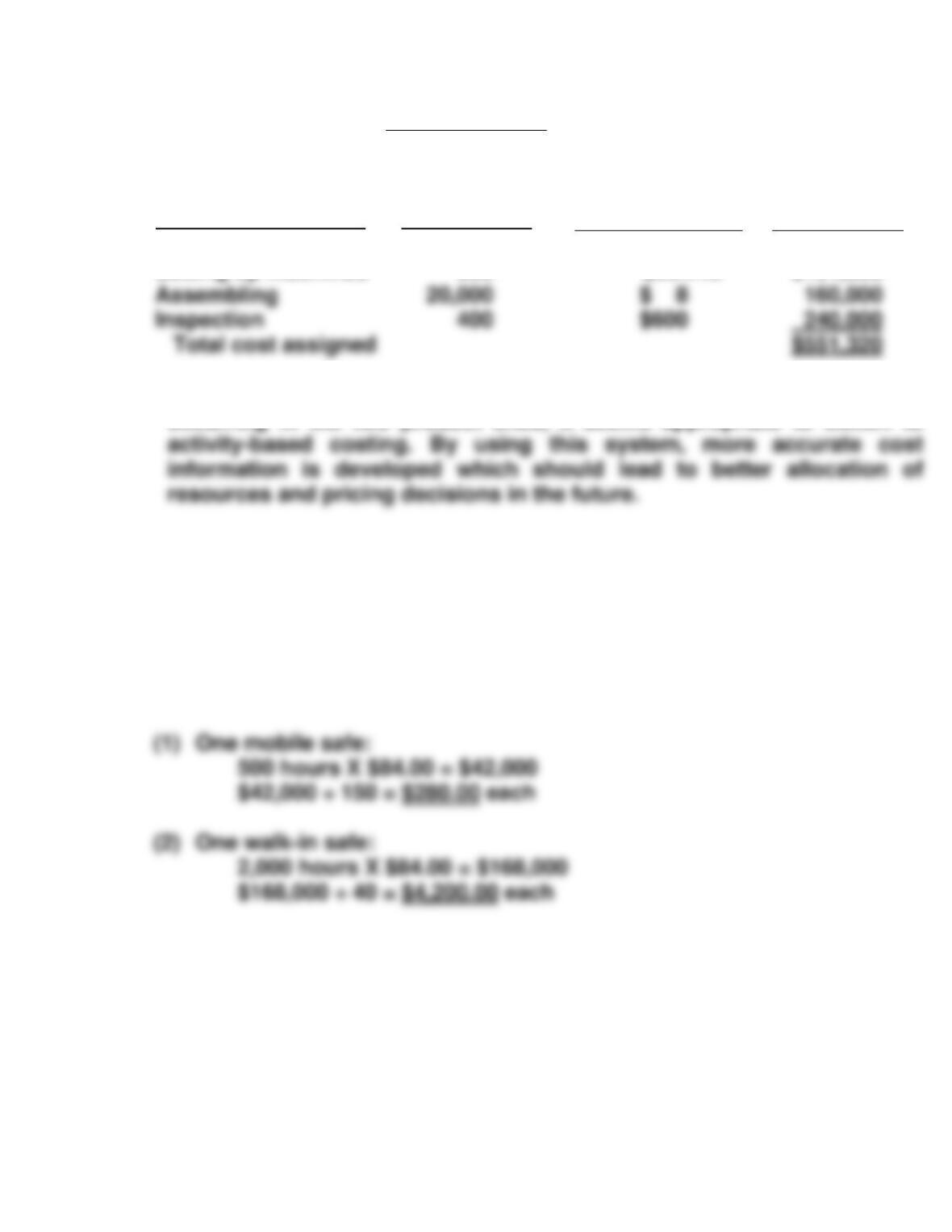
Total cost assigned
$400,880
Car wheels
(60,000 X 5.29)
Total overhead
EXERCISE 4-4B (Continued)
(c)
Truck Wheels
Activity Cost Pools
Expected use
of Cost
Driver per
Product
X
Activity-
Based
Overhead
Rates
=
Cost
Assigned
Setting up machines
300
$504.40
$151,320
(d) Assuming that the cost drivers are a reasonable representation of what is
occurring in the two product lines, it seems appropriate to switch to
EXERCISE 4-5B
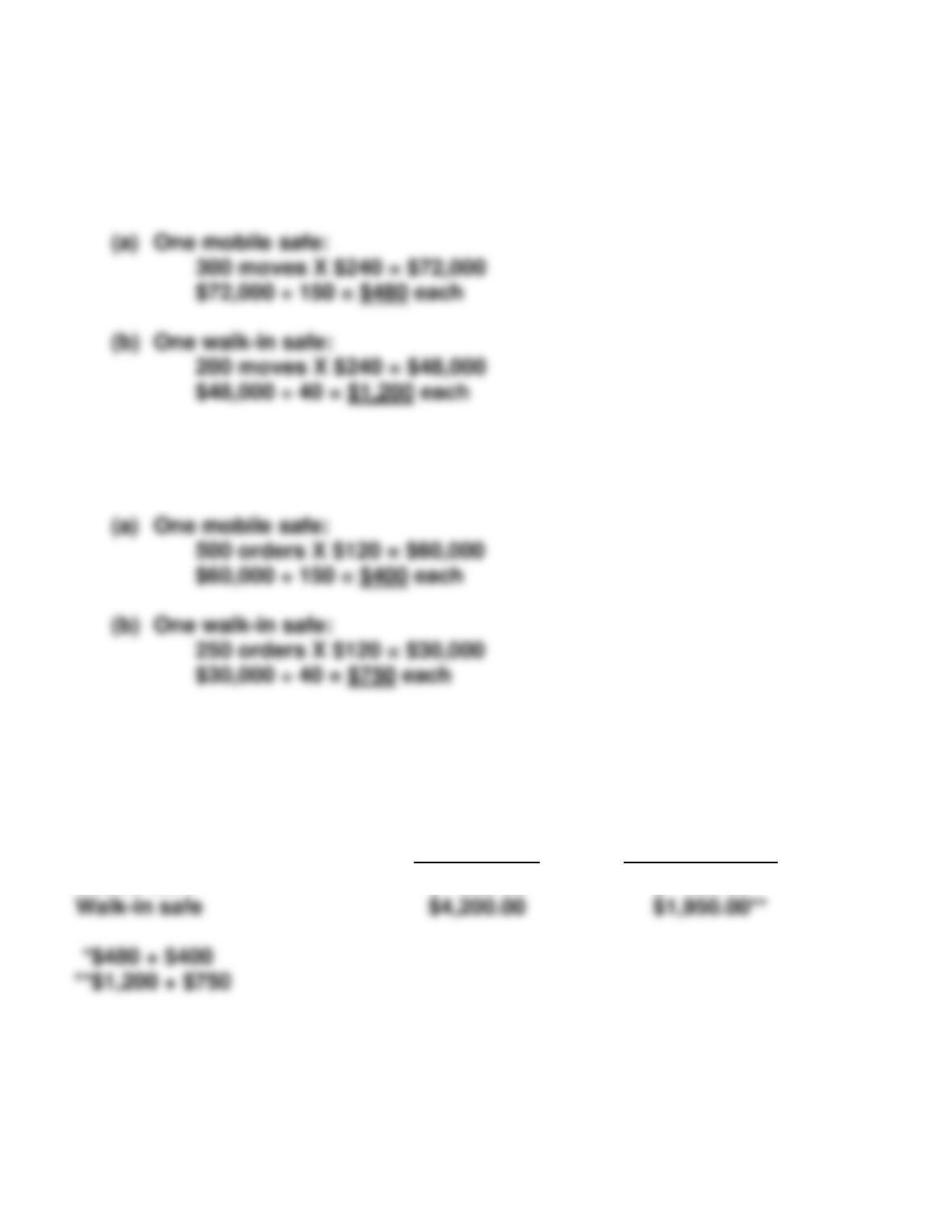
(a) Traditional costing:
$210,000 ÷ 2,500 (500 + 2,000) hours
= $84.00 per direct labor hour
Assembling
Inspection
Total cost assigned
EXERCISE 4-5B (Continued)
(b) Activity-based costing:
(1) Material handling costs
$120,000 ÷ 500 (300 + 200) moves = $240 per move
(2) Purchasing activity costs
$90,000 ÷ 750 (500 + 250) orders = $120 per order
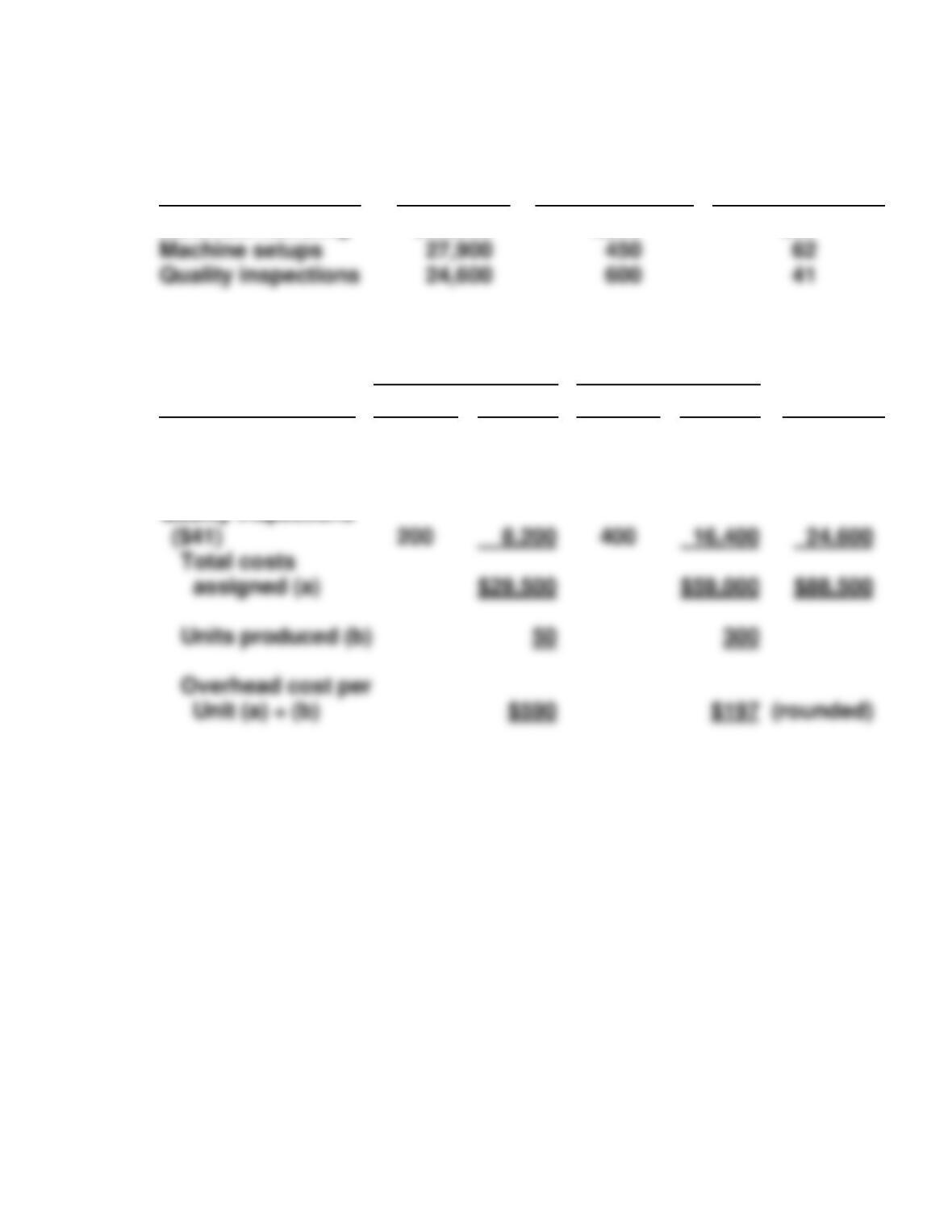
(c) The total amount of overhead allocated to each unit of the two products
under the two allocation approaches is:
Traditional
Costing
Activity-Based
Costing
Mobile safe
$ 280.00
**$ 880.00**
EXERCISE 4-6B
(a) The overhead rates are:
Activity Cost Pools
Estimated
Overhead
÷
Expected Use
of Cost Drivers
per Activity
=
Activity-Based
Overhead Rates
Materials handling
$36,000
1,200
$30
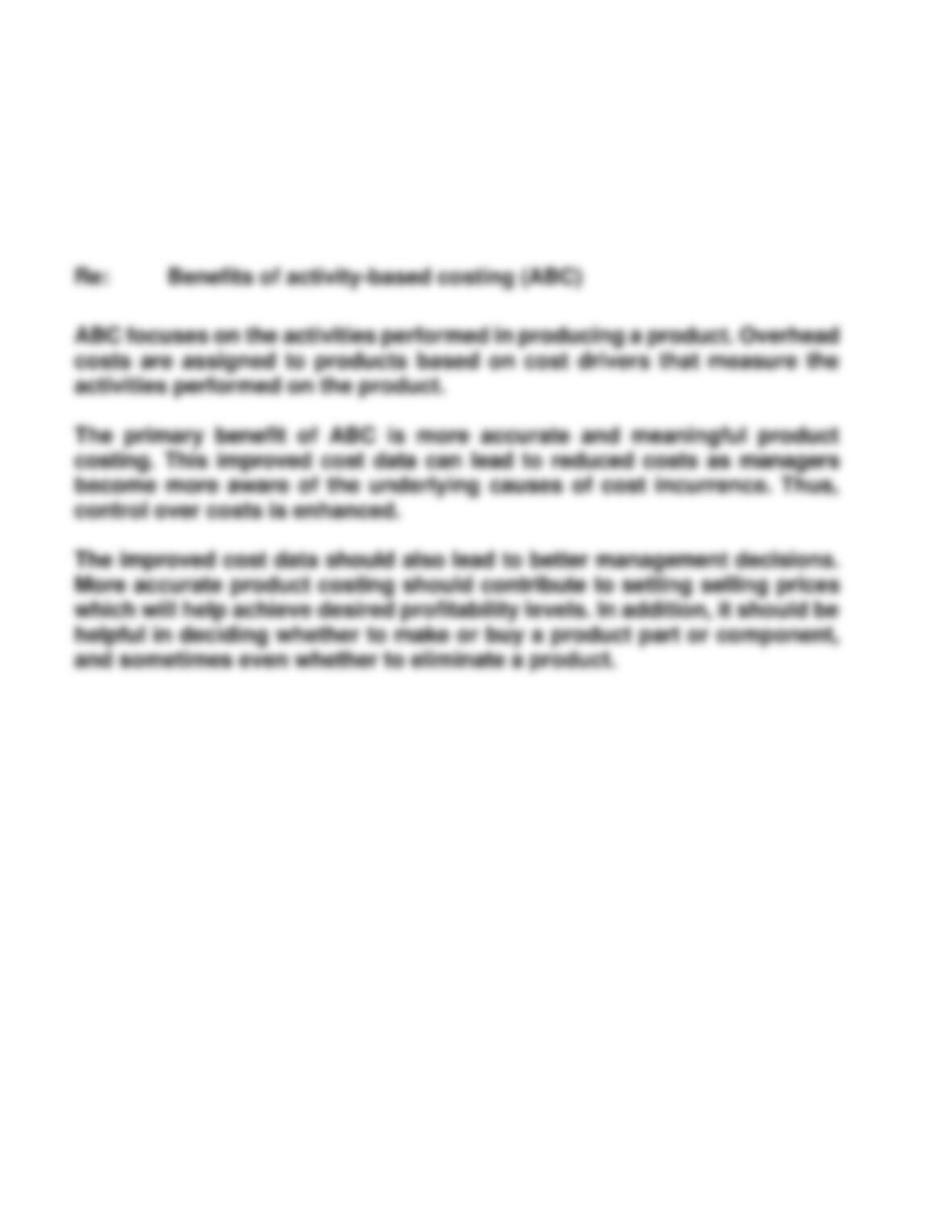
(b) The assignment of the overhead costs to products is as follows:
Instruments
Gauges
Cost
Assigned
Cost Driver
Number
Cost
Number
Cost
Units produced (b)
300
Overhead cost per
$590
Materials handling
($30)
Machine setups ($62)
Quality inspections
400
150
$12,000
9,300
800
300
$24,000
18,600
$36,000
27,900
Machine setups
EXERCISE 4-6B (Continued)
(c) MEMO
To: President, Flair Instruments
From: Student
EXERCISE 4-7B
(a) (1) Traditional product costing system:
(2) Activity-based costing system:
Activity Cost Pools
Cost Drivers
Used
X
Activity-
Based
Overhead
Rates
=
Overhead Cost
Assigned
Catalogs
Credit and collection
Sales commissions
Advertising—TV/Radio
$920,000
250
$.04
$300
$ 36,800
75,000
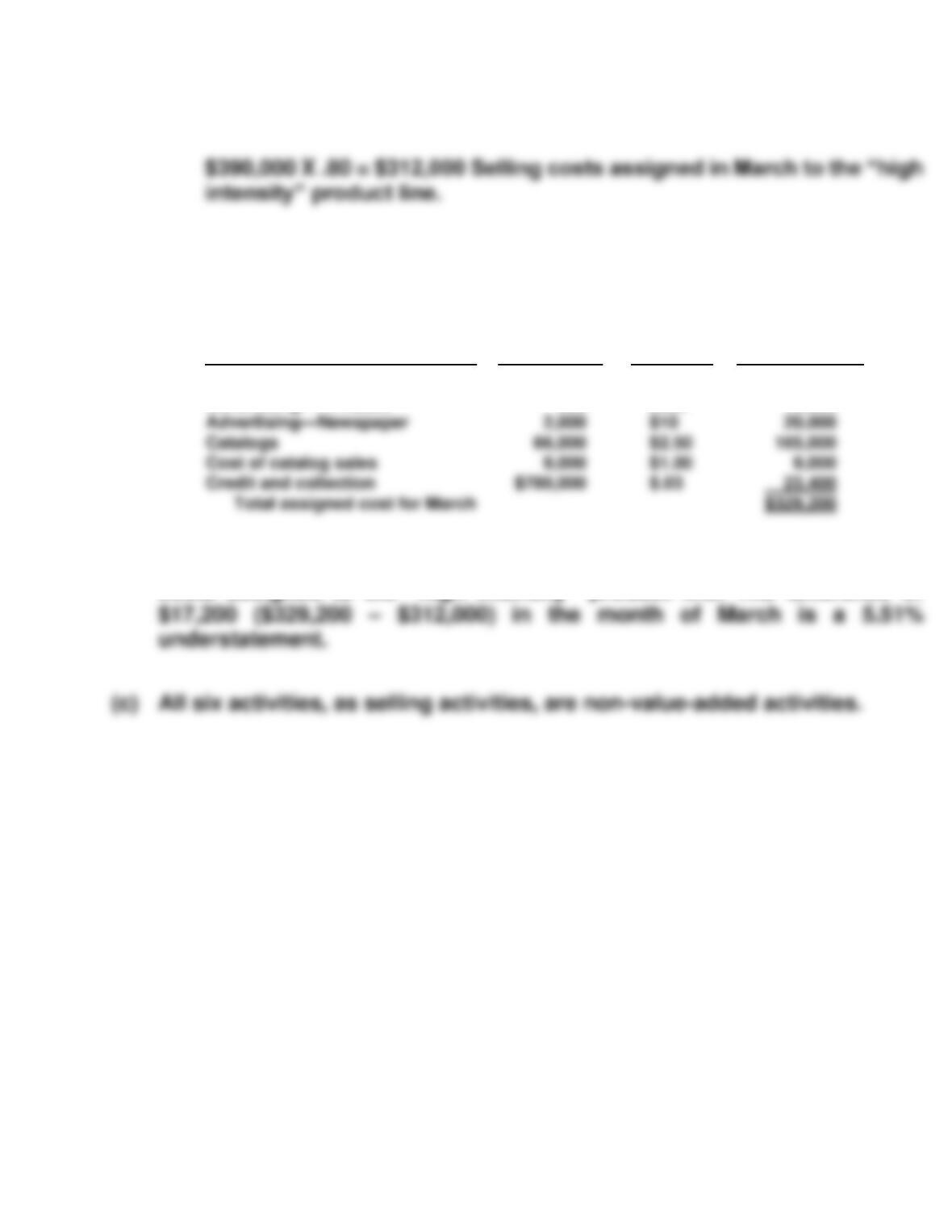
(b) As compared to ABC, traditional costing grossly undercosts the selling
costs assigned to the “high intensity” product line. The difference of
EXERCISE 4-8B
(a) (1) Traditional product costing system:
(2) Activity-based costing system:
Activity Cost Pools
Cost Drivers
Used
X
Activity-
Based
Overhead
Rate
=
Overhead Cost
Assigned
$ .35
Inspections of material received
6,000
$ .85
$ 5,100
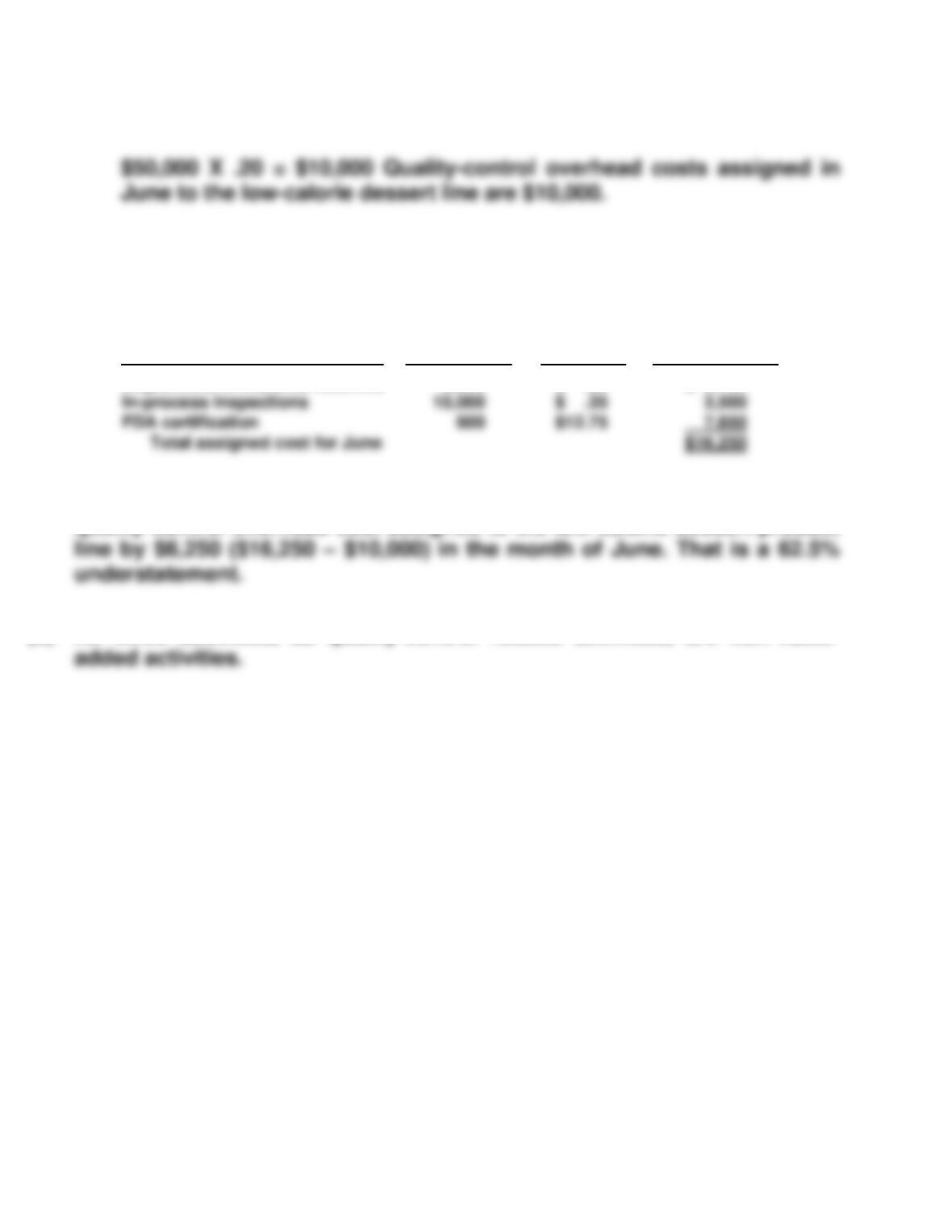
(b) As compared to ABC, the traditional costing system undercosts the
quality-control overhead cost assigned to the low-calorie dessert product
(c) All three activities, as quality-control related activities, are non-value–
EXERCISE 4-9B
(a)
Activity Cost Pools
Estimated Overhead
÷
Expected use
of Cost Drivers
=
ABC Overhead Rates
Scheduling and travel
$96,000
1,200
$ 80.00
Setup time
$79,000
1,000
$ 79.00
Commercial
Activity Cost Pools
Expected use of
Cost Drivers per
Product
X
ABC Overhead Rates
=
Cost Assigned
Scheduling and travel
1,000
$ 80.00
$ 80,000
Setup time
Supervision
$100,000
Total assigned costs
$145,400
Residential
Activity Cost Pools
Expected use of Cost
Drivers per Product
X
ABC Overhead Rates
=
Cost Assigned
Scheduling and travel
200
$ 80.00
$ 16,000
Setup time
Supervision
54,000
Total assigned costs
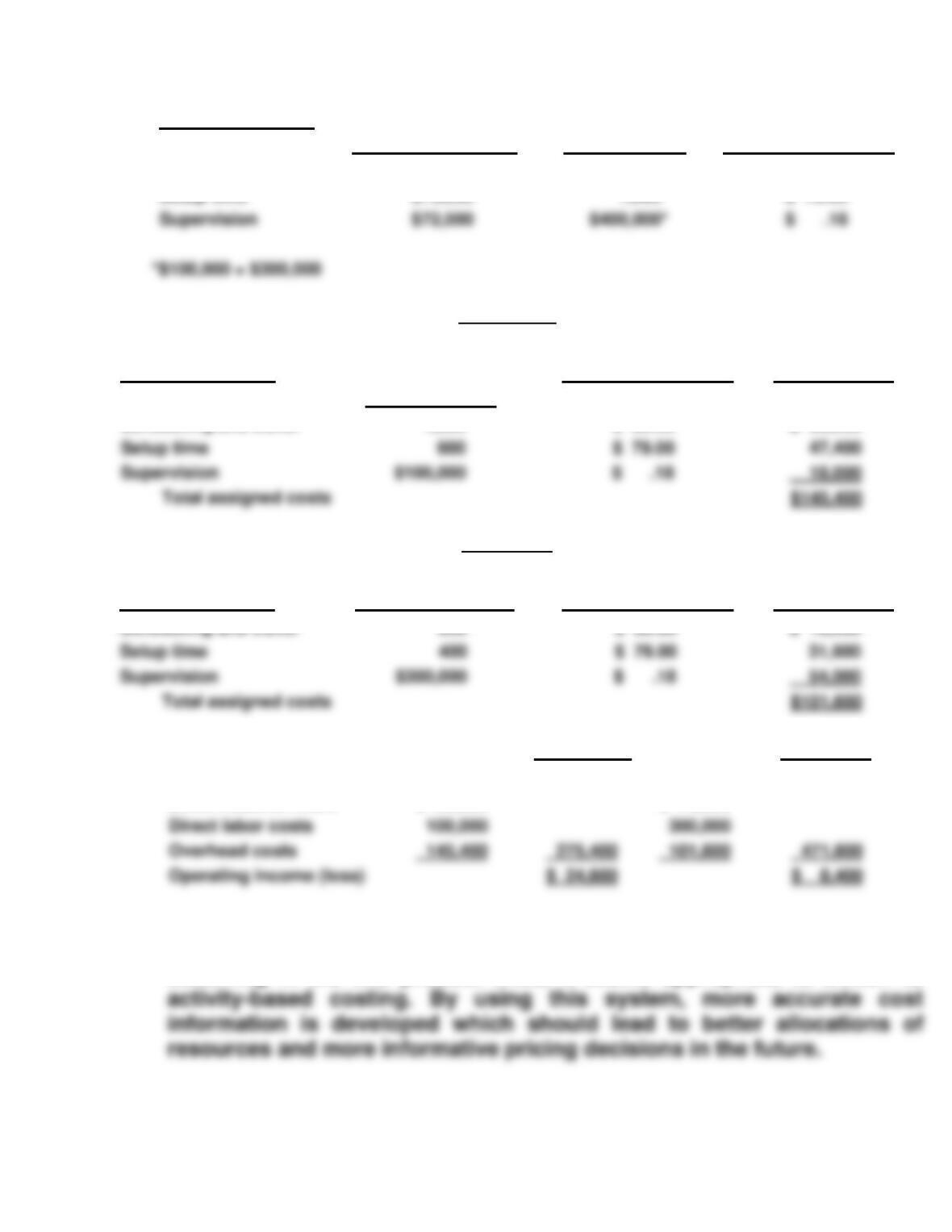
(b)
Commercial
Residential
Revenues
$300,000
$480,000
Direct material costs
$ 30,000
$ 70,000
Direct labor costs
100,000
300,000
Overhead costs
Operating income (loss)
(c) Assuming that the cost drivers are a reasonable representation of what is
occurring in the two product lines, it seems appropriate to switch to
Supervision
$72,000
$ .18
SOLUTIONS TO PROBLEMS—SET C
PROBLEM 4-1C
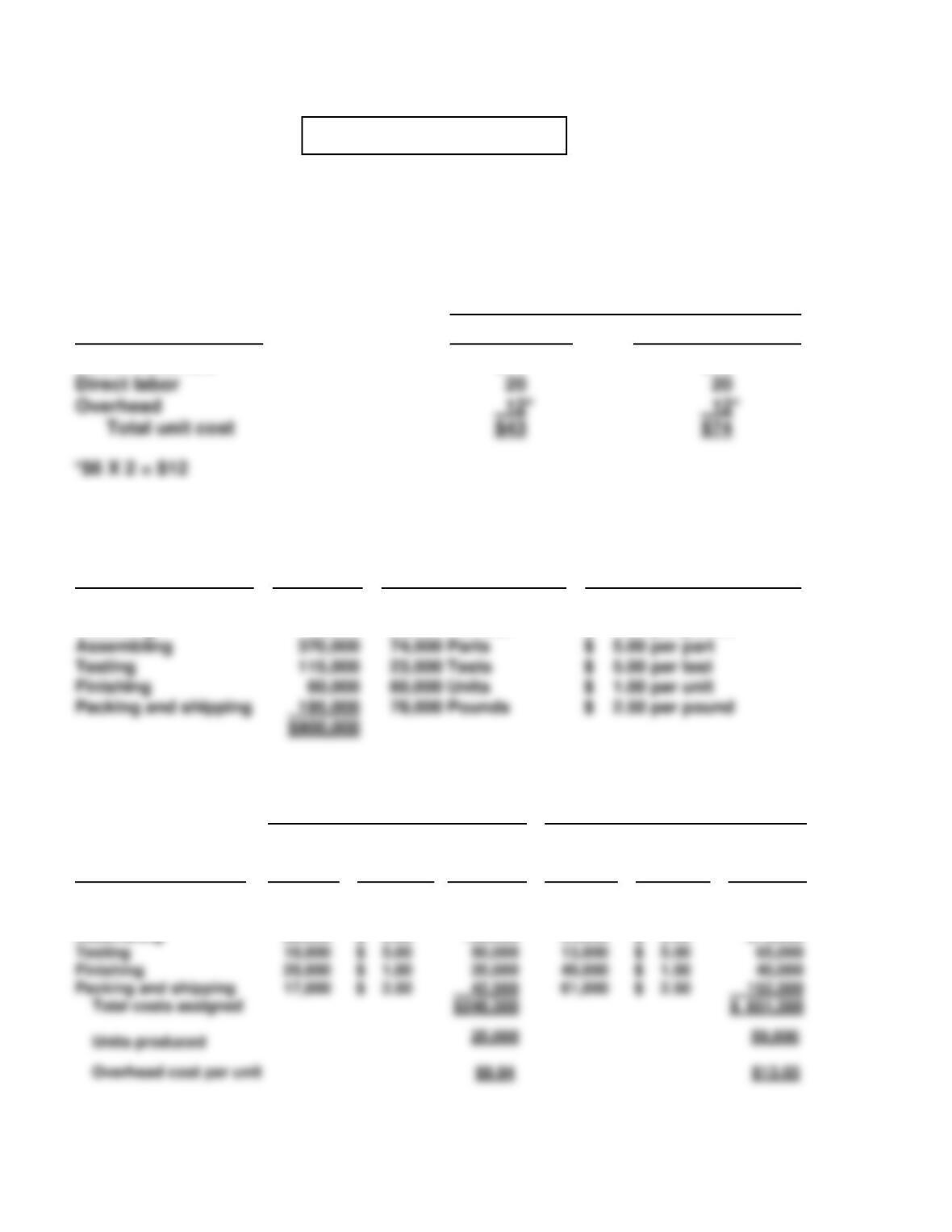
(a) Computation of unit costs—traditional costing.
Velocity, Inc.
Products
Manufacturing Costs
Deluxe Model
Standard Model
Direct materials
$11
$42
(b) Velocity, Inc.
Activity Cost Pool
Estimated
Overhead
÷
Expected
Use of Cost Drivers
=
Activity-Based
Overhead Rate
Packing and shipping
$ 2.50 per pound
Purchasing
Receiving
$130,000
30,000
650 Orders
20,000 Pounds
$200.00 per order
$ 1.50 per pound
(c) Velocity, Inc.
Deluxe Model
Standard Model
Activity Cost Pool
Expected
Use of
Drivers
X
Overhead
Rates
=
Cost
Assigned
Expected
Use of
Drivers
X
Overhead
Rates
=
Cost
Assigned
50,000
Overhead cost per unit
Purchasing
Receiving
Assembling
150
4,000
20,000
$200.00
$ 1.50
$ 5.00
$ 30,000
6,000
100,000
500
16,000
54,000
$200.00
$ 1.50
$ 5.00
$ 100,000
24,000
270,000
Total unit cost
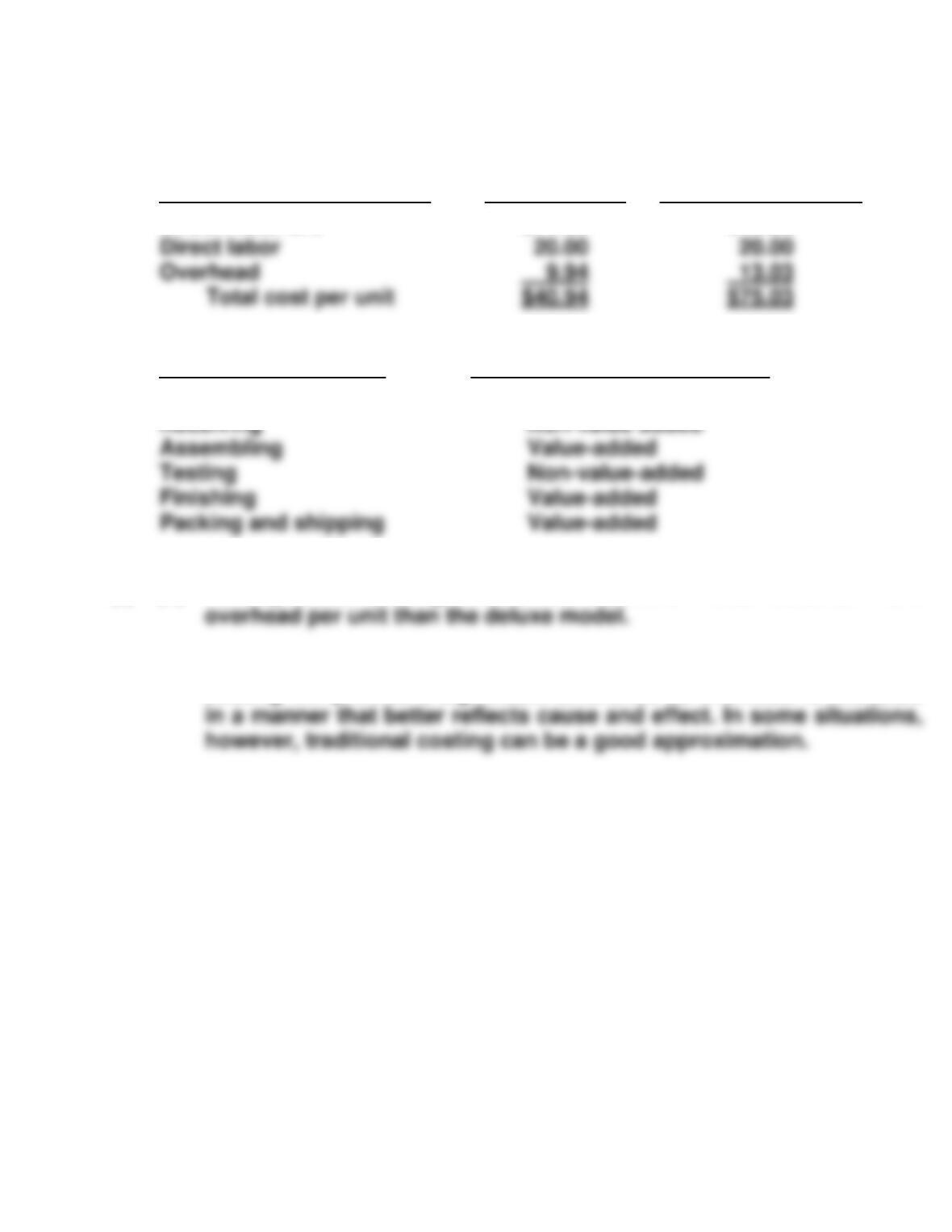
PROBLEM 4-1C (Continued)
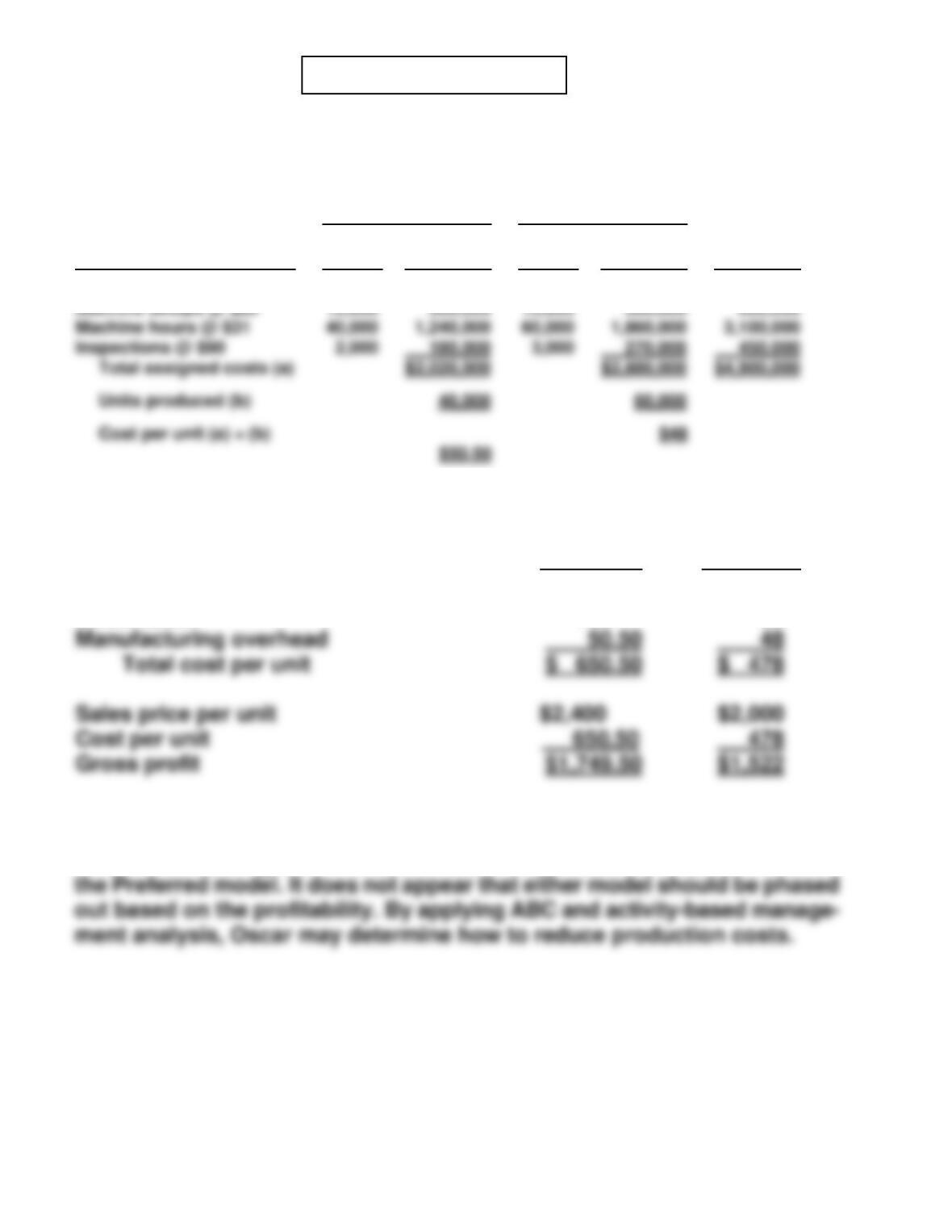
(d) Computation of Units Costs – ABC
Velocity, Inc.
Manufacturing Costs
Deluxe Model
Standard Model
Direct materials
$11.00
$42.00
(e)
Activity
Value- vs. Non-value-added
Purchasing
Non-value-added
(f) (1) Activity-based costing shows the standard model absorbs more
(2) The comparison of ABC and traditional costing shows that, ABC
costing will provide a significant difference as overhead is allocated
Total cost per unit
PROBLEM 4-2C
(a) The allocation of total manufacturing overhead using activity-based
costing is as follows:
Xtra
Preferred
Overhead Rate
Drivers
Used
Cost
Assigned
Drivers
Used
Cost
Assigned
Total
Overhead
Purchase orders @ $15
20,000
$ 300,000
30,000
$ 450,000
$ 750,000
(b) The cost per unit and gross profit of each model under ABC costing were:
Xtra
Preferred
Gross profit
Direct materials
Direct labor
$ 500
100
$ 350
80
(c) Management’s future plans for the two television models are not sound.
Under ABC costing, the Xtra model is $227.50 per unit more profitable than
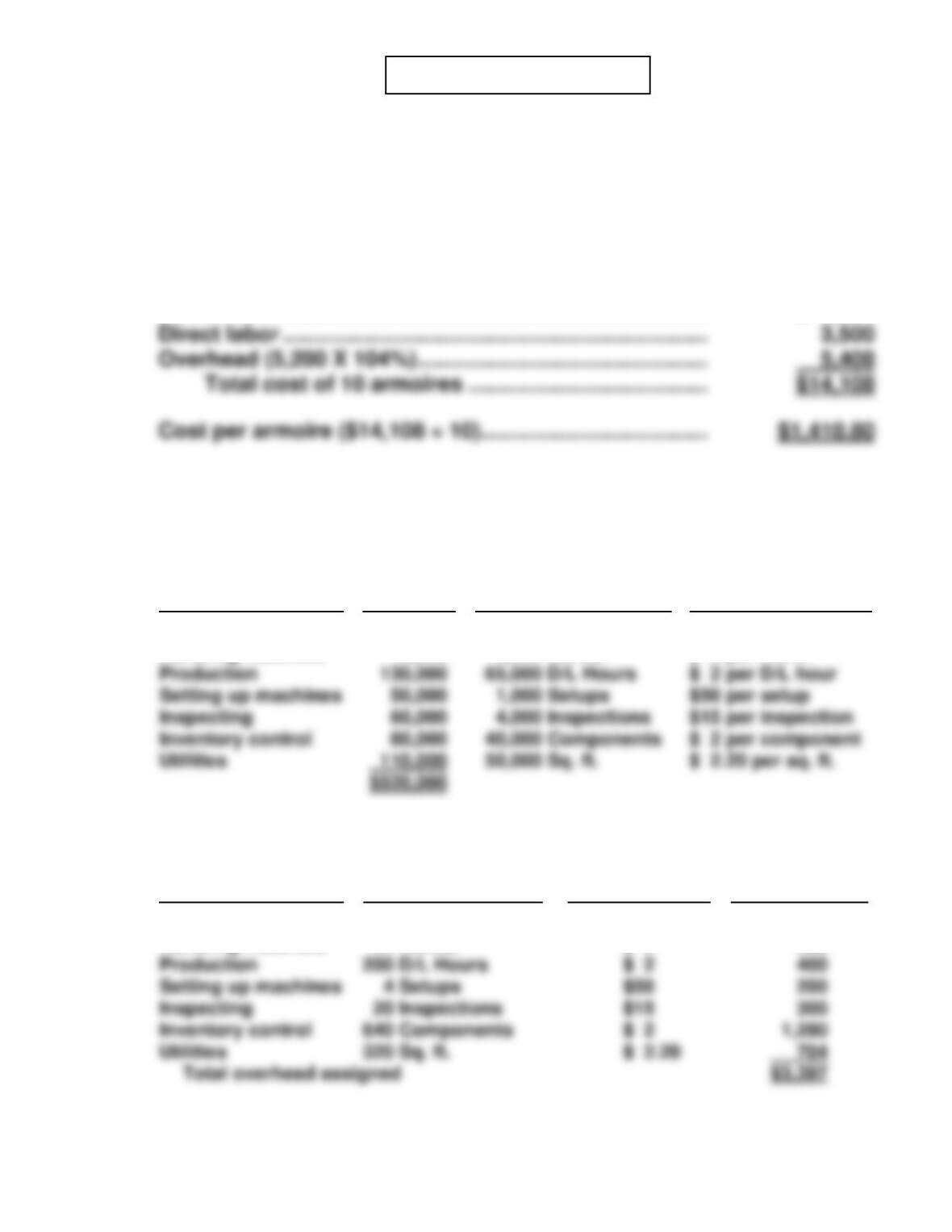
PROBLEM 4-3C
(a) Predetermined overhead rate using materials cost:
$520,000 ÷ $500,000 = 104% of materials cost
(b) Manufacturing cost per armoire under traditional costing:
Direct materials …………………………………………………….. $ 5,200
(c) Manufacturing cost per armoire under activity-based costing:
Computation of Activity-Based Overhead Rate
Activity Cost Pools
Estimated
Overhead
÷
Total
Estimated Drivers
=
Activity-Based
Overhead Rate
Utilities
50,000 Sq. ft.
$ 2.20 per sq. ft.
Purchasing
Handling materials
$ 45,000
45,000
600 Orders
5,000 Moves
$75 per order
$ 9 per move
Assignment of Overhead to Order of 10 armoires
Activity Cost Pools
Expected Use of
Drivers
X
Activity-Based
Overhead Rate
=
Cost Assigned
Inventory control
640 Components
Purchasing
Handling materials
3 Orders
32 Moves
$75
$ 9
$ 225
288
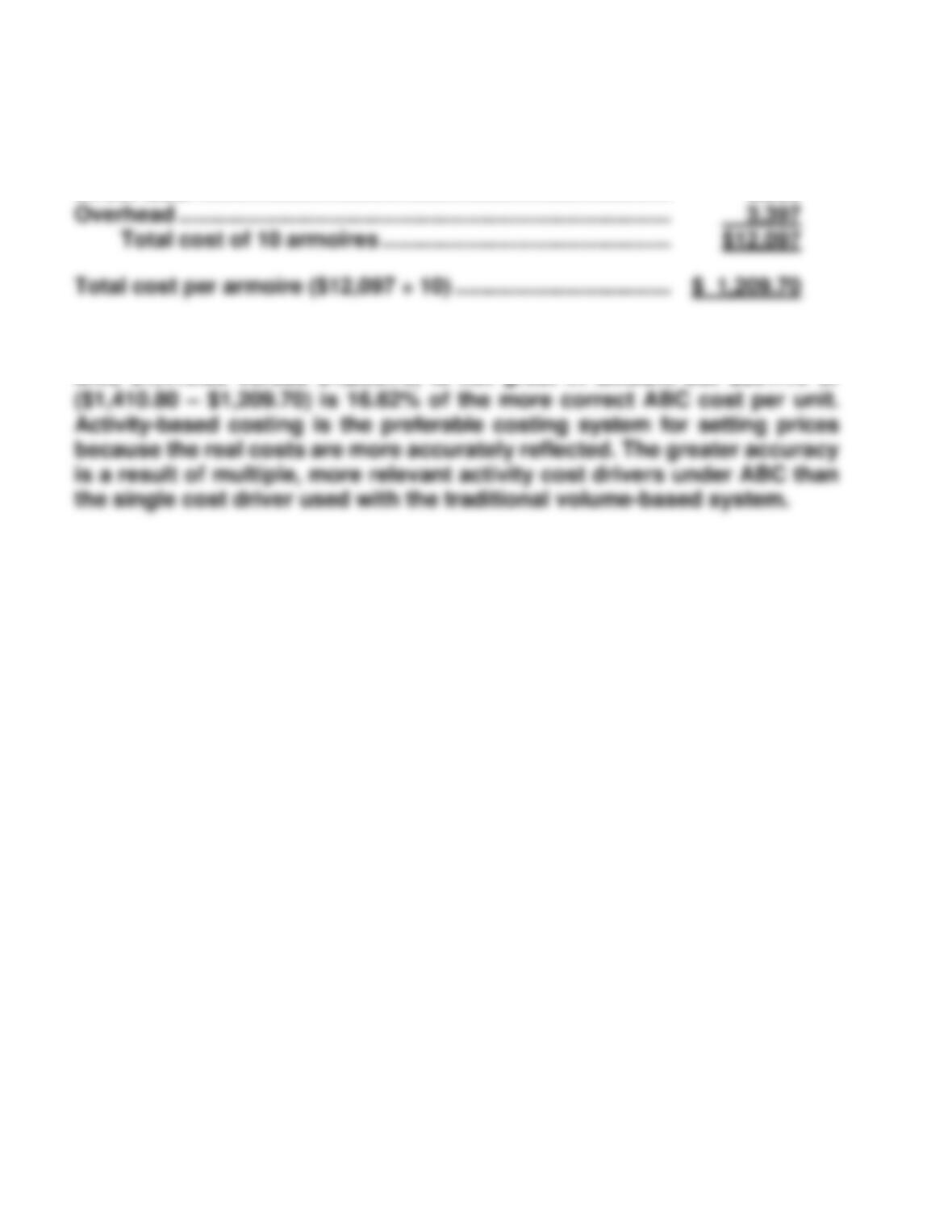
PROBLEM 4-3C (Continued)
Total manufacturing cost per armoire under ABC:
Direct materials ……………………………………………………….…… $ 5,200
Direct labor ………………………………………………………………….. 3,500
(d) The difference between the traditional cost and the activity-based cost per
unit, $1,410.80 versus $1,209.70, is not great in amount but $201.10 or
PROBLEM 4-4C
(a) Computation of unit costs—traditional costing
Overhead cost per labor hour is $1,000,000 ÷ (35,000 + 5,000) =$25
Products
Manufacturing Costs
Valley Fresh
Vargas Valley
Direct materials
Direct labor
$1.350
0.750
$3.600
1.500
(b)
Activity Cost Pools
Estimated
Overhead
Expected Use
of Cost Drivers
Activity-Based
Overhead Rate
equipment
$204.231 per inspection
Grape processing
Aging
$ 124,000
313,600
10,000
6,400,000
$ 12.40 per cart
$ 0.049 per month
(c)
Valley Fresh
Vargas Valley
Activity Cost Pool
Expected
Use of
Drivers
X
Overhead
Rates
=
Cost
Assigned
Expected
Use of
Drivers
X
Overhead
Rates
=
Cost
Assigned
(rounded)
(rounded)
Grape processing
Aging
8,000
1,280,000
$ 12.40
$ 0.049
$ 99,200
62,720
2,000
5,120,000
$ 12.40
$ 0.049
$ 24,800
250,880
PROBLEM 4-4C (Continued)
(d)
Products
Manufacturing Costs
Valley Fresh
Vargas Valley
Direct materials
Direct labor
$1.350
0.750
$3.600
1.500
(e) To: Mr. Vincent Vargas
From: Student
Subject: Product costs using traditional approach versus ABC
The memorandum covers the following points:
a. ABC allocates overhead costs as a function of each product’s use of
b. Traditional approaches that allocate costs as a function of volume
tend to be biased toward allocating too much overhead to high
PROBLEM 4-4C (Continued)
d. The total cost of the two products under the two approaches was as
follows:
Valley Fresh
Vargas Valley
Traditional approach
$3.350
$7.600
PROBLEM 4-5C
(a) Computation of assigned overhead under traditional costing (“direct labor
dollars” appears in the first line of the schedule of overhead data):
Predetermined overhead rate X direct labor dollars
Overhead assigned to corporate:.322 X $900,000 = $289,800
(b) (1) Computation of activity-based overhead rate:
Activity Cost Pool
Estimated
Overhead
÷
Total Expected
Use of Cost Drivers
=
Activity-Based
Overhead Rates
Employee training
$120,000
$1,500,000 Direct labor dollars
$.08 per DL dollar
(2) Assignment of overhead to corporate and individual services:
Corporate
Individual
Activity Cost Pool
Expected
Use of
Driver
Overhead
Rate
Cost
Assigned
Expected
Use of
Driver
Overhead
Rate
Cost
Assigned
Computing
Facility rental
Travel
Overhead assigned
Employee training
$900,000
$.08
$ 72,000
$600,000
$.08
$ 48,000
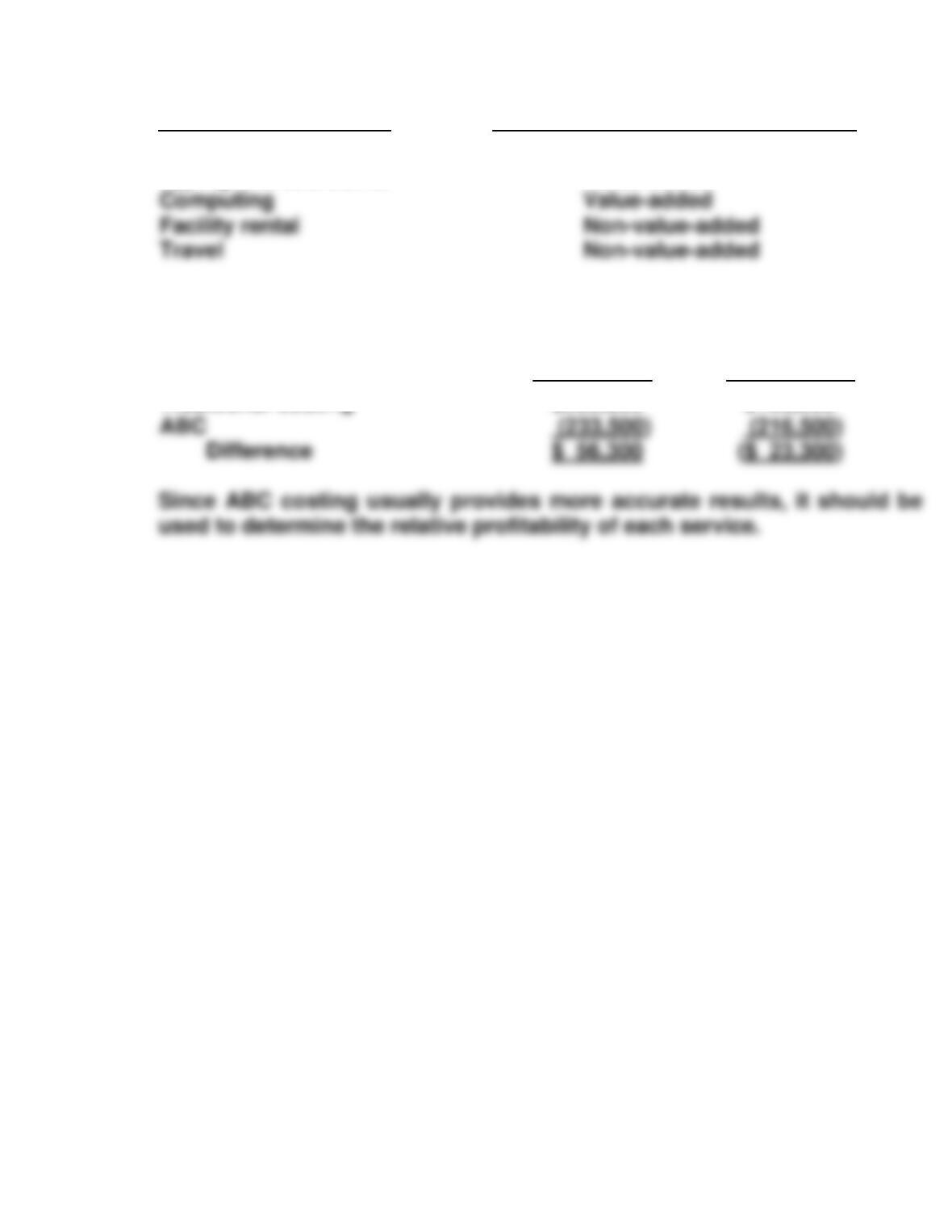
PROBLEM 4-5C (Continued)
(c)
Activity
Value-Added vs. Non-value-Added
Employee training
Typing and secretarial
Non-value-added
Value-added
(d) Overhead is assigned to the two service lines as follows:
Corporate
Individual
Difference
Traditional costing
$289,800
$193,200
Computing
Travel
Value-added
Non-value-added