Wild, Shaw, Financial & Managerial Accounting, 8e Solutions Manual: Chapter 4
312
Copyright © 2019 by McGraw-Hill Education.
All rights reserved. No reproduction or distribution without the prior written consent of McGraw-Hill Education.
Serial Problem — SP 4 (Continued)
Part 4 (a) Single-step income statement
BUSINESS SOLUTIONS
Income Statement
For Three Months Ended March 31, 2020
Revenues
Computer services revenue ……………………………….. $25,307
Net sales* ………………………………………………………….. 18,693
Total revenues …………………………………………………… 44,000
Expenses
Cost of goods sold …………………………………………….. $14,052
Depreciation expense—Office equipment …………… 400
Depreciation expense—Computer equipment ……….. 1,250
Wages expense …………………………………………………. 3,250
Insurance expense …………………………………………….. 555
Wild, Shaw, Financial & Managerial Accounting, 8e Solutions Manual: Chapter 4
Serial Problem — SP 4 (Continued)
Part 4 (b) Multiple-step income statement
BUSINESS SOLUTIONS
Income Statement
For Three Months Ended March 31, 2020
Sales* ……………………………………………………………… $44,547
Less: Sales discounts …………………………………….. $ 47
Sales returns and allowances ………………… 500 547
Net sales …………………………………………………………. 44,000
Cost of goods sold ………………………………………….. 14,052
Gross profit …………………………………………………….. 29,948
Expenses
Selling expenses
Wages expense …………………………………………… 3,250
Mileage expense ………………………………………….. 320
Advertising expense ……………………………………. 600
Total selling expenses …………………………………. 4,170
Part 5
BUSINESS SOLUTIONS
Statement of Retained Earnings
For Three Months Ended March 31, 2020
Retained earnings, Dec. 31, 2019………………………… $ 7,360
Plus: Net income ……………………………………………….. 18,833
26,193
Less: Dividends …………………………………………………. 4,800
Retained earnings, March 31, 2020……………………… $21,393
Wild, Shaw, Financial & Managerial Accounting, 8e Solutions Manual: Chapter 4
Serial Problem — SP 4 (Concluded)
Part 6
BUSINESS SOLUTIONS
Balance Sheet
March 31, 2020
Assets
Current assets
Cash ………………………………………………………………….. $ 68,057
Accounts receivable* ………………………………………….. 22,867
Merchandise inventory ……………………………………….. 704
Computer supplies ……………………………………………… 2,005
Prepaid insurance ………………………………………………. 1,110
Prepaid rent ……………………………………………………….. 825
Total current assets ……………………………………………. 95,568
Liabilities
Current liabilities
Wages payable …………………………………………………… $ 875
Equity
Common stock …………………………………………………….. 98,000
Retained earnings ………………………………………………… 21,393
Total equity ………………………………………………………….. 119,393
Company Analysis — AA 4-1
1. First, compute cost of sales for 2017 as follows ($ millions)
September 2016 inventory ……………………………… $ 2,132
Plus cost of goods purchased ……………………….. ?
Less September 2017 inventory …………………….. (4,855)
Cost of goods sold ………………………………………… $141,048
Then, solve for:
2017
2016
$ millions
Current
Ratio
Acid-Test
Ratio
Current
Ratio
Acid-Test
Ratio
Current assets
Cash and equivalents ……….
$ 20,289
$ 20,289
$ 20,484
$ 20,484
Short–term marketable sec ……
53,892
53,892
46,671
46,671
Accounts receivables, net …..
17,874
17,874
15,754
15,754
Inventories, net …………………
Vendor non–trade receivables …
Other current assets …………
$128,645
$106,869
$ 92,055
3. Underperformed
Explanation: Apple’s current ratio is less than the industry average of
1.5. Although it is below the industry average, a current ratio in excess
of 1.0 still indicates the company likely has sufficient current assets to
settle current liabilities.
4. Underperformed
Comparative Analysis — AA 4-2
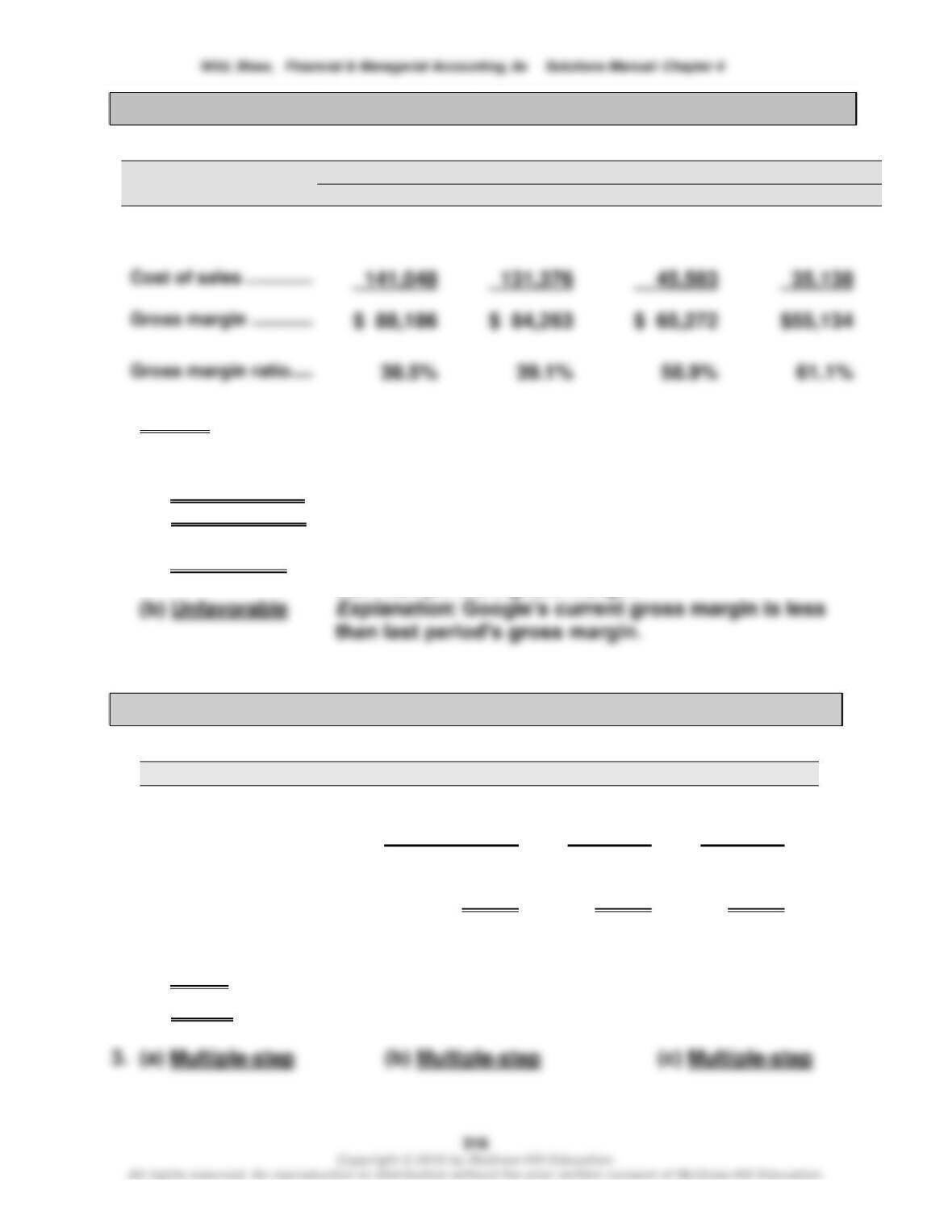
1.
Apple
Google
($ millions)
Current
Prior
Current
Prior
Net sales ………………
$229,234
$215,639
$110,855
$90,272
Gross margin ………..
$ 84,263
$ 65,272
$55,134
2. Google Explanation: In the current year, Google’s gross
margin ratio is higher than that for Apple.
3. (a) Outperformed Explanation: Apple’s margin exceeds the average.
(b) Outperformed Explanation: Google’s margin exceeds the average.
4. (a) Unfavorable Explanation: Apple’s current gross margin is less
than last period’s gross margin.
Global Analysis — AA 4-3
1.
In millions
Samsung*
Apple
Google
Net sales …………………………..
₩ 239,575,376
$229,234
$110,855
Cost of sales …………………………..
129,290,661
141,048
45,583
Gross margin …………………………..
₩ 110,284,715
$ 88,186
$ 65,272
Gross margin ratio ………………………
46.0%
38.5%
58.9%
*millions of Korean won
2. (a) Better Explanation: Samsung’s ratio exceeds Apple’s.
(b) Worse Explanation: Samsung’s ratio does not exceed Google’s.
Ethics Challenge — BTN 4-1
1. A few students sometimes feel that Amy has devised a clever way to
beat the system. She appears to be succeeding in getting something for
free. However, most students fortunately feel that Amy is abusing the
system and that her ethical conduct needs an overhaul. The instructor
2. The merchandising company accounts for sales returns using a contra
revenue account called Sales Returns and Allowances. A dress
returned with a sales bill of $200 would be accounted for as follows:
Sales Returns and Allowances …………… 200
Accounts Receivable ………………… 200
Wild, Shaw, Financial & Managerial Accounting, 8e Solutions Manual: Chapter 4
Communicating in Practice — BTN 4-2
Note: While responses will vary, the essence of its content follows.
TO: Mr. V. Velakturi
FROM:
DATE:
SUBJECT: Reply to inventory shrinkage question
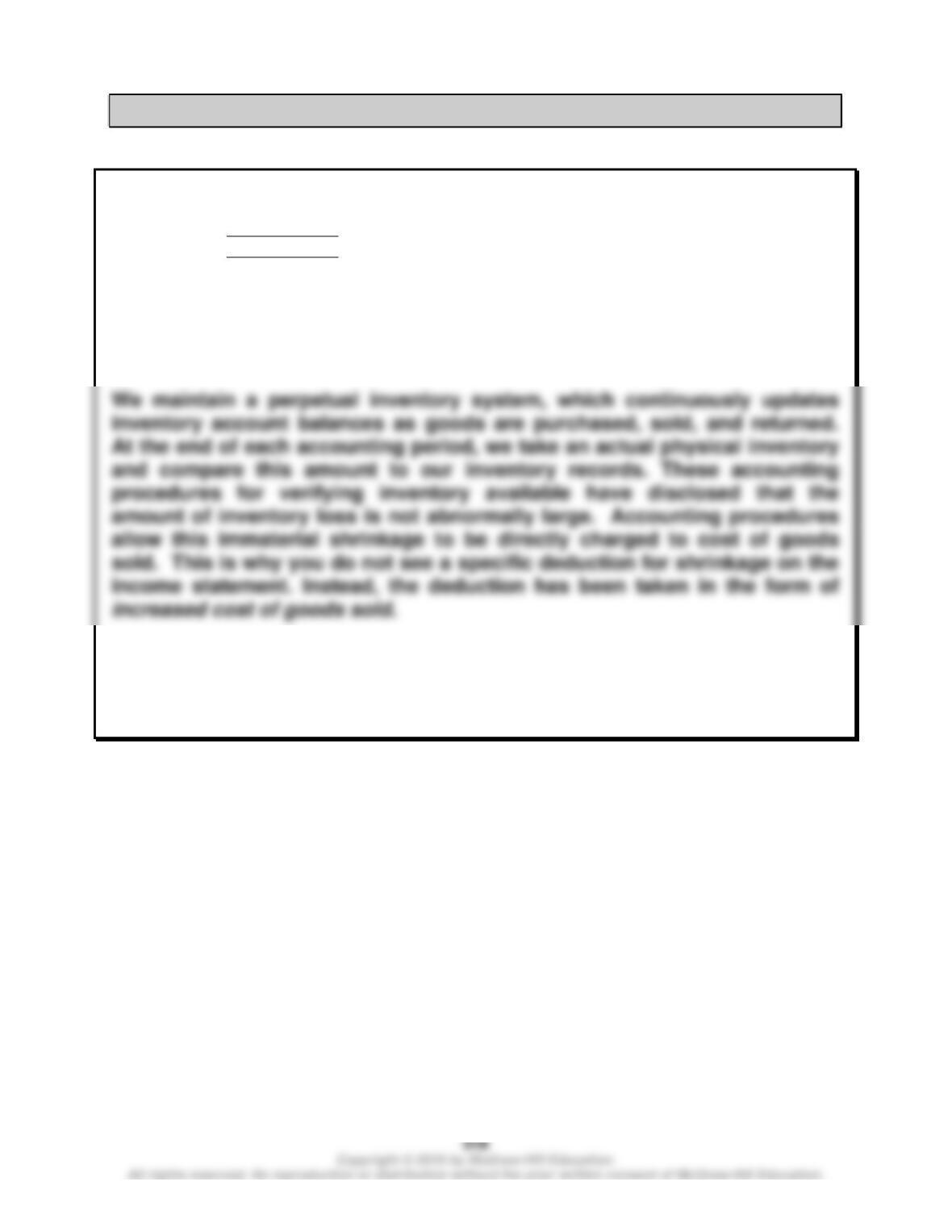
You are correct in noting that Music Plus has lost inventory as a result of
shoplifting and other forms of shrinkage. However, you will be pleased to
know your investment in security has paid off. Let me explain.
I hope this addresses your concern and that you are now confident that net
income is not overstated. If you have any additional questions or require
more specific information regarding inventory shrinkage, please let me
know. The supporting information is available in the accounting records.
Wild, Shaw, Financial & Managerial Accounting, 8e Solutions Manual: Chapter 4
Taking It to the Net — BTN 4-3
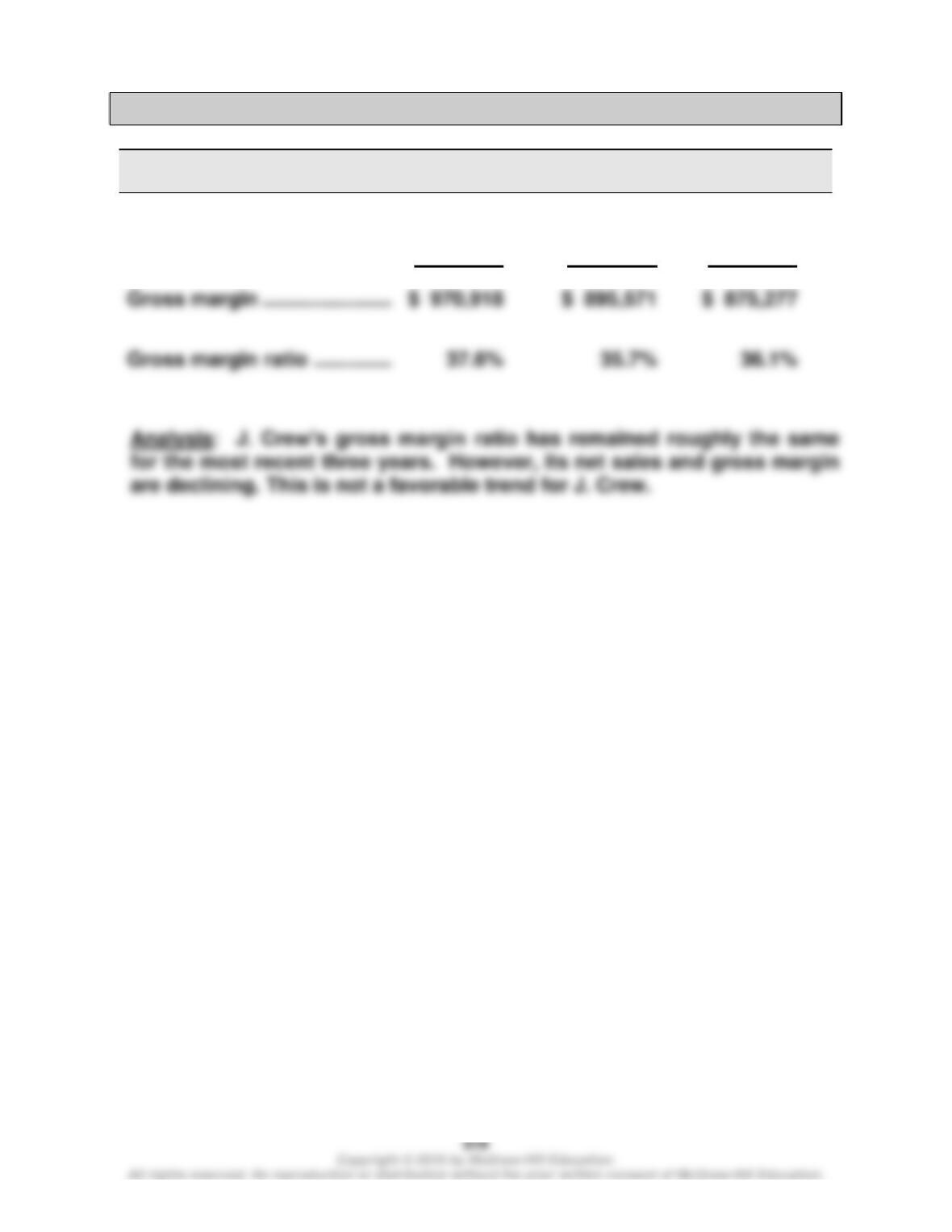
Fiscal Year ($ thousands)
2015
2016
2017
Net sales …………………………..
$2,579,695
$2,505,827
$2,425,462
Cost of goods sold ……………………..
1,608,777
1,610,256
1,550,185
Gross margin …………………………..
Teamwork in Action — BTN 4-4
1.
a. Net sales computation
Sales ……………………………………………………….………… $600,000
Less: Sales discounts ……………………………………… $ 13,000
Sales returns and allowances …………………. 20,000 33,000
Net sales …………………………………………………………… $567,000
c. Cost of goods sold computation
Merchandise inventory, Beginning ……………………… $ 98,000
Total cost of merchandise purchased (from b) …….. 362,000
Merchandise available for sale ……………………………. $460,000
Merchandise inventory, Ending …………………………... (84,000)
Cost of goods sold ……………………………………………… $376,000
e. Net income computation
Gross profit from sales (from d) …………………………. $191,000
Operating expenses (given) ……………………………….. 50,000
Net income ………………………………………………………… $141,000
2. Net income is $141,000.
3. The inventory account balance is $84,000. If actual (physical) inventory
is $76,000, an $8,000 loss from inventory shrinkage occurred. This
Wild, Shaw, Financial & Managerial Accounting, 8e Solutions Manual: Chapter 4
Entrepreneurial Decision — BTN 4-5
1.
Build-A-Bear Workshop
Forecasted Income Statement
For Year Ended January 31, 2019
Net sales ($1,000,000 x 1.09) ………………………………………. $1,090,000
Cost of sales* ($1,090,000 x 61%) ……………………………….. 664,900
Expenses ($200,000 x 1.06) ………………………………………… 212,000
2. The proposal yields a forecasted net income of $213,100. This compares
favorably to the prior year’s net income of $190,000. Accordingly, based
on these facts alone, the company should implement the proposal.
3. There are many issues that should be considered. Among them are:
• First, there is the issue of the prediction itself. That is, are estimates
reasonable or could reality be markedly different from these estimates?
• Second, and related to the first, there is a need to consider “ranges” of
possible scenarios since the future is unpredictable. This would involve
looking at alternative possibilities and then assessing the range of
outcomes.
• In addition to issues of confidence in prediction, one should also
consider that there may be speeding up of cash collections. Customers
currently have 15 days to earn a 1% discount. By changing the terms,
customers will have only 10 days to earn a 3% discount. That additional
discount may motivate some customers to pay sooner.

Hitting the Road — BTN 4-6
There is no formal solution for this field activity. As the discussion
facilitator, the instructor should try to develop a sense of how willing retail
managers are in granting sales allowances, the range of return policies
employed, and strategies managers use to stem return abuses.