
COMPREHENSIVE PROBLEM 4
If you work this problem as a group assignment, each group member
should be prepared to discuss the group’s findings and conclusions in class.
A good starting point for understanding the financial statements of a company such as
Home Depot, Inc. , is to understand the accounting policies used in preparing those statements.
The first note accompanying the financial statements provides a brief description of
the major accounting policies the company used. Most of the areas discussed in this note have
been covered in this text.
60 Easy
50
Medium
40
Strong
This Comprehensive Problem is to acquaint you with the content of the 2015
financial statements of Home Depot, Inc., and related disclosures, excerpts of which
are reproduced in Appendix A of this textbook. (The 2015 financial statements are
for the fiscal year ended January 31, 2016.) The problem contains three major parts,
which are independent of one another: Part I is designed to familiarize you with the
general contents of a company’s financial statements; Part II involves analysis of the
company’s liquidity; and Part III analyzes the trend in its profitability.
The Home Depot, Inc.
Evaluating Liquidity
An analysis of the annual report of a publicly owned corporation. Actually three comprehensive problems in one,
with the three parts independent of one another. All parts build communication skills and make excellent group
assignments.
Student is asked a variety of questions that can be answered directly from various elements of
the annual report. An excellent introduction.
The Home Depot, Inc.
Part I:
Part II:
Part III:
Evaluating the Trend in Profitability
Evaluate the liquidity of the company from the perspective of a supplier. Involves ratios,
judgment, and explanation of conclusions.
Includes evaluation of the company’s level of profitability and a discussion of the
implications for stock price.
Form and Content of an Annual Report
60 Minutes, Easy
PART I
a.
b.
c.
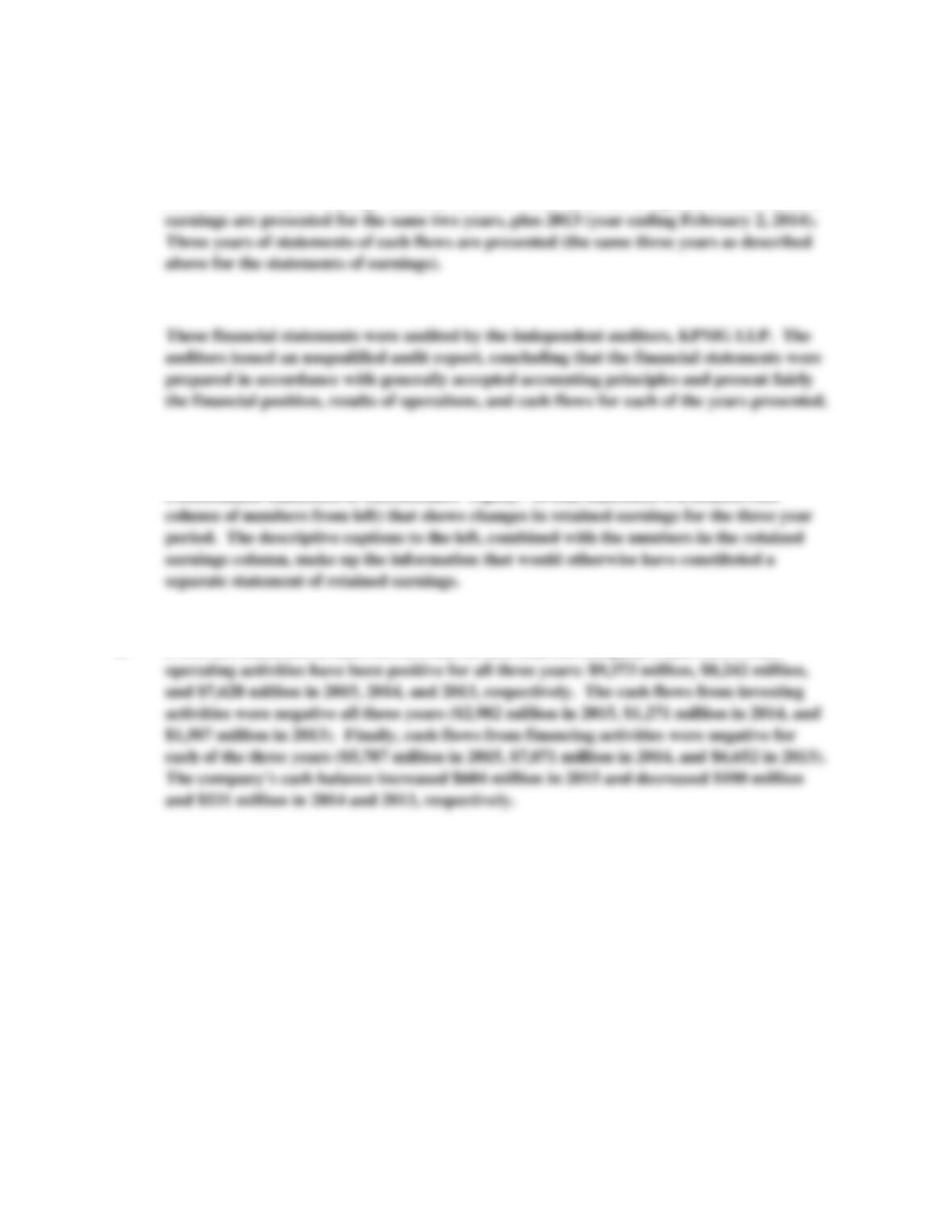
From the statement of cash flows, it can be seen that the company’s cash flows from
COMPREHENSIVE PROBLEM 4
THE HOME DEPOT, INC.:
Comparative balance sheets are presented for two years: 2015 (year ending January 31,
2016) and 2014 (year ending February 1, 2015). Three years of comparative statements of
Rather than presenting a separate statement of retained earnings, Home Depot presents a
Consolidated Statement of Stockholders’ Equity. In that statement is a column (4th
50 Minutes, Medium
Jan. 31, 2016 Feb. 1, 2015
a. (1)
1.36 to 1
1.36 to 1
(5)
$ 2,216 $ 1,723
$ 1,723 $ 1,929
$ 493 (206)$
Operating Results”
balance ($1,929):
Source of Feb. 2, 2014 working capital ($4,530):
Percentage change
Source of Feb. 2, 2014 cash and cash equivalents
Consolidated Statements of Cash Flows
Percentage change in cash and cash equivalents:
Current year balance
Note to instructor: Students may get slightly different answers due to rounding differences.
Previous year balance
COMPREHENSIVE PROBLEM 4
THE HOME DEPOT, INC.:
(Dollars in Thousands)
For the Years Ended
PART II
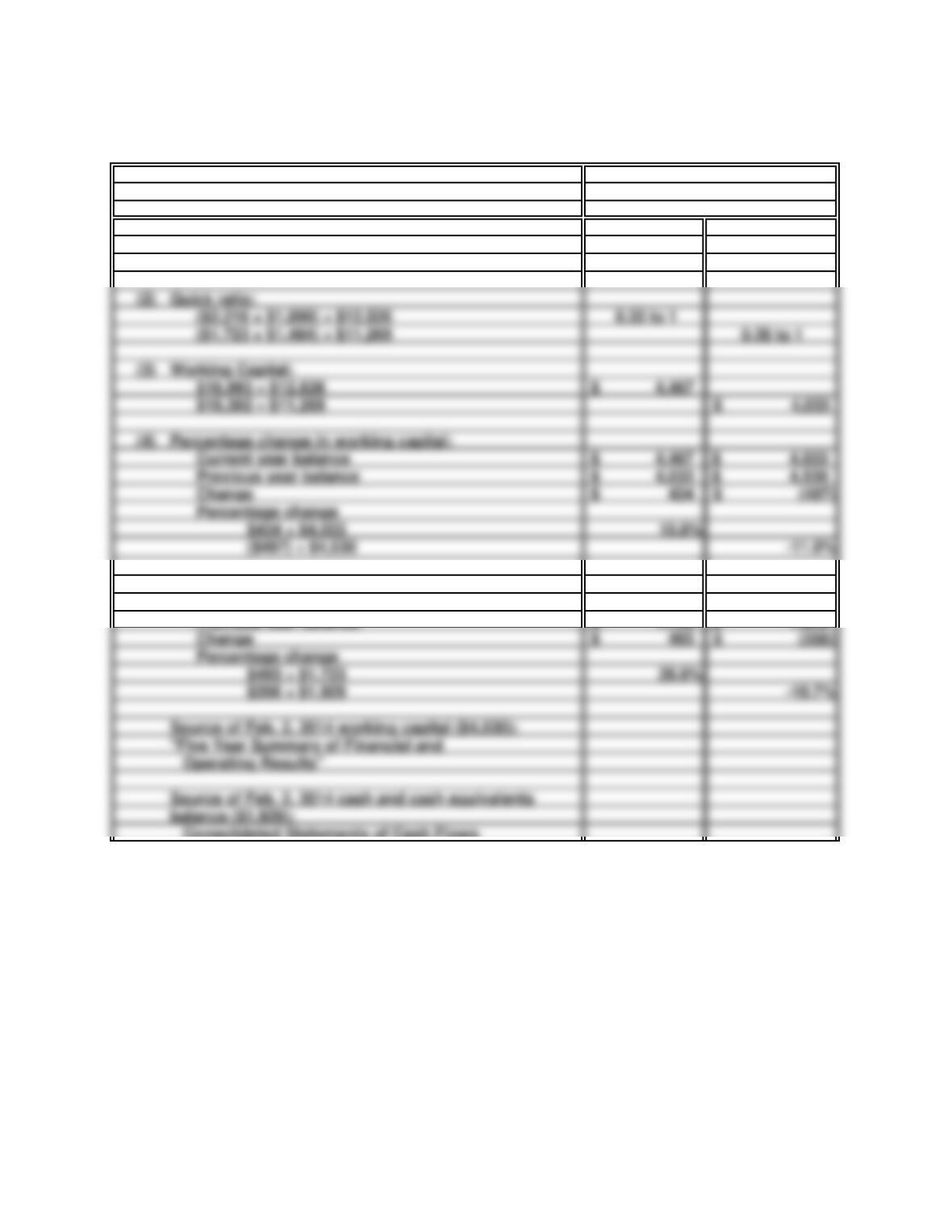
Current ratio:
$16,993 ÷ $12,526
$15,302 ÷ $11,269
(2)
0.33 to 1
0.28 to 1
(3)
$ 4,467
4,033$
(4)
$ 4,467 $ 4,033
$ 4,033 $ 4,530
$ 434 (497)$
Percentage change in working capital:
Current year balance
Previous year balance
Percentage change
($1,723 + $1,484) ÷ $11,269
Quick ratio:
Working Capital:
($2,216 + $1,890) ÷ $12,526
b.
c.
d.
Students may downgrade Home Depot because some of the traditional measure of liquidity
Liquidity has increased between 2014 and 2015, as evidenced by a stable current ratio (1.36
COMPREHENSIVE PROBLEM 4
PART II (continued)
THE HOME DEPOT, INC.:
In the Consolidated Statements of Stockholders’ Equity it is clear that the company has an
40 Minutes, Strong
Jan. 31, 2016 Feb. 1, 2015
a. (1)
$ 88,519 $ 83,176
(3)
$30,265 ÷ $88,519 34.2%
$28,389 ÷ $83,176 34.1%
(4)
$7,009 ÷ $88,519 7.9%
$6,345 ÷ $83,176 7.6%
(5)
($42,549 + $39,946) ÷ 2 $ 41,248
$11,774 ÷ $41,248 28.5%
$10,469 ÷ $40,232 26.0%
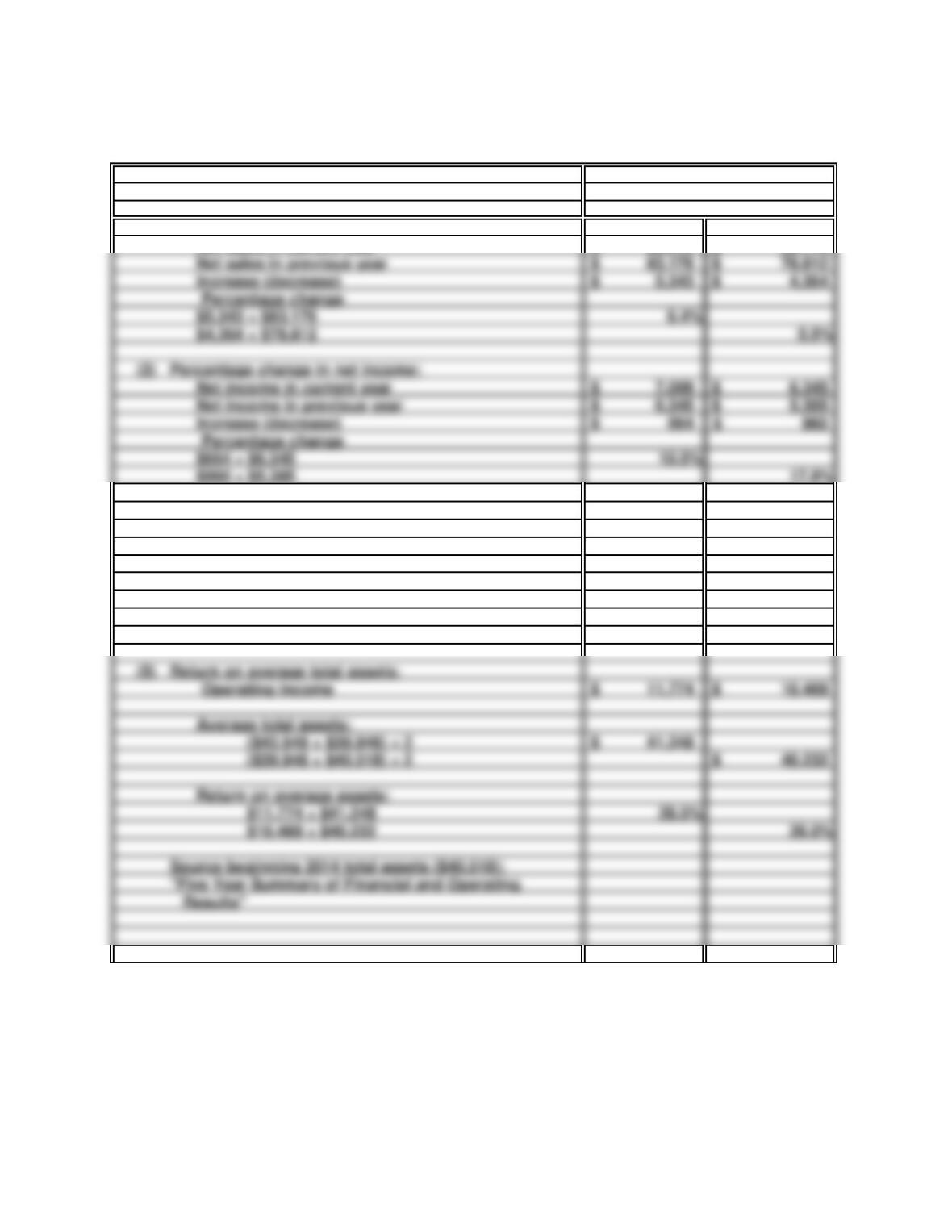
Return on average total assets:
Average total assets:
Return on average assets:
Net income as percentage of sales:
Gross profit rate:
[(sales – cost of sales) ÷ sales]
PART III
(Dollars in Thousands)
For the Years Ended
Percentage change in net sales:
Net sales in current year
COMPREHENSIVE PROBLEM 4
THE HOME DEPOT, INC.:
$ 5,343 $ 4,364
Percentage change
(2)
$ 7,009 $ 6,345
$ 6,345 $ 5,385
$ 664 960$
Percentage change
10.5%
$664 ÷ $6,345
$960 ÷ $5,385
Increase (decrease)
Net sales in previous year
Net income in previous year
Percentage change in net income:
Net income in current year
Increase (decrease)
Jan. 31, 2016 Feb. 1, 2015
(6)
$ 7,009 $ 6,345
b.
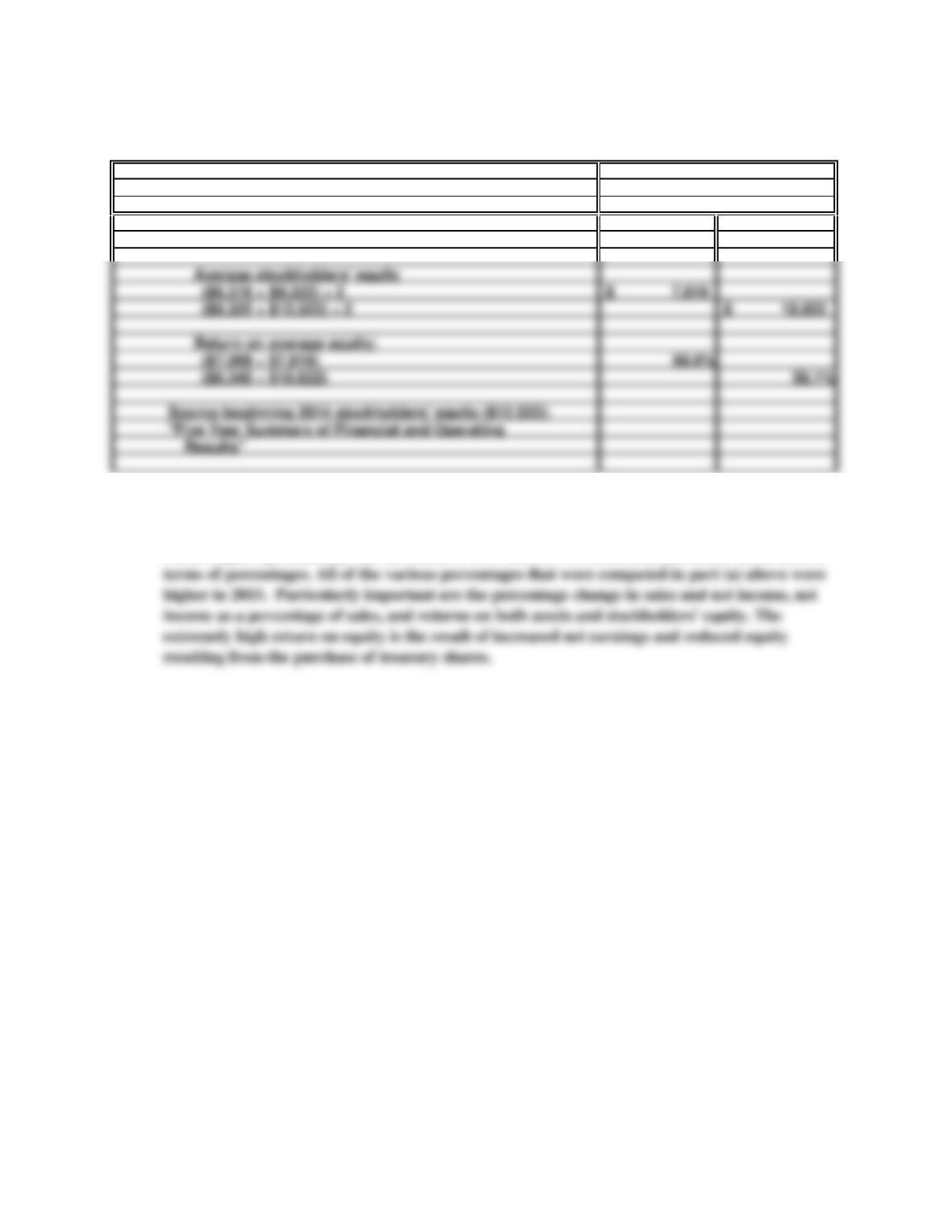
Home Depot’s profitability has increased in 2015 and 2014 in both absolute dollar terms and in
COMPREHENSIVE PROBLEM 4
PART III (concluded)
THE HOME DEPOT, INC.:
Thousands of Dollars
Return on average total equity:
For the Years Ended
Net earnings
$ 7,819
($9,322 + $12,522) ÷ 2
“Five Year Summary of Financial and Operating
Results”
($7,009 ÷ $7,819)
Average stockholders’ equity
($6,316 + $9,322) ÷ 2
($6,345 ÷ $10,922)
Return on average equity: