CHAPTER 4
SOLUTIONS TO PROBLEMS: SET B
PROBLEM 4-1B
(a) Computation of unit costs—traditional costing.
VideoPlus, Inc.
Products
Manufacturing Costs
Standard Model
Deluxe Model
Total unit cost
Direct materials
Direct labor
$11
18
$42
18
(b) VideoPlus, Inc.
Activity Cost Pool
Estimated
Overhead
÷
Expected
Use of Cost Drivers
=
Activity-Based
Overhead Rate
Packing and shipping
$ 2.4375 per pound
Purchasing
Receiving
$ 126,000
30,000
400 Orders
20,000 Pounds
$315.00 per order
$ 1.50 per pound
(c) VideoPlus, Inc.
Standard Model
Deluxe Model
Activity Cost Pool
Expected
Use of
Drivers
X
Overhead
Rates
=
Cost
Assigned
Expected
Use of
Drivers
X
Overhead
Rates
=
Cost
Assigned
Purchasing
Receiving
Assembling
100
4,000
20,000
$315.00
$ 1.50
$ 6.00
$ 31,500
6,000
120,000
300
16,000
54,000
$315.00
$ 1.50
$ 6.00
$ 94,500
24,000
324,000
Overhead cost per unit
$15.17
PROBLEM 4-1B (Continued)
(d) VideoPlus, Inc.
ABC Manufacturing Costs
Standard Model
Deluxe Model
Direct materials
Direct labor
$11.00
18.00
$42.00
18.00
(e)
Activity
Value- vs. Non-value-added
Testing
Purchasing
Receiving
Non-value-added
Non-value added
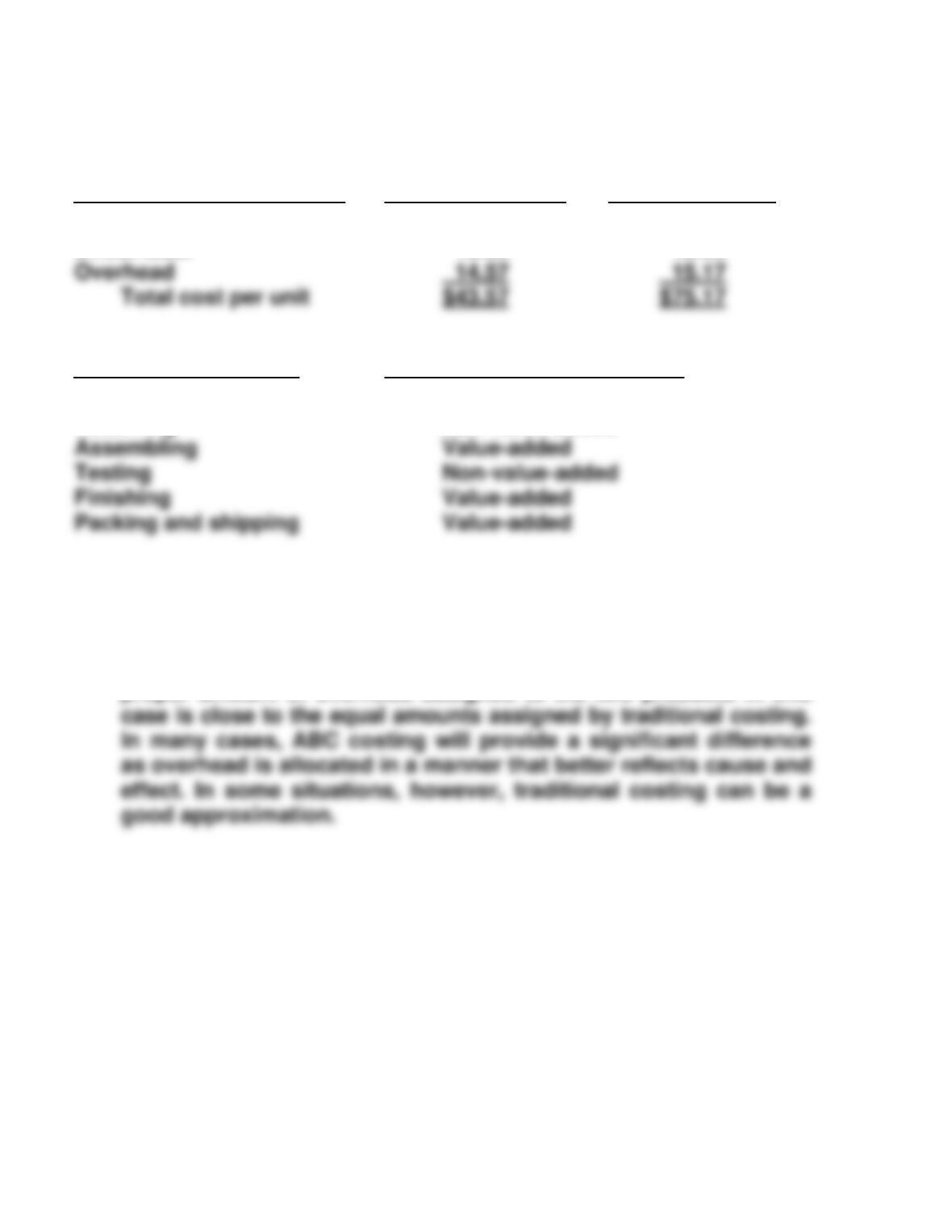
(f) (1) Activity-based costing shows the standard model absorbs about
the same overhead per unit as the deluxe model.
(2) The comparison of ABC and traditional costing shows that the
proper amount of overhead assigned to the two products in this
Total cost per unit
PROBLEM 4-2B
(a) The allocation of total manufacturing overhead using activity-based
costing is as follows:
Elite
Preferred
Overhead Rate
Drivers
Used
Cost
Assigned
Drivers
Used
Cost
Assigned
Total
Overhead
Purchase orders @ $31
Machine setups @ $29
11,250
11,000
$ 348,750
319,000
13,750
9,000
$ 426,250
261,000
$ 775,000
580,000
(b) The cost per unit and gross profit of each model under ABC costing
were:
Elite
Preferred
Direct materials
Direct labor
$ 600.00
100.00
$ 320.00
80.00
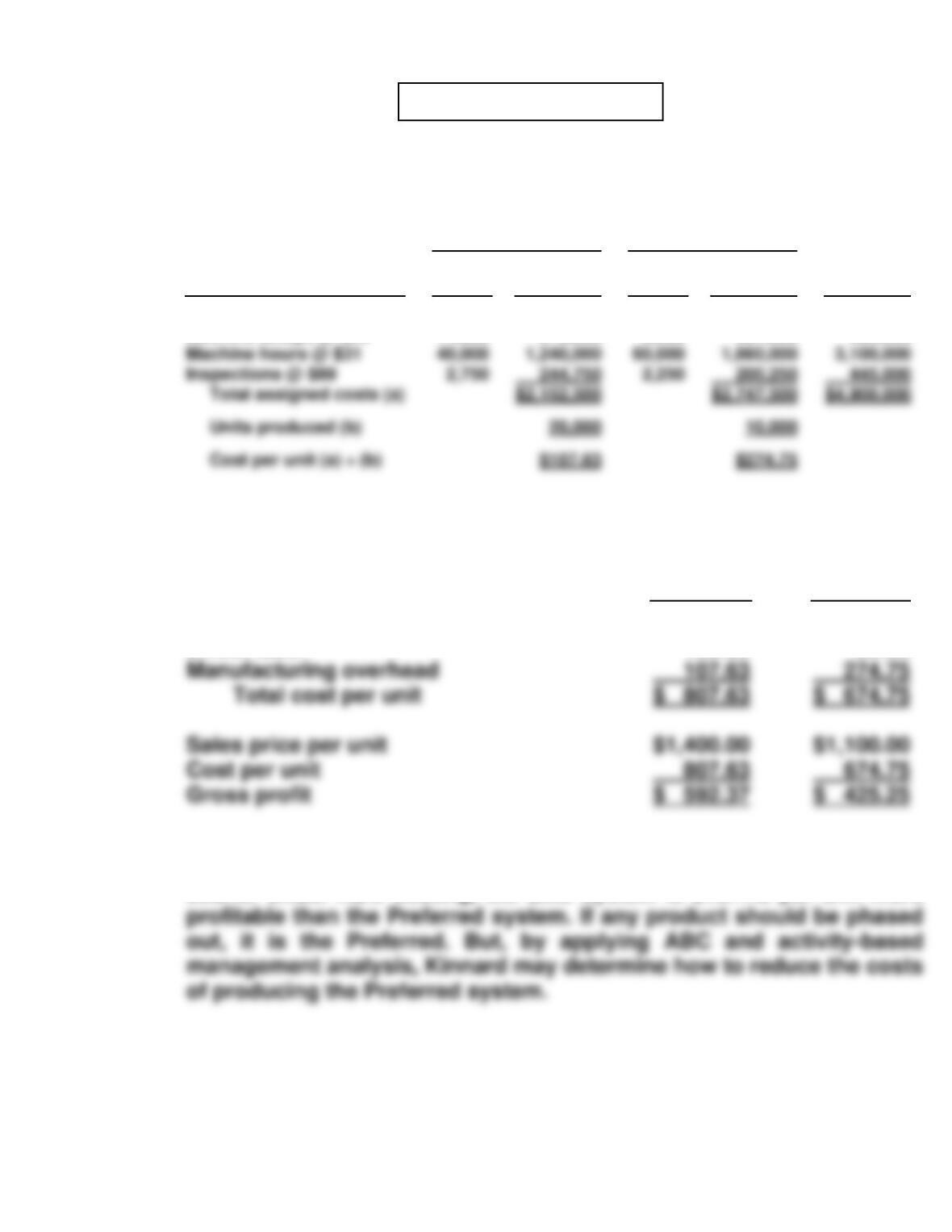
(c) Management’s future plans for the two home theater systems are not
sound. Under ABC costing, the Elite system is $167.12 per unit more
Cost per unit (a) ÷ (b)
$107.63
$274.75
PROBLEM 4-3B
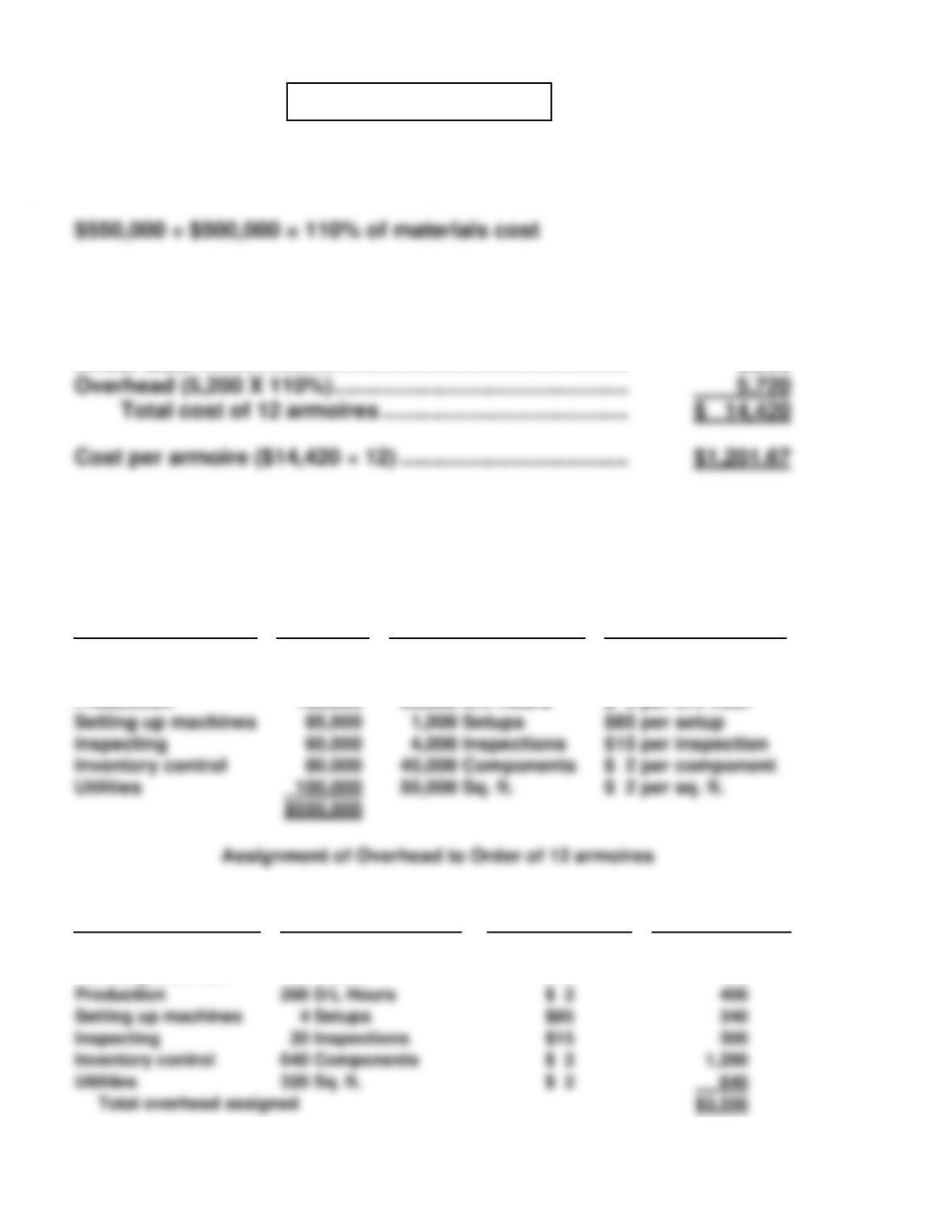
(a) Predetermined overhead rate using materials cost:
(b) Manufacturing cost per armoire under traditional costing:
Direct materials ……………………………………………………… $ 5,200
Direct labor ……………………………………………………………. 3,500
(c) Manufacturing cost per armoire under activity-based costing:
Computation of Activity-Based Overhead Rate
Activity Cost Pools
Estimated
Overhead
÷
Total
Estimated Drivers
=
Activity-Based
Overhead Rate
Utilities
50,000 Sq. ft.
$ 2 per sq. ft.
Purchasing
Handling materials
$ 45,000
50,000
500 Orders
5,000 Moves
$90 per order
$10 per move
Activity Cost Pools
Expected Use of
Drivers
X
Activity-Based
Overhead Rate
=
Cost Assigned
Purchasing
Handling materials
3 Orders
32 Moves
$90
$10
$ 270
320
PROBLEM 4-3B (Continued)
Total manufacturing cost per armoire under ABC:
Direct materials ……………………………………………………………. $ 5,200
Direct labor ………………………………………………………………….. 3,500
(d) The difference between the traditional cost and the activity-based cost
per unit, $1,201.67 versus $1,020.83, is not great in amount but $180.84
or ($1,201.67 – $1,020.83) is 17.7% of the more correct ABC cost per
PROBLEM 4-4B
(a) Computation of unit costs—traditional costing
Overhead cost per labor hour is $1,150,000 ÷ (30,000 + 20,000) =$23
Products
Manufacturing Costs
Valley Fresh
Merando Valley
Direct materials
$1.35
$3.60
(b)
Activity Cost Pools
Estimated
Overhead
Expected Use
of Cost Drivers
Activity-Based
Overhead Rates
$225.00 per inspection
Grape processing
Aging
$ 146,000
420,000
8,000
3,000,000
$ 18.25 per cart
$ 0.14 per month
(c)
Valley Fresh
Merando Valley
Activity Cost Pool
Expected
Use of
Drivers
X
Overhead
Rates
=
Cost
Assigned
Expected
Use of
Drivers
X
Overhead
Rates
=
Cost
Assigned
gallon [(a) ÷ (b)]
Grape processing
Aging
6,000
600,000
$ 18.25
$ 0.14
$109,500
84,000
2,000
2,400,000
$ 18.25
$ 0.14
$ 36,500
336,000
PROBLEM 4-4B (Continued)
(d)
Products
Manufacturing Costs
Valley Fresh
Merando Valley
Direct materials
$1.350
$3.600
(e) To: Mr. Frankie Merando
From: Student
Subject: Product costs using traditional approach versus ABC
The memorandum covers the following points:
a. ABC allocates overhead costs as a function of each product’s use
of cost drivers. Thus, ABC results in overhead allocation that
more closely approximates each product’s generation of overhead
costs.
PROBLEM 4-4B (Continued)
d. The total cost of the two products under the two approaches was
as follows:
Valley Fresh
Merando Valley
Traditional approach
$3.25
$7.40
ABC
PROBLEM 4-5B
(a) Computation of assigned overhead under traditional costing (“direct
labor dollars” appears in the first line of the schedule of overhead
data):
Predetermined overhead rate X direct labor dollars
(b) 1. Computation of activity-based overhead rates:
Activity Cost Pool
Estimated
Overhead
÷
Total Expected
Use of Cost Drivers
=
Activity-Based
Overhead Rates
Employee training
Typing and secretarial
$120,000
60,000
$1,600,000 Direct labor dollars
2,000 Reports/forms
$.075 per DL dollar
$30 per report/form
2. Assignment of overhead to corporate and individual services:
Corporate
Individual
Activity Cost Pool
Expected
Use of
Driver
Overhead
Rate
Cost
Assigned
Expected
Use of
Driver
Overhead
Rate
Cost
Assigned
Computing
Facility rental
Travel
Overhead assigned
Employee training
Typing and secretarial
$900,000
500
$.075
$30
$ 67,500
15,000
$700,000
1,500
$.075
$30
$ 52,500
45,000
PROBLEM 4-5B (Continued)
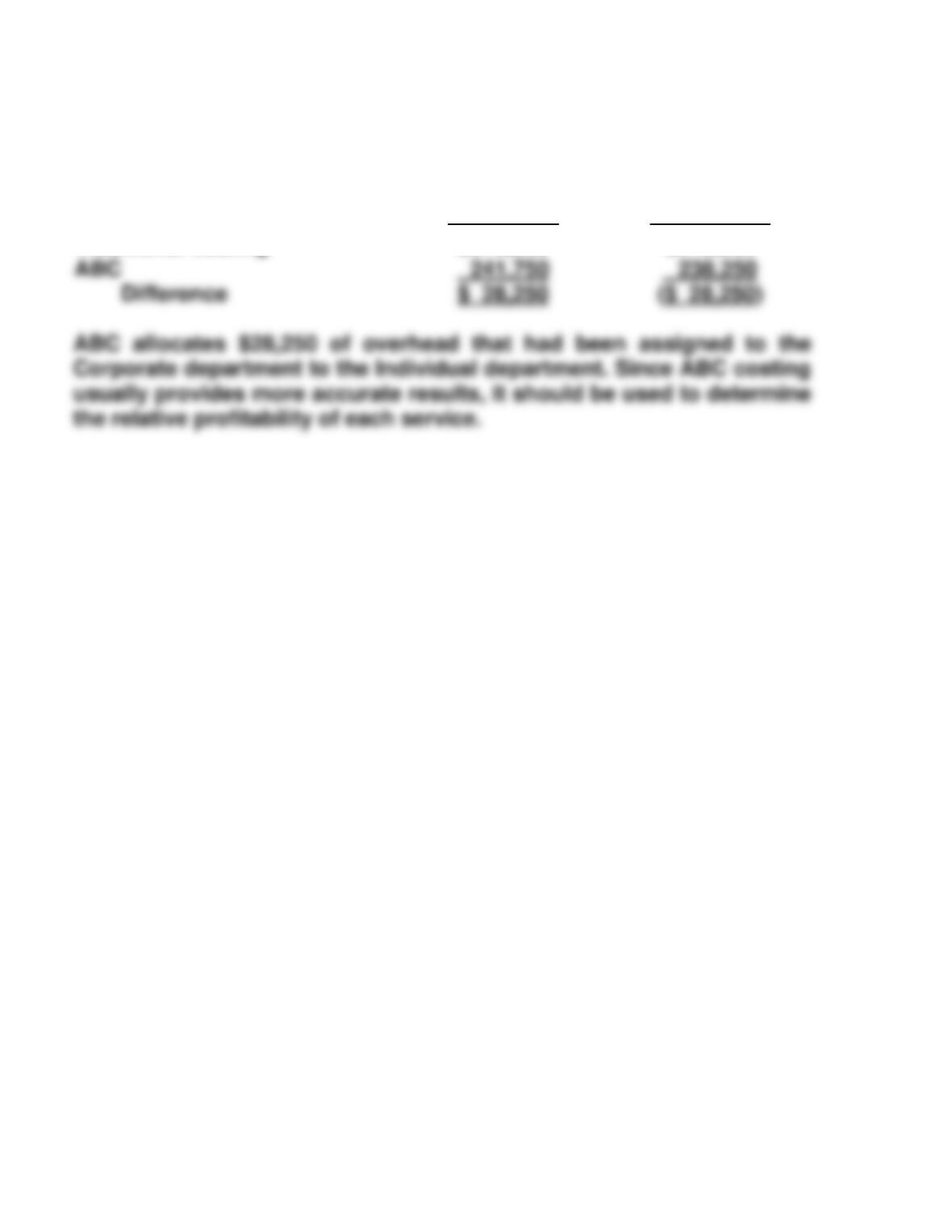
(c) Overhead is assigned to the two service lines as follows:
Corporate
Individual
Traditional costing
$270,000
$210,000