4
Fundamentals of Cost Analysis for Decision
Making
Solutions to Review Questions
4-1.
Costs that are “fixed in the short run” are usually not fixed in the long run. In fact, few, if
any, costs are fixed over a very long time horizon. Over the long run, assets can be sold
or purchased. In the short run, these transactions might be too costly.
4-2.
4-3.
Strictly speaking, sunk costs can never be differential costs. However, sunk costs can
determine the amounts of certain differential costs. For example, federal income taxes
are based on historical (sunk) costs. The disposal of a fixed asset may result in a tax
based on the difference between the sales proceeds and the undepreciated sunk cost.
Many contracts are based on sunk costs as well. Decisions may have contract
implications that arise with changes in plans.
4-4.
4-5.
The full cost of a product is the sum of all fixed and variable costs of manufacturing and
4-6.
A special order is an order that will not affect other orders and is not expected to recur.
4-7.
Costs that are differential should be considered for any decision. In the case of special
orders, these are generally the variable costs associated with the additional volume.
4-8.
The product life cycle covers the time from initial research and development to the time
4-9.
Cost-plus pricing is most likely to be used for unique products where no market price
information exists—areas like construction jobs, defense contracts, and custom orders.
4-10.
1. Develop a product that satisfies the needs of potential customers.
2. Choose a target price based on consumers’ perceived value of the product and
competitor’s prices.
3. Derive a target cost by subtracting the desired profit margin from the target price.
4. Perform value engineering to achieve target costs.
4-11.
Predatory pricing is the practice of a setting a selling price at a low price with the intent
4-12.
Dumping is the practice of exporting products to consumers in another country at an
export price below the domestic price. A cost accountant would help determine the cost
of the product and the costs of exporting versus distributing the product domestically.
4-13.
Price discrimination is the practice of selling identical goods or services to different
customers at different prices. A cost accountant would help determine the costs of
providing the product to different customers. Examples of costs that might differ would
be support costs (for example, for software) or distribution costs (for example, for urban
versus rural consumers).
4-14.
Unit gross margins are typically computed with an allocation of fixed costs. Total fixed
4-15.
The company should compute the contribution margin of each product per unit of the
constraining resource. It should rank the products from highest to lowest contribution
margin per unit of constraining resource, then produce the products in order of this
value.
4-16.
Production constraints mean that managers have to consider the opportunity cost of
4-17.
Common nonfinancial considerations that are important in deciding to drop a product
line include the effect on employees that work on that line, the impact on sales of other
products if it is important to be known as a company that can produce the product
dropped, the effect on the community from possible plant closings, and so on.

4-18.
The theory of constraints focuses on these three factors:
1. Throughput contribution: Sales dollars minus direct materials and other variable
costs.
2. Investments: Inventories, equipment, buildings, and other assets used to generate
throughput contribution.
3. Operating costs: All operating costs other than direct materials and other variable
costs.
Solutions to Critical Analysis and Discussion Questions
4-19.
The main differential costs are the shipping and the staffing for handling returns.
Purchasing and general overhead costs would most likely not be differential.
4-20.
As far as the customer is concerned, they are buying from your company (Nordstrom,
4-21.
Although the variable cost of a passenger is very low, airlines do not usually price
literally at variable cost, even at the last minute. One reason is that this would lead all
passengers to try this approach. The accounting system does not record this type of
cost.
4-22.
4-23.
This is price discrimination. The airlines are able to segment customers who are more
sensitive to the schedule or to knowing travel plans in advance.
4-24.
There is a danger that in making pricing decisions, especially in the short term,
4-25.
Variable costs are usually relevant when talking about changes in production volumes.
However, if the change in production volume extends beyond the “relevant range,”
some fixed costs may also be differential. In addition, there are opportunity costs that
may be differential for a certain decision. In some cases there may be no change in
variable costs. For example, if a company were to add a second copier in the office
4-26.
In the short run, sales revenues need only cover the differential costs of production and
sale. So, from a short-run perspective, so long as the sale does not affect other output
prices or normal sales volume, a “below cost” sale may result in a net increase in
income so long as the revenues cover the differential costs. However, in the long run all
costs must be covered or management would not reinvest in the same type of assets. If
the company must continually sell below the full cost of production then it will most likely
get out of that particular business when it comes time to replace those facilities.
4-27.
This is a difficult and complex issue, so the purpose of this question is to stimulate
discussion and have students think about the complexities of using incremental costs as
a basis for decision making.
4-28.
Most likely most and maybe all of the opportunity costs identified are not included in the
accounting records. Although they are important in the decision, they are difficult to
estimate and the measurement error is so great that accountants do not try to place an
estimate in the accounting records. Note, also, that the airline’s managers are in the
best position to estimate these costs, so any estimate would be subject to management
bias as well.
4-29.
The differential costs include:
• Fuel
4-30.
The differential costs include:
• Cost of the car
• Forgone interest income on funds paid for the car
• Interest on debt on the car
• Insurance
• Maintenance that is time-related
• License and taxes
These costs are different than the costs in 4-29. The costs in 4-29 are those required to
operate the car for an additional few miles. The costs that vary with the number of cars
do not vary with mileage. The costs in 4-30 vary with the number of cars and not with
the miles driven.
Of course, there is the possibility that if you buy a new car you will be asked to drive
your friends around more often than otherwise.
4-31.
4-32.
Fixed costs are relevant anytime they change with the product-mix decision. For
example, if there are fixed costs that can be eliminated with the elimination of one or
more of the individual products, then those fixed costs might be relevant in a multi–
4-33.
Performance can be improved at the bottleneck by increasing capacity or shifting
resources from non-bottleneck areas to the bottleneck.
4-34.
Profits can be increased by decreasing investments, increasing throughput, and
decreasing operating expenses. Most who subscribe to the theory of constraints focus
on increasing throughput contribution.
4-35.
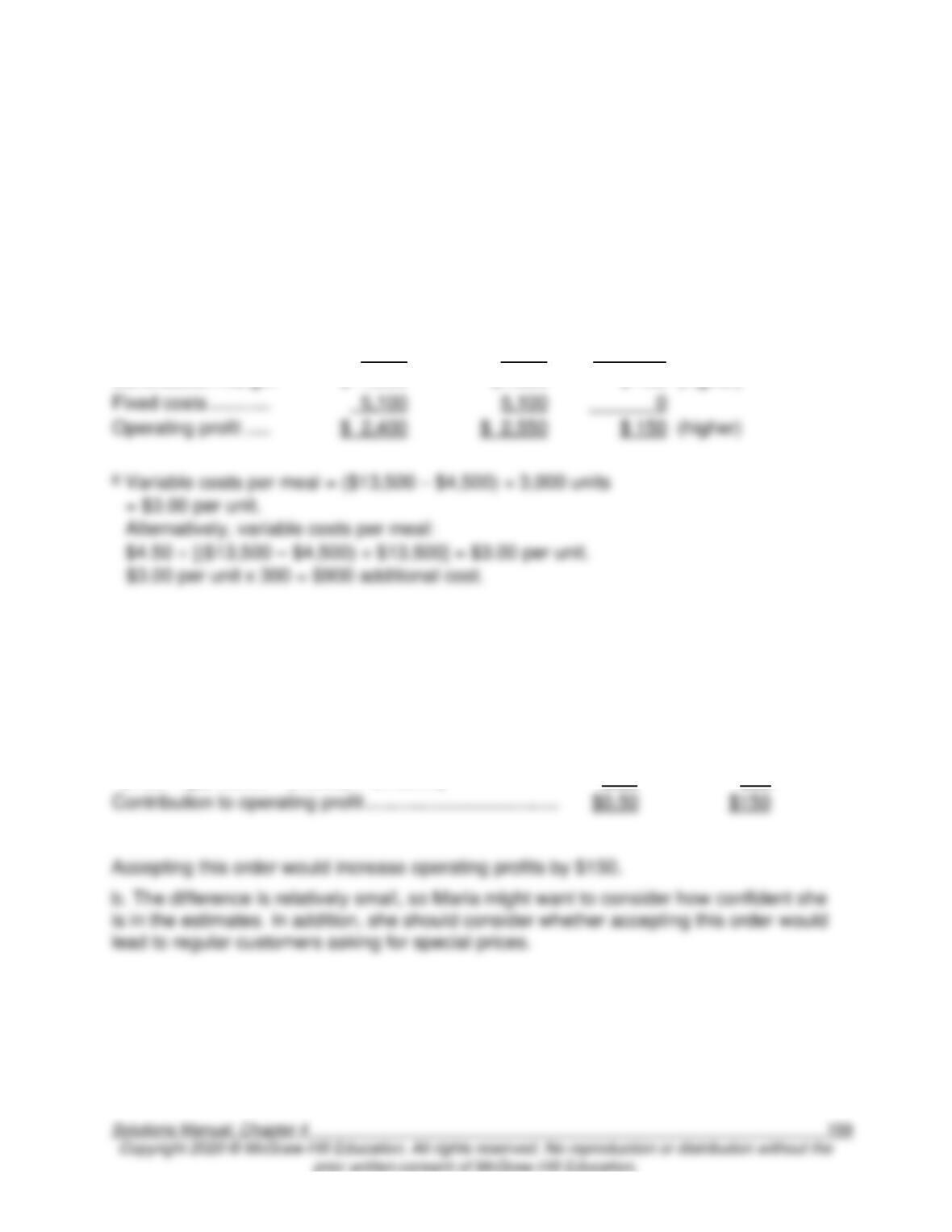
The major differential costs are changing designs to adapt to different materials or fewer
Solutions to Exercises
4-36. (25 min.) Special Orders: Maria’s Food Service.
a.
Status Quo
3,000 Units
Alternative
3,300 Units
Difference
Sales revenue …….
$ 18,000
$19,050
$1,050
(higher)
Variable costs:
Mealsa ……………
9,000
9,900
900
(higher)
Administrativeb ..
1,500
1,500
0
Contribution margin
(higher)
Fixed costs …………
0
b No additional administrative costs according to the exercise.
Alternative presentation.
Per Unit
300 Meals
Sales revenue ……………………………………………………..
$3.50
$1,050
Variable costs:
Meal costs:
$4.50 [($13,500 – $4,500) ÷ $13,500] =
3.00
900
4-37. (25 min.) Special Orders: Alpine Luggage.
Alpine should accept the offer; profit is higher by $80,000.
a.
(All revenues and costs in $000)
Status Quo
80,000 Units
Alternative
85,000 Units
Difference
Sales revenue …………………..
$ 12,800
$13,300
$500
(higher)
Variable costs:
Manufacturing ………………..
5,120
5,440
320
(higher)
Selling and administrative ..
2,560
2,660
100
(higher)
Contribution margin ……………
(higher)
Per Unit
5,000 Units
($000)
Sales revenue ………………………………………….
$100
$500
Variable costs
Manufacturing costs ………………………………..
64
320
Selling and administrative costs ………………..
20
100
Contribution to operating profit ……………………
$16
$80
4-38. (30 min.) Pricing Decisions: MTA Sandwiches.
a.
Status Quo
6,000 units
Alternative
6,400 units
Difference
Sales revenue ……………
$43,200a
$45,360b
$2,160
(higher)
Less variable costs:
Materials………………..
16,200
17,280
1,080
(higher)
Labor …………………….
5,400
5,760
360
(higher)
Variable overhead …..
2,700
2,880
180
(higher)
Total variable cost .
$24,300
$25,920
$ 1,620
(higher)
Contribution margin ……
$18,900
$19,440
$ 540
(higher)
Less fixed costs …………
10,800
10,800
0
Operating profit ………….
$8,100
$8,640
$ 540
(higher)
4-39. (30 min.) Pricing Decisions: Rutkey Collectibles.
a.
Status Quo
20,000 Cars
Alternative
23,000 Cars
Difference
Sales revenue ……………
$800,000a
$884,000b
$84,000
(higher)
Less variable costs:
Materials………………..
240,000
276,000
36,000
(higher)
Labor …………………….
160,000
184,000
24,000
(higher)
Variable overhead …..
80,000
92,000
12,000
(higher)
Total variable cost .
$480,000
$552,000
$72,000
(higher)
Contribution margin ……
$320,000
$332,000
$12,000
(higher)
Less fixed costs …………
160,000
160,000
4-40. (30 min.) Special Order: Andreasen Corporation.
(All Costs in Thousands of Dollars)
a.
Status Quo
100,000 Units
Alternative
107,500 Units
Difference
Sales revenue ……………
$10,000a
$10,450b
$450
(higher)
Less variable costs:
Materials………………..
3,600
3,885c
285
(higher)
Labor …………………….
1,400
1,505
105
(higher)
Variable overhead …..
400
430
30
(higher)
Total variable cost .
$5,400
$5,820
$420
(higher)
Contribution margin ……
(higher)
Less fixed costs …………
(higher)
b. Based on incremental profits, Andreasen should accept the order. The difference is
so small, however, that other factors might be more important. For example,
Andreasen would want to ensure that accepting this order would not have an
adverse effect on current business.
4-41. (30 min.) Special Order: Fairmont Travel Gear.
(All Costs in Thousands of Dollars)
a.
Status Quo
45,000 Units
Alternative
48,000 Units
Difference
Sales revenue ……………
$4,050.0a
$4,239.0b
$189
(higher)
Less variable costs:
Materials………………..
1,215.0
1,314.0c
99.0
(higher)
Labor …………………….
810.0
871.5d
61.5
(higher)
Variable overhead …..
337.5
362.1e
24.6
(higher)
Total variable cost .
$2,362.5
$2,547.6
$185.1
(higher)
Contribution margin ……
$1,687.5
$1,691.4
$ 3.9
(higher)
Less fixed costs …………
(higher)
b. Based on incremental profits, Fairmont should not accept the order. If the customer
might develop a longer-term relationship and pay regular prices, Fairmont might
consider accepting the order.
c. This question can be answered using the break-even analysis of Chapter 3. The
incremental fixed cost is $7,500 (the one-time rental). The contribution margin for the
additional units is $1.30 (= $63.00 − $27.00 − $6.00 − $18.00 − $2.50 − $7.50 −
$0.70). Therefore the break-even point on the incremental units is:
4-42. (10 min.) Target Costing and Pricing: Sid’s Skins.
Profit
=
(Price – Costs)
=
20% Costs
Price
=
Highest acceptable costs
1.20
=
Highest acceptable costs
1.20
$17.50
=
Highest acceptable costs
4-43. (10 min.) Target Costing and Pricing: Domingo Corporation.
Profit
=
(Price – Costs)
=
25% Costs
Price
=
Highest acceptable costs
1.25
=
Highest acceptable costs
1.25
=
Highest acceptable costs
4-44. (20 min.) Target Costing and Purchasing : Mira Mesa Appliances.
$126.
The target cost for Mira Mesa is calculated as follows:
Profit
=
(Price – Costs)
=
30% Price
Price x (1.0 – 0.30)
=
Highest acceptable costs
$260 × 0.70
=
Highest acceptable costs
4-45. (20 min.) Target Costing: Kearney, Inc.
0.75 hours.
The target cost for Kearney is calculated as follows:
Profit
=
(Price – Costs)
=
20% Costs
Price
=
Highest acceptable costs
1.20
=
Highest acceptable costs
1.20
=
Highest acceptable costs
4-46. (20 min.) Make-or-Buy Decisions: Mobility Partners.
The $20,000 savings could not be achieved. The cost to make is only $16,000 more
than the cost to purchase from Trailblazers.
Status Quoa
Alternative
Difference
Trailblazers’ offer …………….
$ –0–
$440,000
$440,000
(higher)
Materials ………………………
100,000
100,000
(lower)
Labor …………………………....
212,000
212,000
(lower)
Variable overhead …………..
64,000
64,000
(lower)
Fixed overhead applied ……
188,000
b
108,000
c
80,000
(lower)
Total costs……………….
$564,000
$548,000
$ 16,000
(lower)
aBased on 2,000 units.
b$94 × 2,000 = $188,000;
c$94 × 2,000 units – $80,000 = $108,000.
Direct materials ……………….
Direct labor …………………….
106
Variable overhead ……………
Avoidable fixed overhead …
(= $80,000 ÷ 2,000 units)
4-47. (15 min.) Make or Buy Decisions: Mel’s Meals 2 Go.
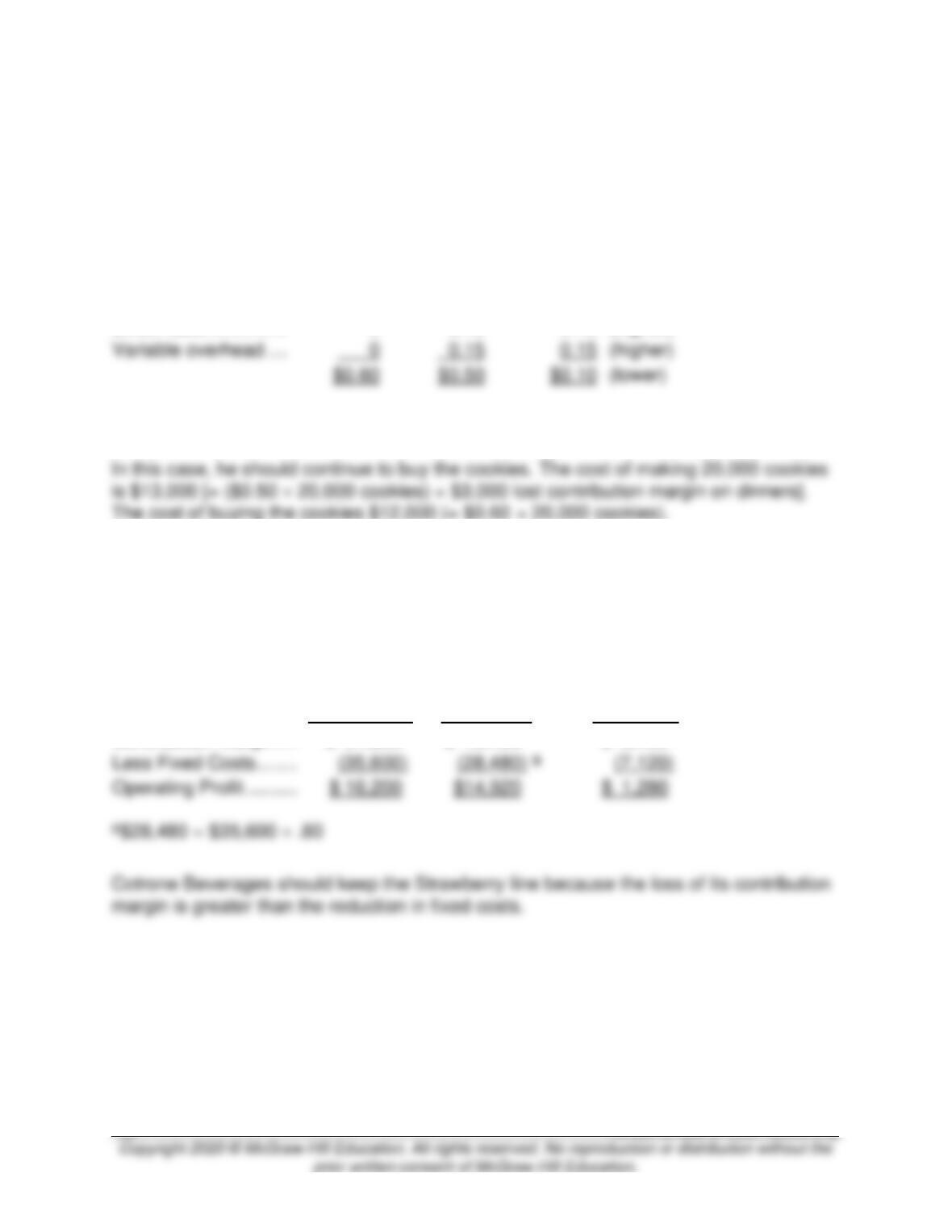
Mel could save $0.10 per cookie ($0.20 per lunch) by making the cookies rather than
buying them.
Status Quo
(Buy)
Alternative
(Make)
Difference
(Buy–Make)
Cost to buy ……………
$0.60
$ 0
$0.60
(lower)
Direct material ……….
0
0.20
0.20
(higher)
Direct labor ……………
0
0.15
0.15
(higher)
Variable overhead ….
0.15
(higher)
4-48. (10 min.) Make or Buy with Opportunity Costs: Mel’s Meals 2 Go.
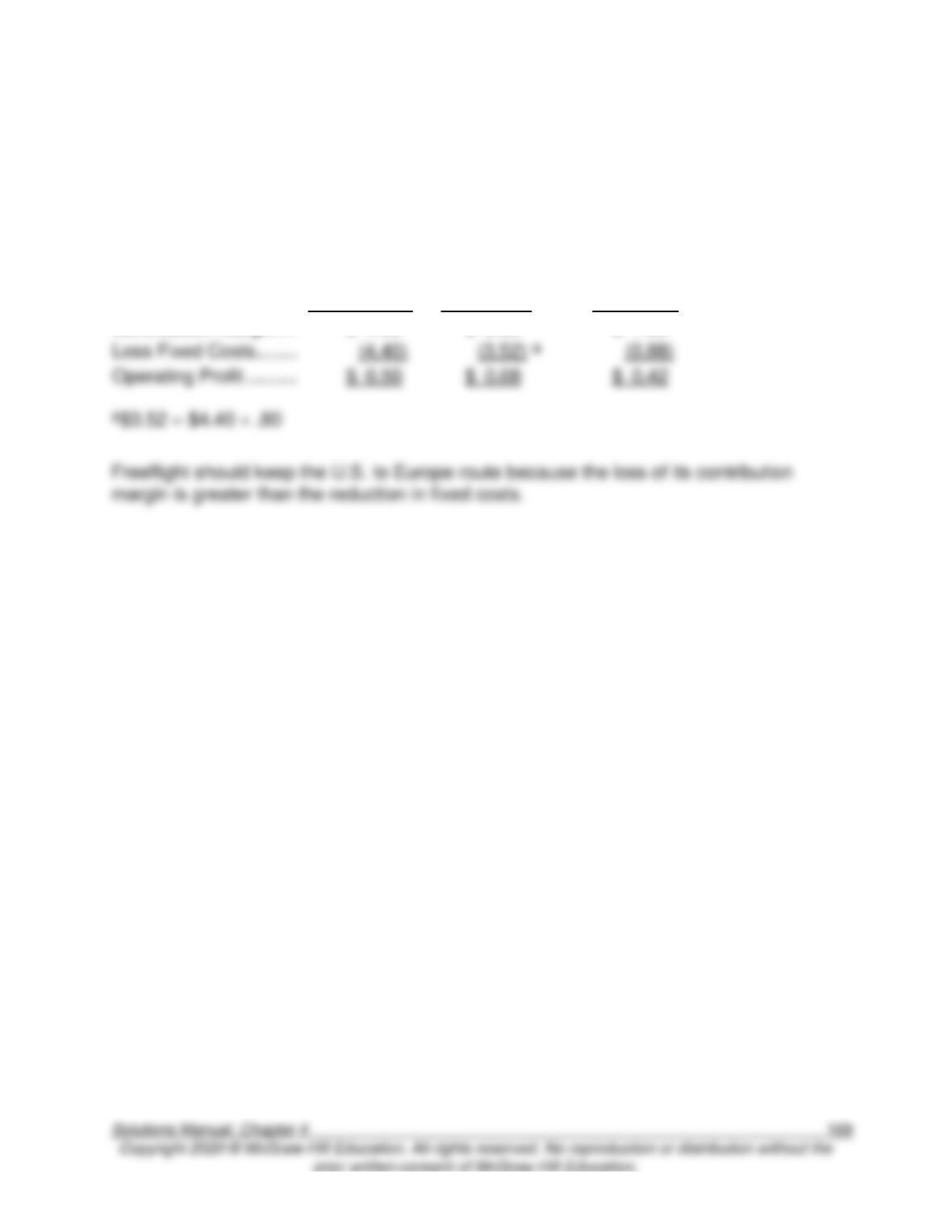
4-49. (30 min.) Dropping Product Lines: Cotrone Beverages.
Status Quo
Alternative:
Drop
Strawberry
Difference
(all lower under
the alternative)
Revenue …………………
$253,200
$167,600
$85,600
Less Variable Costs …
(201,400)
(124,200)
(77,200)
Contribution Margin ….
Less Fixed Costs ……..
(28,480)
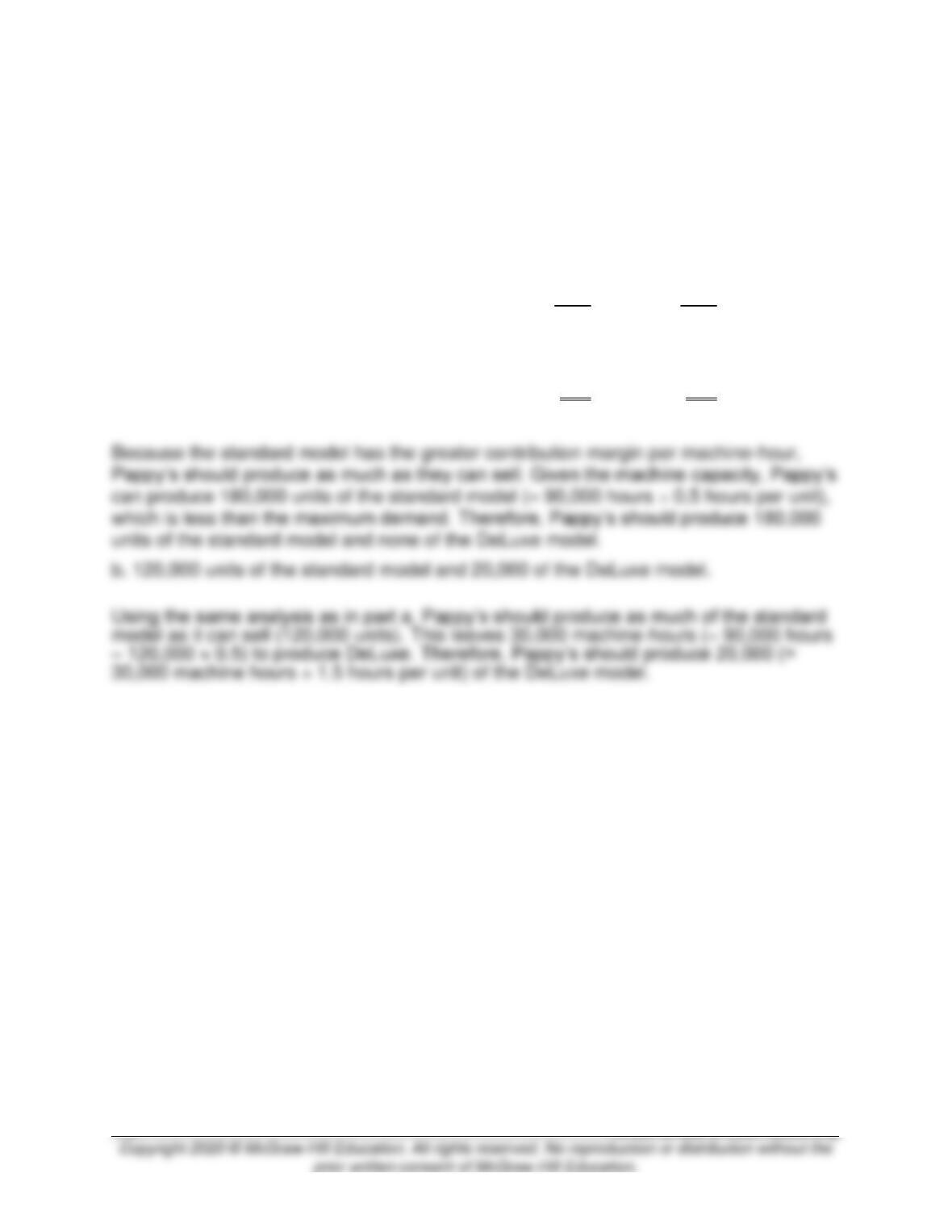
4-50. (30 min.) Dropping Product Lines: Freeflight Airlines.
Status Quo
Alternative:
Drop
U.S. to Europe
Difference
(all lower under
the alternative)
Revenue …………………
$ 8.80
$6.00
$2.80
Less Variable Costs …
(3.90)
(2.40)
(1.50)
Contribution Margin ….
Less Fixed Costs ……..
(4.40)
(3.52)
(0.88)
4-51. (15 min.) Theory of Constraints: Pappy’s Toys.
a. 180,000 units of the standard model. The contribution margin per machine hour for
the two models are:
Standard
DeLuxe
Price …………………………..…………………..
$40
$60
Variable cost ……………………………………
20
24
Contribution margin …………………………..
$20
$36
Machines-hours per unit …………………….
0.5
1.5
Contribution margin per machine hour …
$40
$24