Chapter 04 – Accounting for Governmental Operating Activities—Illustrative Transactions and Financial Statements
4-1
CHAPTER 4: ACCOUNTING FOR GOVERNMENTAL OPERATING
ACTIVITIES⎯ILLUSTRATIVE TRANSACTIONS AND
FINANCIAL STATEMENTS
OUTLINE
Number
Topic
Type/Task
Status
(re: 18/e)
Questions:
4-1
Appropriate choice of governmental fund
Analyze
Same
4-2
Uncollected property taxes
Explain
New
4-3
Tax anticipation notes
Explain
Same
4-4
Dual effects of transactions
Explain, examples
Same
4-5
Property tax revenue
Compute
Same
4-6
Differences in property tax revenues
Explain
Same
4-7
Accounting for supplies
Explain
Same
4-8
Interim financial reporting
Explain
Same
4-9
Payments in lieu of taxes
Describe
New
4-10
Classes of nonexchange transactions
Describe
Same
4-11
Deferred inflows of resources
Describe
Revised
Cases:
4-12
Analyzing budget and actual data
Examine, write
Same
4-13
Policy issues relating to property taxes
Analyze, write
Same
4-14
Delinquent taxes and tax liens
Research, write
Same
4-15
Property taxes and economic development
Analyze, explain
New
Exercises/Problems:
4-16
Examine the CAFR
Examine
Updated
4-17
Various
Multiple Choice
1, 2, and 10 are new
4-18
Various
Multiple Choice
New
4-19
Accounting for property taxes
Calculate, JEs
Same
4-20
Differences in accounting for property taxes
Calculate, JEs
Same
4-21
Tax anticipation financing and issuance of
TANs
Calculate, JEs
Same
4-22
Preparing statements from revenue and
appropriations ledgers
JEs, Statements
New
4-24
Transactions and budgetary comparison
schedule
JEs and schedule
Revised
4-25
Interfund and interactivity transactions
JEs
Same
4-26
Comparison of inventory methods
Calculate, JEs
Same
4-27
Operating transactions and financial
statements
JEs and statement
Revised
4-28
Permanent fund accounting
JEs and statements
Same
Chapter 04 – Accounting for Governmental Operating Activities—Illustrative Transactions and Financial Statements
4-2
CHAPTER 4: ACCOUNTING FOR GOVERNMENTAL OPERATING
ACTIVITIES—ILLUSTRATIVE TRANSACTIONS AND
FINANCIAL STATEMENTS
Answers to Questions
4-1. In addition to the General Fund, governmental fund categories include: special revenue,
debt service, capital projects, and permanent funds. The property taxes are recorded in the
General Fund. As set forth in GASB Codification Sec. 1300, paragraph 105, special
revenue funds are used to account for and report the proceeds of specific revenue sources
that are restricted or committed to expenditure for specified purposes other than debt
service or capital projects. Therefore, the gas tax should be recorded in a special revenue
General Problem Information: Appropriate choice of governmental fund
Learning Objective: 4-4
Learning Objective: 4-6
Topic: Special Revenue Funds, Permanent Funds
4-2. Uncollected property taxes receivable should be reclassified as delinquent after their due
date passes. Furthermore, any amounts that are not expected to be collected within 60
days of fiscal year end, will also be reported as Deferred Inflows of Resources—
General Problem Information: Uncollected property taxes
Learning Objective: 4-1
Topic: Accounting for Property Taxes
Chapter 04 – Accounting for Governmental Operating Activities—Illustrative Transactions and Financial Statements
4-3
Ch. 4, Answers (Cont’d)
4-3. Since cash inflows to governments often do not occur on a consistent basis, many
governments borrow money on a short-term basis. The taxing power of the government
is ample security for short-term debt, thus banks customarily meet the working capital
needs of a government by issuing a tax anticipation note to the government.
General Problem Information: Tax anticipation notes
Learning Objective: 4-1
4-4. Under the GASB financial reporting model, governmental activities are reported on a
long-term perspective at the government-wide level using the economic resources
measurement focus and the accrual basis of accounting, similar to business accounting.
This means that both current and noncurrent assets and liabilities, as well as deferred
inflows and outflows of resources, are reported on the statement of net position.
Revenues, and expenses recognized on the accrual basis, are reported on the statement of
Examples of transactions or events that are recorded only in the General Fund general
journal include budgetary entries and encumbrance transactions. Examples of
transactions that are recorded only in the governmental activities general journal include
depreciation expense on general capital assets and accrual of interest on long-term debt
(as discussed in Chapter 6). Purchases of non-capital goods and services, salaries and
wages, and most revenue items are examples of transactions that are recorded in both the
General Fund general journal and the governmental activities journal.
General Problem Information: Dual effects of transactions
Learning Objective: 4-1
Chapter 04 – Accounting for Governmental Operating Activities—Illustrative Transactions and Financial Statements
4-4
Ch. 4, Answers (Cont’d)
4-5. $6,720,000 = gross levy − (.04 × gross levy)
$6,720,000 = (1 − .04) × gross levy
$6,720,000 = .96 × gross levy
gross levy = $6,720,000/.96 = $7,000,000.
General Problem Information: Property tax revenue
Learning Objective: 4-1
4-6. Property tax revenue is an example of an imposed nonexchange revenue, thus revenue
should be credited in the year for which the tax was levied. In governmental funds,
however, revenue is recognized when measurable and available, with available specified
for property taxes as collected within the current period or within 60 days of year-end
(GASB Codification, Sec. P70.104). The available criteria and 60-day rule do not apply
to governmental activities at the government-wide level, resulting in differences between
property tax revenue reported in governmental funds and in the governmental activities.
In any given year, the full portion of property tax revenue that is considered collectible
General Problem Information: Differences in property tax revenues
Learning Objective: 4-1
Learning Objective: 4-7
Topic: Accounting for Property Taxes
4-7. The purchases method is consistent with the modified accrual basis of accounting as an
expenditure is recognized for the full cost of supplies when purchased, regardless of the
amount used during the year. The consumption method is consistent with the accrual
basis of accounting as an expenditure or expense is recognized for the cost of supplies
Chapter 04 – Accounting for Governmental Operating Activities—Illustrative Transactions and Financial Statements
4-5
Ch. 4, Answers, Question 4-7 (Cont’d)
accounting. The purchases method would therefore be inappropriate at the government-
wide level.
Topic: Adjusting Entries
Bloom’s Taxonomy: Remember
Accreditation Skills tag: AACSB: Communication, AICPA: FN Reporting
Level of Difficulty: Easy
4-8. Although there is no requirement for external interim financial reporting, all state and
local governments should prepare interim financial schedules for the internal use of
administrators and legislators. Interim budgetary comparison schedules are essential to
sound budgetary control and ensure that appropriate officials can take timely action to
correct unexpected revenue or expenditure/encumbrance variances.
General Problem Information: Interim financial statements
Learning Objective: 4-8
Topic: Interim Financial Statements (Appendix B)
4-9. A payment in lieu of taxes (PILOT) is a contribution made by a tax-exempt property
holder to compensate a government for the value of government services provided (e.g.,
police and fire protection). Since some properties within a government’s domain may be
exempt from property tax assessment but still benefit from government services, the
General Problem Information: Payments in lieu of taxes
Learning Objective: 4-1
Topic: Services Provided by an Enterprise Fund
Bloom’s Taxonomy: Remember
Accreditation Skills tag: AACSB: Communication, AICPA: FN Reporting
4-10. As shown in Appendix A to Chapter 4, the four classes of nonexchange transactions are
(1) derived tax revenues, (2) imposed nonexchange revenues, (3) government-mandated
nonexchange transactions, and (4) voluntary nonexchange transactions. For derived tax
Chapter 04 – Accounting for Governmental Operating Activities—Illustrative Transactions and Financial Statements
4-6
Ch. 4, Answers, Question 4-10 (Cont’d)
revenues, such as sales and similar taxes, revenues should be recognized when the
underlying exchange (e.g., sale of goods or services) has occurred. Revenues for imposed
nonexchange revenues should be recognized when resources are required to be used or
the first period that use is permitted. For both government-mandated and voluntary
Topic: Exchange Transactions (Appendix A)
Bloom’s Taxonomy: Remember
Accreditation Skills tag: AACSB: Communication, AICPA: FN Reporting
Level of Difficulty: Medium
4-11. Deferred inflows of resources are resources that have been acquired but are applicable to
a future period (e.g. resources received but unavailable for use until a future period).
Deferred inflows decrease net position. These accounts, used only when required by a
GASB standard, represent timing differences between the actual outflow or inflow of
General Problem Information: Deferred inflows of resources
Learning Objective: 4-1
Learning Objective: 4-3
Topic: Illustrative Journal Entries
Bloom’s Taxonomy: Understand
Solutions to Cases:
4-12. a. Students will examine different governments and may locate budgetary comparisons
with the fund financial statements or in required supplementary information. The
variance column is not required, but it is often presented.
Chapter 04 – Accounting for Governmental Operating Activities—Illustrative Transactions and Financial Statements
4-7
Ch. 4, Solutions, Case 4-12 (Cont’d)
b. Students are often interested in large variances between the original, legally-adopted
budget and the final results. Historically the original budget was not presented in
budgetary comparisons, so the final amended budget was compared to actual results.
You may discuss budgets with students. It is also informative to note whether changes
to revenue projections impacted expenditures.
General Problem Information: Analyzing budget and actual data
Learning Objective: 4-3
Topic: General Fund Financial Statements
Bloom’s Taxonomy: Analyze
4-13. This is a case for which there is no “right” answer. Rather students should be given credit
for how well they identify, develop, and communicate pertinent issues, and on the quality
of their analysis.
a. (1) Most students should see their tax situation during the first two years of the pre-
recession period in a very favorable light. After all, who wouldn’t be delighted to
find their property taxes declining while the market value of the same property is
increasing?
(3) This is the time that the student, as property owner, should be getting very
concerned. On top of owing more than the property is worth, he/she is facing an
increasing property tax payment. Many taxpayers could be expected to appeal to
the commission in hopes of obtaining a decrease in the assessed valuation of their
property. However, if the commission looks at the full five years an appeal might
be dismissed.
Chapter 04 – Accounting for Governmental Operating Activities—Illustrative Transactions and Financial Statements
4-8
Ch. 4, Solutions, Case 4-13, Part b.(1) (Cont’d)
efforts should be focused on maintaining a relatively consistent tax projection.
She/he can argue that assessed values of property are seldom synchronized with
actual market values, so tax rates should be kept within a consistent range to help
deal with uncertainty about future economic and market conditions.
(2) As it was for the property owners, the recessionary period is the period of greatest
concern to the city manager. Revenues from sources other than property taxes,
particularly sales taxes, will be declining sharply during a severe recession. Thus,
while the city manager would like to increase the property tax rate to offset
declining revenues, political opposition to any kind of tax increase can be
General Problem Information: Policy issues relating to property taxes
Learning Objective: 4-1
Topic: Accounting for Property Taxes
4-14. Student responses will vary depending upon the government selected and the policies in
effect regarding delinquent taxes and tax liens. Students should find this research case
interesting, especially when they learn that, in some cases, tax lien buyers are able to
obtain legal title to a property by paying delinquent taxes and filing necessary paperwork.
The instructor may wish to make note of governments with interesting tax lien policies.
General Problem Information: Delinquent taxes and tax liens
Learning Objective: 4-1
Topic: Accounting for Property Taxes
Chapter 04 – Accounting for Governmental Operating Activities—Illustrative Transactions and Financial Statements
4-9
Ch. 4, Solutions, Cases (Cont’d)
4-15. This case addresses the issue of property that may or may not assessed by the local
government for property taxes. In this case the property is in a commercial area where
annual property and sales taxes of $208,000 could potentially be collected if a
commercial property owner moved in, rather than a government agency. The $208,000 is
somewhat offset by estimated payments in lieu of taxes (PILOT) that the government
General Problem Information: Property taxes and economic development
Learning Objective: 4-1
Topic: Services Provided by an Enterprise Fund
Bloom’s Taxonomy: Understand
Solutions to Exercises and Problems
4-16. The answers will differ from student to student, since each has a different annual report.
The instructor may wish to have copies made of good examples of statements, charts,
graphs, informative schedules, and tables. Some class discussion of the different
General Problem Information: Examine the CAFR
Learning Objective: 4-3
Topic: Various
Bloom’s Taxonomy: Understand
Accreditation Skills tag: AACSB: Communication, AICPA: FN Reporting
Level of Difficulty: Easy
2. b. 7. d.
4. c. 9. b.
Chapter 04 – Accounting for Governmental Operating Activities—Illustrative Transactions and Financial Statements
4-10
Ch. 4, Solutions, Exercise 4-18 (Cont’d)
General Problem Information: Various
Learning Objective: 4-1
Topic: Various chapter topics
Bloom’s Taxonomy: Remember/Understand
Accreditation Skills tag: AACSB: Communication, AICPA: FN Reporting
Level of Difficulty: Medium
4-18. 1. b. 6. c.
3. d. 8. a.
5. a. 10. a.
General Problem Information: Various
Learning Objective: 4-1
Learning Objective: 4-7
Topic: Various chapter topics
Bloom’s Taxonomy: Remember/Understand
Accreditation Skills tag: AACSB: Communication, AICPA: FN Reporting
Level of Difficulty: Medium
Chapter 04 – Accounting for Governmental Operating Activities—Illustrative Transactions and Financial Statements
4-11
Ch. 4, Solutions (Cont’d)
4-19. RIDGEDALE COUNTY
General Ledger Subsidiary Ledger
Debits Credits Debits Credits
General Fund:
a. TAXES RECEIVABLE—CURRENT 4,200,000
Revenues Ledger:
PROPERTY TAXES 4,116,000
b. General Fund:
CASH 3,900,000
c. General Fund:
CASH 57,800
TAXES RECEIVABLE—
DELINQUENT 53,000
INTEREST AND PENALTIES
RECEIVABLE ON TAXES 4,800
Revenues Ledger:
PROPERTY TAXES 53,000
INTEREST AND PENALTIES 4,800
Chapter 04 – Accounting for Governmental Operating Activities—Illustrative Transactions and Financial Statements
4-12
Ch. 4, Solutions, Exercise 4-19 (Cont’d)
General Ledger Subsidiary Ledger
Debits Credits Debits Credits
d. General Fund:
TAXES RECEIVABLE—
DELINQUENT 300,000
ALLOWANCE FOR
UNCOLLECTIBLE CURRENT
TAXES 84,000
REVENUES 216,000
DEFERRED INFLOWS OF
RESOURCES—UNAVAILABLE
REVENUES 216,000
Revenues Ledger:
e. General Fund:
INTEREST AND PENALTIES
RECEIVABLE ON TAXES 14,500
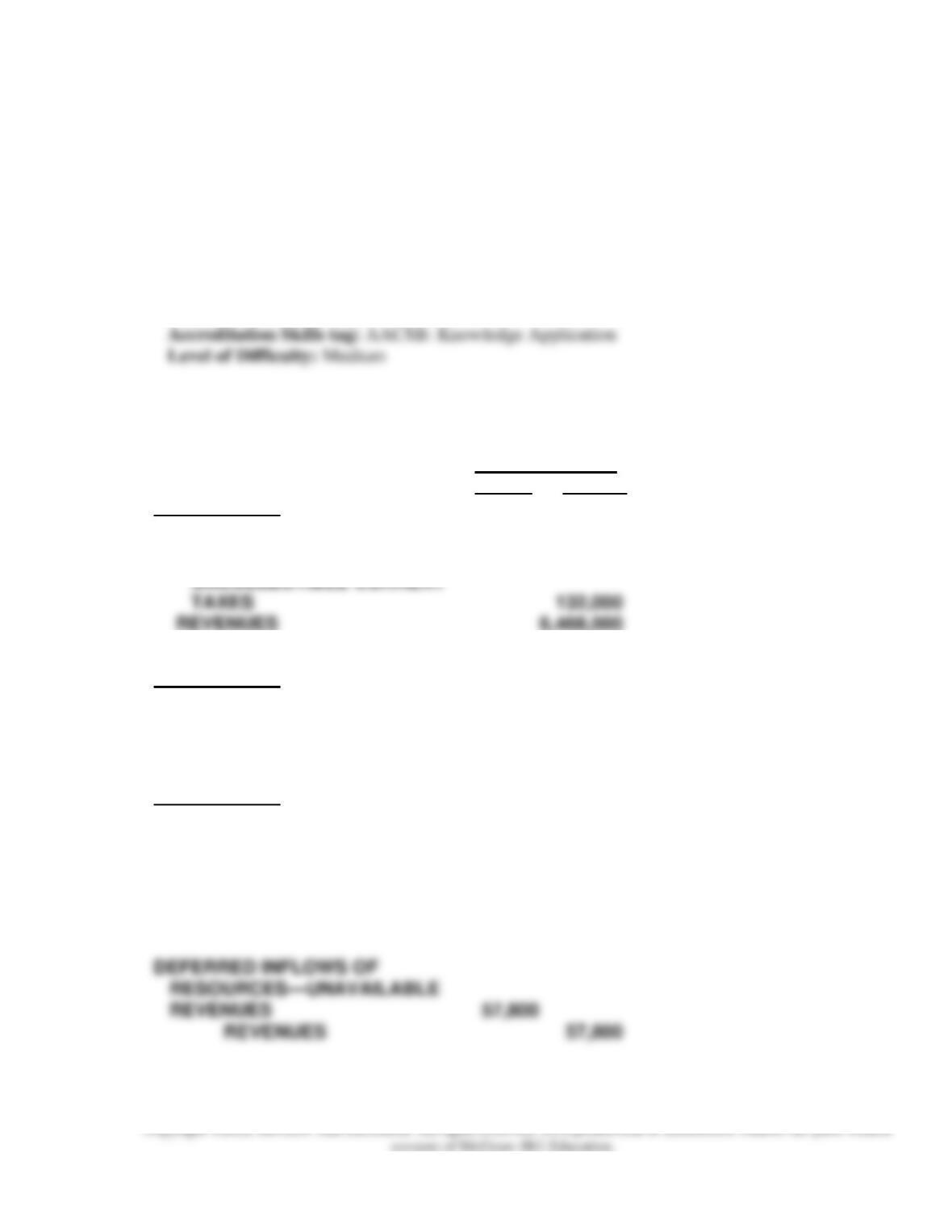
f. Yes. Since the property taxes were not expected to be collected within 60
days of year-end, they were reclassified from Revenues to Deferred Inflows
of Resources—Unavailable Revenues in the General Fund. If the taxes are
collected within 60 days of year-end, they should be recognized in current
year revenues. Since audited financial statements of governments are
Chapter 04 – Accounting for Governmental Operating Activities—Illustrative Transactions and Financial Statements
4-13
Ch. 4, Solutions, Exercise 4-19 (Cont’d)
typically issued several months after year-end, an adjusting entry should
be made to properly include the amounts in tax revenue.
General Problem Information: Accounting for property taxes
Learning Objective: 4-1
Topic: Accounting for Property Taxes
Bloom’s Taxonomy: Apply
4-20. a. CITY OF PLATTSBURGH
General Ledger
Debits Credits
General Fund:
1. TAXES RECEIVABLE—CURRENT 6,600,000
ALLOWANCE FOR
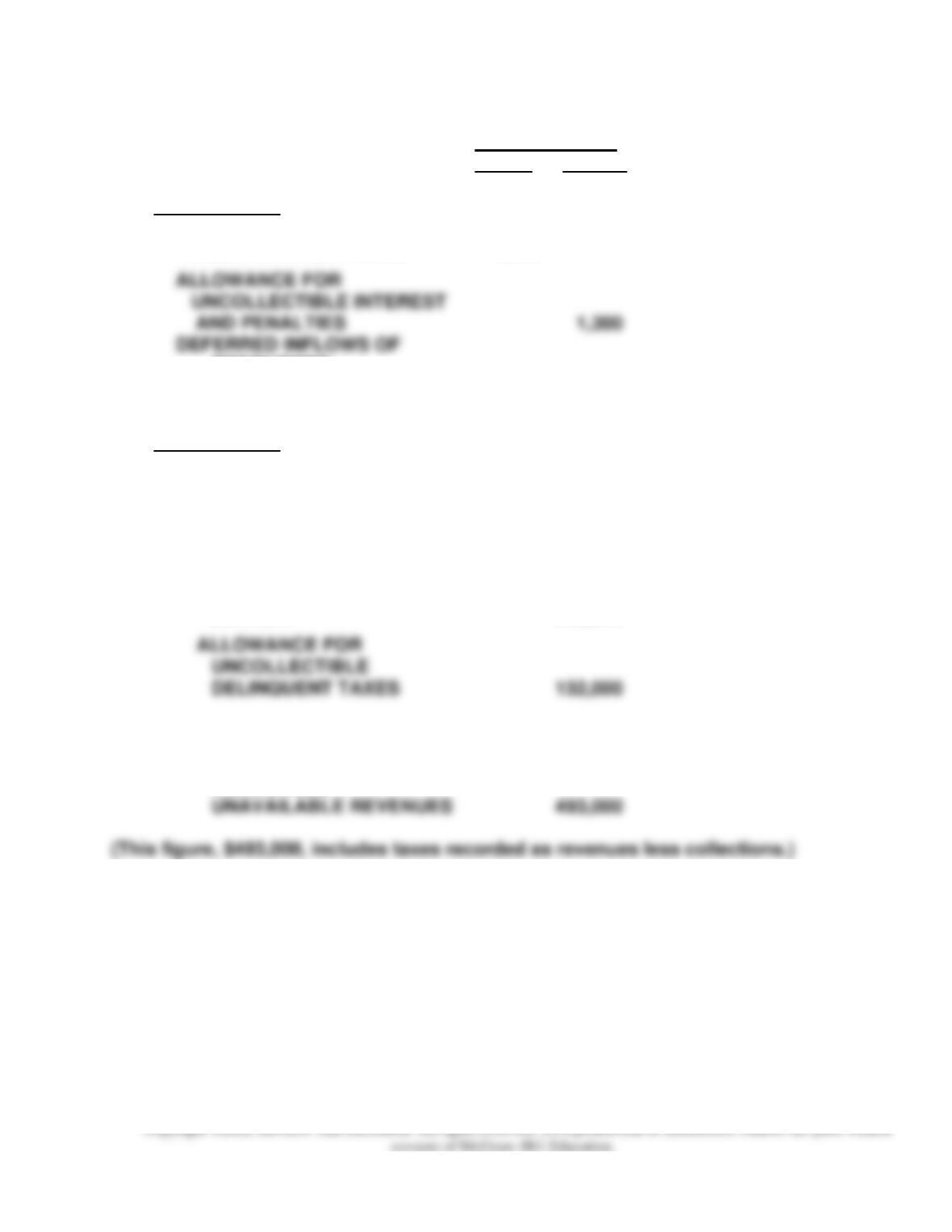
2. General Fund:
CASH 5,975,000
TAXES RECEIVABLE—
CURRENT 5,975,000
3. General Fund:
CASH 57,800
TAXES RECEIVABLE—
DELINQUENT 53,000
INTEREST AND PENALTIES
RECEIVABLE ON TAXES 4,800
Chapter 04 – Accounting for Governmental Operating Activities—Illustrative Transactions and Financial Statements
4-14
Ch. 4, Solutions, Exercise 4-20 a., (Cont’d)
General Ledger
Debits Credits
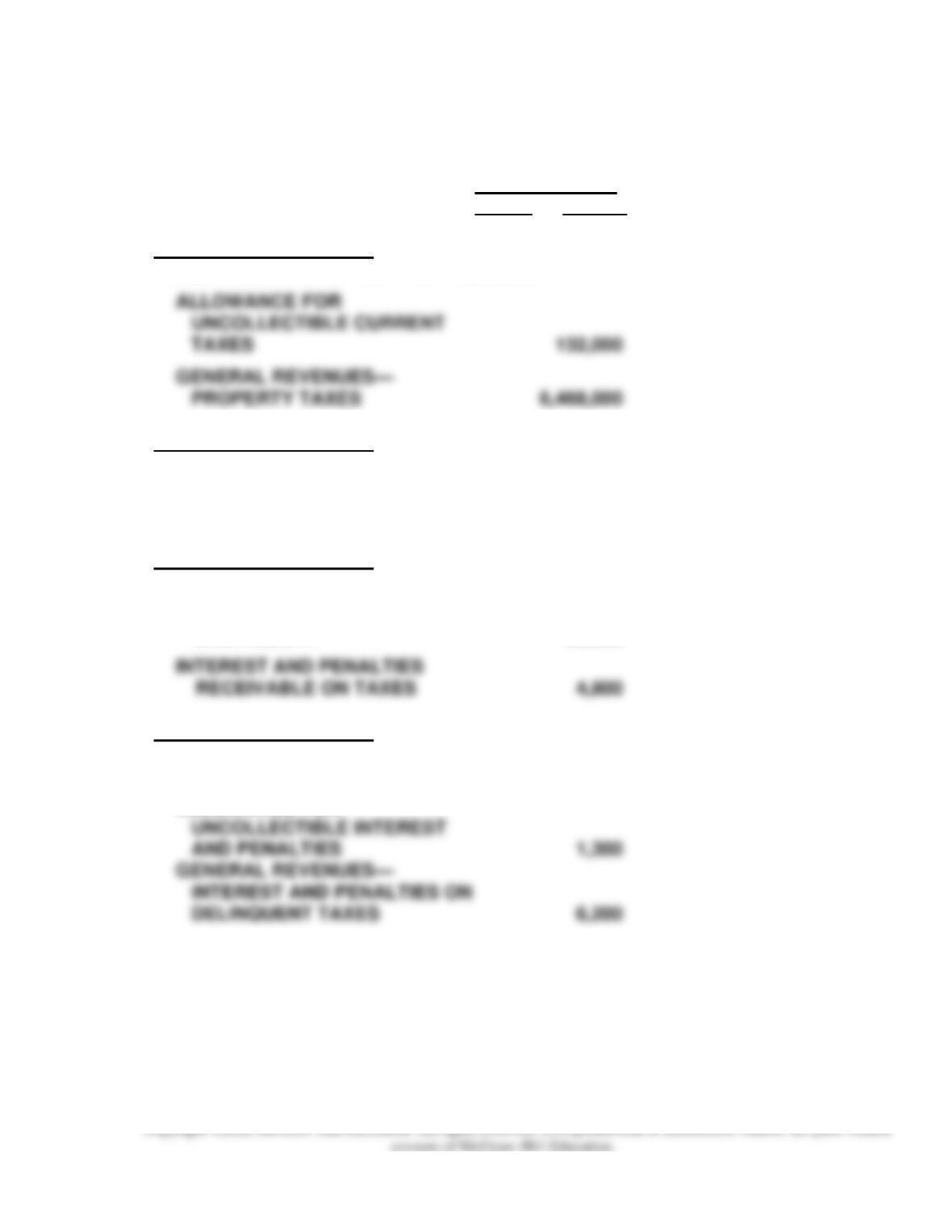
4. General Fund:
INTEREST AND PENALTIES
RECEIVABLE ON TAXES 7,500
RESOURCES—
UNAVAILABLE REVENUES 6,200
5. General Fund:
TAXES RECEIVABLE—
DELINQUENT 625,000
ALLOWANCE FOR
UNCOLLECTIBLE CURRENT
TAXES 132,000
TAXES RECEIVABLE—
CURRENT 625,000
REVENUES 493,000
DEFERRED INFLOWS OF
RESOURCES—
Chapter 04 – Accounting for Governmental Operating Activities—Illustrative Transactions and Financial Statements
4-15
Ch. 4, Solutions, Exercise 4-20 (Cont’d)
b. CITY OF PLATTSBURGH
General Ledger
Debits Credits
Governmental Activities:
1. TAXES RECEIVABLE—CURRENT 6,600,000
2. Governmental Activities:
CASH 5,975,000
TAXES RECEIVABLE—
CURRENT 5,975,000
3. Governmental Activities:
CASH 57,800
TAXES RECEIVABLE—
DELINQUENT 53,000
4. Governmental Activities:
INTEREST AND PENALTIES
RECEIVABLE ON TAXES 7,500
Chapter 04 – Accounting for Governmental Operating Activities—Illustrative Transactions and Financial Statements
4-16
Ch. 4, Solutions, Exercise 4-20 b. (Cont’d)
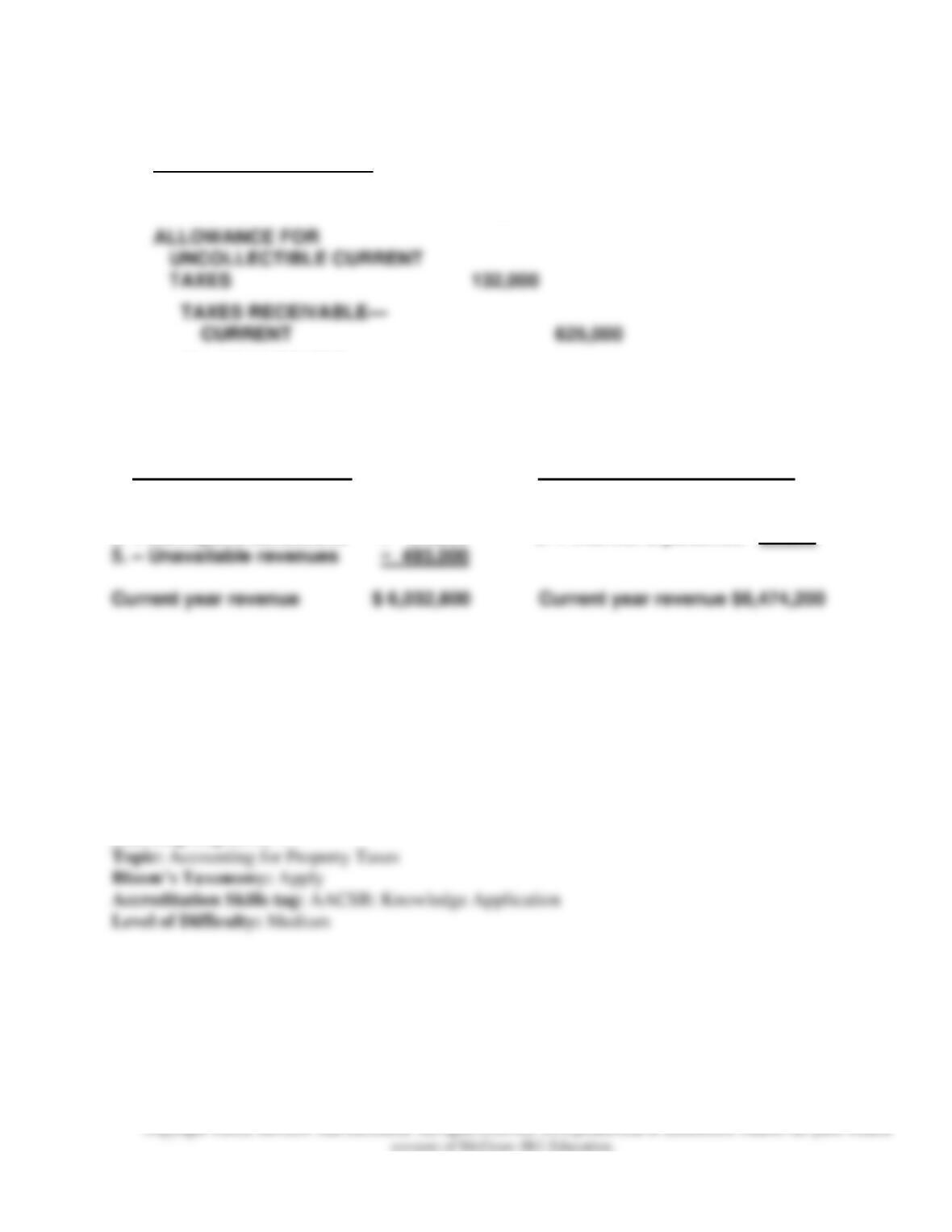
5. Governmental Activities:
TAXES RECEIVABLE—
DELINQUENT 625,000
ALLOWANCE FOR
UNCOLLECTIBLE
DELINQUENT TAXES 132,000
c. General Fund Revenues: Government-wide Revenues:
1. Tax levy $ 6,468,000 1. Tax levy $ 6,468,000
The difference between General Fund revenues and revenues recorded at the
government-wide level is that only amounts that are measurable and available
can be recognized on the modified accrual basis of accounting. The difference of
$441,400 will be a reconciling item within the financial statements.
General Problem Information: Differences in accounting for property taxes
Learning Objective: 4-1
Chapter 04 – Accounting for Governmental Operating Activities—Illustrative Transactions and Financial Statements
4-17
Ch. 4, Solutions (Cont’d)
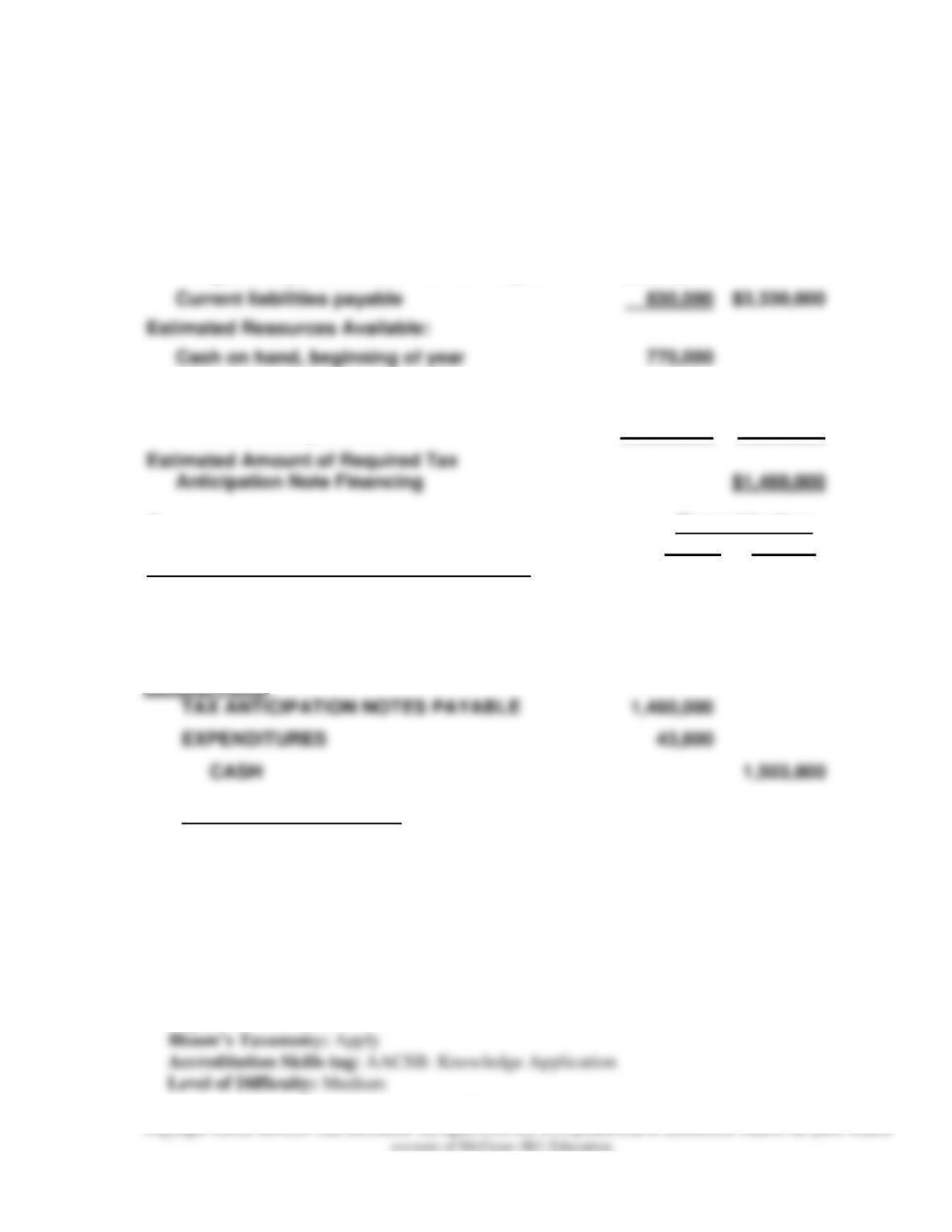
4-21. a. City of Troy
Calculation of Estimated Required
Tax Anticipation Financing
Estimated Expenditure Requirements:
Budgeted expenditures, remainder of year $2,500,000
Collections of budgeted revenues
and delinquent property taxes, including
interest and penalties 1,100,000 1,870,000
b. General Ledger
Debits Credits
General Fund and Governmental Activities:
CASH 1,460,000
TAX ANTICIPATION NOTES PAYABLE 1,460,000
c.
Governmental Activities:
TAX ANTICIPATION NOTES PAYABLE 1,460,000
EXPENSES—GENERAL GOVERNMENT 43,800
CASH 1,503,800
(Note: Interest on notes is $1,460,000 × .06 × 6/12 = $43,800)
General Problem Information: Tax anticipation financing and issuance of TANs
Learning Objective: 4-1
Topic: Tax Anticipation Notes
4-18
4-22. a. CITY OF GREEN FALLS
GENERAL LEDGER
Debits Credits
General Fund:
APPROPRIATIONS 9,134,750
ESTIMATED OTHER FINANCING USES 50,000
BUDGETARY FUND BALANCE 60,200
ESTIMATED REVENUES 9,244,950
REVENUES 9,248,375
b.
ENCUMBRANCES OUTSTANDING:
GENERAL GOVERNMENT $ 830
PUBLIC SAFETY 5,300
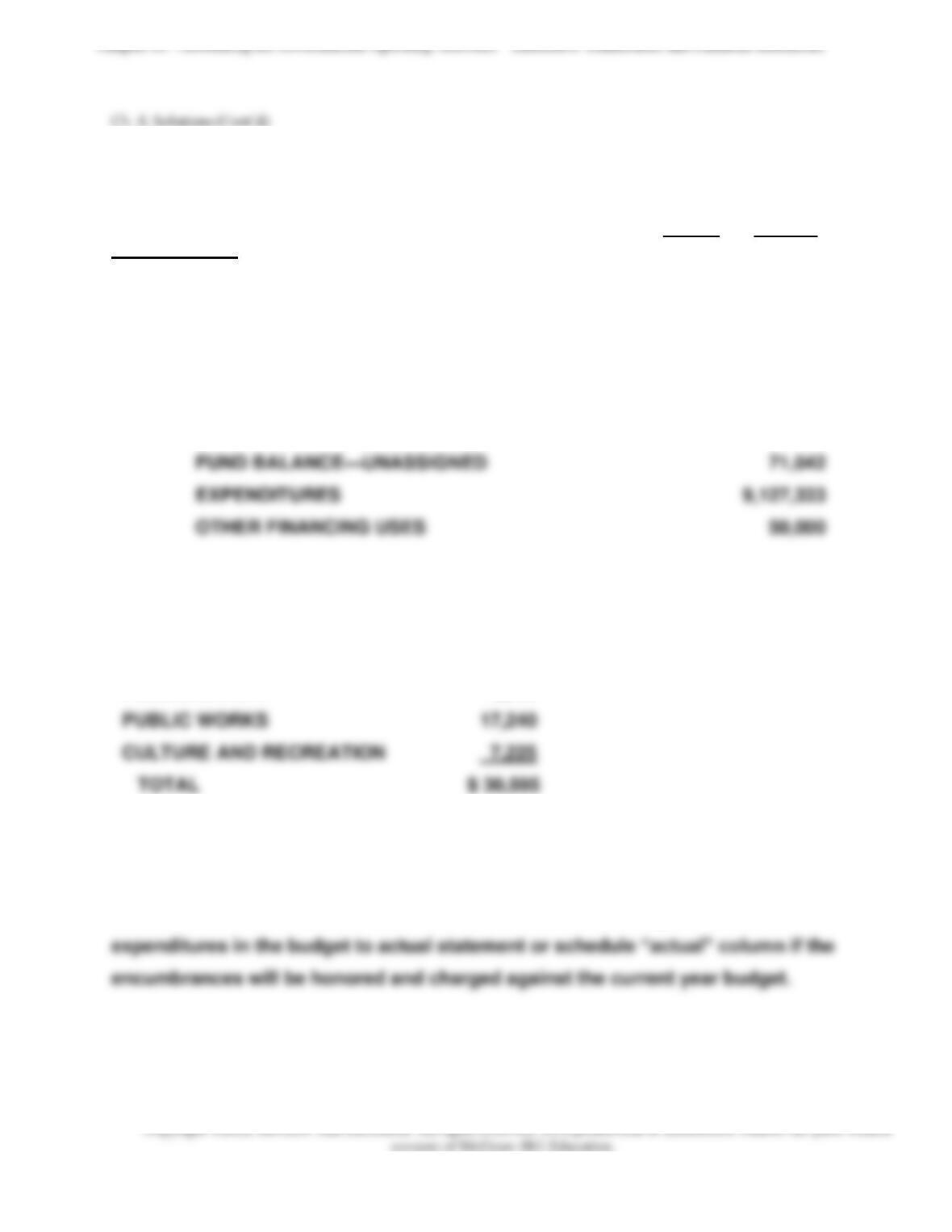
Encumbrances outstanding are not reported on the General Fund balance sheet,
unless amounts are restricted, committed, or assigned. In that case a portion of
fund balance will be so classified. Encumbrances outstanding are added to
Chapter 04 – Accounting for Governmental Operating Activities—Illustrative Transactions and Financial Statements
4-19
c.
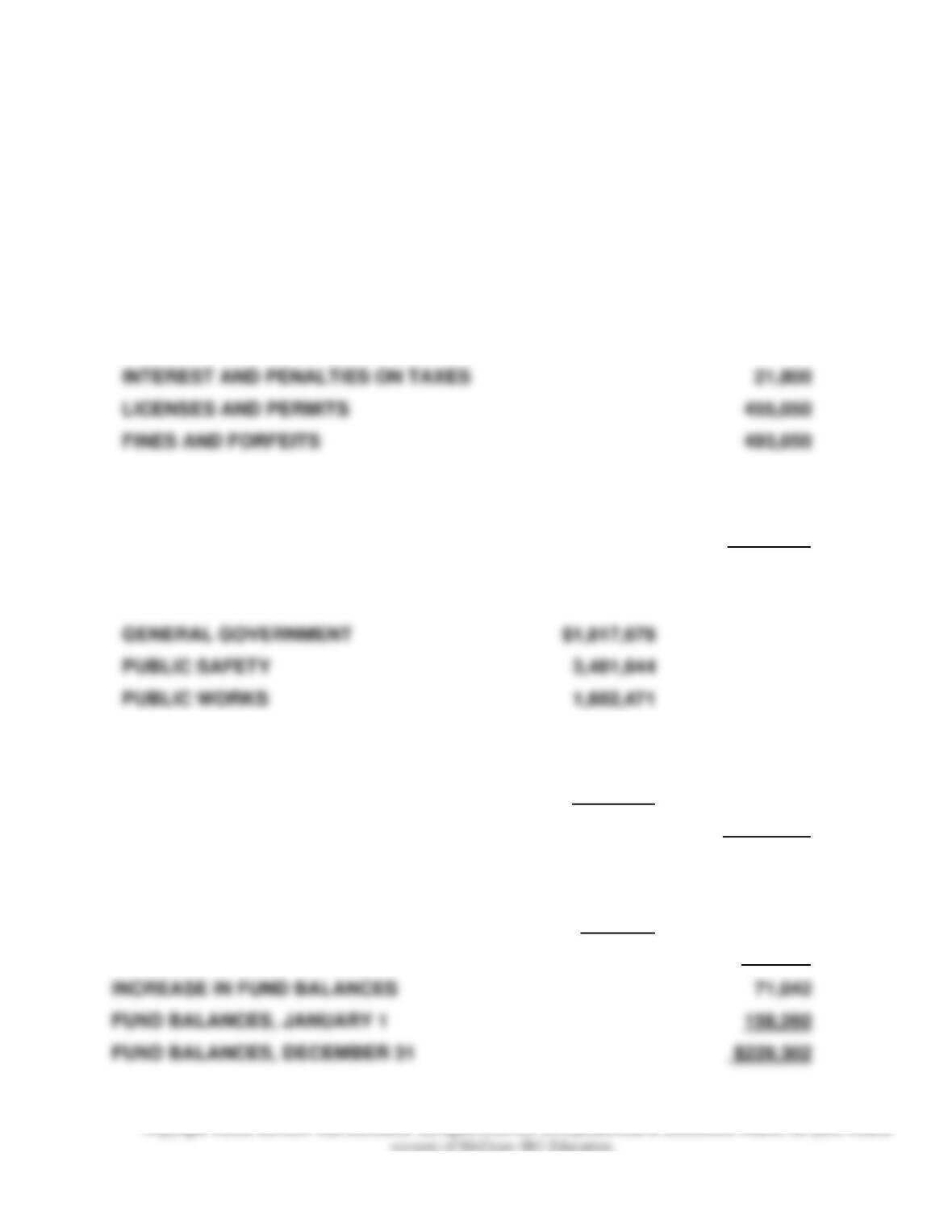
CITY OF GREEN FALLS
GENERAL FUND
STATEMENT OF REVENUES, EXPENDITURES, AND CHANGES IN FUND
BALANCES
FOR THE YEAR ENDED
REVENUES:
TAXES—PROPERTY $6,492,000
TAXES—SALES 710,600
INTERGOVERNMENTAL REVENUE 517,750
CHARGES FOR SERVICES 342,950
MISCELLANEOUS REVENUES 215,175
TOTAL REVENUES 9,248,375
EXPENDITURES:
HEALTH AND WELFARE 1,011,678
CULTURE AND RECREATION 1,025,864
MISCELLANEOUS 108,000
TOTAL EXPENDITURES 9,127,333
EXCESS OF REVENUES OVER EXPENDITURES 121,042
OTHER FINANCING SOURCES (USES):
INTERFUND TRANSFERS OUT (50,000)
TOTAL OTHER FINANCING SOURCES (USES) (50,000)
Chapter 04 – Accounting for Governmental Operating Activities—Illustrative Transactions and Financial Statements
Ch. 4, Solutions 4-22 (Cont’d)
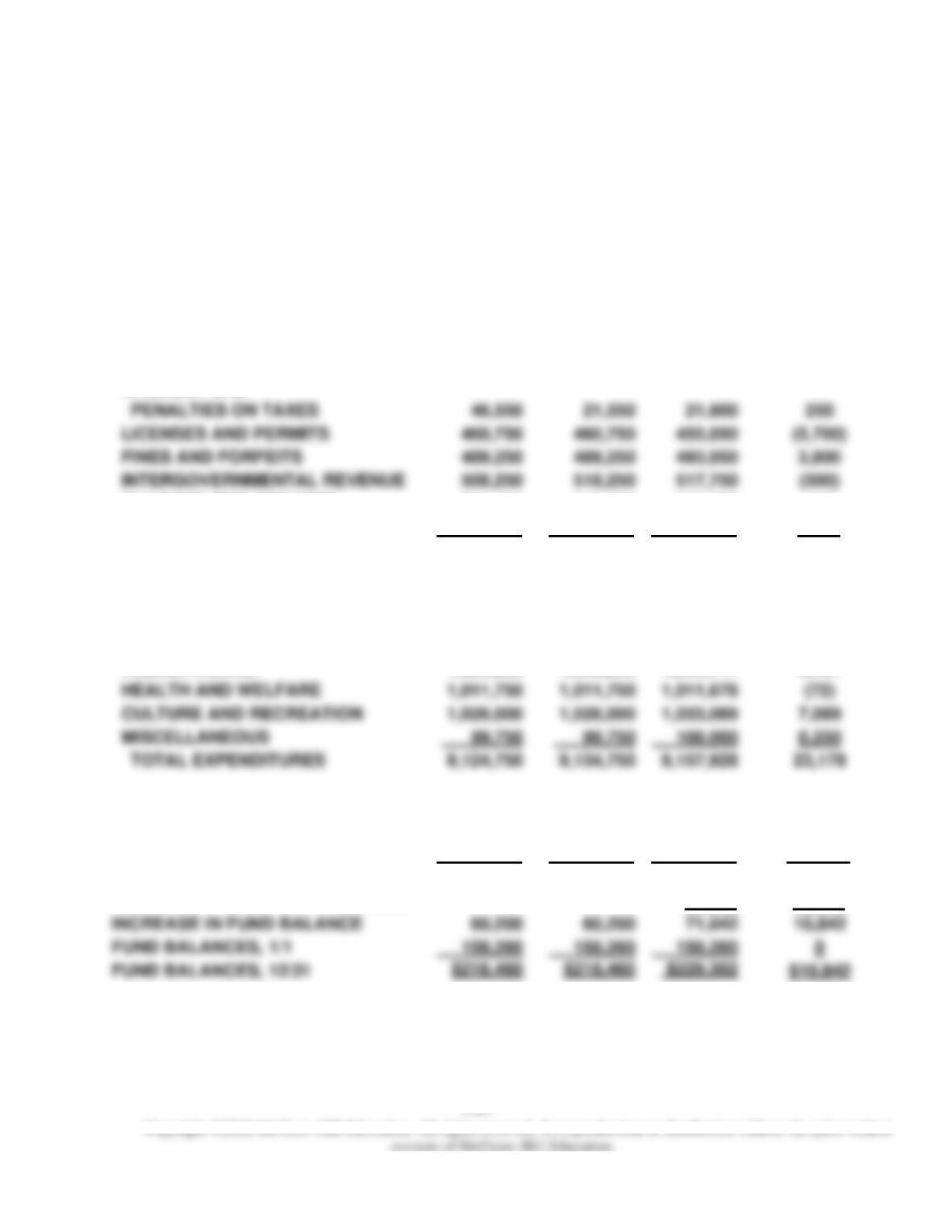
d. CITY OF GREEN FALLS
GENERAL FUND
STATEMENT OF REVENUES, EXPENDITURES, AND CHANGES IN FUND BALANCES—
BUDGET AND ACTUAL
FOR THE YEAR ENDED
ORIGINAL
FINAL
VARIANCE
BUDGET
BUDGET
ACTUAL
OVER(UNDER)
REVENUES:
TAXES —PROPERTY
$6,452,400
$6,492,400
$6,492,000
($400)
TAXES—SALES
736,250
711,250
710,600
(650)
INTEREST AND
PENALTIES ON TAXES
21,550
21,800
250
LICENSES AND PERMITS
460,750
460,750
455,050
FINES AND FORFEITS
489,250
489,250
493,050
3,800
INTERGOVERNMENTAL REVENUE
508,250
518,250
517,750
(500)
CHARGES FOR SERVICES
332,500
342,500
342,950
450
MISCELLANEOUS REVENUES
209,000
209,000
215,175
6,175
TOTAL REVENUES
9,234,950
9,244,950
9,248,375
3,425
EXPENDITURES
GENERAL GOVERNMENT
1,809,750
1,819,750
1,818,506
(1,244)
PUBLIC SAFETY
3,491,250
3,481,250
3,486,944
5,694
PUBLIC WORKS
1,686,250
1,696,250
1,699,711
HEALTH AND WELFARE
1,011,750
1,011,750
1,011,678
CULTURE AND RECREATION
1,026,000
1,026,000
1,033,089
MISCELLANEOUS
99,750
108,000
TOTAL EXPENDITURES
9,124,750
9,134,750
9,157,928
EXCESS OF REVENUES
OVER EXPENDITURES
AND ENCUMBRANCES
110,200
110,200
90,447
(19,753)
OTHER FINANCING USES
(50,000)
(50,000)
(50,000)
0
INCREASE IN ENCUMBRANCES O/S
30,595
30,595
INCREASE IN FUND BALANCE
71,042
FUND BALANCES, 1/1
158,260
158,260
158,260
0
FUND BALANCES, 12/31
$10,842