1. Job-order costing accumulates costs by jobs, and process costing accumulates costs by
processes. Job-order costing is suitable for operations that produce custom-made products that
receive different doses of manufacturing costs. Process costing, on the other hand, is suitable
for operations that produce homogeneous products that receive equal amounts of manufacturing
costs in each process.
4. Actual overhead rates are rarely used because managers cannot wait until the end of the year
to obtain product costs. Information on product costs is needed as the year unfolds for planning,
control, and decision making.
5. Overhead is assigned to production using the predetermined rate. The predetermined overhead
rate is equal to estimated overhead divided by estimated activity level. The predetermined
overhead rate is multiplied by the actual activity level or the cost driver on which the rate is based.
6. Underapplied overhead means that the applied overhead is less than the actual overhead. As a
result, the unadjusted cost of goods is too small (because too little overhead has been applied).
So, Cost of Goods Sold will increase by the amount of underapplied overhead.
7. Overapplied overhead means that the applied overhead is more than the actual overhead. As a
result, the unadjusted cost of goods is too large (because too much overhead has been applied).
So, Cost of Goods Sold will decrease by the amount of overapplied overhead.
4JOB-ORDER COSTING AND
OVERHEAD APPLICATION
DISCUSSION QUESTIONS
CHAPTER 4 Job-Order Costing and Overhead Application
9. Multiple overhead rates often produce a more accurate assignment of overhead costs to jobs.
This can be true if the departments through which products pass have different amounts of
overhead and if the various products spend differing amounts of time in the departments. For
example, a company may have two departments, but some products only go through one
department. It would be more accurate to assign less overhead cost to the products using only
one department. This can be easily accomplished using departmental overhead rates.
11. Because the overhead rate is based on direct labor cost, the amount of overhead applied will
increase. As a result, the total cost of each job will go up.
12. The overhead variance is the difference between applied overhead and actual overhead.
Typically, that variance is relatively small, and it is closed to Cost of Goods Sold. If overhead is
underapplied, the variance is added to Cost of Goods Sold. If overhead is overapplied, the
variance is subtracted from Cost of Goods Sold.
15. A departmental overhead rate application can be easily converted to a plantwide rate. First, the
estimated overhead for all departments is totaled, and a single plantwide driver is chosen. The
plantwide overhead rate is simply the estimated plantwide overhead divided by the plantwide
driver. When overhead is applied, the predetermined plantwide rate is multiplied by the actual
amount of driver used in the factory.
16. Producing departments work directly on the products and services being made, whereas support
departments provide indirect support to the producing departments.
CHAPTER 4 Job-Order Costing and Overhead Application
18. The identification and use of causal factors ensures that support department costs are accurately
assigned to users. This increases the legitimacy of the control function and enhances
product-costing accuracy.
19. a. Number of employees
b. Square footage
c. Pounds of laundry
20. The direct method allocates the direct costs of each support department directly to the producing
departments. No consideration is given to the fact that other support departments may use support
services. The sequential method allocates support department costs sequentially. First, the costs
of the center providing the greatest service to all user departments, including other support
CHAPTER 4 Job-Order Costing and Overhead Application
4-1. d
4-2. c
4-6. a
4-7. a
4-8. e
4-9. a
Direct materials……………………………………… $17,500
Direct labor…………………………………………… 10,000
Applied overhead ($5 × 500 DLH)………………… 2,500
Total job cost……………………………………
…
$30,000
…
MULTIPLE-CHOICE QUESTIONS

CHAPTER 4 Job-Order Costing and Overhead Application
4-14. c
4-17. d
4-18. e
4-19. d
CHAPTER 4 Job-Order Costing and Overhead Application
BE 4-22
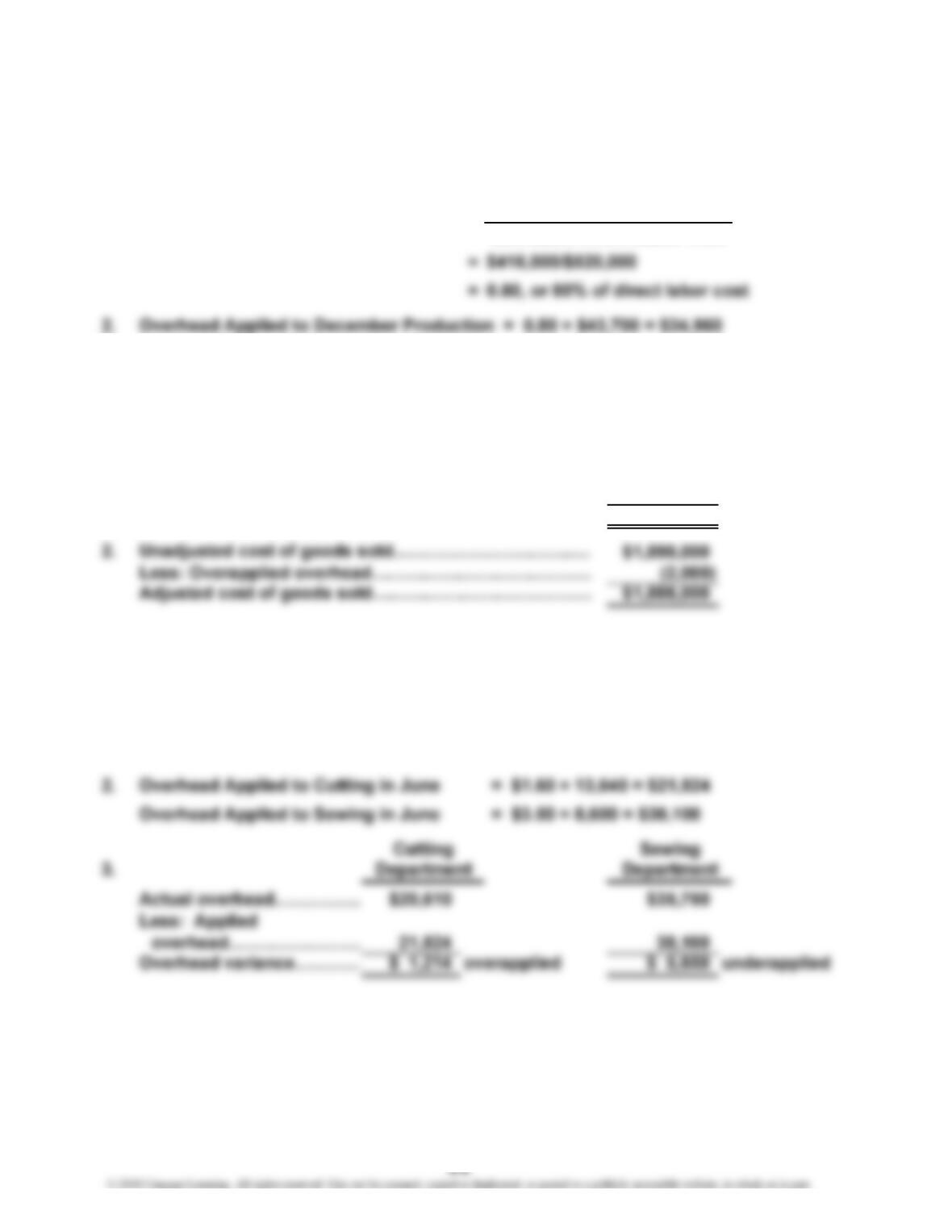
1. Predetermined Overhead Rate =
BE 4-23
1. Applied Overhead = Overhead Rate × Actual Direct Labor Cost
= 0.80 × $532,000 = $425,600
Actual overhead………………………………………………
…
$423,600
Applied overhead……………………………………………
…
425,600
Overhead variance…………………………………………… $ 2,000 overapplied
…
BE 4-24
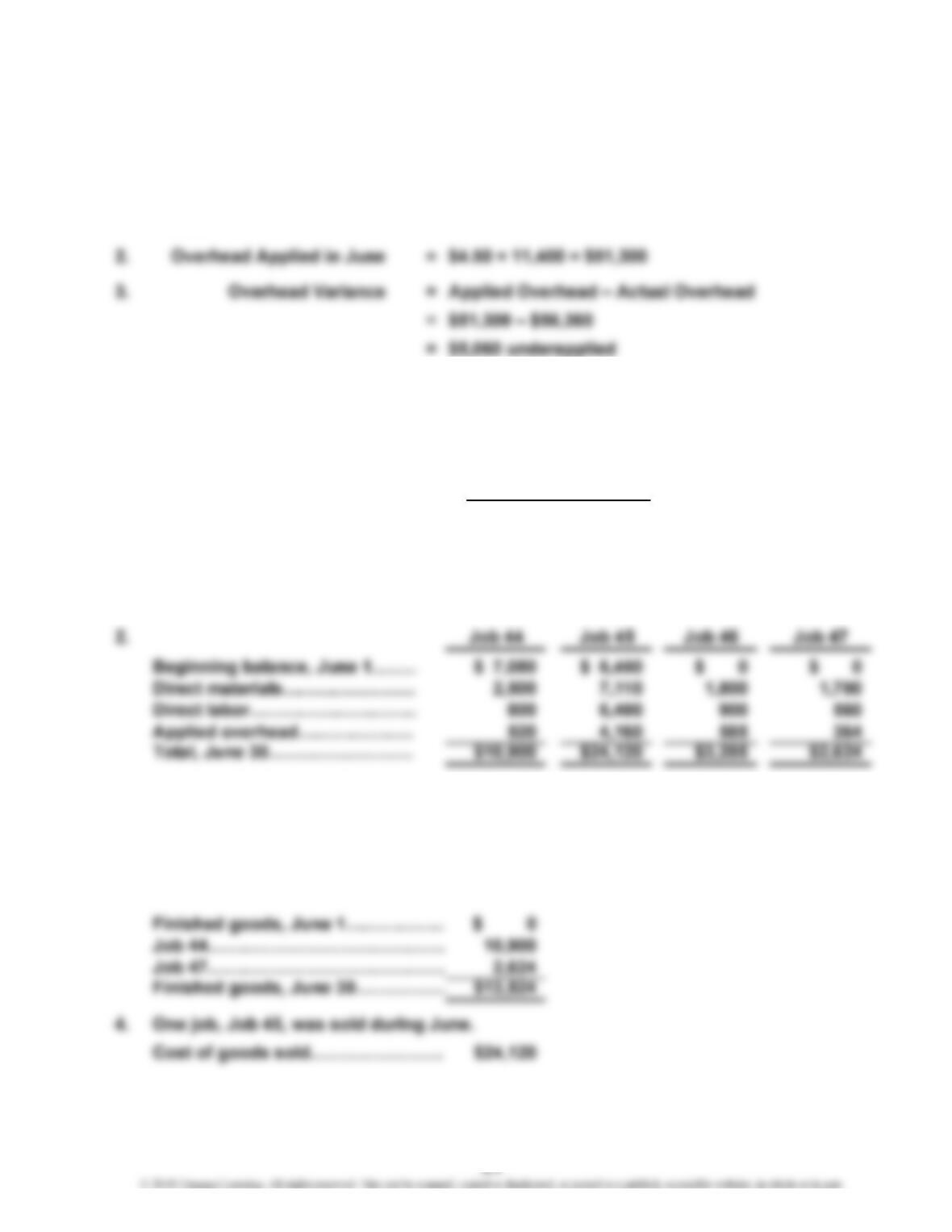
1. Cutting Department Overhead Rate = $240,000/150,000 mhrs
= $1.60 per machine hour
Sewing Department Overhead Rate = $350,000/100,000 DLH
= $3.50 per direct labor hour
BRIEF EXERCISES: SET A
Estimated Direct Labor Cost
Estimated Overhead
CHAPTER 4 Job-Order Costing and Overhead Application
BE 4-25
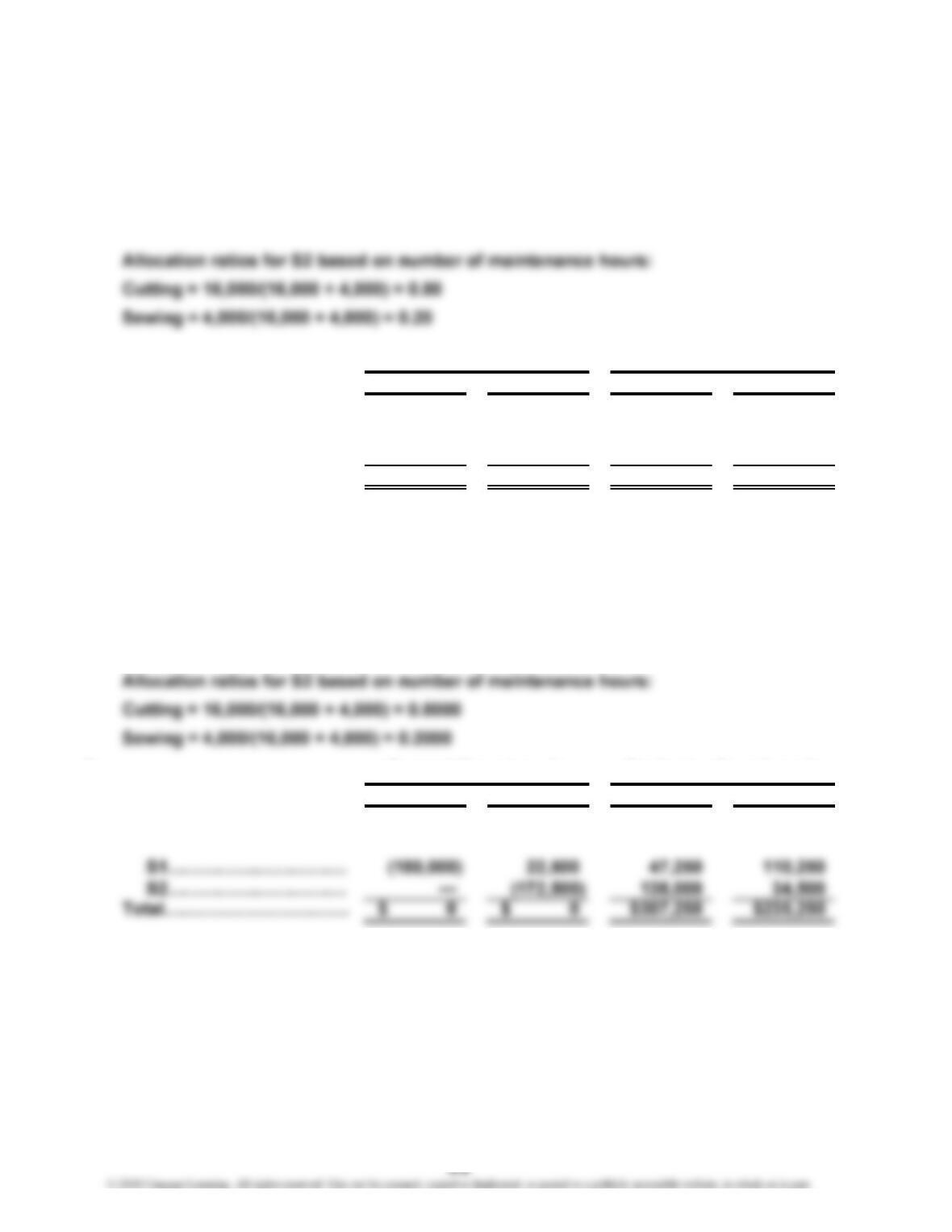
1. Predetermined Plantwide Overhead Rate = $590,000/131,200 DLH
= $4.50 per direct labor hour*
* Rounded
BE 4-26
1. Since the predetermined overhead rate is not given, it must be calculated from
BWIP amounts using either Job 44 or Job 45. Using Job 44,
=
= $780/$1,200
= 0.650, or 65.0%
(The predetermined overhead rate using Job 45 is identical.)
3. By the end of June, Jobs 44, 45, and 47 have been transferred out of Work in
Process. Thus, the ending balance in Work in Process consists of Job 46.
Work in process, June 30…………
…
$3,285
While three jobs (44, 45, and 47) were transferred out of Work in Process and into
Finished Goods during June, only two jobs remain (Jobs 44 and 47).
…
Predetermined Overhead Rate Applied Overhead
Direct Labor Cost
CHAPTER 4 Job-Order Costing and Overhead Application
BE 4-27
1. Allocation ratios for S1 based on number of employees:
Cutting = 63/(63 + 147) = 0.30
Sewing = 147/(63 + 147) = 0.70
2.
Allocate: S1 S2 Cutting Sewing
Direct costs…………………
…
$ 180,000 $ 150,000 $122,000 $ 90,500
S1…………………………
…
(180,000)
—
54,000 126,000
S2…………………………
…
—
(150,000) 120,000 30,000
Total…………………………
…
$ 0 $ 0 $296,000 $246,500
BE 4-28
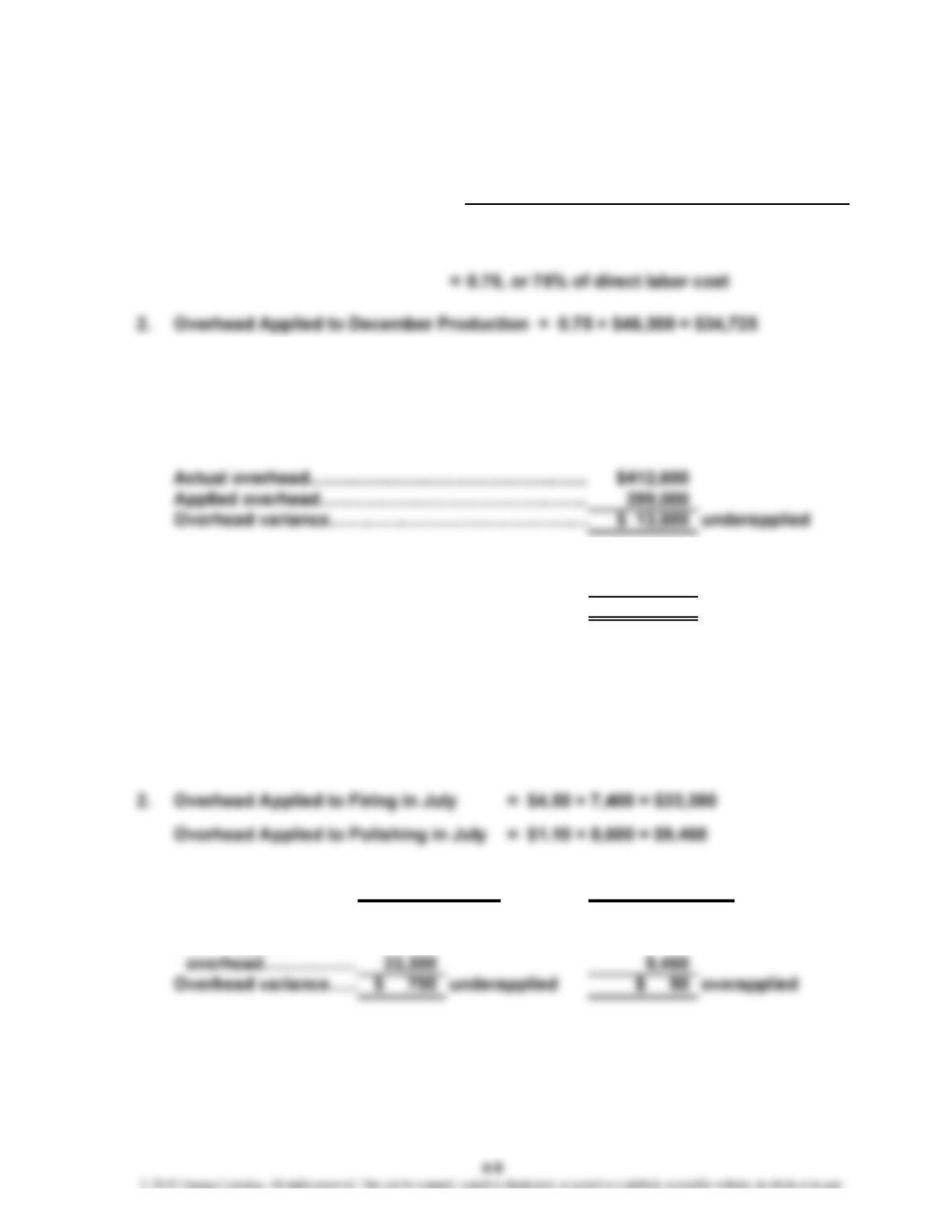
1. Allocation ratios for S1 based on number of employees:
S2 = 30/(30 + 63 + 147) = 0.1250
Cutting = 63/(30 + 63 + 147) = 0.2625
Sewing = 147/(30 + 63 + 147) = 0.6125
2. Support Departments Producing Departments
Allocate: S1 S2 Cutting Sewing
Direct costs…………………
…
$ 180,000 $ 150,000 $122,000 $ 90,500
…
…
—
…
Support Departments Producing Departments
CHAPTER 4 Job-Order Costing and Overhead Application
BE 4-29
1. Predetermined Overhead Rate =
= $450,000/$600,000
BE 4-30
1. Applied Overhead = Overhead Rate × Actual Direct Labor Cost
= 0.75 × $532,000 = $399,000
2. Unadjusted cost of goods sold………………………
…
$1,670,000
Add: Underapplied overhead…………………………
…
13,600
Adjusted cost of goods sold…………………………
…
$1,683,600
BE 4-31
1. Firing Department Overhead Rate = $405,000/90,000 kiln hours
= $4.50 per kiln hou
r
Polishing Department Overhead Rate = $110,000/100,000 DLH
= $1.10 per direct labor hou
r
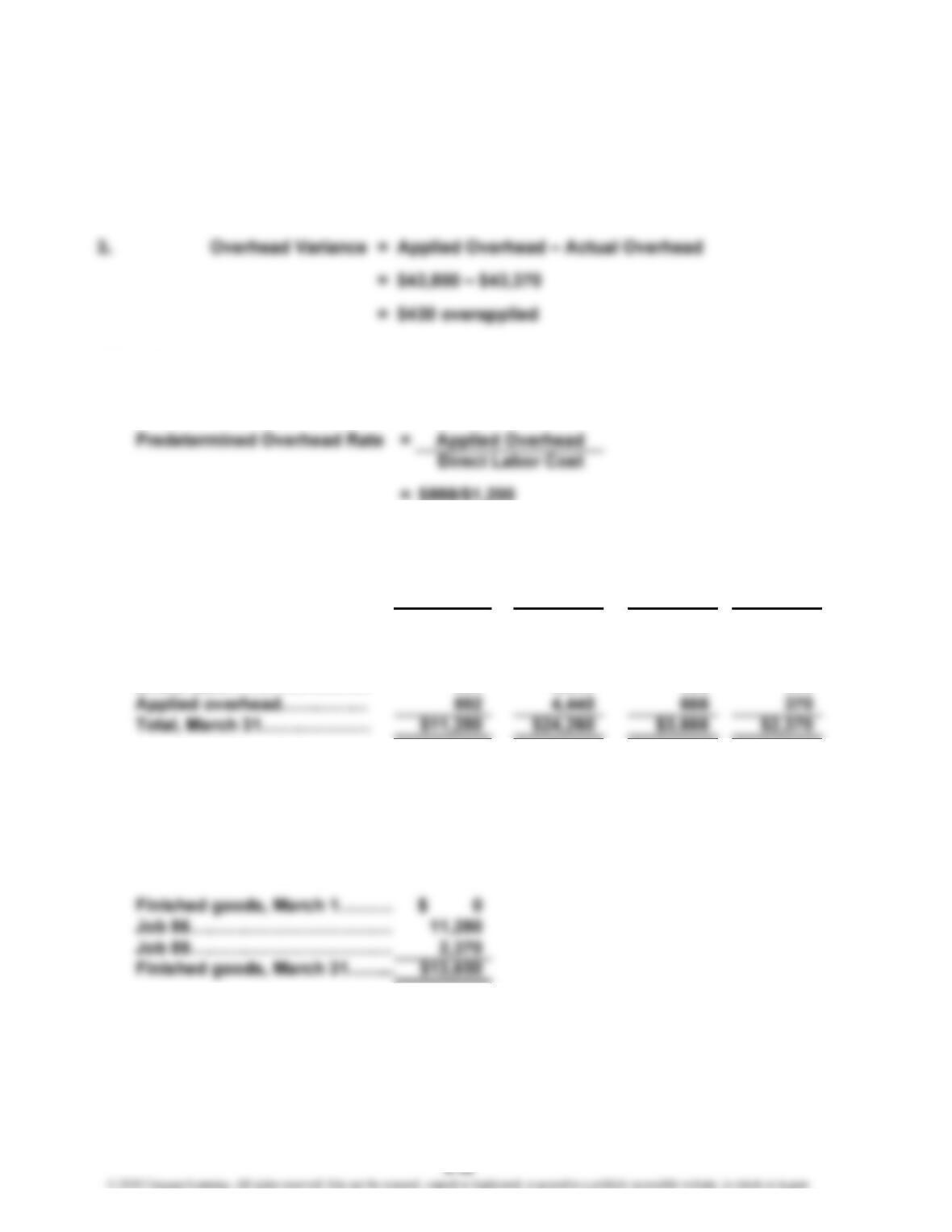
3.
Actual overhead……
…
$34,000 $9,370
Less: Applied
…
Department Department
BRIEF EXERCISES: SET B
Estimated Overhead
Estimated Direct Labor Cost
Firing Polishing
CHAPTER 4 Job-Order Costing and Overhead Application
BE 4-32
1. Predetermined Plantwide Overhead Rate = $515,000/128,750 DLH
= $4.00 per direct labor hou
r
2. = $4.00 × 10,950 = $43,800
BE 4-33
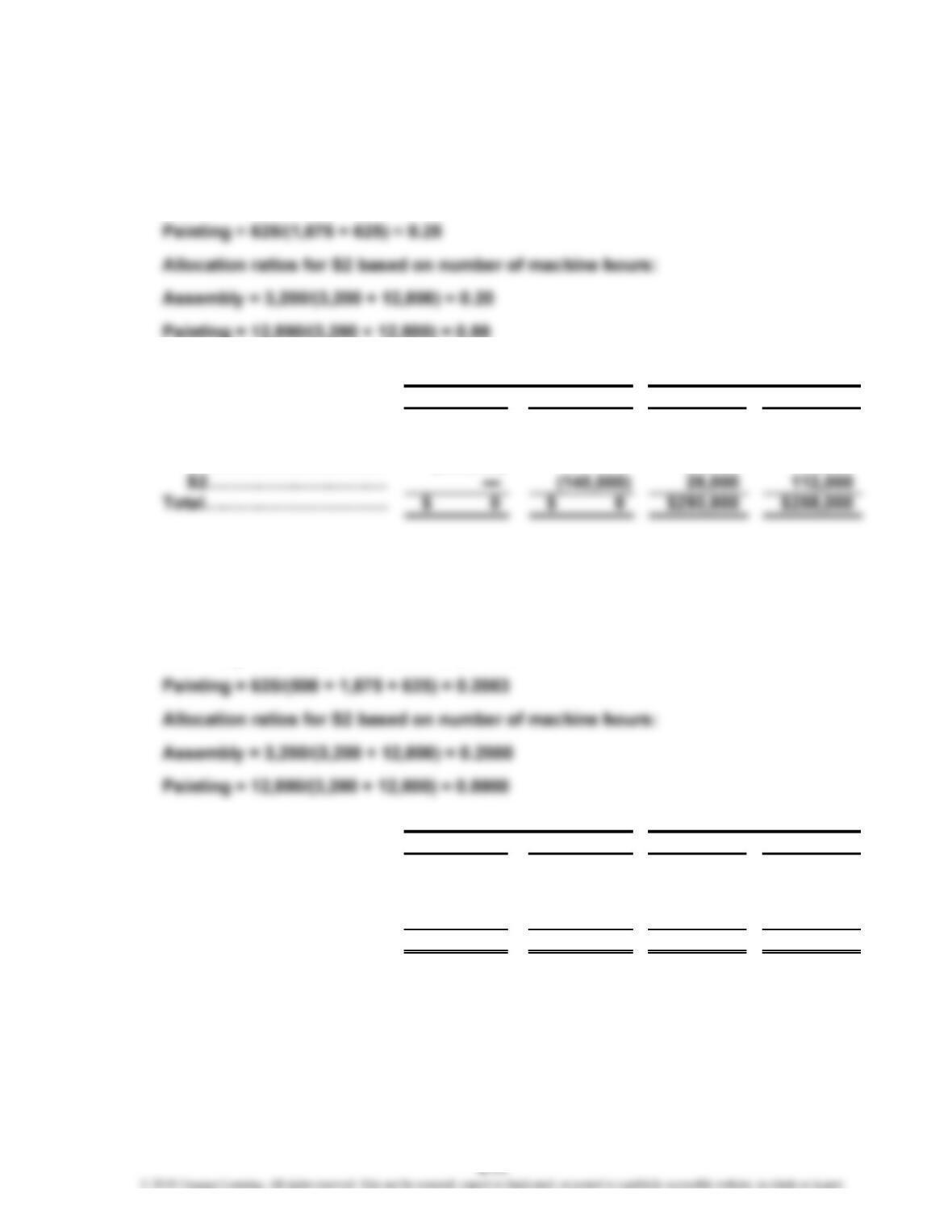
1. Since the predetermined overhead rate is not given, it must be calculated from
BWIP amounts using either Job 86 or Job 87. Using Job 86,
= 0.740, or 74.0%
(The predetermined overhead rate using Job 87 is identical.)
2. Job 87 Job 88 Job 89
Beginning balance, March 1
…
$ 6,820 $ 0 $ 0
Direct materials……………… 7,000 2,100 1,500
Direct labor…………………… 6,000 900 500
3. By the end of March, Jobs 86, 87, and 89 have been transferred out of Work in
Process. Thus, the ending balance in Work in Process consists of Job 88.
Work in process, March 31……
…
$3,666
While three jobs (86, 87, and 89) were transferred out of Work in Process and into
Finished Goods during March, only two jobs remain (Jobs 86 and 89).
4. One job, Job 87, was sold during March.
Cost of goods sold……………
…
$24,260
Overhead Applied in July
Job 86
$ 6,888
3,000
800
CHAPTER 4 Job-Order Costing and Overhead Application
BE 4-34
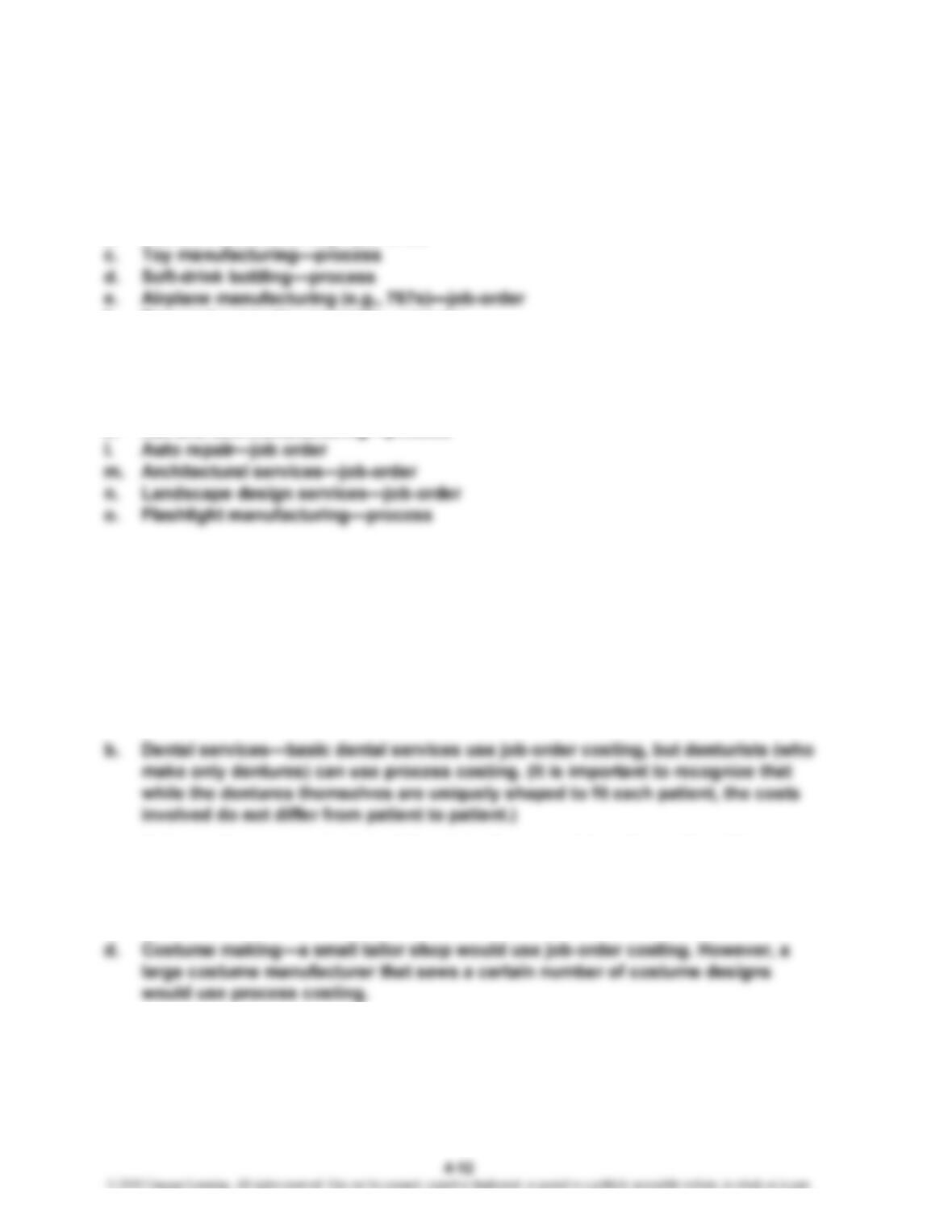
1. Allocation ratios for S1 based on square footage:
Assembly = 1,875/(1,875 + 625) = 0.75
2.
Allocate: S1 S2
A
ssembly Painting
Direct costs…………………
…
$ 200,000 $ 140,000 $115,000 $ 96,000
S1…………………………
…
(200,000)
—
150,000 50,000
…
—
…
BE 4-35
1. Allocation ratios for S1 based on square footage:
S2 = 500/(500 + 1,875 + 625) = 0.1667
Assembly = 1,875/(500 + 1,875 + 625) = 0.6250
2. Support Departments Producing Departments
Allocate: S1 S2
A
ssembly Painting
Direct costs…………………
…
$ 200,000 $ 140,000 $115,000 $ 96,000
S1…………………………
…
(200,000) 33,340 125,000 41,660
S2…………………………
…
—
(173,340) 34,668 138,672
Total…………………………
…
$ 0 $ 0 $274,668 $276,332
Support Departments Producing Departments
CHAPTER 4 Job-Order Costing and Overhead Application
E 4-36
a. Hospital services—job-orde
r
b. Custom cabinet making—job-order
f. Personal computer assembly—process
g. Furniture making—process
h. Custom furniture making—job-order
i. Dental services—job-orde
r
j. Paper manufacturing—process
E 4-37
The following are examples; answers may vary.
a. Auto manufacturing—a shop that builds autos from scratch (the way Rolls Royce
used to build cars, or a car that can be built from kits) would use job-order costing.
Large automobile manufacturers use process costing. (While the customer may
think the car is being built to order when selecting among options, actually the
manufacturer waits until enough of the same orders are received to build a run
of virtually identical cars.)
c. Auto repair—a general automobile repair shop uses job-order costing. However,
a shop devoted to only one type of service or repair (e.g., oil change) can use
process costing yet price the cost of the number of quarts of oil used for each
customer.
EXERCISES
CHAPTER 4 Job-Order Costing and Overhead Application
E 4-38
2. Applied Overhead = $6.30 × 7,600 DLH
= $47,880
E 4-39
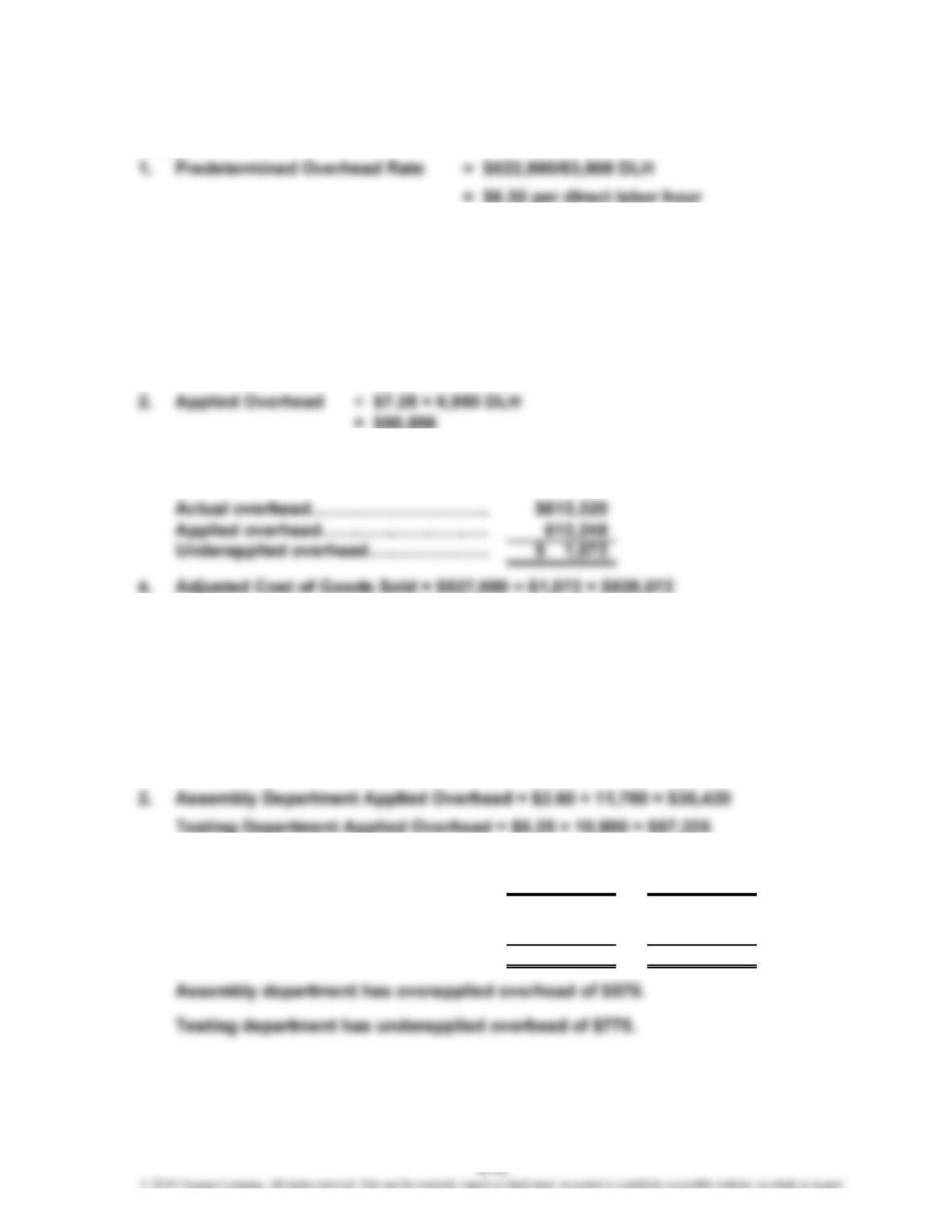
1. Predetermined Overhead Rate = $582,400/80,000 DLH
= $7.28 per direct labor hour
3. Applied Overhead = $7.28 × 84,100 DLH
= $612,248
…
…
E 4-40
1. Assembly Department Overhead Rate = $338,000/130,000 DLH
= $2.60 per direct labor hour
Testing Department Overhead Rate = $630,000/120,000 mhrs
= $5.25 per machine hou
r
3.
A
ssembly Testing
Department Department
Actual overhead…………………………
…
$29,850 $58,000
Applied overhead………………………
…
30,420 57,225
Overhead variance…………………
…
$ (570) $ 775
CHAPTER 4 Job-Order Costing and Overhead Application
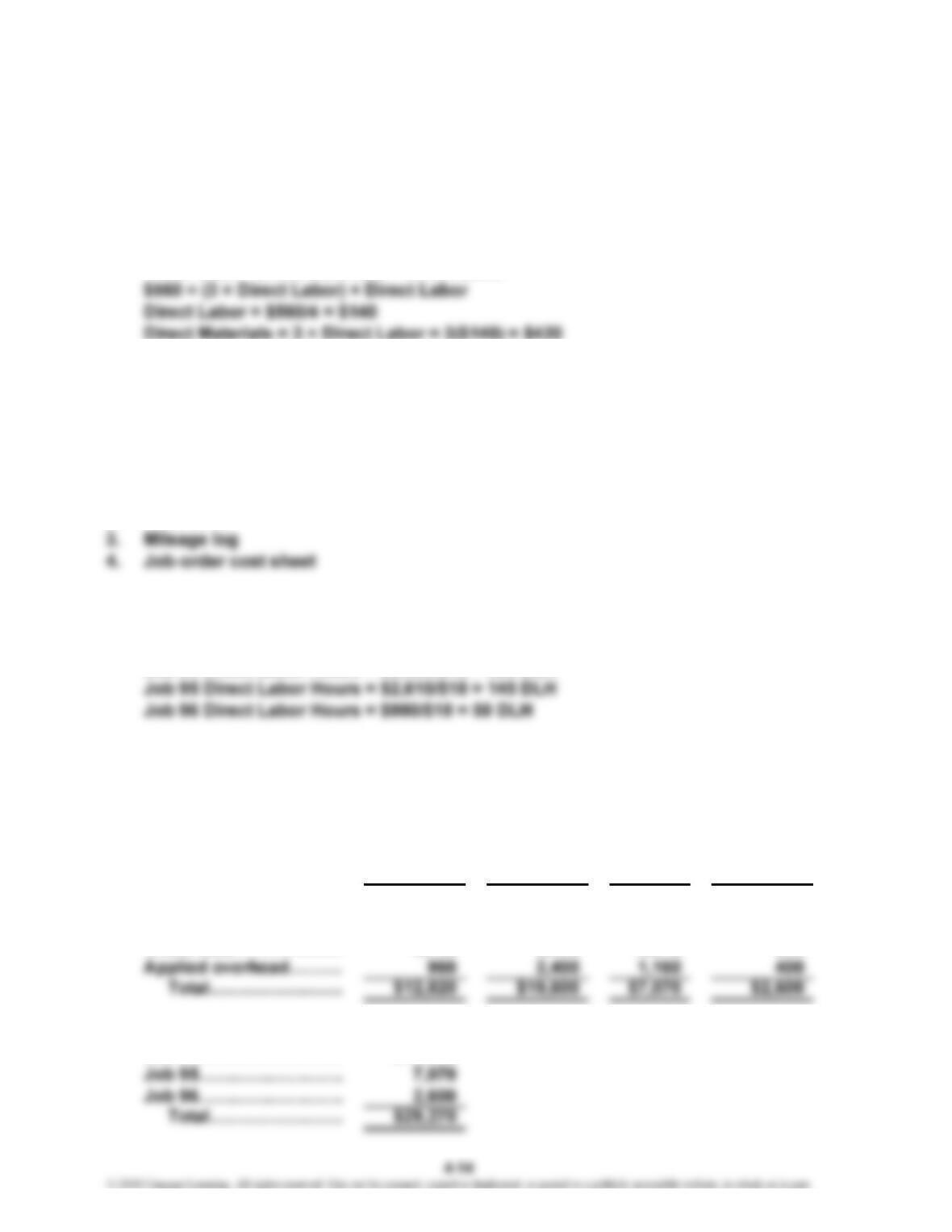
E 4-41
1. Ending Balance = Beginning Balance + Prime Costs + Applied Overhead
$1,921 = $1,235 + $560 + Applied Overhead
Applied Overhead = $1,921 – $1,235 – $560 = $126
2. Direct Materials = 3 × Direct Labo
r
Prime Cost = Direct Materials + Direct Labo
r
3. Applied Overhead = Direct Labor × Overhead Rate
$126 = $140 × Overhead Rate
Overhead Rate = $126/$140 = 0.90, or 90%
E 4-42
1. Materials requisition form
2. Time ticket
E 4-43
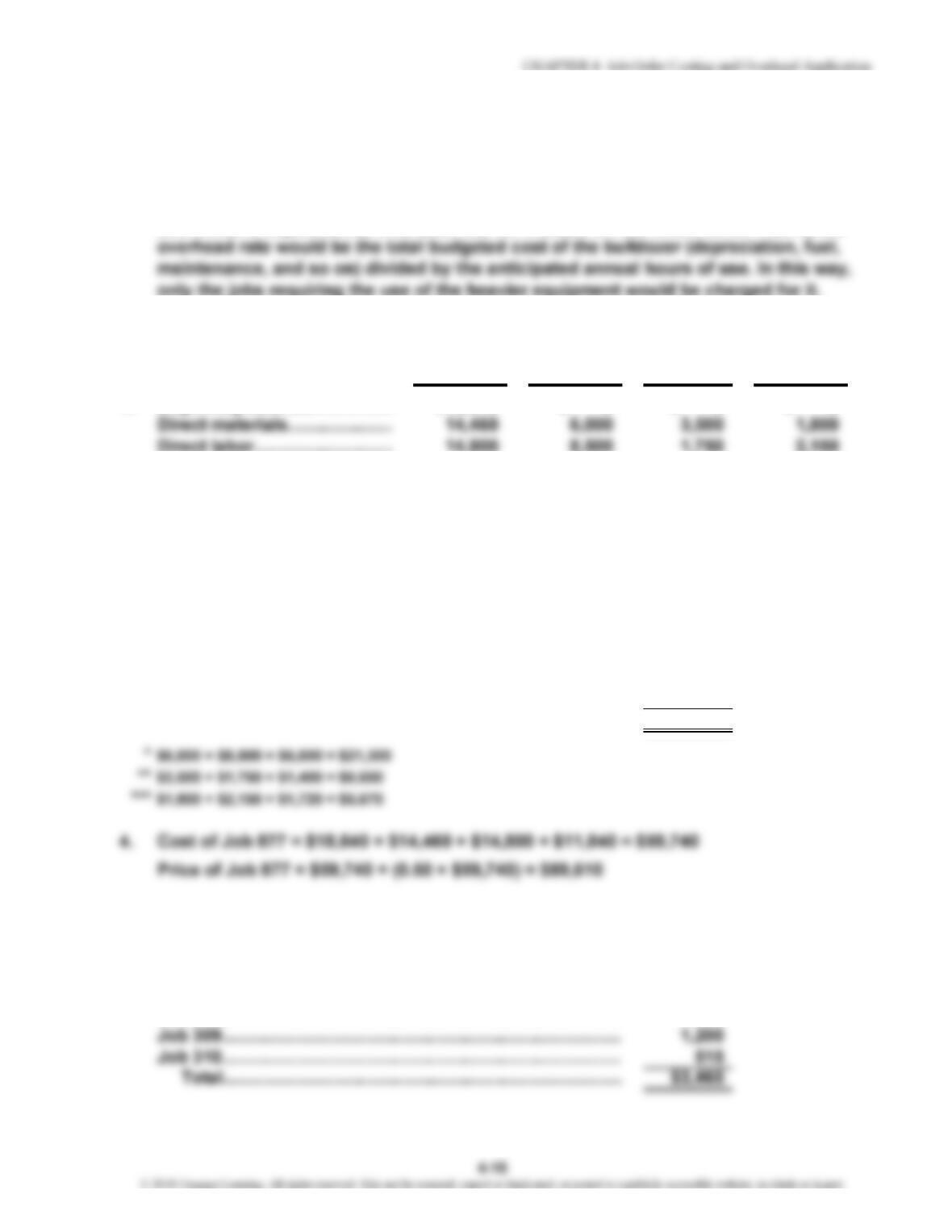
1. Job 93 Direct Labor Hours = $2,160/$18 = 120 DLH
2. August applied overhead for:
Job 93 = 120 DLH × $8 = $960
Job 94 = 300 DLH × $8 = $2,400
Job 95 = 145 DLH × $8 = $1,160
Job 96 = 50 DLH × $8 = $400
3. Job 93 Job 94 Job 95 Job 96
Beginning balance……
…
$ 8,750 $ 7,300 $ 0 $ 0
Direct materials………
…
950 4,500 3,300 1,300
Direct labor……………
…
2,160 5,400 2,610 900
4. Work in Process, August 31, consists of unfinished jobs:
Job 94……………………
…
$19,600
…
…
E 4-43 (Concluded)
5. Price of Job 93 = $12,820 + (0.40 × $12,820) = $17,948
6. Jagjit could treat the acquisition and use of the bulldozer as a separate department
and create a departmental overhead rate for it based on the hours used. That is, the
E 4-44
Job 877 Job 878 Job 879 Job 880
1. Beginning balance…………
…
$18,640 $ 0 $ 0 $ 0
2. Applied overhead in October for:
Job 877 = $14,800 × 0.80 = $11,840
Job 878 = $8,500 × 0.80 = $6,800
Job 879 = $1,750 × 0.80 = $1,400
Job 880 = $2,150 × 0.80 = $1,720
3. Work in Process, October 31:
Job 878*…………………………………………………………
…
$21,300
Job 879**…………………………………………………………
…
6,650
Job 880***………………………………………………………
…
5,670
Total…………………………………………………………… $33,620
E 4-45
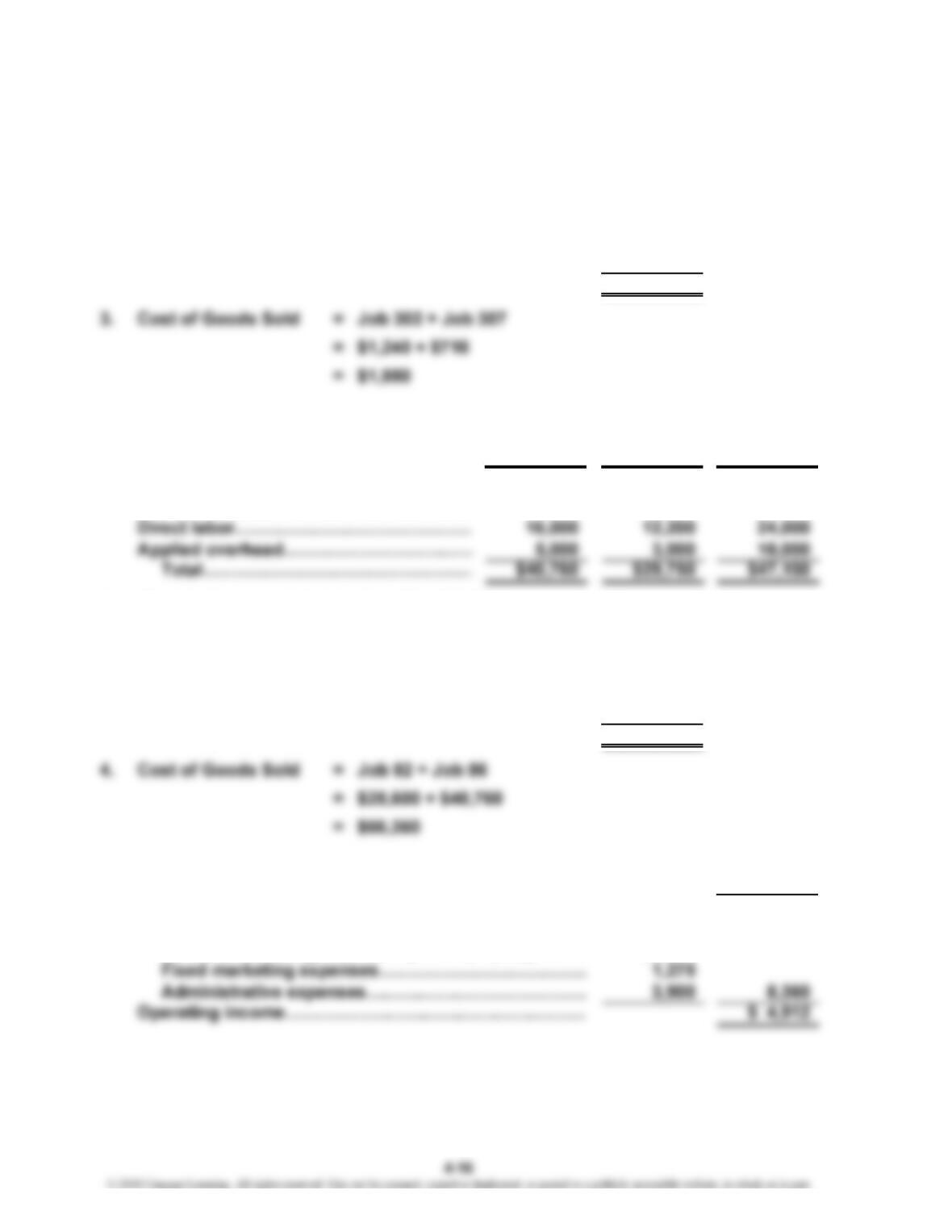
1. Balance in Work in Process (all incomplete jobs):
Job 303…………………………………………………………… $ 780
Job 306…………………………………………………………… 350
Job 308…………………………………………………………… 620
CHAPTER 4 Job-Order Costing and Overhead Application
E 4-45 (Concluded)
2. Balance in Finished Goods (all jobs completed but not sold):
Beginning balance (Job 300)………………………………
…
$ 300
Job 301…………………………………………………………
…
1,600
Job 304…………………………………………………………
…
2,300
Job 305…………………………………………………………
…
4,150
Total…………………………………………………………
…
$8,350
E 4-46
1. Job 86 Job 87 Job 88
Balance, July 1……………………………… $15,310 $ 4,250 $ 0
Direct materials……………………………
…
4,450 10,300 13,150
2. Work in Process, July 31 = Job 87 = $29,750
3. Finished Goods:
Beginning balance…………………………………………… $ 49,000
Job 88 (transferred in)………………………………………
…
47,150
Job 82 (sold)…………………………………………………
…
(25,600)
Ending balance, July 31…………………………………
…
$ 70,550
5. Sales [$66,360 + (0.20 × $66,360)]…………………………
…
$79,632
Cost of goods sold………………………………………….
…
66,360
Gross margin……………………………………………… $13,272
Less:
V
ariable marketing expenses (0.04 × $79,632)……… $3,185
E 4-47
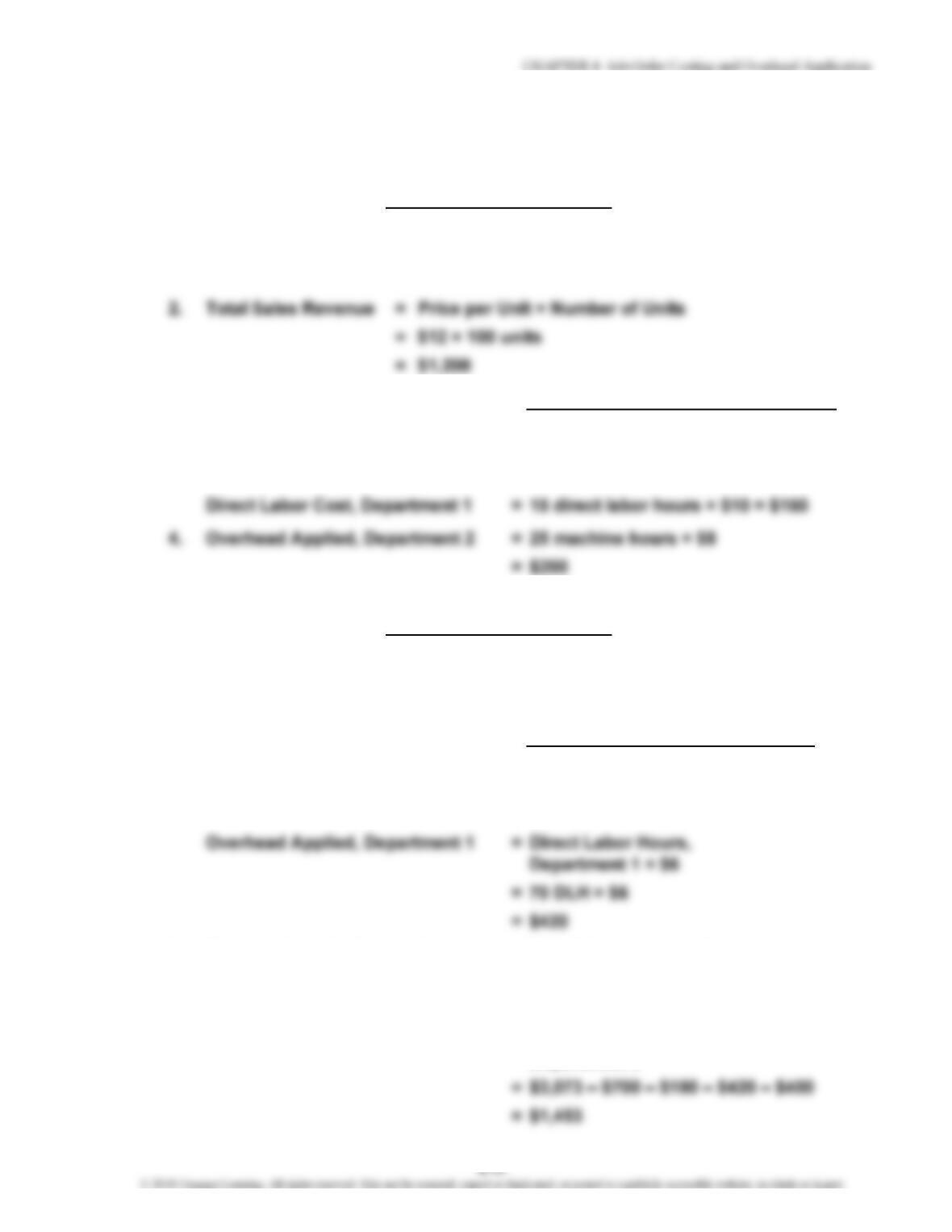
Job 213:
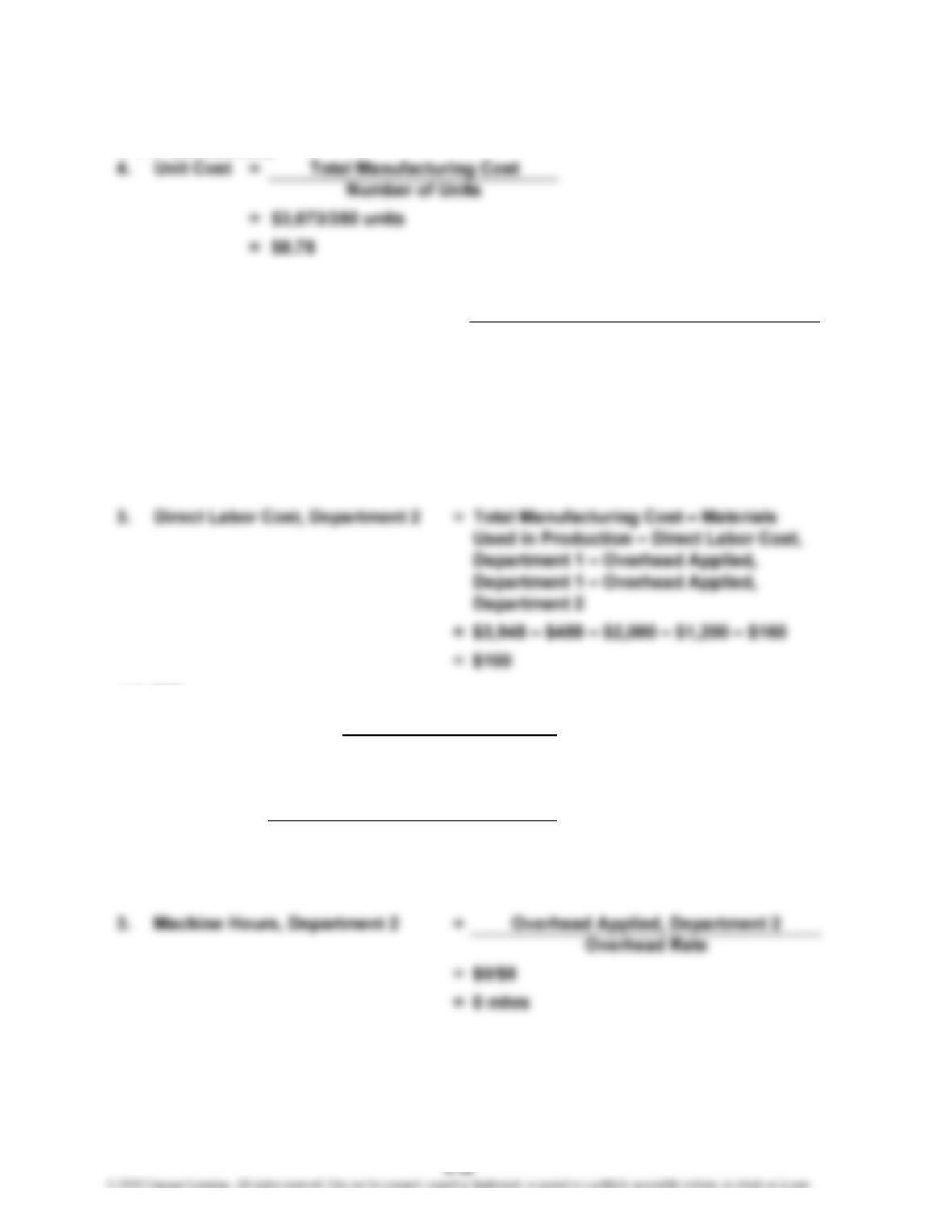
1. Number of Units =
= $855/$8.55
=
3. Direct Labor Hours, Department 1 =
= $90/$6
= 15 DLH
Job 214:
1. Price per Unit =
= $4,375/350 units
=
2. Direct Labor Hours, Department 1 =
= $700/$10
= 70 DLH
3. Materials Used in Production = Total Manufacturing Cost –
Direct Labor Cost,
Department 1 – Direct Labor Cost,
Department 2 – Overhead Applied,
Department 1 – Overhead Applied,
Department 2
Unit Cost
Total Manufacturing Cost
100 units
Direct Labor Rate
Total Sales Revenue
Number of Units
Direct Labor Cost, Department 1
$12.50
Overhead Applied, Department 1
Overhead Rate, Department 1
CHAPTER 4 Job-Order Costing and Overhead Application
E 4-47 (Concluded)
Job 217:
1. Machine Hours, Department 2 =
= $160/$8
= 20 mhrs
2. Total Manufacturing Cost = Unit Cost × Number of Units
= $9.87 × 400 units
= $3,948
Job 225:
1. Number of Units =
= $1,150/$5 = 230 units
2. Unit Cost =
= $575/230 units
=
Total Sales Revenue
Overhead Applied, Department 2
Overhead Rate
Price per Unit
Number of Units
Total Manufacturing Cost
$2.50
CHAPTER 4 Job-Order Costing and Overhead Application
E 4-48
1. Direct materials……………………………..…………………… $12,000
Direct labor:
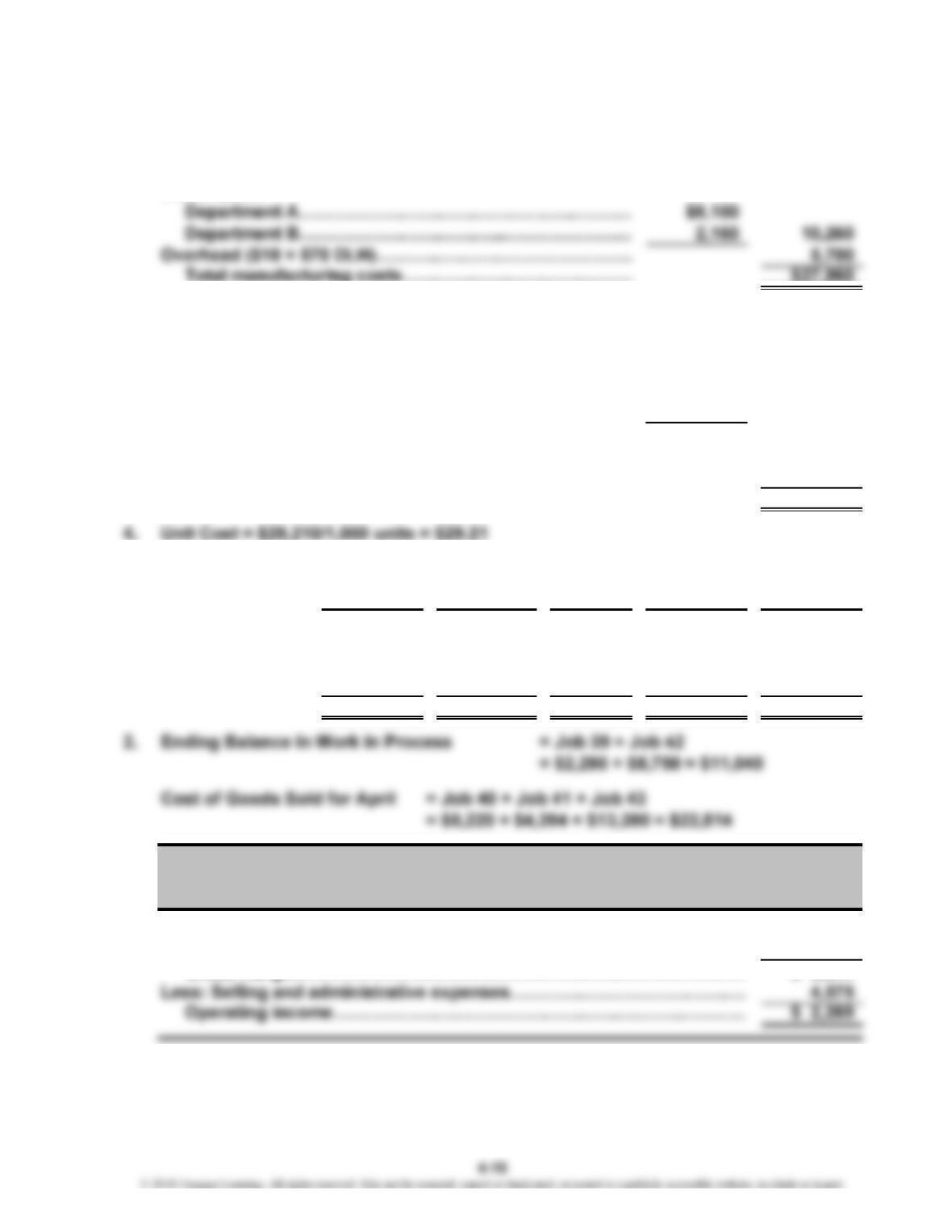
2. Unit Cost = $27,960/1,000 units = $27.96
3. Direct materials…………………………………………………
…
$12,000
Direct labor:
Department A…………………………………………………
…
$8,100
Department B…………………………………………………
…
2,160 10,260
Overhead:
Department A ($3 × 450)……………………………………
…
1,350
Department B ($7 × 800)……………………………………
…
5,600
Total manufacturing costs……………………………………
…
$29,210
E 4-49
1. Job 39 Job 40 Job 41 Job 42 Job 43
Balance, April 1 $ 540 $3,400 $2,990 $ 0 $ 0
Direct materials 700 560 375 3,500 6,900
Direct labo
r
500 600 490 2,500 3,000
Applied overhead 550 660 539 2,750 3,300
Total cost $2,290 $5,220 $4,394 $8,750 $13,200
3.
Sales [$22,814 + (0.30 × $22,814)]……..………..……….………………….…
…
$29,658
Cost of goods sold……………….…………………………..…….……………
…
22,814
For the Month Ended April 30
Ensign Landscape Design
Income Statement
…
…