4-41

4-42
4-34 (20−25 min.) Proration of overhead.
(Z. Iqbal, adapted) The Zaf Radiator Company uses a normal-costing system with a single
manufacturing overhead cost pool and machine-hours as the cost-allocation base. The
following data are for 2014:
Budgeted manufacturing overhead costs $4,800,000
Overhead allocation base Machine-hours
Budgeted machine-hours 80,000
Manufacturing overhead costs incurred $4,900,000
Actual machine-hours 75,000
Machine-hours data and the ending balances (before proration of under- or overallocated
overhead) are as follows:
Actual Machine-Hours
2014 End-of-Year Balance
Cost of Goods Sold
60,000
$8,000,000
Finished Goods Control
11,000
1,250,000
Work-in-Process Control
4,000
750,000
Required:
1. Compute the budgeted manufacturing overhead rate for 2014.
2. Compute the under- or overallocated manufacturing overhead of Zaf Radiator in 2014.
Dispose of this amount using the following:
a. Writeoff to Cost of Goods Sold
b. Proration based on ending balances (before proration) in Work–in-Process Control,
Finished Goods Control, and Cost of Goods Sold
c. Proration based on the overhead allocated in 2014 (before proration) in the ending
balances of Work-in-Process Control, Finished Goods Control, and Cost of Goods Sold
3. Which method do you prefer in requirement 2? Explain.
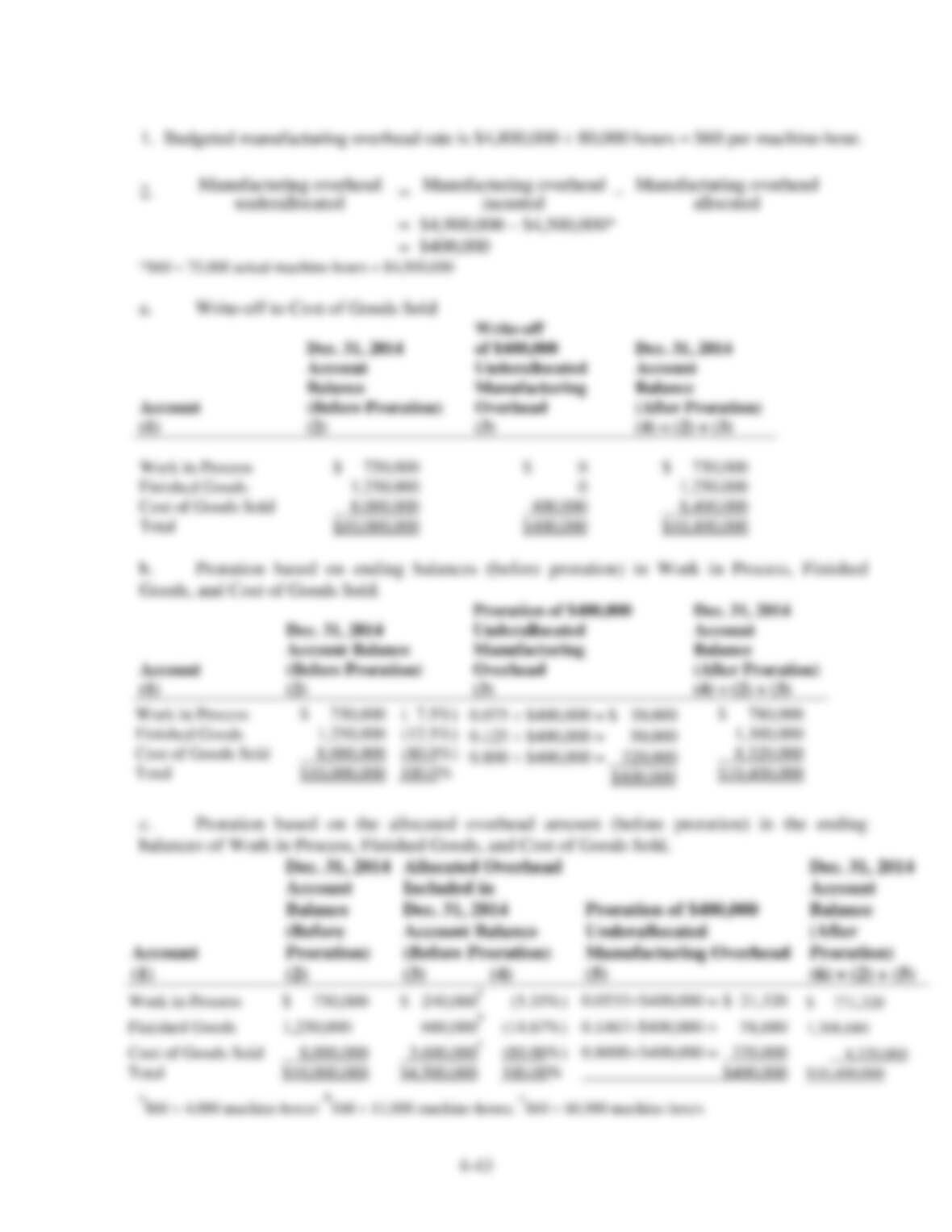
SOLUTION
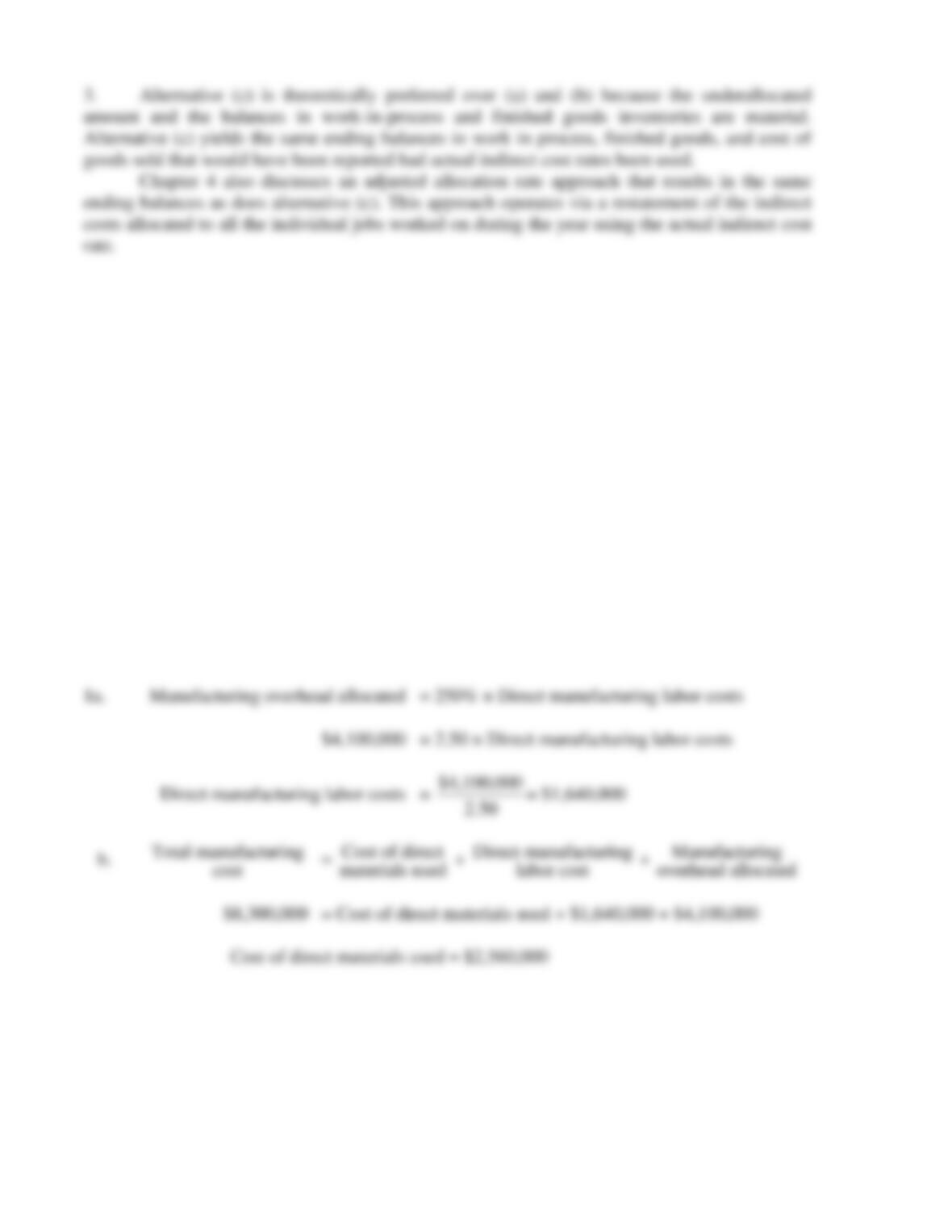
4-44
4-35 (15 min.) Normal costing, overhead allocation, working backward.
Gardi Manufacturing uses normal costing for its job-costing system, which has two direct-cost
categories (direct materials and direct manufacturing labor) and one indirect-cost category
(manufacturing overhead). The following information is obtained for 2014:
▪ Total manufacturing costs, $8,300,000
▪ Manufacturing overhead allocated, $4,100,000 (allocated at a rate of 250% of direct
manufacturing labor costs)
▪ Work-in-process inventory on January 1, 2014, $420,000
▪ Cost of finished goods manufactured, $8,100,000
Required:
1. Use information in the first two bullet points to calculate (a) direct manufacturing labor
costs in 2014 and (b) cost of direct materials used in 2014.
2. Calculate the ending work-in-process inventory on December 31, 2014.
SOLUTION
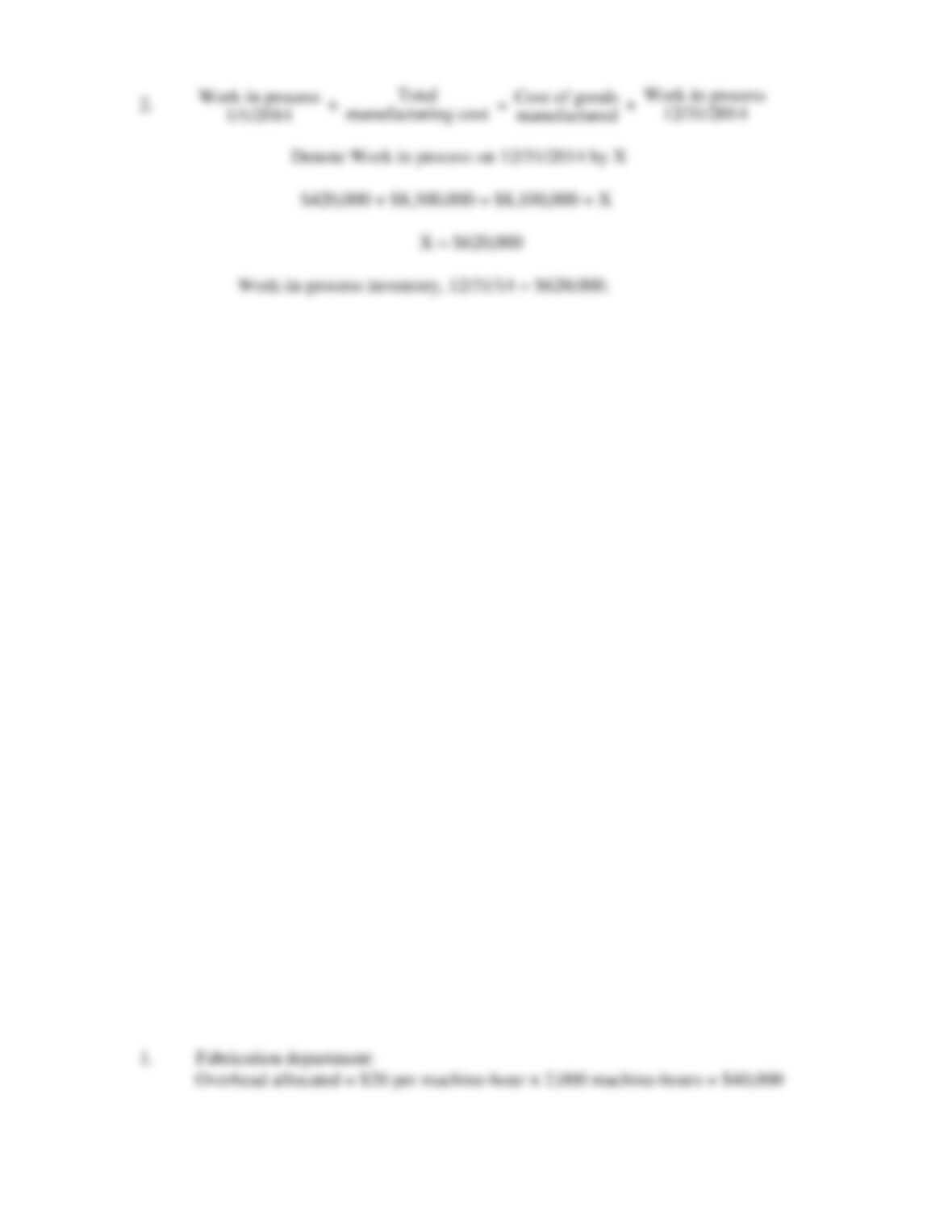
4-45
4-36 (15 min.) Proration of overhead with two indirect cost pools.
Premier Golf Carts makes custom golf carts that it sells to dealers across the Southeast. The carts
are produced in two departments, fabrication (a mostly automated department) and custom
finishing (a mostly manual department). The company uses a normal-costing system in which
overhead in the fabrication department is allocated to jobs on the basis of machine-hours and
overhead in the finishing department is allocated to jobs based on direct labor-hours. During
May, Premier Golf Carts reported actual overhead of $49,500 in the fabrication department and
$22,200 in the finishing department. Additional information follows:
Manufacturing overhead rate (fabrication department) $20 per machine-hour
Manufacturing overhead rate (finishing department) $16 per direct labor-hour
Machine-hours (fabrication department) for May 2,000 machine-hours
Direct labor-hours (finishing department) for May 1,200 labor-hours
Work in process inventory, May 31 $50,000
Finished goods inventory, May 31 $150,000
Cost of goods sold, May $300,000
Premier Golf Carts prorates under- and overallocated overhead monthly to work in process,
finished goods, and cost of goods sold based on the ending balance in each account.
Required:
1. Calculate the amount of overhead allocated in the fabrication department and the finishing
department in May.
2. Calculate the amount of under- or overallocated overhead in each department and in total.
3. How much of the under- or overallocated overhead will be prorated to (a) work in process
inventory, (b) finished goods inventory, and (c) cost of goods sold based on the ending
balance (before proration) in each of the three accounts? What will be the balance in work in
process, finished goods, and cost of goods sold after proration?
4. What would be the effect of writing off under- and overallocated overhead to cost of goods
sold? Would it be reasonable for Premier Golf Carts to change to this simpler method?
SOLUTION
4-46
4-47
4-37 (35 min.) General ledger relationships, under- and overallocation.
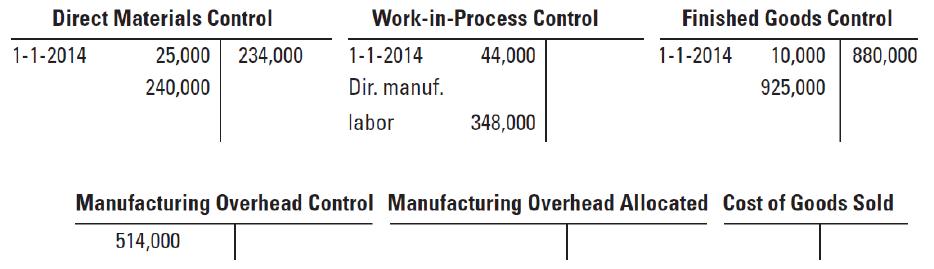
(S. Sridhar, adapted) Southwick Company uses normal costing in its job-costing system.
Partially completed T-accounts and additional information for Southwick for 2014 are as
follows:
Additional information follows:
a. Direct manufacturing labor wage rate was $12 per hour.
b. Manufacturing overhead was allocated at $16 per direct manufacturing labor-hour.
c. During the year, sales revenues were $1,050,000, and marketing and distribution costs were
$125,000.
Required:
1. What was the amount of direct materials issued to production during 2014?
2. What was the amount of manufacturing overhead allocated to jobs during 2014?
3. What was the total cost of jobs completed during 2014?
4. What was the balance of work-in-process inventory on December 31, 2014?
5. What was the cost of goods sold before proration of under- or overallocated overhead?
6. What was the under- or overallocated manufacturing overhead in 2014?
7. Dispose of the under- or overallocated manufacturing overhead using the following:
a. Writeoff to Cost of Goods Sold
b. Proration based on ending balances (before proration) in Work–in-Process Control,
Finished Goods Control, and Cost of Goods Sold
8. Using each of the approaches in requirement 7, calculate Southwick’s operating income for
2014.
9. Which approach in requirement 7 do you recommend Southwick use? Explain your answer
briefly.
4-48
SOLUTION
4-49
4-50
4-38 (40−55 min.) Overview of general ledger relationships.
Brandon Company uses normal costing in its job-costing system. The company produces custom
bikes for toddlers. The beginning balances (December 1) and ending balances (as of December
30) in their inventory accounts are as follows:
Beginning Balance 12/1
Ending Balance 12/31
Materials Control
$2,100
$ 8,500
Work-in-Process Control
6,700
9,000
Manufacturing Department Overhead Control
—
94,000
Finished Goods Control
4,400
19,400
Additional information follows:
a. Direct materials purchased during December were $66,300.
b. Cost of goods manufactured for December was $234,000.
c. No direct materials were returned to suppliers.
d. No units were started or completed on December 31 and no direct materials were
requisitioned on December 31.
e. The manufacturing labor costs for the December 31 working day: direct manufacturing labor,
$4,300, and indirect manufacturing labor, $1,400.
f. Manufacturing overhead has been allocated at 110% of direct manufacturing labor costs
through December 31.
Required:
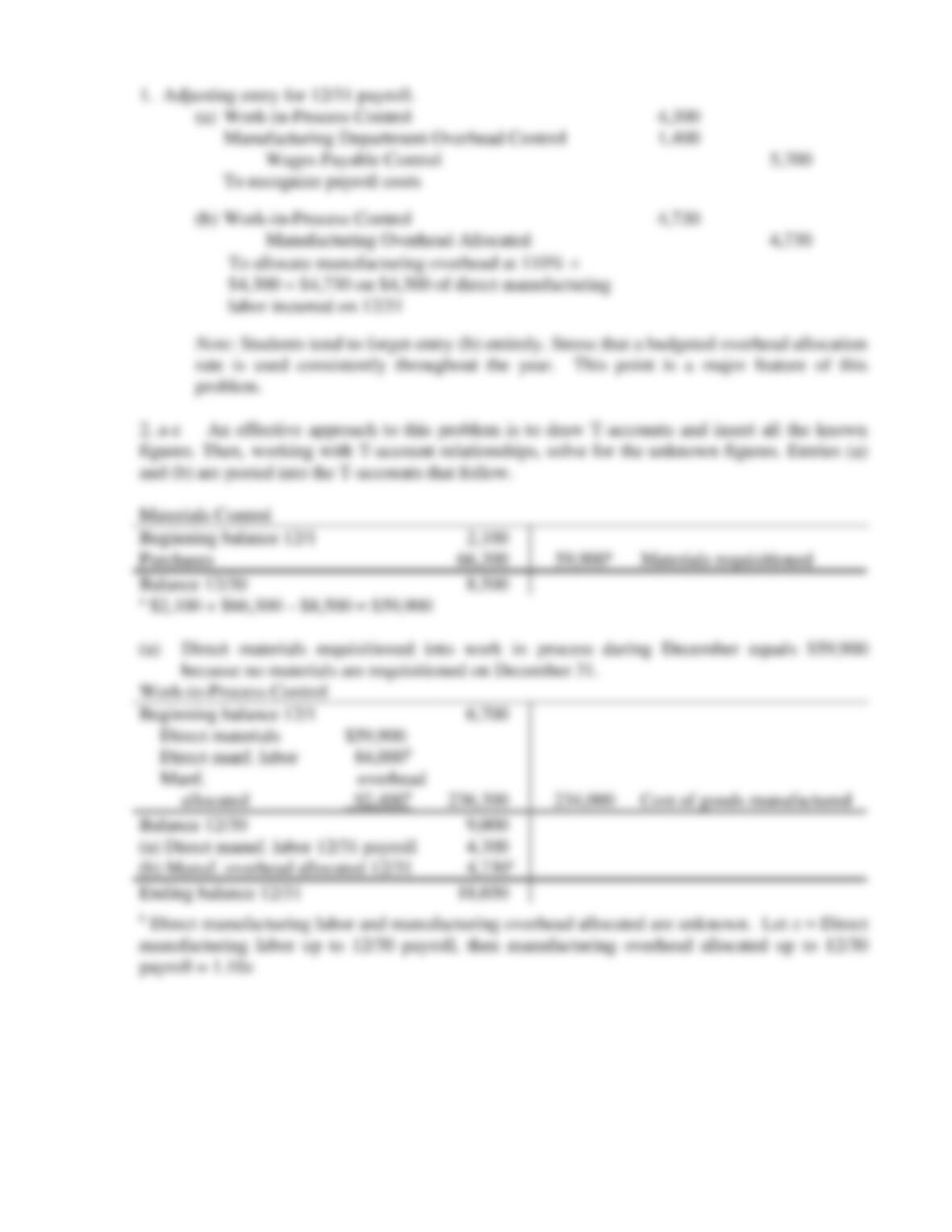
1. Prepare journal entries for the December 31 payroll.
2. Use T-accounts to compute the following:
a. The total amount of materials requisitioned into work in process during December
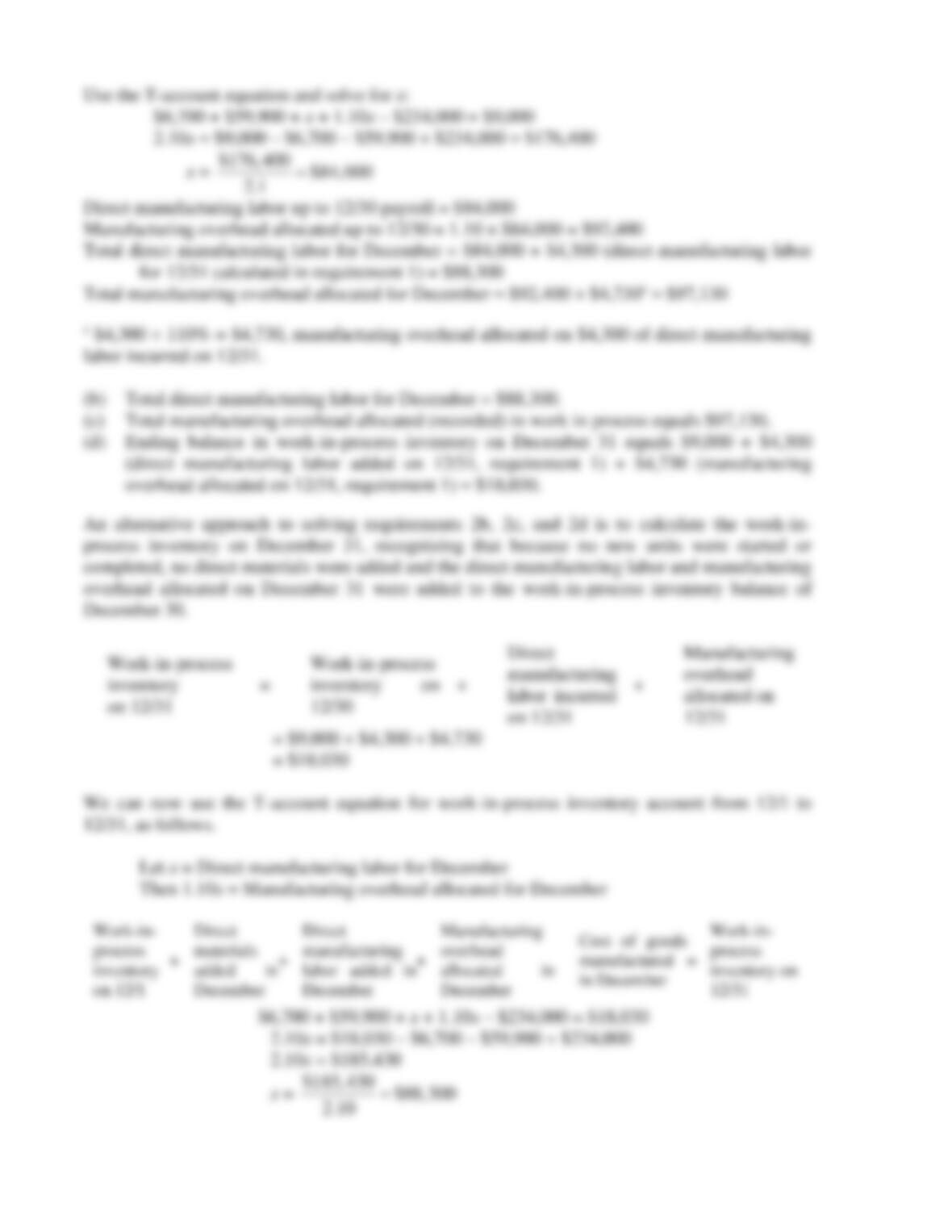
b. The total amount of direct manufacturing labor recorded in work in process during
December (Hint: You have to solve requirements 2b and 2c simultaneously)
c. The total amount of manufacturing overhead recorded in work in process during
December
d. Ending balance in work in process, December 31
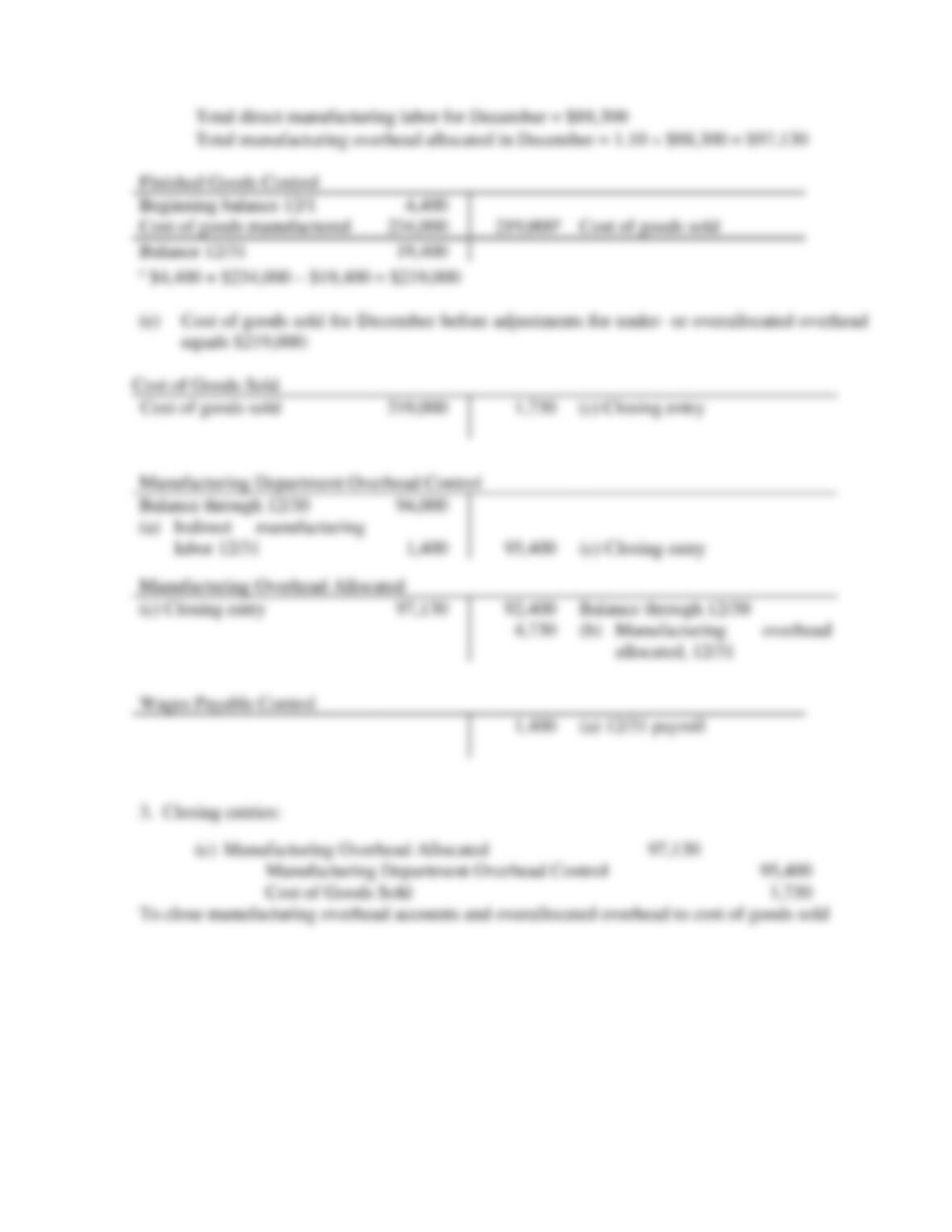
e. Cost of goods sold for December before adjustments for under– or overallocated
manufacturing overhead
3. Prepare closing journal entries related to manufacturing overhead. Assume that all under– or
overallocated manufacturing overhead is closed directly to Cost of Goods Sold.
SOLUTION
4-51
4-52
4-53
4-54
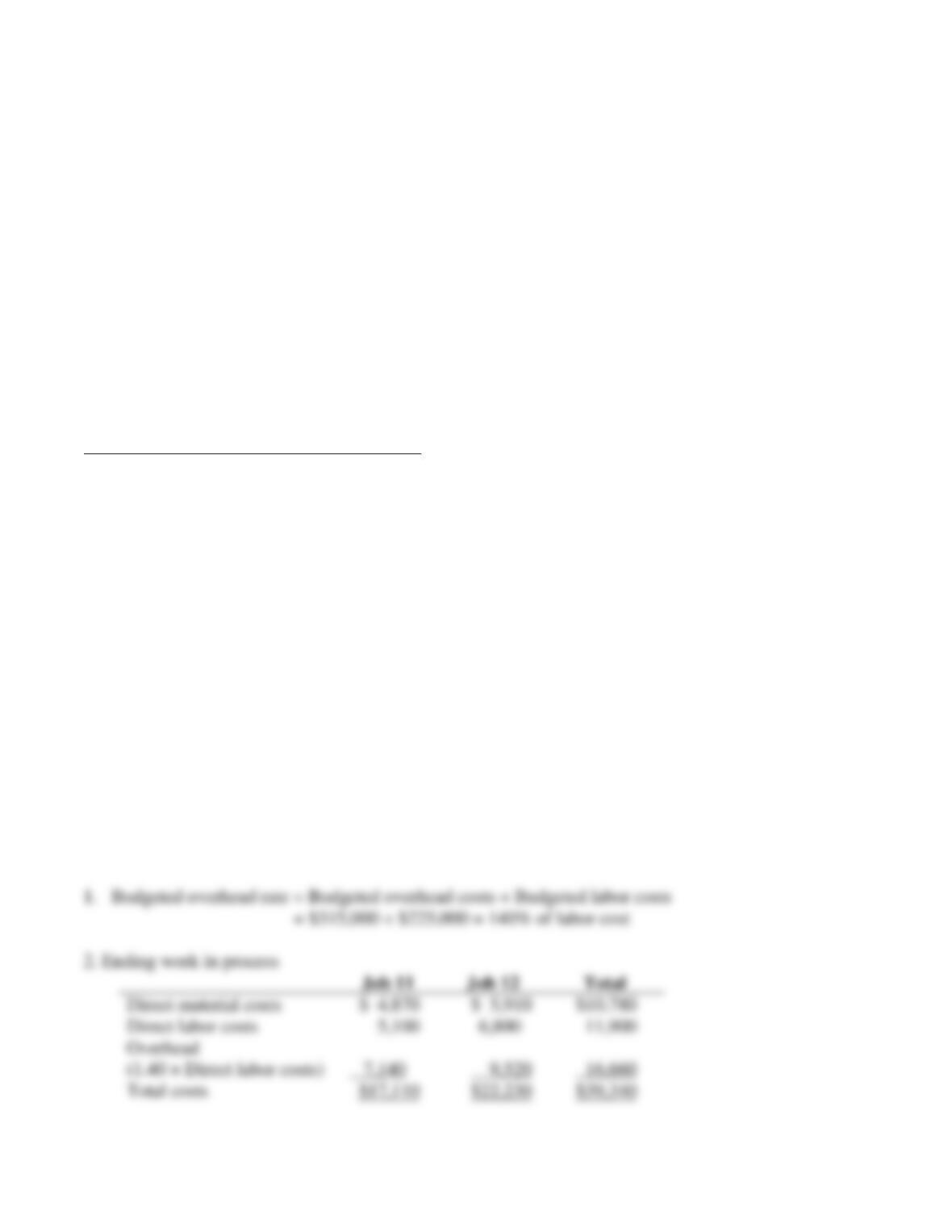
4-39 (25 min.) Allocation and proration of overhead.
InStep Company prints custom training material for corporations. The business was started
January 1, 2014. The company uses a normal-costing system. It has two direct cost pools,
materials and labor, and one indirect cost pool, overhead. Overhead is charged to printing jobs on
the basis of direct labor cost. The following information is available for 2014.
Budgeted direct labor costs
$225,000
Budgeted overhead costs
$315,000
Costs of actual material used
$148,500
Actual direct labor costs
$213,500
Actual overhead costs
$302,100
There were two jobs in process on December 31, 2014: Job 11 and Job 12. Costs added to each
job as of December 31 are as follows:
Direct materials
Direct labor
Job 11
$4,870
$5,100
Job 12
$5,910
$6,800
InStep Company has no finished goods inventories because all printing jobs are transferred to
cost of goods sold when completed.
Required:
1. Compute the overhead allocation rate.
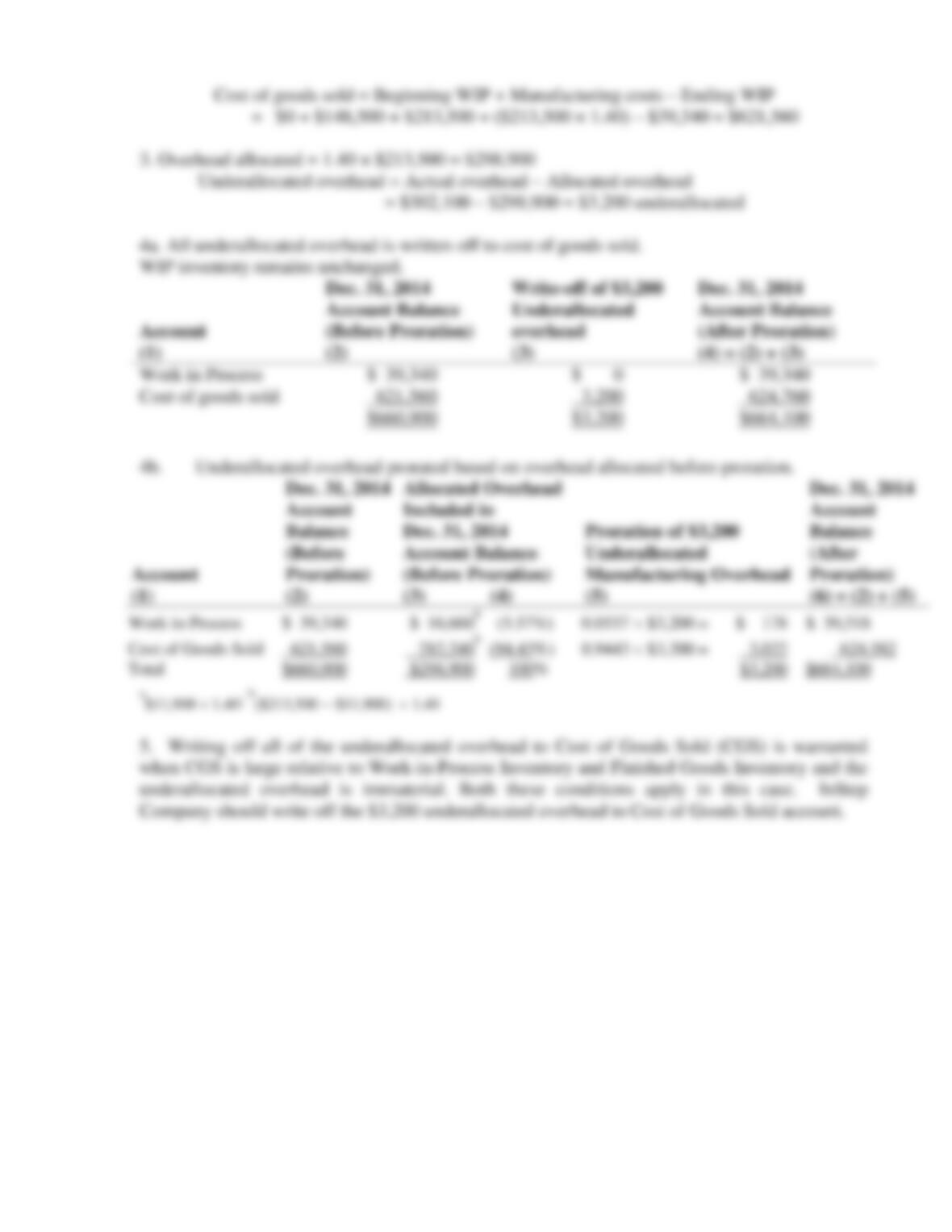
2. Calculate the balance in ending work in process and cost of goods sold before any
adjustments for under- or overallocated overhead.
3. Calculate under- or overallocated overhead.
4. Calculate the ending balances in work in process and cost of goods sold if the under– or
overallocated overhead amount is as follows:
a. Written off to cost of goods sold
b. Prorated using the overhead allocated in 2014 (before proration) in the ending balances of
cost of goods sold and work-in-process control accounts
5. Which of the methods in requirement 4 would you choose? Explain.
SOLUTION
4-55
4-40 (25-30 min.) Job costing, contracting, ethics.
Rand Company manufactures modular homes. The company has two main products that it sells
commercially: a 1,000-square-foot, one-bedroom model and a 1,500-square-foot, two-bedroom
model. The company recently began providing emergency housing (huts) to the Federal
Emergency Management Agency (FEMA). The emergency housing is similar to the 1,000-
square-foot model.
FEMA has requested Rand to create a bid for 150 emergency huts to be sent for wildfire
victims in the West. Your manager has asked that you prepare this bid. In preparing the bid, you
find a recent invoice to FEMA for 200 huts provided during the most recent hurricane season in
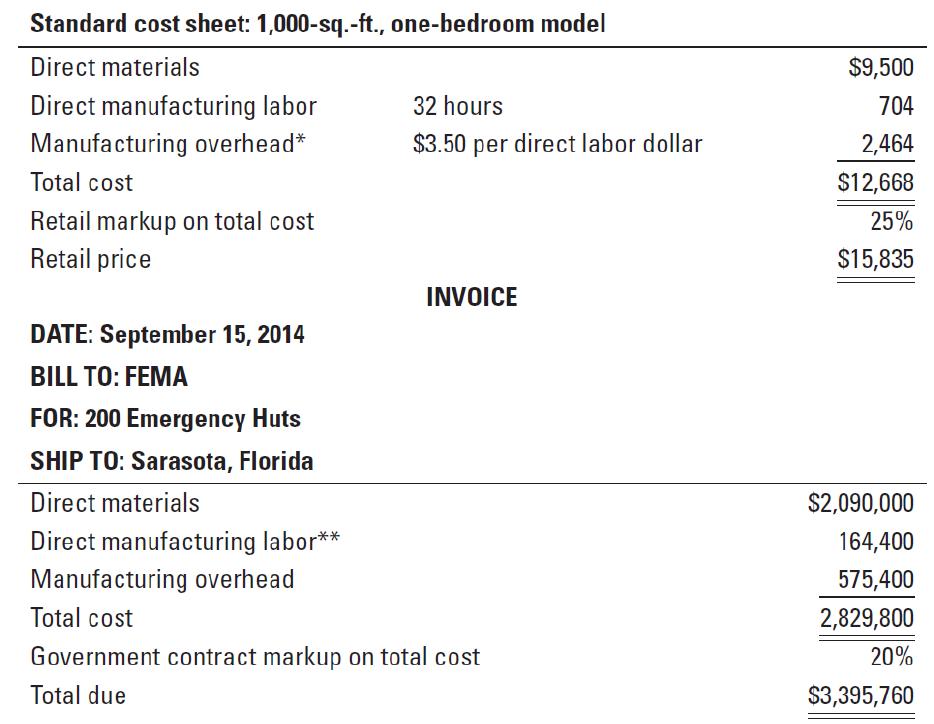
the South. You also have a standard cost sheet for the 1,000-square-foot model sold
commercially. Both are provided as follows:
4-56
Required:
1. Calculate the total bid if you base your calculations on the standard cost sheet assuming a
cost plus 20% government contract.
2. Calculate the total bid if you base your calculations on the September 15, 2014, invoice
assuming a cost plus 20% government contract.
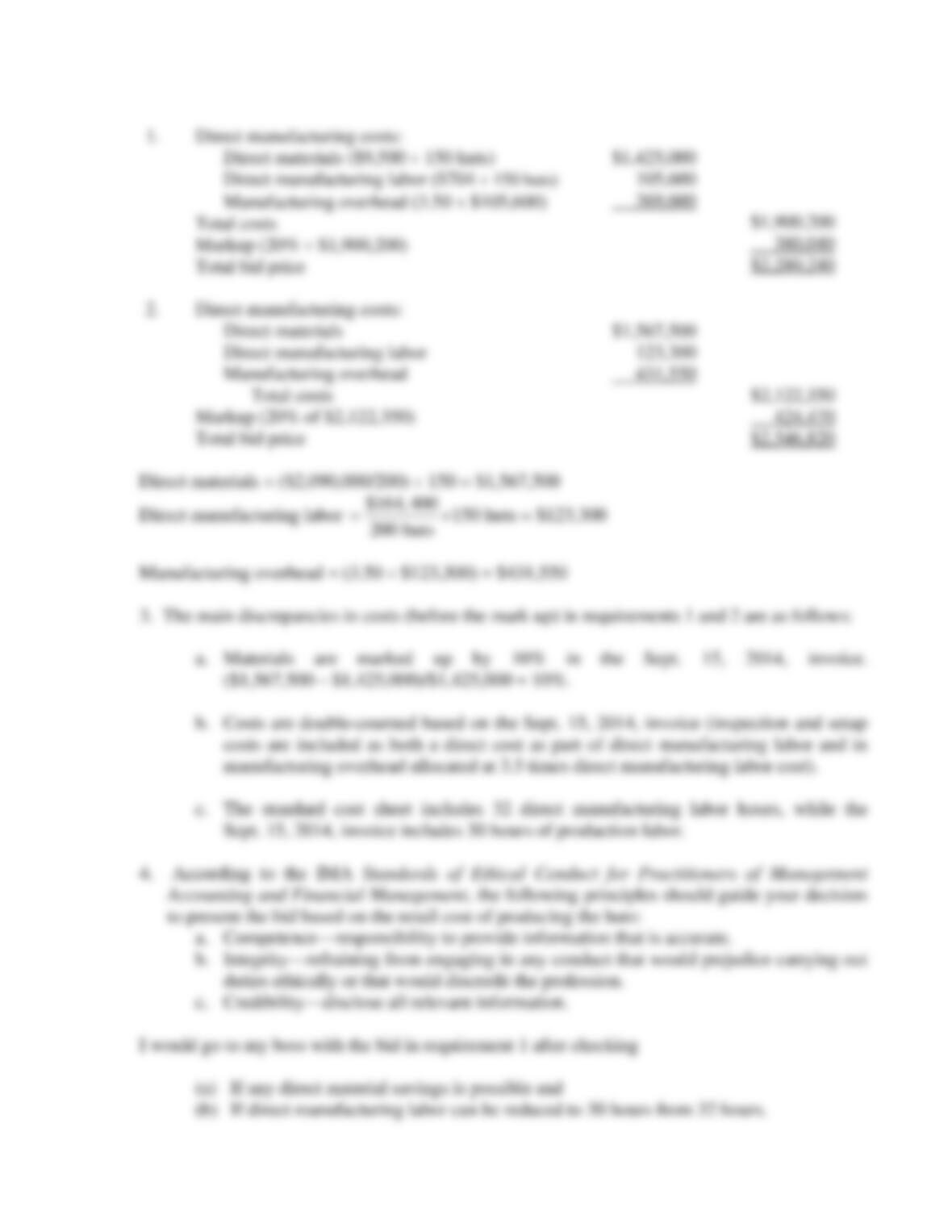
3. What are the main discrepancies between the bids you calculated in requirements 1 and 2?
4. What bid should you present to your manager? What principles from the IMA “Standards of
Ethical Conduct for Practitioners of Management Accounting and Financial Management,”
as described in Chapter 1, should guide your decision? As the manager, what would you do?
*Overhead cost pool includes inspection labor ($15 per hour), setup labor ($12 per hour), and
other indirect costs associated with production.
**Direct manufacturing labor includes 30 production hours per unit, 4 inspection hours per unit,
and 6 setup hours per unit.
4-57
SOLUTION
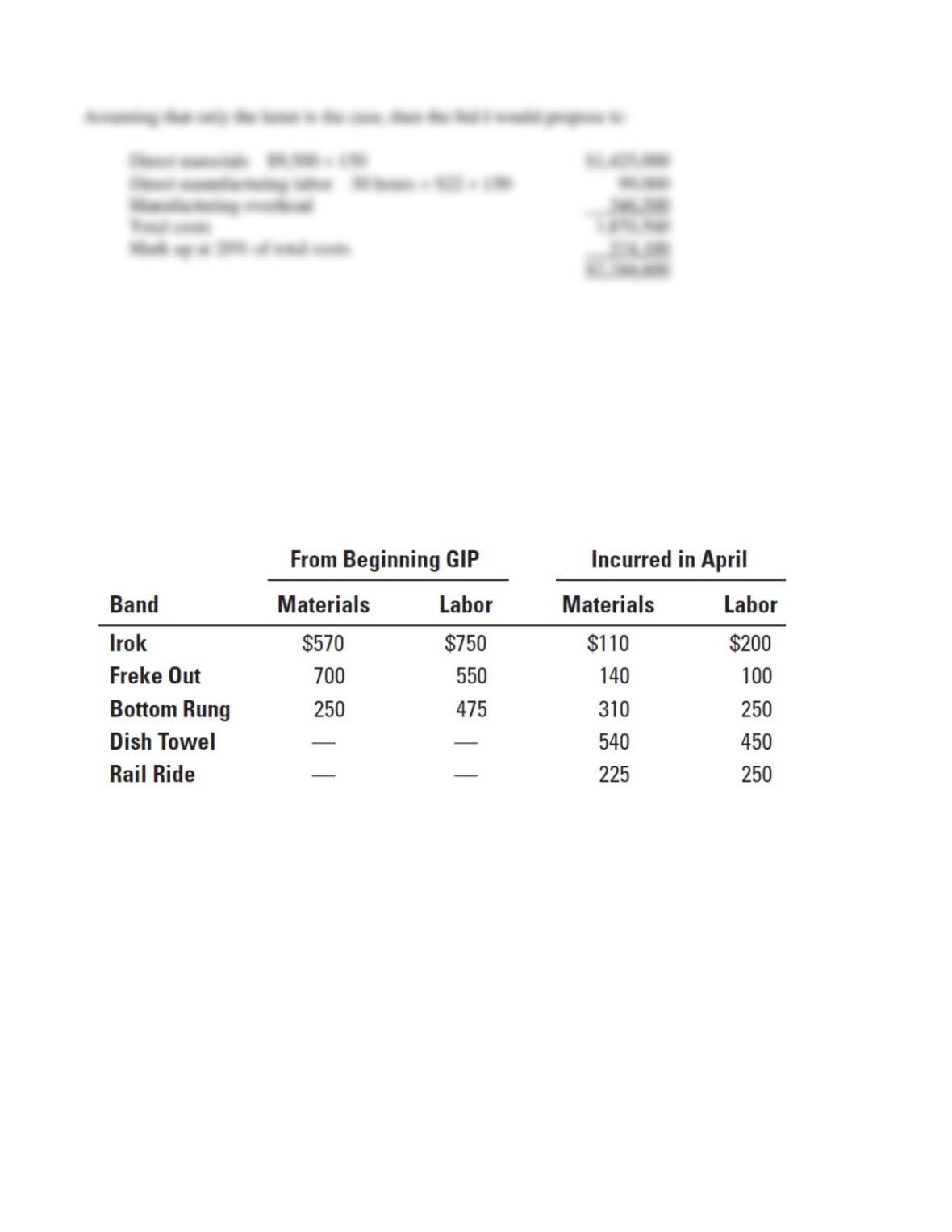
4-58
4-41 (35 min.) Job costing—service industry.
Jordan Brady schedules gigs for local bands and creates CDs and T-shirts to sell at each gig.
Brady uses a normal-costing system with two direct-cost pools, labor and materials, and one
indirect-cost pool, general overhead. General overhead is allocated to each gig based on 120% of
direct labor cost. Actual overhead equaled allocated overhead as of March 2014. Actual
overhead in April was $1,980. All costs incurred during the planning stage for a gig and during
the gig are gathered in a balance sheet account called “Gigs in Progress (GIP).” When a gig is
completed, the costs are transferred to an income statement account called “Cost of Completed
Gigs (CCG).” Following is cost information for April 2014:
As of April 1, there were three gigs in progress: Irok, Freke Out, and Bottom Rung. The
gigs for Dish Towel and Rail Ride were started during April. The gigs for Freke Out and Dish
Towel were completed during April.
Required:
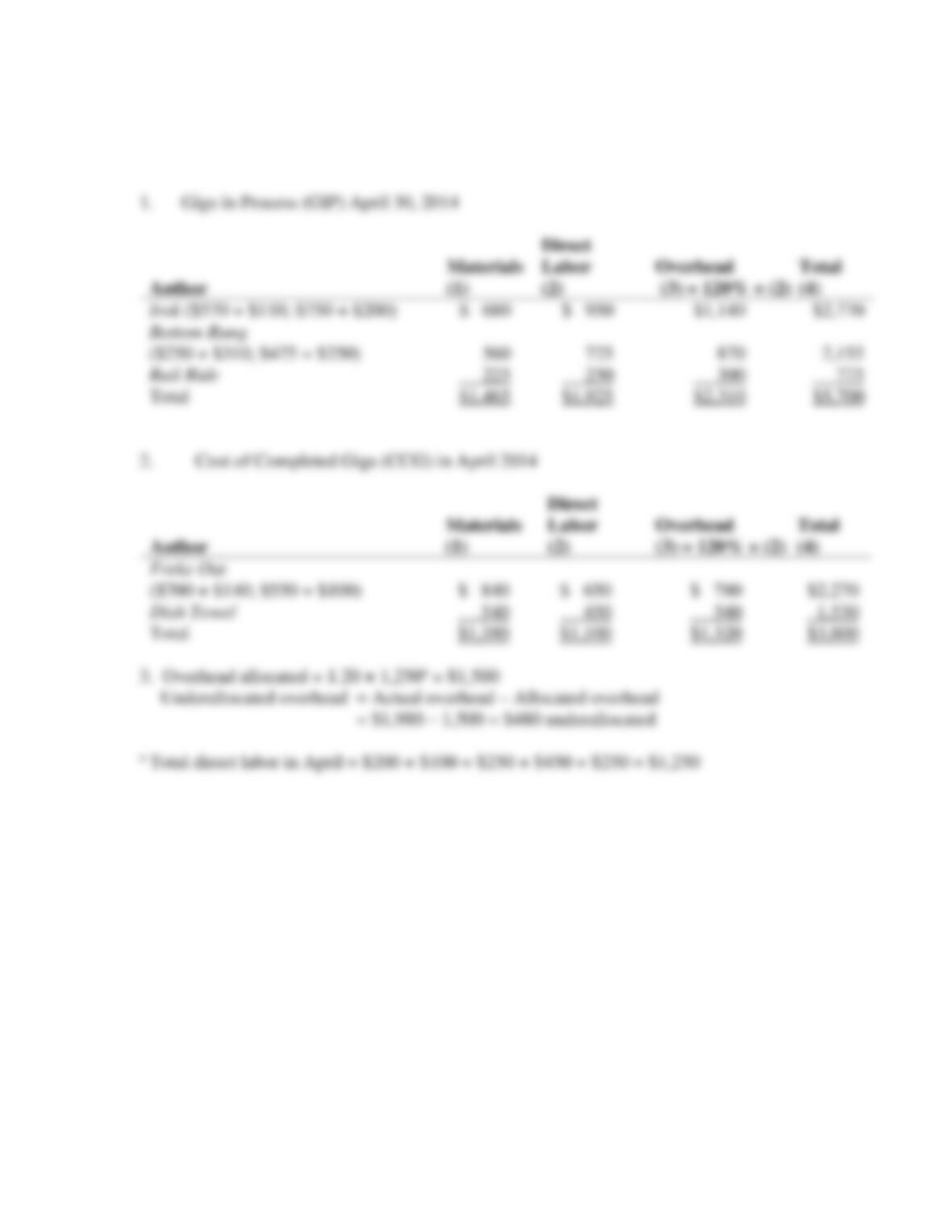
1. Calculate GIP at the end of April.
2. Calculate CCG for April.
3. Calculate under- or overallocated overhead at the end of April.
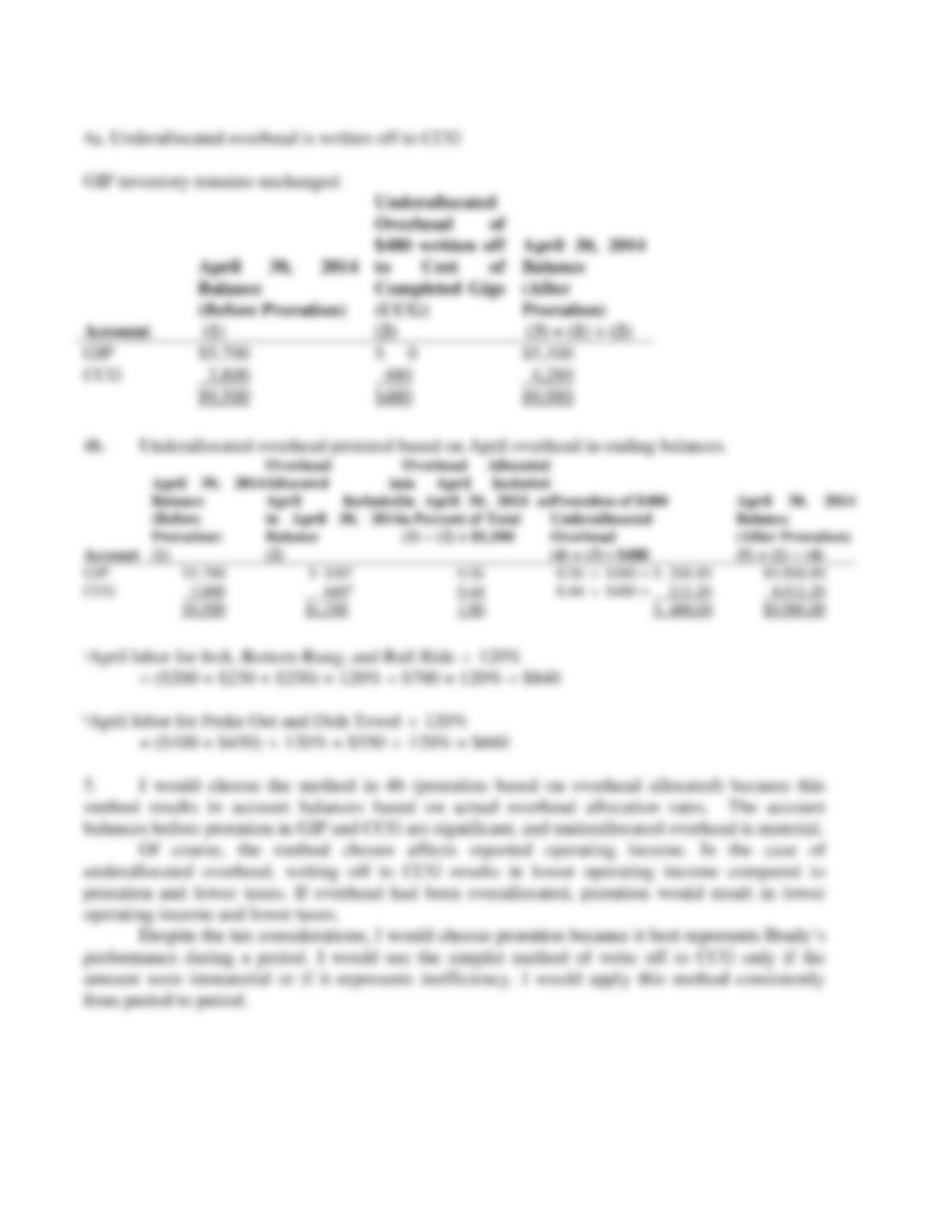
4. Calculate the ending balances in GIP and CCG if the under– or overallocated overhead
amount is as follows:
a. Written off to CCG
b. Prorated based on the ending balances (before proration) in GIP and CCG
c. Prorated based on the overhead allocated in April in the ending balances of GIP and CCG
(before proration)
4-59
5. Which method would you choose? Explain. Would your choice depend on whether overhead
cost is underallocated or overallocated? Explain.
SOLUTION
4-60