Chapter 4
Fundamentals of Cost Analysis for Decision Making
Learning Objectives
1. Use differential analysis to analyze decisions.
2. Understand how to apply differential analysis to pricing decisions.
4. Understand how to apply differential analysis to production decisions.
5. Understand the theory of constraints.
Chapter Overview
I. DIFFERENTIAL ANALYSIS
• Differential Costs versus Total Costs
• Differential Analysis and Pricing Decisions
o The Full-Cost Fallacy in Setting Prices
• Short-Run versus Long-Run Pricing Decisions
• Short-Run Pricing Decisions: Special Orders
• Long-Run Pricing Decisions
II. LEGAL ISSUES RELATING TO COSTS AND SALES PRICES
• Predatory Pricing
• Dumping
• Price Discrimination
• Peak-Load Pricing
• Price Fixing
III. USE OF DIFFERENTIAL ANALYSIS FOR PRODUCTION DECISIONS
IV. THE THEORY OF CONSTRAINTS
Chapter Outline
LO 4-1 Use differential analysis to analyze decisions.
DIFFERENTIAL ANALYSIS
• Common decisions about pricing and production business decisions require an understanding
of (1) the effect of the decision on the organization’s revenues and costs and (2) the business
and competitive environment. (See Business Application box “Cost Analysis and the Choice
of Sales Channels.”)
• Differential analysis refers to the process of estimating revenues and costs of alternative
actions available to decision makers and of comparing these estimates to the status quo.
▪ Short run is defined as the period of time over which capacity will be unchanged,
usually one year.
▪ Both short-run and long-run decisions are concerned with the amount of cash flow.
• Short-run decisions affect cash flow for such a short period of time that the time
value of money is immaterial and hence ignored. Thus, the amount of cash flows
is important for short-run analysis, but the timing of the flows is assumed to be
unimportant.
• If an action affects cash flows over a longer period of time (usually more than one
year), the time value of money is considered (as discussed in the Appendix).
o Differential costs change in response to alternative courses of action. With two or more
alternatives, the differential costs are those that differ among or between alternatives.
▪ Both variable and fixed costs may be differential costs.
o Sunk costs are costs incurred in the past that cannot be changed by present or future
decisions.
• Differential Costs versus Total Costs
o Although we are focusing on differential costs, the information presented to management
can show the detailed costs that are included for making a decision, or it can show just
the differences between alternatives.
▪ The total format includes the two columns that show the total operating profit under
the status quo and the alternative and a third column that shows the difference.
• Advantages of the total format:
▪ The differential format includes a column that shows only the differences.
• The advantage of the differential format is that it highlights the differences
between alternatives.
LO 4-2 Understand how to apply differential analysis to pricing decisions.
• Differential Analysis and Pricing Decisions
o Prices are determined by supply and demand.
o The Full-Cost Fallacy in Setting Prices
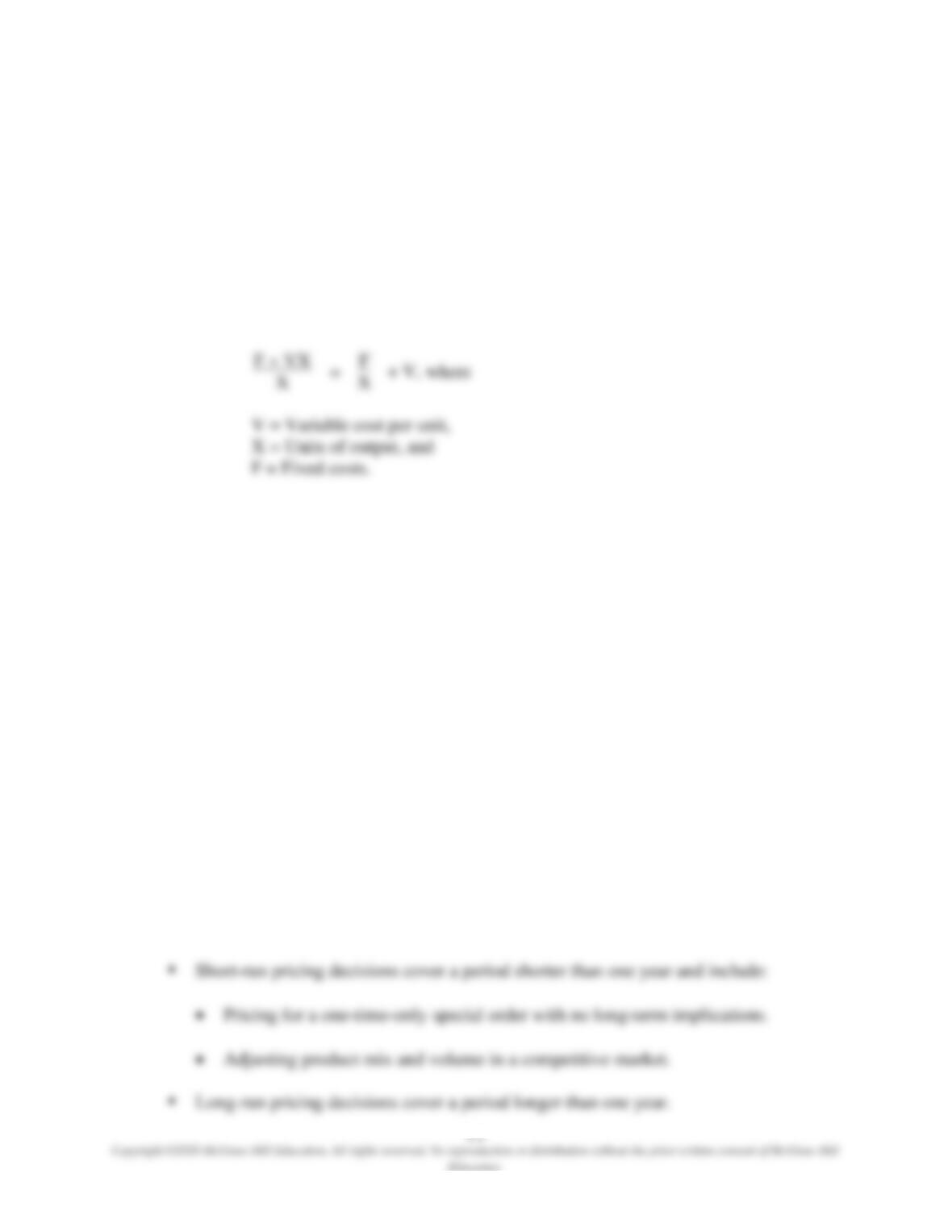
▪ Full cost (or full product cost) is the sum of the fixed and variable costs of
manufacturing and selling a unit.
• Full cost includes both (1) the variable costs of producing and selling the product
and (2) a share of the organization’s fixed costs.
From the cost equation (TC = F + VX) in CVP analysis, full cost can be
expressed as:
• The use of full cost for some short-run decisions will erroneously render the
alternative option less attractive.
Sometimes decision makers use these full costs, mistakenly thinking that they
are variable costs, and fall victim to the full-cost fallacy.
• For short-run decisions (such as whether to accept special orders), the fixed cost
component generally is not differential and, as such, should not be considered.
See Demonstration Problem 1
• In the long run, all costs must be covered or the company will fail.
▪ A special order is an order that will not affect other sales and is usually a short-run
occurrence.
• Short-Run versus Long-Run Pricing Decisions
o The time horizon of the decision is critical in computing the relevant costs in a pricing
decision.
• Long-run decisions include pricing a main product in a large market in which
there is considerable leeway to set prices.
• Short-Run Pricing Decisions: Special Orders
o The differential approach particularly helps in making decisions regarding special orders
where the order will not affect other sales and is not expected to recur.
▪ Determining which costs are relevant depends on the decision being considered.
o Exhibit 4.1 provides a framework for decision making in this context; the option that
provides the highest economic value should be chosen:
See Demonstration Problem 2
▪ The differential approach to pricing works well for special orders, but some criticize
its use for pricing a firm’s regular products.
• Criticisms of the use of the differential approach decisions regarding special
orders include:
• Responses to these criticisms include:
In both the short and long runs, the differential approach indicates only the
minimum acceptable price. The firm always can charge a higher amount,
depending on its customers and competitors.
LO 4-3 Understand several approaches for establishing prices based on costs
for long-run pricing decisions.
• Long-Run Pricing Decisions
o Most firms rely on full-cost information reports when setting prices.
▪ Full cost is the total cost to produce and sell a unit; it includes all costs incurred by
the activities that make up the value chain.
• Cost-plus approach––The accounting department provides cost reports to the
marketing department, which then adds appropriate markups to determine
benchmark or target prices for all products the firm normally sells.
▪ Pricing decisions based on full cost may be appropriate in three circumstances:
• Long-Run versus Short-Run Pricing: Is There a Difference?
o When used in pricing decisions, the differential costs required to sell and/or produce a
product provide a floor. In the short run, differential costs may be very low.
• Cost Analysis for Pricing
o Differential analysis is useful for short-run and long-run pricing decisions.
o Several other approaches are used to establish prices based on costs. In general, these
approaches are especially useful in making long-run pricing decisions.
▪ Life-Cycle Product Costing And Pricing
• The product life cycle covers the time from initial research and development to
the time at which support to the customer ends.
Managers estimate the revenues and costs for each product from its initial
research and development to its final customer support.
▪ Target Costing From Target Pricing
• Target costing is the concept of “price–based costing” instead of “cost-based
pricing.”
A target price is the price based on customers’ perceived value for the
product and the price that competitors charge.
LEGAL ISSUES RELATING TO COSTS AND SALES PRICES
• Predatory Pricing
o Predatory pricing is the practice of setting a selling price below cost with the intent to
harm competition by driving competitors out of the market or by creating a barrier to
entry for new competitors.
o Example: Two companies, P(redator) and C(ompetitor), produce similar products while
employing similar technologies. The variable cost per unit is $5.10 for both.
▪ Company C adopts an industry practice of adding 10% markup to the variable cost to
come up with a selling price of $5.61 per unit.
▪ In order to dominate the market, Company P decides to charge a price of $5 per unit
for the same product resulting a loss of $0.10 per unit.
• Dumping
o Dumping occurs when a company exports its product to consumers in another country at
an export price below its domestic price.
• Price Discrimination
o Price discrimination is the practice of selling identical goods or services to different
customers at different prices.
▪ Price discrimination requires market segmentation based on price sensitivity.
▪ Price discrimination benefits companies because it enables them to sell products to
customers who might not otherwise purchase them.
▪ Price discrimination on the basis of race, religion, disability, or gender is illegal.
• Peak-Load Pricing
o Peak-load pricing is the practice of setting prices highest when the quantity demanded
for the product approaches the physical capacity to produce it (and lower at other times).
• Price Fixing
o Price fixing is the agreement among business competitors to set prices at a particular
level.
LO 4-4 Understand how to apply differential analysis to production
decisions.
USE OF DIFFERENTIAL ANALYSIS FOR PRODUCTION DECISIONS
• Make-It or Buy-It Decisions
o Make-or-buy decision is any decision by a company to acquire goods or services
internally or externally.
▪ The make-or–buy decision is often part of a company’s long-run strategy.
▪ Aside from strategic issues, the make-or-buy decision is ultimately a question of
which firm in the value chain can produce the product or service at the lowest cost.
▪ Whether to rely on outsiders for a substantial amount of materials depends on both
differential cost comparisons and other factors that are not easily quantified.
• Make-or-Buy Decisions Involving Differential Fixed Costs
o In make-or-buy decisions, the differential costs include:
o Make-or-buy decisions are sensitive to volume.
▪ When the cost information can be separated into variable and fixed components in the
accounting system, a unique volume may exist that makes the firm indifferent as to
whether to outsource or not.
▪ Above or below that volume, the decision will be reversed. That is, setting VX + F =
PX will lead to:
X =
F
PV−
, where:
X = The indifferent volume between make or buy
V = Variable cost per unit
F = Fixed costs
P = Purchase price per unit
• Opportunity Costs of Making
o Opportunity costs are the forgone returns from not employing a resource in its best
alternative use.
▪ Theoretically, determining opportunity cost requires considering every possible use of
the resource in question.
• Determining opportunity cost is typically very difficult and involves considerable
subjectivity.
▪ If the company has no alternative beneficial use for its facilities, the opportunity cost
is zero, in which case the previous analysis would stand.
o Exhibit 4.6 extends the make-or-buy analysis to consider the opportunity cost of
alternative facility use.
See Demonstration Problem 3
• Decision to Add or Drop a Product Line or Close a Business Unit
o Managers often must decide whether to add or drop a product line or close a business unit.
▪ Financial statements prepared in accordance with generally accepted accounting
principles do not routinely provide differential cost information. Differential cost
estimates depend on unique information that usually requires separate analysis.
• Exhibit 4.8 illustrates a differential analysis with columns for the status quo (keep
the product line or business unit), alternative (drop the product line or business
unit), and difference.
o Nonfinancial Considerations of Closing a Business Unit
See Demonstration Problem 4
• Product Choice Decisions
o In the short run, capacity is fixed and limited.
o In general, firms face constraints, which are activities, resources, or policies that limit or
bound the attainment of an objective.
▪ The important measure of profitability is based on the contribution margin per unit
of scarce resource, which is the contribution margin per unit of a particular input
with limited availability.
▪ By concentrating on the product(s) that yield the higher contribution margin per unit
of scarce resource, a firm can maximize its profit.
o The following exhibits illustrate a product choice decision:
▪ Exhibit 4.9 provides the revenue and cost information.
LO 4-5 Understand the theory of constraints.
THE THEORY OF CONSTRAINTS
• The theory of constraints (TOC) is a management method for dealing with constraints; it
focuses on revenue and cost management when faced with bottlenecks.
o A bottleneck is an operation where the work required limits production.
o The theory of constraints focuses on three factors:
▪ The rate of throughput contribution
• Throughput contribution, which equals sales dollars minus direct materials
costs and variables such as energy and piecework labor.
▪ Minimizing investments
▪ Minimizing other operating costs
• Other operating costs are all operating costs other than direct materials and other
variable costs; they are incurred to earn throughput contribution and include most
salaries and wages, rent, utilities, and depreciation.
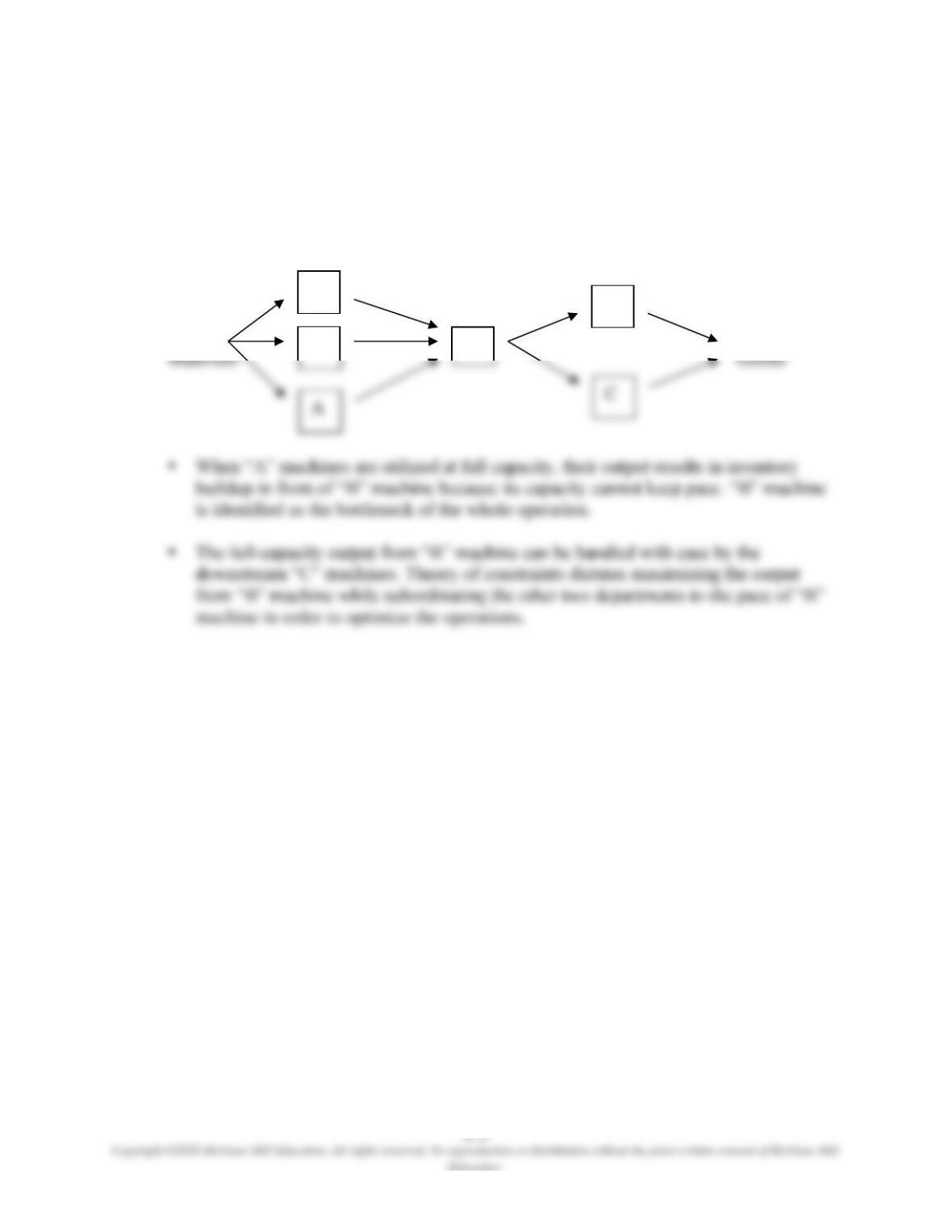
o Example: The following illustrates the manufacturing process in a factory. Every unit of
the finished product has to go through three departments as identified by the machines
used, A, B, and C. There are three “A” machines (capacity: 1,200 units each per hour),
one “B” machine (capacity: 3,000 units per hour), and two “C” machines (capacity: 1,600
units each per hour).
Raw Finished
A
C
A
A
B
C
1,200 units
3,000 units
1,600 units