Ethical Obligations and Decision Making in Accounting, 4/e 1
Case 4-4 Commercialism versus Professionalism (a GVV case)
One area of concern for the accounting profession for the past 20 years has been the proliferation of
alternative practice structures. Potential problems exist because the audit side of the business may
be influenced by the public entity that controls it. One such situation involves K&B, CPA
Associates, and Cryden Business and Tax Services.
Billy Kamen, CPA, has been a partner of K&B for more than 30 years. He thought he had seen it
all in the accounting profession. The rules of conduct slowly have been eaten away because of
growing commercial interests. First it was competitive bidding, which used to be against the rules
but has become the standard way to gain new clients. Next, it was advertising and soliciting new
This is the way the arrangement works. K&B provides all of the audit and other attest-related
services and is 100 percent owned by CPAs. Cryden, on the other hand, provides accounting (i.e.,
bookkeeping), tax compliance, and consulting services (i.e., financial planning) often to the same
audit clients of K&B. The owners of K&B are also employees of Cryden and, from time to time, do
tax planning work and some consulting services for clients of Cryden who may also be audit clients
of K&B. The rest of the employees of Cryden are employees of the company only, and some of
them hold the CPA designation.
It turns out that Hall Industries was a tax client of Cryden as well as an audit client of K&B, and
Frederick Hall had pressured Chad to exert influence over Billy to accept the company’s
accounting for the software development expenses. That is why Chad had come to see Billy.
Ethical Obligations and Decision Making in Accounting, 4/e 2
Questions
1. Discuss the issue of commercialism versus professionalism in the accounting profession
with respect to the changes in the rules of conduct described in the case. Do you think
these changes are good or bad for the profession? For the public? Explain.
The changes in many of the rules cited (i.e., advertising, contingent fees, and commissions)
occurred because CPAs started performing a series of nonaudit services to audit clients back
in the 1960s, such as consulting and personal financial planning, that placed these CPAs in
direct competition with non-CPAs who performed the same services. A good example is
financial planning where the former stock brokerage firms and now investment advising
entities were in the field. Given that these firms were not 100 percent CPA-owned, they did
not come under the rules of conduct in the AICPA Code. That meant they could advertise
and solicit services more freely. The playing field was not level The nonaudit/CPA
practice but keep them in-house.
Ethical Obligations and Decision Making in Accounting, 4/e 3
2. What are the threats to compliance with the rules of conduct that arise as a result of
the alternative practice structure in this case? Why are they threats?
3. What safeguards might be established to ensure the threats have been eliminated or
reduced to acceptable levels?
Both questions are answered by the discussion below.
Under an alternative practice structure (APS), an acquired CPA firm is split into two pieces.
Regulated services-audits, reviews, compilations, attestation services, WebTrustM, and the
like-are performed by the CPA firm from which the practice was acquired (or a successor
partnership). These firms have strict independence and other ethical requirements.
The Revised AICPA Code identifies Independence (1.200.001), Conflicts of Interest
(1.000.020), Compliance with Standards (1.310.001), and Form of Ownership and Name
(1.800.001) as rules of conduct that could be violated because of the relationship between
the public entity and CPA professionals and CPA firm. The rules of conduct from the Code
are explained later on. The discussion covers both questions 2 and 3. Here is a brief
summary of the most salient provisions of the Code.
• Non-CPAs with direct control over partner/manager CPAs may benefit by
controlling actions of the CPAs. These are direct superiors.
• Indirect superiors do not have direct contact with partners/managers but do have
influence by virtue of the fact they are one or two levels above direct superiors.
Ethical Obligations and Decision Making in Accounting, 4/e 4
to apply the Independence Rule and interpretations with respect to the attest clients
of the CPA firm.
o Covered members of the new firm (CPA firm)
o Direct superiors of any partner/manager who is a covered member of the
CPA/new firm and entities within the APS over which such individuals can
Extended Discussion
AICPA Code Section 1.220.020
Terminology
• The term direct superiors include those persons so closely associated with a partner or
manager who is a covered member that such persons can directly control the partner’s or
manager’s activities. For this purpose, a person who can directly control is the
immediate superior of the partner or manager who has the power to direct the activities
of that person so as to be able to directly or indirectly (for example, through another
entity over which the direct superior can exercise significant influence) derive a benefit
from that person’s activities. An example is the person who has day-to– day responsibility
for the activities of the partner or manager and is in a position to recommend
promotions and compensation levels. This group of persons is so closely aligned
Ethical Obligations and Decision Making in Accounting, 4/e 5
APS Model
The APS described in the chart below provides an example of a structure in use at
the time that this interpretation was developed. Many of the references in this
interpretation are to the example, but CPAs should apply the concepts in spirit and
substance to variations of the example structure as they develop.
The example APS in this interpretation is one in which an existing CPA practice
(Oldfirm) is sold by its owners to another (possibly public) entity (PublicCo).
PublicCo has subsidiaries or divisions, such as a bank, an insurance company, or a
broker-dealer. It also has one or more professional service subsidiaries (PSS) or
divisions that offer nonattest services (for example, tax, personal financial planning,
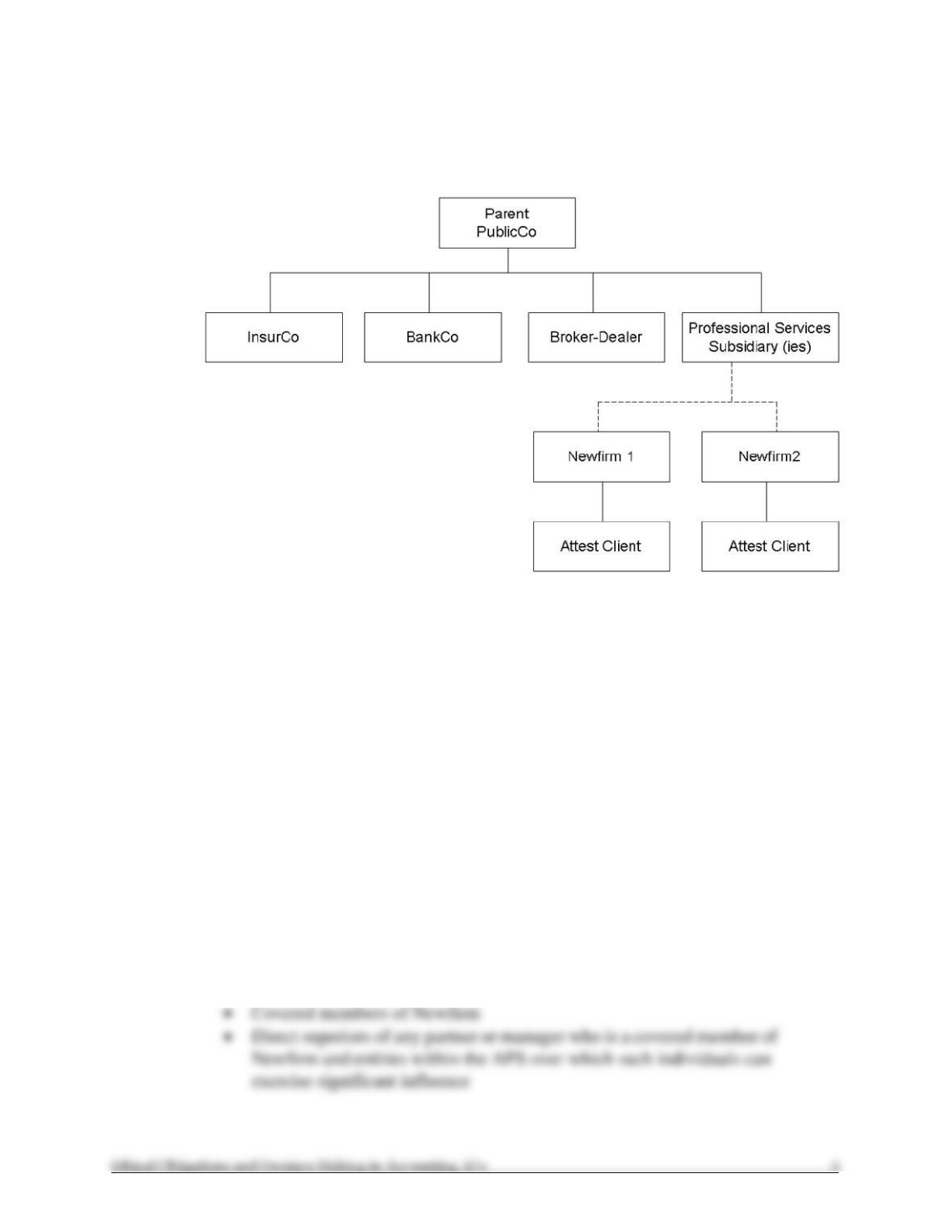
Interpretations
The “Independence Rule” and interpretations normally extend only to those
persons and entities included in the definition of covered members. However, in an
APS environment, the self-interest, management participation, self-review,
advocacy, or undue influence threats to a covered member’s compliance with the
“Independence Rule” may not be at an acceptable level unless certain safeguards are
implemented by other individuals or entities.
Threats to compliance with the Independence Rule would not be at an acceptable
level, could not be reduced to an acceptable level by the application of safeguards,
and independence would be impaired when the following individuals or entities
fail to apply the “Independence Rule” and interpretations with respect to attest
clients of Newfirm:
Ethical Obligations and Decision Making in Accounting, 4/e 7
In addition, threats to compliance with the Independence Rule not be at an acceptable
level, could not be reduced to an acceptable level by the application of safeguards,
and independence would be impaired in the following circumstances:
• Indirect superiors and other public company entities have a material
relationship with an attest client of Newfirm that is prohibited by the
“Overview of Financial Interests” interpretation [1.240.010], the “Trustee
or Executor” interpretation [1.245.010], the “Loans” interpretation
[1.260.010], or the “Joint Closely Held Investments” interpretation
[1.265.020] of the “Independence Rule” (for example, investments, loans,
and so on). In making the test for materiality for financial relationships of an
• Any other public company entity over which an indirect superior has direct
responsibility has a financial relationship with an attest client during the
period of the professional engagement that is material in relation to the other
public company entity’s financial statements.
• Financial relationships of indirect superiors or other public company entities
allow such persons or entities to exercise significant influence over the attest
client during the period of the professional engagement. In making the test
for significant influence, financial relationships of all indirect superiors
and other public company entities should be aggregated.
Ethical Obligations and Decision Making in Accounting, 4/e 8
If an attest client of Newfirm holds an investment in PublicCo that is material to
the attest client or that allows the attest client to exercise significant influence
over PublicCo during the period of the professional engagement, threats to
compliance with the Independence Rule would not be at an acceptable level and
could not be reduced to an acceptable level through the application of safeguards.
1.810.050 Alternative Practice Structures
The Rule states, “A member may practice public accounting only in a form of
organization permitted by law or regulation whose characteristics conform to
resolutions of Council.” The Council resolution requires, among other things, that CPAs
own a majority of the financial interests in a firm engaged to provide attest services (as
defined therein) to the public. This interpretation explains the application of this rule to
an alternative practice structure (APS) in which (a) the majority of the financial interests
in the attest firm is owned by CPAs and (b) all or substantially all of the revenues are
paid to another entity in return for services and the lease of employees, equipment, and
office space.
4. What would you do if you were Billy? Consider the following:
o How can you get it done effectively and efficiently?
o What do you need to say and to whom?
o What can you expect the pushback to be and how might you counteract any
reasons and rationalizations?
From the facts of the case it seems Billy has a reporting relationship to Chad Cryden. It
may be informal or Chad may be Billy’s direct/indirect supervisor. If Chad is the direct
supervisor, his relationship with Billy enables him to exercise significant influence
over Billy’s decision. Even if he is an indirect supervisor, Chad could exercise
significant influence. Either way, Billy, K&B, and even Chad have to be sure not to
violate the Independence Rule. The problem seems to be that Chad could care less
about that and, instead, wants to keep his client happy – Hall Technologies. Based on
this analysis, the questions in #4 can be answered as follows:
1. Billy should speak to the managing partner of the CPA firm and explain the
2. Assuming Billy can enlist the help of the managing partner, they should go to
see Chad and explain the ethical problem. Chad needs to know that just because
3. Chad is likely to play the loyalty card; be a team player; just go along this one
time; and it is standard practice in his experience to make the client happy.
4. Billy and the managing partner should counter that their loyalty is to public
5. As for this being a one-time request and it being standard practice, Billy should
7. In the end, Billy and the managing partner must exercise objectivity, not be
swayed by the conflict of interests, and maintain their integrity in refusing to go