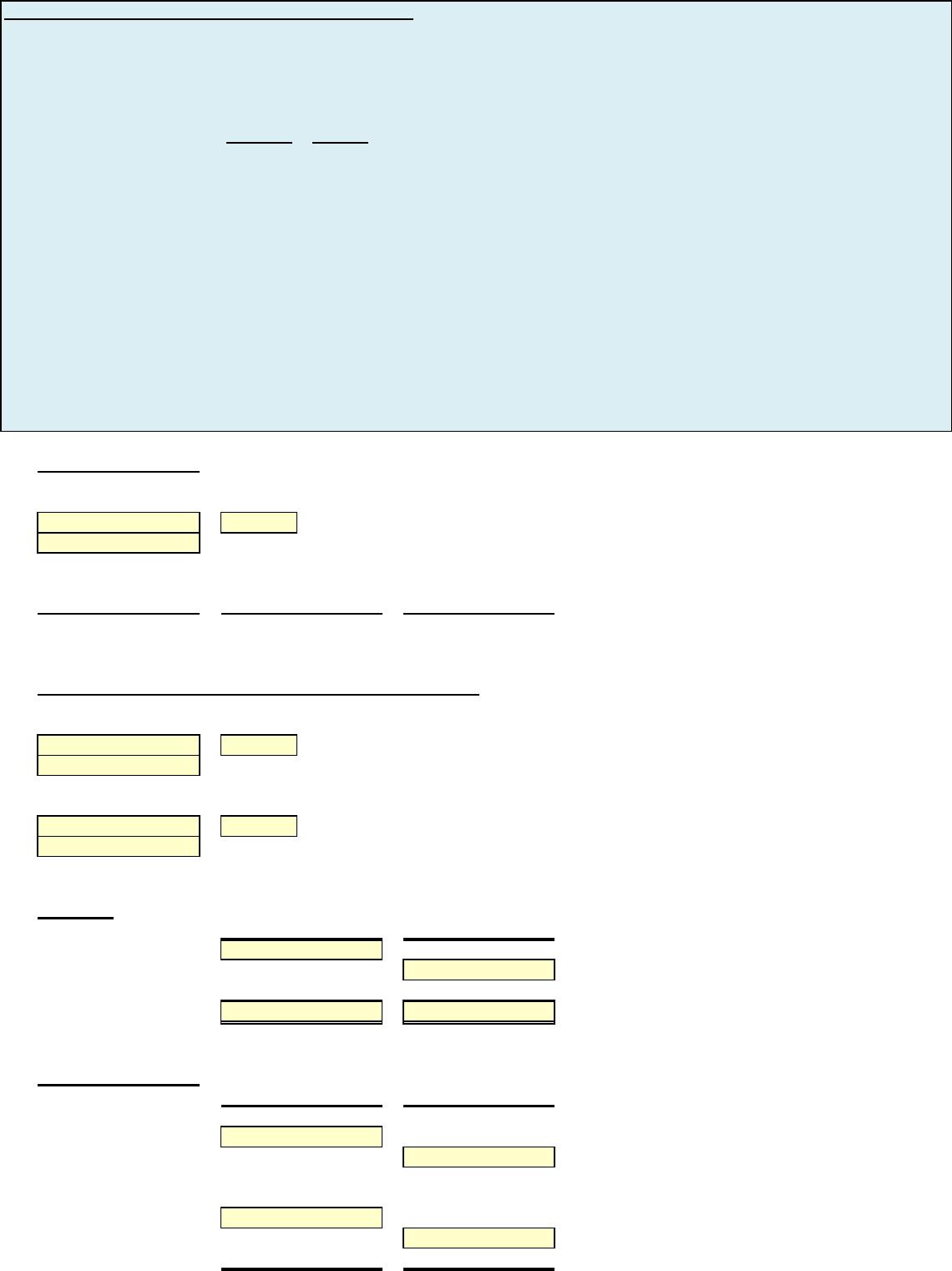
E4-1 Assign overhead using traditional costing and ABC
Saddle Inc. has two types of handbags: standard and custom. The controller has decided to use a plantwide
overhead rate based on direct labor costs. The president has heard of activity-based costing and wants to see how
the results would differ if this system was used. Two activity cost pools were developed: machining and machine
setup. Presented below is information related to the company’s operations.
Standard Custom
Direct labor costs $50,000 $100,000
Machine hours 1,000 1,000
Setup hours 100 400
Total estimated overhead costs are $240,000. Overhead cost allocated to the machining activity cost pool is
$140,000 and $100,000 is allocated to the machine setup activity cost pool.
Instructions
(a) Compute the overhead rate using the traditional (plantwide) approach.
(b) Compute the overhead rates using the activity-based costing approach.
(c) Determine the difference in allocation between the two approaches.
NOTE: Enter a number in cells requesting a value; enter either a number or a formula in cells with a “?” .
(a) Estimated overhead = Predetermined overhead rate
Direct labor costs
= Value of direct labor cost
(b)
Machining
Machine setup
Machining:
= ? per machine hour
Machine setup:
= ? per setup hour
(c ) Traditional costing:
$50,000 x
POH rate
$100,000 x POH rate
Total OH allocation
Machining:
1,000 MH x OH rate
1,000 MH x OH rate
Machine setup:
100 Setup Hr x OH rate
400 Setup Hr x OH rate
?
?
Standard
Custom
?
?
?
?
?
Activity-based costing
Value
Value
Value
Standard
Custom
?
Machine hours
Setup hours
$140,000
100,000
Value
Activity-based overhead rates
Value
Value
Cost drivers
Activity cost pools
Estimated overhead
Total OH allocation
After you have completed E4-1, consider the additional question.
1. Assume that total estimated overhead costs are $285,000. Overhead cost allocated to the machining
activity cost pool is$150,000 and $135,000 is allocated to the machine setup activity cost pool.
Redo instructions (a) to (c).
?
?
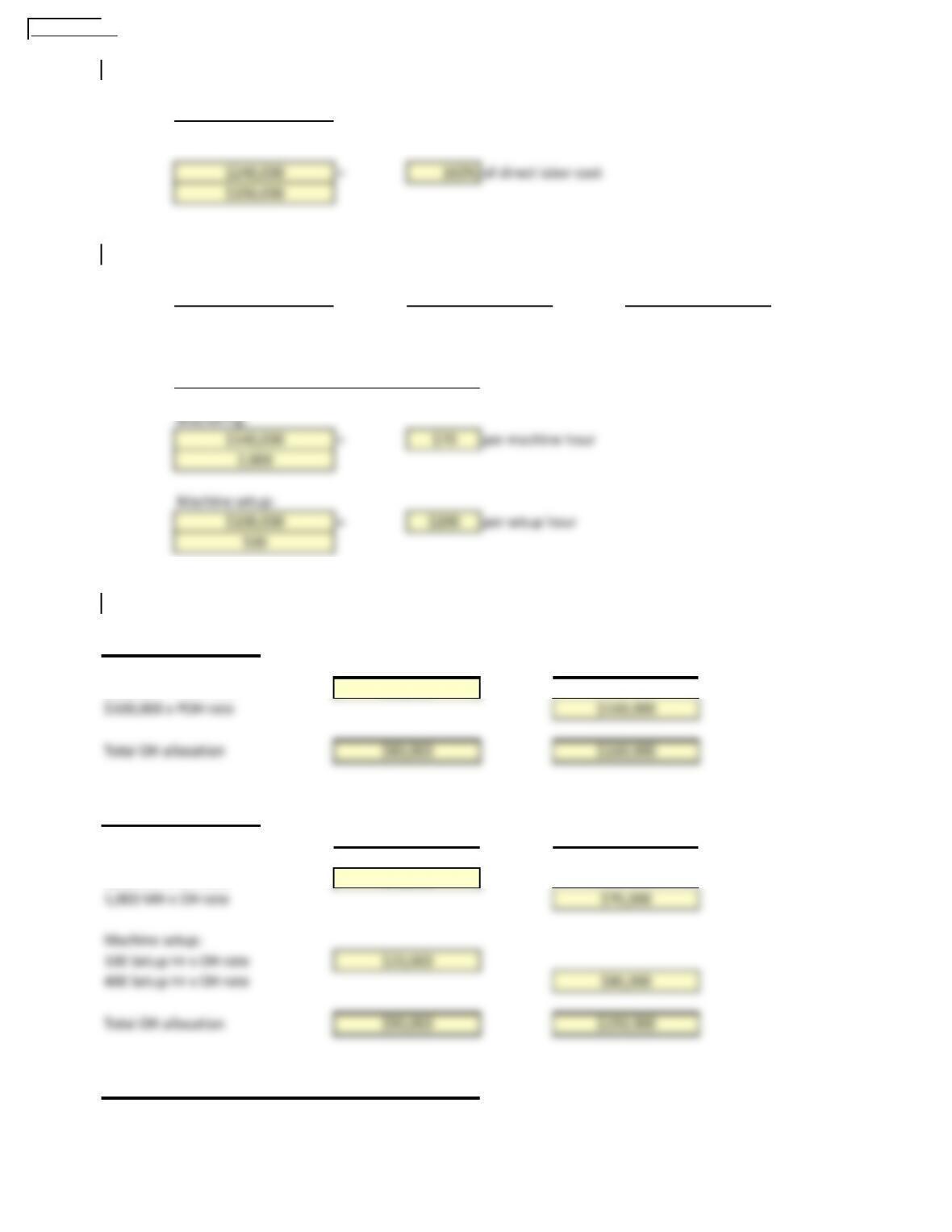
E4-1 Solution
(a) Compute the overhead rate using the traditional (plantwide) approach.
Estimated overhead = Predetermined overhead rate
Direct labor costs
(b) Compute the overhead rates using the activity-based costing approach.
Machining
Machine setup
(c) Determine the difference in allocation between the two approaches.
$50,000 x POH rate
$70,000
$20,000
$80,000
Machining:
1,000 MH x OH rate
The ABC method of OH allocation results in $10,000 ( $90,000 – $80,000) more in OH allocation to standard handbags
and $10,000 ($150,000 – $160,000) less OH allocation to custom handbags.
Difference between traditional costing and ABC:
Activity-based costing
Standard
Custom
$70,000
Standard
Custom
$80,000
Traditional costing:
Machine hours
$140,000
Activity cost pools
Cost drivers
Estimated overhead
Setup hours
100,000
Activity-based overhead rates
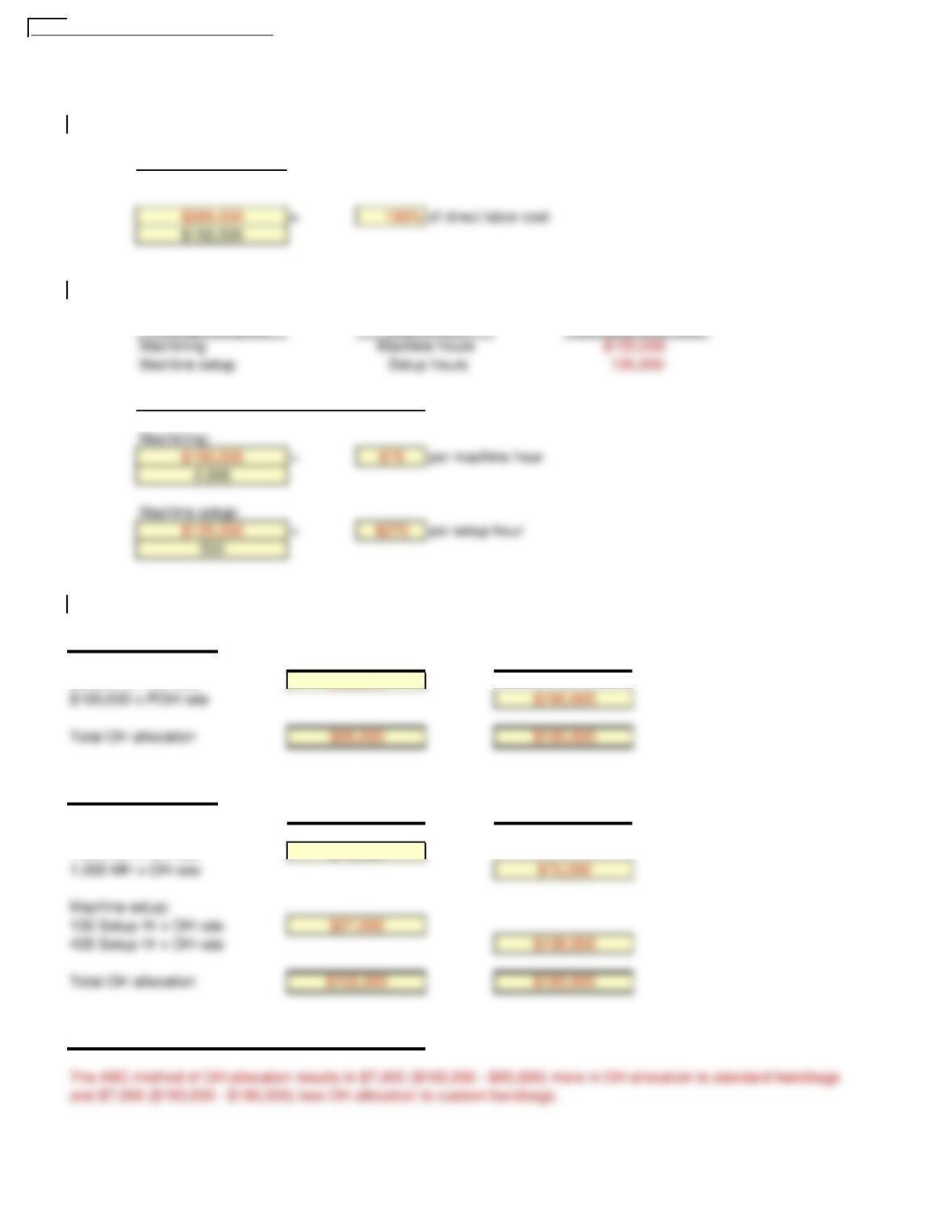
E4-1 Solution to Additional Question
1. Assume that total estimated overhead costs are $285,000. Overhead cost allocated to the machining
activity cost pool is $150,000 and $135,000 is allocated to the machine setup activity cost pool.
Redo instructions (a) to (c).
(a) Compute the overhead rate using the traditional (plantwide) approach.
Estimated overhead = Predetermined overhead rate
Direct labor costs
(b) Compute the overhead rates using the activity-based costing approach.
(c) Determine the difference in allocation between the two approaches.
$50,000 x
$75,000
$27,000
POH rate
Machining:
1,000 MH x OH rate
Difference between traditional costing and ABC:
$75,000
Standard
Custom
Traditional costing:
Standard
Custom
$95,000
Activity-based costing
Estimated overhead
Activity cost pools
Cost drivers
Activity-based overhead rates
E4-4 – Assign overhead using traditional costing and ABC
Altex Inc. manufactures two products: car wheels and truck wheels. To determine the amount of overhead to
assign to each product line, the controller, Robert Hermann, has developed the following information.
Car Truck
Estimated wheels produced 40,000 10,000
Direct labor hours per wheel 1 3
Total estimated overhead costs for the two product lines are $770,000.
Instructions
(a) Compute the overhead cost assigned to the car wheels and truck wheels, assuming that direct labor hours
is used to allocate overhead costs.
(b) Hermann is not satisfied with the traditional method of allocating overhead because he believes that most
of the overhead costs relate to the truck wheels product line because of its complexity. He therefore develops
the following three activity cost pools and related cost drivers to better understand these costs.
Setting up machines
Assembling
Inspection
Compute the activity-based overhead rates for these three cost pools.
(c) Compute the cost that is assigned to the car wheels and truck wheels product lines using an activity-based
costing system, given the following information.
Car Truck
Number of setups 200 800
Direct labor hours 40,000 30,000
Number of inspections 100 1,100
(d) What do you believe Hermann should do?
NOTE: Enter a number in cells requesting a value; enter either a number or a formula in cells with a “?” .
(a) Direct labor hours for car wheels Value
Direct labor hours for truck wheels Value
Total Direct labor hours
?
Total estimated overhead Value Expected Use of Drivers
Total direct labor hours Value
OH rate/DLH ?
Car wheels Truck wheels
Direct labor hours ? ?
Overhead rate / direct labor hour ? ?
Total OH assigned ? ?
Expected Use ABC OH
(b) 0 ÷ of Cost Drivers = Rate
Setting up machines
Value Value ? /setup
Assembling Value Value ? /labor hour
Inspection Value Value ? /inspection
(c )
Expected Use of ABC OH Cost
Cost Driver/Unit Rates Assigned
Setting up machines
Value Value ?
=
Overhead assigned:
Activity Cost Pool
Activity Cost Pool
Car Wheels
x
Expected Use of Cost Drivers per Product
Expected Use of
Activity Cost Pools
Estimated Overhead
Costs
1,000 setups
70,000 labor hours
1,200 inspections
$220,000
280,000
270,000
Cost Drivers
Assembling Value Value ?
Inspection Value Value ?
Total cost assigned ?
Expected Use of ABC OH Cost
Cost Driver/Unit Rates Assigned
Setting up machines
Value Value ?
Assembling Value Value ?
Inspection Value Value ?
Total cost assigned ? ? ?
(d) What do you believe Hermann should do?
After you have completed E4-4, consider the additional question.
1. Assume that total estimated overhead costs changed to $850,000 and the estimated overhead for
Setting up machines and Assembly changed to $260,000 and $320,000 respectively. Redo instruction
(a) to (c). Round overhead rates to two decimal points.
Truck Wheels
x
=
Activity Cost Pool
E4-4 Solution
(a) Compute the overhead cost assigned to the car wheels and truck wheels, assuming that direct labor hours
is used to allocate overhead costs.
Direct labor hours for car wheels 40,000
Car wheels Truck wheels
Direct labor hours 40,000 30,000
(b) Compute the activity-based overhead rates for these three cost pools.
Expected Use ABC OH
Estimated OH ÷ of Cost Drivers = Rate
Setting up machines
$220,000 1,000 $220 /setup
(c) Compute the cost that is assigned to the car wheels and truck wheels product lines using an activity-based
costing system.
Expected Use of ABC OH Cost
Cost Drive/unit Rates Assigned
Setting up machines
200 $220 $44,000
Expected Use of Drivers
Expected Use of ABC OH Cost
Cost Drive/unit Rates Assigned
Setting up machines
800 $220 $176,000
(d) What do you believe Hermann should do?
Assuming that the cost drivers are a reasonable representation of what is occurring in the two product lines, it
seems appropriate to switch to activity-based costing. By using this system, more accurate cost information is
developed which should lead to better allocation of resources and pricing decisions in the future.
120,000
Truck Wheels
x
=
Activity Cost Pool
Overhead assigned:
Activity Cost Pool
Car Wheels
x
=
Activity Cost Pool
E4-4 Solution to Additional Question
1. Assume that total estimated overhead costs changed to $850,000 and the estimated overhead for
Setting up machines and Assembly changed to $260,000 and $320,000 respectively. Redo instructions
(a) to (c ) and round overhead rates to two decimal points.
(a) Compute the overhead cost assigned to the car wheels and truck wheels, assuming that direct labor hours
is used to allocate overhead costs.
Direct labor hours for car wheels 40,000
Direct labor hours for truck wheels 30,000
(b) Compute the activity-based overhead rates for these three cost pools.
Expected Use ABC OH
Estimated OH ÷
of Cost Drivers
= Rate
Setting up machines
$260,000 1,000 $260.00 /setup
(c) Compute the cost that is assigned to the car wheels and truck wheels product lines using an activity-based
costing system.
Expected Use of
ABC OH Cost
Cost Driver/unit
Rates Assigned
Setting up machines
200 $260.00 $52,000
Expected Use of
ABC OH Cost
Cost Drive/unit Rates Assigned
Setting up machines
800 $260.00 $208,000
(d) What do you believe Hermann should do?
=
Assuming that the cost drivers are a reasonable representation of what is occurring in the two product lines, it
seems appropriate to switch to activity-based costing. By using this system, more accurate cost information is
developed which should lead to better allocation of resources and pricing decisions in the future.
Truck Wheels
x
=
Activity Cost Pool
Activity Cost Pool
Car Wheels
x
=
Activity Cost Pool
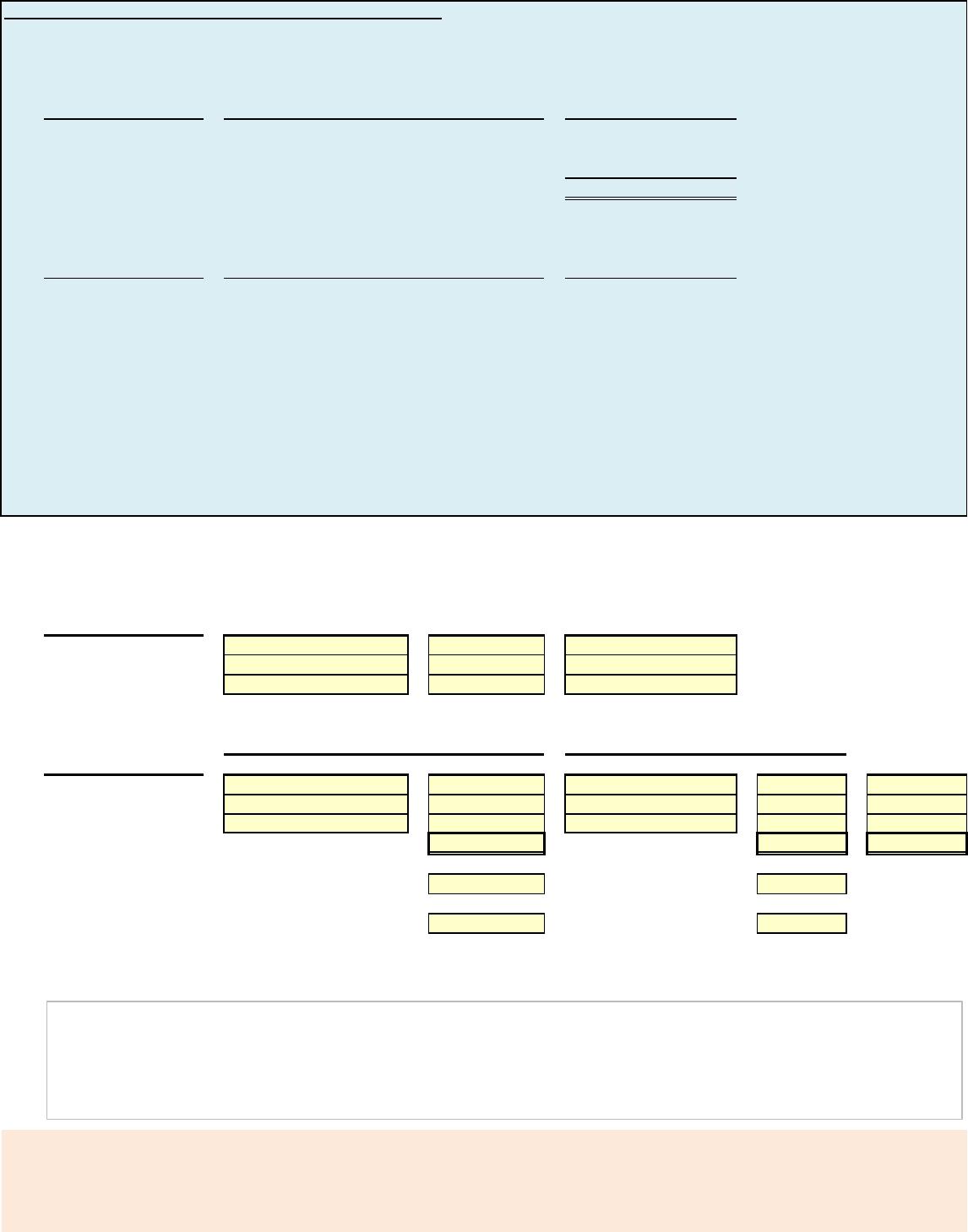
E4-9 Compute overhead rates and assign overhead using ABC
Air United, Inc. manufactures two products: missile range instruments and space pressure gauges. During April,
50 range instruments and 300 pressure gauges were produced, and overhead costs of $94,500 were estimated. An
analysis of estimated overhead costs reveals the following activities.
Total Cost
1. Materials handling Number of requisitions $40,000
2. Machine setups Number of setups 21,500
3. Quality inspections Number of inspections 33,000
$94,500
The cost driver volume for each product was as follows.
Instruments Gauges Total
Number of requisitions 400 600 1,000
Number of setups 200 300 500
Number of inspections 200 400 600
Instructions
(a) Determine the overhead rate for each activity.
(b) Assign the manufacturing overhead costs for April to the two products using activity-based costing.
and compute the overhead cost per unit.
(c) Write a memorandum to the president of Air United explaining the benefits of activity-based costing.
NOTE: Enter a number in cells requesting a value; enter either a number or a formula in cells with a “?” .
(a) The overhead rates are:
Expected Use
Estimated ÷ of Cost Driver/ = Activity-Based
Overhead Activity OH Rates
Materials Handling Value Value ? / requisition
Machine Setups Value Value ? / setup
Quality inspections Value Value ? / inspection
(b) The assignment of overhead costs to products is as follows:
Cost
Number Cost Number Cost Assigned
Requisitions Value ? Value ? ?
Machine setups Value ? Value ? ?
Inspections Value ? Value ? ?
Total costs assigned ? Expected Use of Drivers ? ?
Units produced Value Value
OH cost per unit ? ?
`
(c ) Write a memorandum to the president of Air United explaining the benefits of activity-based costing.
0
After you have completed E4-9, consider the additional question.
1. Assume that total estimated overhead costs changed to $190,000 and the estimated overhead for
materials handling, machine setup and quality inspection changed to $105,000, $38,000 and
$47,000 respectively. Redo instructions (a) to (b) and round overhead rates to two decimal points.
Cost Driver
Instruments
Gauges
Activities
Cost Drivers
Cost Drivers
Activity Cost Pools
E4-9 Solution
(a) Determine the overhead rate for each activity.
The overhead rates are:
Expected Use
Estimated ÷ of Cost Driver/ = Activity-Based
Overhead Activity OH Rates
Materials Handling $40,000 1,000 $40 / requisition
(b) Assign the manufacturing overhead costs for April to the two products using activity-based costing.
The assignment of overhead costs to products is as follows:
Cost
Number Cost Number Cost Assigned
Requisitions 400 $16,000 600 $24,000 $40,000
Machine setups 200 $8,600 300 $12,900 $21,500
`
(c ) Write a memorandum to the president of Air United explaining the benefits of activity-based costing.
To: President, Major Instrument, Inc.
From: Student
Re: Benefits of activity-based costing (ABC)
Activity Cost Pools
Instruments
Gauges
Cost Driver
MEMO
E4-9 Solution to Additional Question
1. Assume that total estimated overhead costs changed to $190,000 and the estimated overhead for
materials handling, machine setup and quality inspection changed to $105,000, $38,000 and
$47,000 respectively. Redo instructions (a) to (b) and round overhead rates to two decimal points.
(a) Determine the overhead rate for each activity.
Expected Use
Estimated ÷ of Cost Driver/ = Activity-Based
Overhead Activity OH Rates
Activity Cost Pools
(b) Assign the manufacturing overhead costs for April to the two products using activity-based costing.
The assignment of overhead costs to products is as follows:
Cost
Cost Driver Number Cost Number Cost Assigned
(c) Write a memorandum to the president of Air United explaining the benefits of activity-based costing.
MEMO
To: President, Major Instrument, Inc.
From: Student
Re: Benefits of activity-based costing (ABC)
ABC focuses on the activities performed in producing a product. Overhead costs are assigned to
products based on cost drivers that measure the activities performed on the product.
The primary benefit of ABC is more accurate and meaningful product costing. This improved
Gauges
The overhead rates are:
Instruments
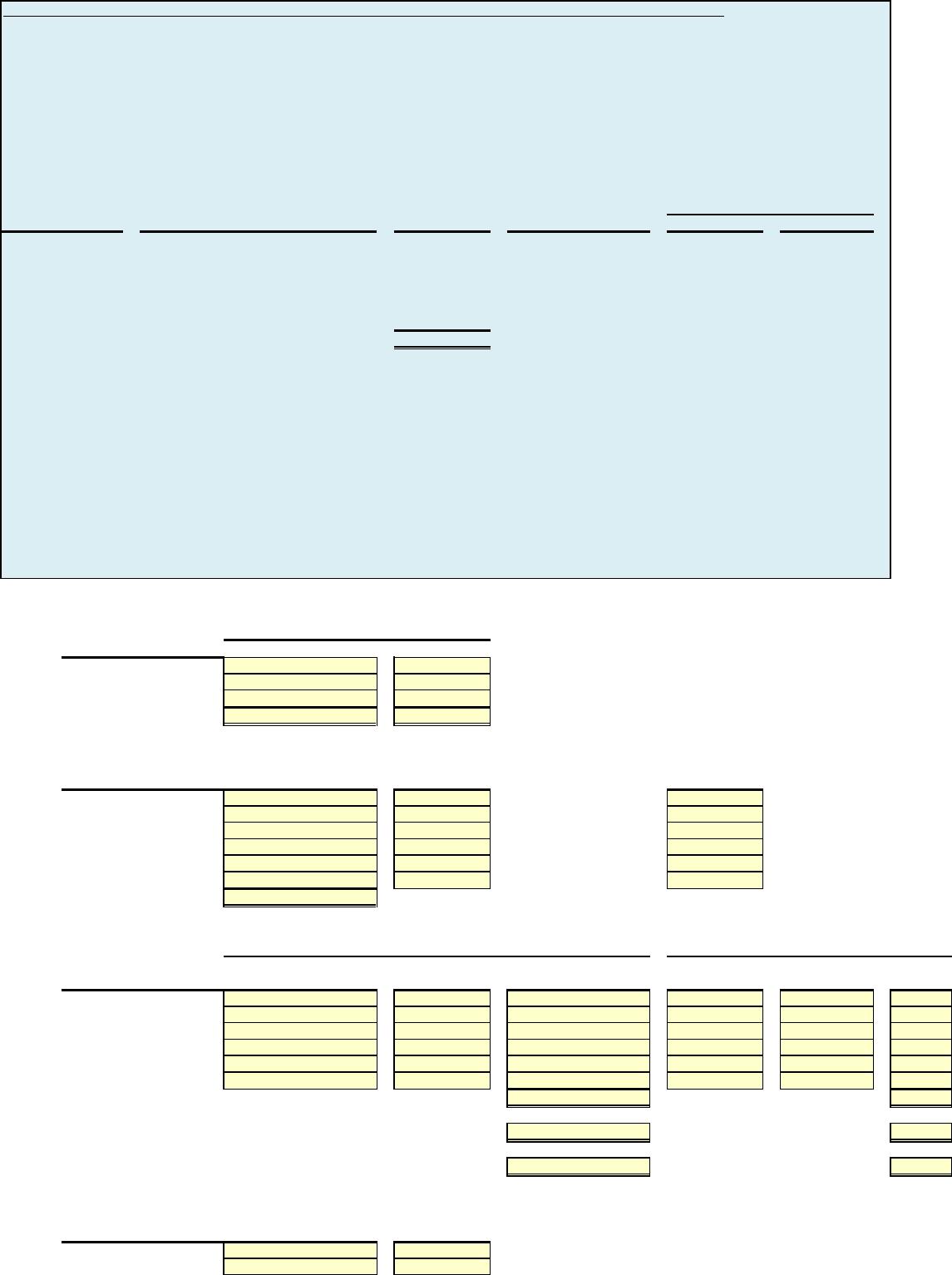
P4-1A Assign overhead using traditional costing and ABC; compute unit costs; classify activities as value- or non-value-added
Combat Fire, Inc. manufactures steel cylinders and nozzles for two models of fire extinguishers: (1) a home fire extinguisher
and (2) a commercial fire extinguisher. The home model is a high-volume (54,000 units), half-gallon cylinder that holds 2 1/2
pounds of multi-purpose dry chemical at 480 PSI. The commercial model is a low-volume (10,200 units), two-gallon cylinder
that holds 10 pounds of multi-purpose dry chemical at 390 PSI. Both products require 1.5 hours of direct labor for completion.
Therefore, total annual direct labor hours are 96,300 or [1.5 hours x (54,000 + 10,200)]. Expected annual manufacturing
overhead is $1,584,280. Thus, the predetermined overhead rate is $16.45 or ($1,584,280 ÷ 96,300) per direct labor hour.
The direct materials cost per unit is $18.50 for the home model and $26.50 for the commercial model. The direct labor cost
is $19 per unit for both the home and the commercial models.
The company’s managers identified six activity cost pools and related cost drivers and accumulated overhead by cost pool
as follows.
Estimated
Estimated Use of Cost
Overhead Drivers Home Commercial
Receiving Pounds $80,400 335,000 215,000 120,000
Forming Machine hours 150,500 35,000 27,000 8,000
Assembling Number of parts 412,300 217,000 165,000 52,000
Testing Number of tests 51,000 25,500 15,500 10,000
Painting Gallons 52,580 5,258 3,680 1,578
Packing and shipping Pounds 837,500 335,000 215,000 120,000
$1,584,280
Instructions
(a) Under traditional product costing, compute the total unit cost of each product. Prepare a simple comparative
schedule of the individual costs by product (similar to Illustration 4-3 on page 5).
(b) Under ABC, prepare a schedule showing the computations of the activity-based overhead rates (per cost driver).
(c) Prepare a schedule assigning each activity‘s overhead cost pool to each product based on the use of cost drivers.
(Include a computation of overhead cost per unit, rounding to the nearest cent.)
(d) Compute the total cost per unit for each product under ABC.
(e) Classify each of the activities as a value-added activity or a non-value-added activity.
(f) Comment on (1) the comparative overhead cost per unit for the two products under ABC, and (2) the comparative
total costs per unit under traditional costing and ABC.
NOTE: Enter a number in cells requesting a value; enter either a number or a formula in cells with a “?” .
(a) Manufacturing Costs Home Model Commercial Model
Direct materials Value Value
Direct labor Value Value
Overhead Value Value
Total unit cost ? ?
Expected Use of Drivers
Estimated ÷
Expected Use of
= Activity-Based
(b) Overhead Cost Drivers OH Rate
Receiving Value Value Pounds ?
Forming Value Value MH ?
Assembling Value Value Parts ?
Testing Value Value Tests ?
Painting Value Value Gallons ?
Packing and shipping Value Value Pounds ?
?
(c)
MH x Activity-Based = Cost Expected Use x
Activity-Based
= Cost
of Drivers OH Rates Assigned of Drivers OH Rates Assigned
Receiving Value Value ? Value Value ?
Forming Value Value ? Value Value ?
Assembling Value Value ? Value Value ?
Testing Value Value ? Value Value ?
Painting Value Value ? Value Value ?
Packing and shipping Value Value ? Value Value ?
Total cost assigned (a) ? ?
Units produced Value Value
OH cost per unit (a) +(b) ? ?
Home Commercial
(d) Model Model
Direct materials Value Value
Direct labor Value Value
Commercial Model
Expected Use of
Drivers by Product
ABC Manufacturing Costs
Products
Activity Cost Pool
Activity Cost Pools
Activity Cost Pool
Home Model
Cost Drivers
Overhead Value Value
Total cost per unit ? ?
(e )
Receiving
Forming
Assembly
Testing
Painting
Packing and shipping
(f) Comment on (1) the comparative overhead cost per unit for the two products under ABC, and (2) the comparative
total costs per unit under traditional costing and ABC.
After you have completed P4-1A, consider the additional question.
1. Assume that total estimated overhead costs for Receiving, Assembly and Painting changed to
$110,400, $425,000, and $72,600 respectively. Redo instructions (a) to (c ) and round overhead
rates to two decimal points.
classification
classification
classification
classification
classification
classification
Activity
Value- vs. Non-Value-Added
P4-1A Solution
(a) Under traditional product costing, compute the total unit cost of each product. Prepare a simple comparative
schedule of the individual costs by product (similar to Illustration 4-3 on page 5).
Manufacturing Costs Home Model Commercial Model
Direct materials $18.50 $26.50
Direct labor 19.00 19.00
(b) Under ABC, prepare a schedule showing the computations of the activity-based overhead rates (per cost driver).
Estimated ÷ Expected Use of = Activity-Based
Overhead Cost Drivers OH Rate
Receiving $80,400 335,000 Pounds $0.24 / pound
(c ) Prepare a schedule assigning each activity’s overhead cost pool to each product based on the use of cost drivers.
(Include a computation of overhead cost per unit, rounding to the nearest cent.)
Expected Use x Activity-Based = Cost Expected Use x
Activity-Based
Value-added
Value-added
Non-value-added
= Cost
of Drivers OH Rates Assigned of Drivers OH Rates Assigned
Receiving 215,000 $0.24 $51,600 120,000 $0.24 $28,800
Forming 27,000 $4.30 116,100 8,000 $4.30 34,400
(d) Compute the total cost per unit for each product under ABC.
Home Commercial
Model Model
Direct materials $18.50 $26.50
Direct labor 19.00 19.00
0
(e ) Classify each of the activities as a value-added activity or a non-value-added activity.
Receiving
Forming
(f)(1) Comment on the comparative overhead cost per unit for the two products under ABC
(f)(2) Comment on the comparative total costs per unit under traditional costing and ABC.
The comparison of ABC and traditional costing shows that the proper amount of overhead assigned to
the two products is not equal at $24.68 but rather $20.12 for the home model and $48.80 for the commercial
Activity
Value- vs. Non-Value-Added
Non-value-added
Value-added
ABC Manufacturing Costs
Products
Activity Cost Pool
Home Model
Commercial Model
Activity Cost Pool
P4-1A Solution to Additional Question
1. Assume that total estimated overhead costs for Receiving, Assembly and Painting changed to
$110,400, $425,000, and $72,600 respectively. Redo instructions (a) to (c ) and round overhead
rates to two decimal points.
(a) Under traditional product costing, compute the total unit cost of each product. Prepare a simple comparative
schedule of the individual costs by product (similar to Illustration 4-3 on page 5).
Manufacturing Costs Home Model Commercial Model
Direct materials $18.50 $26.50
Direct labor 19.00 19.00
(b) Under ABC, prepare a schedule showing the computations of the activity-based overhead rates (per cost driver).
Estimated ÷ Expected Use of = Activity-Based
Overhead Cost Drivers OH Rate
Receiving $110,400 335,000 Pounds $0.33 /pound
Forming 150,500 35,000 MH $4.30 / MH
(c ) Prepare a schedule assigning each activity’s overhead cost pool to each product based on the use of cost drivers.
(Include a computation of overhead cost per unit, rounding to the nearest cent.)
Expected Use x Activity-Based = Cost Expected Use x
Activity-Based
= Cost
of Drivers OH Rates Assigned of Drivers OH Rates Assigned
Receiving 215,000 $0.33 $70,854 120,000 $0.33 $39,546
Forming 27,000 $4.30 116,100 8,000 $4.30 34,400
Value-added
Non-value-added
(d) Compute the total cost per unit for each product under ABC.
Home Commercial
Model Model
Direct materials $18.50 $26.50
Direct labor 19.00 19.00
(e ) Classify each of the activities as a value-added activity or a non-value-added activity.
Receiving
Forming
Assembly
(f)(1) Comment on the comparative overhead cost per unit for the two products under ABC
(f)(2) Comment on the comparative total costs per unit under traditional costing and ABC.
The comparison of ABC and traditional costing shows that the proper amount of overhead assigned to
the two products is not equal at $24.68 but rather $20.92 for the home model and $50.74 for the commercial
Activity
Value- vs. Non-Value-Added
Non-value-added
Value-added
Value-added
ABC Manufacturing Costs
Products
Activity Cost Pool
Home Model
Commercial Model
Activity Cost Pool
P4-2A Assign overhead to products using ABC and evaluate decision
Schultz Electronics manufactures two ultra high-definition television models: the Royale which sells for $1,600 and
a new model, the Majestic, which sells for $1,300. The production cost computed per unit under traditional costing
for each model in 2017 as follows.
Royale Majestic
Direct materials $700 $420
Direct labor ($20 per hours)
120 100
Manufacturing overhead ($38 per DLH) 228 190
Total per unit cost $1,048 $710
In 2017, Schultz manufactured 25,000 units of the Royale and 10,000 units of the Majestic. The overhead rate of
$38 per direct labor hour was determined by dividing total expected manufacturing overhead of $7,600,000 by the
total direct labor hours (200,000) for the two models.
Under traditional costing, the gross profit on the models was Royale 552 ($1,600 – $1,048) and Majestic $590
($1,300 – $710). Because of this difference, management is considering phasing out the Royale model and increasing
the production of the Majestic model.
Before finalizing its decision, management asks Schultz’s controller to prepare an analysis using activity-based
costing (ABC). The controller accumulates the following information about overhead for the year ended December 31, 2017.
Activity Estimated Estimated Use Activity-Based
Cost Pools Overhead of Cost Drivers
Overhead
Rates
Purchasing Number of orders $1,200,000 $30/order
Machine setups Number of setups 900,000 $50/setup
Machining Machine hours 4,800,000 $40/hour
Quality control Number of inspections 700,000 $25/inspection
The cost drivers used for each product were:
Cost Drivers Royale Majestic Total
Purchase orders 17,000 23,000 40,000
Machine setups 5,000 13,000 18,000
Machine hours 75,000 45,000 120,000
Inspections 11,000 17,000 28,000
Instructions
(a) Assign the total 2017 manufacturing overhead costs to the two products using activity-based costing (ABC) and
determine the overhead cost per unit.
(b) What was the cost per unit and gross profit of each model using ABC costing?
(c) Are management’s future plans for the two models sound? Explain.
NOTE: Enter a number in cells requesting a value; enter either a number or a formula in cells with a “?” .
Expected Use of Drivers
(a) The allocation of total manufacturing overhead using activity-based costing is as follows:
Total
Overhead Rate Drivers Used Cost Assigned Drivers Used Cost Assigned Overhead
Purchase order@$30 Value ?Value ? ?
Machine setups @$50 Value ?Value ? ?
Machine hours @$40 Value ?Value ? ?
Inspections @$25 Value ?Value ? ?
Total assigned costs (a) ? ? ?
Units produced (b) Value Value
$0
Cost per unit (a) ÷ (b) ? ?
(b) The cost per unit and gross profit of each model under ABC costing were:
Royale Majestic
Direct materials Value Value
Direct labor Value Value
Manufacturing overhead Value Value
Total cost per unit ? ?
Royale
Majestic
Traditional Costing
28,000
40,000
18,000
120,000
Cost Drivers
Sales price per unit Value Value
Cost per unit Value Value
Gross profit per unit ? ?
(c) Are management’s future plans for the two models sound? Explain.
After you have completed P4-2A, consider the additional question.
1. Assume that the purchase orders used by Royale and Majestic changed to 19,000 and 21,000 respectively.
Also assume that the number of inspections used by Royale and Majestic models changed to 12,000 and 16,000
respectively. Redo instsructions (a) to (c ) and round cost and gross profit per unit to two decimal points.
P4-2A Solution
(a) The allocation of total manufacturing overhead using activity-based costing is as follows:
Total
Drivers Used Cost Assigned Drivers Used Cost Assigned Overhead
Purchase order@$30 17,000 $510,000 23,000 $690,000 $1,200,000
Machine setups @$50 5,000 250,000 13,000 650,000 900,000
(b) The cost per unit and gross profit of each model under ABC costing were:
Royale Majestic
Direct materials $700.00 $420.00
Direct labor 120.00 100.00
(c ) Are management’s future plans for the two models sound? Explain.
Royale
Majestic
Overhead Rate
P4-2A Solution to Additional Question
1. Assume that the purchase orders used by Royale and Majestic changed to 19,000 and 21,000 respectively.
Also assume that the number of inspections used by Royale and Majestic models changed to 12,000 and 16,000
respectively. Redo instsructions (a) to (c ) and round cost and gross profit per unit to two decimal points.
(a) The allocation of total manufacturing overhead using activity-based costing is as follows:
Total
Drivers Used Cost Assigned Drivers Used Cost Assigned Overhead
Purchase order@$30 19,000 $570,000 21,000 $630,000 $1,200,000
Units produced (b) 25,000 10,000
(b) The cost per unit and gross profit of each model under ABC costing were:
Royale Majestic
Direct materials $700.00 $420.00
Direct labor 120.00 100.00
(c ) Are management’s future plans for the two models sound? Explain.
Royale
Majestic
Overhead Rate
Management’s future plans for the two television models are not sound.
Under ABC costing, the Royale model is $183.20 per unit ($615.20 –
CD4 – Excel Tutorial
As you learned in the previous chapters, Current Designs has two main product lines – composite kayaks, which are handmade and
very labor-intensive, and rotomolded kayaks, which require less labor but employ more expensive equipment. Current Design’s
controller, Diane Buswell, is now evaluating several different methods of assigning overhead to these products. It is important to
ensure that costs are appropriately assigned to the company’s products. At the same time, the system that is used must not be so
complex that its costs are greater than its benefits.
Diane has decided to use the following activities and costs to evaluate the methods of assigning overhead.
Cost
Designing new models $121,000
Creating and testing prototypes 152,000
Creating molds for kayaks 188,500
Operating oven for the rotomolded kayaks 40,000
Operating the vacuum line for the composite kayaks 28,000
Supervising production employees 180,000
Curing time :(the time that is needed for the chemical
processes to finish before the next step in
the production process; many of these
costs are related to the space required in
the building) 190,500
Total $900,000
As Diane examines the data, she decides that the cost of operating the oven for the rotomolded kayaks and the cost of operating
the vacuum line for the composite kayaks can be directly assigned to each of these products lines and do not need to be allocated
with the other costs.
Instructions
For purpose of this analysis, assume that Current Designs uses $234,000 in direct labor costs to produce 1,000 composite kayaks
and $286,000 in direct labor costs to produce 4,000 rotomolded kayaks each year.
(a) One method of allocating overhead would allocate the common costs to each product line by using a allocation basis such as
the number of employees working on each type of kayak or the amount of factory space used for the production of each type of kayak.
Diane knows that about 50% of the area of the plant and 50% of the employees work on the composite kayaks, and the remaining space
and other employees work on the rotomolded kayaks. Using this information and remembering that the cost of operating the oven
and vacuum line have been directly assigned, determine the total amount to be assigned to the composite kayak line and the
rotomolded kayak line, and the amount to be assigned to each of the units in each line.
(b) Another method of allocating overhead is to use direct labor dollars as an allocation basis. Remembering that the costs of the
oven and the vacuum line have been assigned directly to the product lines, allocate the remaining costs using direct labor
dollars as the allocation basis. Then, determine the amount of overhead that should be assigned to each unit of each product
line using this method.
(c) Activity-based costing requires a cost driver for each cost pool. Use the following information to assign the costs to the product
Expected Use of Drivers
lines using the activity-based costing approach.
Designing new models Number of models
Creating and test prototypes Number of prototypes
Creating molds for kayaks Number of molds
Supervising production kayaks Number of employees
Curing time Number of days of curing time
What amount of overhead should be assigned to each composite kayak using this method? What amount of overhead
should be assigned to each rotomolded kayak using this method?
Composite Kayaks
(d) Which of the three methods do you think Current Designs should use? Why?
NOTE: Enter a number in cells requesting a value; enter either a number or a formula in cells with a “?” .
(a) Determine the total amount to be assigned to the composite kayak line and the rotomolded kayak line, and the amount to be
assigned to each of the units in each of the units in each line.
Composite Rotomolded
Directly assigned Value Value
Remaining amount allocated 50%
to each product line
Total ? ?
Number of units Value Value
Cost assigned per unit ? ?
(b) Determine the amount of overhead that should be assigned to each unit of each product using direct labor dollars as an allocation basis.
Value
Value
3
6
12
12
15,000
1
2
1
12
2,000
Driver Amount for
Rotomolded Kayaks
Activities
Activity Cost Pools
Cost Drivers
Driver Amount for
Composite Kayaks
Overhead Rate
Total OH costs (a)_ Value
Direct labor cost (b)
Composite Value
Rotomolded Value ?
OH rate (a) ÷ (b) ?
Composite Rotomolded
Directly assigned Value Value
Remaining amount allocated
based on direct labor costs
Total ? ?
Number of units Value Value
Cost assigned per unit ? ?
(c) What amount of overhead should be assigned to each composite kayak and rotomolded kayak using the activity-based costing method?
Activity Cost Pools Estimated Overhead
Estimated Use
of Cost Drivers
Activity-Based
OH Rates
Design Value Value ? / model
Prototypes Value Value ? / prototype
Molds Value Value ? / mold
Supervision Value Value ? / employee
Curing time Value Value ? / day
Activity Cost Pools Expected Use of Drivers
Overhead
Rates
Cost
Assigned
Expected Use of
Drivers
Overhead
Rates
Cost
Assigned
Design Value Value ?Value Value ?
Prototypes Value Value ?Value Value ?
Molds Value Value ?Value Value ?
Supervision Value Value ?Value Value ?
Curing time Value Value ?Value Value ?
Total amount allocated ? ?
Directly assigned ? ?
Total Cost (a) ? ?
Number of units(b) Value Value
Cost assigned/unit ? ?
(a) ÷ (b)
(d) Which of the three methods do you think Current Designs should use? Why?
After you have completed CD4, consider the additional question.
1. Assume that the number of prototypes created for composite kayaks and rotomolded kayaks changed to 8 and 4 respectively.
Redo instruction (c) and round cost assigned /unit to two decimal points.
Rotomolded
?
?
Composite
CD4 – Excel Tutorial Solution
(a) Determine the total amount to be assigned to the composite kayak line and the rotomolded kayak line, and the amount to be
assigned to each of the units in each of the units in each line.
Composite Rotomolded
Directly assigned $28,000 $40,000
Remaining amount allocated 50% ($832,000)
(b) Determine the amount of overhead that should be assigned to each unit of each product using direct labor dollars as an allocation basis.
Overhead Rate
Total OH costs (a) $832,000
Composite Rotomolded
Directly assigned $28,000 $40,000
Remaining amount allocated
to each product line
based on direct labor costs
(c ) What amount of overhead should be assigned to each composite kayak and rotomolded kayak using the activity-based costing method?
Activity Cost Pools Estimated Overhead
Estimated Use
of Cost Drivers
Activity-Based
OH Rates
Design $121,100 4 $30,275 / model
Prototypes 152,000 8 $19,000 / prototype
Molds 188,500 13 $14,500 / mold
Activity Cost Pools Expected Use of Drivers
Overhead
Rates
Cost
Assigned
Expected Use of Drivers
Overhead
Rates
Cost Assigned
Design 3 $30,275 $90,825 1 $30,275 $30,275
Prototypes 6 $19,000 114,000 2 $19,000 38,000
Total amount allocated 636,825 195,175
Directly assigned 28,000 40,000
12
(d) Activity based costing assigns significantly more costs to the composite kayaks. Since the cost is divided into pools and each
pool is allocated using a cost driver that is related to those particular costs, it provides a more accurate way to allocate the
costs. Current Designs would need to weigh the additional costs of implementing an ABC system against the benefits that
it provides.
374,400
457,600
Composite
Rotomolded
416,000
416,000
374,400
457,600
CD4 – Excel Tutorial Solution to Additional Question
1. Assume that the number of prototypes created for composite kayaks and rotomolded kayaks changed to 8 and 4 respectively.
Redo instruction (c) and round cost assigned /unit to two decimal points.
(a) Determine the total amount to be assigned to the composite kayak line and the rotomolded kayak line, and the amount to be
assigned to each of the units in each of the units in each line.
Composite Rotomolded
Directly assigned $28,000 $40,000
Remaining amount allocated 50% ($832,000)
to each product line
(b) Determine the amount of overhead that should be assigned to each unit of each product using direct labor dollars as an allocation basis.
Overhead Rate
Total OH costs (a) $832,000
Direct labor cost (b)
Composite $234,000
Composite Rotomolded
Directly assigned $28,000 $40,000
(c ) What amount of overhead should be assigned to each composite kayak and rotomolded kayak using the activity-based costing method?
Activity Cost Pools Estimated Overhead
Estimated Use
of Cost Drivers
Activity-
Based OH
Rates
Design $121,100 4 $30,275 / model
Activity Cost Pools Expected Use of Drivers
Overhead
Rates
Cost
Assigned
Expected Use of
Drivers
Overhead
Rates
Cost Assigned
Design 3 $30,275 $90,825 1 $30,275 $30,275
Supervision 12 $7,500 90,000 12 $7,500 90,000
Curing time 15,000 $11.20 168,000 2,000 $11.20 22,400
(d) Activity based costing assigns significantly more costs to the composite kayaks. Since the cost is divided into pools and each
Rotomolded
416,000
416,000
Composite