1. The end-of-period spreadsheet illustrates the flow of accounting information from the unadjusted
trial balance into the adjusted trial balance and into the financial statements. In doing so, the
spreadsheet illustrates the impact of the adjustments on the financial statements.
3. Current liabilities are liabilities that will be due within a short time (usually one year or less) and
that are to be paid out of current assets. Liabilities that will not be due for a comparatively long
time (usually more than one year) are called long-term liabilities.
4. Revenue, expense, and drawing accounts are generally referred to as temporary accounts.
5. Cash, Office Equipment
6. Closing entries are necessary at the end of an accounting period (1) to transfer the balances in
temporary accounts to permanent accounts and (2) to prepare the temporary accounts for use in
recording transactions for the next accounting period.
10. a. The financial statements are the most important output of the accounting cycle.
b. Yes. All companies have an accounting cycle that begins with analyzing and journalizing
transactions and ends with a post-closing trial balance. However, companies may differ in
how they implement the steps in the accounting cycle. For example, while most companies
use computerized accounting systems, some companies may use manual systems.
CHAPTER 4
COMPLETING THE ACCOUNTING CYCLE
DISCUSSION QUESTIONS
CHAPTER 4 Completing the Accounting Cycle
PE 4-1A
1. Balance sheet 5. Income statement
PE 4-1B
1. Balance sheet 5. Balance sheet
2. Balance sheet 6. Balance sheet
PE 4-2A
Cyrus Bautista, capital, January 1, 20Y3 $471,900
PE 4-2B
Ava Marie Rowland, capital, January 1, 20Y3 $781,000
Net loss $(34,500)
Withdrawals (19,000)
Road Runner Delivery Services
Statement of Owner’s Equity
For the Year Ended December 31, 20Y3
PRACTICE EXERCISES
Aquarius Advertising Services
Statement of Owner’s Equity
For the Year Ended December 31, 20Y3
CHAPTER 4 Completing the Accounting Cycle
PE 4-3A
1. Property, plant, and equipment (b) 5. Current liability (c)
PE 4-3B
1. Current liability (c) 5. Owner’s equity (e)
PE 4-4A
Dec. 31 Fees Earned 1,644,500
Wages Expense 1,239,200
Closing Entries
PE 4-4B
Apr. 30 Oscar Killingsworth, Capital 5,500
Fees Earned 279,100
PE 4-5A
The following two steps are missing: (1) posting the transactions to the ledger
and (2) preparing the financial statements. Transactions should be posted
to the ledger after step (a). The financial statements should be prepared after step (f).
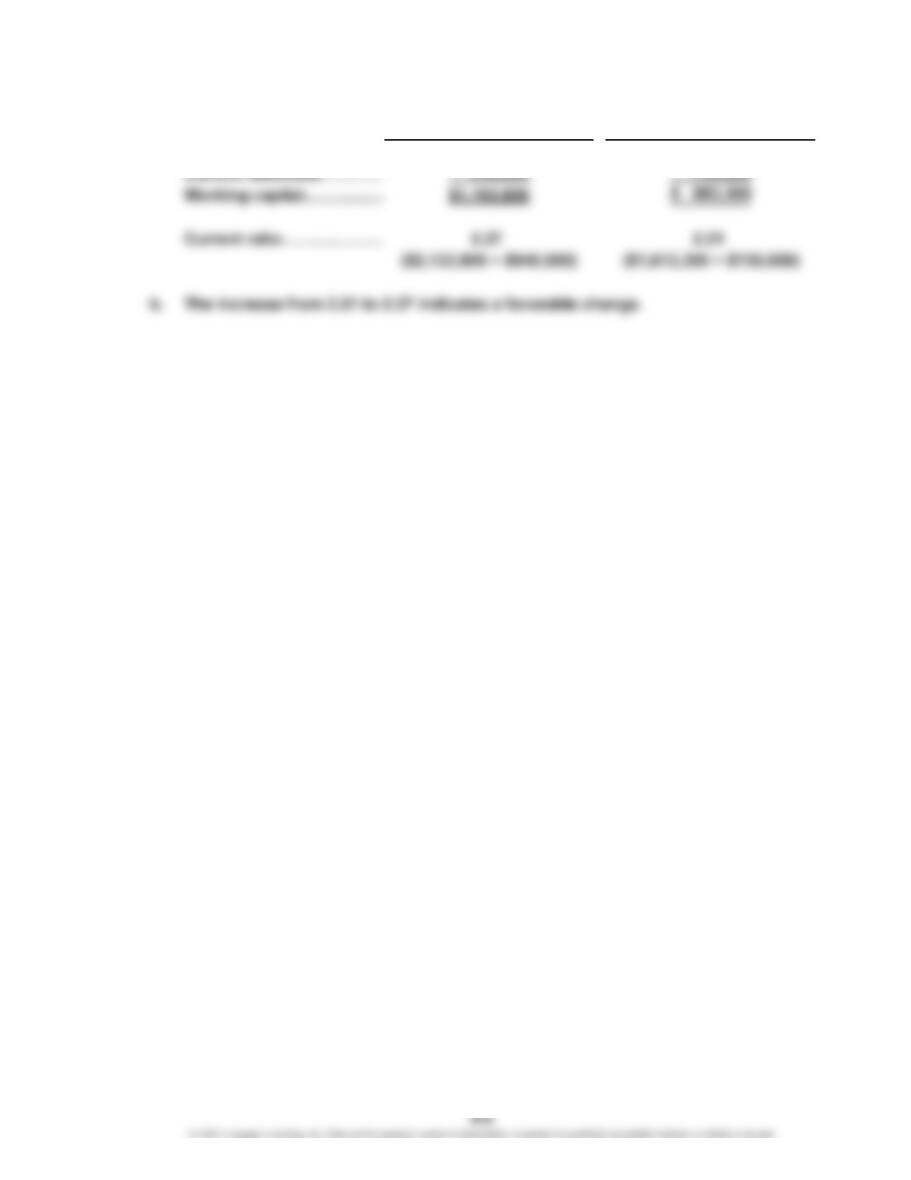
PE 4-6A
a.
Current assets…………
…
…
1,150,000
Closing Entries
20Y9
$2,042,400
20Y8
$1,759,500
1,380,000
CHAPTER 4 Completing the Accounting Cycle
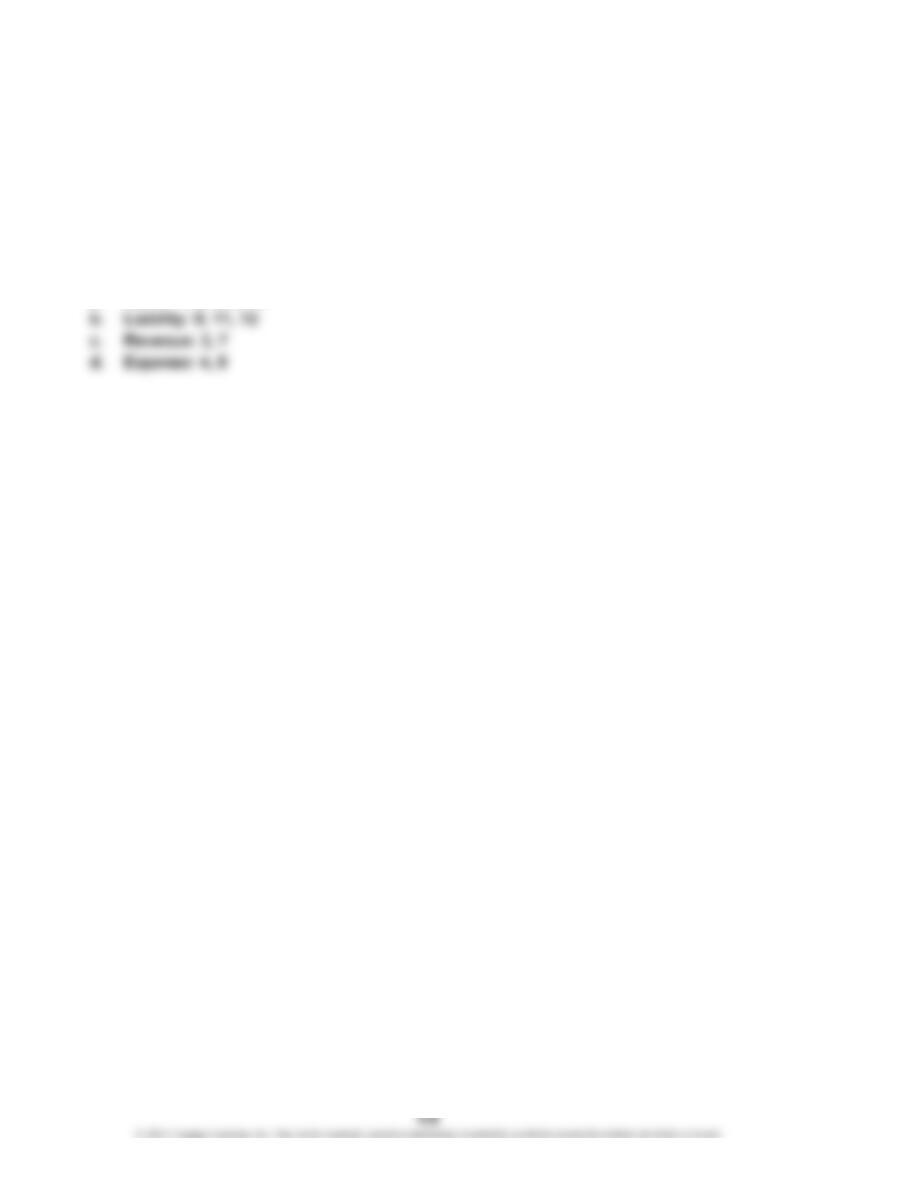
PE 4-6B
a.
Current assets……………
…
20Y9
$2,133,800
20Y8
$1,613,300
…
CHAPTER 4 Completing the Accounting Cycle
Ex. 4-1
1. Income statement: 5, 8, 9
2. Statement of owner’s equity: 4
3. Balance sheet: 1, 2, 3, 6, 7, 10
Ex. 4-2
a. Asset: 1, 2, 5, 6, 10
EXERCISES
CHAPTER 4 Completing the Accounting Cycle
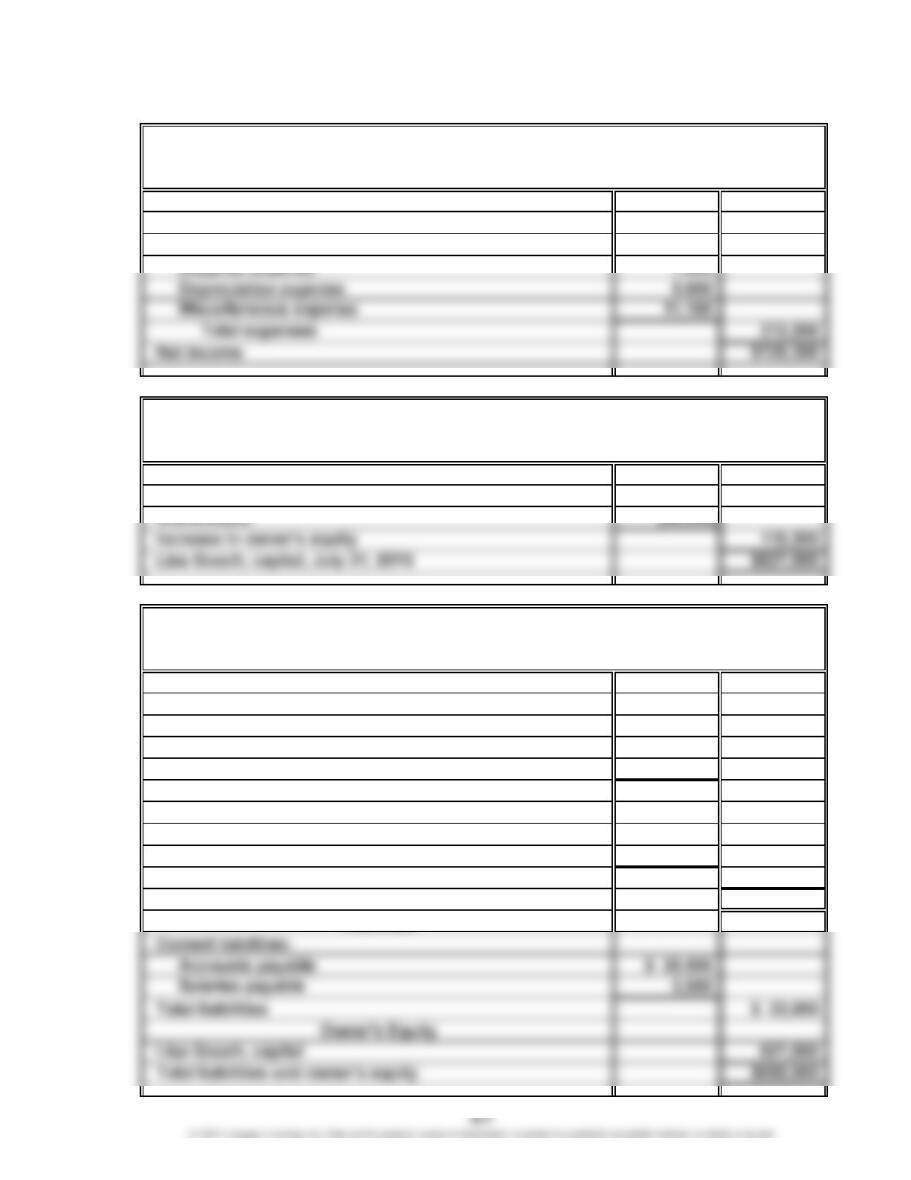
Ex. 4-3
Fees earned $348,500
Expenses:
Salary expense $189,000
Lisa Gooch, capital, August 1, 20Y4 $516,700
Net income $135,300
Current assets:
Cash $ 58,000
Accounts receivable 106,200
Supplies 4,400
Total current assets $168,600
Property, plant, and equipment:
Office equipment $515,000
Less accumulated depreciation 33,600
Total property, plant, and equipment 481,400
Total assets $650,000
Bamboo Consulting
Income Statement
For the Year Ended July 31, 20Y5
Assets
Bamboo Consulting
Statement of Owner’s Equity
For the Year Ended July 31, 20Y5
Bamboo Consulting
Balance Sheet
July 31, 20Y5
CHAPTER 4 Completing the Accounting Cycle
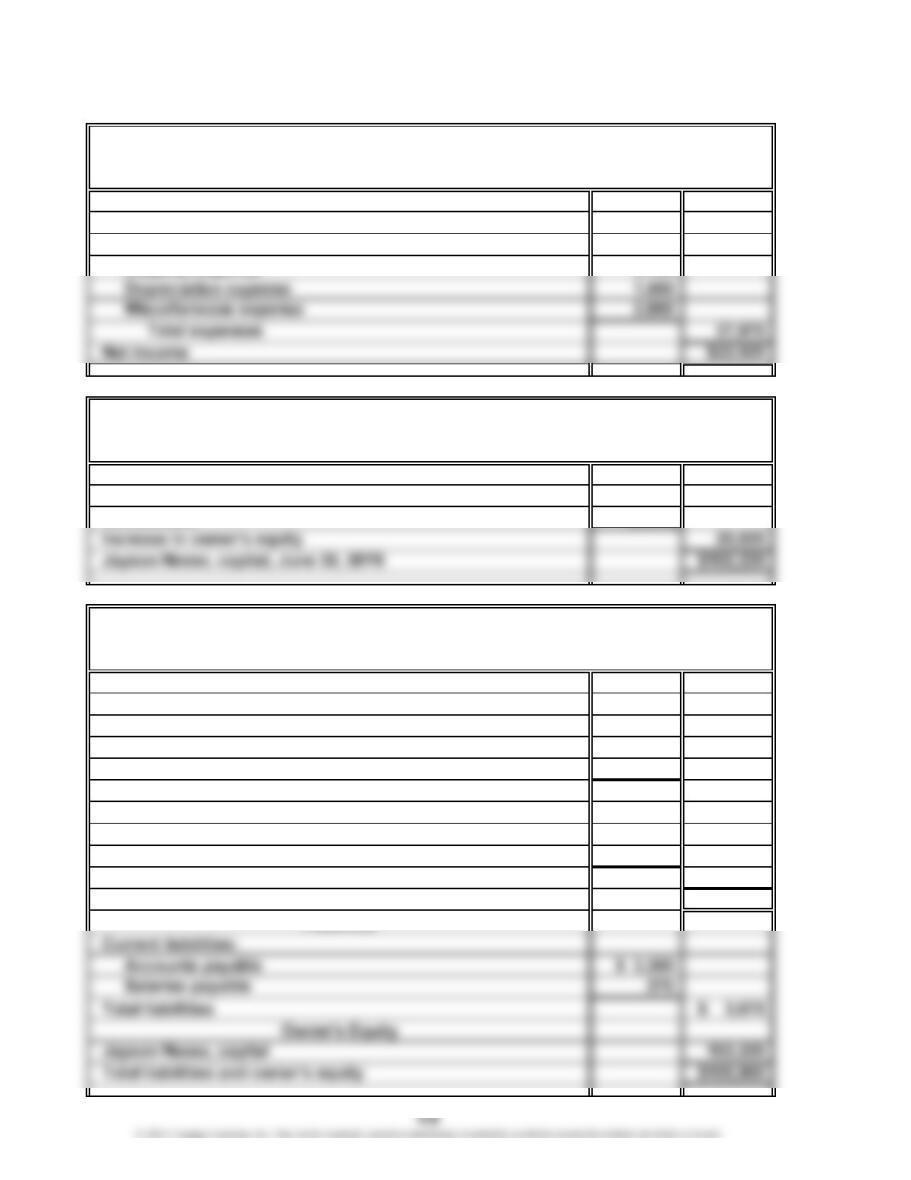
Ex. 4-4
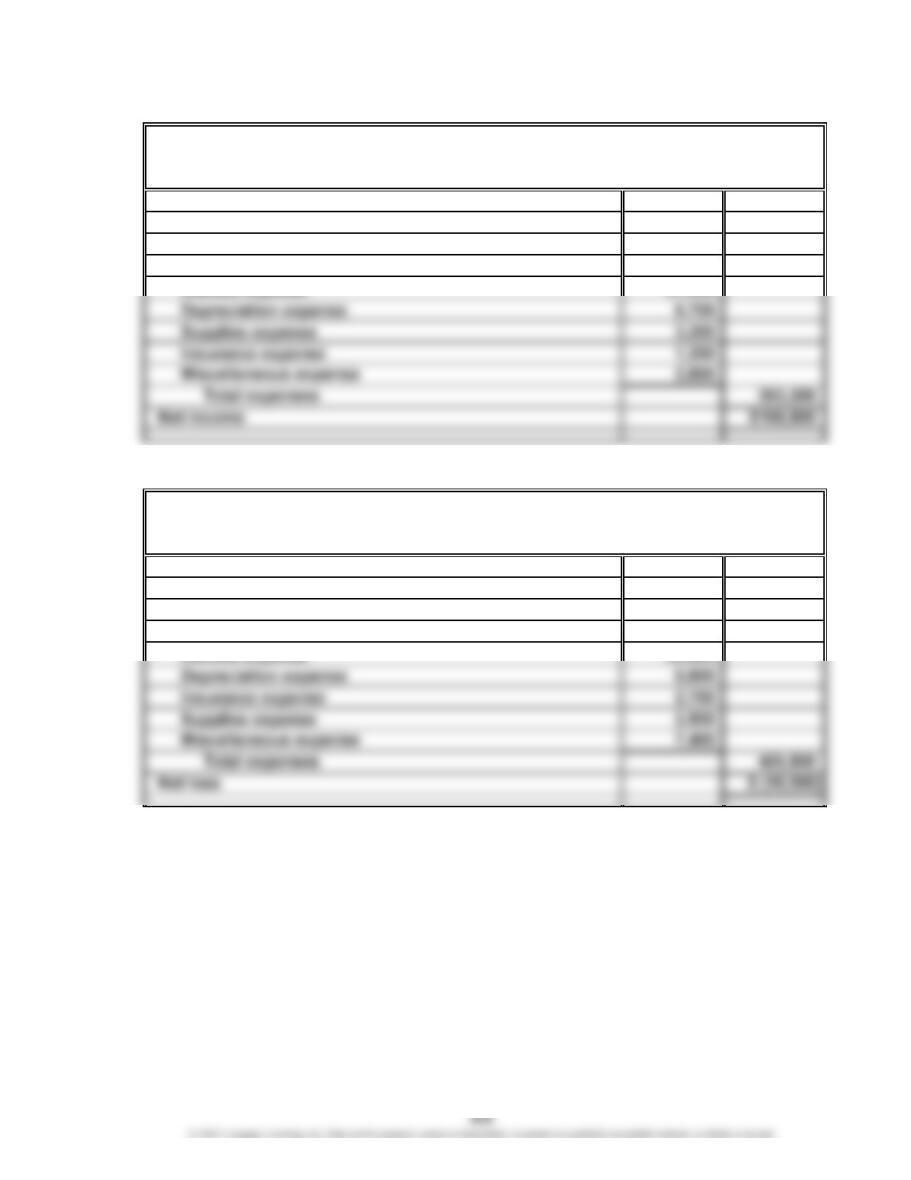
Fees earned $60,000
Expenses:
Salary expense $32,375
Jayson Neese, capital, July 1, 20Y5 $ 82,200
Net income $22,025
Withdrawals (2,000)
Current assets:
Cash $27,000
Accounts receivable 53,500
Supplies 900
Total current assets $ 81,400
Property, plant, and equipment:
Office equipment $30,500
Less accumulated depreciation 6,000
Total property, plant, and equipment 24,500
Total assets $105,900
Assets
Elliptical Consulting
Income Statement
For the Year Ended June 30, 20Y6
Elliptical Consulting
Statement of Owner’s Equity
For the Year Ended June 30, 20Y6
Elliptical Consulting
Balance Sheet
June 30, 20Y6
CHAPTER 4 Completing the Accounting Cycle
Ex. 4-5
Fees earned $522,000
Expenses:
Salaries expense $260,900
Rent expense 46,500
Ex. 4-6
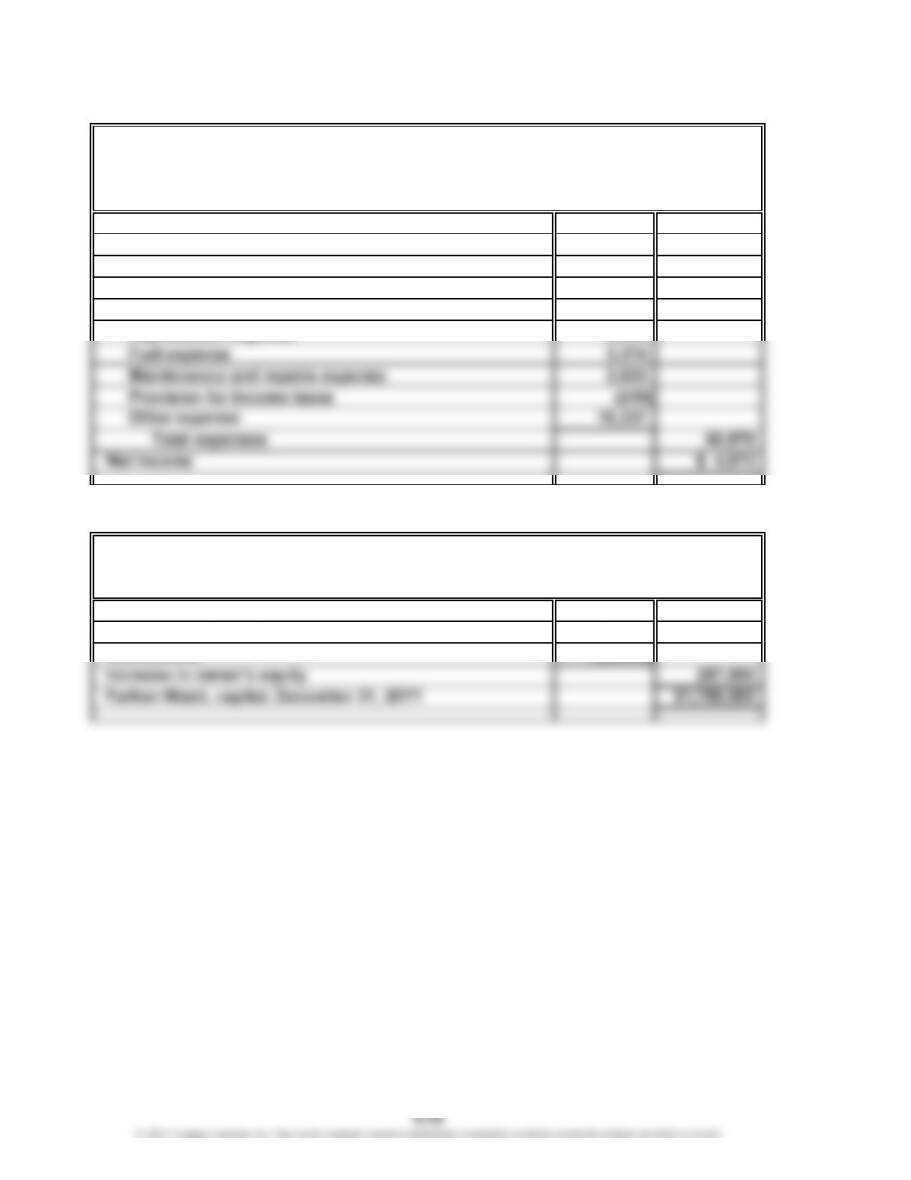
Service revenue $407,900
Expenses:
Wages expense $327,500
Rent expense 49,100
Income Statement
For the Year Ended February 28, 20Y0
Capstone Messenger Service
Income Statement
For the Year Ended April 30, 20Y7
Guardian Health Services Co.
CHAPTER 4 Completing the Accounting Cycle
Ex. 4-7
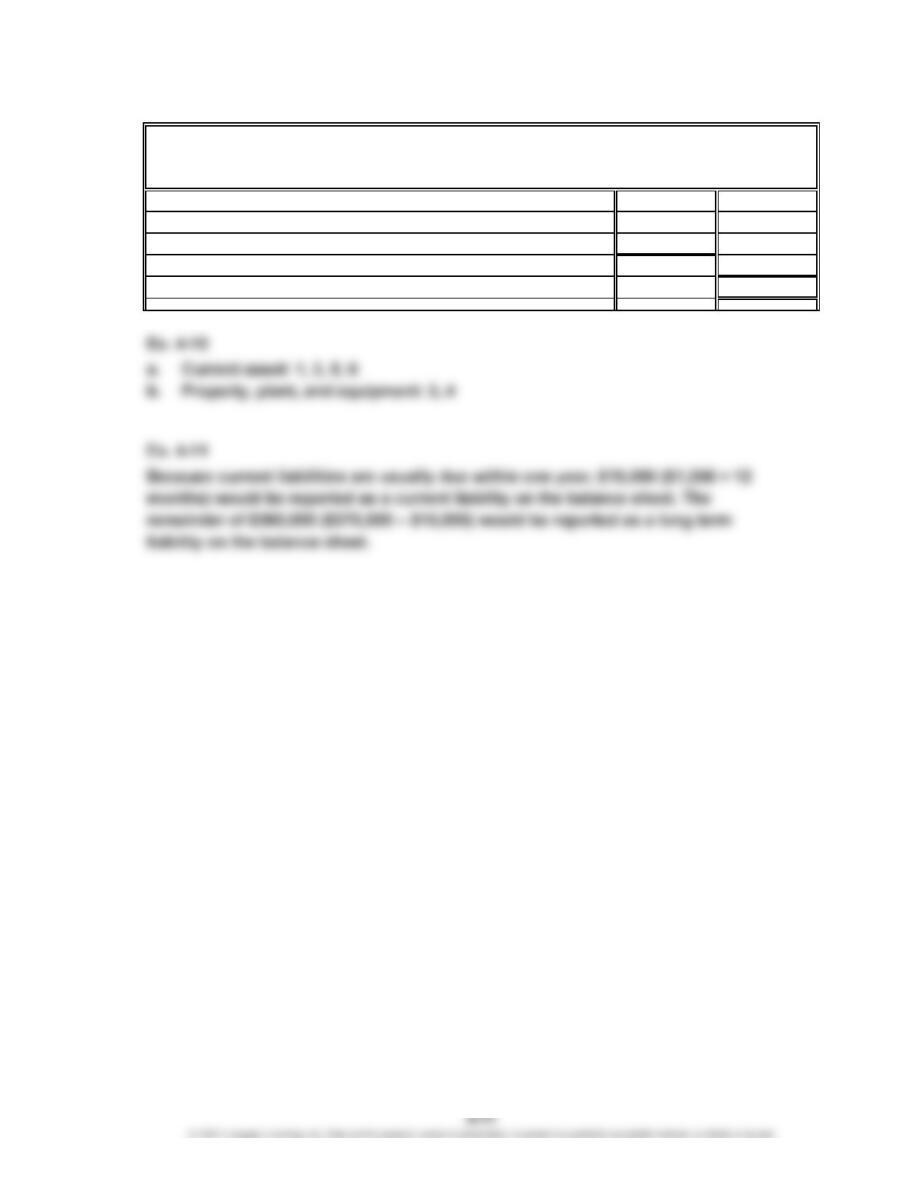
Revenues $65,450
Expenses:
Salaries and employee benefits $23,207
Purchased transportation 15,101
Rentals and landing fees 3,361
Ex. 4-8
Farhan Wasti, capital, January 1, 20Y1 $1,502,000
Net income $385,000
Statement of Owner’s Equity
For the Year Ended December 31, 20Y1
FedEx Corporation
Income Statement
For the Year Ended May 31
(in millions)
Serenity Systems Co.
CHAPTER 4 Completing the Accounting Cycle
Ex. 4-9
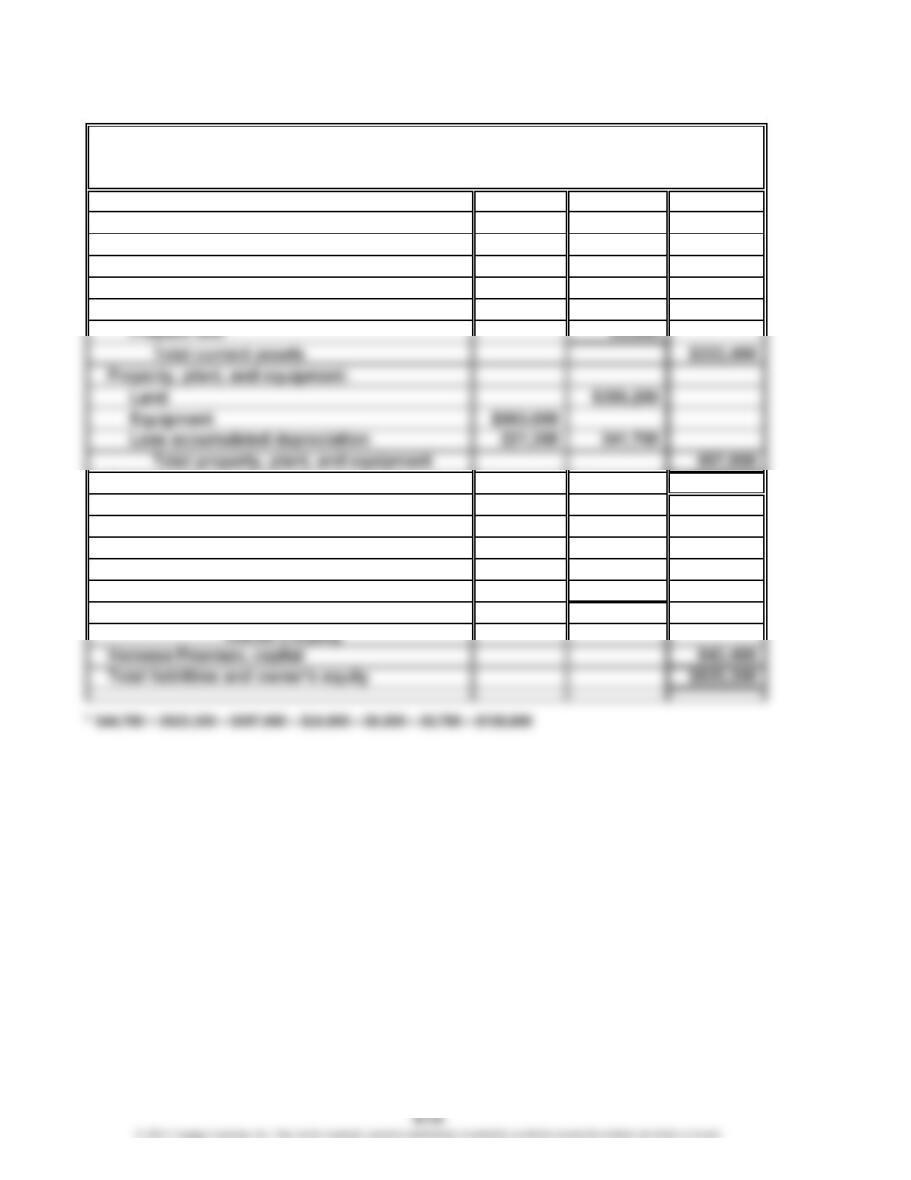
Angelo Phelps, capital, May 1, 20Y1 $537,100
Net loss $(35,200)
Withdrawals (9,200)
Decrease in owner’s equity (44,400)
Angelo Phelps, capital, April 30, 20Y2 $492,700
Masterpiece Arts
Statement of Owner’s Equity
For the Year Ended April 30, 20Y2
CHAPTER 4 Completing the Accounting Cycle
Ex. 4-12
Current assets:
Cash* $ 44,700
Accounts receivable 138,600
Supplies 5,700
Prepaid insurance 8,500
Total assets $920,300
Current liabilities:
Accounts payable $ 44,800
Salaries payable 10,700
Unearned fees 21,400
Total liabilities $ 76,900
MaxFit Weight Loss Co.
Balance Sheet
November 30, 20Y4
Assets
Liabilities
CHAPTER 4 Completing the Accounting Cycle
Ex. 4-13
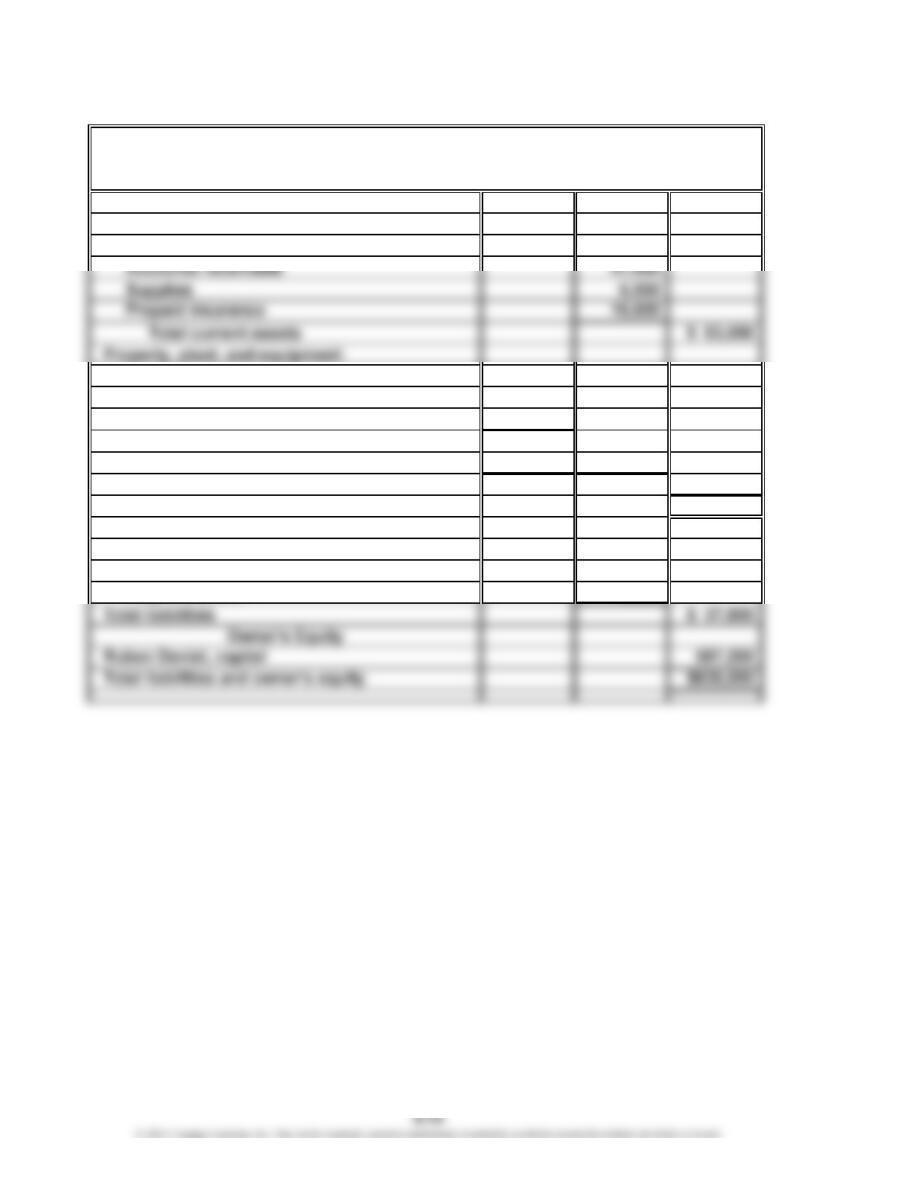
1. The date of the statement should be “August 31, 20Y3” and not “For the Year
3. Land should be classified as property, plant, and equipment.
4. “Accumulated depreciation” should be deducted from the related fixed asset.
5. An adding error was made in determining the amount of the total property,
plant, and equipment.
6. Accounts receivable should be a current asset.
CHAPTER 4 Completing the Accounting Cycle
Ex. 4-13 (Concluded)
Current assets:
Cash $ 18,500
Land $225,000
Building $400,000
Less accumulated depreciation 155,000 245,000
Equipment $ 97,000
Less accumulated depreciation 25,000 72,000
Total property, plant, and equipment 542,000
Total assets $625,000
Current liabilities:
Accounts payable $ 31,300
Wages payable 6,500
Liabilities
Labyrinth Services Co.
Balance Sheet
August 31, 20Y3
Assets
CHAPTER 4 Completing the Accounting Cycle
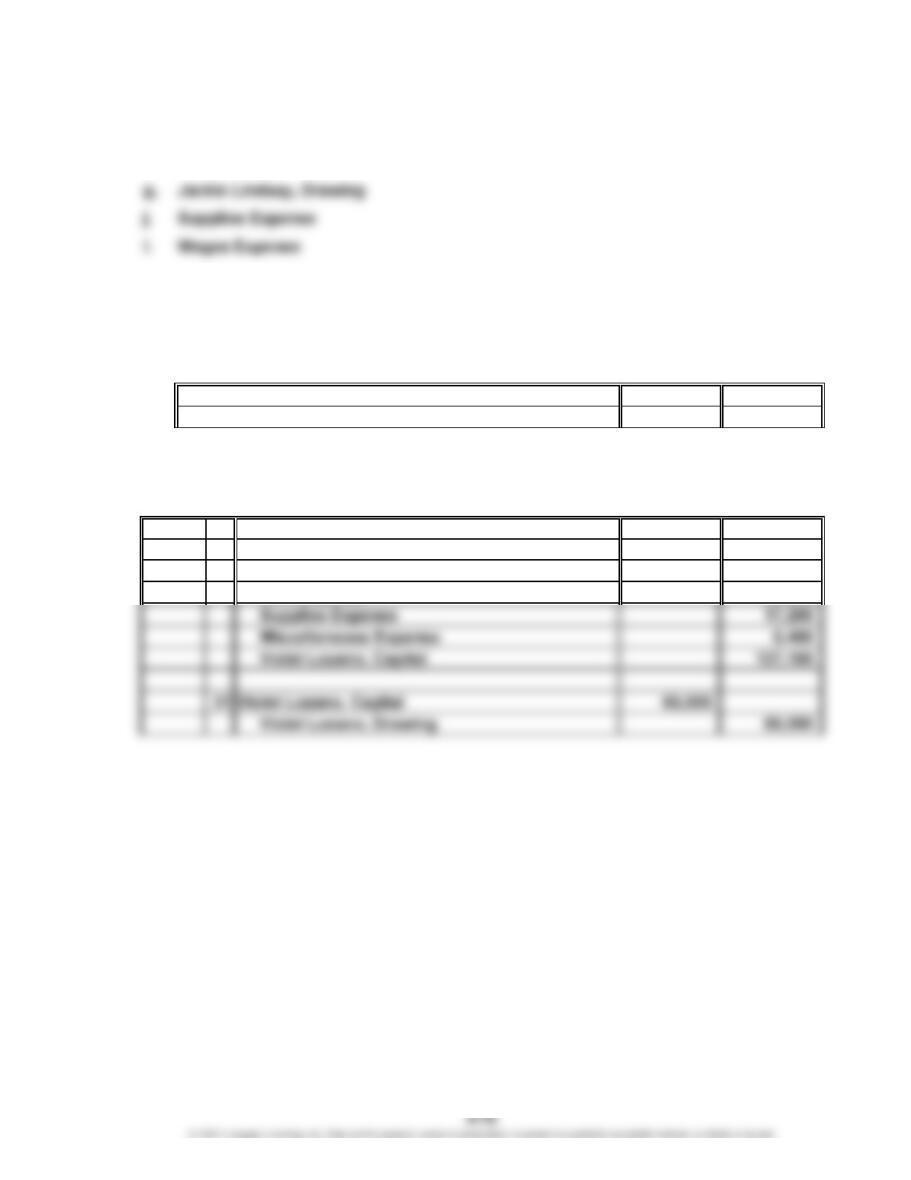
Ex. 4-14
d. Depreciation Expense
e. Fees Earned
Ex. 4-15
$1,447,000 ($8,315,000 – $6,460,000 – $408,000)
Ex. 4-16
a. Teresa Schafer, Capital 770,000
Teresa Schafer, Drawing 770,000
b. $1,955,000 ($1,885,000 + $3,190,000 – $2,350,000 – $770,000)
Ex. 4-17
July 31 Fees Earned 545,000
Wages Expense 342,400
Rent Expense 52,900
Closing Entries
CHAPTER 4 Completing the Accounting Cycle
Ex. 4-18
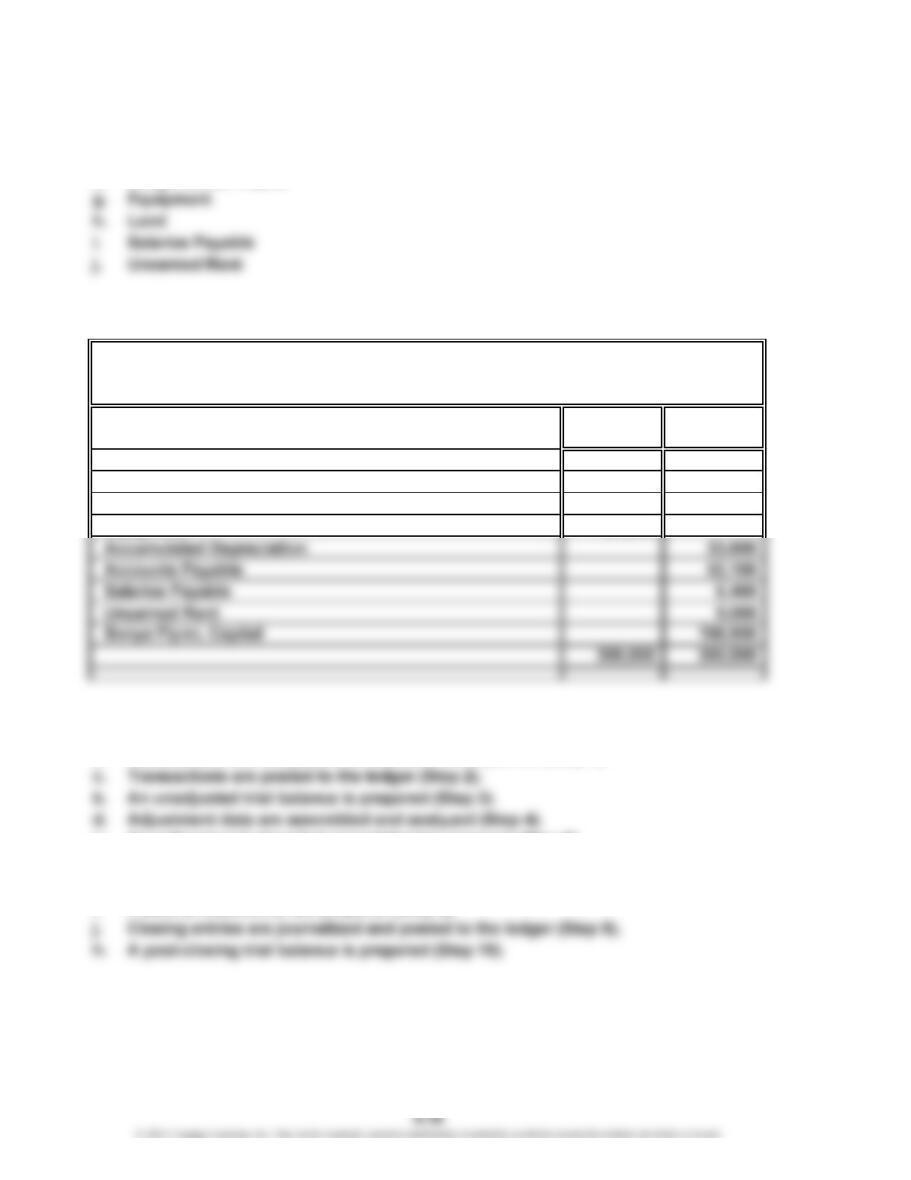
a. Accounts Receivable
b. Cash
e. Doug Woods, Capital
Ex. 4-19
Debit Credit
Balances Balances
Cash 46,540
Accounts Receivable 122,260
Supplies 4,000
Equipment 127,200
Ex. 4-20
a. Transactions are analyzed and recorded in the journal (Step 1).
g. An optional end-of-period spreadsheet is prepared (Step 5).
f. Adjusting entries are journalized and posted to the ledger (Step 6).
e. An adjusted trial balance is prepared (Step 7).
La Casa Services Co.
Post-Closing Trial Balance
March 31, 20Y6
CHAPTER 4 Completing the Accounting Cycle
Ex. 4-21
a.
Current assets……………
Current liabilitites………
…
Working capital…………
…
Current ratio……………
…
Ex. 4-22
a.
Current assets……………
Current liabilitites………
…
Working capital…………
…
Current ratio……………
…
Appendix 1 Ex. 4-23
1. i 6. f
2. a 7. j
3. g 8. e
5,684,200 4,220,700
($12,494,200 ÷ $5,684,200)
$1,277,304
2.20
($2,337,679 ÷ $1,060,375)
$12,494,200 $5,283,400
($5,283,400 ÷ $4,220,700)
$ 6,810,000 $1,062,700
2.20 1.25
December 31
Year 2 Year 1
1.97
($2,593,628 ÷ $1,315,977)
Year 1Year 2
$2,593,628
1,315,977
$1,277,651
$2,337,679
1,060,375
CHAPTER 4 Completing the Accounting Cycle
Appendix 1 Ex. 4-24
Account Title Debit Credit Debit Credit
Accumulated Depreciation 4 (d) 3 7
Accounts Payable 36 36
Wages Payable 0 (e) 1 1
Brenda Schultz, Capital 260 260
Brenda Schultz, Drawing 8 8
Fees Earned 200 (a) 13 213
Wages Expense 110 (e) 1 111
Rent Expense 12 12
Alert Security Services Co.
End-of-Period Spreadsheet (Work Sheet)
For the Year Ended October 31, 20Y5
Unadjusted Adjusted
Debit Credit
Trial Balance Adjustments Trial Balance
CHAPTER 4 Completing the Accounting Cycle
Appendix 1 Ex. 4-25
Account Title Debit Credit Debit Credit
Land 190 190
Equipment 50 50
Accumulated Depreciation 7 7
Accounts Payable 36 36
Wages Payable 1 1
Brenda Schultz, Capital 260 260
Brenda Schultz, Drawing 8 8
Fees Earned 213 213
Wages Expense 111 111
Alert Security Services Co.
End-of-Period Spreadsheet (Work Sheet)
For the Year Ended October 31, 20Y7
Adjusted BalanceIncome
Debit Credit
Trial Balance Statement Sheet
CHAPTER 4 Completing the Accounting Cycle
Appendix 1 Ex. 4-26
Fees earned $213
Expenses:
Wages expense $111
Rent expense 12
Brenda Schultz, capital, November 1, 20Y6 $260
Net income $65
Statement of Owner’s Equity
For the Year Ended October 31, 20Y7
Alert Security Services Co.
Income Statement
For the Year Ended October 31, 20Y7
Alert Security Services Co.