
Brief
Exercises
B. Ex. 4.1
B. Ex. 4.2
B. Ex. 4.3
B. Ex. 4.4 Analysis
B. Ex. 4.5
B. Ex. 4.6
B. Ex. 4.7
B. Ex. 4.8
B. Ex. 4.9
B. Ex. 4.10
Learning
Objectives
4.1 4-1–4-9
4.2 4-1–4-6, 4-9
4.3 4-1-4-7
4.4 Deferred expenses and revenue 4-1-4-7 Analysis
4.5 Accrued revenue 4-1-4-7 Analysis
4.6 4-1, 4-2, 4-4 Analysis
4.7 Accruals and deferrals 4-1-6, 4-9 Analysis
4.8 Notes payable and interest 4-1, 4-2, 4-5 Analysis
4.9 4-1–4-7, 4-9
4.10
4-1, 4-3–4-5,
4-7
4.11 4-1, 4-4, 4-7
Deferred revenue
4.12 4-1–4-7, 4-9
4.13 Effects of adjusting entries 4-1–4-6 Analysis
4.14 4-1–4-8
4.15 4-1, 4-2
Accounting terminology
Analysis
Analysis
Analysis
Skills
Analysis, judgment
Communication, analysis
Communication, analysis
Analysis, judgment
Communication, analysis,
judgment
Analysis
Concept of materiality
Interpreting business transactions
4-8
Deferred expenses and revenue
Analysis
Accounting for supplies
Analysis
Accounting for depreciation
4-3
Adjustments and the balance sheet
Real World: Various firms
Accounting principles
Analyzing the adjusted trial balance
Real World: Home Depot Using
an annual report
Deferred revenue
Real World: American Airlines
Effects of adjusting entries
Exercises
4-6
Analysis
Analysis
Analysis
Analysis
Accrued taxes
Accrued revenue
Unearned revenue
4-4
Accrued salaries
4-5
4-5
Accrued interest
4-5
Judgment, communication,
analysis
Topic
CHAPTER 4
THE ACCOUNTING CYCLE:
ACCRUALS AND DEFERRALS
4-3, 4-4
Analysis
Deferred expenses and revenue
4-3
Topic
Objectives
Deferred expenses and revenue
OVERVIEW OF BRIEF EXERCISES, EXERCISES, PROBLEMS, AND CRITICAL
THINKING CASES
Learning
Skills
4-3, 4-4
Analysis

Problems Learning
Sets A, B Objectives
4.1 A,B 4-1-4-7
4.2 A,B 4-1–4-6, 4-9
4.3 A,B Analysis of adjusted data 4-1–7, 4-9
4.4 A,B 4-1–7, 4-9
4-1–7, 4-9
4.5 A,B 4-1–7, 4-9
4-1–7, 4-9
4.6 A,B
Preparing and analyzing adjusting
entries
4-1–7, 4-9
4.7 A,B
Preparing and analyzing adjusting
entries
4-1–7, 4-9
4.8 A,B 4-1–7, 4-9
4.1 4-1–4-7
4.2
Real World: Avis
4-8
The concept of materiality
4.3 4-3, 4-7, 4-8
4.4
accounts involved in adjusting 4-1–4-6
Analysis
Analysis, communication
Analysis, communication
Skills
Preparing and analyzing adjusting
entries
Topic
Preparing and analyzing adjusting
entries
process (Internet)
Expense Manipulation (Ethics,
fraud & corporate governance)
Analysis, communication
Analyzing the effects of errors
Preparing and analyzing adjusting
entries
Analysis, communication
Preparing and analyzing adjusting
entries
Critical Thinking Cases
Real World: Hershey Identifying
Determining whether adjusting
entries are required
Communication, technology,
judgment, research
Analysis, communication
Analysis, communication
Analysis, judgment,
communication
Communication, judgment,
analysis
Analysis, judgment,
communication
Analysis

DESCRIPTIONS OF PROBLEMS AND CRITICAL THINKING CASES
Problems (Sets A and B)
4.1 A,B 20 Easy
4.2 A,B 40 Medium
4.3 A,B 25 Strong
4.4 A,B
4.5 A,B 30 Medium
4.6 A,B 30 Medium
Terrific Temps/Marvelous Music
Requires students to prepare adjusting entries and determine
amounts reported in the financial statements.
Alpine Expeditions/Mate Ease
Requires students to prepare adjusting entries, determine
amounts reported in the financial statements, and interpret
certain deferrals.
Requires students to prepare adjusting entries and interpret
financial information.
Below are brief descriptions of each problem and case. These descriptions are accompanied by the
estimated time (in minutes) required for completion and by a difficulty rating. The time estimates
assume use of the partially filled-in working papers.
30 Medium
Campus Theater/Off-Campus Playhouse
Requires students to prepare adjusting entries, analyze financial
information, and interpret differences between income taxes
expense and income taxes payable.
Gunflint Adventures/River Rat
Requires students to prepare adjusting entries, classify them as
accruals or deferrals, and discuss the difference between the
book value of an asset and its fair market value.
Requires students to prepare adjusting entries, classify them as
accruals or deferrals, analyze their effects on the financial
statements, and report assets at book value in the balance sheet.
Florida Palms Country Club/Georgia Gun Club
Enchanted Forest/Big Oaks

Problems (continued)
Ken Hensley Enterprises, Inc./Stillmore Investigations 60 Strong
Requires students to journalize adjusting entries, prepare an adjusted trial
balance, and understand various relationships among financial statement
elements.
Coyne Corporation/Stephen Corporation
Requires students to analyze the effects of errors on financial statement
elements.
Critical Thinking Cases
Judgments and Year-End Adjustments
The Concept of Materiality
Expense Manipulation
Ethics, Fraud & Corporate Governance
Identifying Accounts
Internet
4.7 A,B
4.8 A,B
20 Strong
Students are asked to identify accounts in Hershey’s balance sheet that
were most likely to have been involved in the company’s year-end
adjusting entry process.
4.4
10 Easy
Requires students to exercise judgment regarding the need for adjusting
entries.
Discusses the concept of materiality. The purchase of automobiles by
Avis for its rental fleet is used to illustrate how the cumulative effect of
many immaterial transactions can become material.
Students must determine whether the capitalization of advertising
expenditures was in compliance with generally accepted accounting
principles, and whether the decision to do so was ethical.
10 Easy
4.3
30 Medium
4.2
25 Medium
4.1
SUGGESTED ANSWERS TO DISCUSSION QUESTIONS
1.
2.
3.
4.
5.
6.
The purpose of making adjusting entries is to recognize certain revenue and expenses that
All adjusting entries affect both an income statement account and a balance sheet account.
Making adjusting entries requires a better understanding of accrual accounting than does the
Under accrual accounting, an expense is defined as the cost of goods and services used in
Accrual accounting requires that revenue be recognized in the accounting records when it is
The term, unearned revenue, describes amounts that have been collected from customers in
7.
8.
9.
10.
11.
15.
Carnival Corporation accounts for customer deposits as deferred, or unearned, revenue. As
Materiality refers to the relative importance of an item or an event to the users of financial
statements. An item is “material” if knowledge of it might reasonably influence the decisions
of financial statement users.
12.
Deferred revenue (also referred to as unearned revenue or customer deposits) is reported in the
The realization principle governs the timing of revenue recognition. The principle states that
A $1,000 expenditure is not considered material to all businesses. Most large enterprises
Deferred expenses are those assets reported in the balance sheet that will later become
The matching principle governs the manner in which revenue is offset by the expenses
13.
B. Ex. 4.1 a. Nov. 30 750
Unexpired Insurance …………………….
750
B. Ex. 4.2 a. Feb. 28 300
Prepaid Rent ………………………………………………
300
Rent Revenue Earned …………………………………………
300
Unearned Rent Revenue……………………………………………..
B. Ex. 4.3 Mar 31 1,300
1,300
B. Ex. 4.4 a. Dec. 31 1,800
Accumulated Depreciation: Equipment …………………………………….
1,800
B. Ex. 4.5 3,250
Client Service Revenue ………………………………………
3,250
Insurance Expense ……………………………………………………..
Rent Expense …………………………………………………
Office Supplies Expense ………………………………………………….……….
Depreciation Expense: Equipment…………………………….
Accounts Receivable ………………………………………….
Premium Revenue Earned………………………………….
750
Unearned Insurance Premiums………………………..
B. Ex. 4.6 a. 2,500
Client Revenue Earned …………………
2,500
B. Ex. 4.7 a. Dec. 31 210,000
Salaries Payable ………………………………………………
210,000
B. Ex. 4.8 a. Dec. 31 200
Interest Payable………….………………….
200
60,400
Interest Expense…………………………………….
B. Ex. 4.9 a. Dec. 31 15,000
Income Taxes Payable………………………………………
15,000
Unearned Client Revenue ……………………………………………………..
Interest Expense ………………………………………………….……….
Salaries Expense …………………………………………………
Income Taxes Expense ………………………………………….
426,000
Salaries Payable………………………………………
Salaries Expense…………………………………………..
B. Ex. 4.10 a.
b.
c.
1.
accepted accounting principles. However, immaterial items may be accounted for
in the most convenient and economical manner.
Materiality refers to the relative importance of an item. An item is material if
knowledge of it might reasonably influence the decisions of users of financial
Whether a specific dollar amount is “material” depends upon the (1) size of the
amount and (2) nature of the item. In evaluating the size of a dollar amount,
accountants consider the amount in relation to the size of the organization.
financial statements of a large, publicly owned corporation. For a small business
however, this amount could be material.
In summary, one cannot say whether $2,500 is a material amount. The answer
depends upon the related circumstances.
Two ways in which the concept of materiality may save time and effort for
accountants are:
Adjusting entries may be based upon estimated amounts if there is little or no
2.
unrecorded expenses or unrecorded revenue. For example, no adjusting
entries normally are made to record utility expense payable at year-end.
Ex 4.1 a.
Ex. 4.2
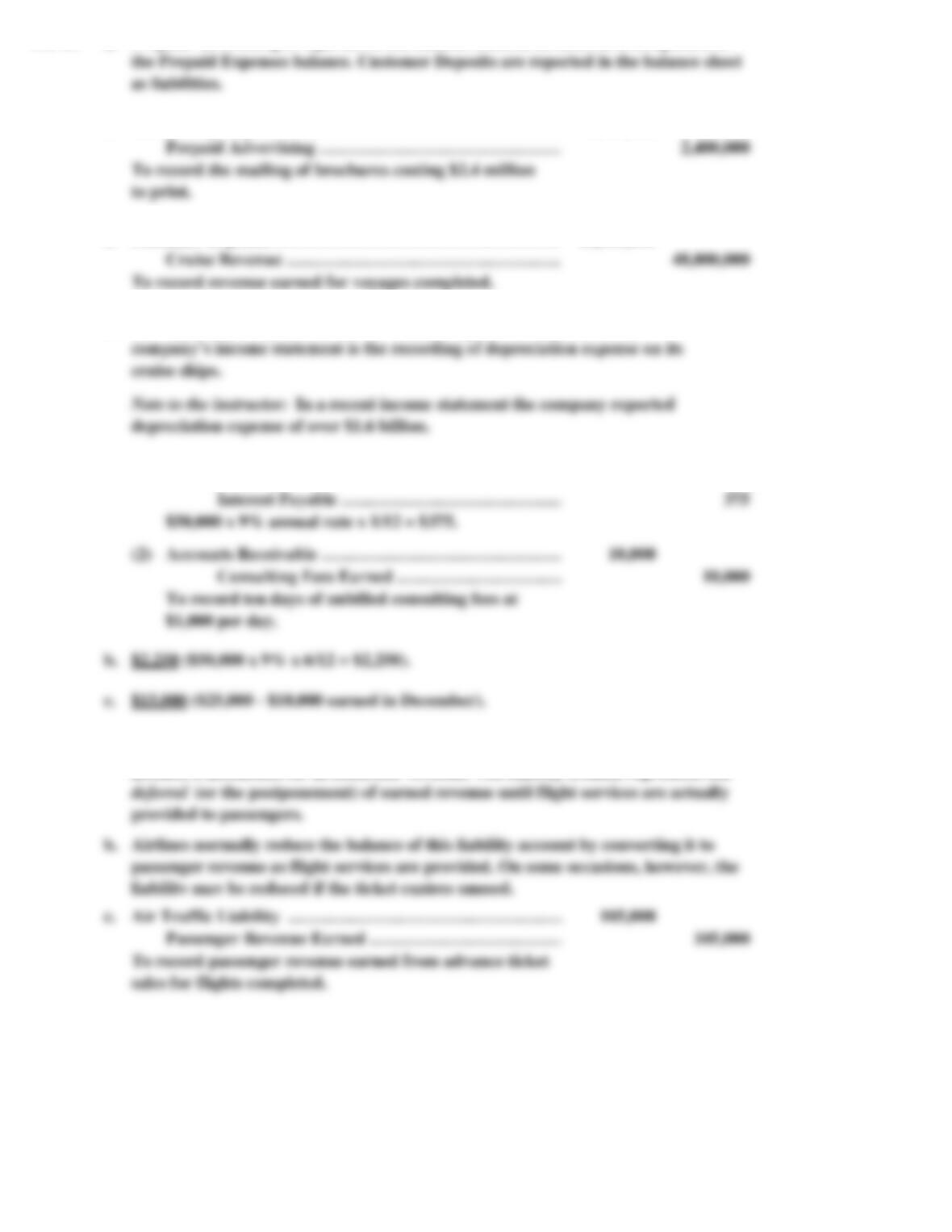
Revenue –Expenses = Assets –Liabilities =
NE I D D NE D
Ex. 4.3 1. 250,000
Prepaid Rent ……………………………………………………
2. 750,000
Ticket Revenue Earned …………………………………………..
Unearned Ticket Revenue ……………………………………………..
Balance Sheet
Owners’
Equity
Net
Income
Rent Expense ………………………………………………………….
Income Statement
SOLUTIONS TO EXERCISES
Book value
a.
Adjusting
Entry
g.
Prepaid expenses
None (This is an example of “depreciation expense.”)
Unrecorded revenue
Adjusting entries
Unearned revenue
Matching principle
Ex. 4.4 a.
b. 2,400,000
c. 48,000,000
Cruise Revenue ………………………………………………..
d.
Ex. 4.5 a. (1) 375
b.
c.
Accounts Receivable ………………………………………………
Consulting Fees Earned ………………………………
Interest Payable …………………………………………
Ex. 4.6 a.
b.
Passenger Revenue Earned ………………………………………
Air Traffic Liability …………………………………………………..
At the time cash is collected by Delta Airlines for advance ticket sales, the entire
amount is accounted for as unearned revenue. The liability created represents the
The adjusting entry that results in the most significant expense in the
Customer Deposits ………………………………………………….
Prepaid Advertising is reported in the balance sheet as an asset as a component of
Advertising Expense ……………………………………………….
Interest Expense ………………………………………………….
Prepaid Advertising ………………………………………….
Ex. 4.7 1,500
1,500
9,000
9,000
1,900
1,900
To record portion of unearned revenue that had become
6.
Salaries Expense …………………………………………………………
Salaries Payable ………………………………………………………
To record accrued salaries in December.
Ex. 4.8 a.
The liability to the bank at December 31, year 1, is $151,500 (Principal, $150,000 +
The monthly interest expense is $750 ($4,500/6 = $750).
c.
150,000
Notes Payable ……………………………………………
150,000
e.
Dec.
31
The liability to the bank at March 31, year 2, is $153,750, consisting of $150,000
Interest Expense ……………………………………………
Obtain from bank six-month loan with interest at 6%
The total interest expense over the life of the note is $4,500 ($150,000 x .06 x 6/12 =
$4,500).
Yr. 1
Oct.
31
Cash ……………………………………………………………..
Marketing Revenue Earned …………………………………..
5.
Unearned Revenue ………………………………………………………..
a. 1.
Interest Expense ………………………………………………………
Interest Payable ……………………………………………………
1,250
1,250
Prepaid Insurance …………………………………………………
To record insurance expense ($2,400/12 months = $200).
To record interest accrued on bank loan during
Accumulated Depreciation: Office Building …………………….
4.
Insurance Expense ……………………………………………………
To record depreciation on office building ($450,000/30 years)
2.
Depreciation Expense: Office Building ………………………………
To record accrued marketing revenue earned in December.
3.
Accounts Receivable …………………………………………………
Marketing Revenue Earned ………………………………………
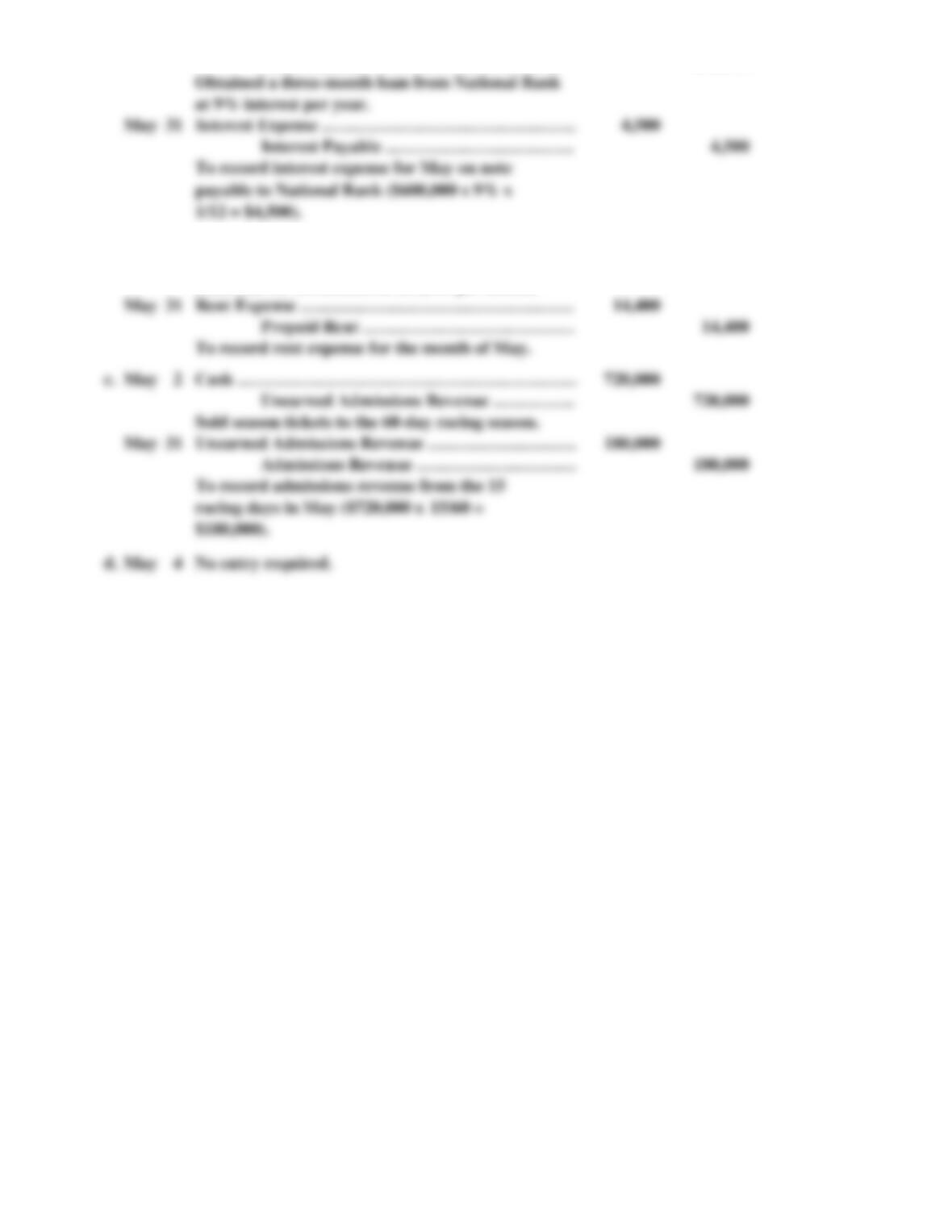
Ex. 4.9 a. May 1 600,000
Notes Payable …………………………….
600,000
b. May 1 86,400
Cash ………………………………………………
86,400
Paid rent for six months at $14,400 per month.
Prepaid Rent …………………………………………
14,400
Unearned Admissions Revenue ………………….
720,000
Admissions Revenue …………………………………….
180,000
d. May 4
Rent Expense ……………………………………………..
Cash ………………………………………………….……….
Unearned Admissions Revenue …………………………….
Cash ……………………………………………………..
Prepaid Rent …………………………………………………
Interest Payable ………………………………….
4,500
Interest Expense …………………………………………….
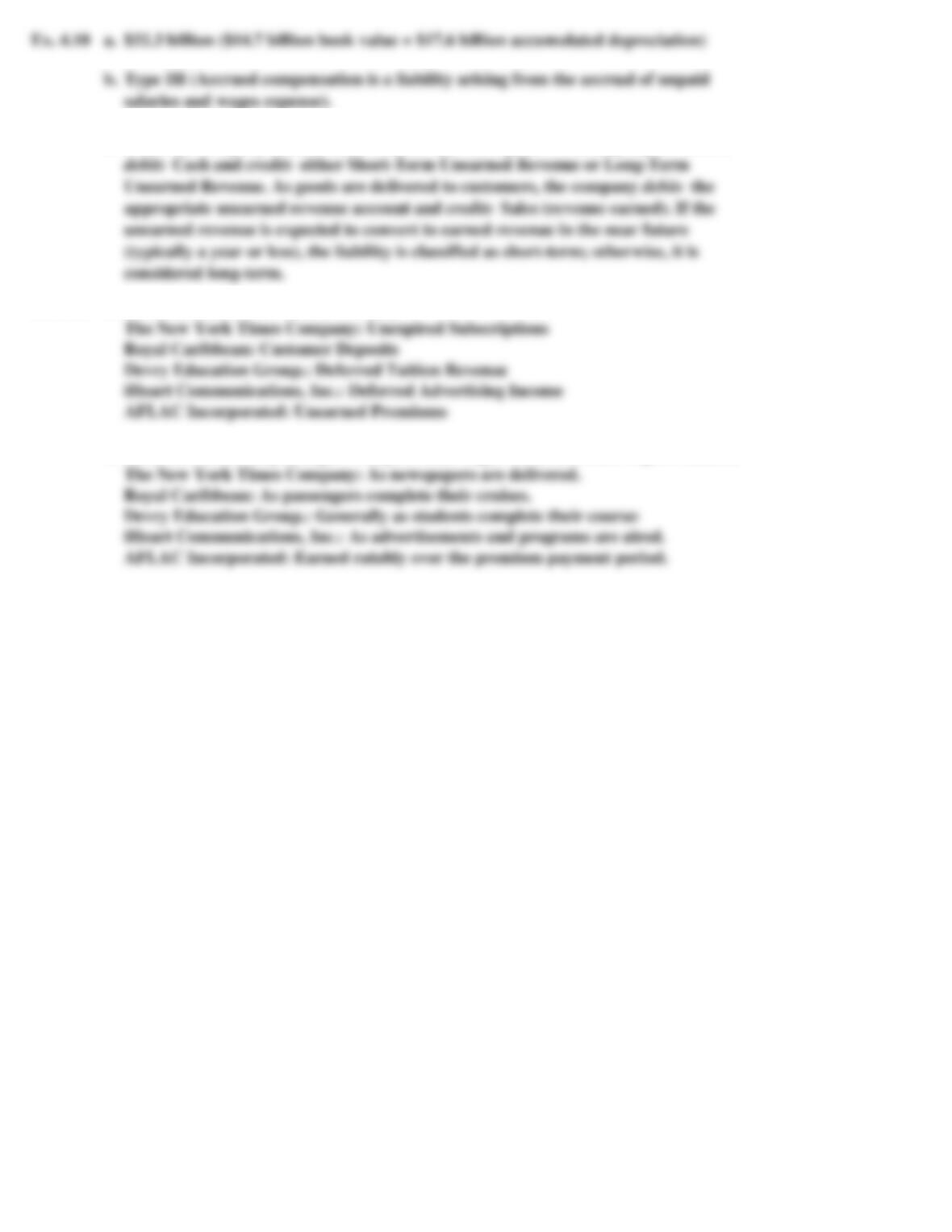
c.
b.
Delta Air Lines: As passengers complete their flights or as the ticket expires unused.
Ex. 4.10
a.
Ex. 4.11
a.
When the company receives cash from its customer prior to earning any revenue it
Delta Air Lines.: Air Traffic Liability
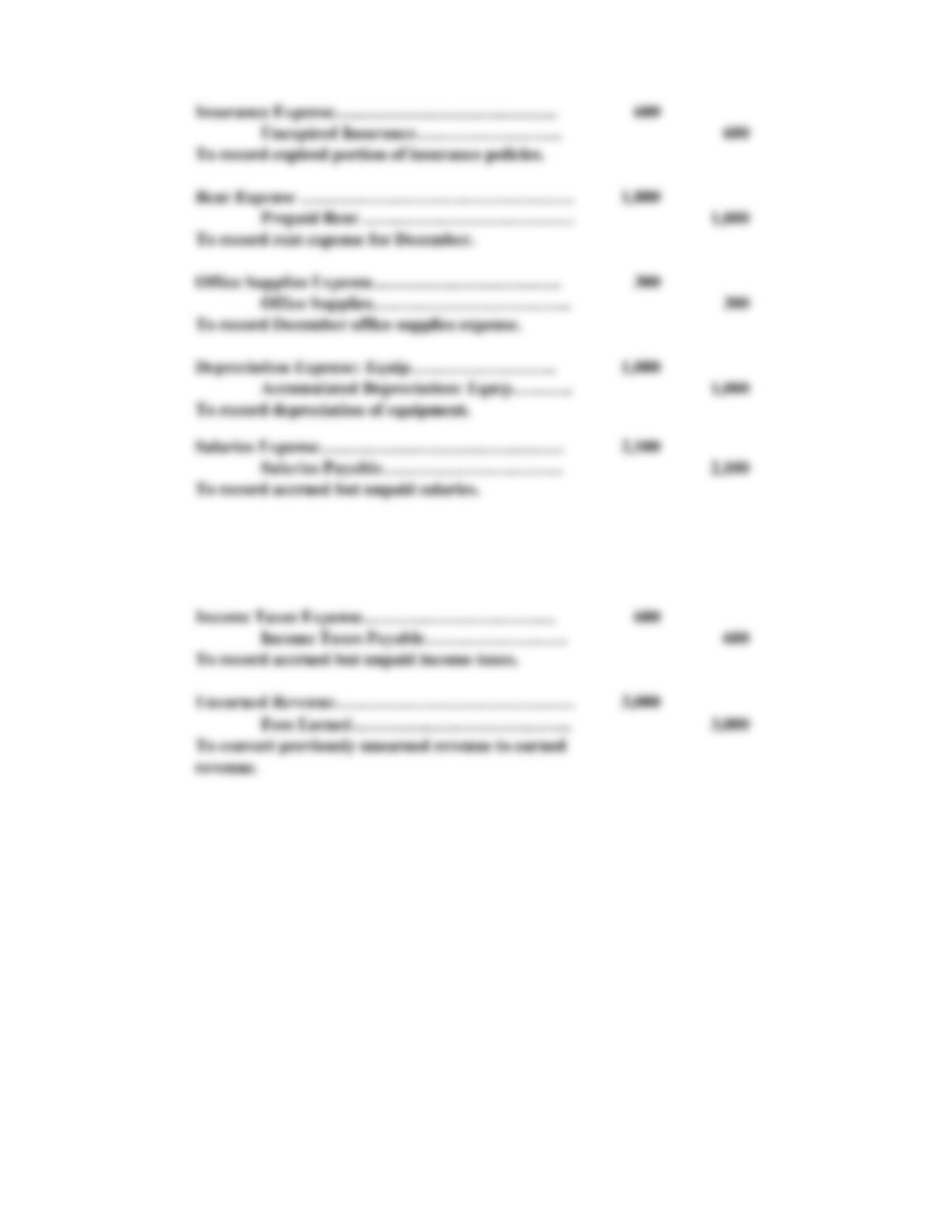
Ex. 4.12 5,000
Fees Earned………………………………
5,000
50
Interest Payable…………………………..
50
3,000
To convert previously unearned revenue to earned
To record accrued but unpaid income taxes.
Income Taxes Expense…………………………….
Accounts Receivable………………………………………
To record accrued but uncollected revenue.
To record accrued but unpaid interest expense.
Interest Expense……………………………………
2,100
Insurance Expense…………………………………
Rent Expense ……………………………………………..
Depreciation Expense: Equip……………………..
Salaries Expense…………………………………….
Office Supplies Expense……………………………
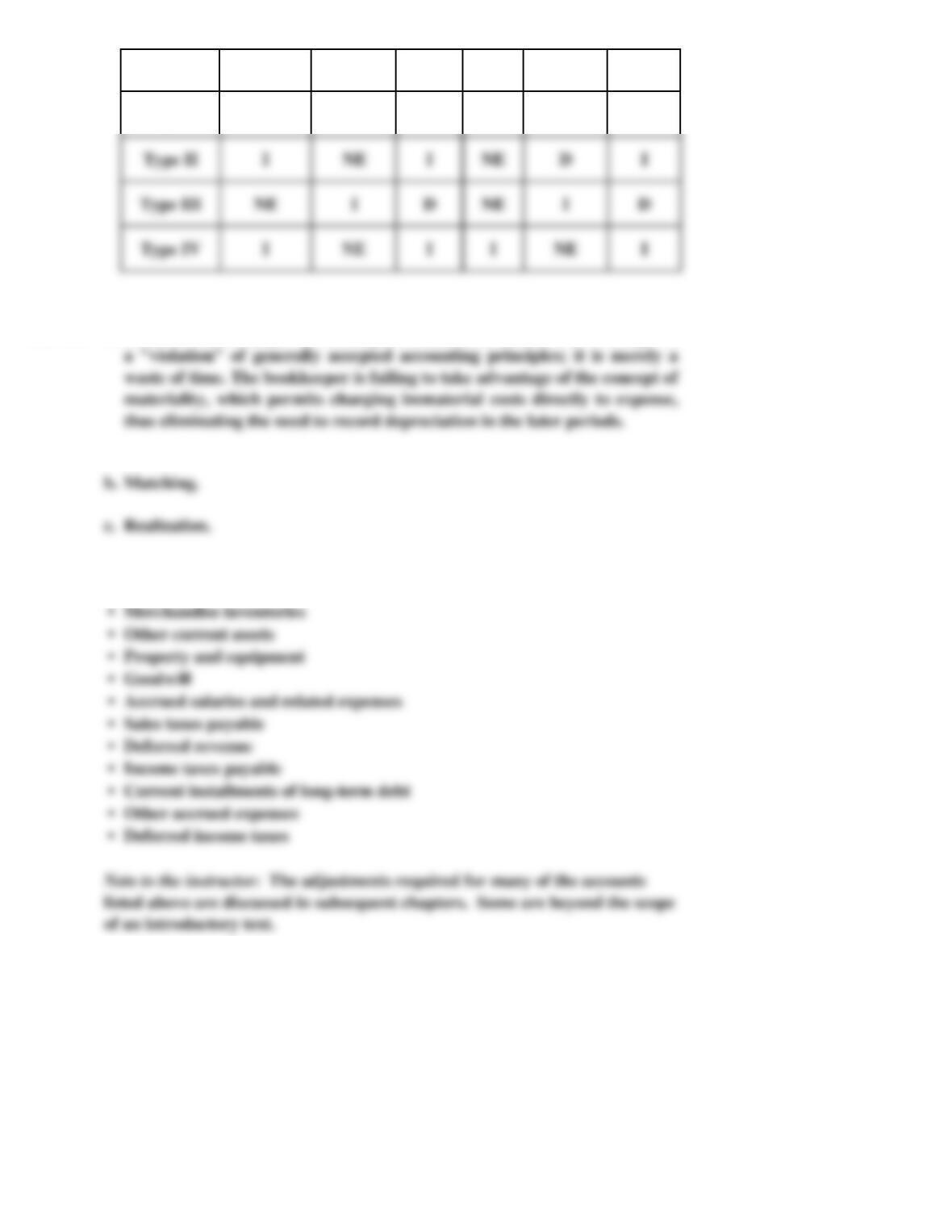
Ex. 4.13
Adjustment Net Owners‘
Type Revenue Expenses Income Assets Liabilities Equity
Type I NE I D D NE D
Ex. 4.14 a.
Ex. 4.15
•
•
•
•
•
•
•
•
•
•
•
None (or Materiality). Accounting for immaterial items is not “wrong” or
Accounts requiring adjusting entries may include:
Receivables
20 Minutes, Easy
a.
Dec. 31 9,600
Salaries Payable 9,600
31 300
Interest Payable 300
31 650
Unexpired Insurance 650
31
31 19,000
Income Taxes Payable 19,000
(8)
No adjusting entry required. Revenue is recognized
To record income taxes accrued in December.
(7)
when it is earned. Entering into a contract does not
Income Taxes Expense
constitute the earning of revenue.
SOLUTIONS TO PROBLEMS SET A
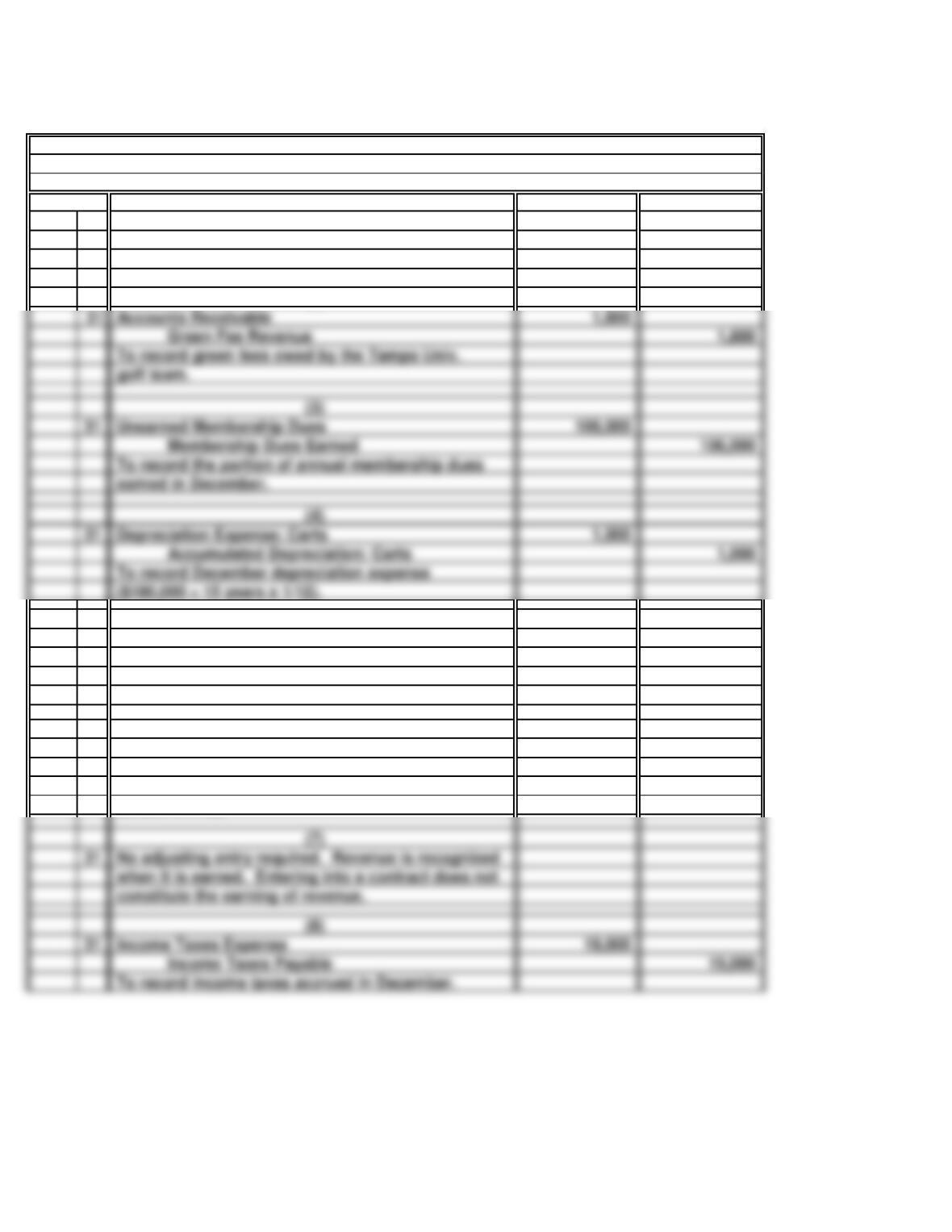
FLORIDA PALMS COUNTRY CLUB
(Adjusting Entries)
(1)
(2)
PROBLEM 4.1A
General Journal
To record December insurance expense
($7,800 x 1/12).
(5)
(6)
($45,000 x 8% x 1/12).
FLORIDA PALMS COUNTRY CLUB
Interest Expense
Salaries Expense
To record accrued salaries at December 31.
Insurance Expense
To record accrued interest expense in December
Green Fee Revenue 1,800
31 106,000
Membership Dues Earned 106,000
31 1,000
Accumulated Depreciation: Carts 1,000
(3)
($180,000 ÷ 15 years x 1/12).
Accounts Receivable
To record green fees owed by the Tampa Univ.
(4)
earned in December.
golf team.
Depreciation Expense: Carts
Unearned Membership Dues
To record the portion of annual membership dues
To record December depreciation expense
b.
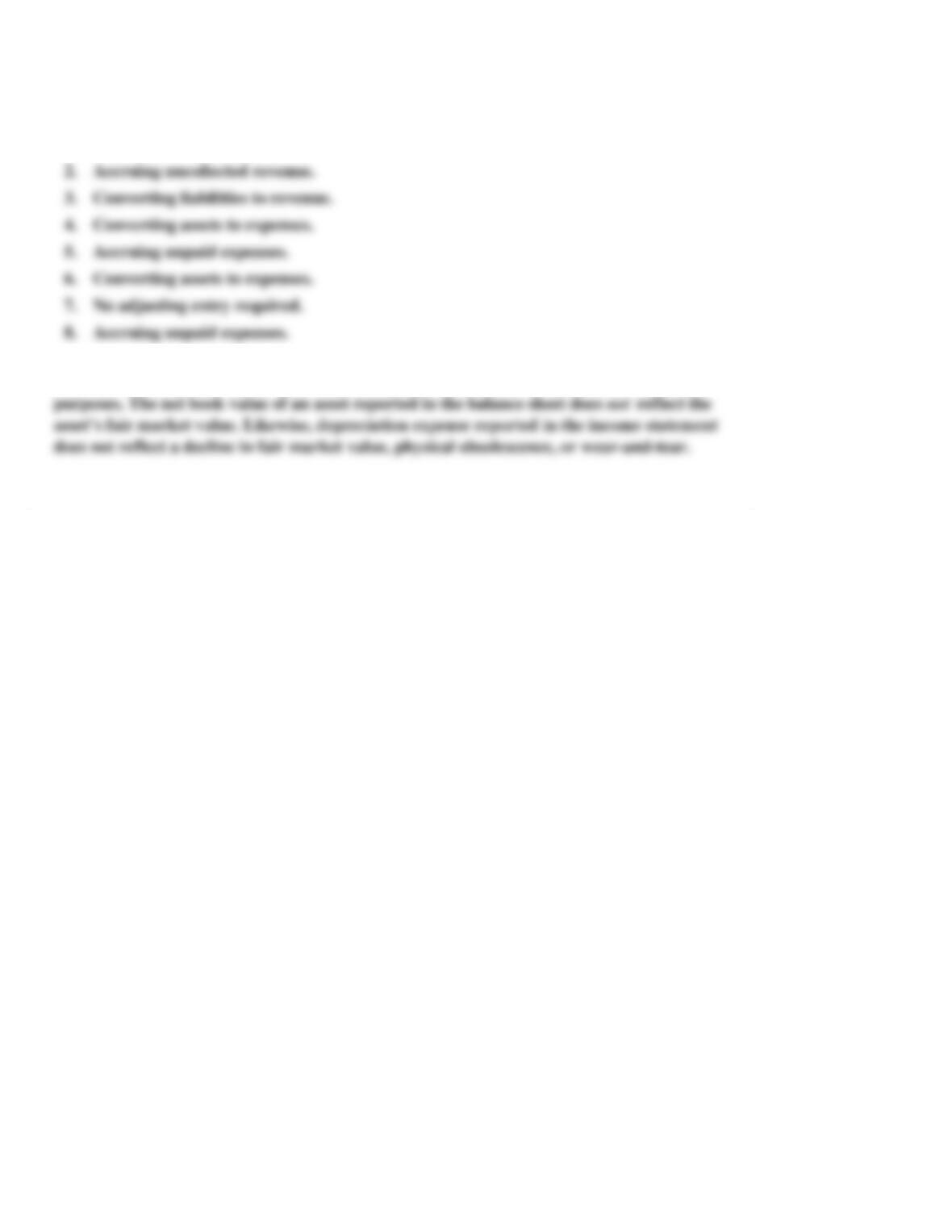
1.
c.
The clubhouse was built in 1925 and has been fully depreciated for financial accounting
Accruing unpaid expenses.
PROBLEM 4.1A
FLORIDA PALMS COUNTRY CLUB (concluded)
2.
3.
4.
5.
6.
7.
8.
Converting liabilities to revenue.
Converting assets to expenses.
Accruing unpaid expenses.
Converting assets to expenses.
No adjusting entry required.
Accruing unpaid expenses.
Accruing uncollected revenue.
40 Minutes, Medium
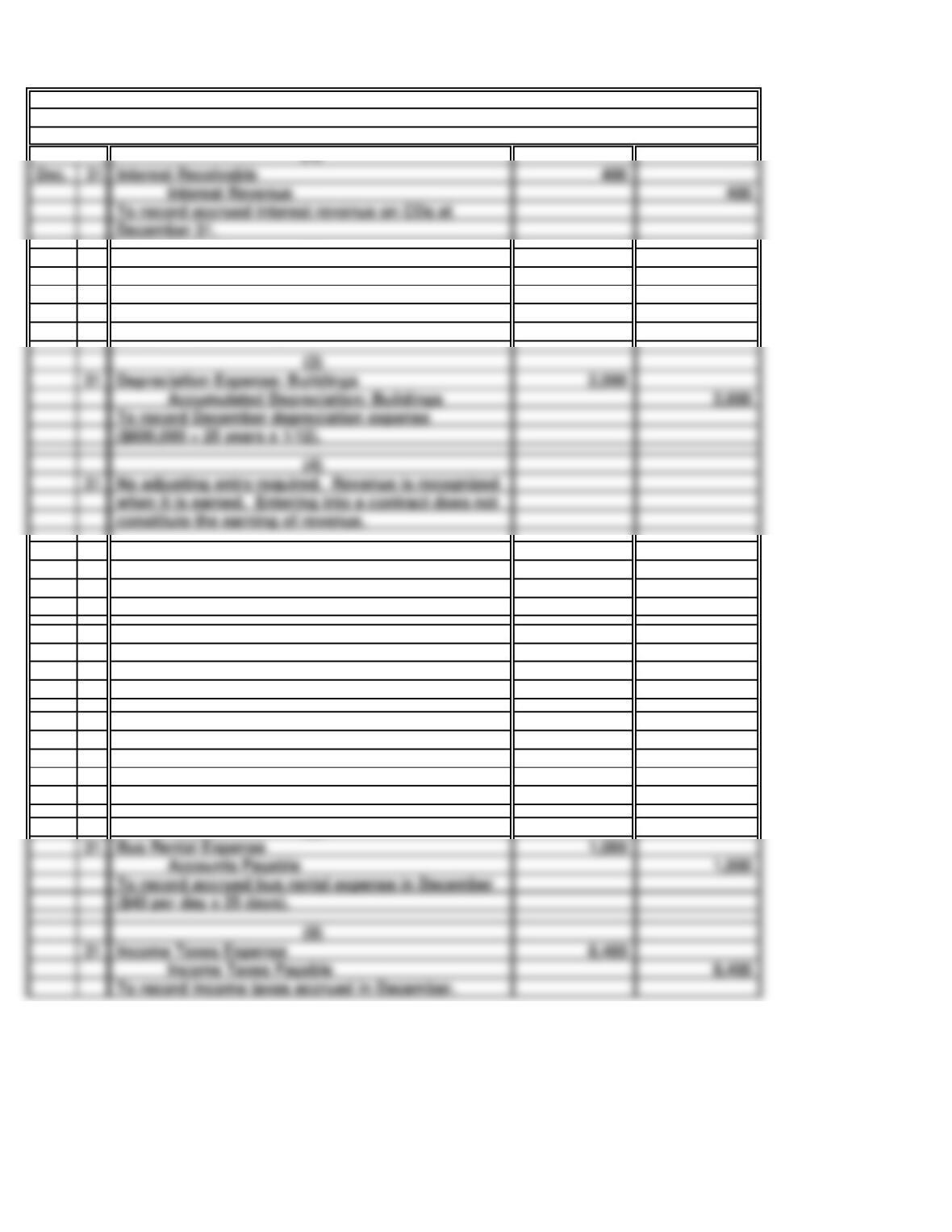
31 85
Interest Payable 85
31 2,000
Accumulated Depreciation: Buildings 2,000
31
(4)
when it is earned. Entering into a contract does not
Depreciation Expense: Buildings
($600,000 ÷ 25 years x 1/12).
(3)
No adjusting entry required. Revenue is recognized
To record December depreciation expense
constitute the earning of revenue.
31 1,250
Salaries Payable 1,250
31 2,400
Camper Revenue 2,400
31 900
Camper Revenue 900
31 1,000
Accounts Payable 1,000
31 8,400
Income Taxes Payable 8,400
To record income taxes accrued in December.
(9)
Income Taxes Expense
To record accrued bus rental expense in December
Bus Rental Expense
($40 per day x 25 days).
advance ($5,400 ÷ 6 months).
(8)
a.
(Adjusting Entries)
General Journal
To record accrued interest expense in December
PROBLEM 4.2A
(7)
To record revenue earned from campers that paid in
To record camper revenue earned in December.
($12,000 x 8.5% x 1/12).
(5)
(6)
ENCHANTED FOREST
Unearned Camper Revenue
Camper Revenue Receivable
To record accrued salary expense in December.
Interest Expense
(1)
(2)
Salaries Expense
Interest Revenue 400
December 31.
Interest Receivable
To record accrued interest revenue on CDs at
b.
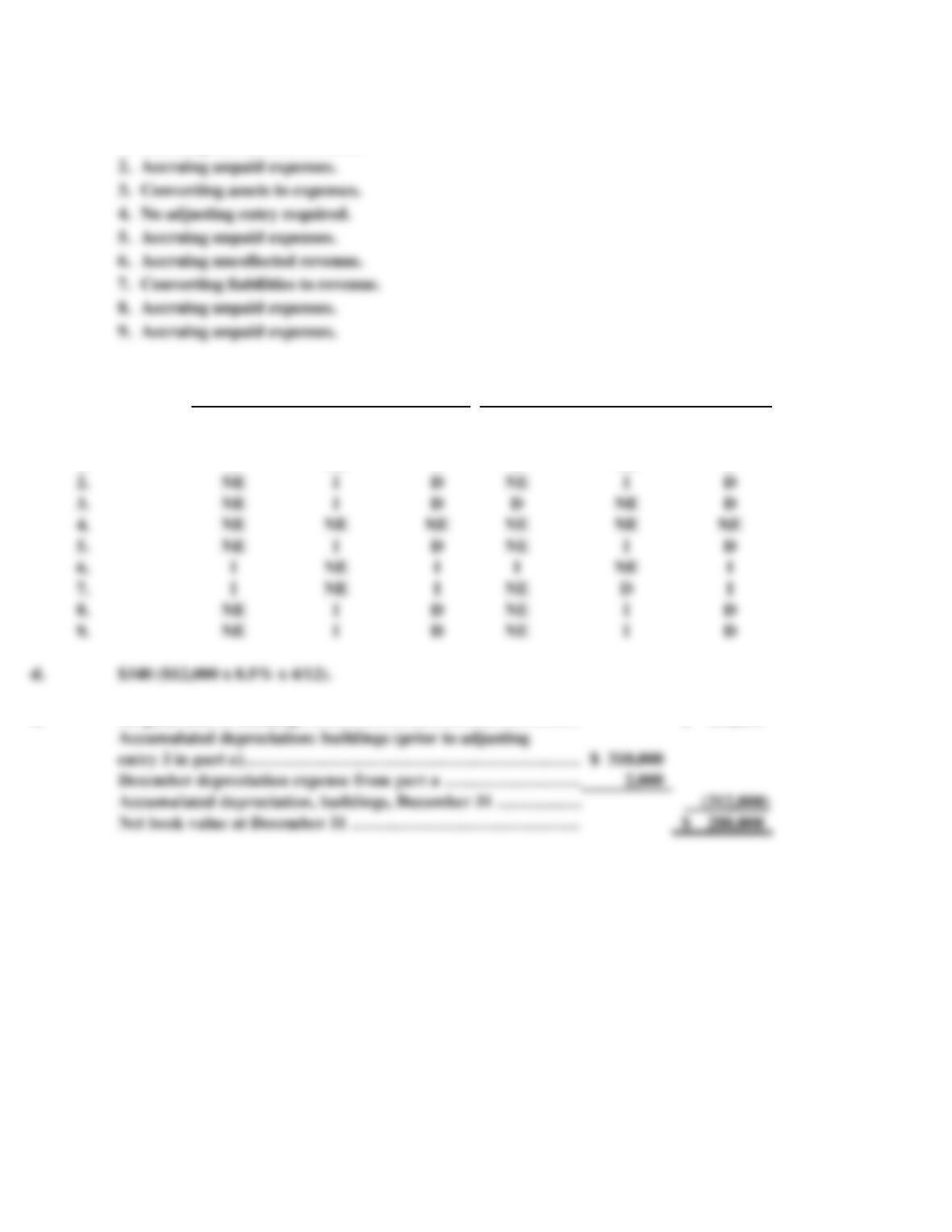
1.
c.
Owners’
Revenue –Expenses = Assets = Liabilities + Equity
INE I I NE I
INE I I NE I
INE INE D I
8.
9.
2.
3.
4.
5.
6.
7.
e.
288,000$
December depreciation expense from part a ………………………..
Accumulated depreciation, buildings, December 31 ……………………………
Net book value at December 31 …………………………………………
entry 3 in part a)…………………………………………………………….
PROBLEM 4.2A
Accruing uncollected revenue.
ENCHANTED FOREST (concluded)
Net
Income
Income Statement
Balance Sheet
1.
Adjustment
Original cost of buildings …………………………………………………
600,000$
2.
3.
4.
5.
6.
7.
8.
9.
Accruing unpaid expenses.
Accruing unpaid expenses.
Accruing uncollected revenue.
Converting liabilities to revenue.
Accruing unpaid expenses.
No adjusting entry required.
Converting assets to expenses.
Accruing unpaid expenses.