Financial and Managerial Accounting, 8th Edition
CHAPTER 4
ACCOUNTING FOR MERCHANDISING OPERATIONS
Related Assignment Materials
Student Learning Objectives
Questions
Quick
Studies*
Exercises*
Problems*
AA
and
BTN
Conceptual objectives
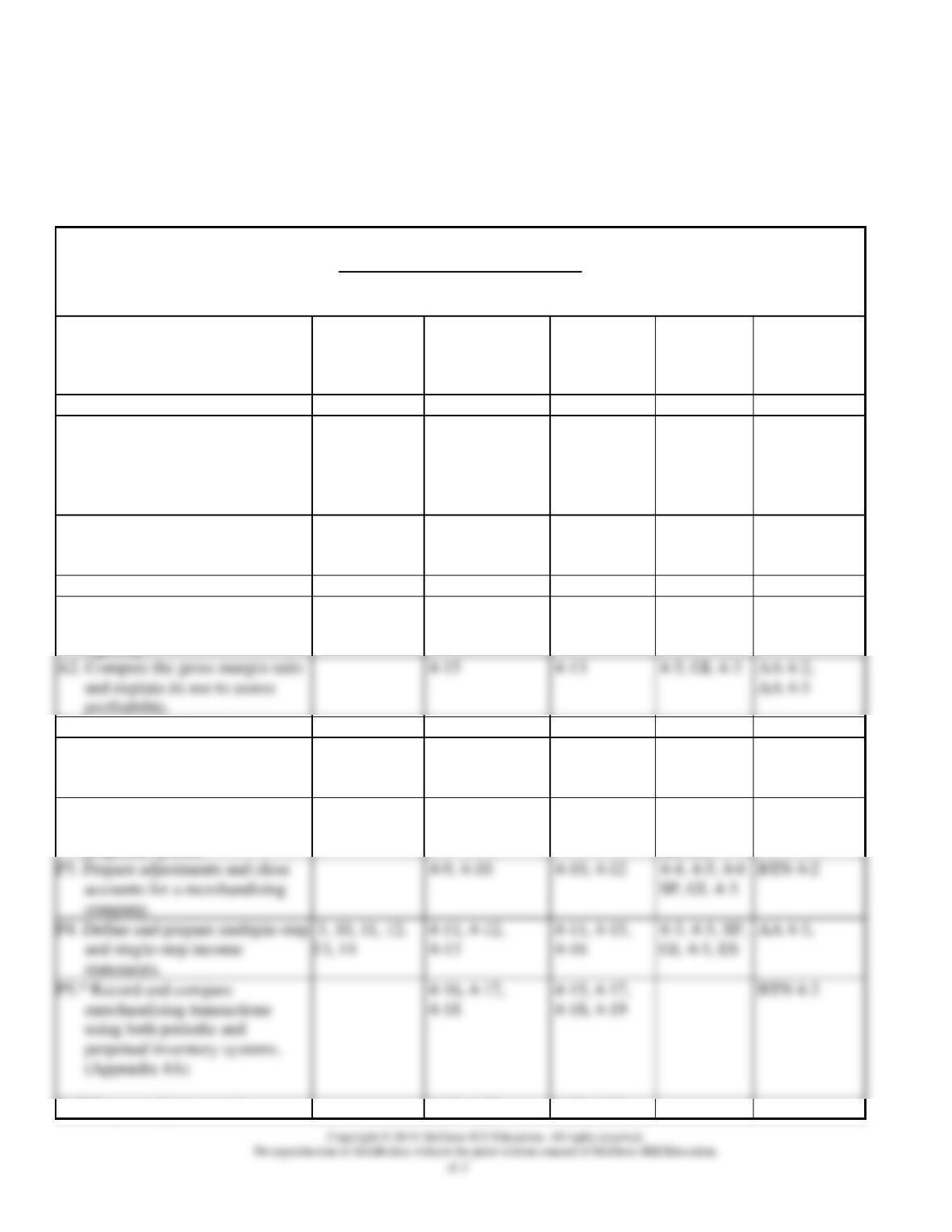
C1. Describe merchandising
activities and identify income
components for a merchandising
company.
1, 2, 3, 4
4-1
4-1
BTN 4-1,
BTN 4-3,
BTN 4-4,
BTN 4-5,
BTN 4-6
C2. Identify and explain the
inventory asset and cost flows of
a merchandising company.
4-2, 4-3
4-1, 4-2
4-3, 4-4
BTN 4-2,
BTN 4-4,
BTN 4-5
Analytical objectives:
A1. Compute the acid-test ratio and
explain its use to assess
A2. Compute the gross margin ratio
and explain its use to assess
profitability.
4-15
4-13
4-5, GL 4-3
AA 4-2,
AA 4-3
4-14
4-14
4-5, GL 4-3
AA 4-1
Procedural objectives:
P1. Analyze and record transactions
for merchandise purchases using
a perpetual system.
6, 7, 8, 9,
15
4-1, 4-4, 4-5,
4-6, 4-7
4-3, 4-5, 4-6,
4-7, 4-8, 4-9,
4-25
4-1, 4-2, SP
GL 4-1,
GL 4-2
BTN 4-5
P2. Analyze and record transactions
for merchandise sales using a
GL 4-2
company.
P4. Define and prepare multiple-step
and single-step income
3, 10, 11, 12,
13, 14
4-11, 4-12,
4-13
4-11, 4-15,
4-16
4-3, 4-5, SP,
GL 4-3, ES
AA 4-3,
5, 7, 8, 9
4-8, 4-23
4-4, 4-6, 4-7,
4-8, 4-9
4-1, 4-2, SP,
GL 4-1,
BTN 4-1,
BTN 4-6
P6.B Prepare adjustments for
4-19, 4-20
4-20, 4-21,
Financial and Managerial Accounting, 8th Edition
Copyright © 2019 McGraw-Hill Education. All rights reserved.
No reproduction or distribution without the prior written consent of McGraw-Hill Education.
4-2
discounts, returns, and
allowances per revenue
recognition rules.
using the gross method and net
4-22
Additional Information on Related Assignment Material
See Chapter 1 of the Instructor’s Resource Manual for more information on materials for this text available in
Connect.
Connect
Available on the instructor’s course-specific website, Connect:
• All numerical Quick Studies, all Exercises and Problems Set A.
o Connect also provides algorithmic versions for Quick Study, Exercises, and Problems.
• General Ledger Problems
• Excel Simulations
• LearnSmart/SmartBook
Hints/Guided Examples
Please note that the Guided Examples are labeled as “Hints” in Connect assignments. The animated PowerPoints
without the video and audio functions for the Guided Examples are also available in the Connect Instructor Library
and Exercise Presentations. These are indicated in the Related Assignment Materials grid on page 1 in blue bold
font.
Need-to-Know Videos
LO
Need–to-Know
Title
Time
C1, C2
4-1
Merchandise Accounts and Computations
1:58
P1
4-2
Merchandise Purchases
3:22
P2
4-3
Merchandise Sales
4:46
P3
4-4
Recording Shrinkage and Closing Entries
3:02
P4
4-5
Multiple-and Single-Step Income Statements
2:33
P6
4-8
Estimating Discounts, Returns, and Allowances
4:35
Concept Overview Videos
LO
Title
Time
C1
Describe merchandising activities and identify income components for a
Financial and Managerial Accounting, 8th Edition
Income Statement
0:36
C2
Identify and explain the inventory asset and cost flows of a merchandising
company.
Reporting Inventory
0:29
Operating Cycle for a Merchandiser
0:43
Cost of Goods Sold
0:33
Cost Flow Example
0:59
Inventory Systems
0:45
Compute the acid-test ratio and explain its use to assess liquidity.
Acid-Test Ratio
1:08
Acid-Test Ratio—Background Information
1:09
Acid-Test Ratio Illustration
1:22
A2
Compute the gross margin ratio and explain its use to assess profitability.
Gross Margin Ratio
1:04
Gross Margin Ratio Illustration
1:29
P1
Analyze and record transactions for merchandise purchases using a perpetual
system.
Purchases without Cash Discounts
0:26
Credit Terms and Cash Discounts
1:43
Purchases with Cash Discounts
3:15
Purchases with Returns and Allowances
2:09
Purchases and Transportation Costs
2:42
Itemized Costs of Purchases
1:30
P2
Analyze and record transactions for merchandise sales using a perpetual
system.
Sales without Cash Discounts
1:20
Sales with Cash Discounts
2:38
Sales with Returns
2:23
Sales with Allowances
0:32
P3
Prepare adjustments and close accounts for a merchandising company.
Adjusting Entries for Merchandisers
0:17
Adjusting Entries for Inventory Shrinkage
0:59
Overview of Closing Entries
0:30
Closing Entries Illustration
1:04
P4
Define and prepare multiple-step and single-step income statements.
Multiple-Step Income Statement
0:53
Multiple-Step Income Statement Illustration
3:17
Single-Step Income Statement
0:31
Classified Balance Sheet
0:23
P5A
Record and compare merchandising transactions using both periodic and
perpetual inventory systems.
Periodic versus Perpetual Inventory Systems
1:35
Periodic Inventory System
1:04
Purchases Transactions
1:43
Financial and Managerial Accounting, 8th Edition
4-4
Sales Transactions
1:35
Adjusting Entries
0:53
Closing Entries
1:58
P6B
Prepare adjustments for discounts, returns, and allowances per Adjustments for
sales discounts, revenue and allowances.
Expected Sales Discounts
1:58
Expected Returns and Allowances
3:09
net method.
Gross and Net Methods
0:45
Purchases Using Net Method
2:02
Sales Using Net Method
1:59
Synopsis of Chapter Revisions
NEW opener—Build-A-Bear and entrepreneurial assignment.
Updated introduction for servicers vs. merchandisers using Liberty Tax and Nordstrom.
Revised NTK 4-1 covers basics of merchandising.
Reorganized “Purchases” section to aid learning.
New Decision Insight on growing number of returns for businesses.
Enhanced entries on payment of purchases within discount period vs. after discount period.
Improved discussion of entries for sales with discounts vs. sales without discounts.
Appendix 4B explains adjusting entries for future sales discounts, returns, and allowances.
Financial and Managerial Accounting, 8th Edition
4-5
Chapter Outline
I. Merchandising Activities
A. Merchandise refers to products, also called goods, which a company buys to resell. Merchandisers
can be either wholesalers (those that buy from manufacturers and sell to retailers) or retailers (those
that buy from manufacturers or wholesalers and sell to consumers).
Revenue from selling merchandise (net sales) minus the cost of goods sold to customers is called
2. The cost of this asset includes the cost incurred to buy the goods, ship them to the store, and
make them ready for sale.
D. Operating Cycle for a Merchandiser
Begins with purchasing merchandise for cash and ends with collecting cash from selling the
merchandise.
E. Inventory Systems
Two alternative inventory systems that can be used to collect information about the cost of goods
sold and the inventory (cost of goods available) are:
Note: This outline describes the accounting using a Perpetual Inventory System. Periodic
Inventory is discussed in the Appendix 4A section of this outline. Also note, the terms inventory
and merchandise inventory are synonymous. Inventory is used for brevity.
II. Accounting for Merchandise Purchases
The invoice serves as a source document for the event.
A. Purchases without Cash Discounts.
1. Entry to record purchase—debit Inventory, credit Cash or Accounts Payable.
2. Trade Discounts—deductions from list price (catalog price) to determine the invoice price (actual
selling price). Trade discounts are not entered into accounts.
B. Purchase with Cash Discounts
1. Credit terms describe cash discounts offered to purchasers by the seller for payment within a
specified period of time called the discount period.
2. Cash Discounts—granted by the seller to encourage buyers to pay the amount they owe earlier.
Buyers view cash discounts as purchase discounts and sellers view them as sales discounts.
Financial and Managerial Accounting, 8th Edition
6. Managing Discounts—Missing out on cash discounts can be very costly. A system should be set
up to ensure that all invoices are paid on the last day of discount period.
7. Payment after Discount Period—debit Accounts Payable and credit Cash.
C. Purchases with Returns and Allowances
1. Purchases allowances refers to a reduction in the cost of defective merchandise that a buyer
acquires.
4. Entry on buyer’s books—debit Accounts Payable or Cash (if refund given) and credit Inventory.
D. Purchases and Transportation Costs—the point at which ownership is transferred (called FOB or free
on board). Two alternative points of title transfer are:
1. FOB shipping point—title transfers at shipping point and buyer pays shipping costs.
a. Increases cost of merchandise (cost principle)
b. Debit Inventory, credit Cash or Accounts Payable (if to be paid for with merchandise
later)
2. FOB destination—title transfers at destination and seller pays shipping costs.
a. Operating expense for seller
b. Debit Delivery Expense and credit Cash
for management to evaluate and control.
III. Accounting for Merchandise Sales—involves sales, sales discount, sales returns and allowances,
and cost of goods sold
A. Each sale of merchandise transaction involves two entries: the revenue entry and the cost
entry.
1. Recognize revenue—debit Accounts Receivable (or cash), credit Sales (both for the
invoice amount).
2. Recognize cost—debit Cost of Goods Sold, credit Inventory (both for the cost of the
inventory sold).
Inventory.
4-7
4. Sales Discounts is a contra revenue account—subtraction from Sales.
Sales with Returns and Allowances
5. Sales returns—merchandise that a customer returned to the seller after a sale.
6. Sales allowances—reductions in selling price of merchandise sold to customers (usually
for damaged merchandise that a customer is willing to keep at a reduced price).
7. Buyer Returns Goods—seller issues refund for returned goods. Entry: debit Sales
Returns and Allowances and credit Cash; additional entry to restore cost of returned
goods to inventory if merchandise is returned and it is salable: debit Inventory, credit
Cost of Goods Sold.
keep, seller will record a debit to Sales Returns and Allowances and a credit to Cash for
the reduction in price. If seller has not yet collected cash for goods sold, seller could
IV. Adjusting and Closing for Merchandisers
A. Adjusting Entries for Merchandisers
Generally same as discussed for a service business with an additional adjustment needed to
update inventory to reflect any loss of inventory referred to as shrinkage.
1. Shrinkage determined by comparing a physical count of the inventory with recorded
quantities.
2. Adjusting entry—debit Cost of Goods Sold, credit Inventory—Adjusting Entries.
3. Sales Discounts, Returns, and Allowances—Sales are to be reported at the net amount
expected which follows new revenue recognition rules. Period-end adjusting entries are
commonly made for: expected sales discounts; expected returns and allowances
(revenue side) and expected returns and allowances (cost side). Appendix 4C explains
these adjusting entries.
B. Preparing Financial Statements—statements similar to service business with the following
differences:
1. Income Statement includes the cost of goods sold and gross profit. Also, net sales is
Financial and Managerial Accounting, 8th Edition
4-8
2. Balance Sheet includes merchandise inventory as part of current assets.
C. Closing Entries for Merchandisers—similar to a service business, except there are additional
temporary accounts to close including sales, sales discount, sales returns and allowances, and cost of
goods sold. Debit balance accounts are closed with the expense accounts to Income Summary.
V. More on Financial Statement Formats—Common formats include multiple-step and single-step.
A. Multiple-Step Income Statement—details of net sales and expenses. Has three main parts:
1. Gross profit—net sales minus cost of goods sold.
receivable, according to how quickly they can be converted to cash.
VI. Decision Analysis—Acid-Test Ratio and Gross Margin Ratio
A. Acid-Test Ratio
1. Used to assess the company’s liquidity or ability to pay its current liabilities. Differs from
current ratio in that it is based on quick assets (which excludes less liquid current assets such as
inventory and prepaid expenses) rather than all current assets.
2. Calculated by dividing quick assets by current liabilities.
3. Quick assets are cash, short-term investments, and current receivables.
B. Gross Margin Ratio (Gross Profit Ratio)
2. Calculated by dividing gross margin by net sales.
VII. Periodic System (Appendix 4A)—textbook shows comparison of periodic and perpetual in this
appendix. The following chapter notes relate only to the periodic system, because the preceding notes
outline the perpetual system.
A. A periodic inventory system records merchandise acquisitions, discounts and returns in
temporary accounts (Purchases, Purchase Returns, Purchases Discounts) rather than the
merchandise inventory account.
VIII. Adjusting Entries under New Revenue Recognition Rules (Appendix 4B)
A. Expected Sales Discounts—Adjusting Entry: New revenue recognition rules require the
reporting of sales at the net amount expected. Period-end adjusting entry needed to estimate sales
discounts for current-period’s sales expected to be taken in future periods. Entry: debit Sales
Financial and Managerial Accounting, 8th Edition
4-9
D. Revenue Side for Expected R&A—seller credits Sales Refund Payable, current liability reflecting
amount expected to be refunded to customers and debits Sales Returns and Allowances.
E. Sales Refund Payable is updated only during the adjusting entry process. Balance remains
unchanged during the period.
VIX. Net Method (Appendix 4C)
Net method initially records the invoice at an amount net of any cash discount, so cash discounts
are deducted from Inventory when initially recorded.
H. Perpetual Inventory System Purchases—debit Inventory and credit Accounts Payable for the net
amount.
1. If invoice paid within discount period, debit Accounts Payable and credit Cash for net amount.
2. If invoice paid after discount period, debit Accounts Payable for net amount, debit Discounts
Lost (for amount of discount), and credit Cash for full invoice amount.
I. Periodic Inventory System Purchases—Merchandise Inventory remains unchanged during the
period and is updated only at period-end as part of the adjusting process.
1. Debit Purchases for net amount and credit Accounts Payable.
2. If invoice paid within discount period, debit Accounts Payable and credit Cash for the net
Financial and Managerial Accounting, 8th Edition
Chapter 4 Alternate Demonstration Problem #1
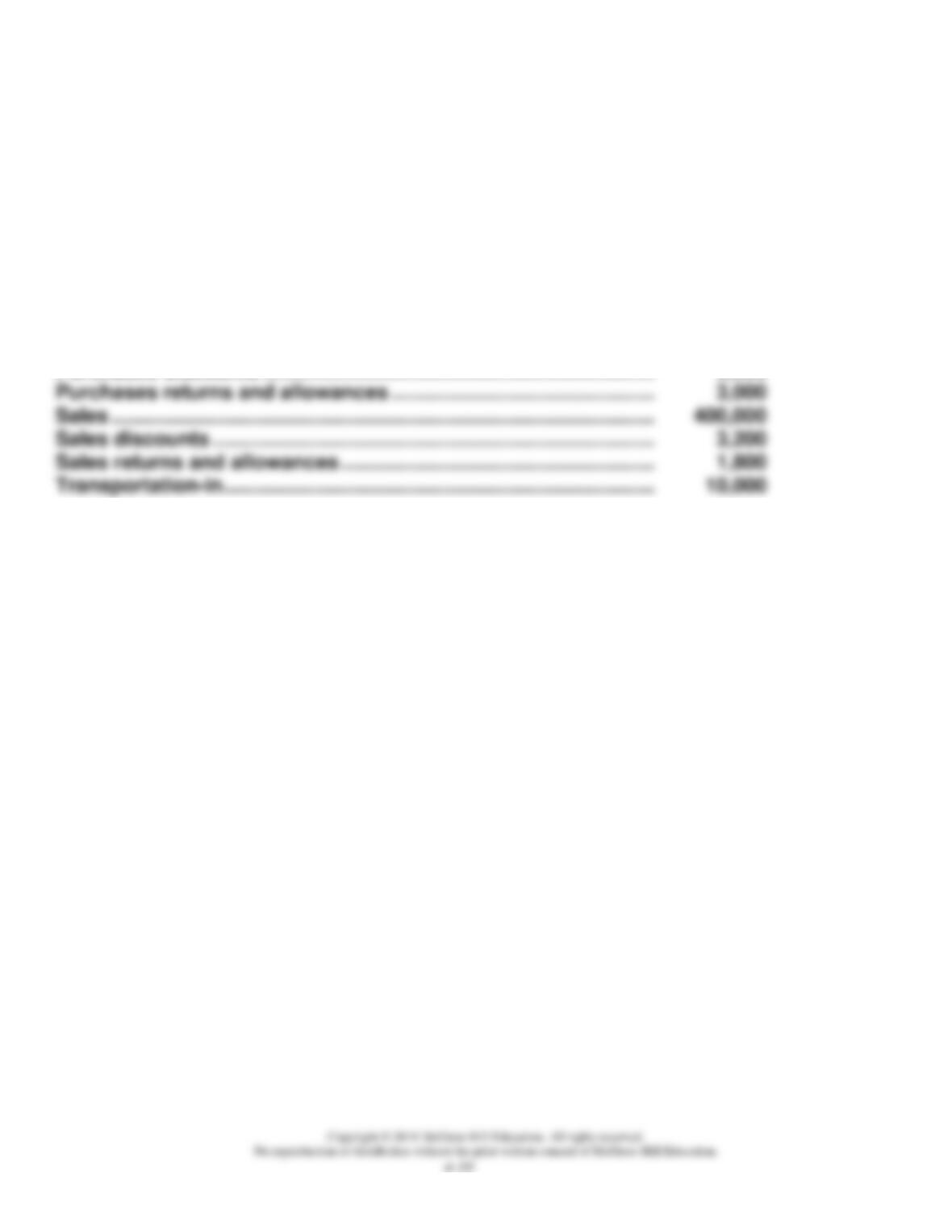
The following data was taken from ledger account balances and supplementary
data for the Whisk Company. Whisk Company uses periodic inventory method to
account for its inventory.
Merchandise inventory, beginning …………………………………………
$ 20,000
Merchandise inventory, ending ……………………………………………..
23,000
Purchases …………………………………………………………………………….
215,000
Purchases discounts …………………………………………………………….
Purchases returns and allowances ………………………………………..
400,000
Sales discounts …………………………………………………………………….
Sales returns and allowances ………………………………………………..
10,000
Required:
Show the computation, in Income Statement format, of net sales, cost of goods
sold, and gross profit for the year ended December 31, 2019.
4-11
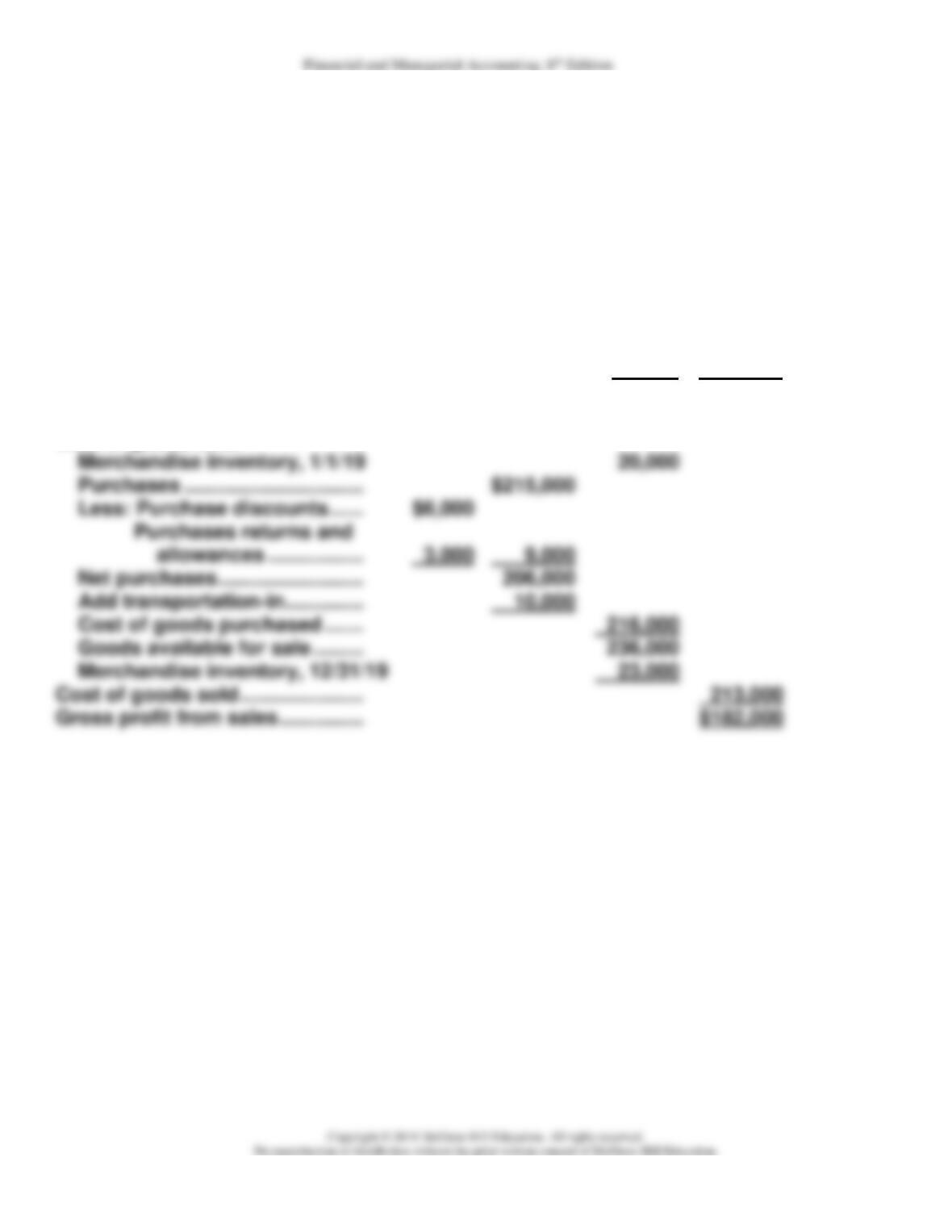
Chapter 4 Solution: Alternate Demonstration Problem #1
WHISK COMPANY
Income Statement
For the Year Ended December 31, 2019
Revenue from sales:
Sales …………………………………..
$400,000
Less: Sales discounts ………….
$ 3,200
Sales returns and
allowances ……………..
1,800
5,000
Net sales …………………………..…
395,000
Cost of goods sold:
Merchandise inventory, 1/1/19
Purchases …………………………..
$215,000
Less: Purchase discounts ……
allowances ……………..
9,000
10,000
216,000
Goods available for sale ………
236,000
Merchandise inventory, 12/31/19
23,000
Cost of goods sold ………………….
213,000
Gross profit from sales ……………
$182,000
Financial and Managerial Accounting, 8th Edition
Chapter 4 Alternate Demonstration Problem #2
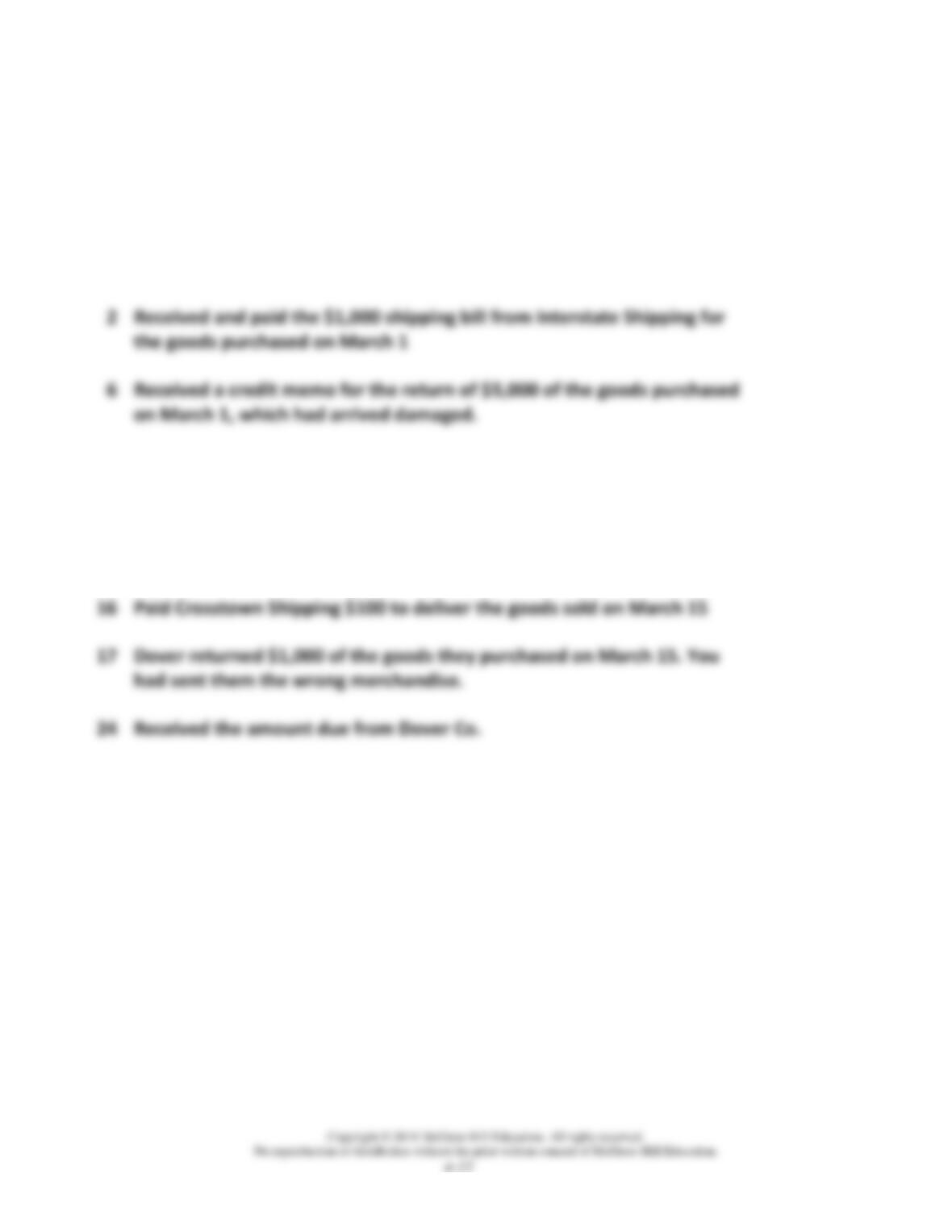
Koda Company is a wholesale company that had the following purchase and sales transactions
related to its merchandise inventory during the month of May.
May 1
Purchased $20,000 of merchandise on account from Webber Mfg. Co.
Credit terms: 2/10, n/30. FOB shipping point
the goods purchased on March 1
Received a credit memo for the return of $5,000 of the goods purchased
on March 1, which had arrived damaged.
10
Paid Webber Mfg. Co. the amount due.
15
Sold merchandise on account to Dover Company for $5,000. The cost of
the merchandise was $3,000 (cost is 60% of the retail value). Terms:
2/10, n/30; FOB Destination
16
Paid Crosstown Shipping $100 to deliver the goods sold on March 15
had sent them the wrong merchandise.
24
Received the amount due from Dover Co.
Requirement 1: Record the transactions assuming Koda Company uses perpetual inventory
system
Requirement 2: Record the transactions assuming that Koda Company uses periodic system.
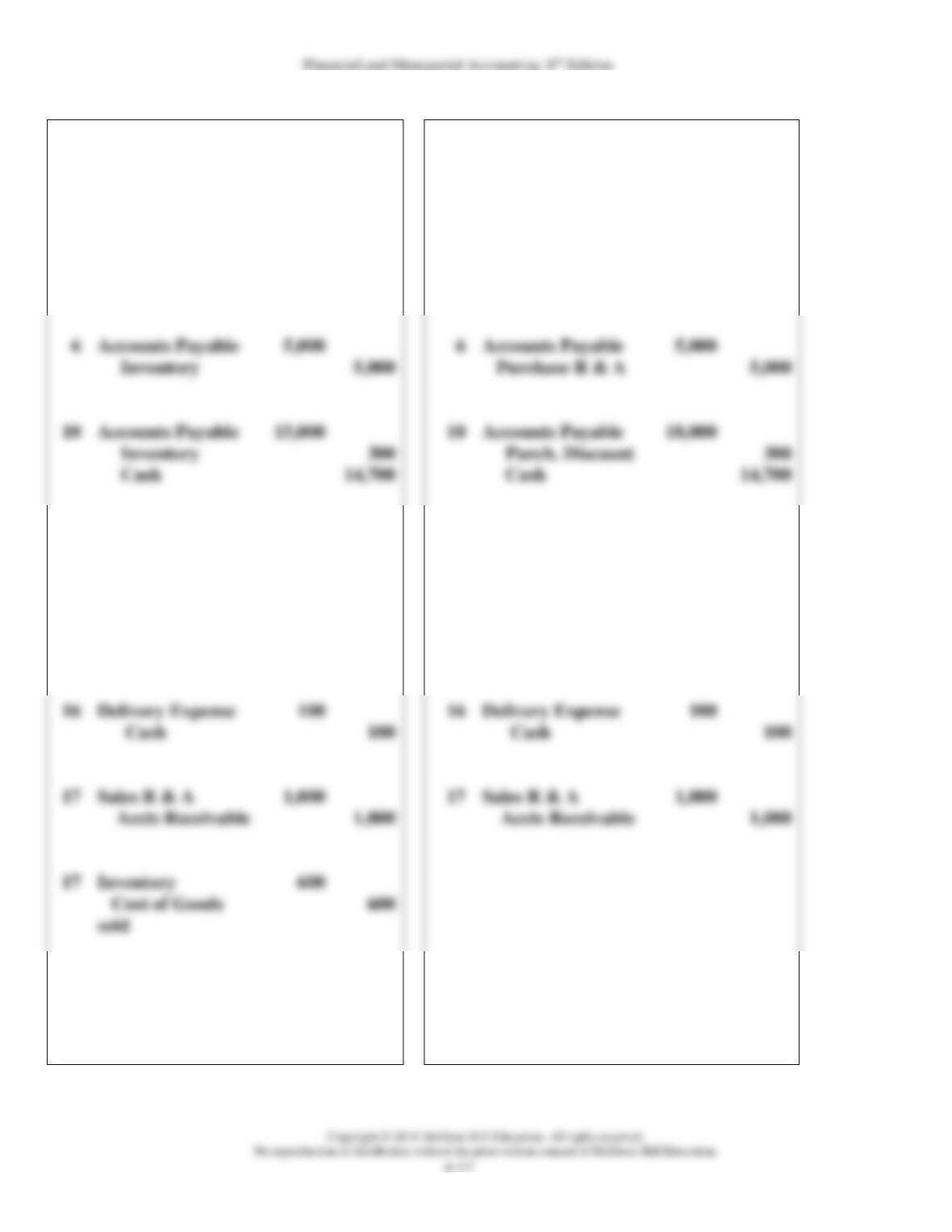
Chapter 4 Solution: Alternate Demonstration Problem #2
PERPETUAL INVENTORY SYSTEM
PERIODIC INVENTORY SYSTEM
4-1
Inventory
20,000
4-1
Purchases
20,000
Accounts Payable
20,000
Accounts Payable
20,000
2
Inventory
1,000
2
Freight-In
1,000
Cash
1,000
Cash
1,000
6
Accounts Payable
5,000
6
Accounts Payable
5,000
Inventory
5,000
Purchase R & A
5,000
10
Accounts Payable
15,000
10
Accounts Payable
18,000
Inventory
Purch. Discount
Cash
14,700
Cash
14,700
15
Accts Receivable
5,000
15
Accts Receivable
5,000
Sales
5,000
Sales
5,000
15
Cost of Goods Sold
3,000
Inventory
3,000
16
Delivery Expense
16
Delivery Expense
100
Cash
Cash
17
Sales R & A
1,000
17
Sales R & A
1,000
Accts Receivable
1,000
Accts Receivable
1,000
17
Inventory
sold
24
Cash
3,920
24
Cash
3,920
Sales Discount
80
Sales Discount
80
Accts Receivable
4,000
Accts Receivable
4,000