Problem 4A-10 (continued)
3. and 4.
Costs of Ending Work in Process Inventory and Units Transferred Out
Materials
Conversion
Total
Ending work in process inventory:
Equivalent units ……………………………………………………………
20,000
8,000
Cost per equivalent unit …………………………………………………
$0.82
$1.48
Cost of ending work in process inventory …………………………..
$16,400
$11,840
$28,240
Units transferred out:
Cost in beginning work in process inventory ……………………….
$8,500
$4,900
$13,400
Cost to complete the units in beginning work in process inventory:
Equivalent units required to complete the beginning
inventory ……………………………………………………………..
0
7,000
$10,360
$10,360
Cost of units started and completed this period:
150,000
150,000
$0.82
$1.48
$123,000
$345,000
Cost of units transferred out ……………………………………………
$368,760
Problem 4A-11 (45 minutes)
FIFO method
1.
Equivalent units of production
Materials
Conversion
Equivalent units needed to complete beginning
work in process inventory:
Materials: 20,000 units x (100% − 100%) ..
0
Conversion: 20,000 units x (100% − 75%)
5,000
Units started and completed during the period
(180,000 units started − 40,000 units in
140,000
Materials: 40,000 units x 100% complete …
Conversion: 40,000 units x 25% complete ..
Equivalent units of production ……………………
155,000
2.
Cost per equivalent unit
Materials
Conversion
Cost added during the period (a) …………..
$334,800
$238,700
Equivalent units of production (b) ………….
180,000
155,000
Cost per equivalent unit (a) ÷ (b) ………….
$1.86
$1.54
3. and 4. See the next page.
5.
Cost Reconciliation
Costs to be accounted for:
Total cost to be accounted for …………………………...
$623,500
Costs accounted for as follows:
Cost of ending work in process inventory …………….
Costs of units transferred out …………………………...
Total cost accounted for …………………………………..
Problem 4A-11 (continued)
3. and 4.
Costs of Ending Work in Process Inventory and Units Transferred Out
Materials
Conversion
Total
Ending work in process inventory:
Equivalent units ……………………………………………………………
40,000
10,000
Cost per equivalent unit …………………………………………………
$1.86
$1.54
Cost of ending work in process inventory …………………………..
$74,400
$15,400
$89,800
Units transferred out:
Cost in beginning work in process inventory ……………………….
$25,200
$24,800
$50,000
Cost to complete the units in beginning work in process inventory:
Equivalent units needed to complete the beginning
5,000
Cost of units started and completed this period:
140,000
140,000
$1.86
$1.54
$260,400
$476,000
Cost of units transferred out ……………………………………………
$533,700
Case 4A-12 (60 minutes)
1.
Transferred In
Materials
Conversion
Equivalent units needed to complete beginning work in
process inventory:
Transferred in: 450 units × (100% − 100%) ……………..
0
Materials: 450 units × (100% − 100%) ……………………
0
Conversion: 450 units × (100% − 60%) …………………..
180
Units started and completed during the period (1,950 units
started − 600 units in ending inventory) …………………….
1,350
1,350
1,350
Equivalent units in ending work in process inventory:
Transferred in: 600 units x 100% complete
600
Conversion: 600 units x 35% complete …………………….
Materials
Conversion
Cost added during the period (a) ………………………………..
1,350
Cost per equivalent unit (a) ÷ (b) ……………………………….
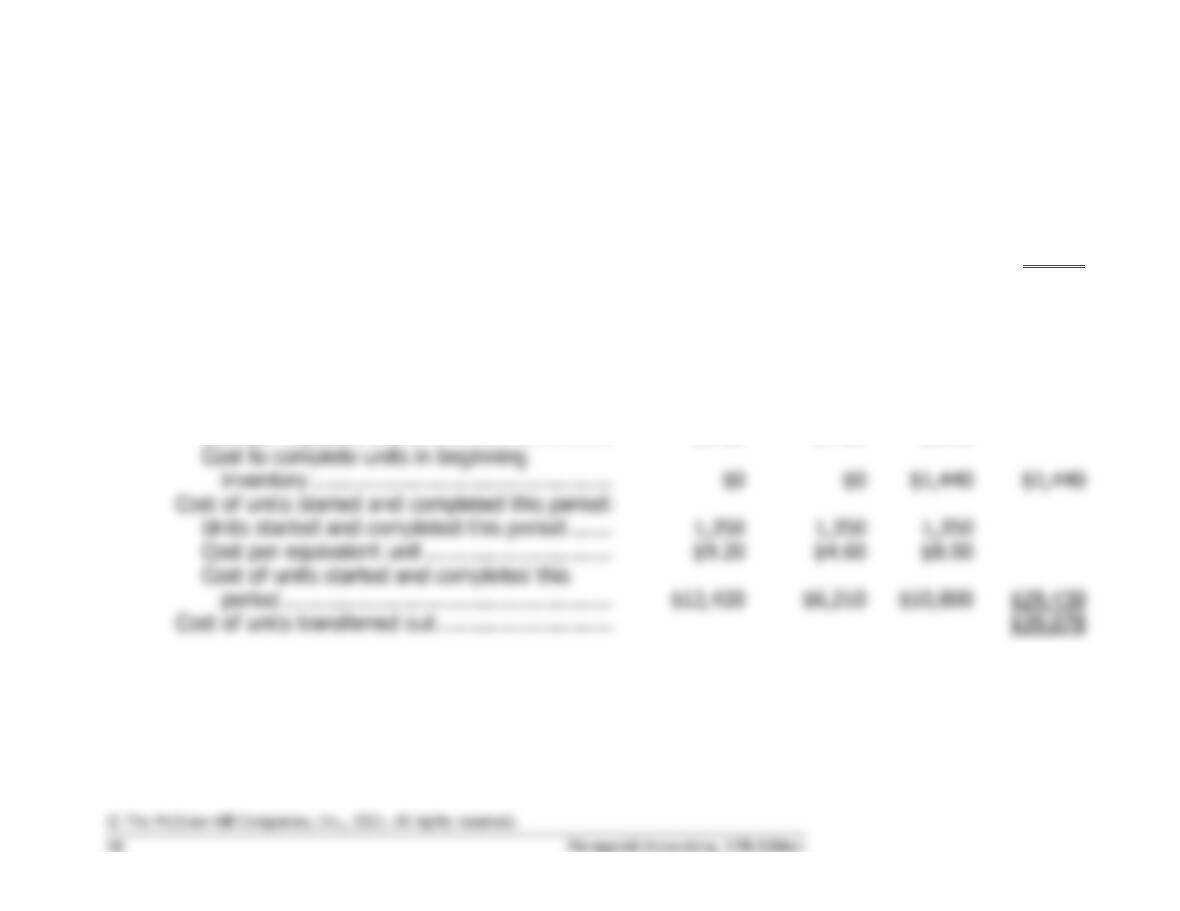
Case 4A-12 (continued)
Transferred In
Materials
Conversion
Total
Ending work in process inventory:
Equivalent units ……………………………………….
600
0
210
Cost per equivalent unit …………………………….
$9.20
$4.60
$8.00
Cost of ending work in process inventory ………
$5,520
$0
$1,680
$7,200
Units transferred out:
Cost in beginning work in process inventory …..
$4,068
$1,980
$2,160
$8,208
Cost to complete units in beginning work in
process inventory:
Equivalent units needed to complete the
beginning inventory (see above) …………..
0
0
180
Cost per equivalent unit …………………………
$9.20
$4.60
$8.00
$0
$1,440
$1,440
Cost of units started and completed this period:
1,350
1,350
1,350
$9.20
$4.60
$8.00
$6,210
Cost of units transferred out ……………………….
2. The unit cost in the report prepared by the new assistant controller is high because none of the cost
incurred during the month was assigned to the units in ending work in process inventory. Because all
of the cost was assigned to the units completed and transferred to finished goods, the cost of those
units was incorrectly inflated.
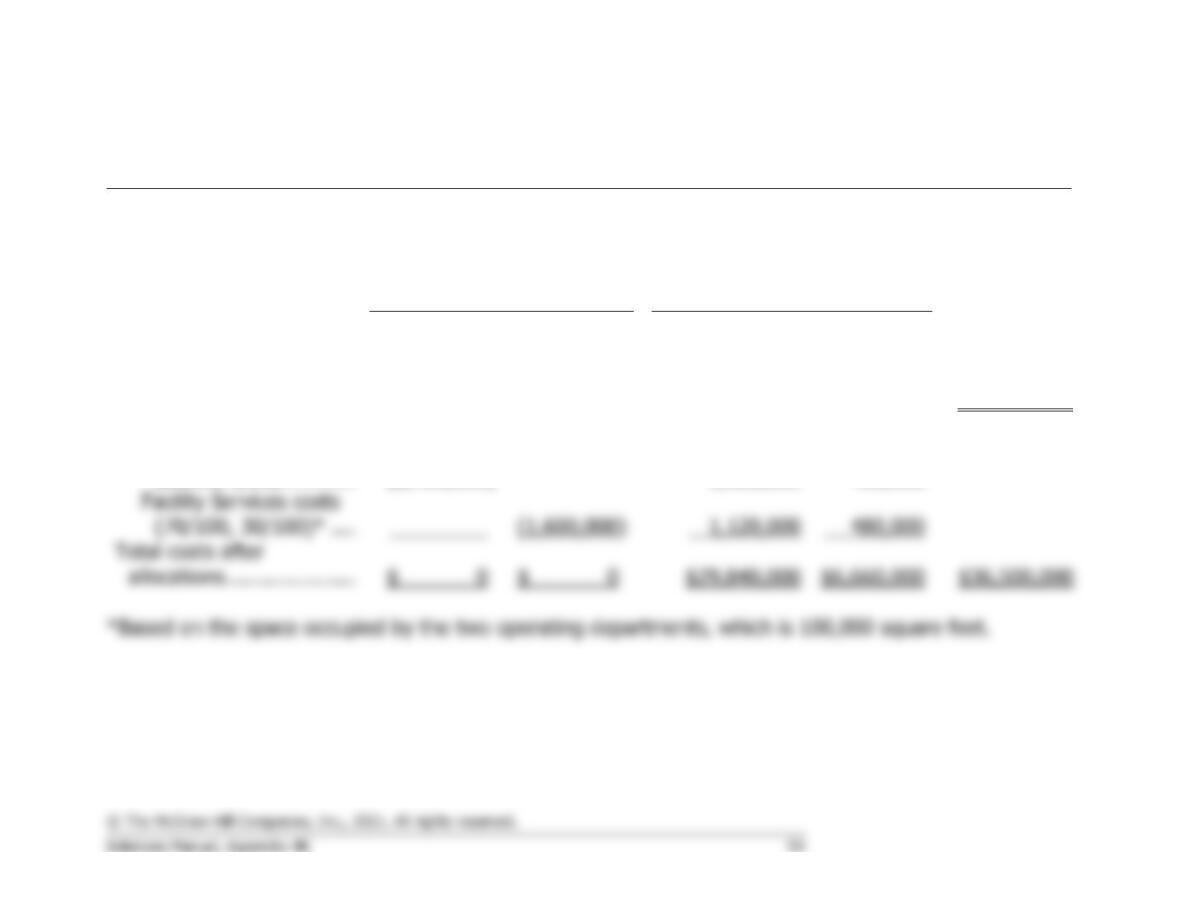
Appendix 4B
Service Department Cost Allocations
Exercise 4B-1 (15 minutes)
Service Departments
Operating Departments
Admini-
stration
Facility
Services
Undergraduate
Programs
Graduate
Programs
Total
Departmental costs
before allocations ……….
$2,400,000
$1,600,000
$26,800,000
$5,700,000
$36,500,000
Allocations:
Administration costs
(20/25, 5/25) …………
(2,400,000)
1,920,000
480,000
(1,600,000)
Total costs after
allocations …………………
$ 0
$ 0
$29,840,000
$6,660,000
$36,500,000
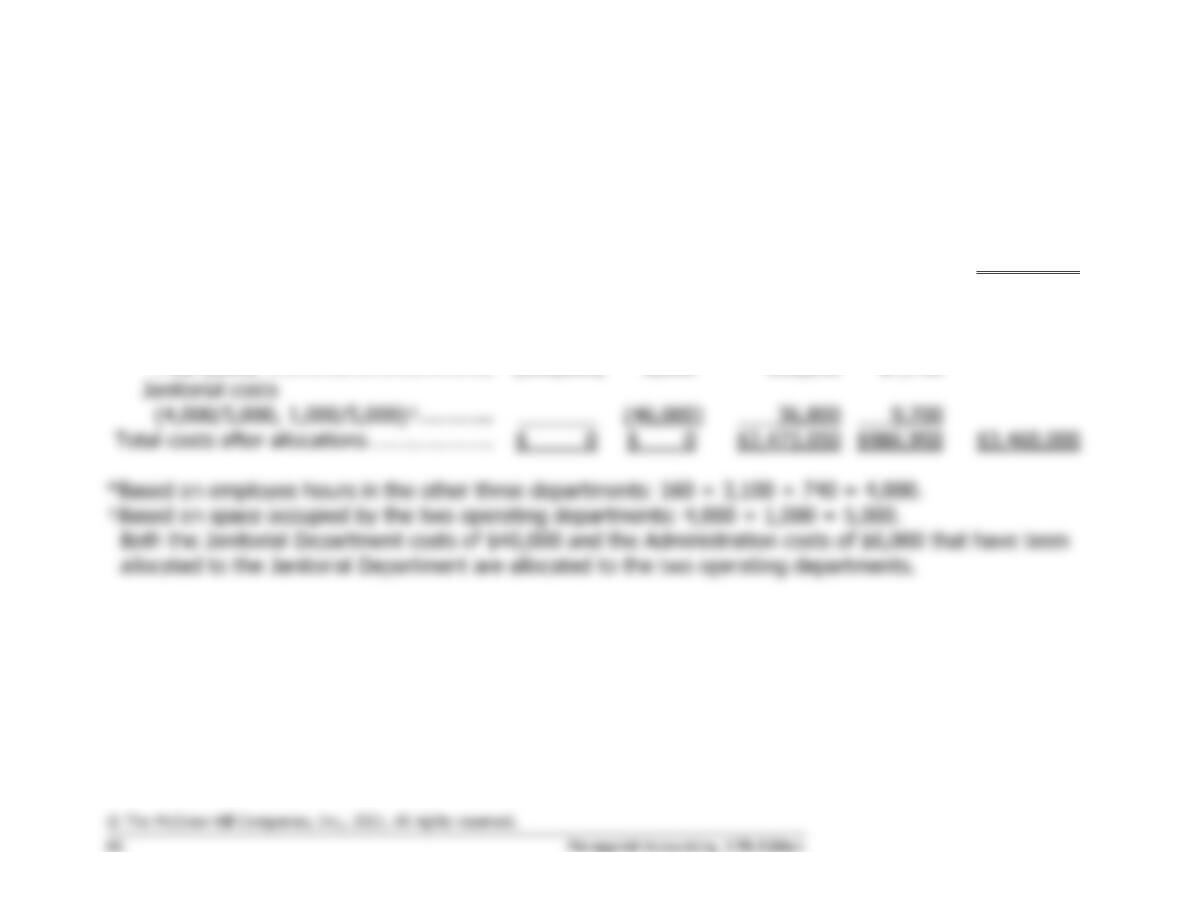
Exercise 4B-2 (15 minutes)
Service
Departments
Operating
Departments
Admini-
stration
Janitorial
Groceries
Gifts
Total
Departmental costs before allocations …..
$150,000
$40,000
$2,320,000
$950,000
$3,460,000
Allocations:
Administration costs
(160/4,000, 3,100/4,000,
(150,000)
36,800
9,200
Total costs after allocations ………………..
$ 0
$2,473,050
$986,950
$3,460,000
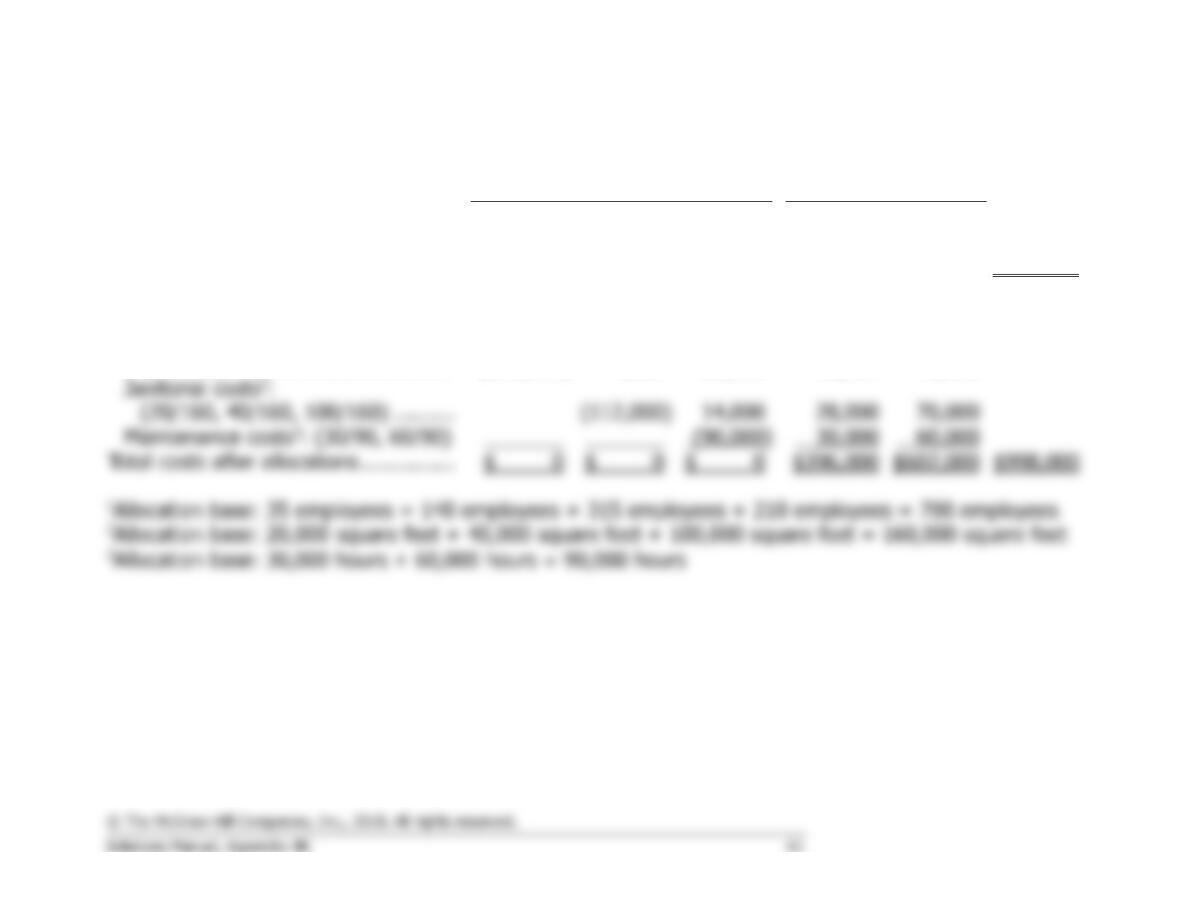
Exercise 4B-3 (20 minutes)
Service
Departments
Operating
Departments
Admini-
stration
Janitorial
Mainte-
nance
Binding
Printing
Total
Departmental costs before allocations
$140,000
$105,000
$ 48,000
$275,000
$430,000
$998,000
Allocations:
Administration costs1:
(35/700, 140/700, 315/700,
210/700)……………………………….
(140,000)
7,000
28,000
63,000
42,000
Total costs after allocations ……………
$396,000
$602,000
$998,000
Exercise 4B-4 (20 minutes)
Service
Departments
Operating
Departments
Admini-
stration
Janitorial
Mainte-
nance
Binding
Printing
Total
Departmental costs before
allocations …………………………..
$140,000
$105,000
$ 48,000
$275,000
$430,000
$998,000
Allocations:
Administration costs1:
(315/525, 210/525) …………….
(140,000)
84,000
56,000
Janitorial costs2:
Maintenance costs3:
(30/90, 60/90) …………………..
16,000
32,000
Total costs after allocations ……….
$405,000
$593,000
$998,000
Problem 4B-5 (45 minutes)
House-
keeping
Services
Food
Services
Admini-
strative
Services
Laboratory
Radiology
General
Hospital
Departmental costs before
allocations …………………………..
$87,000
$301,060
$249,020
$405,900
$520,500
$475,800
Allocations:
Housekeeping Services costs
(87,000)
Food Services costs
Admin. Services costs:
(14/46; 7/46; 25/46) …………..
(256,361)
78,023
39,011
139,327
Total costs after allocations ……….
$ 0
$ 0
$ 0
$498,526
$568,313
$972,441
1. Step-down method:
Personnel
Custodial
Services
Mainte-
nance
Printing
Binding
Departmental costs before allocations ……………
$360,000
$141,000
$201,000
$525,000
$373,500
Allocations:
Personnel costs (15/200, 25/200, 40/200,
120/200)1 …………………………………………..
(360,000)
27,000
45,000
72,000
216,000
Custodial services costs
(20/140, 80/140, 40/140)2 ……………………..
(168,000)
24,000
96,000
48,000
Maintenance costs (150/180, 30/180)3 ………..
(270,000)
225,000
45,000
Total costs after allocations …………………………
$ 0
$918,000
Divide by machine-hours …………………………….
Divide by direct labor-hours ………………………..
Predetermined overhead rate ………………………
Based on 15 + 25 + 40 + 120 = 200 employees
Based on 20,000 + 80,000 + 40,000 = 140,000 square feet
Based on 150,000 + 30,000 = 180,000 machine-hours
Case 4B-6 (continued)
2. Direct method:
Personnel
Custodial
Services
Mainte-
nance
Printing
Binding
Departmental costs before allocations ……………
$360,000
$141,000
$201,000
$525,000
$373,500
Allocations:
Personnel costs (40/160, 120/160)1 ……………
(360,000)
90,000
270,000
Custodial Services costs (80/120, 40/120)2 …..
(141,000)
94,000
47,000
Maintenance costs (150/180, 30/180)3 ………..
(201,000)
167,500
33,500
Total costs after allocations …………………………
$ 0
$876,500
$724,000
Divide by machine-hours …………………………….
Divide by direct labor-hours ………………………..
Predetermined overhead rate ………………………
Based on 80,000 + 40,000 = 120,000 square feet
Based on 150,000 + 30,000 = 180,000 machine-hours
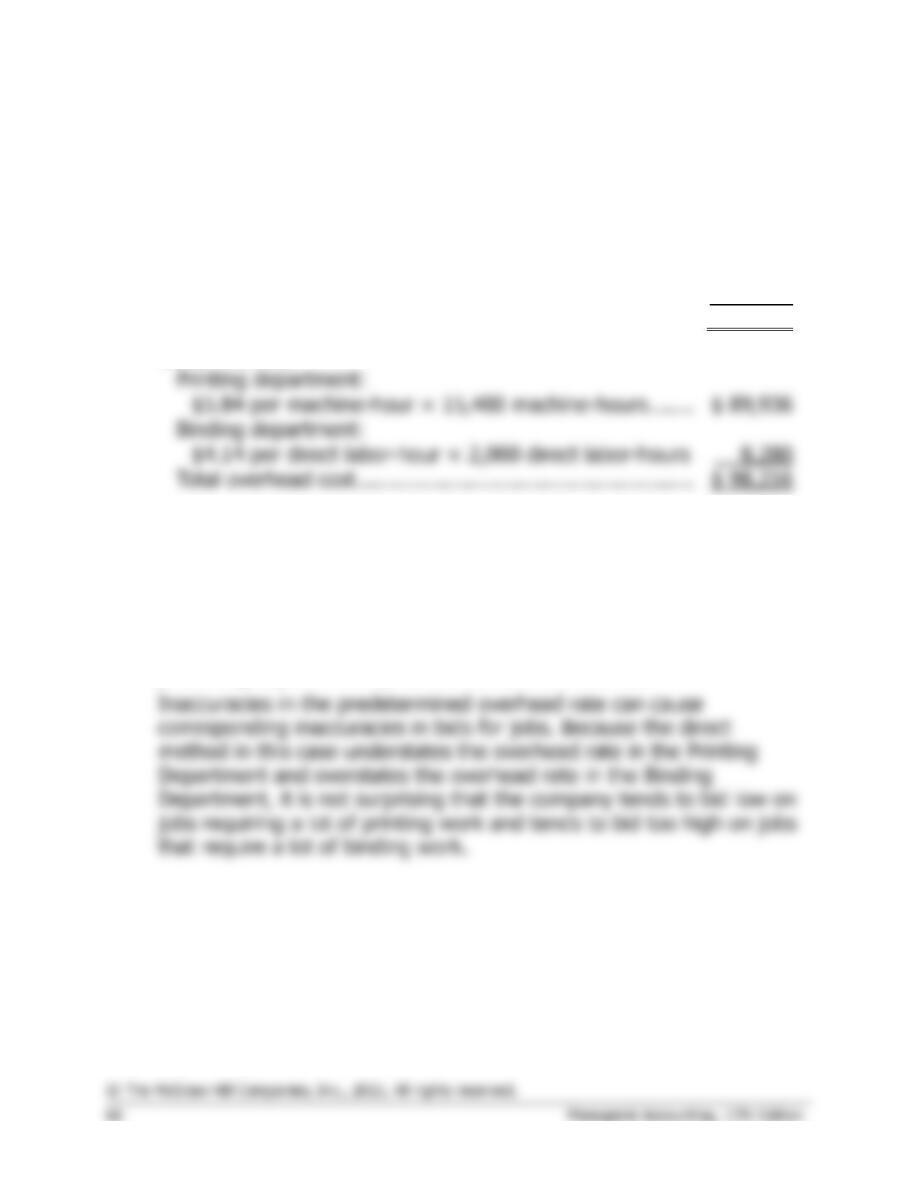
Case 4B-6 (continued)
3. a. The amount of overhead cost assigned to the job would be:
Step-down method
:
Printing department:
$6.12 per machine-hour × 15,400 machine-hours …….
$ 94,248
Binding department:
$3.90 per direct labor-hour × 2,000 direct labor-hours
7,800
Total overhead cost ………………………………………………
$102,048
Direct method
:
Printing department:
$5.84 per machine-hour × 15,400 machine-hours …….
Binding department:
$4.14 per direct labor-hour × 2,000 direct labor–hours
8,280
Total overhead cost ………………………………………………
b. The step-down method provides a better basis for computing
predetermined overhead rates than the direct method because it
gives recognition to services provided between service departments.
If this interdepartmental service is not recognized, then either too
much or too little of a service department’s costs may be allocated to
a producing department. The result will be an inaccuracy in the
producing department’s predetermined overhead rate.