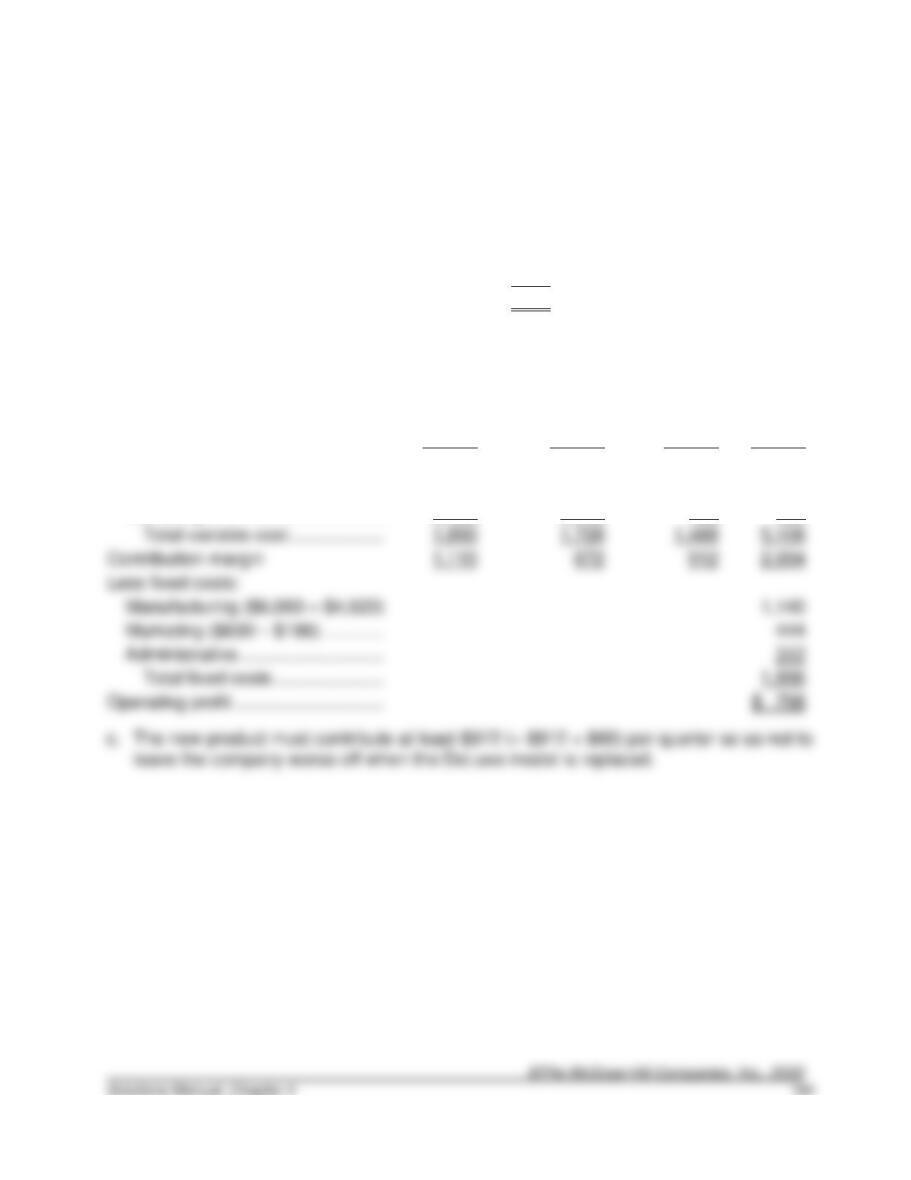
4-64. Decision Whether to Add or Drop: Agnew Manufacturing.
a. The regional market should not be dropped as this market not only covers all the
variable costs and separable fixed costs but also gives net market contribution of
$390,000 toward the common fixed costs, as shown below (in thousands of dollars).
Sales
=
$1,800
Variable manufacturing costs:
(.6 $600) + (.7 $600) + (.6 $600)
=
$1,140
Marketing costs (given)
=
$270
Net market contribution
=
$390
(= $1,800 – $1,140 – $270)
b. Quarterly income statement (in thousands):
Model
Standard
Model
Superior
Model
DeLuxe
Total
Sales revenue …………………………..
$3,000
$2,400
$2,400
$7,800
Less variable costs …………………….
Manufacturing ………………………..
1,800
1,680
1,440
4,920
Marketing ………………………………
90
48
48
186
Contribution margin
1,110
2,694
Less fixed costs:
444
Administrative ………………………..
312
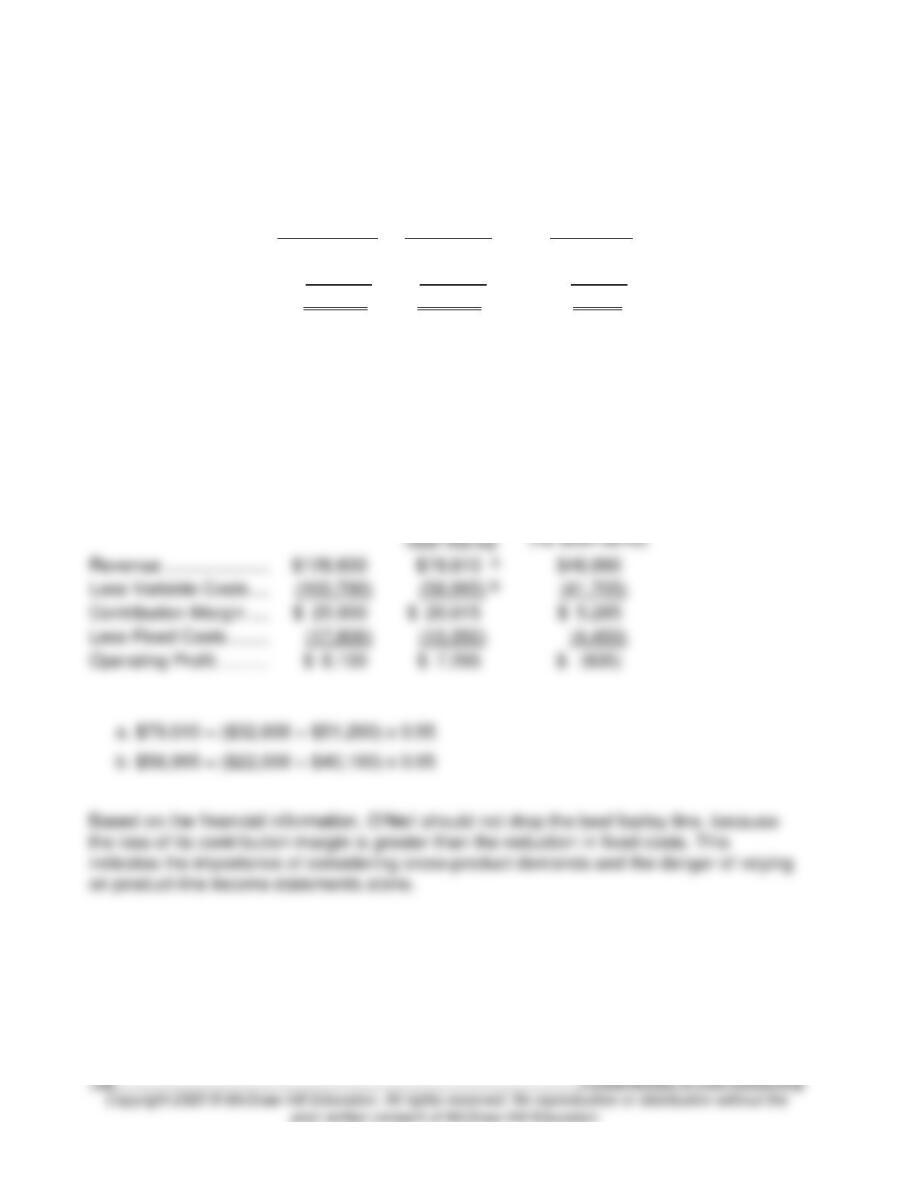
4-65. Decision Whether to Add or Drop: O’Neil Enterprises.
a.
Status Quo
Alternative:
Drop
Beef Barley
Difference
(all lower under
the alternative)
Revenue …………………
$126,600
$83,800
$42,800
Less Variable Costs ….
(100,700)
(62,100)
(38,600)
Contribution Margin ….
$ 25,900
$ 21,700
$ 4,200
Less Fixed Costs ……..
(17,800)
(13,350)
a
(4,450)
Operating Profit………..
$ 8,100
$ 8,350
$ 250
a$13,350 = $17,800 .75
Based on the financial information, O’Neil should drop the beef barley line, because the
loss of its contribution margin is less than the reduction in fixed costs.
.
b.
Status Quo
Alternative:
Drop
Revenue …………………
$126,600
$46,990
Less Variable Costs ….
(58,995)
Less Fixed Costs ……..
Difference
(all lower under
4-66. (30 min.) Decision Whether to Close a Store: Power Music.
We recommend that Power Music close the store. The cost savings are greater than
the lost margin on the sales. The difference, however, is not large and if there are
other considerations, they might outweigh the estimated increase in profits.
The analysis shows that closing the Fifth Avenue Store results in lost gross margin of
$270,000 (= $1,950,000 in sales less $1,680,000 in cost of goods sold). The cost
savings are $283,500:
Payroll, Direct Labor, and Supervisiona
$153,000
Renta
48,300
State Taxesb
7,500
Insurance on Inventoryb
55,200
Depreciationc
Interest for Inventory Carrying Costsb
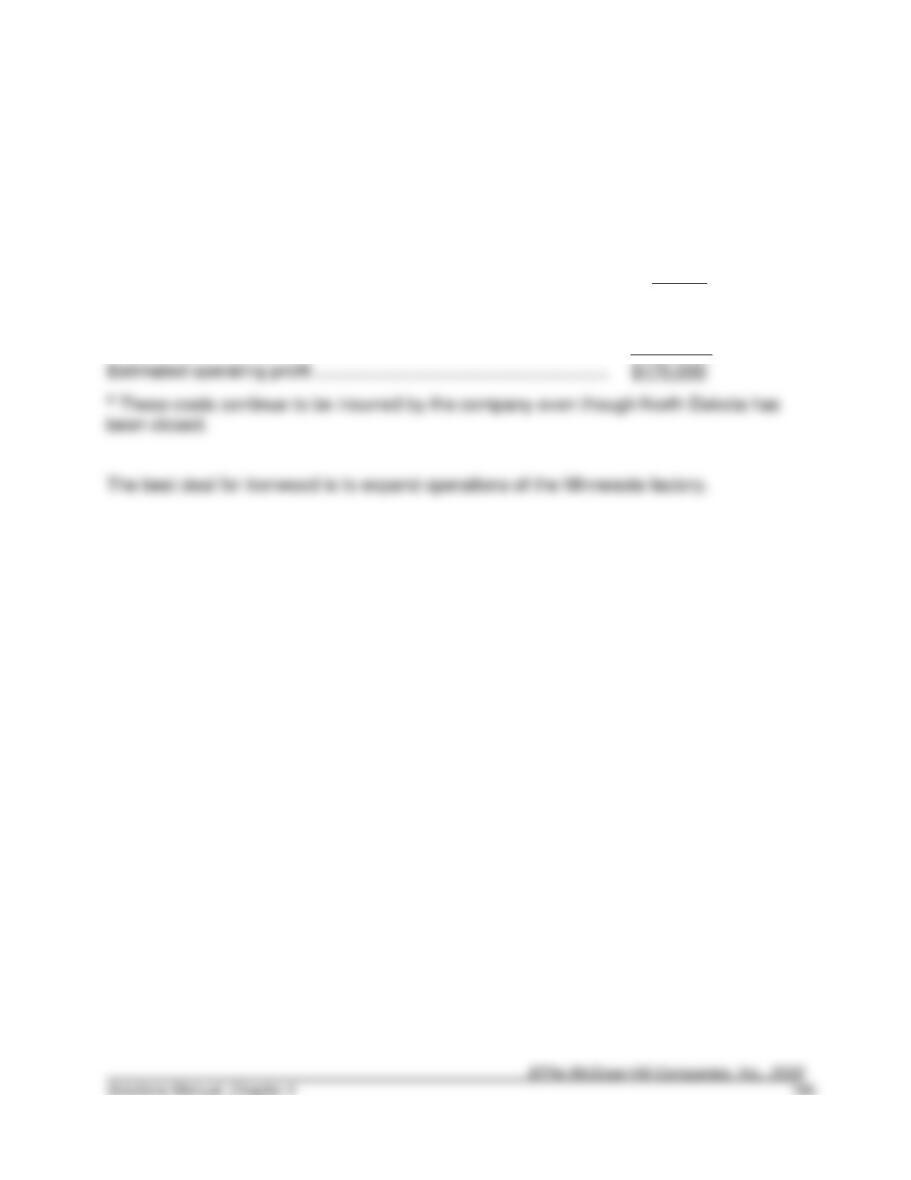
4-67. (45 min.) Closing a Plant: Ironwood Corporation.
a.
Ironwood Corporation
Computation of Estimated Profit from Operations
after Expansion of Minnesota Factory
Minnesota factory:
Sales ($280,000 x 150%) ………………………………………..
$420,000
Fixed costs
Factory ($56,000 x 120%) ……………………………………
$67,200
Administration ($22,000 x 110%) …………………………..
24,200
Variable costs [$2 ($420,000 ÷ $5 sales price)] ……….
168,000
Allocated home office costs ……………………………………..
35,000
Total ………………………………………………………………….
294,400
Estimated operating profit ………………………………………..
$125,600
Wisconsin factory—estimated operating profit ………………..
108,000
Less home office costs previously allocated to North
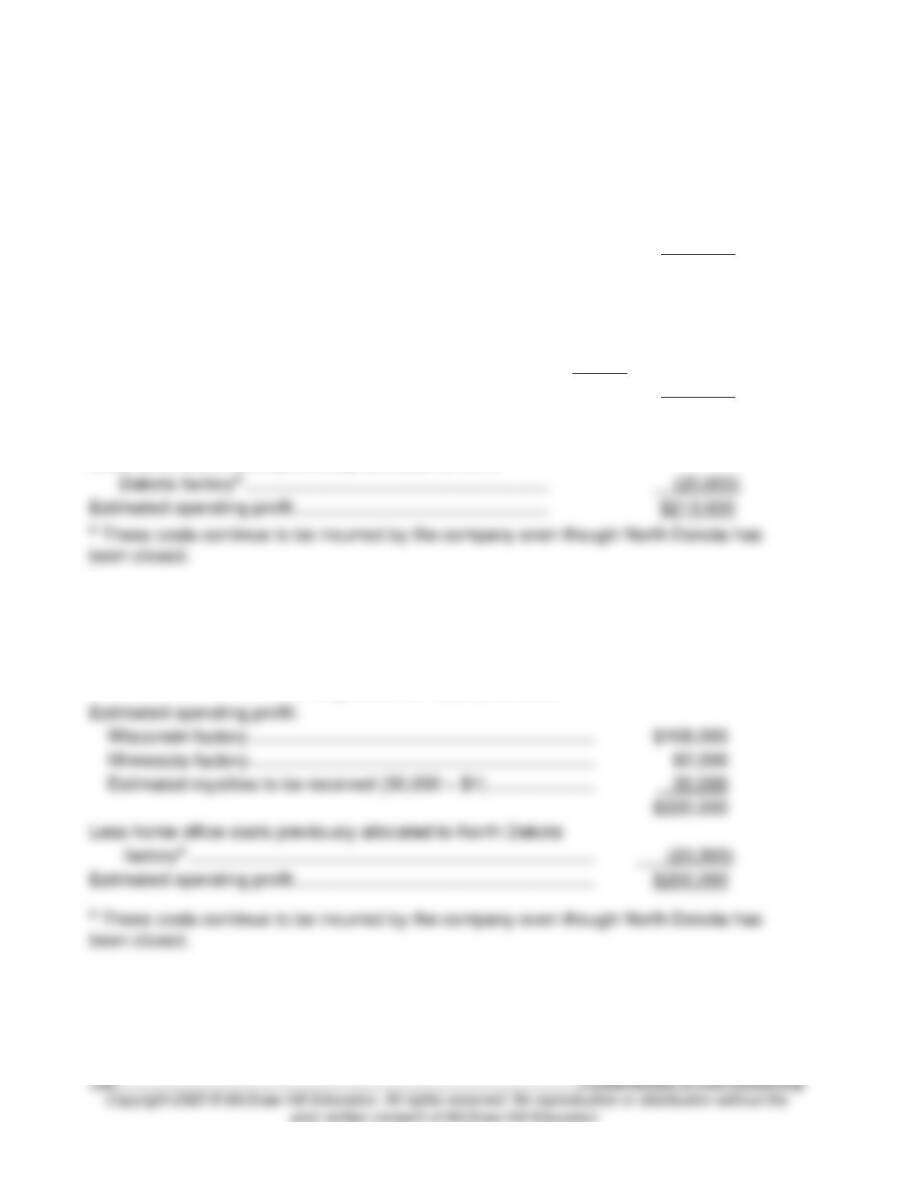
b.
Ironwood Corporation
Computation of Estimated Profit from Operations
after Negotiation of Royalty Contract
Estimated operating profit:
Wisconsin factory ……………………………………………………………
Minnesota factory ……………………………………………………………
Estimated royalties to be received (30,000 $1) …………………
Less home office costs previously allocated to North Dakota
4-67. (continued)
c.
Ironwood Corporation
Computation of Estimated Profit from Operations
after Shutdown of North Dakota Factory
Estimated operating profit:
Wisconsin factory …………………………………………………………..
$108,000
Minnesota factory …………………………..………………………………
82,000
$190,000
Less home office costs previously allocated to North Dakota
factorya ………………………………………………………………………
(20,000)
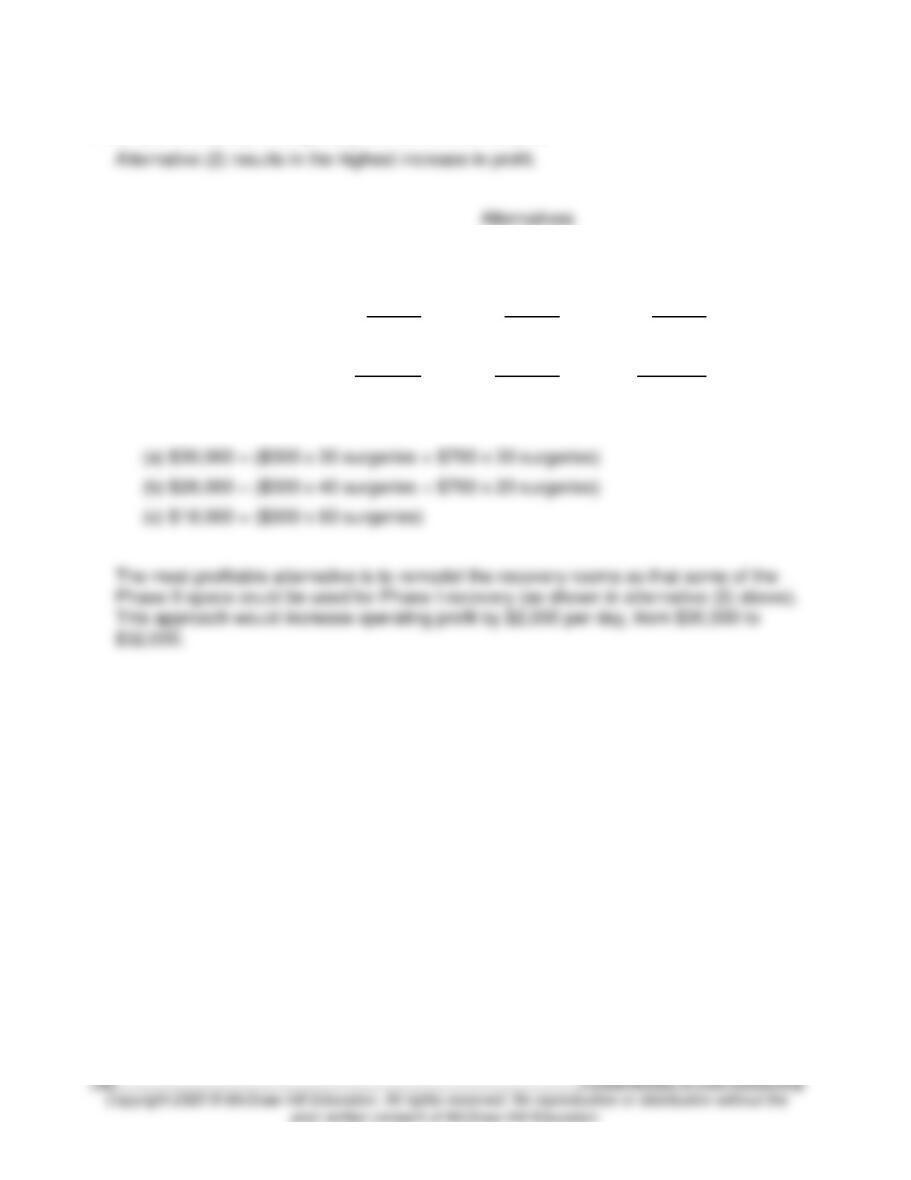
4-68. (30 min.) Expanding Surgical Units in a Hospital
(1)
(2)
(3)
Revenue
$60,000
$60,000
$60,000
Variable costs
30,000
(a)
26,000
(b)
18,000
(c)
Contribution margin
$30,000
$34,000
$42,000
Fixed costs (per day)
-0-
2,000
15,000
Operating profit
$30,000
$32,000
$27,000
4-69. (30 min.) Theory of Constraints: CompDesk, Inc.
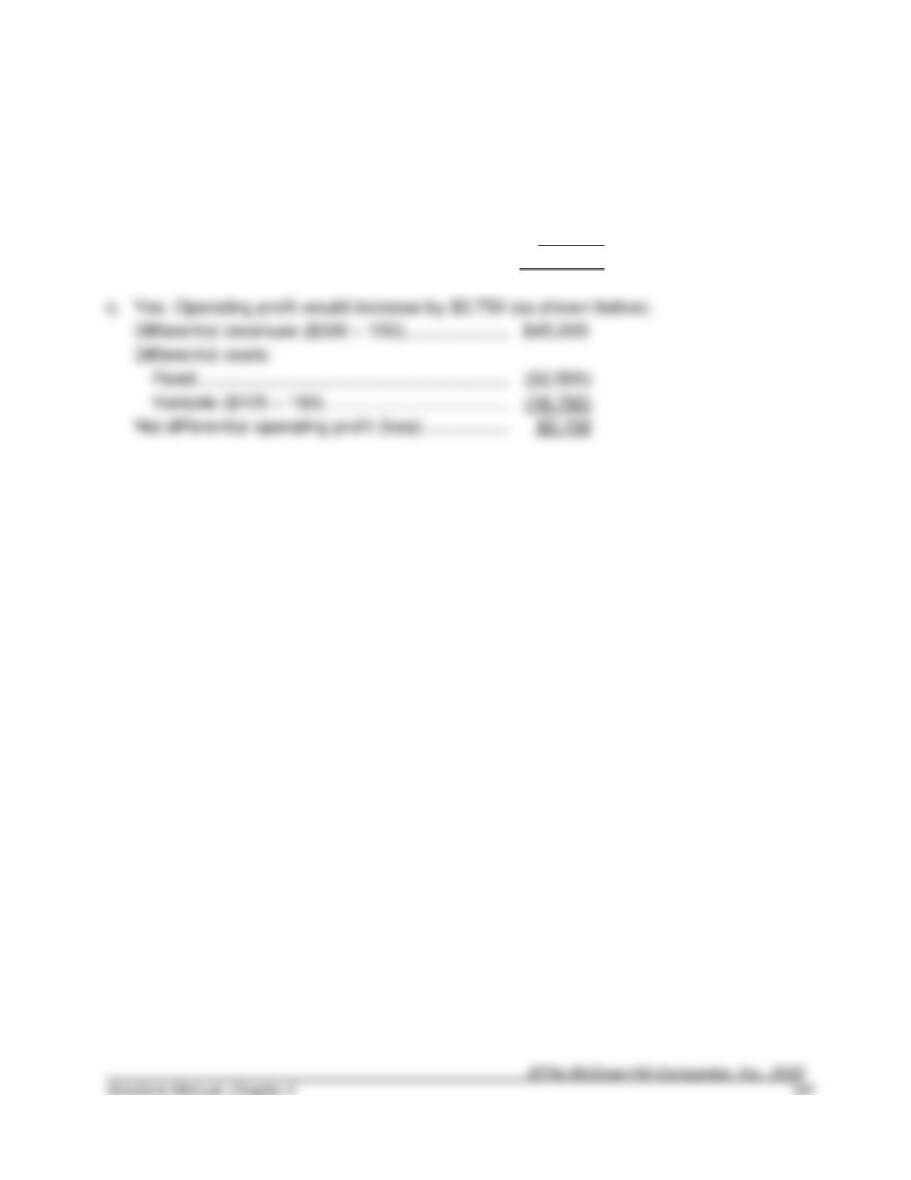
a. Yes. The bottleneck is in Building 1, which can only produce 600 desks.
b. No. Operating profit would decrease by $11,250 (as shown below).
Differential revenues ($300 150 units) …………
$45,000
Differential costs:
Fixed ……………………………………………………..
(30,000)
Variable ($175 150 units) ……………………….
(26,250)
Net differential operating profit (loss) …………….
$ (11,250)
Differential revenues ($300 150) …………………
Differential costs:
Fixed ……………………………………………………..
Variable ($125 150) ……………………………….
4-70. (30 min.) Theory of Constraints: Playful Pens, Inc.
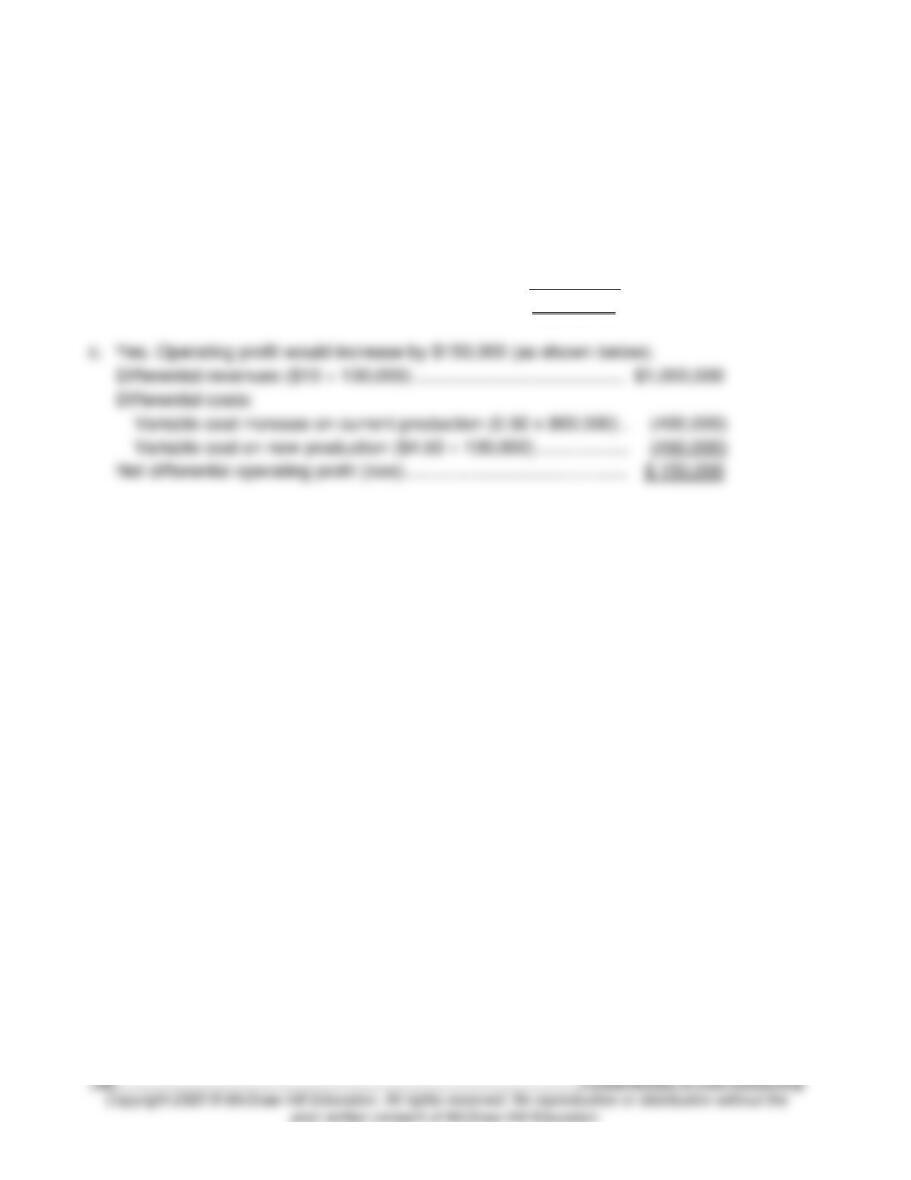
a. Yes. The bottleneck is Machine 2, which can only produce 800,000 holders.
b. Yes. Operating profit would increase by $200,000 (as shown below).
Differential revenues ($10 200,000 units) ……..
$2,000,000
Differential costs:
Fixed ………………………………………………………
(800,000)
Variable ($5 200,000 units) ……………………..
(1,000,000)
Net differential operating profit ……………………..
$ 200,000
Differential revenues ($10 100,000) ……………………………………
Differential costs:
Variable cost increase on current production (0.50 x 800,000) ..
Variable cost on new production ($4.50 100,000) ..……………..
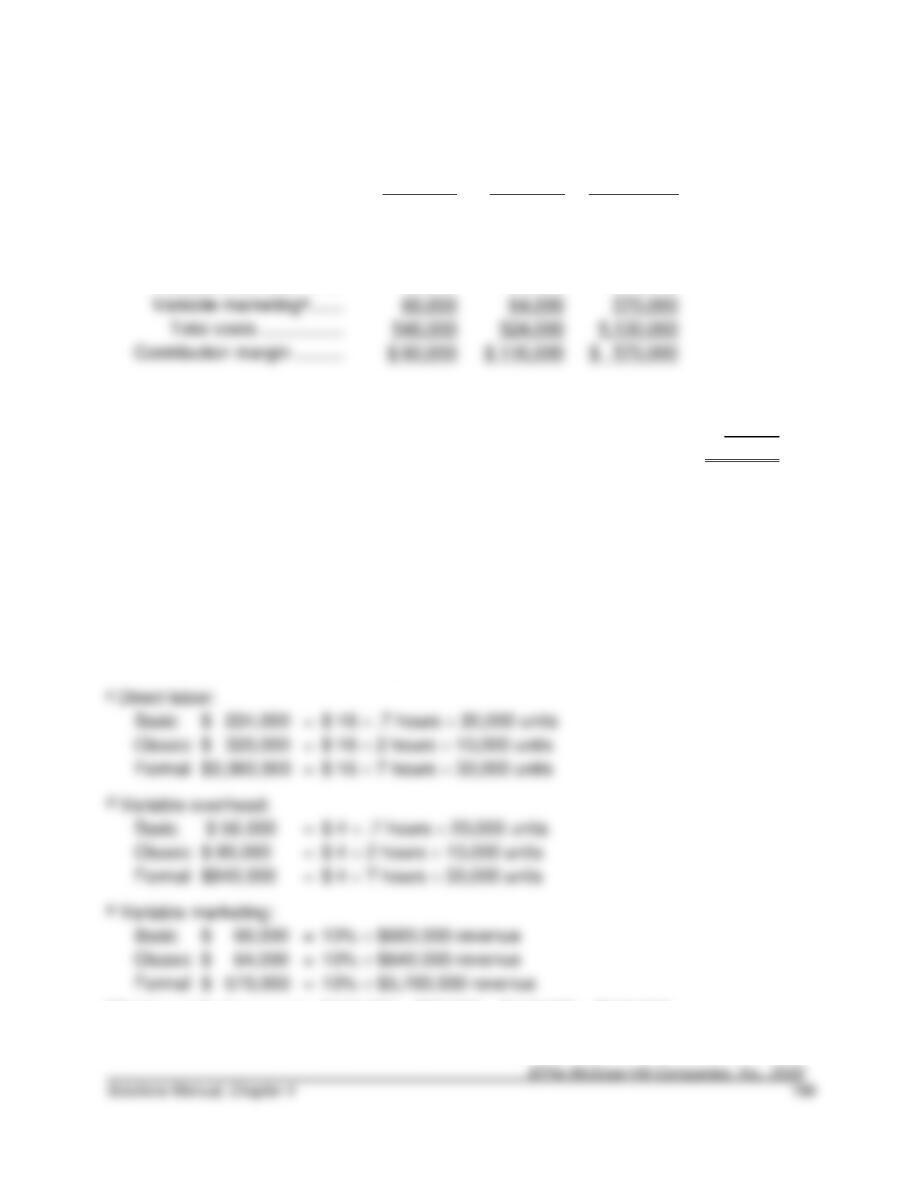
4-71. (60 min.) Optimum Product Mix: Austin Enterprises.
a.
Basic
Classic
Formal
Total revenuea ………………….
$600,000
$640,000
$5,700,000
Less variable manufacturing costs:
Direct materialsb …………
200,000
60,000
360,000
Direct laborc ………………
224,000
320,000
3,360,000
Variable overheadd …….
56,000
80,000
840,000
Variable marketinge …….
60,000
64,000
570,000
540,000
524,000
5,130,000
Total contribution marginf……………………………..
$746,000
Total fixed costsg ………………………………………..
74,000
Total operating profit …………………………..……….
$672,000
a Revenue:
Basic
$ 600,000
=
$30 20,000 units
Classic
$ 640,000
=
$64 10,000 units
Formal
$5,700,000
=
$190 30,000 units
b Direct materials:
Basic
$200,000
=
$20 .5 yards 20,000 units
Classic
$ 60,000
=
$20 .3 yards 10,000 units
Formal
$360,000
=
$20 .6 yards 30,000 units
Basic
$ 224,000
=
$ 16 .7 hours 20,000 units
Classic
$ 320,000
=
$ 16 2 hours 10,000 units
Formal
$3,360,000
=
$ 16 7 hours 30,000 units
Basic
$ 56,000
=
$ 4 .7 hours 20,000 units
Classic
$ 80,000
=
$ 4 2 hours 10,000 units
Formal
$840,000
=
$ 4 7 hours 30,000 units
Basic
$ 60,000
=
10% $600,000 revenue
Classic
$ 64,000
=
10% $640,000 revenue
Formal
$ 570,000
=
10% $5,700,000 revenue
f Total contribution margin: $746,000 = $60,000 + $116,000 + $570,000
g Total fixed costs: $ 74,000 = $36,000 + $8,000 + $30,000
4-71. (continued)
b. Contribution margin per constrained resource, labor:
Basic
$4.286
=
($60,000 ÷ 20,000 units) ÷ .7 hours
Classic
$5.80
=
($116,000 ÷ 10,000 units) ÷ 2 hours
Formal
$2.714
=
($570,000 ÷ 30,000 units) ÷ 7 hours
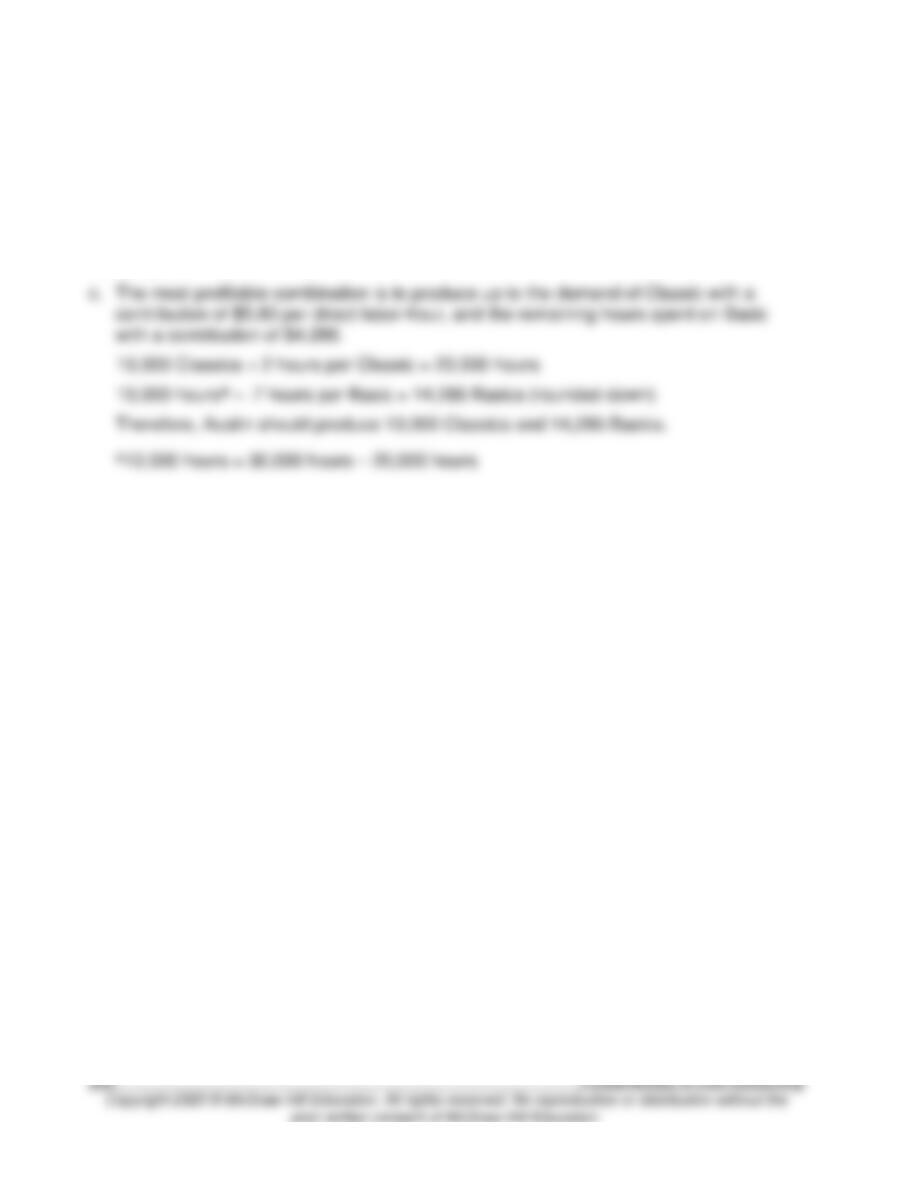
The Classic would be the most profitable product line given the constrained resource,
direct labor.
4-71. (continued)
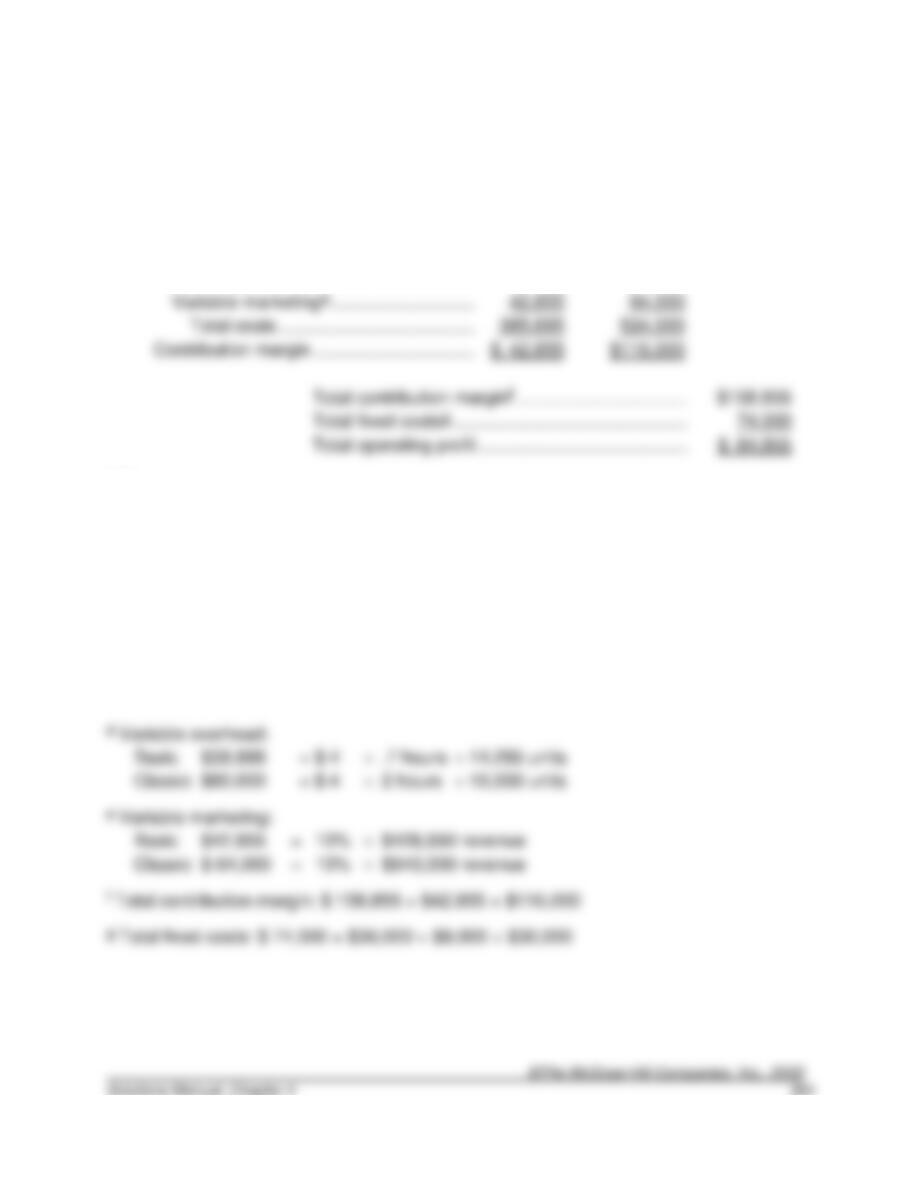
d.
Basic
Classic
Total revenuea …………………………..……..
$428,550
$640,000
Less variable manufacturing costs:
Direct materialsb …………………………….
142,850
60,000
Direct laborc ………………………………….
159,992
320,000
Variable overheadd ………………………..
39,998
80,000
Variable marketinge ………………………..
42,855
64,000
385,695
524,000
$158,855
a Revenue:
Basic
$428,550
=
$30
14,285 units
Classic
$640,000
=
$64
10,000 units
b Direct materials:
Basic
$142,850
=
$20
.5 yards
14,285 units
Classic
$60,000
=
$20
.3 yards
10,000 units
c Direct labor:
Basic
$ 159,992
=
$ 16
.7 hours
14,285 units
Classic
$320,000
=
$ 16
2 hours
10,000 units
Basic
=
$ 4
.7 hours
14,285 units
Classic
=
$ 4
2 hours
10,000 units
Basic
$42,855
10%
$428,550 revenue
4-71. (continued)
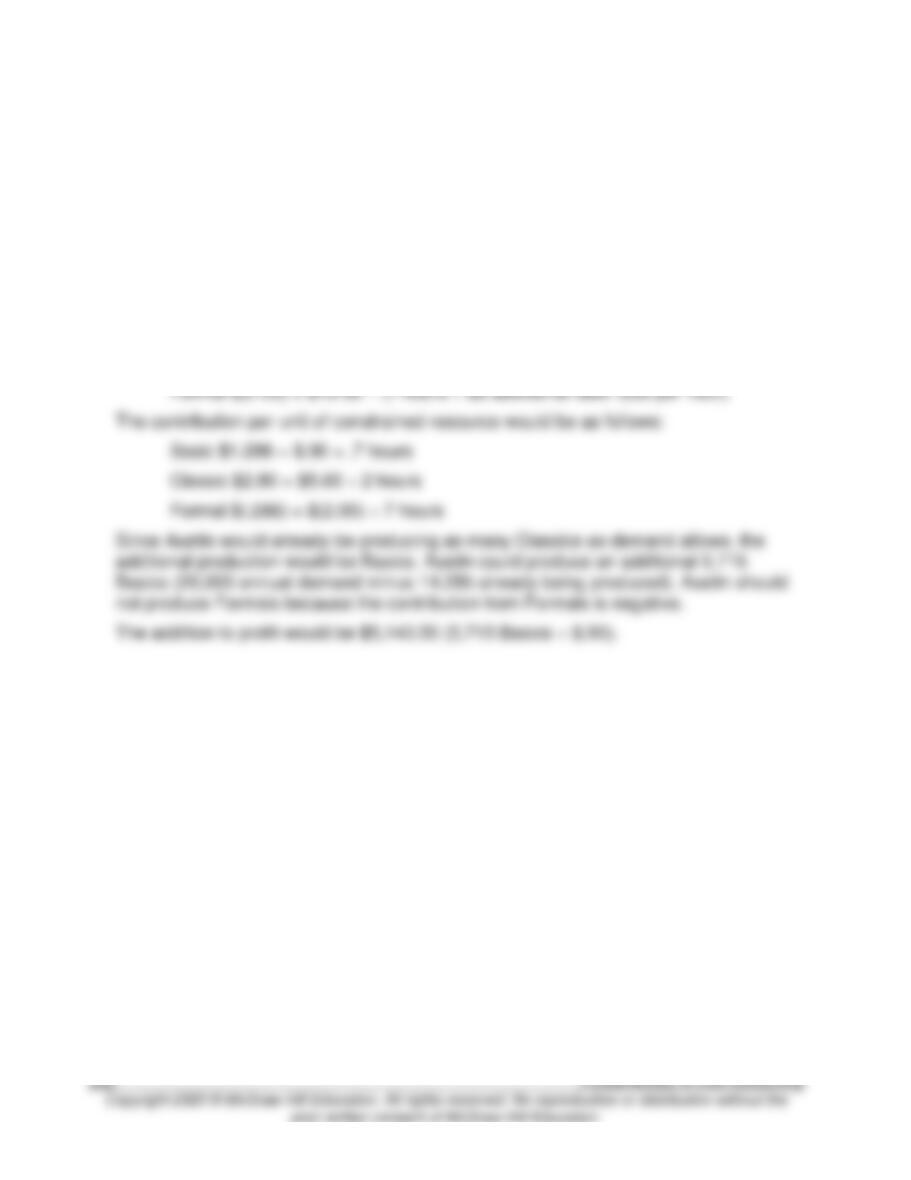
e. At an increase in the cost of labor from $16 to $19, the contribution margins per
constrained resource of labor (10,000 additional hours) would be as follows:
Contribution margins before labor cost increase:
Basic $3.00 = $60,000 ÷ 20,000 units
Classic $11.60 = $116,000 ÷ 10,000 units
Formal $19.00 = $570,000 ÷ 30,000 units
Additional labor costs would change contribution margins as follows:
Basic $ .90 = $3.00 – (.7 hours $3 additional labor cost per hour)
Classic: $ 5.60 = $11.60 – (2 hours $3 additional labor cost per hour)
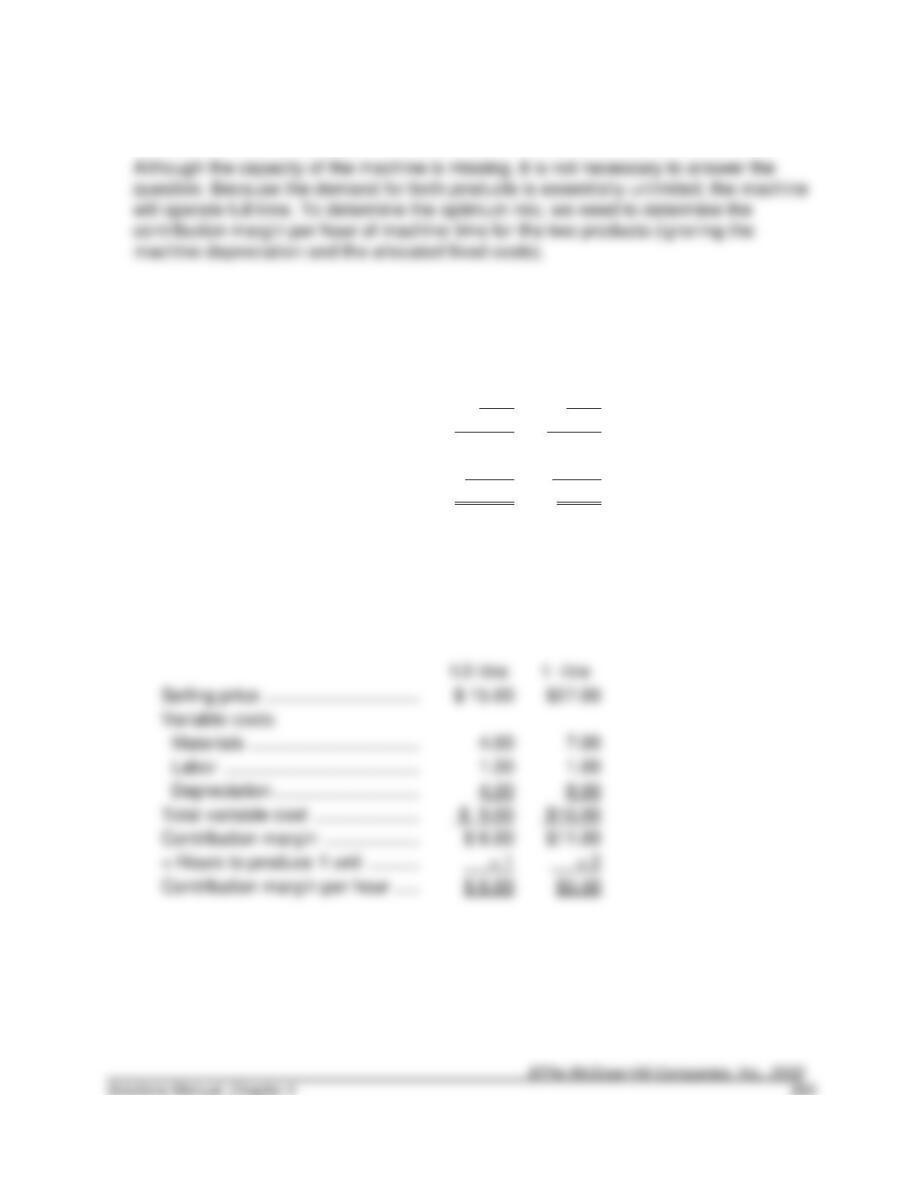
4-72. (20 min.) Optimum Product Mix: Bubble Company.
Bubble should produce only 1/2-litre bottles.
1/2-litre
1 -litre
Selling price ………………………….
$ 15.00
$27.00
Variable costs
Materials …………………………....
4.00
7.00
Labor …………………………………
1.00
1.00
Total variable cost …………………
$ 5.00
$ 8.00
Contribution margin ……………….
$ 10.00
$ 19.00
÷ Hours to produce 1 unit ……….
÷ 1
÷ 2
Contribution margin per hour …..
$ 10.00
$9.50
An equivalent approach is to consider the machine depreciation when computing the
contribution margin (it is listed as variable with respect to hours). In the solution above,
we recognize that because we will operate the machine at capacity, the cost is really
fixed. If we treat it as variable, the solution is as follows:
1/2-litre
1 -litre
Selling price ………………………….
$ 15.00
$27.00
Variable costs
Materials …………………………....
4.00
7.00
Labor …………………………………
1.00
1.00
Total variable cost …………………
Contribution margin ……………….
$11.00
÷ Hours to produce 1 unit ……….
Contribution margin per hour …..
4-73. (20 min.) Optimum Product Mix – Excel Solver: Slavin Corporation.
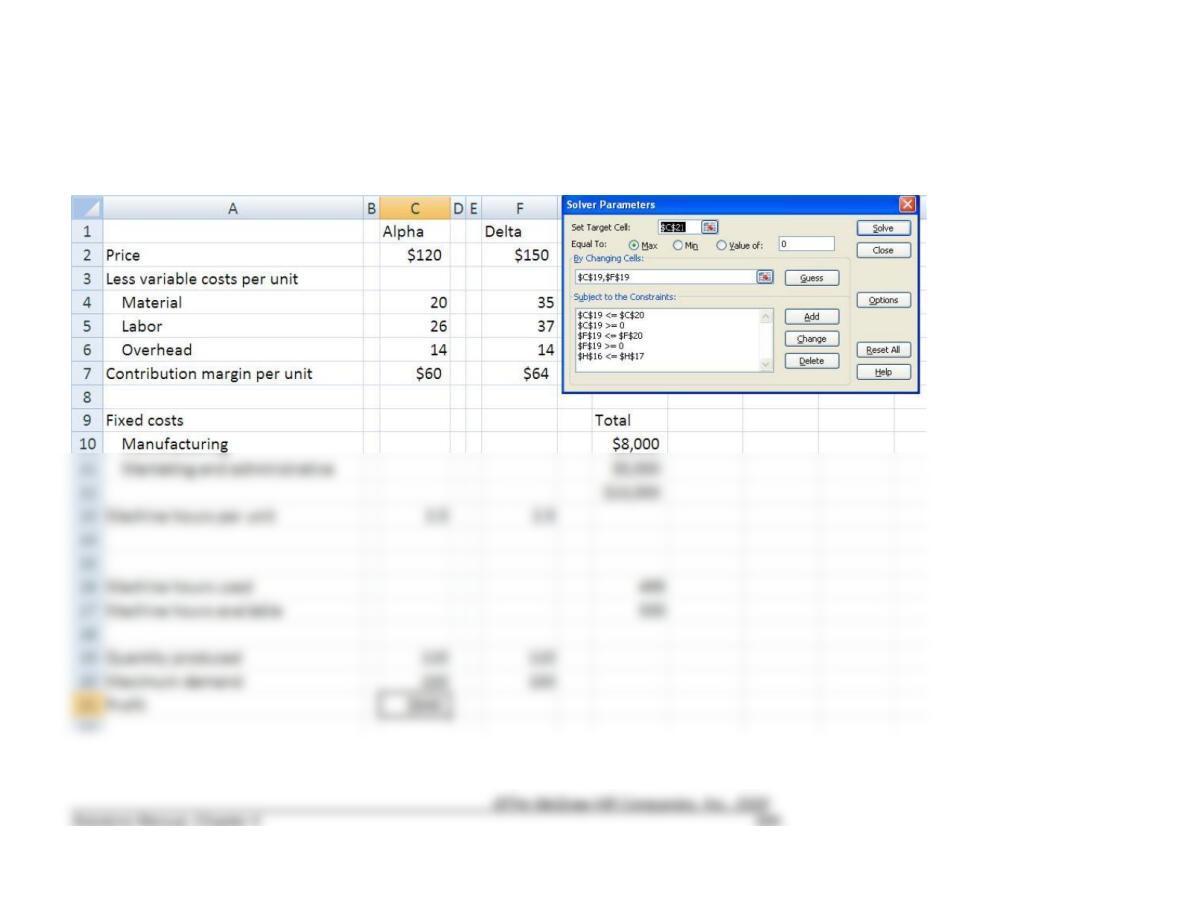
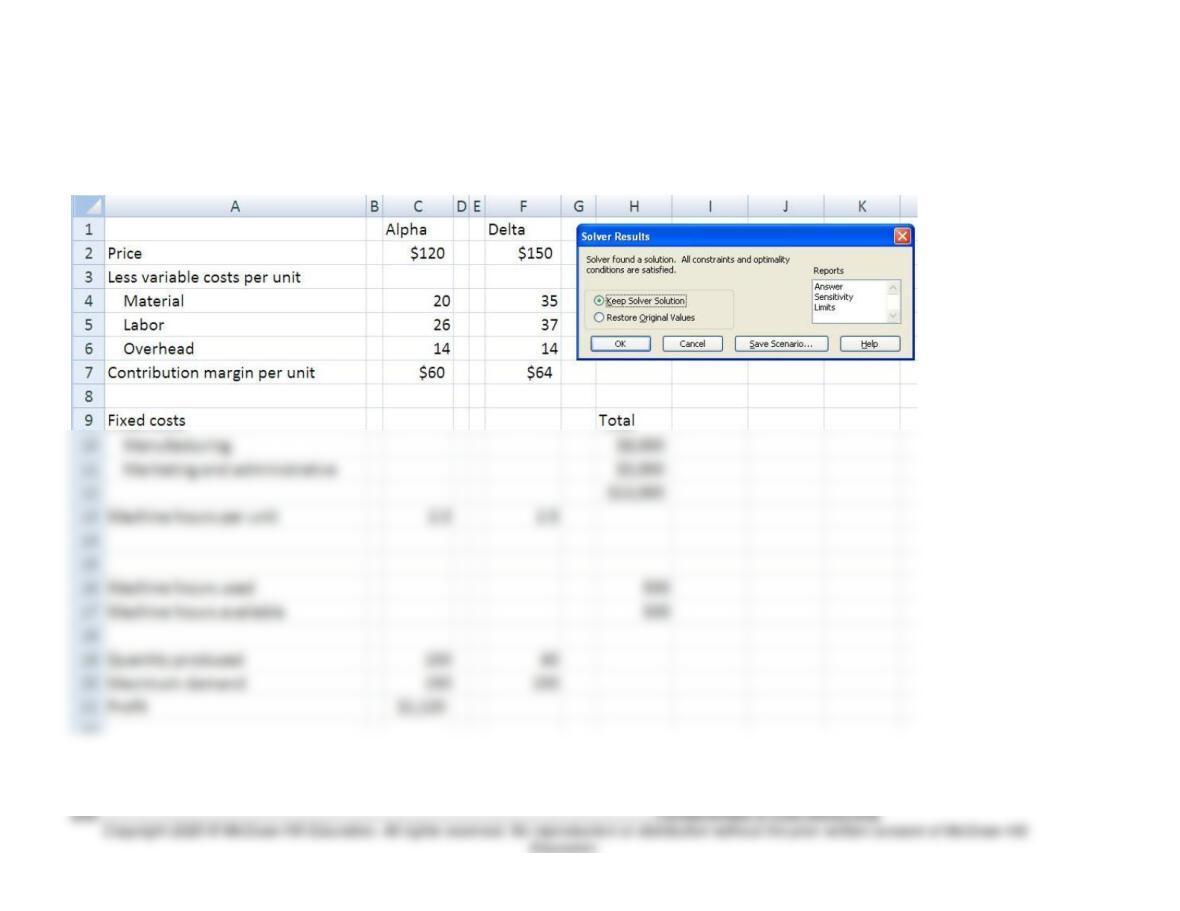
a. Slavin should produce 150 units of Alpha and 80 units of Delta. The next two pages
show the setup using Excel Solver and the solution. The problem can be solved
without Excel as follows. First, compute the contribution margins per hour on the
machine for the two products:
Alpha:
($60 ÷ 2.0) = $30.00 per hour
Delta:
($64 ÷ 2.5) = $25.60 per hour
Because Alpha has a higher contribution margin per unit of the constraining
resource, Slavin should produce up to demand (150 units) assuming machine
capacity is available. It requires 300 hours to produce 150 units of Alpha (= 2 hours
4-73. (continued)
(i) Setup of Excel Solver:
4-73. (continued)
(ii) Solution to problem:
4-74. (20 min.) Optimum Product Mix – Excel Solver: Layton Machining
Company.
a. Layton should produce 100,000 Standard units 50,000 Custom units. The next two
pages show the setup using Excel Solver and the solution. The problem can be
solved without Excel as follows. First, compute the contribution margins per hour
on the machine for the two products:
Standard (Grinding machine):
($1.50 ÷ 0.2) = $7.50 per hour
Standard (Finishing machine):
($1.50 ÷ 0.1) = $15.00 per hour
Custom (Grinding machine):
($2.00 ÷ 0.3) = $6.67 per hour
Custom (Finishing machine):
($2.00 ÷ 0.4) = $5.00 per hour
Because Standard has a higher contribution margin per unit of both constraining
resources, Layton should produce up to demand (100,000 units) assuming
machine capacity is available. It requires 20,000 grinding hours to produce 100,000
Standard units (= 0.2 hours per unit 100,000 units) and 10,000 finishing hours (=
0.1 hours per unit 100,000 units). This leaves 30,000 grinding hours (= 50,000