Wild, Shaw & Chiappetta: Fundamental Accounting Principles, 23rd Edition
4-1
CHAPTER 4
COMPLETING THE ACCOUNTING CYCLE
Related Assignment Materials
Student Learning Objectives
Questions
Quick
Studies*
Exercises*
Problems*
Beyond the
Numbers
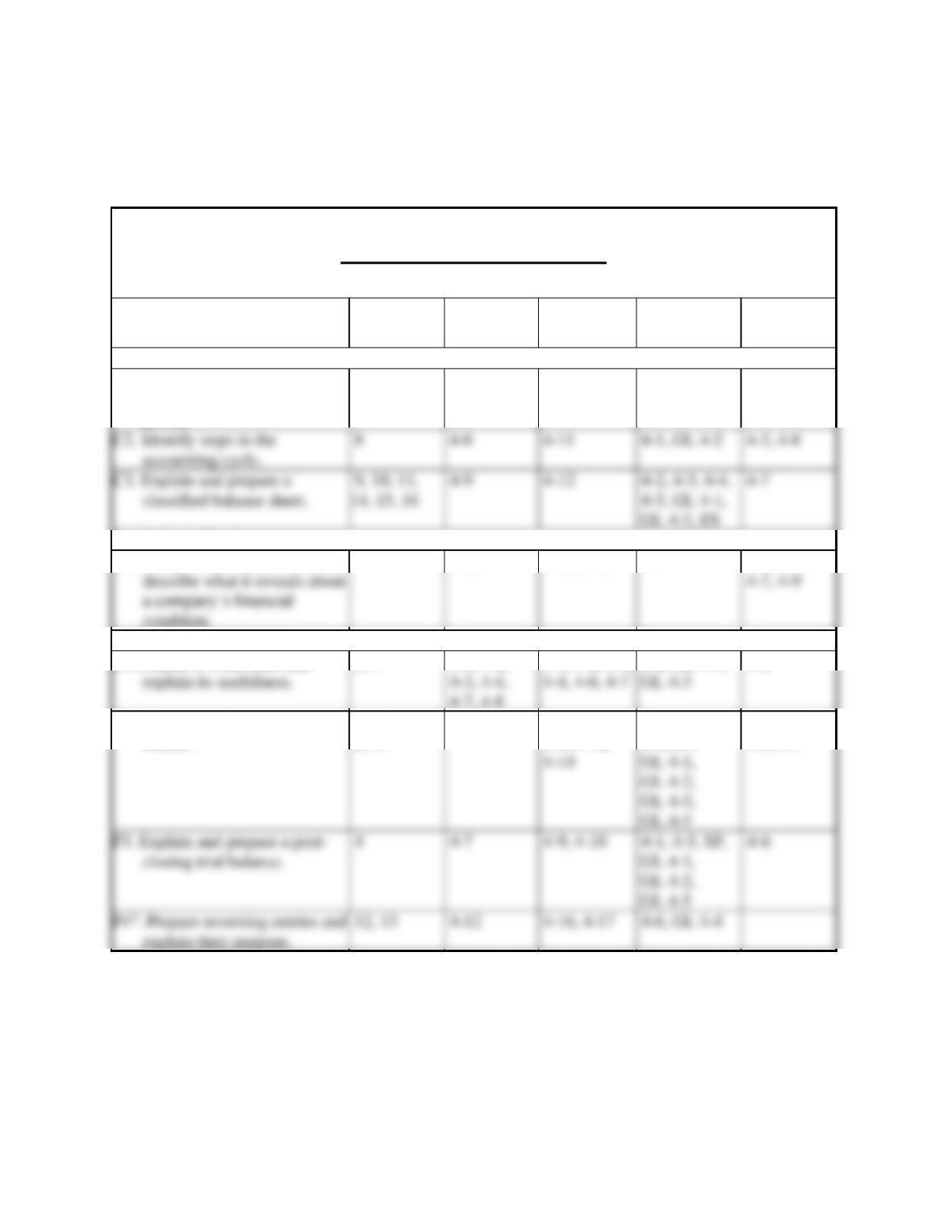
Conceptual objectives:
C1. Explain why temporary
accounts are closed each
period.
2, 3, 4, 5
4-5
4-5
4-1, GL 4-2
4-1, 4-4
Analytical objectives:
condition.
4-7, 4-9
A1. Compute the current ratio and
4-11
4-13, 4-15
4-4
4-2, 4-5,
Procedural objectives:
P1. Prepare a work sheet and
6, 7
4-1, 4-2,
4-1, 4-2, 4-3,
4-2, GL 4-1,
4-6
P2. Describe and prepare closing
entries.
1, 2, 3, 4, 5,
6, 17
4-6, 4-10
GL 4-2,
GL 4-1,
explain their purpose.
4-6, 4-7, 4-8,
4-9, 4-10,
4-1, 4-2, 4-4,
4-5, SP,
4-1, 4-4,
4-6, 4-7
*See additional information on next page that pertains to these quick studies, exercises and problems.
SP refers to the Serial Problem
GL refers to the General Ledger problems
ES refers to Excel Simulations
accounting cycle.
classified balance sheet.
Wild, Shaw & Chiappetta: Fundamental Accounting Principles, 23rd Edition
4-2
Additional Information on Related Assignment Material
Connect
Available on the instructor’s course-specific website) repeats all numerical Quick Studies, all Exercises
Connect Insight
The Serial Problem for Success Systems continues in this chapter.
General Ledger
Assignable within Connect, General Ledger (GL) problems offer students the ability to see how
Excel Simulations
Assignable within Connect, Excel Simulations allow students to practice their Excel skills—such as basic
Synopsis of Chapter Revision
NEW opener—LuminAID and entrepreneurial assignment.
Wild, Shaw & Chiappetta: Fundamental Accounting Principles, 23rd Edition
4-3
Chapter Outline
Notes
I. Work Sheet as a Tool
A. The work sheet is an internal document that serves as a useful tool
for organizing accounting information. It is not a required report.
B. Benefits of a Work Sheet: aids the preparation of financial
statements, reduces risk of errors, links accounts and adjustments
to their impacts in financial statements, helps in preparing interim
(monthly and quarterly) financial statements, and shows the effect
of proposed or “what if” transactions.
C. Use of a Work Sheet – constructed at the end of a period before
the adjusting process. Steps to prepare a work sheet:
financial statements. The financial statement columns yield pro
2. Enter Adjustments in the third and fourth columns. Total
columns to verify debit adjustments equal credit adjustments.
3. Prepare the Adjusted Trial Balance. This is done by
4. Sort Adjusted Trial Balance Amounts to Financial Statements.
Expenses and revenues go to the Income Statement.
5. Total Statement Columns, Compute Income or Loss and
Balance Columns by adding net income or loss.
D. Work Sheet Applications and Analysis—it does not substitute for
II. Closing Process—The closing process is an important step at end of
the accounting period after financial statements are completed. It
prepares accounts for recording transactions and events for the next
period.
A Steps in closing process:
2. Record and post closing entries.
B. Purpose of closing process:
1. To reset revenues, expenses, and withdrawals account
2. To summarize a period’s revenue minus expenses.
C. Temporary and Permanent Accounts
Wild, Shaw & Chiappetta: Fundamental Accounting Principles, 23rd Edition
4-4
Chapter Outline
Notes
include all income statement accounts, withdrawals accounts,
and Income Summary. Closing process applies only to
temporary accounts.
2. Permanent accounts report on activities related to one or more
future accounting periods. They include asset, liability, and
owner capital accounts — all balance sheet accounts.
Permanent accounts are not closed each period and carry their
balance into future periods.
D. Recording Closing Entries—the purpose is to transfer the end-of-
period balances in revenue, expense, and withdrawals accounts to
the permanent capital account.
1. Use a new temporary account called Income Summary. The
four closing entries are:
a. Close credit balances in revenue (and gain) accounts by
debiting the accounts and crediting Income Summary.
2. After all closing entries are posted, all temporary accounts
have a zero balance and capital is up to date.
E. Post-Closing Trial Balance—a list of permanent accounts and their
balances taken from the ledger after all closing entries have been
journalized and posted.
2. Verifies that all temporary accounts have zero ending
balances.
1. Verifies that total debits equal total credits for permanent
accounts.
amount of net income (or debit capital for a net loss).
d. Close withdrawals account by crediting the account and
Wild, Shaw & Chiappetta: Fundamental Accounting Principles, 23rd Edition
4-5
Chapter Outline
Notes
F. Accounting Cycle—steps in preparing financial statements (see
Exhibit 4.7 and Visual #4-1).
The ten steps repeated each accounting cycle are as follows:
1. Analyze transactions
3. Post
5. Adjust
7. Prepare statements
9. Prepare post-closing trial balance.
10. Reverse (optional)
III. Classified Balance Sheet—organizes assets and liabilities into
important subgroups and provides more information for decision
makers.
A. Classification Structure
2. Current items are expected to come due (either collected or
3. An operating cycle is the time span from when cash is used to
acquire goods and services until cash is received from the sale
of those goods and services.
B. Classification Categories
accounts receivable, short-term notes receivable, merchandise
1. Current assets—cash or other resources that are expected to be
sold, collected, or used within one year or the operating cycle,
that are not used in business operations. Examples: stocks,
2. Long-term investments—assets held for more than one year,
produce or sell goods and services. Examples: equipment,
buildings, land.
3. Plant assets—tangible, long-lived assets that are used to
4. Intangible assets—long-term resources that benefit business
operation. They lack physical form. Their value comes from
Wild, Shaw & Chiappetta: Fundamental Accounting Principles, 23rd Edition
4-6
Chapter Outline
Notes
5. Current liabilities—obligations due to be paid or settled within
the longer of one year or the operating cycle. Examples:
6. Long-term liabilities—obligations that are not due to be paid
7. Equity—owner’s claim on assets. For a proprietorship it is
reported in this section as the owner’s capital account. In a
corporation, equity is divided into two main subsections:
capital stock and retained earnings.
IV. Decision Analysis—Current Ratio
A. Assesses a company’s ability to pay its debts in the near future.
B. Calculation: total current assets divided by total current liabilities.
V. Appendix 4A—Reversing Entries
A. Accounting without reversing entries
1. To construct proper entries when the cash receipt/payment
2. With or without reversing entries use, it will yield the same
result.
B. Accounting with reversing entries (an optional step)
balance equal to the amount earned or incurred in that period.
1. Linked to asset and liability account balances that arose from
the accrual of revenues and expenses.
3. They are prepared after closing entries and dated the first day
of the new period.
4. Procedure is to transfer accrued asset and liability account
5. The full subsequent cash receipts (and payments) are recorded
Wild, Shaw & Chiappetta: Fundamental Accounting Principles, 23rd Edition
4-7
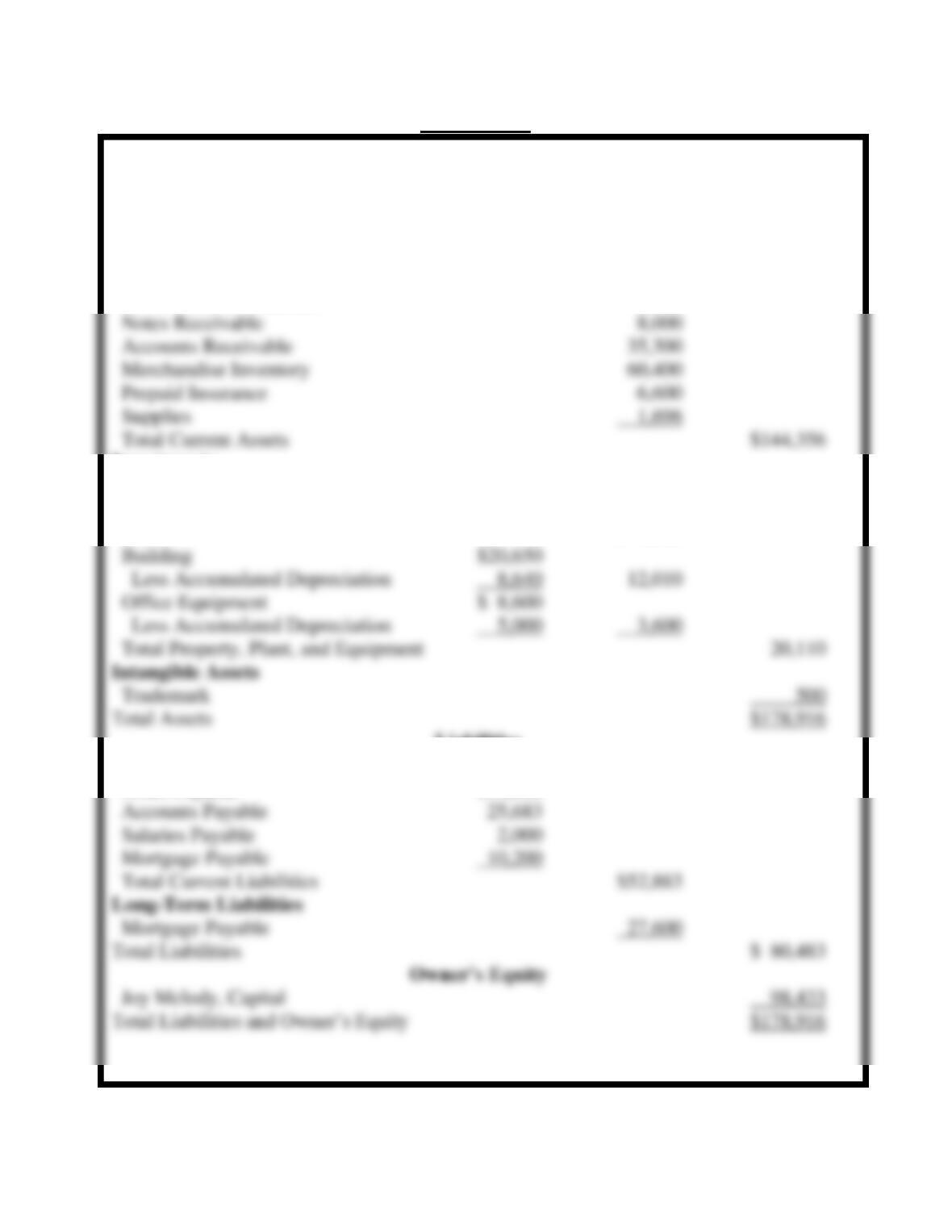
VISUAL #4-1
THE ACCOUNTING CYCLE
STEPS
PURPOSE
TIMING
2. Journalize
To record the daily transactions
During the period
3. Post
entries to the individual accounts
affected by the recorded transaction
To transfer the amounts from journal
During the period
balance
accounts and amount.
4. Prepare
To summarize unadjusted ledger
End of period
adjusting entries
5. Journalizing and
To bring the ledger accounts to
End of year
6. Prepare adjusted
trial balance
To summarize adjusted ledger
accounts and amounts
End of year
7. Preparing the
statements
To report financial information
End of period*
closing entries
date
8. Journalizing and
To bring all temporary accounts to
End of year
9. Post-closing
trial balance
To prove the accuracy of the
adjusting and closing procedures
End of year
adjustments.
*If statements are to be prepared for interim period (less than a year), a worksheet
is generally used to project adjusted numbers for statements.
Steps 4 and 6 can be done on a worksheet.
10. Reversing
entries
To provide for recording in new fiscal
period without consideration of
Beginning of new
year
1. Analyze
transactions
To determine accounts to be debited
and credited
During the period
Wild, Shaw & Chiappetta: Fundamental Accounting Principles, 23rd Edition
4-8
VISUAL #4-2
MUSIC WORLD
BALANCE SHEET
DECEMBER 31, 2017
Assets
Current Assets
Cash
$30,360
Short-Term Investments
2,000
Investments
Land Held for Future Use
13,950
Property, Plant, and Equipment
Land
$ 4,500
Building
$20,650
Less Accumulated Depreciation
8,640
12,010
Office Equipment
$ 8,600
Less Accumulated Depreciation
5,000
3,600
Total Property, Plant, and Equipment
20,110
Trademark
500
$178,916
Liabilities
Current Liabilities
Notes Payable
$15,000
Accounts Payable
25,683
Salaries Payable
2,000
Mortgage Payable
10,200
Total Current Liabilities
$52,883
Mortgage Payable
27,600
$ 80,483
Joy Melody, Capital
98,433
$178,916
Notes Receivable
8,000
Accounts Receivable
35,300
Merchandise Inventory
60,400
Prepaid Insurance
6,600
Supplies
1,696
Total Current Assets
$144,356
Wild, Shaw & Chiappetta: Fundamental Accounting Principles, 23rd Edition
4-9
Chapter 4 Alternate Demo Problem
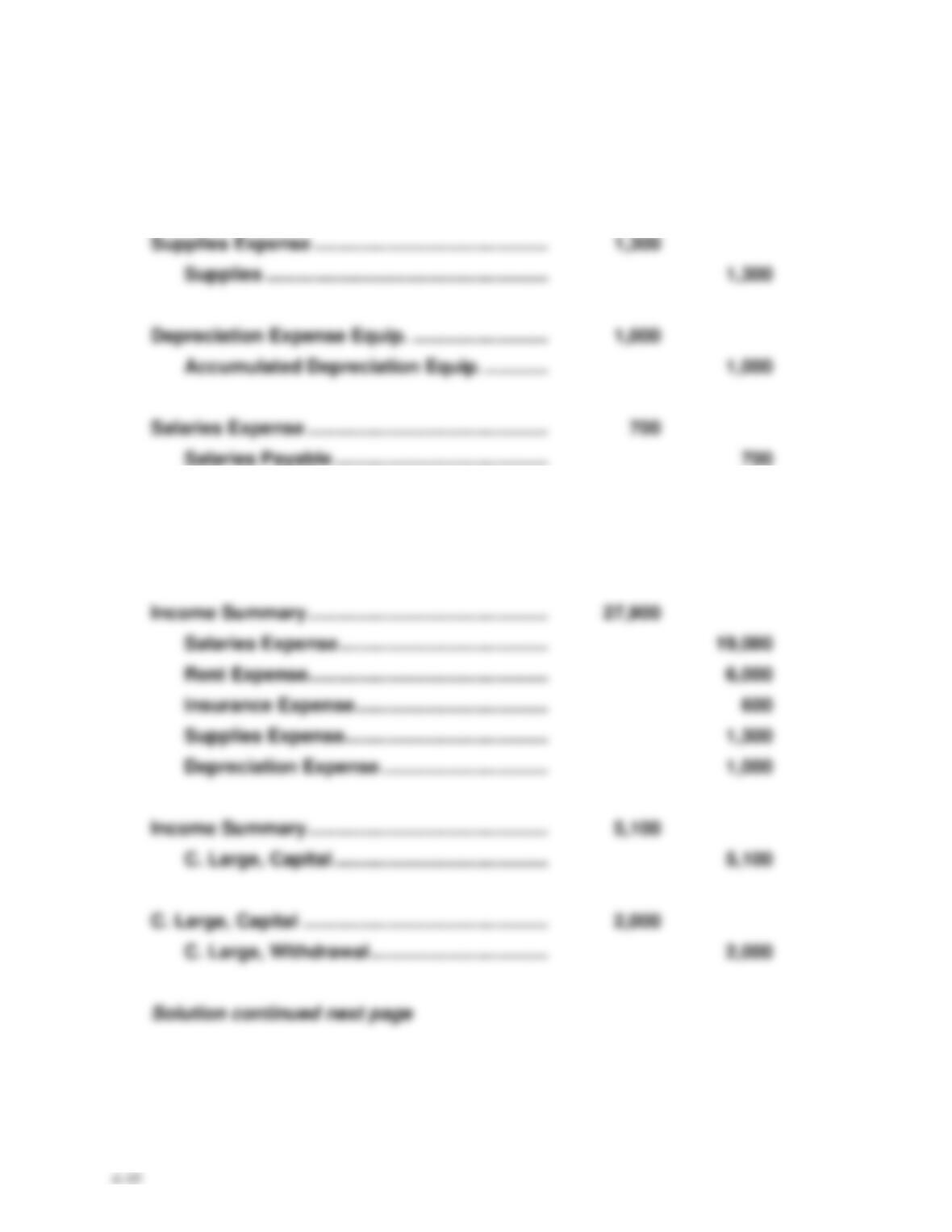
The trial balance of Large Company, Inc. at the end of its annual
accounting period is as follows:
LARGE COMPANY, INC.
Trial Balance
December 31, 2017
Cash ………………………………………………………………..
$ 4,000
Additional information:
1. Expired insurance, $600.
Supplies …………………………………………………………
Equipment ………………………………………………………
Accumulated Depreciation—Equipment ……………
$ 2,000
Revenue ………………………………………………………….
Salaries Expense ……………………………………………..
Totals ………………………………………………………………
$54,000
$54,000
Wild, Shaw & Chiappetta: Fundamental Accounting Principles, 23rd Edition
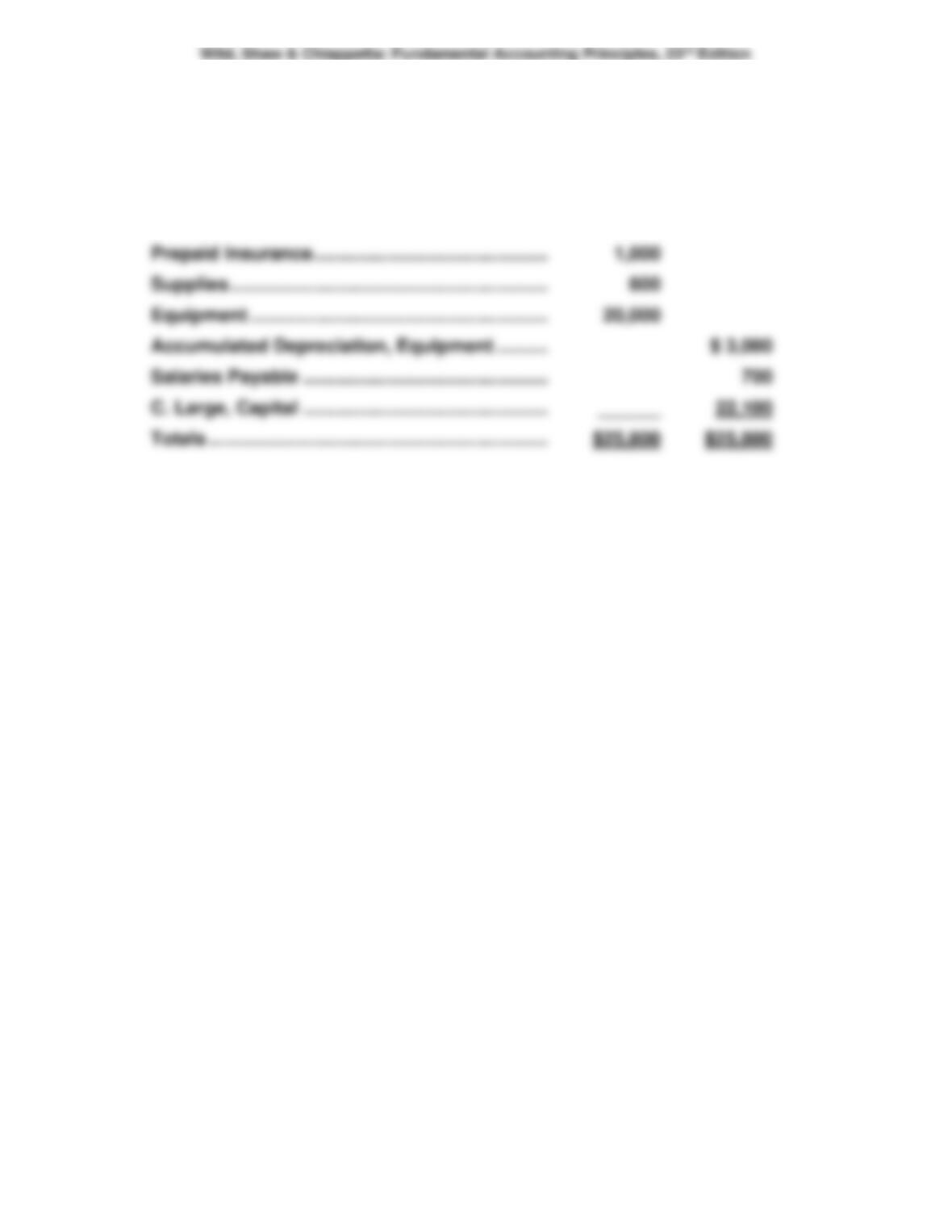
Chapter 4 Solution: Alternate Demo Problem
1.
Insurance Expense …………………………………….
600
Prepaid Insurance ………………………………..
600
Supplies Expense ………………………………………
Supplies ………………………………………………
Depreciation Expense Equip. ……………………..
Salaries Expense ……………………………………….
700
Salaries Payable …………………………………..
700
2.
Revenue …………………………………………………….
33,000
Income Summary …………………………………
33,000
Income Summary ……………………………………….
27,900
Rent Expense ……………………………………….
Insurance Expense ……………………………….
600
Supplies Expense …………………………………
Depreciation Expense …………………………..
Income Summary ……………………………………….
C. Large, Capital …………………………………..
C. Large, Capital ………………………………………..
C. Large, Withdrawal …………………………….
4-11
3.
LARGE COMPANY, INC.
Post-Closing Trial Balance
December 31, 2017
Dr.
Cr.
Cash ………………………………………………………….
$4,000
Prepaid Insurance ………………………………………
Supplies …………………………………………………….
Equipment …………………………………………………
20,000
Accumulated Depreciation, Equipment ……….
C. Large, Capital ………………………………………..
22,100
Totals ………………………………………………………..