(30-45 min.) P 4-53B
Carvel Wireless
Cash Budget
2017
Cash balance, beginning
$ 7,900
Budgeted cash receipts:
Collections from customers ($65,000 × 1.12)
72,800
Receipt of interest
300
81,000
Budgeted cash payments:
Cash paid for inventory ($44,000 × 1.20)
$52,800
Cash paid for operating expenses
13,900
Purchase of equipment
4,400
Purchases of investments
400
Payment of dividends
Payments of long-term debt
Cash available (needed) before financing
Budgeted cash balance, ending
Cash available for additional investments, or
(New financing needed)
Challenge Exercises and Problem
(15-25 min.) E 4-54
Wood could be:
Brown could investigate by:
1.
Writing business checks to
herself.
1.
Performing the bank
reconciliation and examining all
checks written by the business.
2.
Submitting purchase invoices a
second time for duplicate
payment, perhaps altering the
mailing address on the
duplicate invoice and sending
the check to a post office box
that Wood controls.
2.
Examining purchase invoices for
authenticity and comparing
invoices to receiving reports to
determine that the business
received all goods it paid for.
Any invoice with a hole indicates
it was paid earlier.
Calling the suppliers directly to
inquire about any questionable
invoices.
items needed by the business.
Student responses may vary.
(20-30 min.) E 4-55
Req. 1
Dollar Depot, Inc.
Cash Budget
Year Ended December 31, 2017
Thousands
Cash balance, December 31, 2016
$ 100
Budgeted cash receipts:
Collections from customers
20,400
Issuance of stock
647
21,147
Budgeted cash payments:
Purchases of inventory items
$14,445
Payment of operating expenses
2,349
Purchase of property and equipment
1,548
Payment of dividends
Cash available (shortage) before financing
1,598
Budgeted cash balance, December 31, 2017
Cash available for additional investments
$11,588
Req. 3
Dollar Depot will have cash available for additional investments and
should not need to borrow.
(20-30 min.) P 4-56
The Parkview Company
Bank Reconciliation
December 31
BANK:
Balance, December 31
$ 3,936
Add: Deposit in transit
Actual amount of December 30 deposit
670
Subtotal
4,606
Less: Outstanding checks
Check No.
1560
$184
1901
849
1902
168
(1,201)
Adjusted bank balance, December 31
$ 3,405
BOOKS:
Balance, December 31
EFT receipt from customer
Interest revenue
Subtotal
Less: NSF check
EFT payment of utility bill
deposit)
Unexplained difference
Adjusted book balance, December 31
(continued) P 4-56
Checks No. 1880, 1882, and 1883 were outstanding in November so
should not also be deducted from Cash in December. The unexplained
difference of $3,638* consists of: $1,138 erroneous November
outstanding checks and the $2,500 difference between deposit in transit
Decision Cases
(20-30 min.) Decision Case 1
Environmental Concerns, Inc.
Bank Reconciliation
September 30
BANK:
Balance, September 30
$ 8,224
Add: Deposit of September 30 in transit
3,794
Subtotal
12,018
Less: Outstanding checks ($116 + $150 +
$853 + $990 + $206 + $145)
(2,460)
Adjusted bank balance, September 30
$ 9,558
BOOKS:
Balance, September 30
Add: Bank collection
200
Subtotal
10,602
Less: Service charge
NSF check
(44)
Adjusted book balance, September 30
$10,558
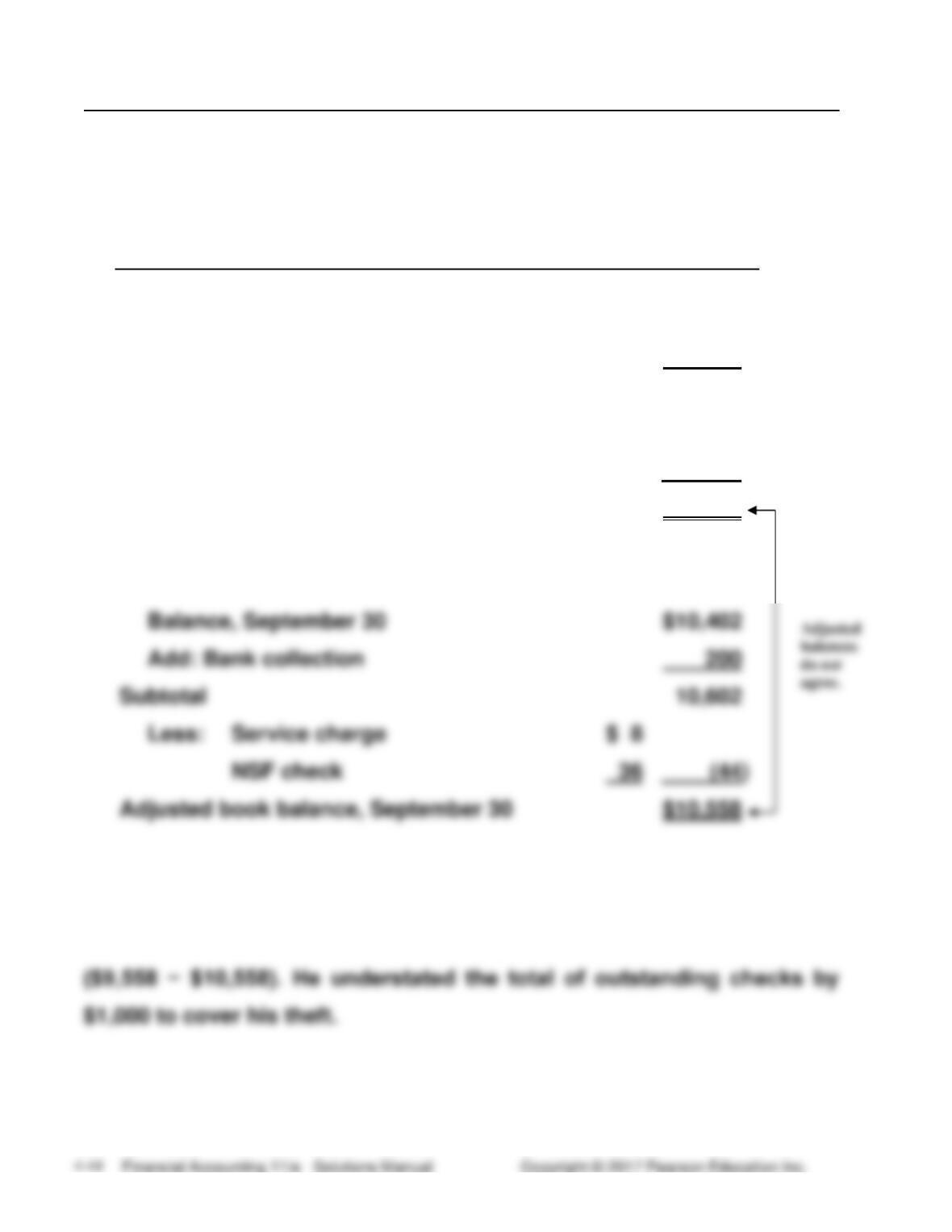
Based on the above reconciliation, it appears the bookkeeper has stolen
$1,000, the difference between the adjusted bank and book amounts
(continued) Decision Case 1
Benz should assign an employee with no cash-handling duties to
prepare the bank reconciliation. The bookkeeper should not perform this
duty, because a person who handles cash and also prepares the
reconciliation can steal cash and manipulate the reconciliation to cover
the theft. Perhaps Benz should prepare the reconciliation himself.
Other internal control deficiencies:
1. The bookkeeper should not handle incoming mail. The mailroom
employee should open the mail. The mailroom employee should
(15-30 min.) Decision Case 2
The internal control weakness in this case is a lack of separation of
duties. The foreman performs too many duties.
1. The foreman hires the workers.
2. The foreman controls workers’ employment documents.
3. The foreman fills out workers’ time sheets and transmits all
documents to the home office.
The foreman could steal from the company as follows:
1. The foreman could enter a fictitious worker into the payroll system
and fill out bogus time sheets for the fictitious employee. Then the
foreman could pocket the pay check written to the employee.
The following actions will correct the internal control weakness:
1. The home office could have the construction workers come to the
office for processing their employee documents. Then the home
office would at least know that all the workers exist.
2. Have employees sign their own time sheets.
(continued) Decision Case 2
3. Don’t allow Pickins to pass out paychecks. Have employees pick up
paychecks at corporate office or have another corporate employee go
and pass out paychecks. The check distributor should ask for a
picture identification.
4. Have a home-office employee compare signatures on the workers’
time sheets to their signatures on file and, occasionally, to their
endorsements on the backs of their paychecks.
Ethical Issues
Ethical Issue 1
1. Identify the ethical issue. You must decide whether it is ethical for the
auditor not to require the bank to record the loss.
2. What are the alternatives? Require the client to record the loss, or
permit the client not to record the loss.
3. Identify the stakeholders. The auditor, the bank, and the public at
large can be affected. The auditor’s reputation is on the line. The
bank’s financial statements are in question. The public, including
creditors and investors, can be affected if the bank issues financial
statements that include erroneous amounts.
4. Make the decision. The auditor should require the bank to record the
loss even if that means losing the bank as a client. By sticking to his
or her belief that the bank should record the loss, the auditors’
Ethical Issue 2
1. Identify the ethical issue. Galvin’s ethical issue is whether to use his
knowledge of The Salvation Army’s plans and of Nadar’s situation to
either party’s advantage (or disadvantage). Should Galvin help The
2. What are the alternatives? There are several:
(a) Let other members of the Salvation Army board of directors
know of Nadar’s situation in order to help The Salvation Army
buy the land at a bargain price.
(b) Disclose Nadar’s situation to fellow board members and insist
that The Salvation Army pay market price ($3.6 million) for the
land.
3. Identify the stakeholders involved. Galvin, The Salvation Army,
Nadar, and Community Banks.
Assess the possible consequences. Disclosing Nadar’s weakened
condition to The Salvation Army board may help The Salvation Army
buy the land at a low price, depending on the ethical bearing of
(continued) Ethical Issue 2
fellow board members. This would help The Salvation Army and hurt
Nadar, relative to her ability to sell the land at market value of $3.6
million. Insisting that The Salvation Army offer market price for the
land would seem fair to both parties, but that would betray the trust of
Nadar. And it may or may not sway the board to go along with a $3.6
million offer for the land.
Taking a temporary leave of absence would preserve Galvin’s
integrity and remove him from the conflict of interest. It would also
preserve Galvin’s reputation for fairness and the reputation of
Community Bank for keeping depositor information confidential.
4. Make the decision. The authors would take the leave of absence and
hope other Salvation Army board members do not probe Galvin’s
1. Identify the ethical issue. French’s ethical issue is whether to tell IMS
personnel about Snicker Foods’ possible bankruptcy.
2. What are the alternatives?
3. Identify the stakeholders involved. IMS, Snicker Foods, Community
Bank, and everyone connected to these organizations — owners,
employees, creditors, depositors, and their communities.
4. Make the decision. French should not tell IMS of Snicker’s financial
difficulties (after all, Snicker isn’t bankrupt yet). French should let
nature take its course. Then she will protect the bank’s (and her own)
reputation for keeping client information confidential. In her aiding
Focus on Financials: Apple Inc.
(20-30 min.)
Req. 1
Cash equivalents include assets that are slightly less liquid than cash,
but similar enough to be reported together. Cash equivalents must be
readily convertible to known amounts of cash and close to maturity (with
an original maturity of three months or less at the time of purchase).
Req. 2
Req.3
Yes, Note 2 – Financial Instruments (Cash, Cash Equivalents, and
Marketable Securities) contains more detail about cash equivalents. The
categories are described in two levels. For 2014 and 2013 fiscal year
ends, level one cash equivalents include money market funds. For 2014
Focus on Analysis: Under Armour, Inc.
(20-30 min.)
Req. 1
1. Proceeds from a term loan, which provided $250 million, in the
financing section.
2. Net income of $208 million, in the operating section.
3. Capital spending for property and equipment, which used $141
million, in the investing section.
4. Changes in its accounts receivable, a decrease of $101 million, in
the operating section.
Req. 2
The following items from the report are also mentioned in the chapter:
• “Management is responsible for establishing and maintaining
adequate internal control over financial reporting”. Management
concluded that internal control over financial reporting was
effective as of the end of the year.
• An accounting firm audited the internal controls and reported on
their effectiveness.
Student responses will vary.

Group Project
Student responses will vary.