CASE 4.9
ACCUHEALTH, INC.
Synopsis
Suppose that you were hired by a company to serve as its chief accounting officer. A few
months later, you stumble across evidence of a large embezzlement scheme within the company, a
scheme masterminded by the firm’s top executives. What would you do? What should you do?
Those were questions faced by the central character in this case, William Makadok.
An interesting facet of this case is the SEC’s consideration of whether Makadok violated Rule
10b-5 of the Securities Exchange Act of 1934. The Supreme Court opinion issued in the Hochfelder
case established that scienter must be present for an individual to have violated that rule. In this
case, the SEC deemed that although Makadok “did not actively participate in the fraud or benefit
from it financially,” his “reckless behavior” satisfied the scienter standard, meaning that he had
violated Rule 10b-5.
262
Case 4.9 Accuhealth, Inc.
263
Accuhealth, Inc.—Key Facts
1. Stanley Lepelstat, his family, and a few close friends dominated Accuhealth’s operations.
3. An SEC investigation revealed that for more than a decade Lepelstat and his associates had
embezzled funds from Accuhealth’s retail operations.
5. In 1989, Accuhealth’s management began overstating period-ending inventories to inflate the
6. Accuhealth’s officers and employees had a nonchalant attitude toward the fraudulent schemes
but took aggressive measures to conceal them from the company’s independent auditors.
7. William Makadok accepted a position as Accuhealth’s chief accounting officer in the summer
8. Makadok “consciously avoided undertaking any effort” to confirm or discredit the existence of
10. The SEC barred Lepelstat and several other Accuhealth officers from serving as officers or
directors of public companies; Lepelstat later pleaded guilty to federal fraud charges.
264 Case 4.9 Accuhealth, Inc.
Instructional Objectives
1. To illustrate ethical dilemmas that corporate accountants may face when a company’s executives
are dishonest and to examine accountants’ professional responsibilities in such situations.
Suggestions for Use
This case centers on a cash embezzlement scheme carried out for several years by Accuhealth
management. That scheme eventually “forced” Accuhealth’s officers to begin manipulating the
firm’s inventory records to conceal the impact of the stolen funds on the company’s reported profits.
Several years into the scheme, William Makadok arrived on the scene as the company’s chief
accounting officer.
alternatives available to them other than simply avoiding the issue or problem.
Besides the obvious auditing and control issues involving cash and inventory and the ethical
issues related to Makadok’s role (or non-role) in the Accuhealth fraud, there are several other
interesting issues raised by this case. Hopefully, students recognize in this case a common feature of
many financial frauds, namely, the dominance of the given company by one individual or small
group of individuals. Another red flag that I hope students identify in this case is the resignation of a
key accounting officer. When key accounting officials of a company suddenly resign, auditors
should question those individuals to determine what motivated their decision to leave.
A tangential issue in this case is the modest compensation that the Accuhealth executives
received. In recent years, the business press has often criticized the large salaries and “perks” that
companies provide their top executives. Here, we have a company whose executives chose to pay
themselves modest salaries—the Lepelstat family controlled the company’s board of directors,
allowing them to dictate Accuhealth’s compensation policies. Quite possibly, the executives used
Case 4.9 Accuhealth, Inc.
265
Suggested Solutions to Case Questions
1. The principal parties who had a stake in the resolution of Makadok’s ethical dilemma were the
general public, which would include potential stockholders and creditors of Accuhealth, the actual
stockholders and creditors of Accuhealth, the company’s executives, members of the accounting
profession, and Makadok himself. One could argue that Makadok’s primary responsibility was to
the “public interest.” As a professional accountant, Makadok had an obligation to ensure that
2. Individual students will provide a variety of responses to this question. My experience has been
that many students candidly admit that they would adopt Makadok’s strategy and simply attempt to
minimize their awareness and contact with the fraud while waiting for an opportune time to resign
from the company. My objective here is to help students recognize that Makadok had several
alternatives available to him in this situation: walking into Lepelstat’s office and demanding that the
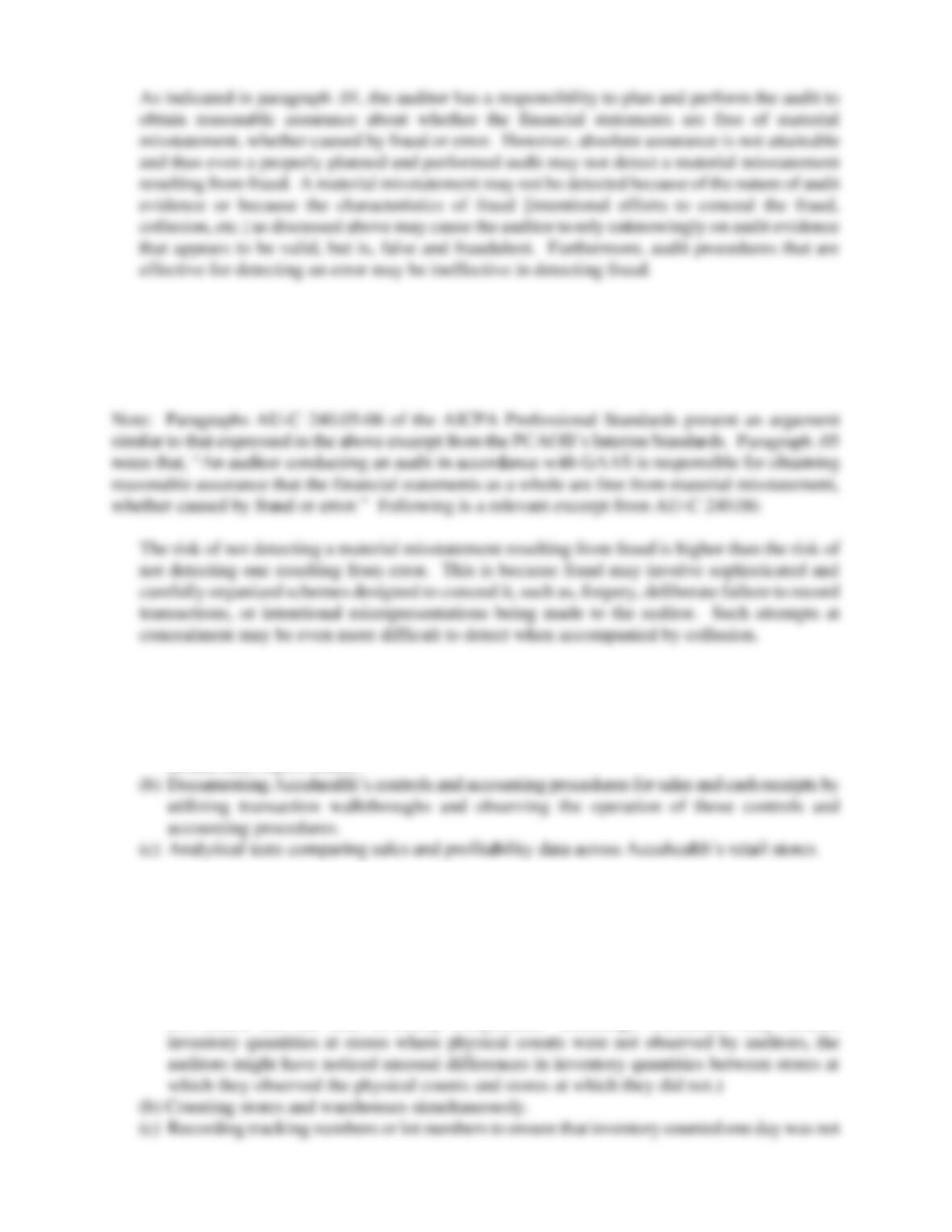
3. AU 316 of the PCAOB’s Interim Standards discusses auditors’ need to consider the possibility
that client financial statements may have been impacted by fraud. The following excerpt from
paragraph 12 of that section identifies the general scope and extent of auditors’ responsibility to
detect fraudulent schemes that affect the reliability of client financial statements and the
circumstances or conditions that tend to mitigate that responsibility.
266 Case 4.9 Accuhealth, Inc.
The previous passage suggests that auditors generally face a greater responsibility for detecting a
fraudulent scheme when that scheme is poorly concealed and/or involves little or no collusion.
Likewise, auditors’ have a lessened responsibility to detect material misstatements resulting from
artfully crafted and well-disguised fraudulent schemes.
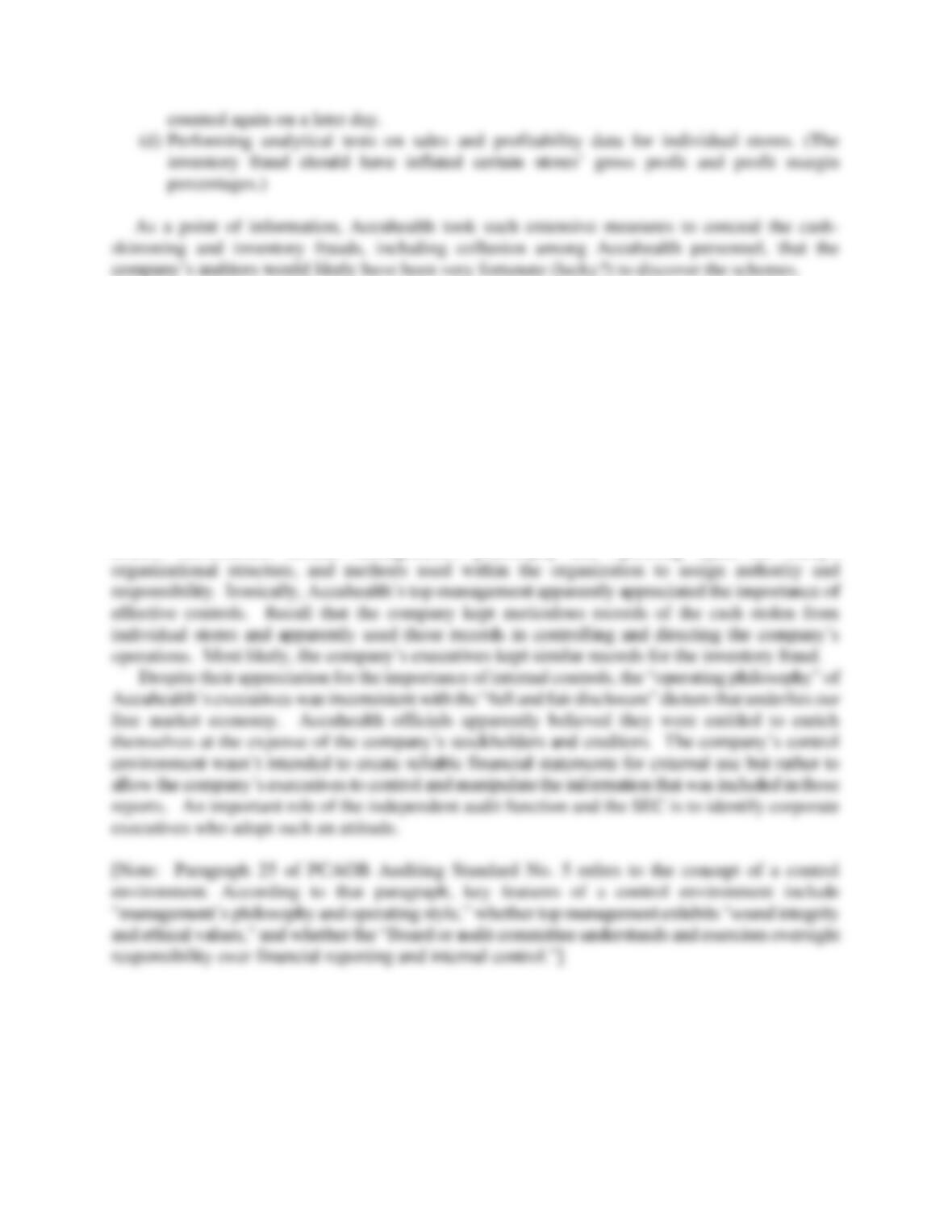
4. Listed next are examples of audit procedures that might have led directly or indirectly to the
detection of Accuhealth’s cash-skimming scheme:
(a) Inquiring of client personnel and management regarding the “Office” line item appearing on
certain cash report sheets.
Note: Of course, the effectiveness of items “a” and “b” would be diminished greatly if the stores
involved in the embezzlement scheme were not selected for testing by the auditors.
Listed next are audit procedures that might have led directly or indirectly to detection of
Accuhealth’s inventory fraud:
(a) Observing physical inventories at stores and performing test counts and then tracking those
test counts into the final inventory compilation. (Although Accuhealth only inflated
Case 4.9 Accuhealth, Inc.
267
5. AU-C 315.71 of the AICPA Professional Standards describes the control environment
element of an internal control process as follows:
The control environment sets the tone of an organization, influencing the control consciousness
of its people. It is the foundation for all other components of internal control, providing
discipline and structure. (emphasis added)
Notice that the highlighted phrase indicates that the control environment is the “foundation” for
the remaining components of an entity’s internal control process. If an organization has a weak
control environment, its remaining internal control components will almost certainly be weak and
ineffective as well. Examples of factors that auditors should consider when evaluating a client’s
control environment include management’s philosophy and operating style, the entity’s