4-52. (15 min.) Theory of Constraints: Christine’s Chronographs.
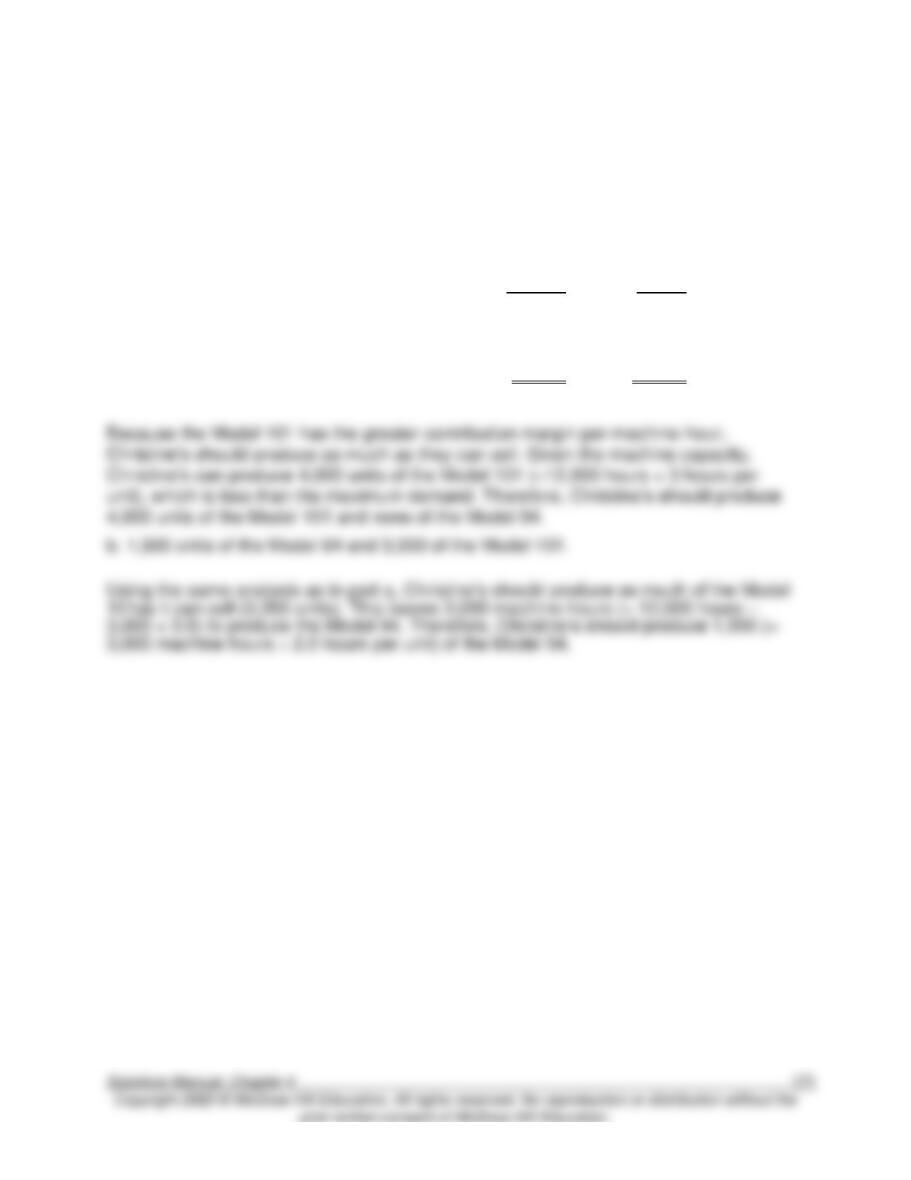
a. 4,000 units of the Model 101. The contribution margin per machine hour for the two
models are:
Model 94
Model 101
Price ……………………………………………….
$4,500
$8,500
Variable cost ……………………………………
2,300
4,600
Contribution margin …………………………..
$2,200
$3,900
Machines-hours per unit …………………….
2
3
Contribution margin per machine hour …
$1,100
$1,300
Solutions to Problems
4-53. (60 min.) Special Order: Unter Components.
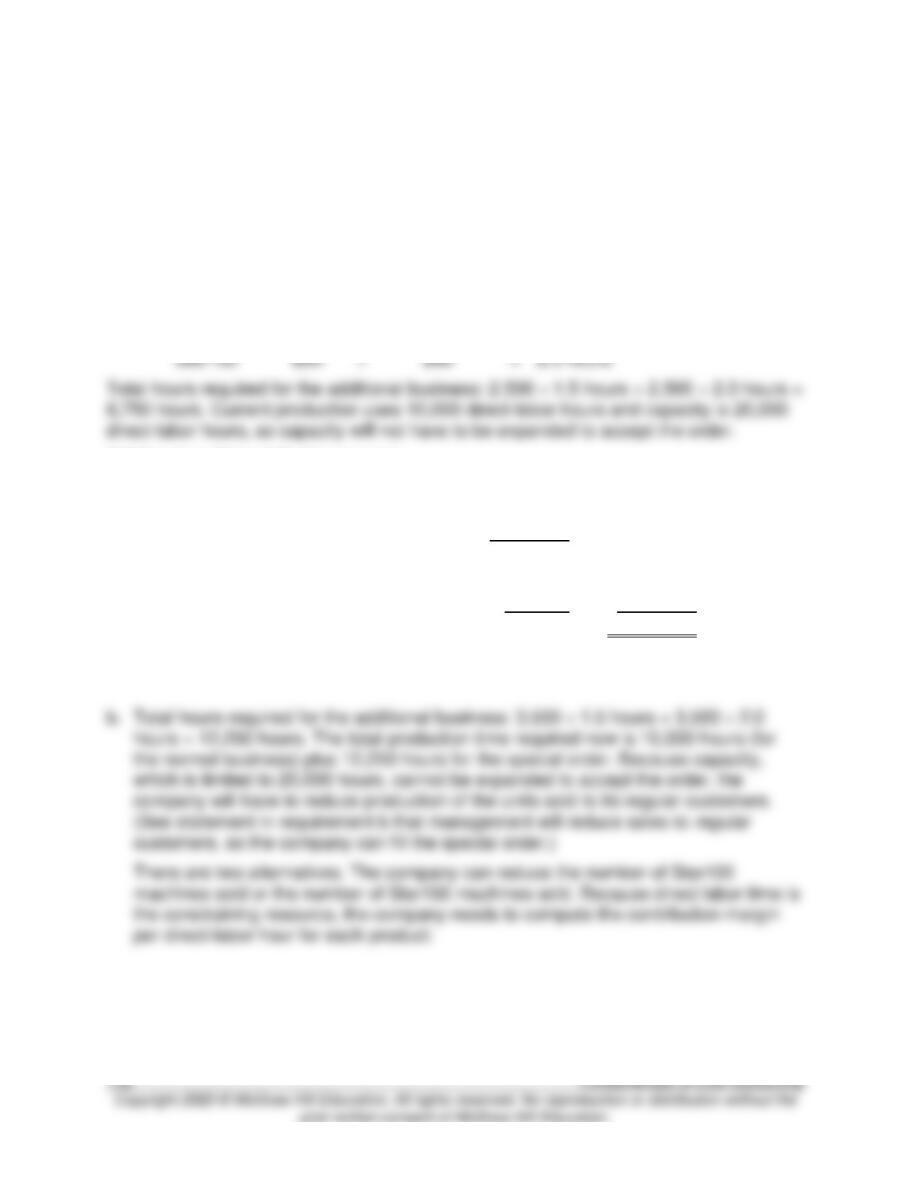
a.
Direct labor hours per unit:
Model
Labor
cost per
unit
÷
Wage rate
per
labor-hour
=
Labor-hours per unit
Star100
$60
÷
$40
=
1.5 hours
Star150
$80
÷
$40
=
2.0 hours
Additional profit (contribution margin):
Differential revenues:
Star100 ……………..
2,500 x $400
=
$1,000,000
Star150 ……………..
2,500 x $500
=
1,250,000
$2,250,000
Differential costs
Star100 ……………..
2,500 x $220*
=
550,000
Star150 ……………..
2,500 x $270*
=
675,000
1,225,000
Differential profit ……..
$1,025,000
* Total variable cost per unit.
4-53. (continued)
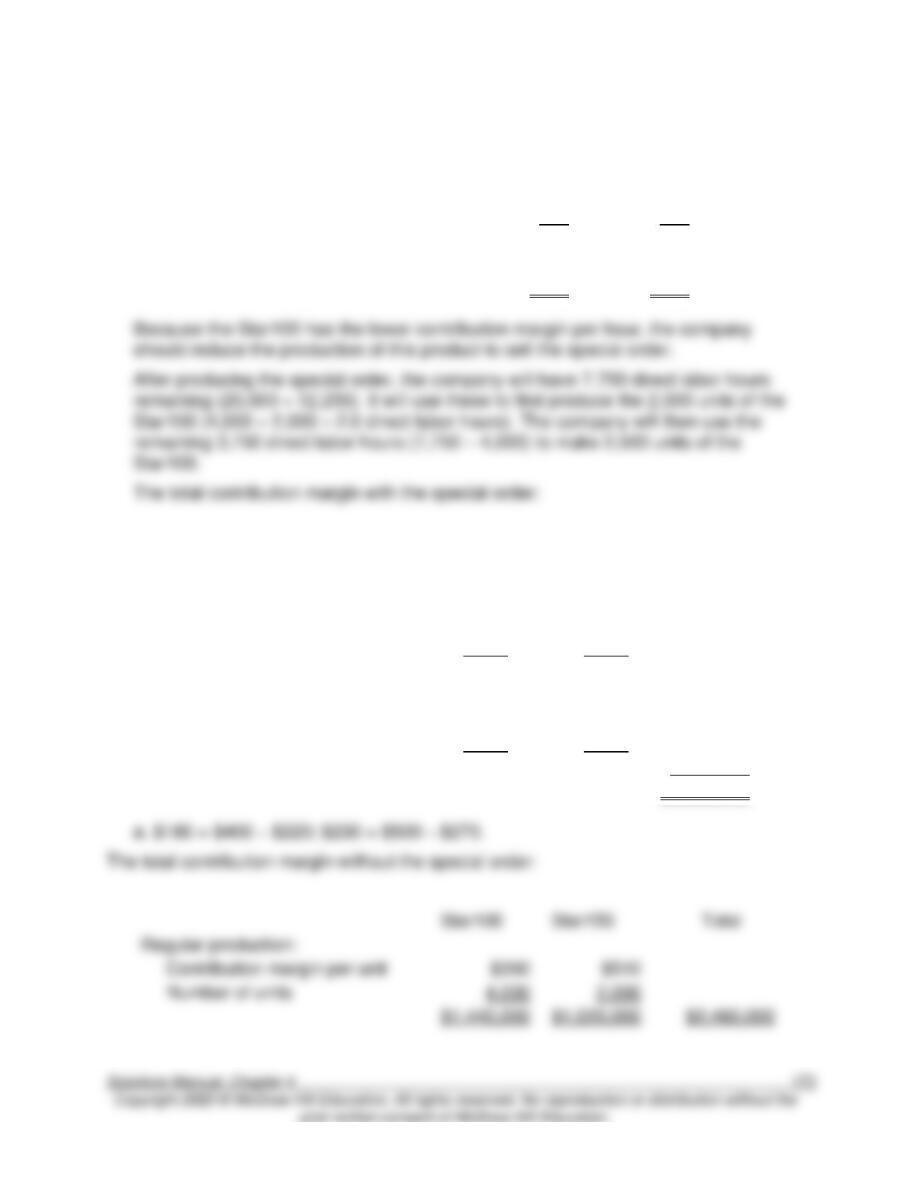
Star100
Star150
Revenue per unit …………………………….
$580
$780
Variable cost per unit ……………………….
220
270
Contribution margin per unit ……………..
$360
$510
Divide by Direct-labor hours per unit ..
1.5
2.0
Contribution margin per hour …………….
$240
$255
Star100
Star150
Total
Special order
Contribution margin per unit
(Price – Variable cost)
$180a
$230a
Number of units
3,500
3,500
Total contribution margin
$630,000
$805,000
$1,435,000
Regular production:
Contribution margin per unit
$360
$510
Number of units
2,500
2,000
$900,000
$1,020,000
1,920,000
$3,355,000
Star100
Star150
Regular production:
Contribution margin per unit
Number of units
4-53. (continued)
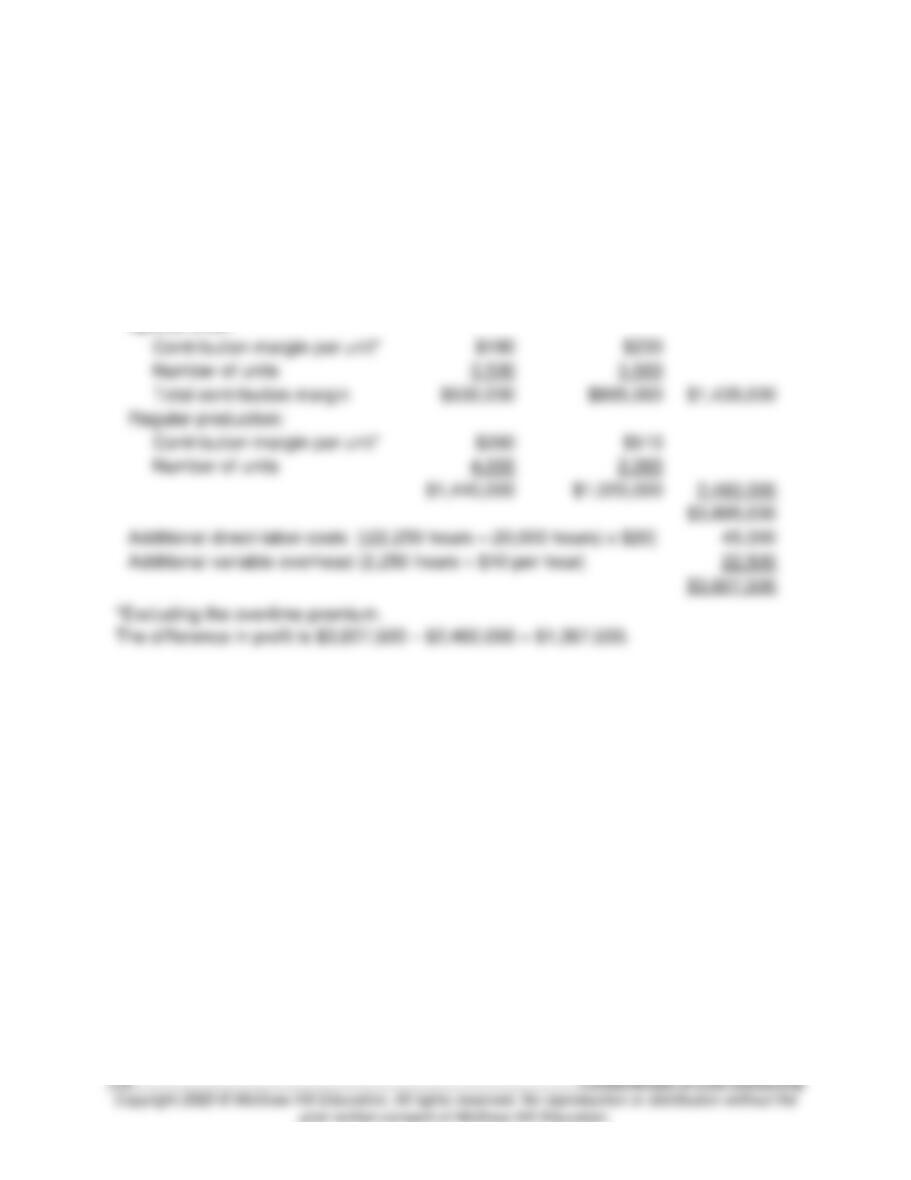
The difference in profit is $3,355,000 − $2,460,000 = $895,000.
The company is better off accepting the special order. (Of course, the company
would earn even more profit if it could first produce for the regular customers and
use any excess capacity to fill part, but not all, of the special order.)
c.
The total contribution margin with the special order:
Star100
Star150
Total
Regular production:
Additional variable overhead (2,250 hours $10 per hour)
4-54. (30 min.) Special Orders: Sherene Nili
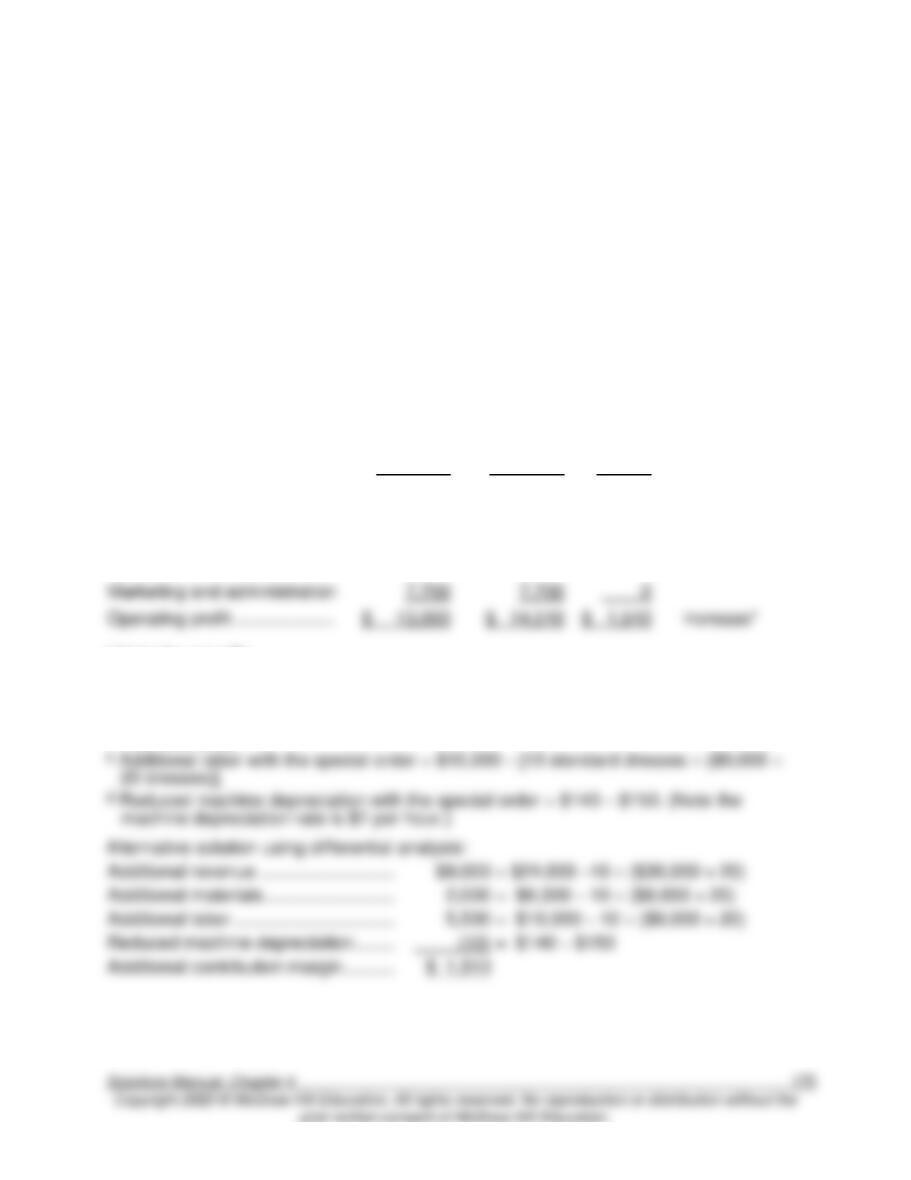
a. Based on profit, Ms. Nili should accept the special order. Accepting the special
order means Ms. Nili will only be able to produce 10 standard dresses. Each
standard dress requires 15 (= 300 hours ÷ 20 dresses) hours of machine time per
dress. Because she is committed to the custom dresses (whether more profitable or
not), she must cut back the number of standard dresses by 10. The rent, heat and
light, and other production costs are fixed and will not be affected by this decision.
Without
Special
Order
With
Special
Order
Impact
Revenuea ………………………..
$ 80,000
$ 89,000
$ 9,000
increase
Materialsb ………………………..
18,000
20,000
2,000
increase
Laborc …………………………….
29,000
34,500
5,500
increase
Machine depreciationd ………
900
890
10
decrease
Contribution margin… …….
$ 32,100
$ 33,610
$ 1,510
increase*
Rent ……………………………….
7,000
7,000
0
Heat and light …………………..
1,600
1,600
0
Other production costs ………
2,800
2,800
0
* Note the equality.
a Additional revenues with the special order = $24,000 – [10 standard dresses
($30,000 ÷ 20 dresses)].
b Additional materials with the special order = $6,000 – [10 standard dresses ($8,000
÷ 20 dresses)].
Additional revenue ………………………
= $24,000 –10 ($30,000 ÷ 20)
Additional materials ……………………..
Additional labor …………………………..
Reduced machine depreciation ……..
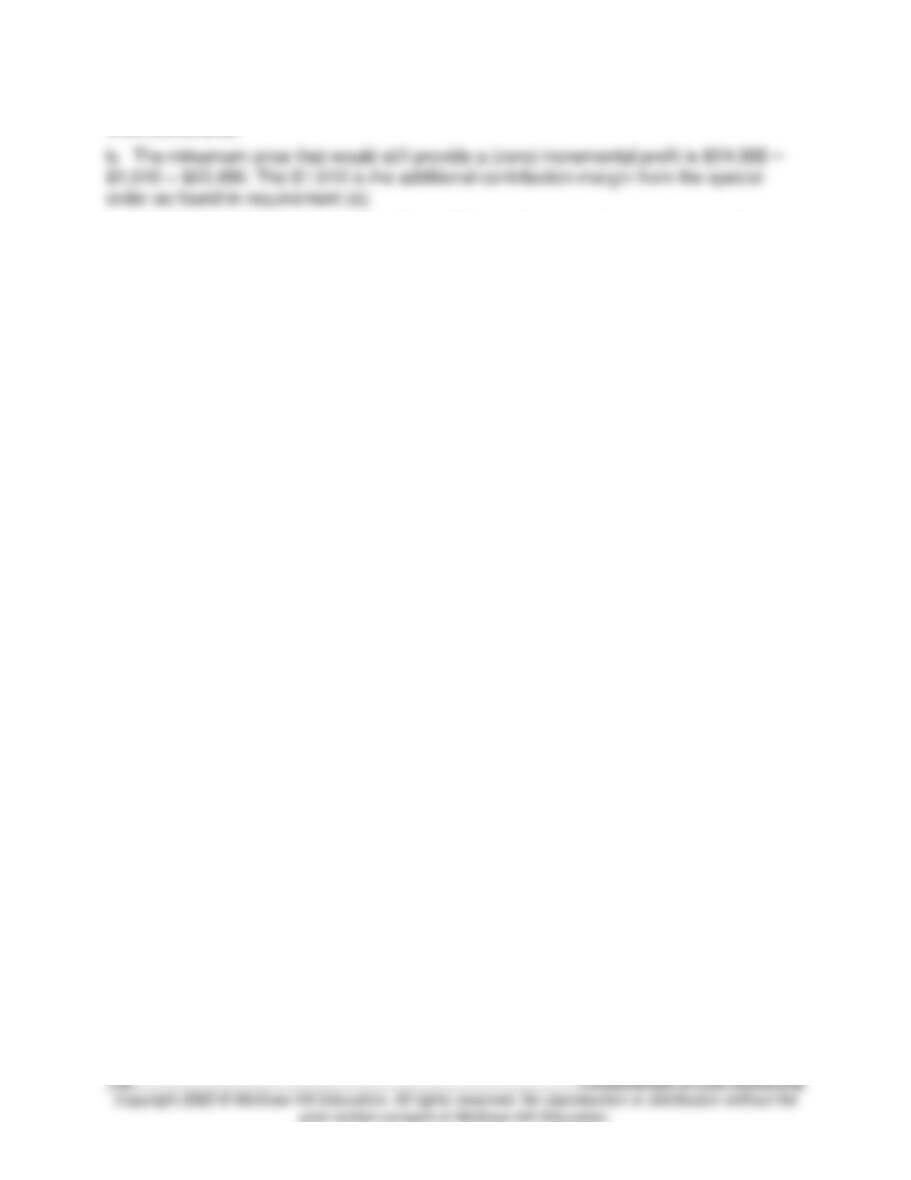
c. Ms. Nili should consider whether there will be customers who planned to order a
standard dress and will now order from a competitor. Although the price of the special
order offsets any lost contribution margin from the standard dresses, these customers
might have been repeat customers who will now buy in the future from her competitors.
She might also consider whether the wedding consultant will provide her more custom
orders (or referrals) if she does this special order.
4-55. (30 min.) Pricing Decisions: CSU EE
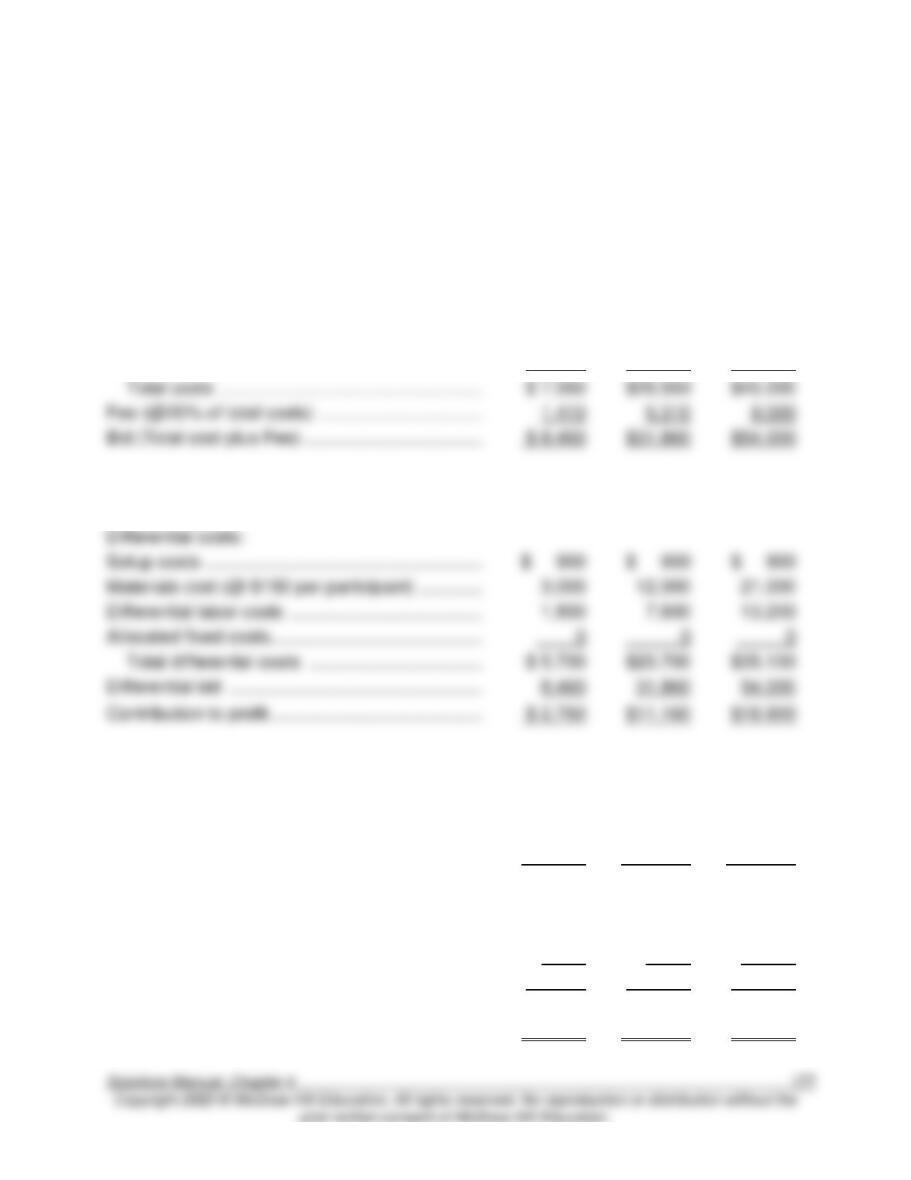
a.
One
Four
Eight
Seminar
Seminars
Seminars
Number of participants …………………………………………
20
80
140
Setup costs ……………………………………………………….
$ 900
$ 900
$ 900
Materials cost (@ $150 per participant) …………………..
3,000
12,000
21,000
Differential labor costs ………………………………………….
1,800
7,800
13,200
Allocated fixed costs (@75% of direct labor
costs) …………………………………………………………………
1,350
5,850
9,900
b.
One
Four
Eight
Seminar
Seminars
Seminars
Differential costs:
Setup costs ……………………………………………………….
$ 900
$ 900
$ 900
Materials cost (@ $150 per participant) …………………..
3,000
12,000
21,000
Differential labor costs ………………………………………….
1,800
7,800
13,200
Allocated fixed costs……………………………………………..
0
Total differential costs ………………………………………
$ 5,700
$20,700
$35,100
Differential bid …………………………………………………….
8,460
31,860
54,000
Contribution to profit ……………………………………………..
$18.900
c. Disagree. The contribution to profit is greatest for eight seminars.
One
Four
Eight
Seminar
Seminars
Seminars
Bid (from requirement a, above, @90% for
eight seminars) …………………………………………………….
$ 8,460
$ 31,860
$ 48,600
Incremental costs:
Setup costs ……………………………………………………….
900
900
900
Materials cost (@ $150 per participant) …………………..
3,000
12,000
21,000
Differential labor costs ………………………………………….
1,800
7,800
13,200
Total incremental costs …………………………………….
$ 5,700
$20,700
$35,100
Contribution to profit ……………………………………………..
$ 2,760
$ 11,160
$13,500
4-56. Pricing Decisions: M. Anthony, LLP.
a. Total fixed costs = $2,760,000 [= 60 songs ($21,000 fixed overhead + $25,000
fixed marketing and administrative)]
Variable cost per song = $20,000 (= $17,000 + $3,000)
Profit
=
(P – V)X – F
$0
=
($80,000 – $20,000)X – $2,760,000
$60,000X
=
$2,760,000
X =
$2,760,000
$60,000
X =
46
songs
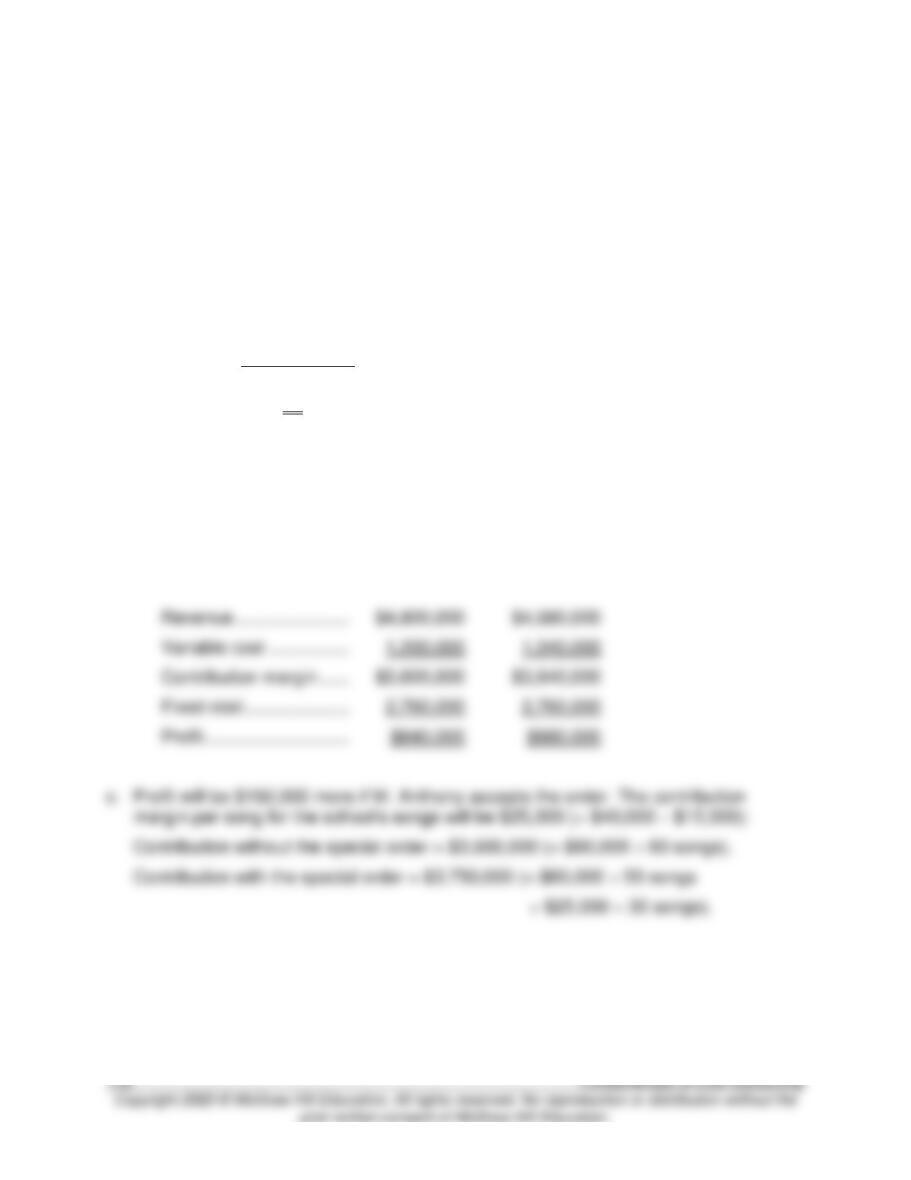
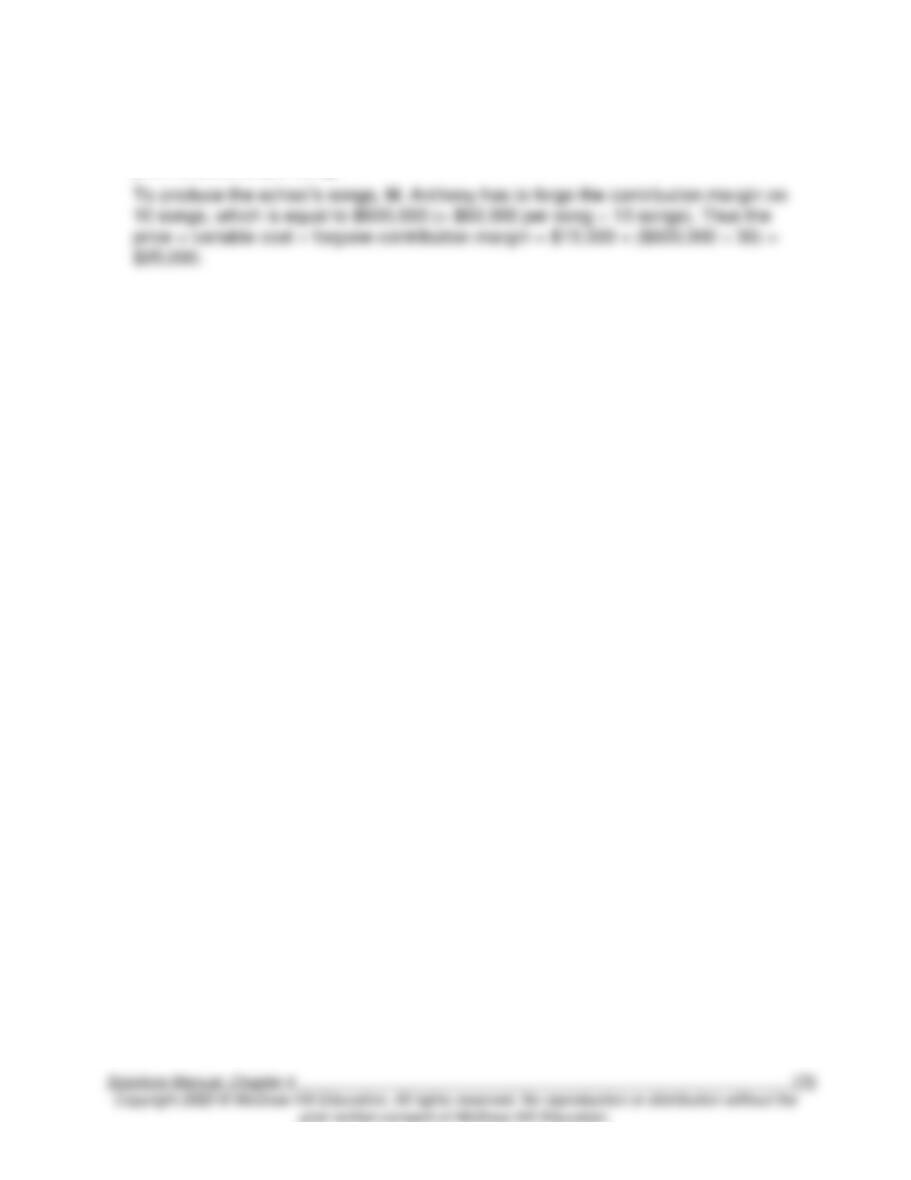
b. Profit will be $40,000 higher if the price is $90,000 per song:
Price per song
$80,000
$90,000
Number of songs ……….
60
52
Revenue …………………..
Variable cost …………….
Contribution margin ……
Fixed cost …………………
Profit ………………………..
4-56 (continued)
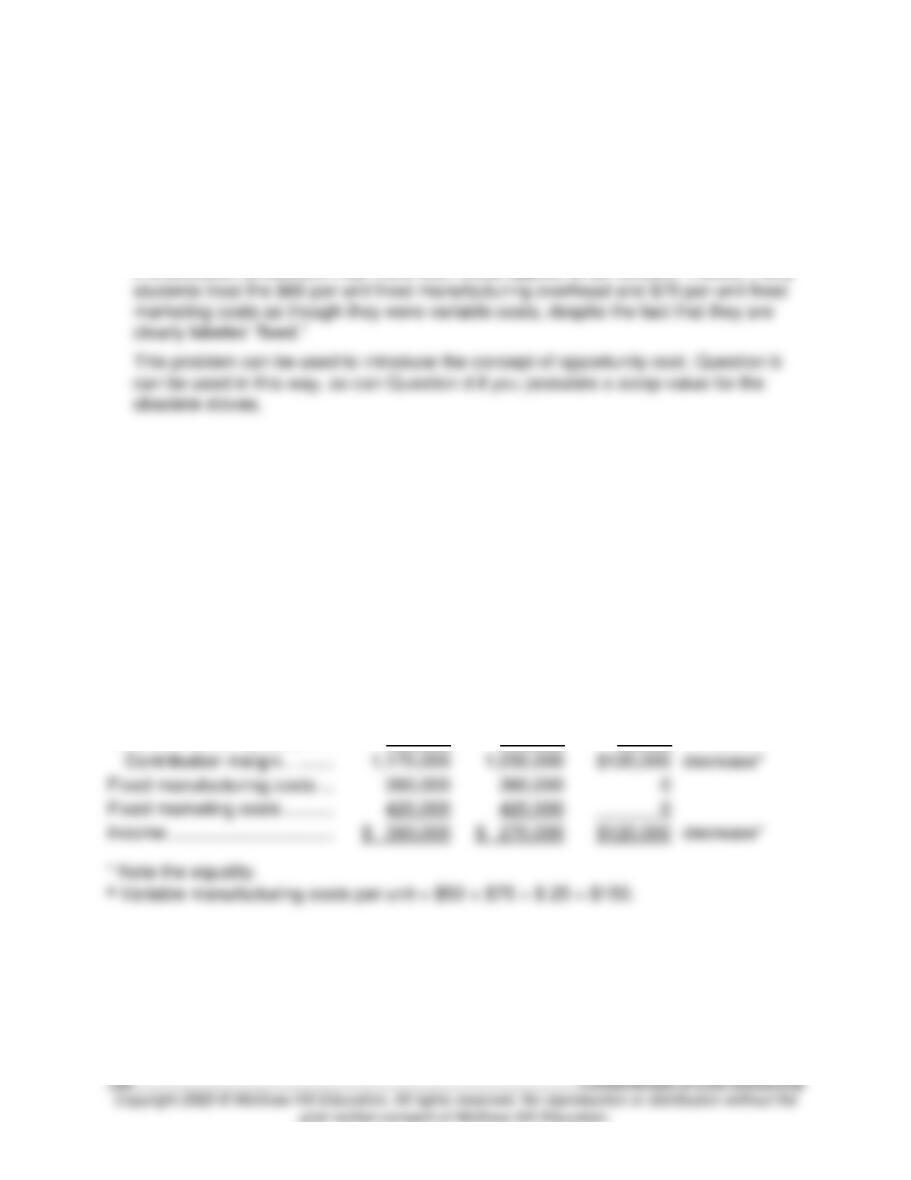
d. The lowest price on the school’s songs that M. Anthony can accept without reducing
profit is $35,000 per song.
4-57. (120 min.) Comprehensive Differential Costing Problem: Davis Kitchen
Supply.
This problem gives students a good understanding of the fixed/variable cost
dichotomy. It is worthwhile to emphasize to students that fixed costs may be
“unitized” (i.e., allocated to individual units of product) for certain purposes, and that
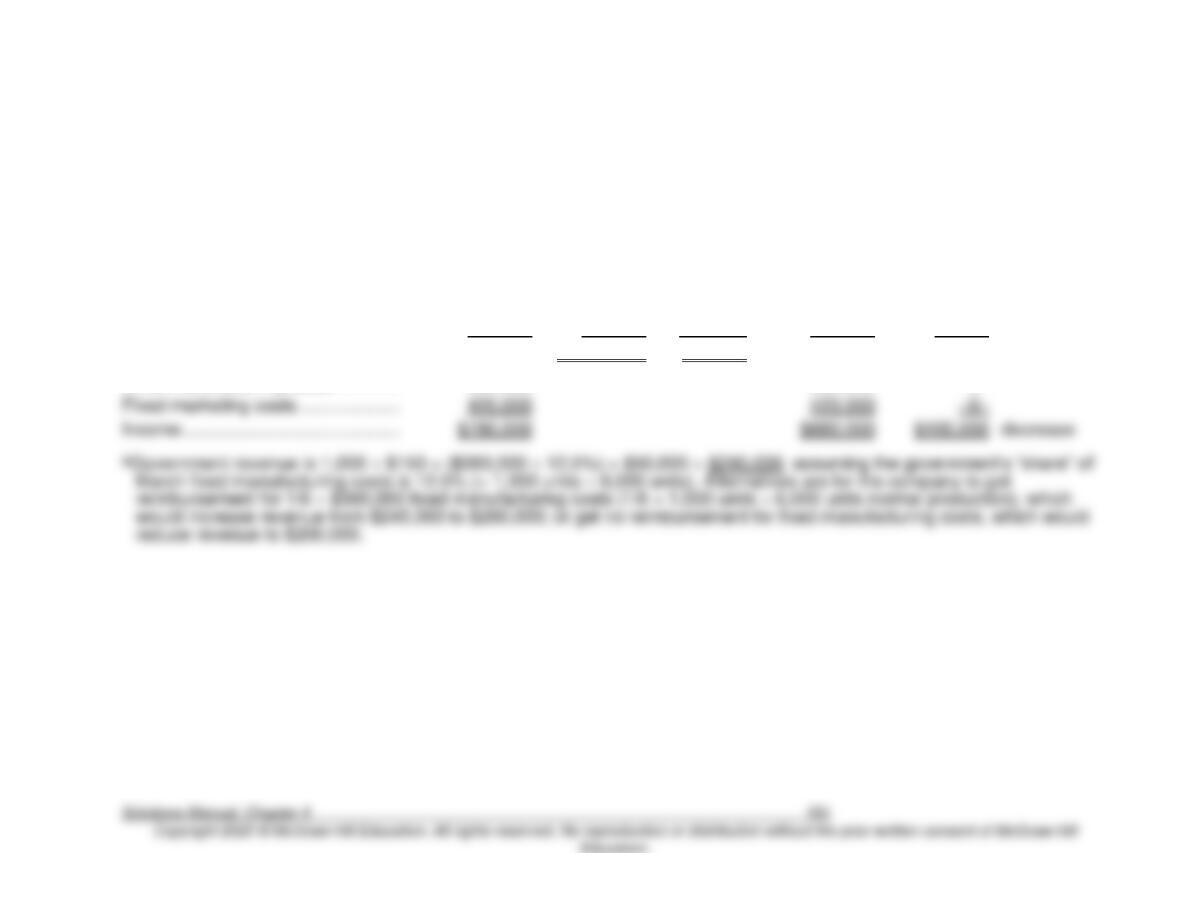
a. Recommendation: Lowering prices reduces operating profit. Other factors, such as
the reduction of available capacity and the impact on market share, could also affect
the decision.
Before Price
Reduction
After
Price
Reduction
Impact
Sales price ………………………
$ 370
$ 325
Quantity …………………………..
6,000
7,000
Revenue ………………………….
$2,220,000
$2,275,000
$ 55,000
increase
Variable manufacturing costsa
900,000
1,050,000
150,000
increase
Variable marketing costs ……
150,000
175,000
25,000
increase
decrease*
Fixed manufacturing costs …
360,000
360,000
Fixed marketing costs ……….
420,000
420,000
4-57. (continued)
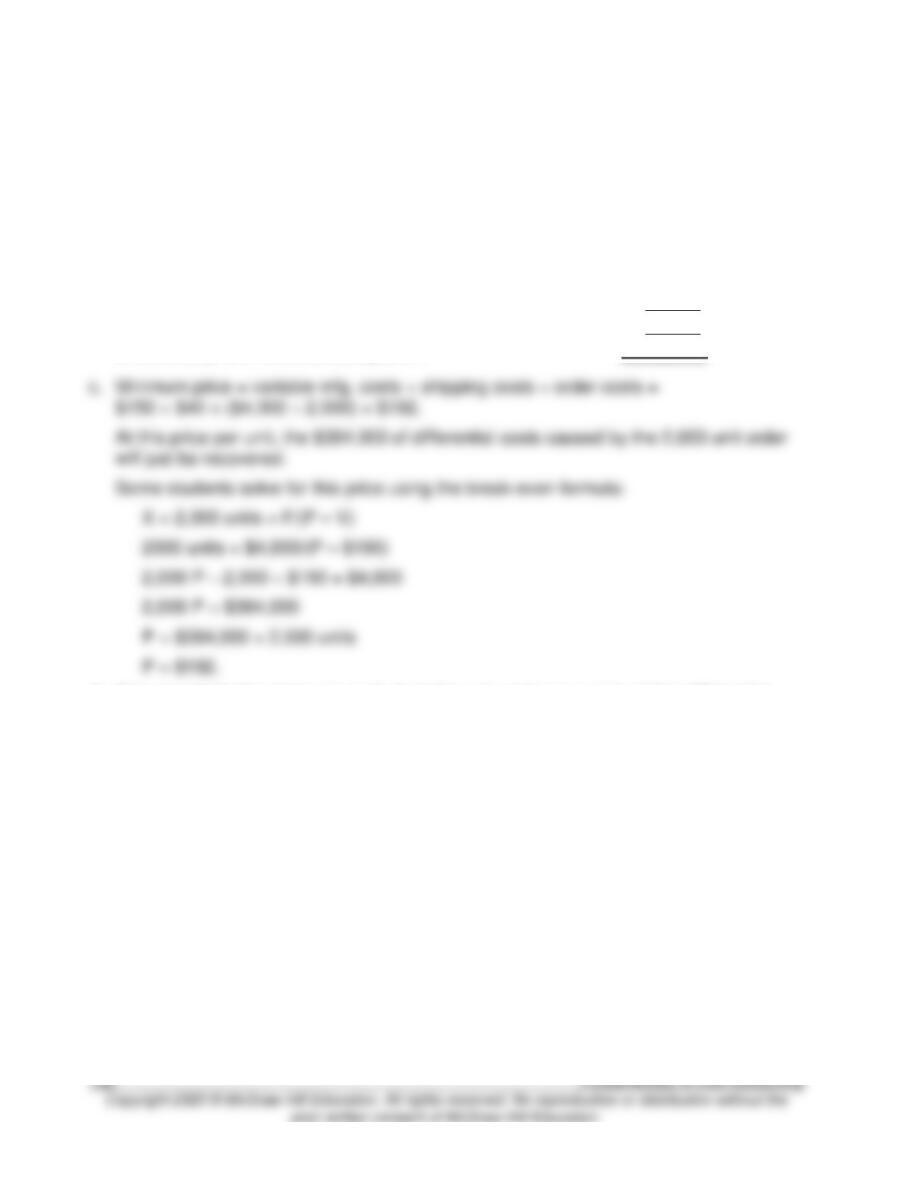
b. Recommendation: Don’t accept contract.
Without
Government
Contract
With Government Contract
Impact
Regular
Government
Total
Revenue …………………………………..
$2,960,000
$2,590,000
$245,000a
$2,835,000
$125,000
decrease
Variable manufacturing costs ………
1,200,000
1,050,000
150,000
1,200,000
–0–
Variable marketing costs …………….
200,000
175,000
—
175,000
25,000
decrease
Contribution margin ……………………
1,560,000
$1,365,000
$95,000
1,460,000
100,000
decrease
Fixed manufacturing costs ………….
360,000
360,000
–0–
Fixed marketing costs ………………..
420,000
420,000
4-57. (continued)
A shorter approach to Requirement b (but more difficult for some students to
understand) is this:
Forgone contribution (equals forgone income)
on regular sales if government contract is
accepted ………………………………………….
1,000 $195
=
$(195,000)
lost
Profit from government contract:
Fixed fee ………………………………………
50,000
gained
Share of fixed mfg. costs ($360,000 ÷ 8)
45,000
gained
Gain ………………………………………………..
95,000
gained
Differential profit if contract accepted..…
$(100,000)
d. The manufacturing costs are sunk; therefore, any price in excess of the differential
costs of selling the stoves will add to income. In this case, those differential costs are
apparently the $25 per unit variable marketing costs, since the stoves are to be sold
through regular channels; thus, the minimum price is $25. (If the instructor wishes to
reinforce the concept of opportunity cost, the most general answer to this question is
that the price should exceed the sum of 1) the differential marketing costs and 2) the
potential scrap proceeds, which are an opportunity cost of selling the stoves rather
than scrapping them.)
4-57. (continued)
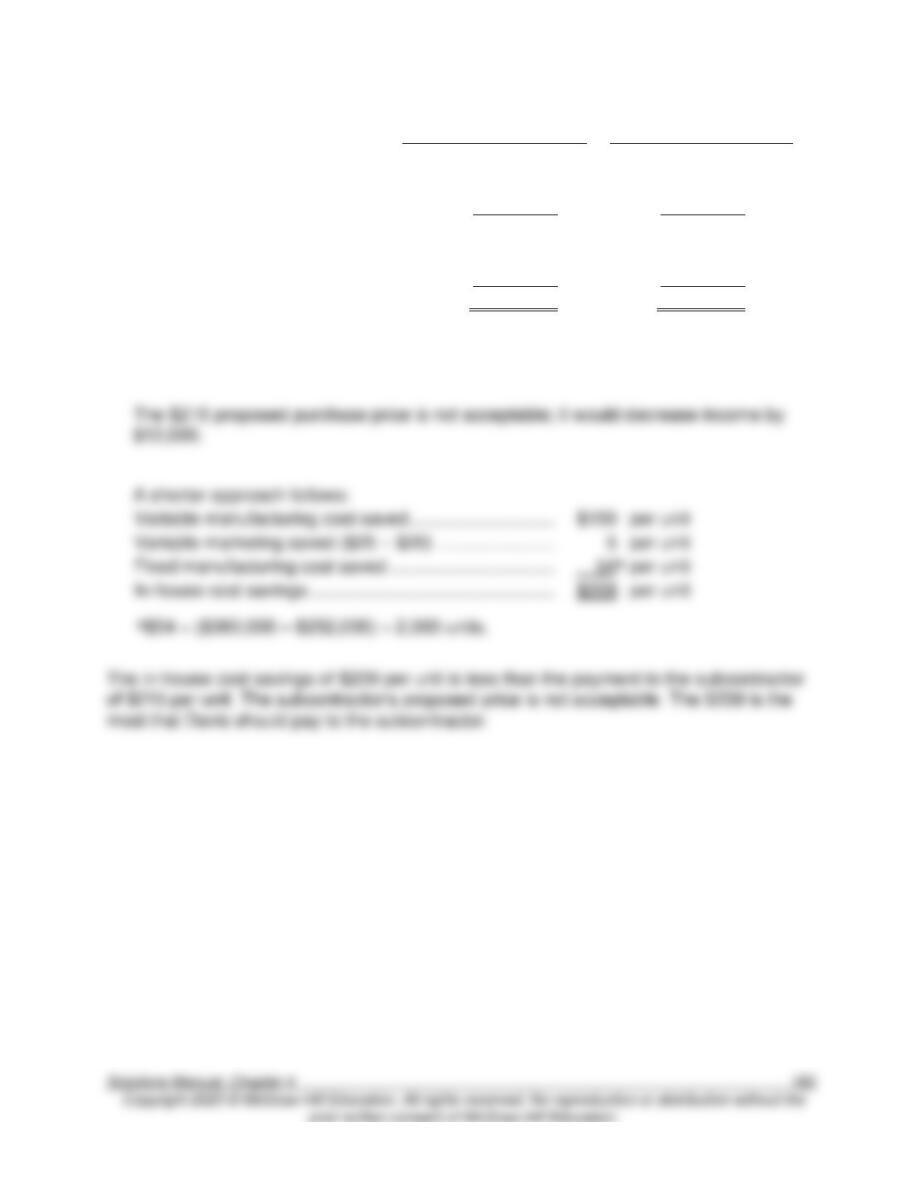
e. No, the $215 proposed purchase price is not acceptable.
All Production In-house
2,000 Units Contracted
Total revenue ………………………….
$2,220,000
$2,220,000
Total variable manufacturing costs
900,000
1,030,000
a
Total variable marketing costs………
150,000
140,000
b
Total contribution margin………
$1,170,000
$1,050,000
Total fixed manufacturing costs……
360,000
252,000
c
Total fixed marketing costs…………
420,000
420,000
Income …………………………….
$ 390,000
$ 378,000
a$1,030,000 = (4,000 units $150 per unit) + (2,000 units $215 per unit).
b$140,000 = (4,000 units $25 per unit) + (2,000 units .8 $25 per unit).
c$252,000 = $360,000 – (.3 $360,000)
Variable manufacturing cost saved ………………………..
$150
per unit
Variable marketing saved ($25 – $20) …………………..
per unit
Fixed manufacturing cost saved …………………………...
per unit
4-57. (continued)
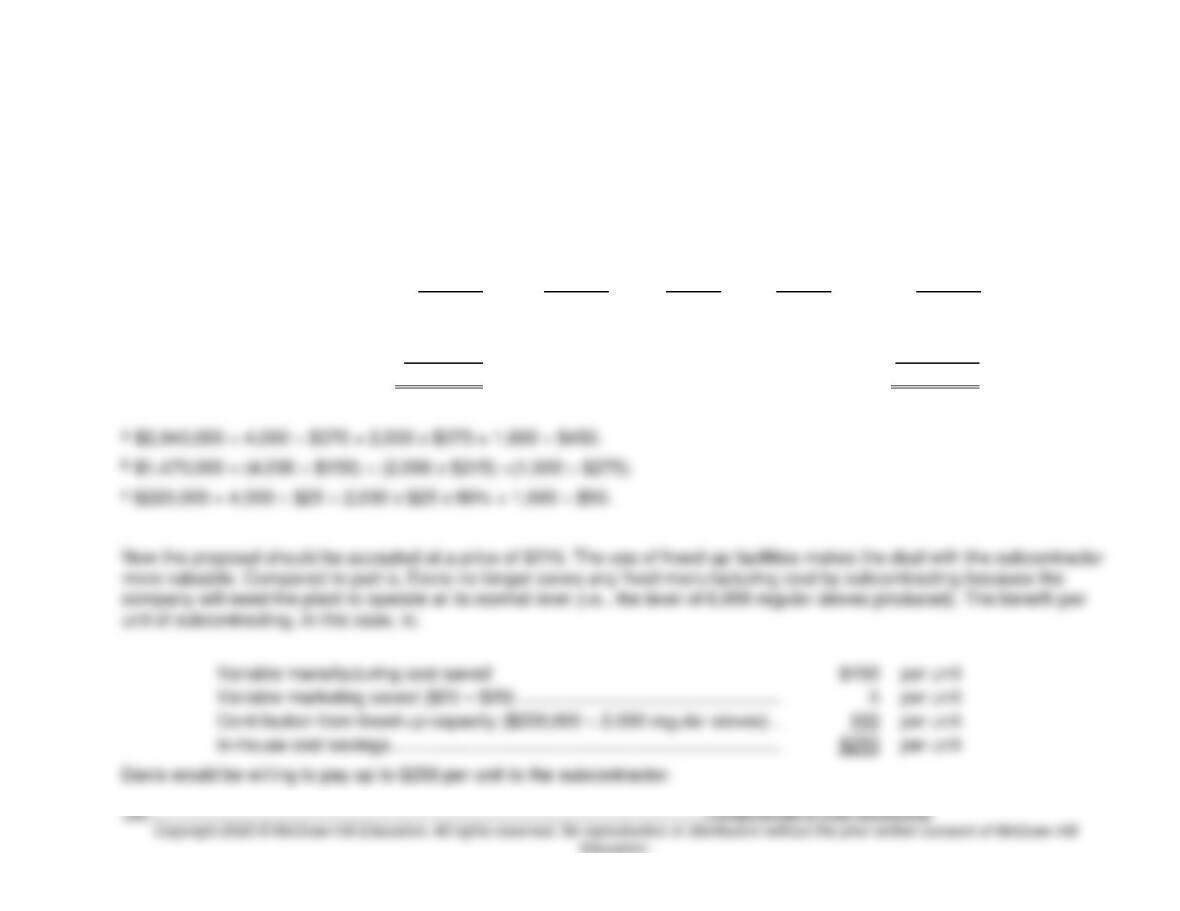
f.
6,000 Regular
Stoves Produced
Contract 2,000 Regular Stoves;
Produce 1,600 Modified Stoves and 4,000 Regular Stoves
In-house
Regular (In)
Regular (Out)
Modified
Total
Revenue ……………………………….
$2,220,000
$1,480,000
$740,000
$720,000
$2,940,000a
Variable manufacturing costs …..
900,000
600,000
430,000
440,000
1,470,000b
Variable marketing costs …………
150,000
100,000
40,000
80,000
220,000c
Contribution margin ……………..
1,170,000
$ 780,000
$270,000
$200,000
1,250,000
Fixed manufacturing costs ……….
360,000
360,000
Fixed marketing costs ……………..
420,000
420,000
Income …………………………...
$ 390,000
$ 470,000
4-58. (60 min.) Make or Buy: King City Specialty Bikes (KCSB).
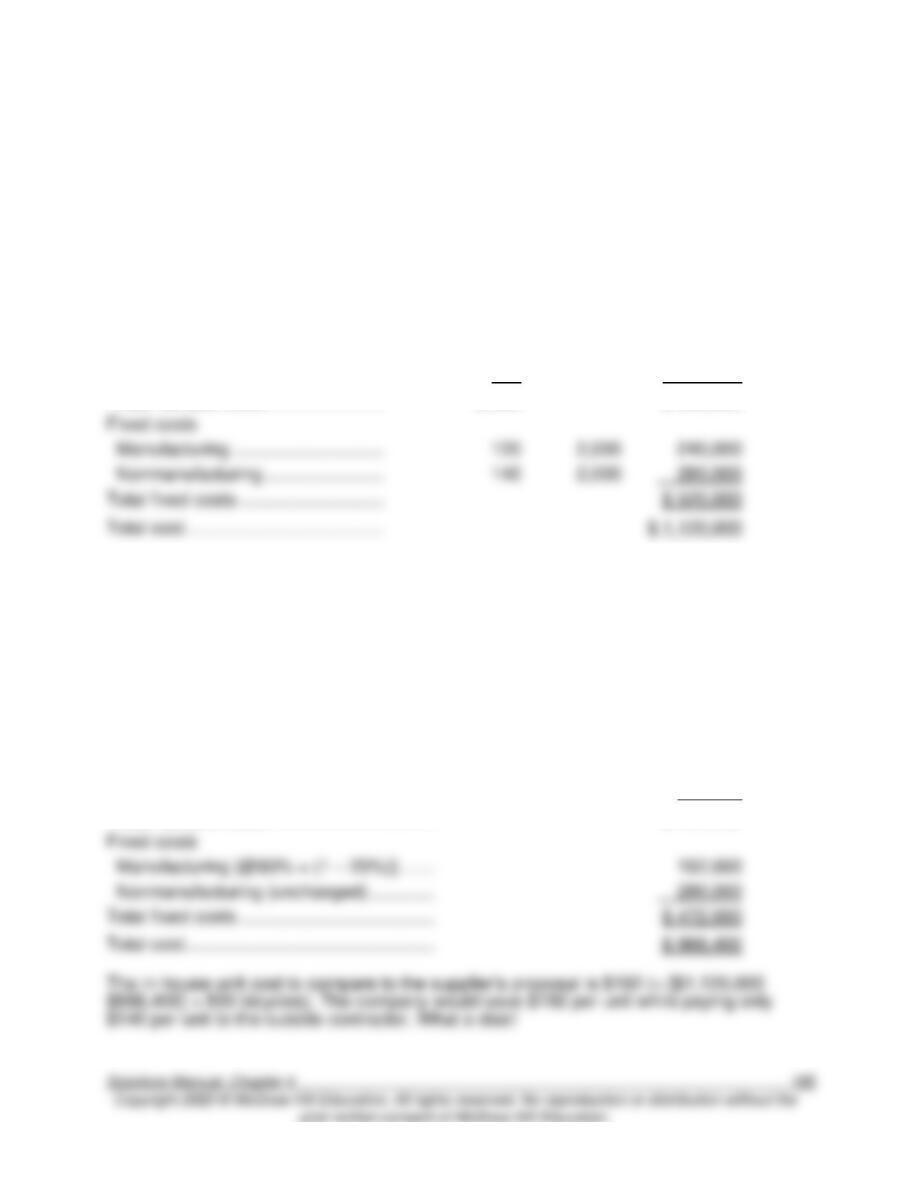
a. The in-house unit cost that should be used to evaluate the quotation received from
the outside contractor is $192. Therefore the proposal for $140 from the outside
contractor should be accepted.
Without contract:
Per unit
Number of
Bicycles
Total costs
Variable costs
Manufacturing …………………………
$ 240
2,000
$ 480,000
Non-manufacturing …………………..
60
2,000
120,000
$ 300
$ 600,000
Fixed costs
Manufacturing …………………………
120
2,000
Nonmanufacturing ……………………
140
2,000
Total fixed costs ………………………..
$ 520,000
The unit variable costs incurred by KCSB for the bikes assembled by the supplier are
$144 (= $240 [1 – 40%]) manufacturing costs and $24 (= $60 [1 – 60%])
nonmanufacturing costs, for a total of $168 (= $144 + $24) per bicycle.
With contract (before payment to supplier)
Total costs
For the bikes assembled by KCSB:
Variable costs:
Per unit
Number of
Bicycles
For the bikes assembled by KCSB ………..
$ 300
1,200
$ 360,000
For the bikes not assembled by KCSB …..
168
800
134,400
Total variable costs …………………………...
$ 494,400
Fixed costs
Nonmanufacturing (unchanged) ………….
Total fixed costs …………………………………
$ 472,000
4-58. (continued)
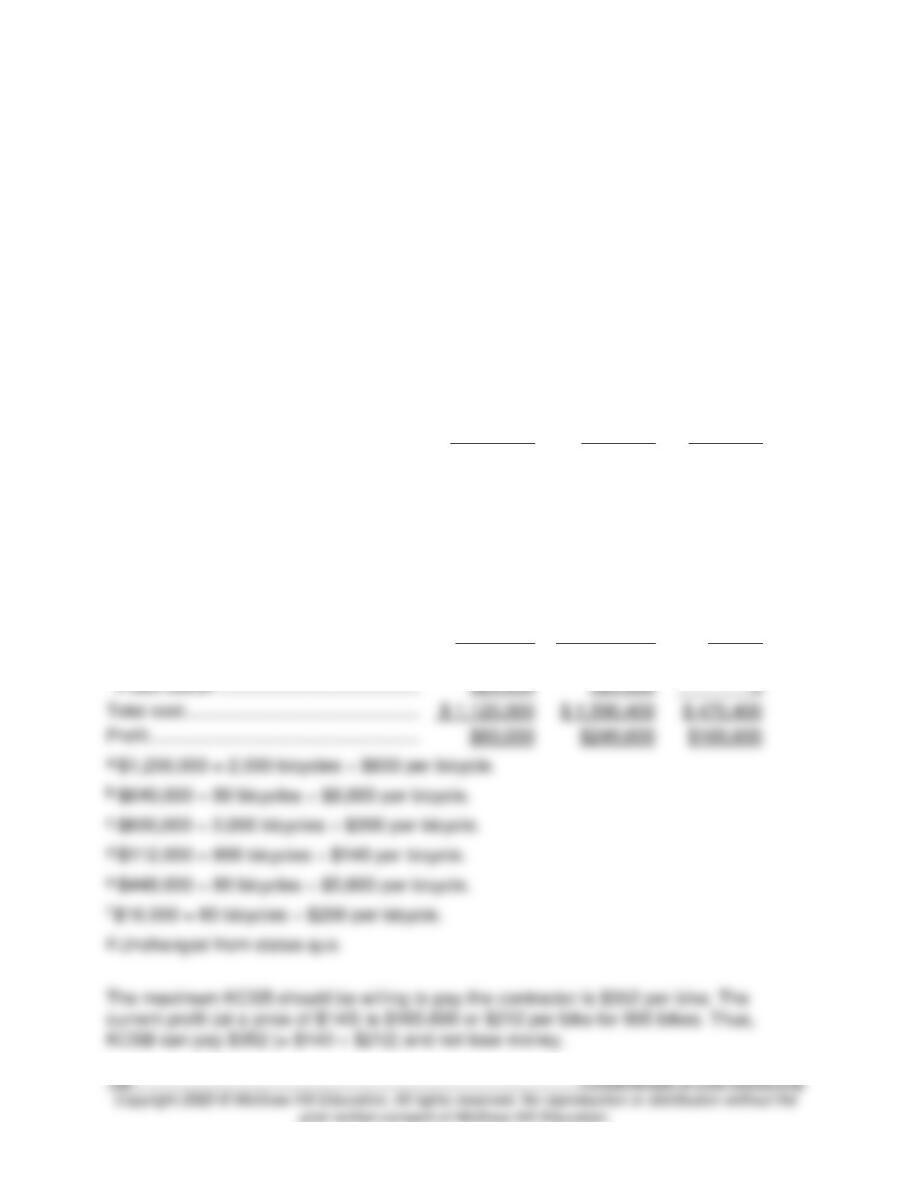
b. The additional revenue from the racing bicycles is greater than the additional costs
from using the supplier and assembling the racing bicycles. Therefore the supplier’s
offer should be accepted.
Status Quo
Accept
Supplier’s
Offer and
Assemble 80
Racing
Bicycles
Difference
Revenue:
From regular bicyclesa ………………….
$1,200,000
$1,200,000
$ 0
From racing bicyclesb ……………………
0
640,000
640,000
Total revenue ………………………………….
$1,200,000
$ 1,840,000
$ 640,000
Costs:
Variable costs
From regular bicyclesc ………………….
$ 600,000
$ 494,400
$ (105,600)
Payment to supplierd …………………….
0
112,000
112,000
For racing bicycles (manufacturing)e .
0
448,000
448,000
For racing bicycles (marketing)f ……..
0
16,000
16,000
Total variable cost ………………………
$ 600,000
$ 1,070,400
$ 470,400
Fixed costsg ………………………………….
520,000
520,000
0
Total cost ………………………………………..
$ 1,590,400
$ 470,400
Profit ………………………………………………
4-59. (20 min.) Target Costing: Polar Industries.
a. $46.20.
Cost plus price = $46.20 (= $42 manufacturing cost 1.10).
4-60. (20 min.) Target Costing: Innerspace, Inc.
a. $470.40.
Cost plus price = $470.40 (= $336 manufacturing cost 1.40).
b. $321.43.
The highest acceptable cost is one that allows a 40% margin with a $450
selling price. This $321.43 (= $450 selling price ÷ 1.40).
c. Answers will vary.
The cost of $336 per unit is higher than the highest acceptable cost of
4-61. (20 min.) Target Costing: Reunion Enterprises
a. No, Reunion Enterprises will not achieve the target operating margin of 30%
based on these product characteristics.
Price……………………………………………
$84.50
Costs…………………………………………..
Materials ………………………………….
$35.00
Direct labor (a) ………………………….
20.00
Overhead (b) …………………………….
15.00
70.00
Profit …………………………………………..
$14.50
Profit as a percentage of cost …………
20.7%
Notes –
4-62. (20 min.) Target Costing: DBU Systems.
a. No, DBU systems will not achieve the target operating margin of 20% based on
these product characteristics.
Price ……………………………………………
$100
Costs …………………………………………..
Materials (a) ……………………………..
$32
Direct labor (b)…………………………..
24
Overhead (c) …………………………….
36
92
Profit ……………………………………………
Profit as a percentage of cost ………….
8.7%
b: Direct labor hours (1.2) x wage rate ($20).
c: Overhead is 150% of direct labor cost (1.5 $24).
a. Yes, DBU Systems will achieve the target operating margin of 20% based on these
product characteristics and with the alternative overhead estimation approach.
Price ……………………………………………
$100
Costs …………………………………………..
Materials (a) ……………………………..
$32
Direct labor (b)…………………………..
24
Overhead (c) …………………………….
24
80
Profit ……………………………………………
Profit as a percentage of cost ………….
b: Direct labor hours (1.2) wage rate ($20).
c: Overhead is 75% of direct material (0.75 $32).
4-63. (15 min.) Target Costing: DBU Systems – Ethical Issues.
There are at least two issues with using the alternative overhead estimation
approach to justify the new product.
First, the target operating margins have been set in such a way that new products
will contribute toward meeting the company’s profit goal. If each new product is
justified based on the more favorable overhead estimation method, there is no
longer any assurance that even if each individual product meets the goal, the
company will reach its goal.