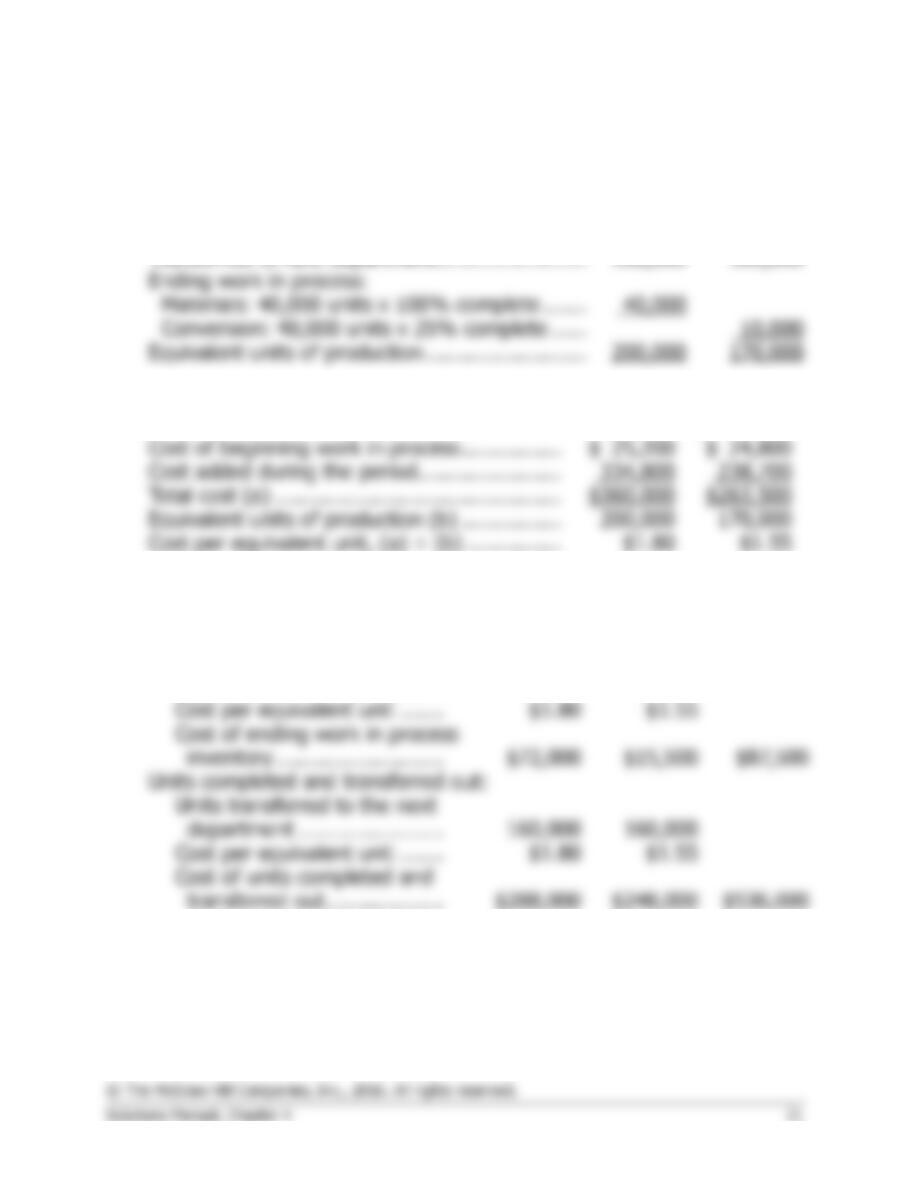
Problem 4-15A (45 minutes)
Weighted-Average Method
1.
Equivalent units of production:
Materials
Conversion
Transferred to next department ……………………
160,000
Ending work in process:
Equivalent units of production ……………………..
2.
Cost per Equivalent Unit
Materials
Conversion
Cost of beginning work in process …………….
Cost added during the period …………………..
Total cost (a) ……………………………………….
Equivalent units of production (b) …………….
170,000
Cost per equivalent unit, (a) ÷ (b) ……………
3.
Applying costs to units:
Materials
Conversion
Total
Ending work in process inventory:
Equivalent units of production
40,000
10,000
$15,500
Units completed and transferred out:
160,000
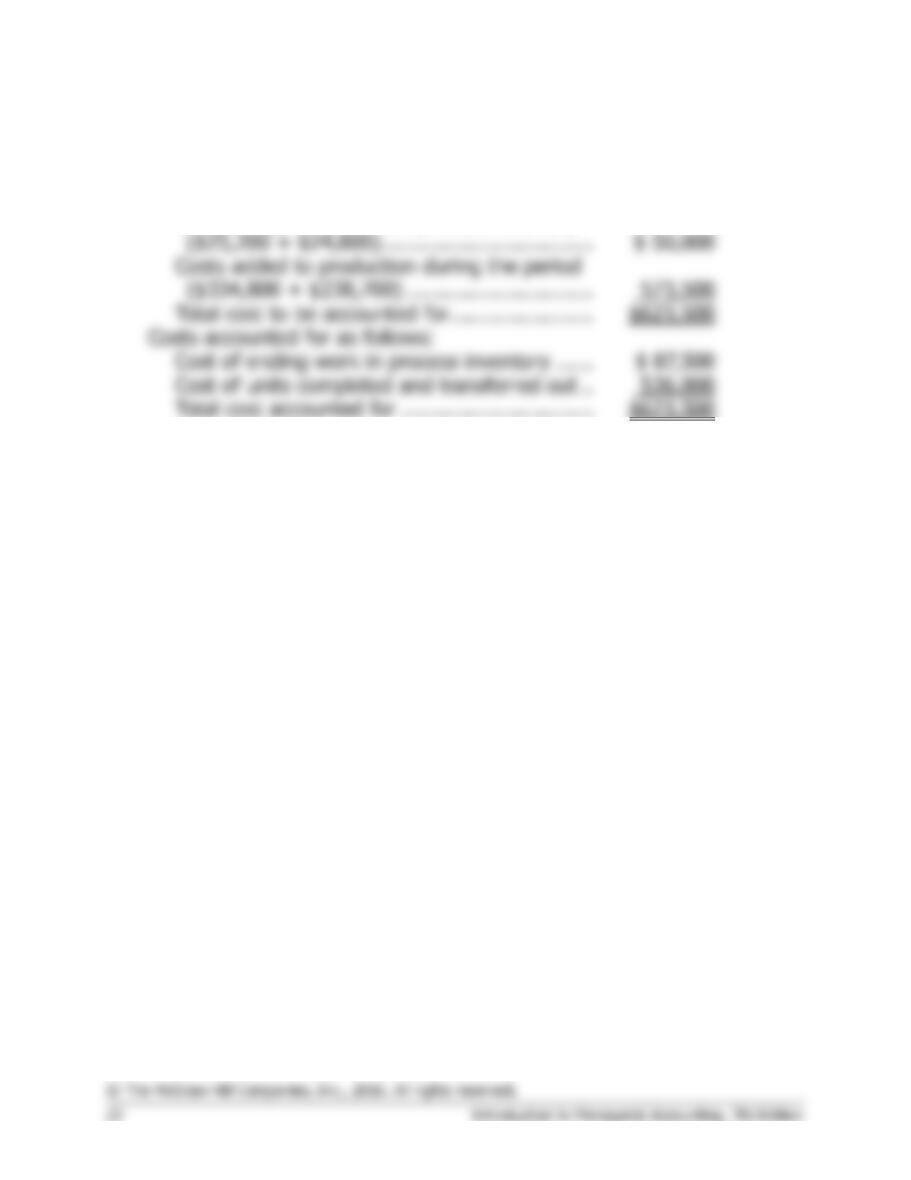
Problem 4-15A (continued)
4.
Cost reconciliation:
Costs to be accounted for:
Costs added to production during the period
Costs accounted for as follows:
Cost of beginning work in process inventory
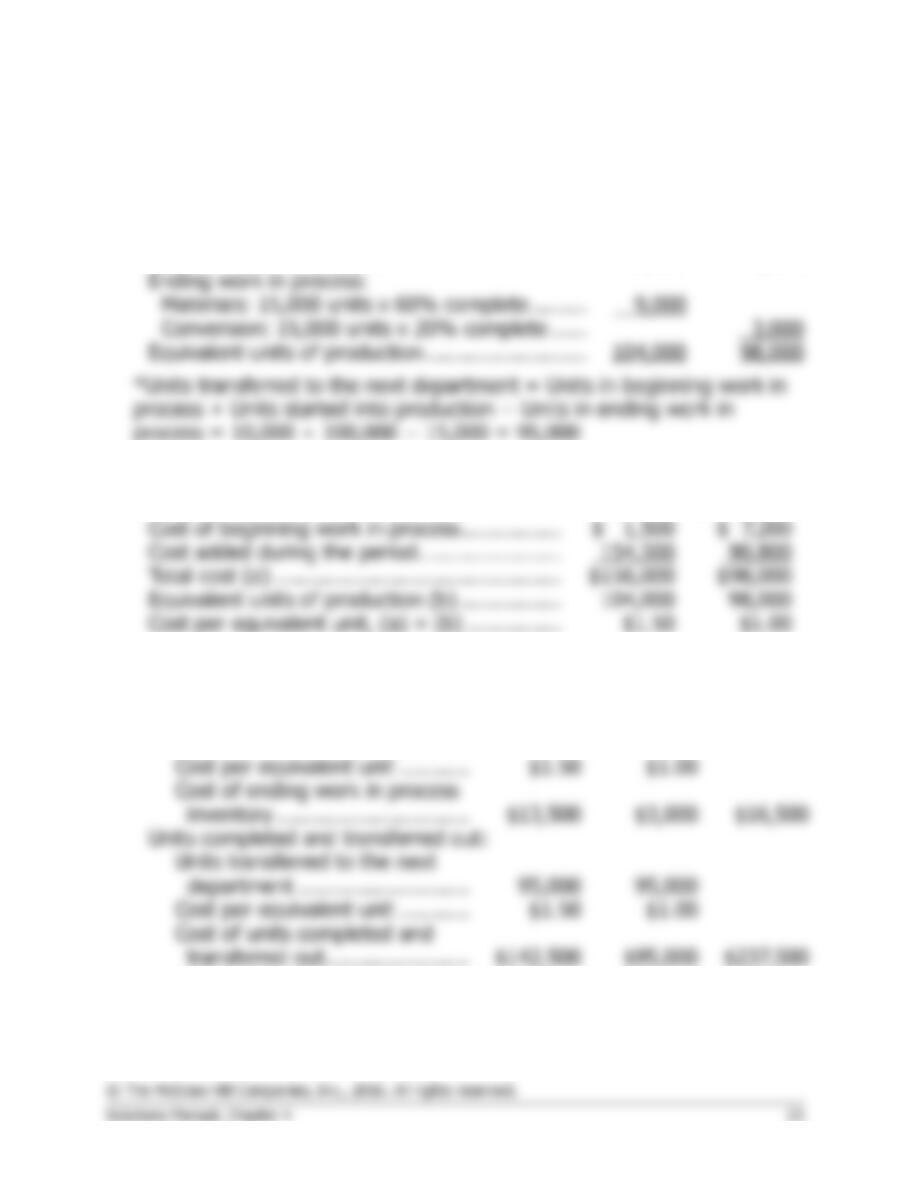
Problem 4-16A (45 minutes)
Weighted-Average Method
1.
Equivalent units of production
Materials
Conversion
Transferred to next department* ………………….
95,000
95,000
Ending work in process:
Equivalent units of production ……………………..
2.
Cost per equivalent unit
Materials
Conversion
Cost of beginning work in process …………….
Cost added during the period …………………..
Total cost (a) ……………………………………….
Equivalent units of production (b) …………….
98,000
Cost per equivalent unit, (a) ÷ (b) ……………
$1.50
$1.00
3.
Cost of ending work in process inventory and units transferred out
Materials
Conversion
Total
Ending work in process inventory:
Equivalent units of production…
9,000
3,000
Cost per equivalent unit ………..
$1.50
$1.00
$3,000
Units completed and transferred out:
95,000
Cost per equivalent unit ………..
$1.50
$1.00
$95,000
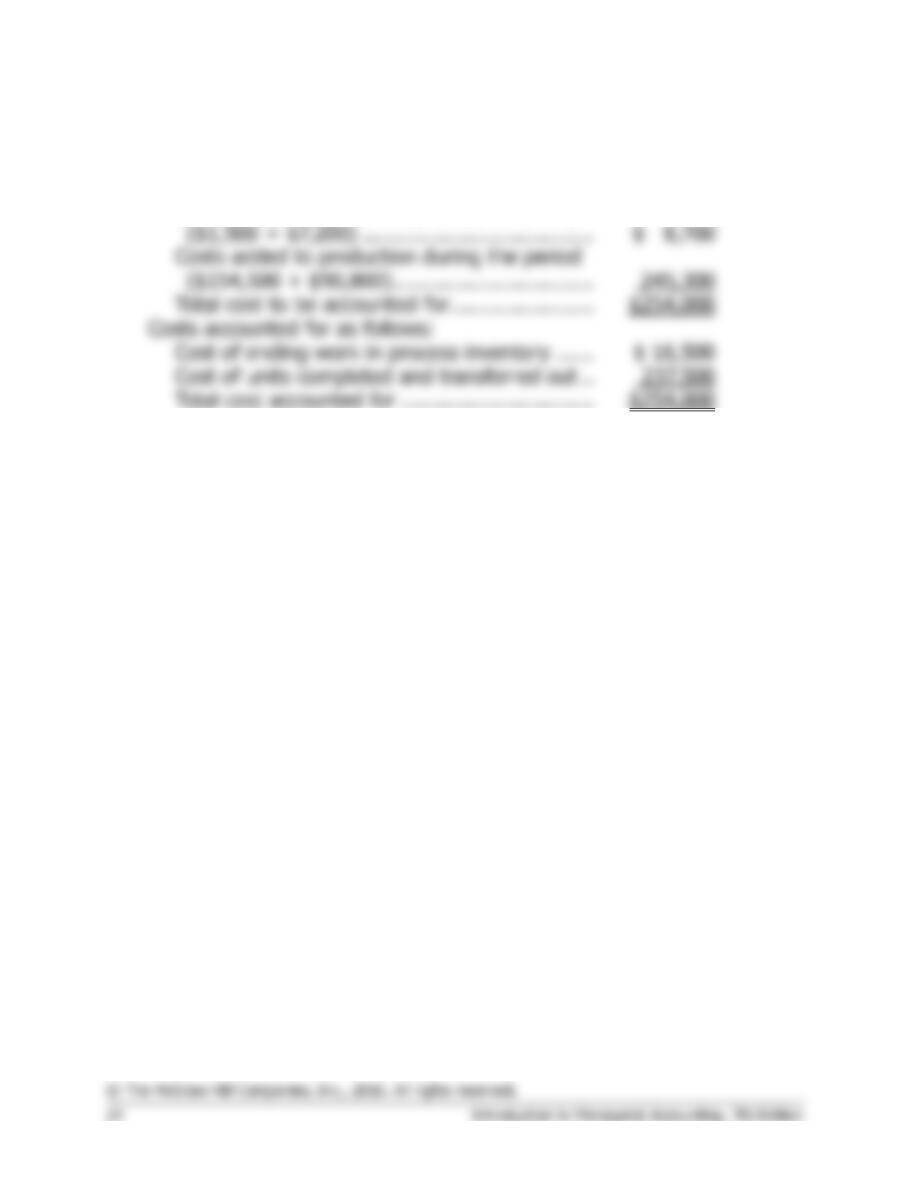
Problem 4-16A (continued)
4.
Cost Reconciliation
Costs to be accounted for:
Costs added to production during the period
Costs accounted for as follows:
Cost of beginning work in process inventory
Problem 4-17A (45 minutes)
Weighted-Average Method
1.
a.
Work in Process—Refining Department ………
495,000
Work in Process—Blending Department ……..
115,000
Raw Materials ………………………………….
610,000
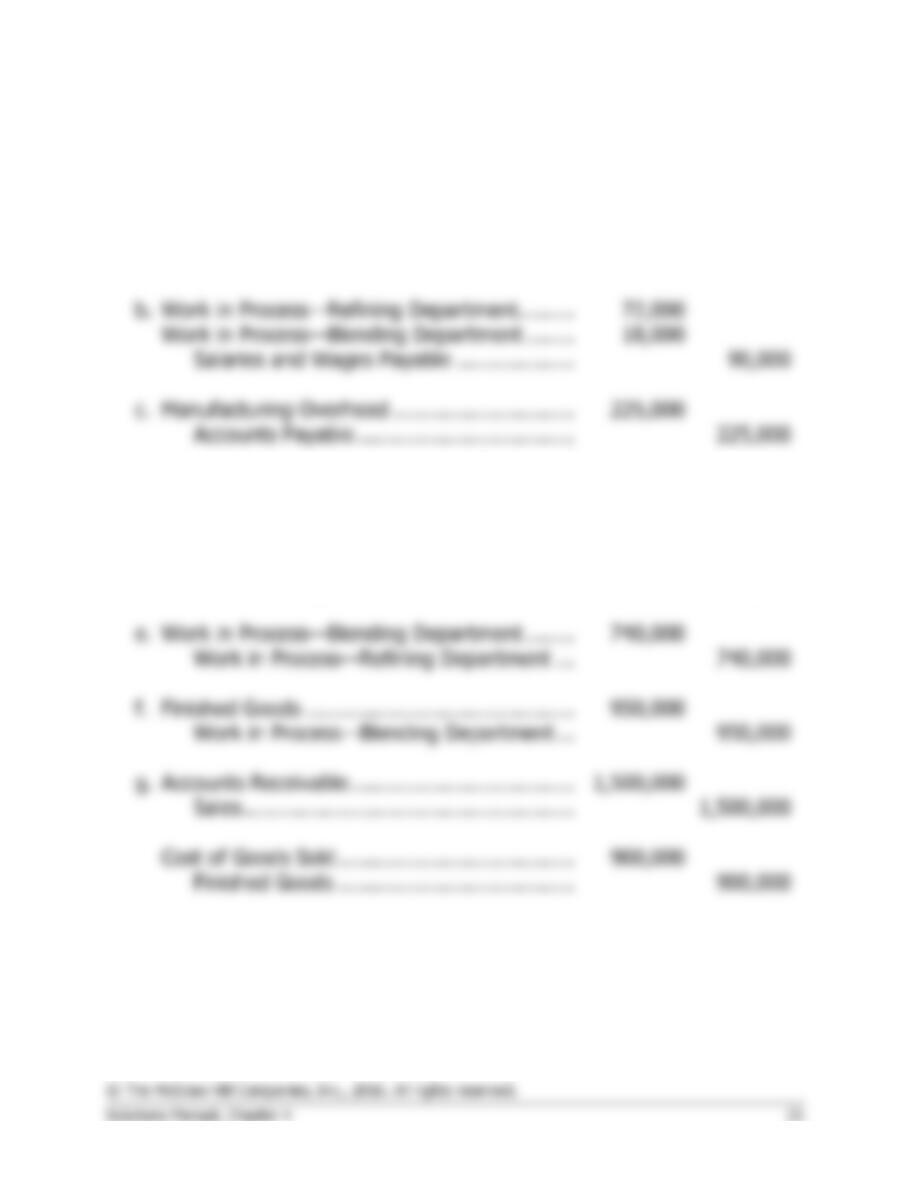
b.
Work in Process—Refining Department ………
72,000
Work in Process—Blending Department ……..
18,000
Salaries and Wages Payable ……………….
Manufacturing Overhead ………………………..
Accounts Payable ……………………………..
225,000
d.
Work in Process—Refining Department ………
181,000
Manufacturing Overhead ……………………
181,000
d.
Work in Process—Blending Department ……..
42,000
Manufacturing Overhead ……………………
42,000
Work in Process—Blending Department ……..
740,000
Work in Process—Refining Department …
740,000
Finished Goods …………………………………….
Work in Process—Blending Department …
950,000
g.
Accounts Receivable ………………………………
Sales ……………………………………………..
Cost of Goods Sold ………………………………..
Finished Goods ………………………………..
900,000
Problem 4-17A (continued)
2.
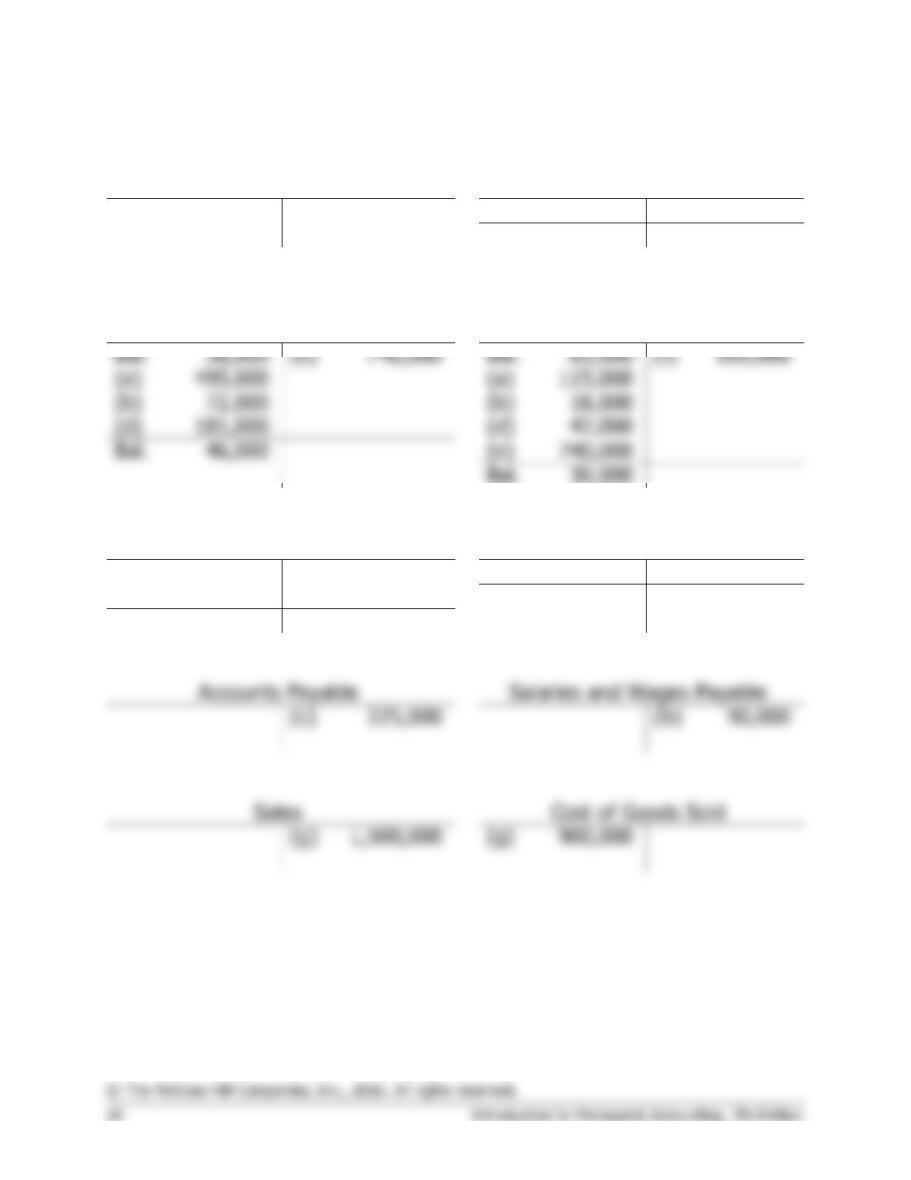
Accounts Receivable
Raw Materials
(g)
1,500,000
Bal.
618,000
(a)
610,000
Bal.
8,000
Work in Process
Refining Department
Work in Process
Blending Department
(a)
495,000
(a)
(b)
(b)
(d)
181,000
(d)
Bal.
46,000
(e)
Bal.
Finished Goods
Manufacturing Overhead
Bal.
20,000
(g)
900,000
(c)
225,000
(d)
223,000
(f)
950,000
Bal.
2,000
Bal.
70,000
Accounts Payable
(c)
225,000
(b)
(g)
1,500,000
(g)
Problem 4-18A (30 minutes)
Weighted-Average Method
1.
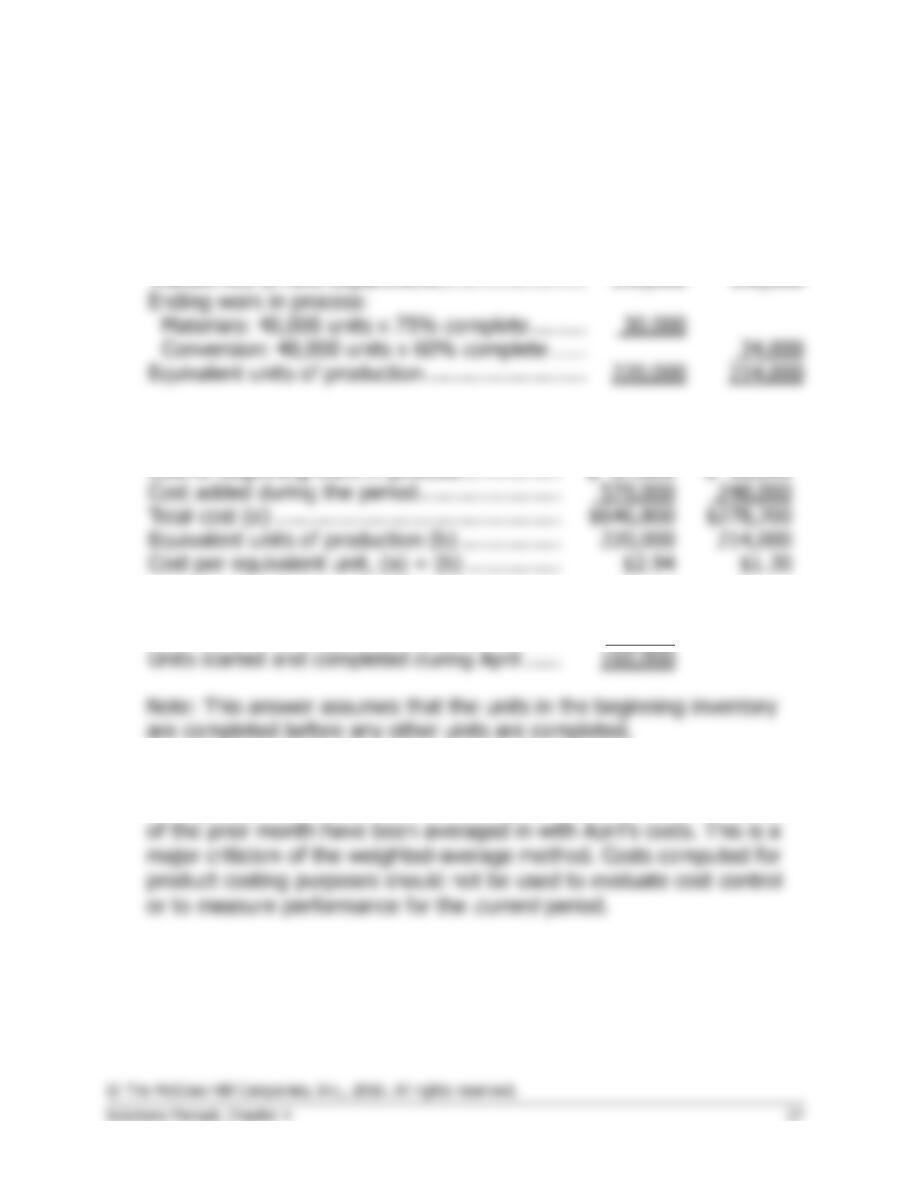
Equivalent units of production
Materials
Conversion
Transferred to next department ……………………
190,000
190,000
Ending work in process:
Equivalent units of production ……………………..
2.
Cost per equivalent unit
Materials
Conversion
Cost of beginning work in process …………….
$ 67,800
$ 30,200
Cost added during the period …………………..
Total cost (a) ……………………………………….
Equivalent units of production (b) …………….
220,000
214,000
Cost per equivalent unit, (a) ÷ (b) ……………
3.
Total units transferred …………………………...
190,000
Less units in the beginning inventory …………
30,000
Units started and completed during April ……
4. No, the manager should not be rewarded for good cost control. The
Mixing Department’s low unit cost for April occurred because the costs
Analytical Thinking (45 minutes)
Weighted-Average Method
1. The revised computations follow:
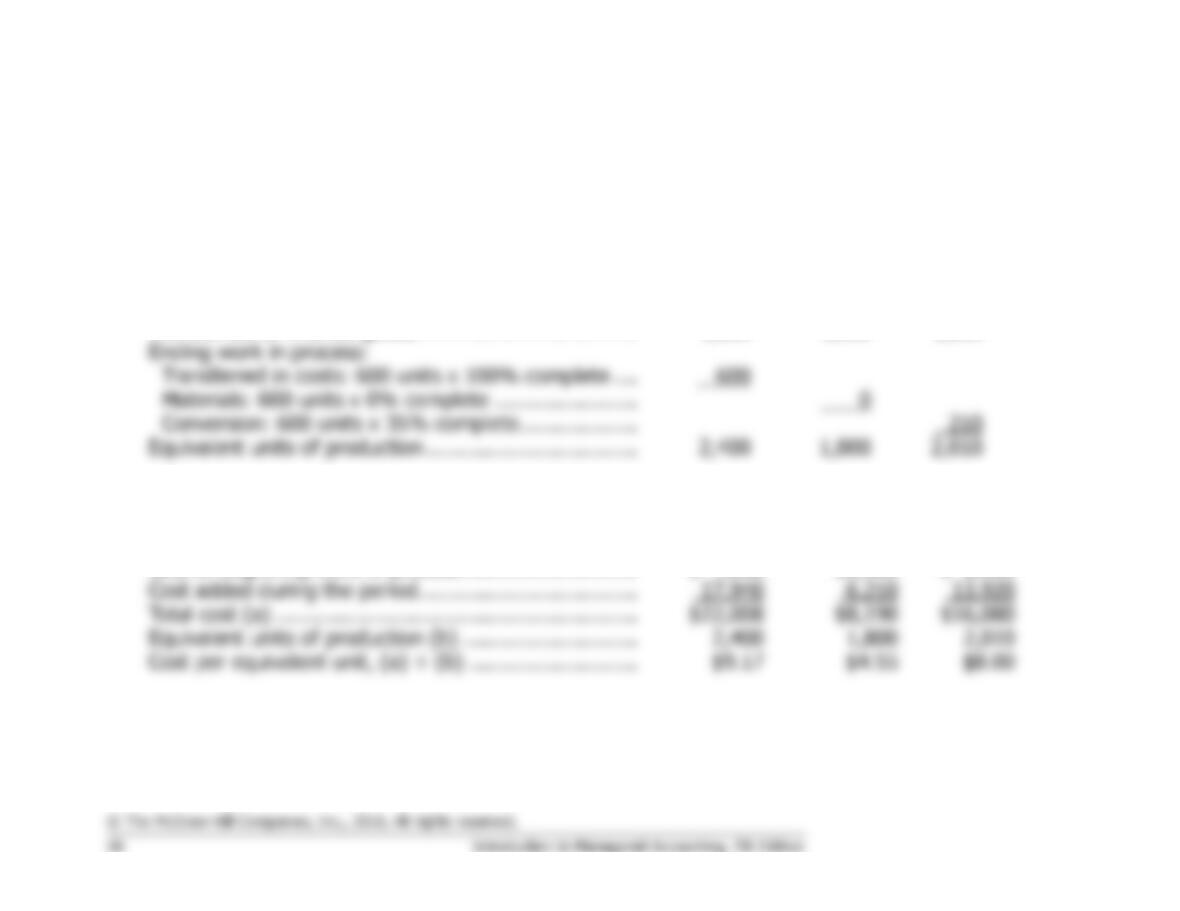
Equivalent Units of Production:
Transferred
In Costs
Materials
Conversion
Transferred to finished goods ……………………………..
1,800
1,800
1,800
Ending work in process:
Equivalent units of production …………………………….
2,400
1,800
2,010
Cost per Equivalent Unit:
Transferred
In Costs
Materials
Conversion
Cost of beginning work in process ……………………….
$ 4,068
$1,980
$ 2,160
Cost added during the period ……………………………..
Total cost (a) ………………………………………………….
Equivalent units of production (b) ……………………….
Cost per equivalent unit, (a) ÷ (b) ………………………
Analytical Thinking (continued)
Transferred
In Costs
Materials
Conversion
Total
Ending work in process inventory:
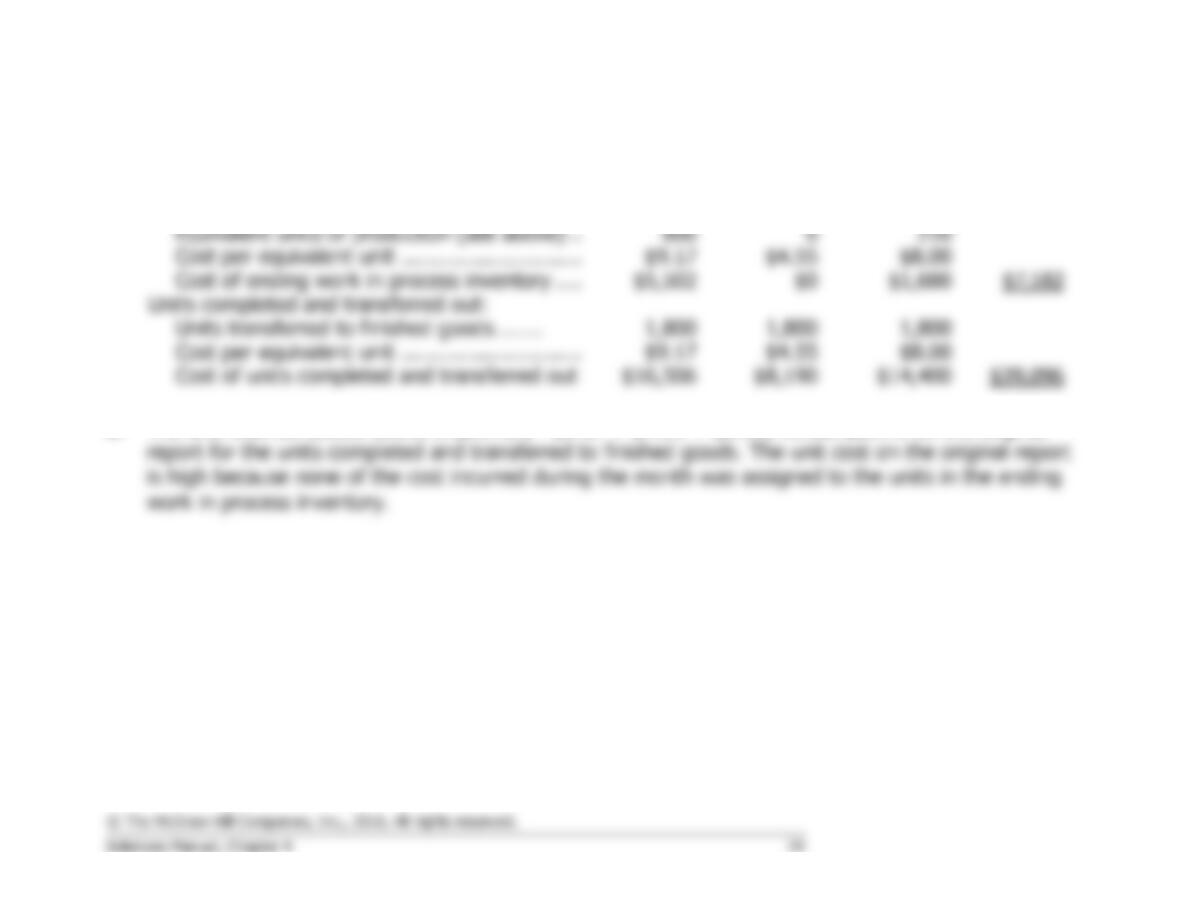
2. The unit cost computed above is $21.72 (= $9.17 + $4.55 + $8.00) versus $25.71 on the original
Ethics Challenge (90 minutes)
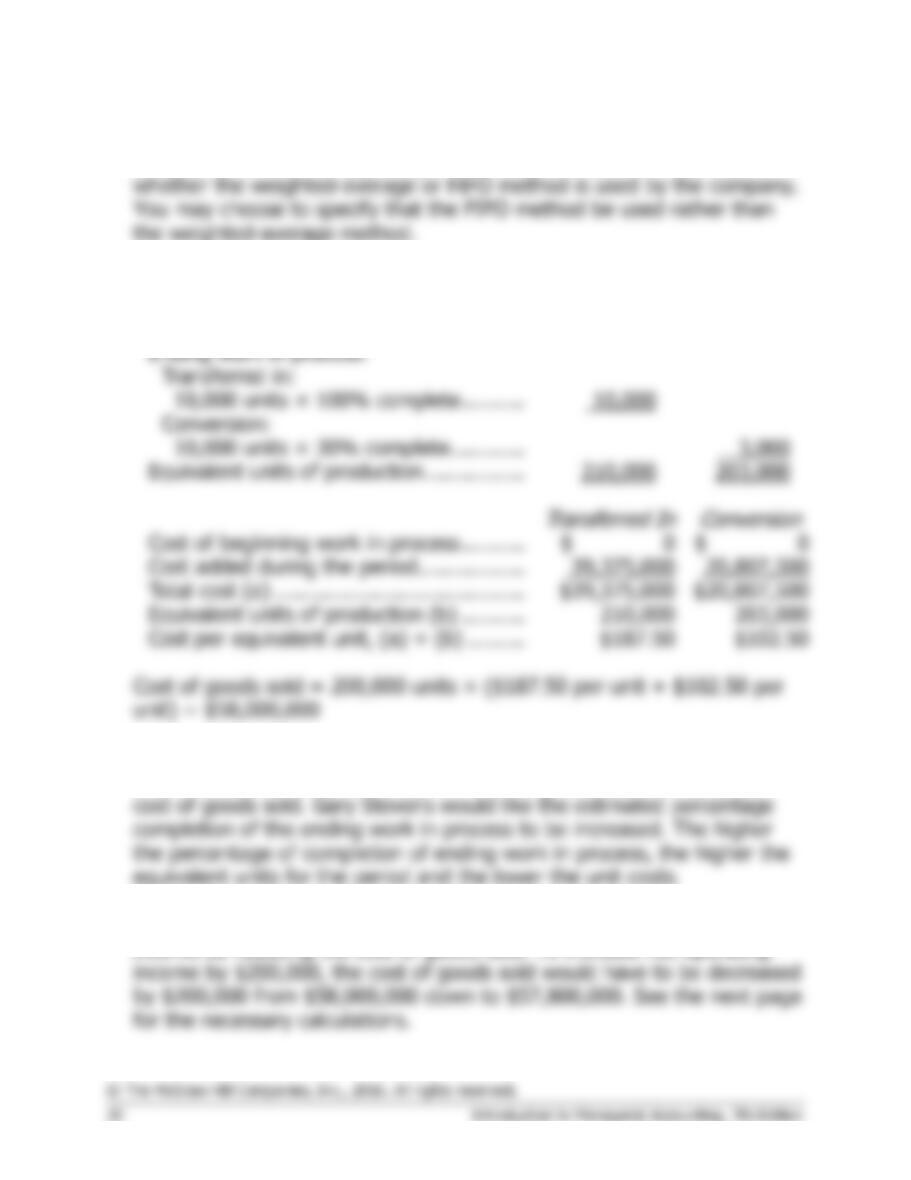
Because there are no beginning inventories, it makes no difference
1.
Computation of the Cost of Goods Sold:
Transferred In
Conversion
Units completed and sold …………………..
200,000
200,000
Ending work in process:
Equivalent units of production …………….
210,000
203,000
Transferred In
Conversion
Cost of beginning work in process ……….
Cost added during the period ……………..
Total cost (a) ………………………………….
Equivalent units of production (b) ……….
Cost per equivalent unit, (a) ÷ (b) ………
2. The estimate of the percentage completion of ending work in process
inventories affects the unit costs of finished goods and therefore the
3. Increasing the percentage of completion can increase net operating
income by reducing the cost of goods sold. To increase net operating
Ethics Challenge (continued)
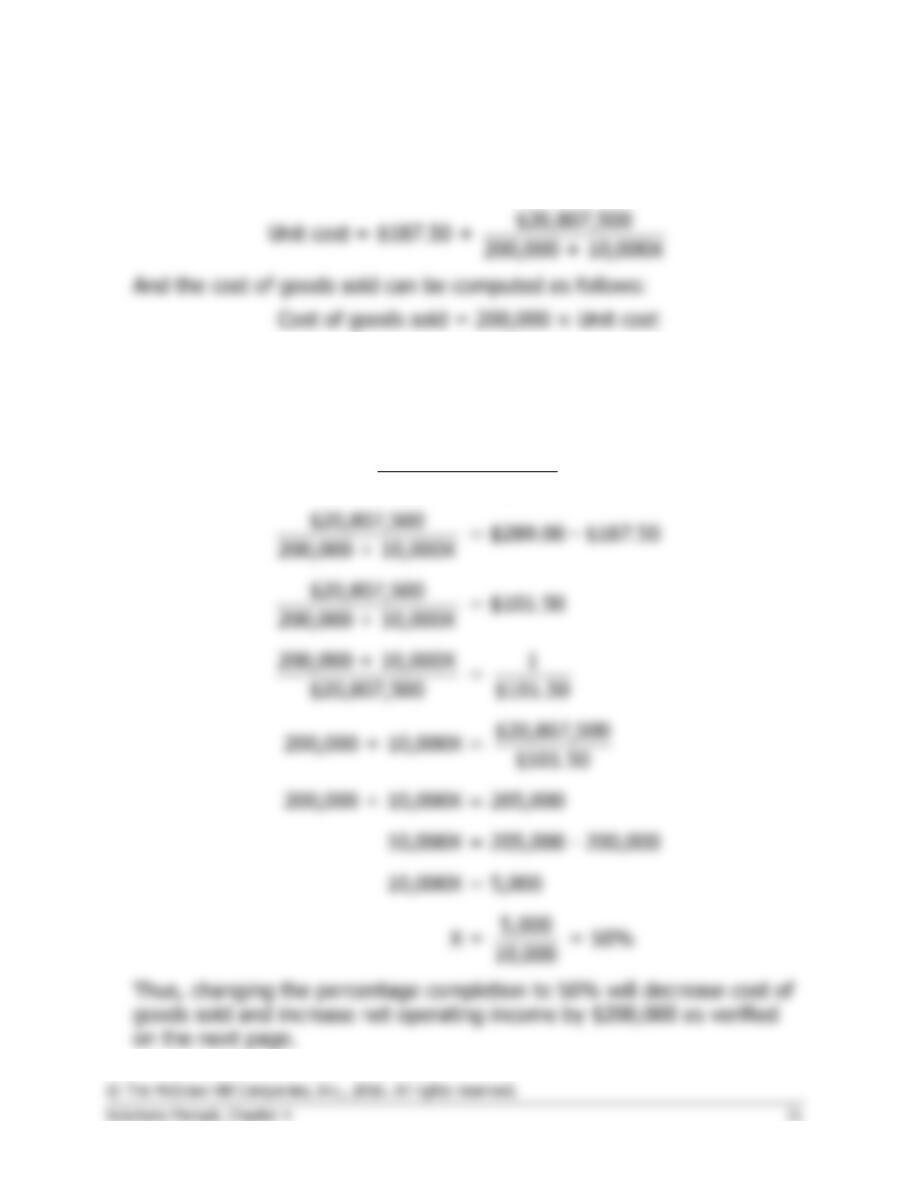
The percentage of completion, X, affects the cost of goods sold by its
effect on the unit cost, which can be determined as follows:
Because the cost of goods sold must be reduced down to $57,800,000,
the unit cost must be $289.00 ($57,800,000 ÷ 200,000 units). Thus, the
required percentage completion, X, to obtain the $200,000 reduction in
cost of goods sold can be found by solving the following equation:
$20,807,500
$187.50 + = $289.00
200,000 + 10,000X
Ethics Challenge (continued)
3. (continued)
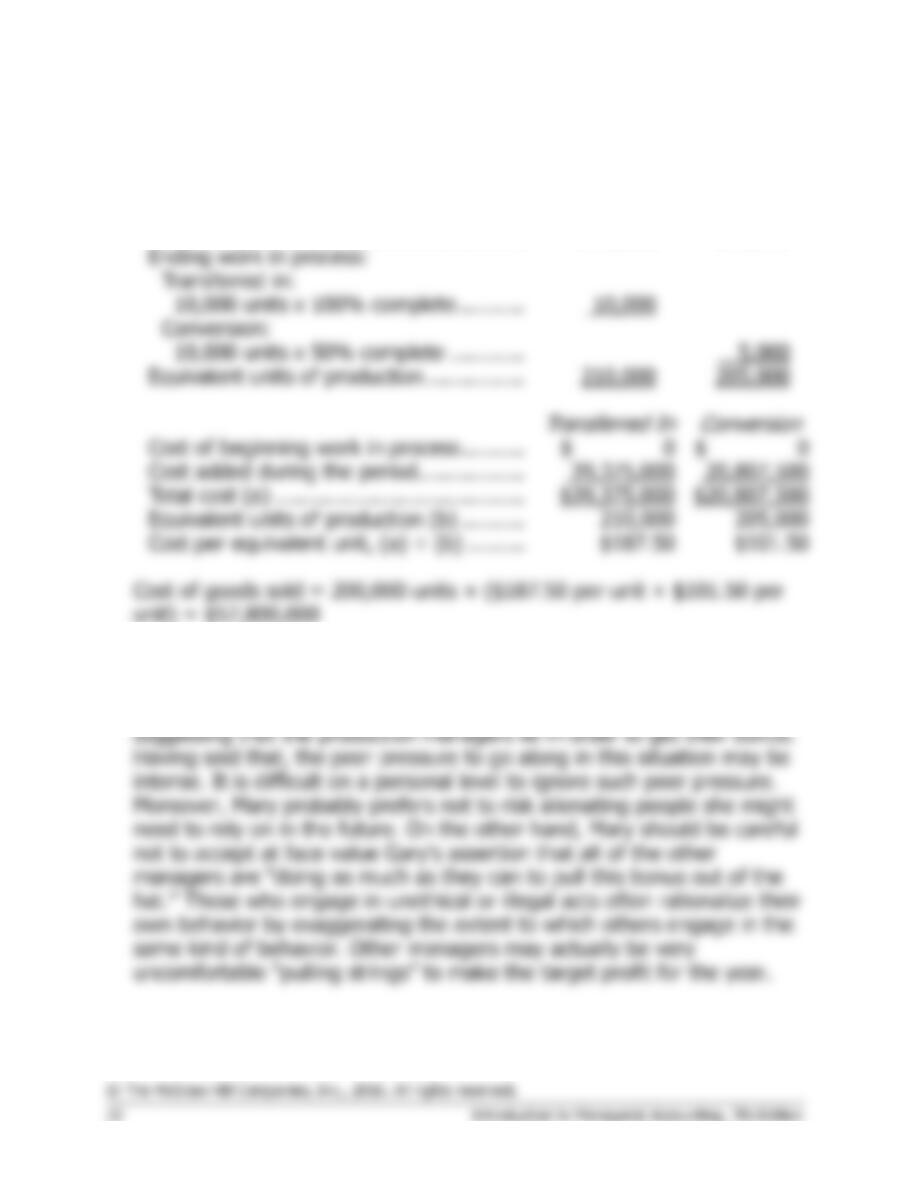
Computation of the Cost of Goods Sold:
Transferred In
Conversion
Units completed and sold …………………..
200,000
200,000
Ending work in process:
Equivalent units of production …………….
210,000
205,000
Transferred In
Conversion
Cost of beginning work in process ……….
Cost added during the period ……………..
Equivalent units of production (b) ……….
Cost per equivalent unit, (a) ÷ (b) ………
4. Mary is in a very difficult position. Collaborating with Gary Stevens in
subverting the integrity of the accounting system is unethical by almost
any standard. To put the situation in its starkest light, Stevens is
Ethics Challenge (continued)
From a broader perspective, if the net profit figures reported by the
managers in a division cannot be trusted, then the company would be
foolish to base bonuses on the net profit figures. A bonus system based
on divisional net profits presupposes the integrity of the accounting
system.
The company should perhaps reconsider how it determines the bonus. It
Chapter 4
Take Two Solutions
Exercise 4-2 (10 minutes)
Weighted-Average Method
Equivalent Units
Materials
Conversion
Units transferred out ………………….
190,000
190,000
Exercise 4-3 (10 minutes)
Weighted-Average Method
1.
Materials
Labor
Overhead
Cost added during the period ……..
Total cost (a) ………………………….
Equivalent units of production (b) .
Cost per equivalent unit (a) ÷ (b) .
Cost of beginning work in process
2.
Cost per equivalent unit for materials …..
$ 7.34
Cost per equivalent unit for labor ………..
Cost per equivalent unit for overhead …..
13.00
Exercise 4-4 (10 minutes)
Materials
Conversion
Total
Ending work in process inventory:
Equivalent units of production ……
2,000
800
Cost per equivalent unit ……………
Units completed and transferred out:
Cost per equivalent unit ……………
Cost of units transferred out ………
$278,586
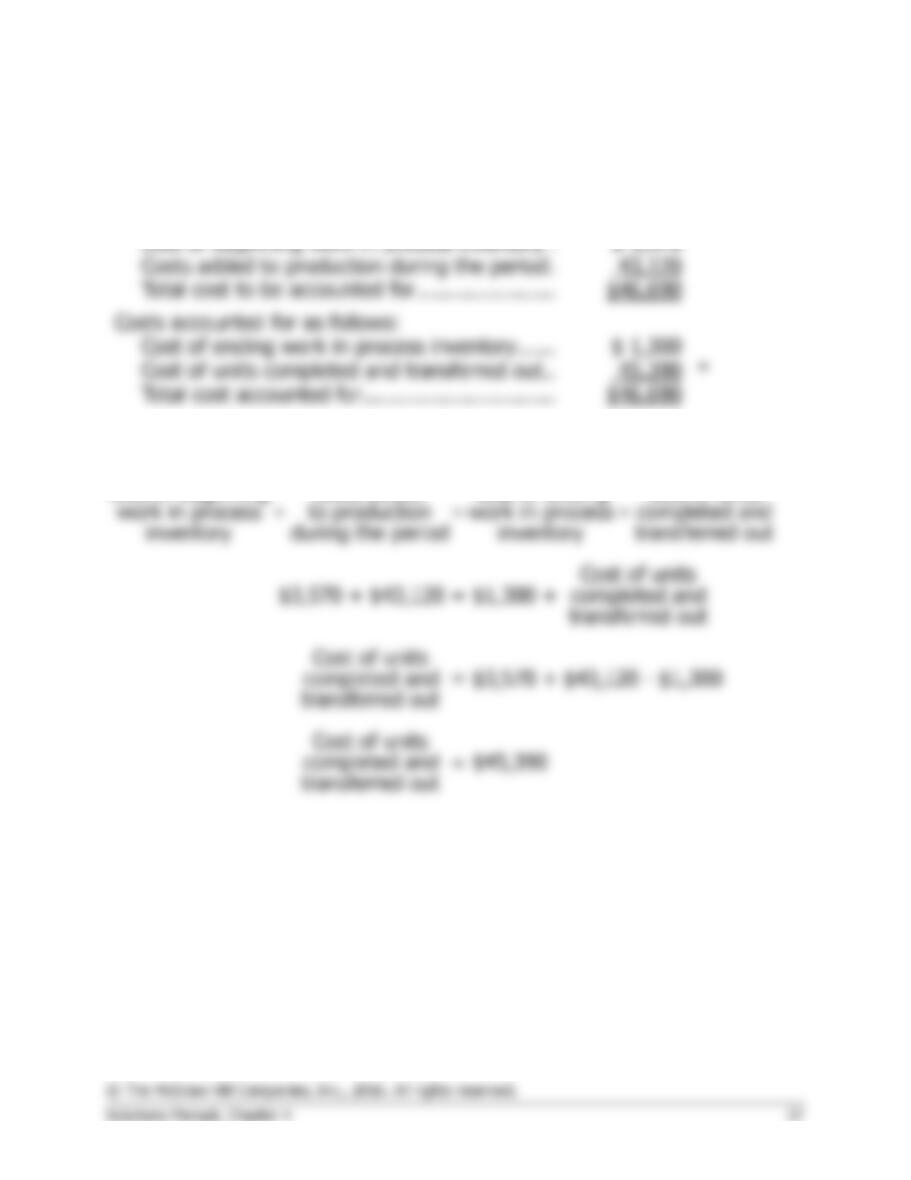
Exercise 4-5 (10 minutes)
Baking Department
Cost Reconciliation
Costs to be accounted for:
*
*The cost of units completed and transferred out can be deduced as
follows:
Cost of beginning Costs added Cost of ending Cost of units
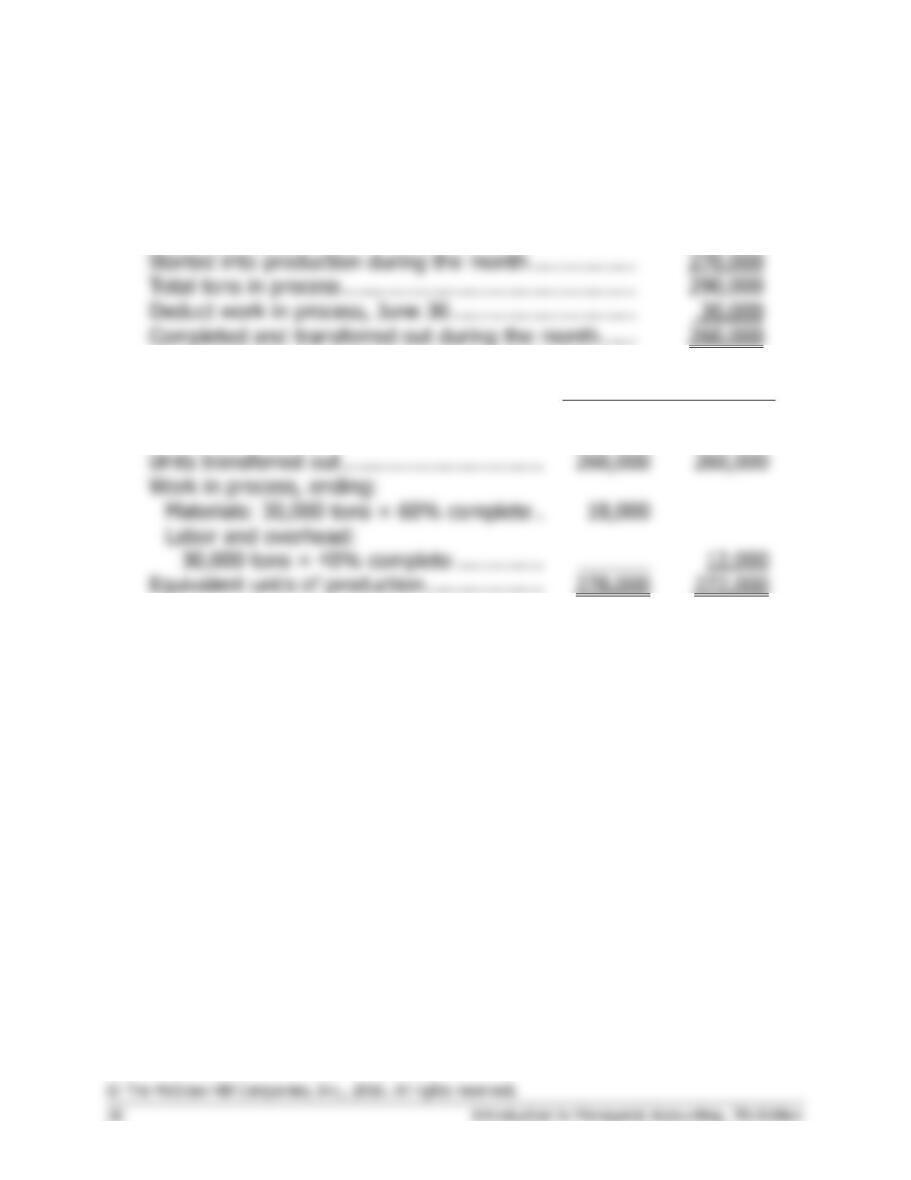
Exercise 4-6 (10 minutes)
Weighted-Average Method
1.
Tons of Pulp
Work in process, June 1 ……………………………………
20,000
Started into production during the month ……………..
Total tons in process ………………………………………..
Deduct work in process, June 30 …………………………
Completed and transferred out during the month ……
2.
Equivalent Units
Materials
Labor and
Overhead
Units transferred out …………………………..
Work in process, ending:
Equivalent units of production ……………….
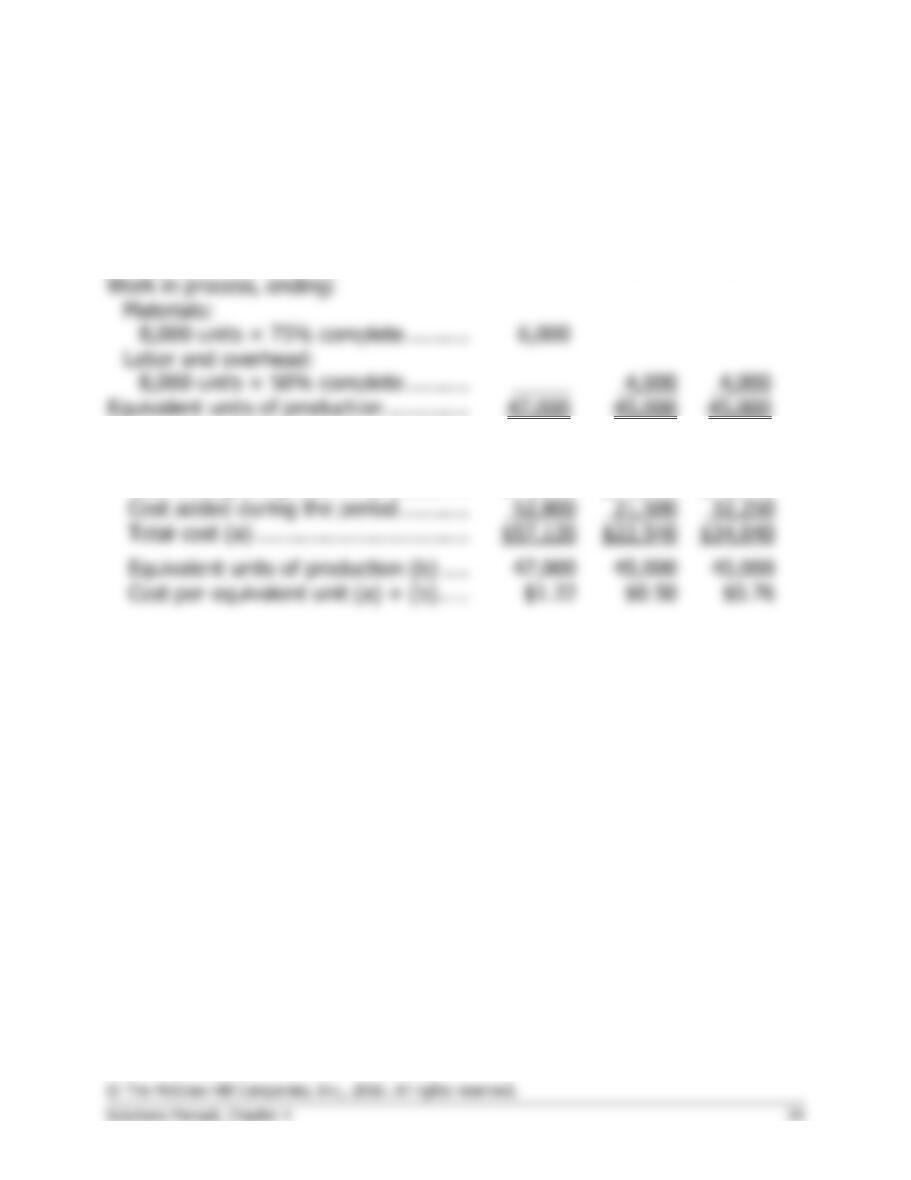
Exercise 4-9 (15 minutes)
Weighted-Average Method
1.
Materials
Labor
Overhead
Units transferred to the next
department ………………………………..
41,000
41,000
41,000
Work in process, ending:
Equivalent units of production ………….
2.
Materials
Labor
Overhead
Cost of beginning work in process ….
$ 4,320
$ 1,040
$ 1,790
Cost added during the period ………..
Total cost (a) …………………………….
$57,120
$22,540
$34,040
Equivalent units of production (b) ….
Cost per equivalent unit (a) ÷ (b) …..