CHAPTER 4
Income Statement and Related Information
ASSIGNMENT CLASSIFICATION TABLE (BY TOPIC)
Topics
Questions
Brief
Exercises
Exercises
Problems
Concepts
for Analysis
1.
Income measurement
concepts.
1, 2, 3, 4, 5,
6, 7, 8, 9, 10,
18, 22, 23, 30,
33, 34, 35
2, 3, 4, 6
2.
Computation of net
income from balance
sheets and selected
accounts.
1
1, 2, 3, 8
Single-step income
statements; earnings
per share.
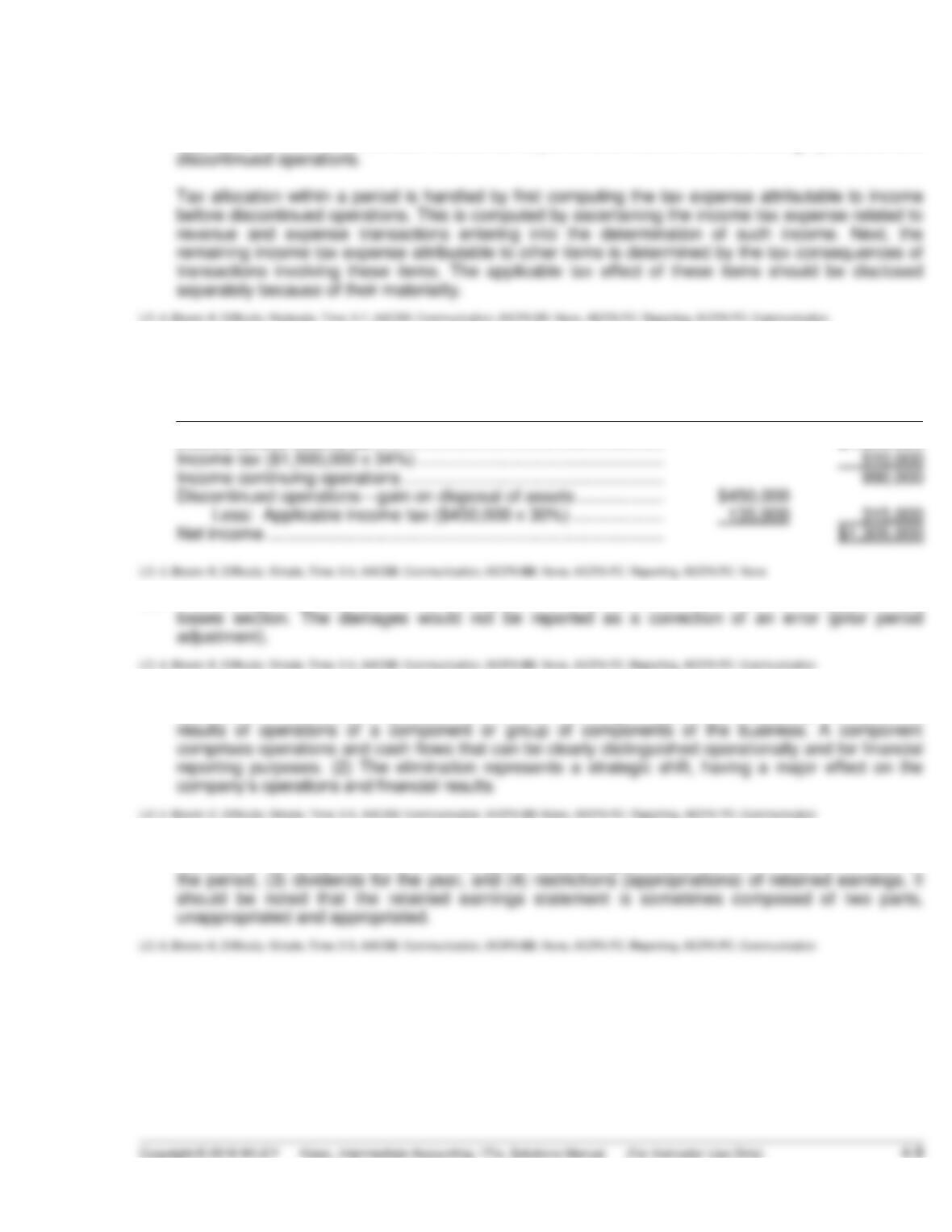
11, 19,
1, 2, 8
4, 5, 7, 8,
10, 11, 13,
2, 3, 4, 5
1, 5
statements.
12, 17,
19, 20
5, 6, 7, 9
1, 4
5.
Accounting changes;
discontinued
operations; prior
period adjustments;
errors.
13, 14, 15,
16, 22, 29,
31, 37
4, 5, 6, 7
6, 8, 10, 11,
13, 14
3, 5, 6, 7
1, 2, 4, 5, 6
Retained earnings
statement.
9, 10
1, 2, 4, 5, 6
Intraperiod tax
allocation.
21, 24, 27,
28, 29
14, 17
3, 5, 7
Comprehensive
income.
15, 16, 17
7
ASSIGNMENT CLASSIFICATION TABLE (BY LEARNING OBJECTIVE)
Learning Objectives
Questions
Brief
Exercises
Exercises
Problems
Concepts
for
Analysis
1. Identify the uses and
limitations
of an income statement.
1, 2, 6, 7,
9
2, 3
17, 18, 19,
20, 35, 37
11, 15, 17
4. Explain the reporting of
accounting changes and
errors.
14, 15, 16
6, 7, 10
14
3, 4, 5, 6, 7
2, 6
5. Describe related
statements.
3, 32, 34,
36, 37
9, 10, 11
9, 12, 15,
16, 17
1, 2, 4, 5, 6
ASSIGNMENT CHARACTERISTICS TABLE
Item
Description
Level of
Difficulty
Time
(minutes)
E4.1
Computation of net income.
Simple
18–20
E4.2
Compute income measures.
Simple
10–15
E4.3
Income statement items.
Simple
25–35
E4.4
Single-step income statement.
Moderate
20–25
E4.5
Multiple-step and single-step statements
Simple
30–35
E4.6
Multiple-step statement
Moderate
30–35
E4.7
Multiple-step and single-step statements
Moderate
30–40
E4.8
Income statement, EPS.
15–20
E4.9
Multiple-step statement with retained earnings statement
Simple
30–35
E4.10
Earnings per share.
Simple
20–25
E4.11
method.
20–25
E4.12
Retained earnings statement.
Simple
20–25
E4.13
Earnings per share.
Moderate
15–20
E4.14
Change in accounting principle.
Moderate
15–20
E4.15
Comprehensive income.
Simple
15–20
E4.16
Comprehensive income.
Moderate
15–20
E4.17
Various reporting formats.
Moderate
30–35
P4.1
Multiple-step statement, retained earnings statement
Moderate
30–35
P4.2
Single-step statement, retained earnings statement,
periodic inventory.
Simple
25–30
P4.3
Various income-related items.
Moderate
30–40
P4.4
Multiple- and single-step statements, retained earnings
statement.
45–55
P4.5
Unusual or infrequent items.
Moderate
20–25
P4.6
Retained earnings statement, prior period adjustment.
Moderate
25–35
P4.7
Income statement, irregular items.
Moderate
25–35
CA4.1
Identification of income statement deficiencies.
Simple
20–25
CA4.2
Earnings management.
Moderate
20–25
CA4.3
Earnings management.
Simple
15–20
CA4.4
Income reporting items.
Moderate
30–35
CA4.5
Identification of income statement weaknesses.
Moderate
30–40
CA4.6
Classification of income statement items.
Moderate
20–25
CA4.7
Comprehensive income.
Simple
10–15
ANSWERS TO QUESTIONS
1. The income statement is important because it provides investors and creditors with information
that helps them predict the amount, timing, and uncertainty of future cash flows. It helps investors
and creditors predict future cash flows in a number of different ways. First, investors and creditors can
use the information on the income statement to evaluate the past performance of the company.
2. Information on past transactions can be used to identify important trends that, if continued, provide
information about future performance. If a reasonable correlation exists between past and future
3. Some situations in which changes in value are not recorded in income are:
(a) Unrealized gains or losses on available-for-sale debt investments,
(b) Changes in the fair values of long-term liabilities, such as bonds payable,
4. Some situations in which application of different accounting methods or estimates lead to comparison
problems include:
(a) Inventory methods—LIFO vs. FIFO,
(b) Depreciation Methods—straight-line vs. accelerated,
Questions Chapter 4 (Continued)
5. The transaction approach focuses on the activities that have occurred during a given period and
instead of presenting only a net change, a description of the components that comprise the change
6. Earnings management is often defined as the planned timing of revenues, expenses, gains and
losses to smooth out bumps in earnings. In most cases, earnings management is used to increase
7. Earnings management has a negative effect on the quality of earnings if it distorts the information
in a way that is less useful for predicting future cash flows. Within the Conceptual Framework,
8. Caution should be exercised because many assumptions and estimates are made in accounting
and the net income figure is a reflection of these assumptions. If for any reason the assumptions are
9. The term “quality of earnings” refers to the credibility of the earnings number reported. Companies
that use aggressive accounting policies report higher income numbers in the short-run. In such
10. The major distinction between revenues and gains (or expenses and losses) depends on the
typical activities of the company. Revenues (expenses) can occur from a variety of different
11. The advantages of the single-step income statement are: (1) simplicity and conciseness, (2) probably
better understood by the layperson, (3) emphasis on total costs and expenses, and net income,
Questions Chapter 4 (Continued)
12. Operating items are the expenses and revenues which relate directly to the principal activity of the
company; they are the revenue and expenses which contribute to the sale of goods or services for
13. The current operating performance income statement contains only the revenues and usual
expenses of the current year, with all unusual gains or losses or material corrections of prior periods’
revenues and expenses appearing in the retained earnings statement. The modified all-inclusive
income statement includes most items including irregular ones, as part of net income. The retained
14. Items considered corrections of errors should be charged or credited to the opening balance of
15. (a) This transaction will be shown in the income statement in the “Other revenues and gains”
section.
(b) The bonus should be shown as an operating expense in the income statement. Although the
basis of computation is a percentage of net income, it is an ordinary operating expense to the
Questions Chapter 4 (Continued)
16. (a) The remaining book value of the equipment should be depreciated over the remainder of the
five-year period. The additional depreciation ($425,000) is not a correction of an error and is not
shown as an adjustment to retained earnings. The change is considered a change in estimate.
17. (a) Other expenses and losses section.
(b) Other expenses and losses section.
(c) Operating expense section, as a selling expense, but sometimes reflected as an administrative
18. Perlman and Sheehan should not report the sales in a similar manner. This type of transaction
appears to be typical of Perlman’s central operations. Therefore, Perlman should report revenues of
19. You should tell Greg that a company’s reported net income is the same whether the single-step or
20. Both formats are acceptable. The amount of detail reported in the income statement is left to the
judgment of the company whose goal in making this decision should be to present financial
statements which are most useful to decision makers. We want to present a simple, understand-
21. Intraperiod tax allocation should not affect the reporting of an unusual gain. The FASB specifically
prohibits a “net–of–tax” treatment for such items to ensure that users of financial statements can
Questions Chapter 4 (Continued)
22. (a) A loss on discontinued operations is reported net of tax in the income statement between
income from continuing operations and net income.
23. Lebron presents the income information as follows:
Net income
$ 124,700
the noncontrolling interest
24. Intraperiod tax allocation has no effect on reported net income, although it does affect the amounts
reported for various components of income. The effects on these components offset each other so
25. If Neumann has preferred stock outstanding, the numerator in its computation may be incorrect.
A better description of “earnings per share” is “earnings per common share.” The numerator should
include only the earnings available to common shareholders. Therefore, the numerator should be
26. The earnings per share trend is not favorable. Discontinued items are often one-time occurrences
which are not expected to be reported in the future. Therefore, earnings per share on income from
27. Tax allocation within a period is the practice of allocating the income tax for a period to such items
as income from continuing operations, discontinued items, and prior period adjustments.
Questions Chapter 4 (Continued)
28. Tax allocation within a period (intraperiod) becomes necessary when a firm encounters such items
as discontinued operations, or corrections of errors. Such allocation is necessary to bring about an
appropriate relationship between income tax expense and income from continuing operations and
29.
LISELOTTE COMPANY
Partial Income Statement
For the Year Ended December 31, 2020
Income before income tax …………………………………………………..
$1,500,000
Income tax ($1,500,000 x 34%) ……………………………………………
510,000
Income continuing operations ………………………………………………
Less: Applicable income tax ($450,000 x 30%) ……………….
315,000
30. The damages are reported in Frazier Corporation’s financial statements in the other expenses and
31. No, these sales would not be reported as discontinued operations after income from continuing
operations. A discontinued operation occurs when two things happen: (1) A company eliminates the
32. The major items reported in the retained earnings statement are: (1) adjustments of the beginning
balance for corrections of errors or changes in accounting principle, (2) the net income or loss for
Questions Chapter 4 (Continued)
33. Generally accepted accounting principles are ordinarily concerned only with a “fair presentation” of
business income. In contrast, taxable income is a statutory concept which defines the base for
raising tax revenues by the government, and any method of accounting which meets the statutory
definition will “clearly reflect” taxable income as defined by the Internal Revenue Code. It should
34. From the revenue side, there are many types of revenue transactions which require estimation.
For example, it is difficult to estimate the amount of revenue to recognize for a long–term contract
in a given period. Other estimation situations also prevalent such as high rates of return on
products sold, net versus gross sales issues, sales with buyback options, estimating revenues in
licensing arrangements and so on. During a single fiscal period it often is difficult to determine the
Questions Chapter 4 (Continued)
35. Elements are the basic ingredients which comprise the income statement; that is, revenues, gains,
expenses, and losses. Items are descriptions of the elements such as rent revenue, rent expense, etc.
In order to predict the future, the amounts of individual items may have to be reported. For example,
36. Other comprehensive income must be displayed (reported) in one of two ways: (1) a single
37. The results of continuing operations should be reported separately from discontinued operations,
and any gain or loss from disposal of a component of a business should be reported with the
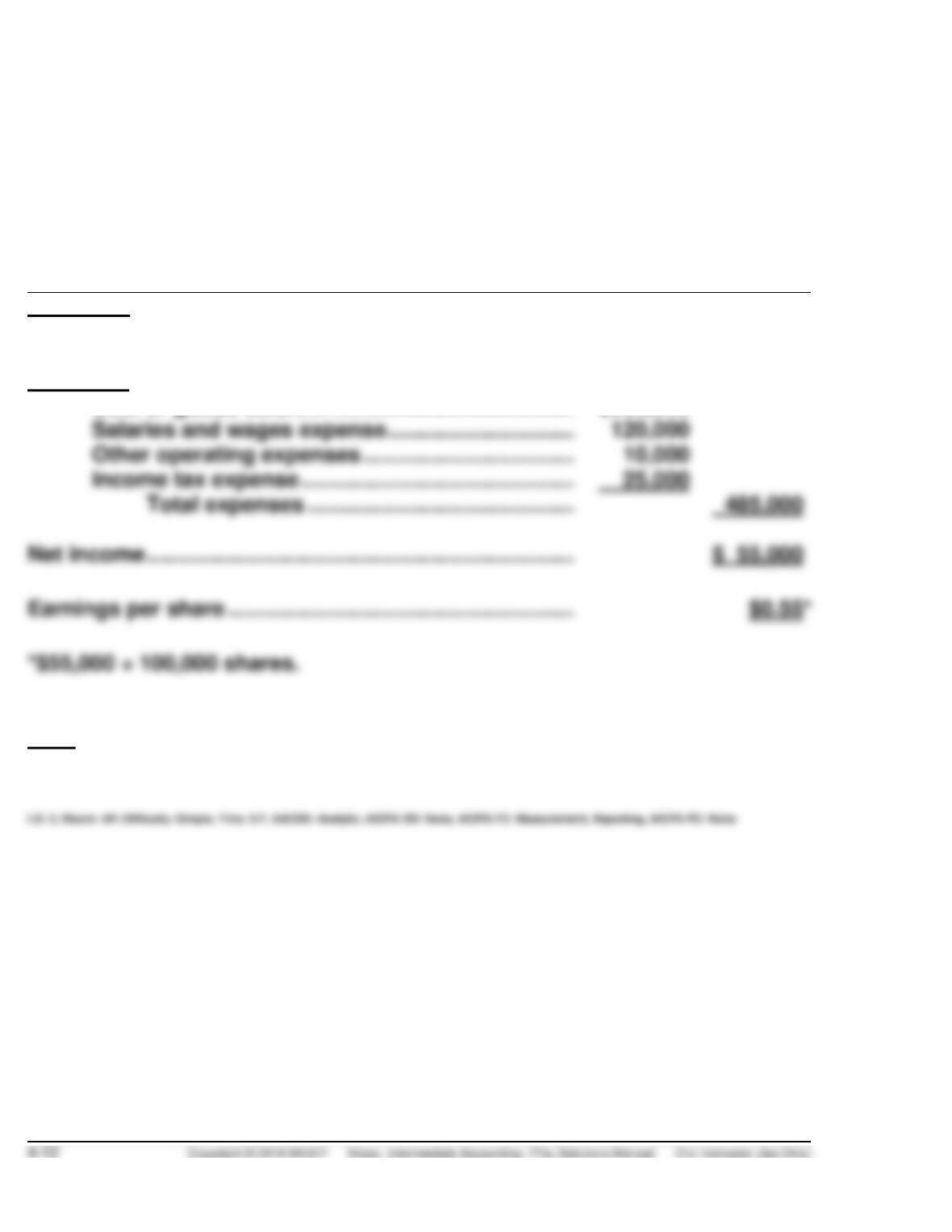
related results of discontinued operations. The following format illustrates the proper disclosure:
Income from continuing operations before income tax ………………………….
$XXX
Income tax……………………………………………………………………………………
Income from continuing operations ……………………………………………………
Discontinued operations
Gain (loss) on disposal of Division X
SOLUTIONS TO BRIEF EXERCISES
BRIEF EXERCISE 4.1
STARR CO.
Income Statement
For the Year 2020
Revenues
Sales revenue ………………………………………………….
$540,000
Expenses
Cost of goods sold…………………………………………..
$330,000
Salaries and wages expense …………………………..
Other operating expenses ………………………………..
Income tax expense …………………………………………
25,000
Total expenses ………………………………………..
Note: The increase in value of the company reputation and the unrealized
gain on the value of patents are not reported.
BRIEF EXERCISE 4.2
BRISKY CORPORATION
Income Statement
For the Year Ended December 31, 2020
Revenues
Net sales ……………………………………………………….
$2,400,000
Interest revenue ……………………………………………..
Total revenues…………………………………………
Expenses
Cost of goods sold …………………………………………
Selling expenses …………………………………………….
Administrative expenses …………………………..
Interest expense …………………………………………….
Income tax expense* ………………………………………
Total expenses ……………………………………….
Net income ……………………………………………………….
$ 310,800
Earnings per share** ………………………………………………..
$4.44
BRIEF EXERCISE 4.3
BRISKY CORPORATION
Income Statement
For the Year Ended December 31, 2020
Net sales ……………………………………………………….
$2,400,000
Cost of goods sold ………………………………………….
1,450,000
Gross profit …………………………………………..
950,000
Selling expenses …………………………………………….
$280,000
Administrative expenses …………………………………
Income from operations …………………………………..
458,000
Other revenue and gains
Interest revenue …………………………………….
Other expenses and losses
Interest expense …………………………………….
45,000
Income before income tax ……………………………….
Income tax expense ($444,000 x 30%) ………………
133,200
BRIEF EXERCISE 4.4
Income from continuing operations ……………………..
$10,600,000
Discontinued operations
Loss from operation of discontinued
restaurant division net of tax …………………..
$315,000
Net income ……………………………………………………….
$10,096,000
Earnings per share ……………………………………………..
Income from continuing operations …………….
Discontinued operations, net of tax ……………..
BRIEF EXERCISE 4.5
Income from operations ………………………………………
$7,200,000
Other Revenues and Gains
Interest revenue ………………………………………….
17,000
Other Expenses and Losses
Loss due to volcano eruption ………………………
Impairment loss – building …………………………...
Income before income tax …………………………………..
Income tax ($6,394,000 X .30) ……………………
Net income ………………………………………………………….
$4,475,800
Per share of common stock:
Net income ($4,475,800 ÷ 5,000,000) ……………..
BRIEF EXERCISE 4.6
2020
2019
2018
Income before income tax
$180,000
$145,000
$170,000
Income tax (30%)
Net Income
BRIEF EXERCISE 4.7
Vandross would not report any cumulative effect because a change in estimate
BRIEF EXERCISE 4.8
BRIEF EXERCISE 4.9
PORTMAN CORPORATION
Retained Earnings Statement
For the Year Ended December 31, 2020
Retained earnings, January 1 …………………………………….
$ 675,000
BRIEF EXERCISE 4.10
PORTMAN CORPORATION
Retained Earnings Statement
For the Year Ended December 31, 2020
Retained earnings, January 1, as reported …………………….
$ 675,000
Correction for overstatement of expenses in
BRIEF EXERCISE 4.11
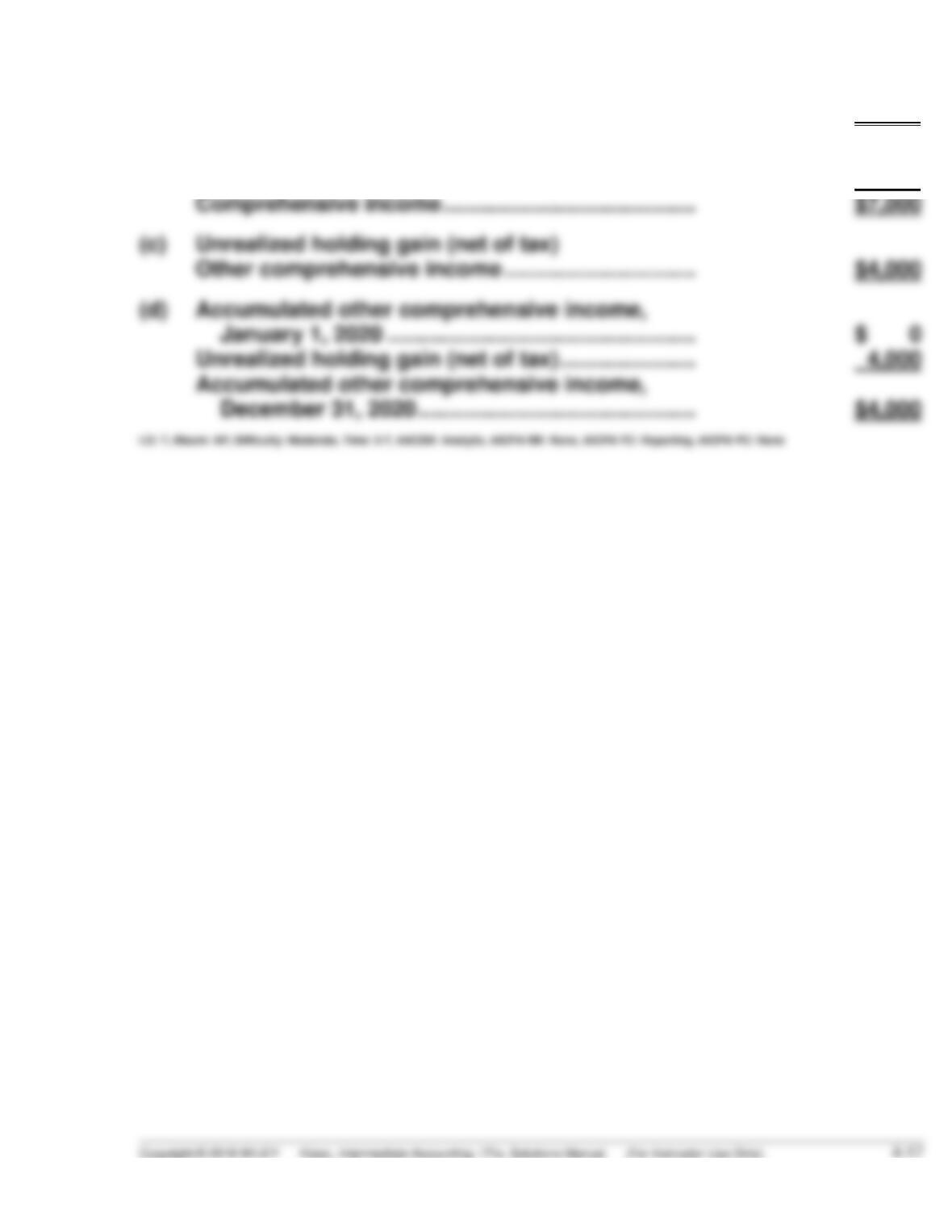
(a) Net income (Interest revenue) ………………………….
$3,000
(b) Net income ……………………………………………………..
$3,000
Unrealized holding gain (net of tax) ………………….
4,000
Comprehensive income …………………………………..
Unrealized holding gain (net of tax) ………………….
SOLUTIONS TO EXERCISES
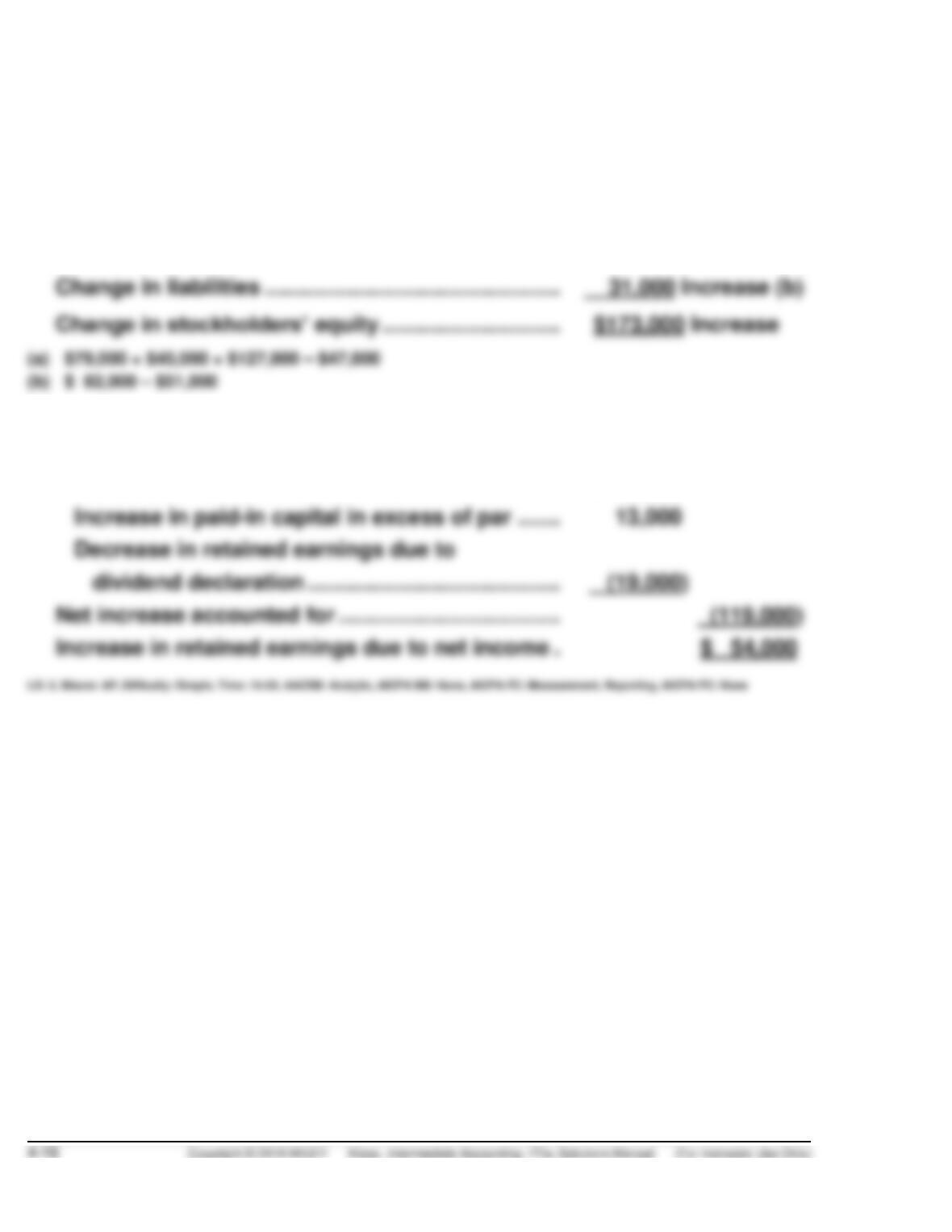
EXERCISE 4.1 (18–20 minutes)
Computation of net income
Change in assets …………………………………………….
$204,000 Increase (a)
Change in stockholders’ equity accounted for as follows:
Net increase ……………………………………………………
$ 173,000
Increase in common stock …………………………….
$125,000
Increase in paid-in capital in excess of par …….
dividend declaration …………………………..………
(19,000)
Net increase accounted for ………………………………
EXERCISE 4.2 (10–15 minutes)
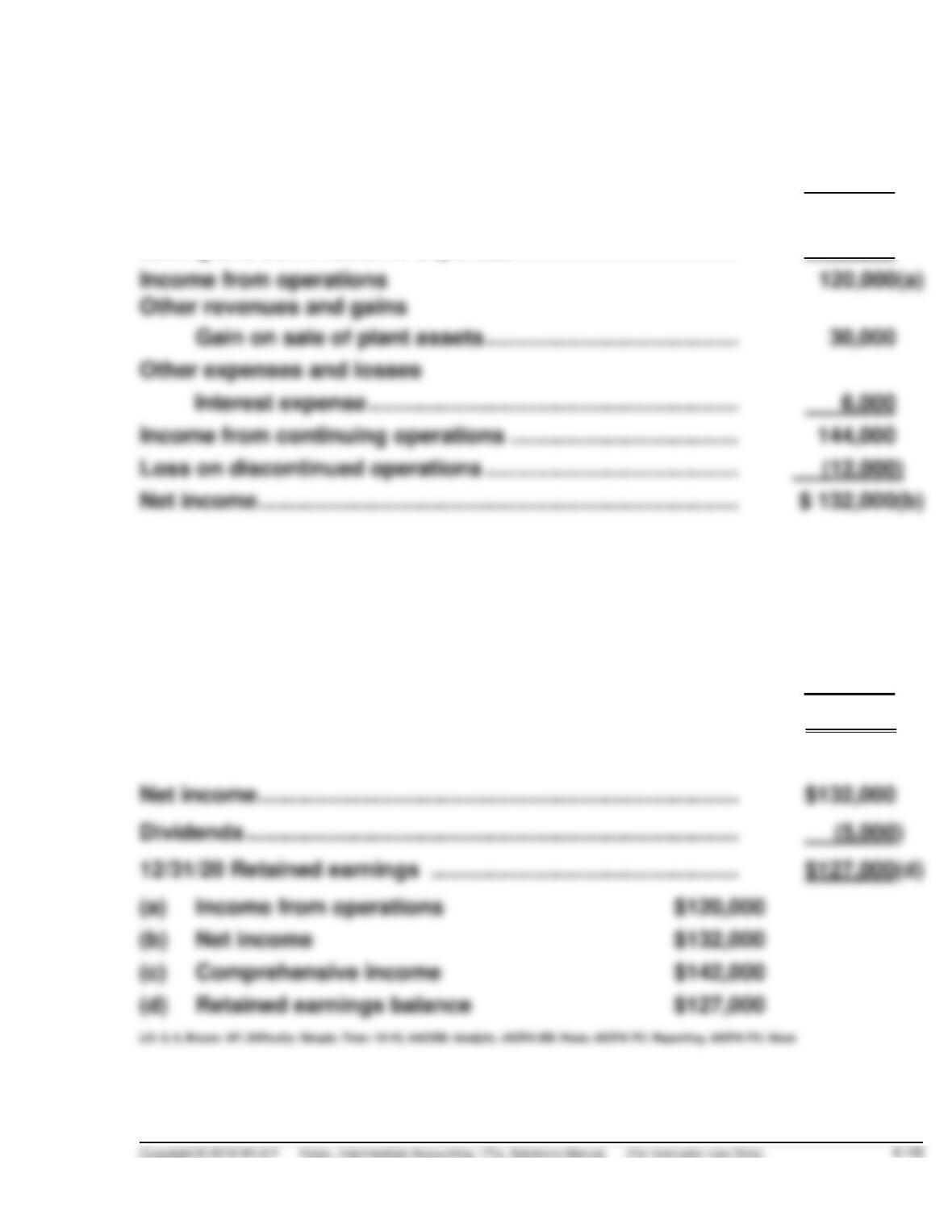
Sales revenue ……………………………………………………………….
$310,000
Cost of goods sold ………………………………………………………..
140,000
Gross profit …………………………………………………………………..
170,000
Selling and administrative expenses ………………………………
50,000
Income from operations
Gain on sale of plant assets …………………………………..
30,000
Interest expense ……………………………………………………
6,000
Income from continuing operations ……………………………….
144,000
Loss on discontinued operations …………………………………..
Net income ……………………………………………………………………
Net income ……………………………………………………………………
$132,000
Unrealized gain on available-for-sale debt investments …..
10,000
Comprehensive income …………………………………………………
$142,000(c)
Net income ……………………………………………………………………
$132,000
Dividends …………………………..…………………………………………
$127,000(d)
EXERCISE 4.3 (25–35 minutes)
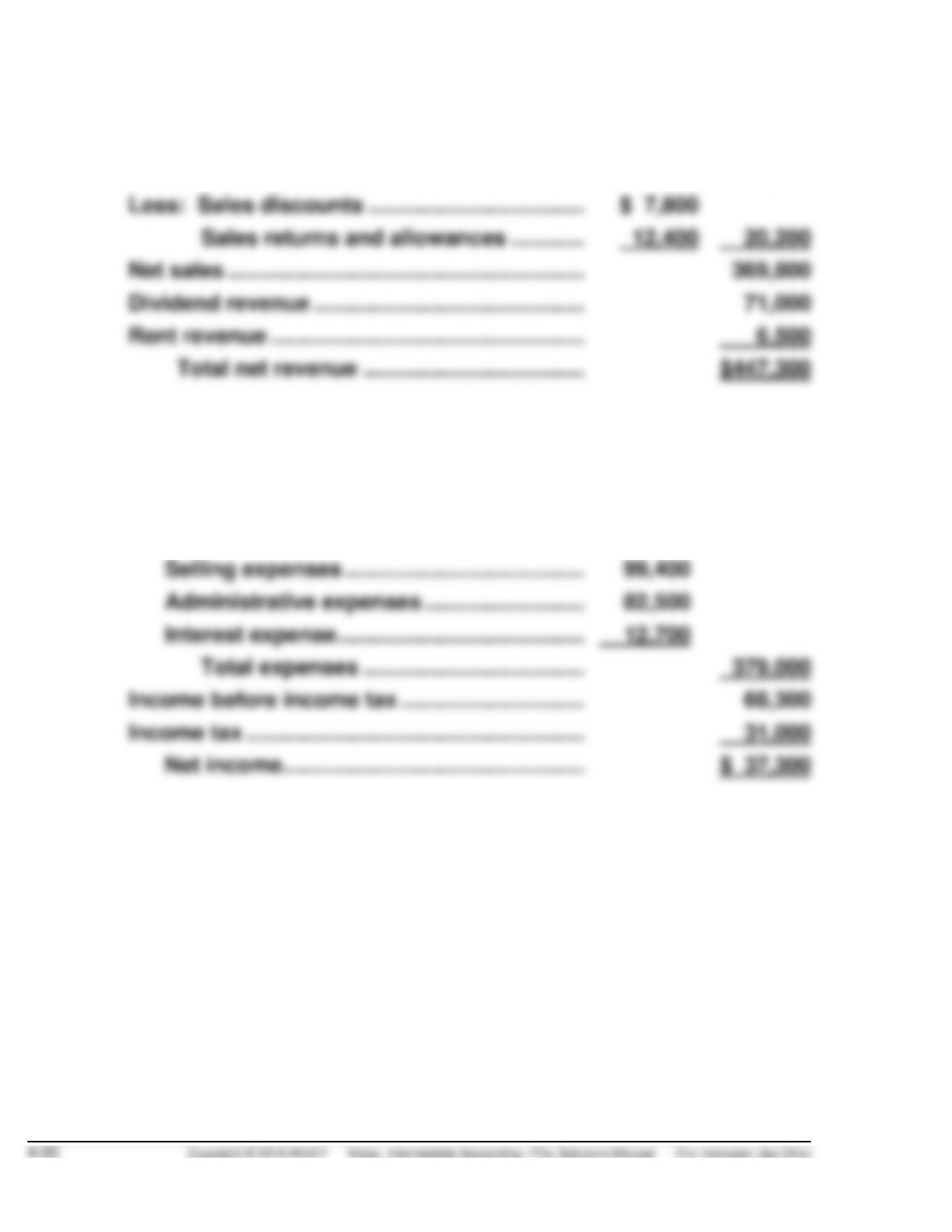
(a)
Total net revenue:
Sales revenue ……………………………………………
$390,000
Less: Sales discounts ………………………………
Sales returns and allowances ………….
20,200
Net sales …………………………………………………..
Dividend revenue ………………………………………
Rent revenue …………………………………………….
6,500
(b)
Net income:
Total net revenue (from a) ………………………….
$447,300
Expenses:
Cost of goods sold ……………………………….
$184,400
Selling expenses ………………………………….
Administrative expenses ………………………
Total expenses ……………………………….
Income before income tax ………………………….
Income tax ………………………………………………..
31,000