
Chapter 6
Reporting and Analyzing
Cash and Internal Controls
QUESTIONS
1. The seven broad principles are: Establish responsibilities; Maintain adequate records;
Insure assets and bond key employees; Separate recordkeeping from custody of assets;
Divide responsibilities for related transactions; Apply technology controls; Perform
regular and independent reviews.
2. Internal control procedures become especially critical when the manager of a business
can no longer control the business through personal supervision and direct
participation.
3. Responsibility for related transactions should be divided so that the work of one
department or individual acts as a check on that of another.
4. Separation of custody from recordkeeping of an asset encourages the asset custodian to
avoid misplacing, misappropriating, or wasting the asset. This arrangement makes
collusion necessary if an asset is to be stolen and the theft concealed in the records.
5. If individual departments were permitted to deal directly with suppliers, the amount of
merchandise purchased and the resulting liabilities would not be well controlled. Having
individual departments place orders through a purchasing department helps control the
amounts purchased and the resulting liabilities.
6. The limitations of internal control arise from two sources: the human element (human
error or human fraud) and the cost-benefit principle.
7. Cash is most liquid; and least liquid is a building. The four assets ordered from most to
least liquid are: cash, accounts receivable, inventory, and building.
8. A petty cash receipt is a document stating that a payment has been made from petty
cash. The one who received payment and the one who approved payment both sign the
receipt.
9. Depositing all receipts on the day of receipt (1) creates an independent record of the
amount of cash received and (2) helps prevent an employee from having personal use of
the money for a period of time before depositing it.
10. During the year ended September 27, 2014, cash (and equivalents) of $22,579
million is used by investing activities. Cash (and equivalents) of $37,549 million is used
by financing activities.

11. Google’s net income for 2014 was $14,444 million. Further, it reported a net decrease in
cash (and equivalents) of $551 million. These two figures are different because (1) net
income is computed on the accrual basis, and includes the effects of several noncash
transactions, and (2) some transactions affect cash but not net income. For instance, the
purchase of property, plant, and equipment as part of assets reduces cash, but does not
affect income, except through annual depreciation over the life of the asset.
12. Samsung’s cash (liquid assets) at December 31, 2014, equals ₩16,840,766 (all in KRW
millions). It is the fourth largest current asset and makes up about 14.6% of its current
assets.
Its cash (liquid assets) increased from ₩16,284,780 at December 31, 2013, to
₩16,840,766 at December 31, 2014 (all in KRW millions). As a percent of total current
assets, its cash balance decreased from about 14.7% to about 14.6%.
13. Samsung’s cash and equivalents increased by ₩555,986 million during 2014;
specifically, from ₩16,284,780 to ₩16,840,766 (all in KRW millions). Its statement of cash
flows identifies the three major sources and uses of its cash flows: (1) ₩36,975,389
million from operating activities; (2) ₩32,806,408 million used in investing activities; and
(3) ₩3,057,109 used by financing activities.
QUICK STUDIES
Quick Study 6-1 (10 minutes)
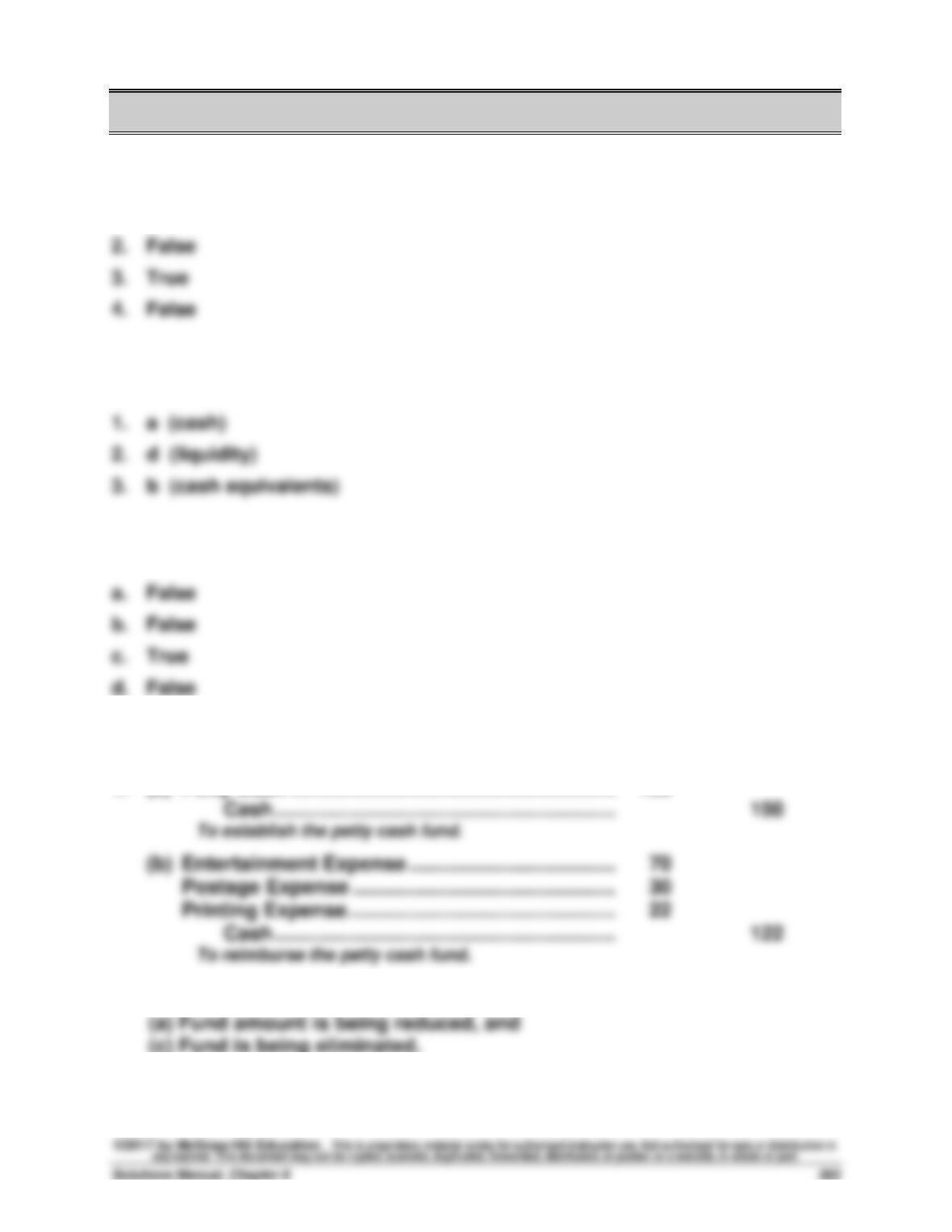
1. True
Quick Study 6-2 (10 minutes)
Quick Study 6-3 (10 minutes)
Quick Study 6-4 (10 minutes)
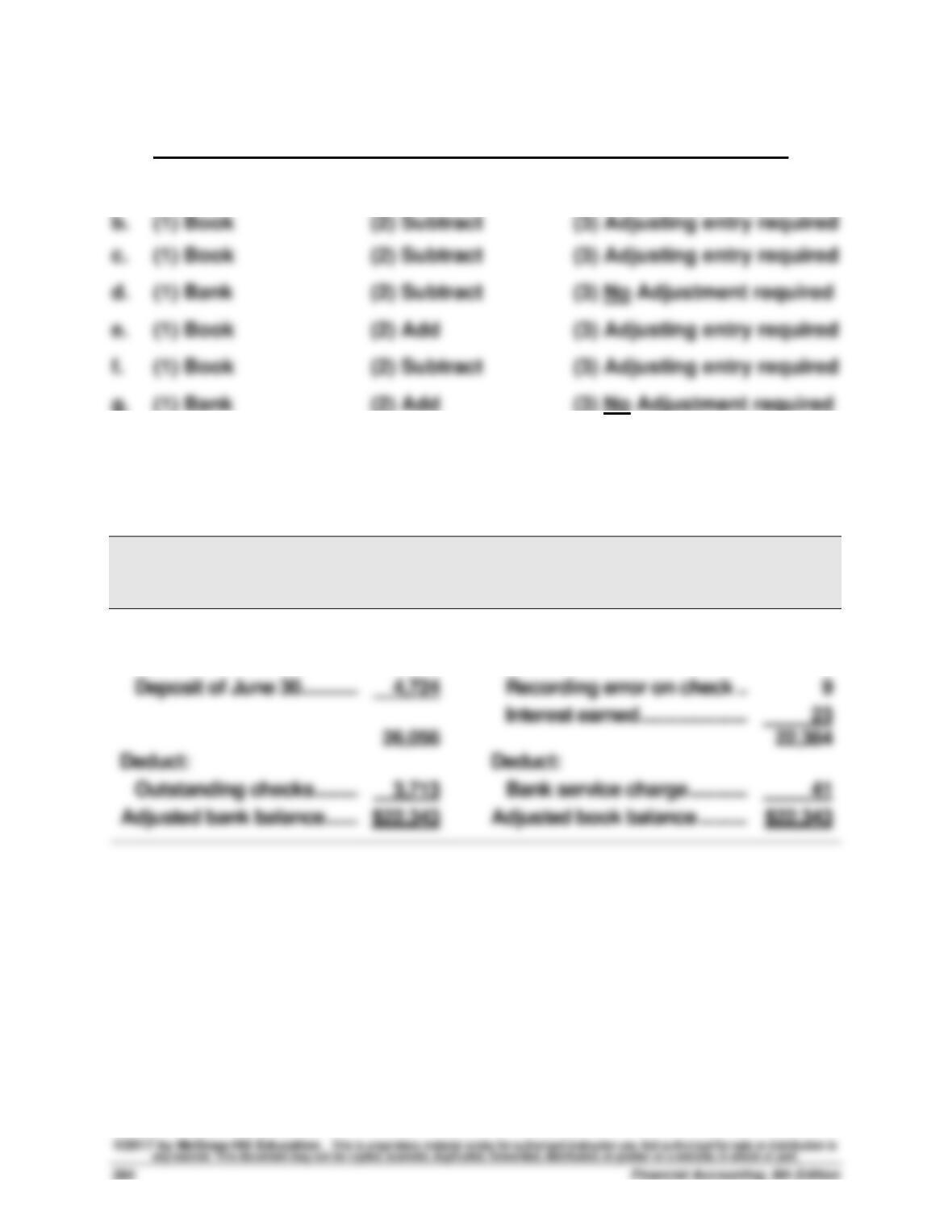
1. (a) Petty Cash …………………………………………………. 150
2. Answers: a and c. The Petty Cash account is credited when:
Quick Study 6-5 (15 minutes)
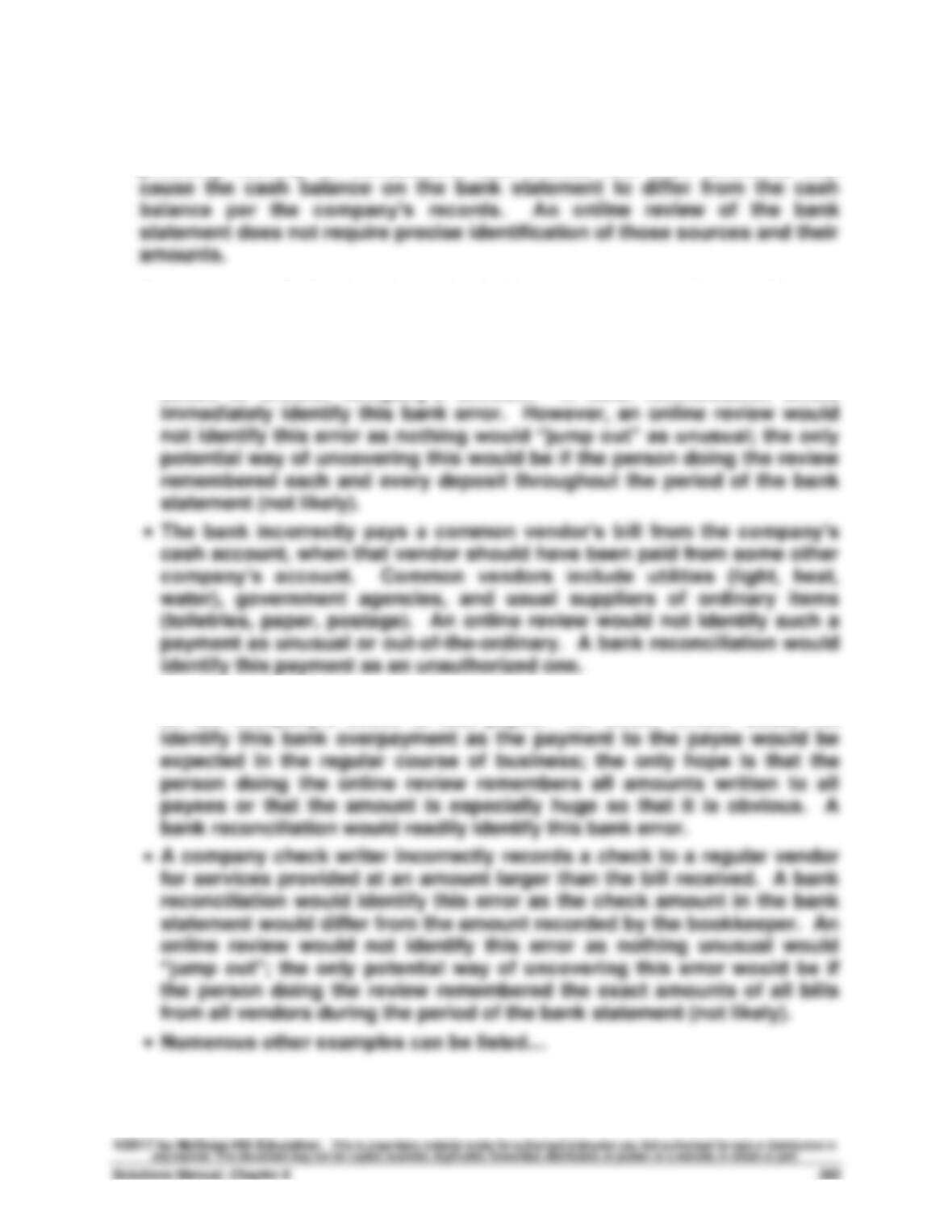
Bank or Book Side Add or Subtract Adjusting Entry or Not
a. (1) Book (2) Add (3) Adjusting entry required
Quick Study 6-6 (25 minutes)
NOLAN COMPANY
Bank Reconciliation
June 30, 2016
Bank statement balance…..
$21,332
Book balance …………………………..
$22,352
Add:
Add:
Deduct:
Deduct:
Quick Study 6-7 (15 minutes)
a. A bank reconciliation is a formal review process that requires the person to
precisely identify all transactions and events, and their amounts, that
b. A bank reconciliation has the potential to uncover several kinds of frauds
or errors that an online review is unlikely to reveal. Those include the
following:
• A company makes a deposit to its account but that deposit is incorrectly
added to another company’s account. A bank reconciliation would
• The bank incorrectly pays a larger amount to a payee than what is written
on the company’s check to that payee. An online review would not
Quick Study 6-8 (15 minutes)
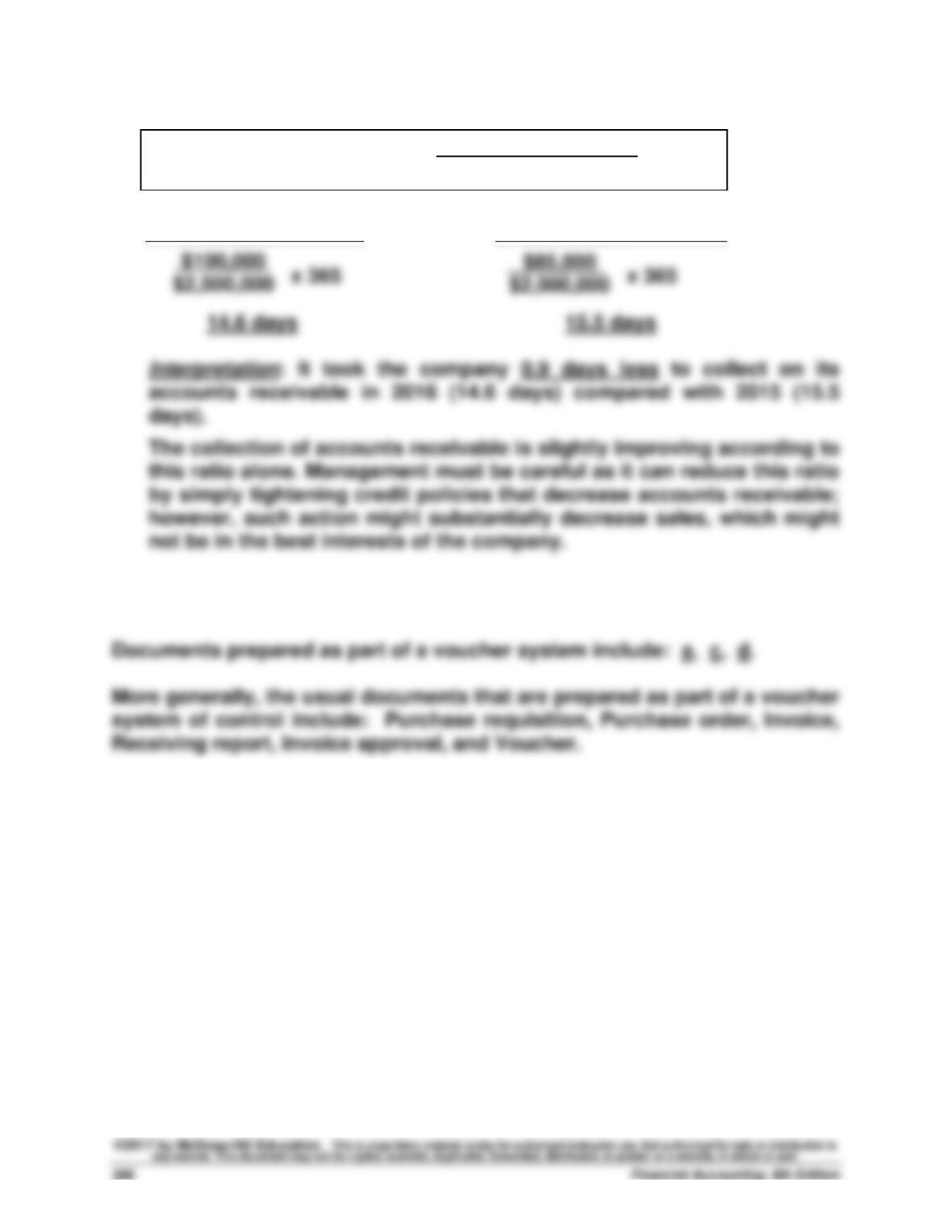
Days’ sales uncollected = x 365
2016 2015
Quick Study 6-9A (10 minutes)
Accounts receivable
Net sales
Quick Study 6-10 (10 minutes)
a. The purposes and principles of internal control systems are
b. Internal controls for cash are fundamentally the same worldwide.
EXERCISES
Exercise 6-1 (10 minutes)
Evaluation
The company’s internal control system failed to require separation of asset
custody from asset recordkeeping.
Principles Ignored
Exercise 6-2 (15 minutes)
1. A cash register (with a locked record) should be used at the sales
stand—it should also be anchored to the stand. If a cash register
2. The employee should sign a receipt for the total amount of cash he or
she is given each weekend. Each time the employee makes a
Exercise 6-3 (10 minutes)
1. A liquid asset refers to an asset that can be readily converted into
another type of asset or be used to satisfy an obligation. A cash
2. Companies usually invest idle cash in cash equivalents to earn a higher
return on these assets.
3. Effective cash management applies the following five principles:
a. Encourages collection of receivables.
Exercise 6-4 (15 minutes)
(a) Internal Control Problems
(1) A major internal control problem is that the recordkeeper (who has
(2) The recordkeeper might also delay recording a cash receipt from a
(b) Internal Control Recommendations
(1) If only one person is present when the mail is opened, that person may
steal cash and claim it was never received. If possible, two people
Exercise 6-5 (20 minutes)
1.
Sept. 9
Petty Cash ………………………………………………………
350
2.
Sept. 30
Merchandise Inventory* …………………………………..
40
Postage Expenses …………………………………………..
123
Miscellaneous Expenses …………………………..…….
80
Cash Short and Over ……………………………………….
3.
Oct. 1
Petty Cash ………………………………………………………
50
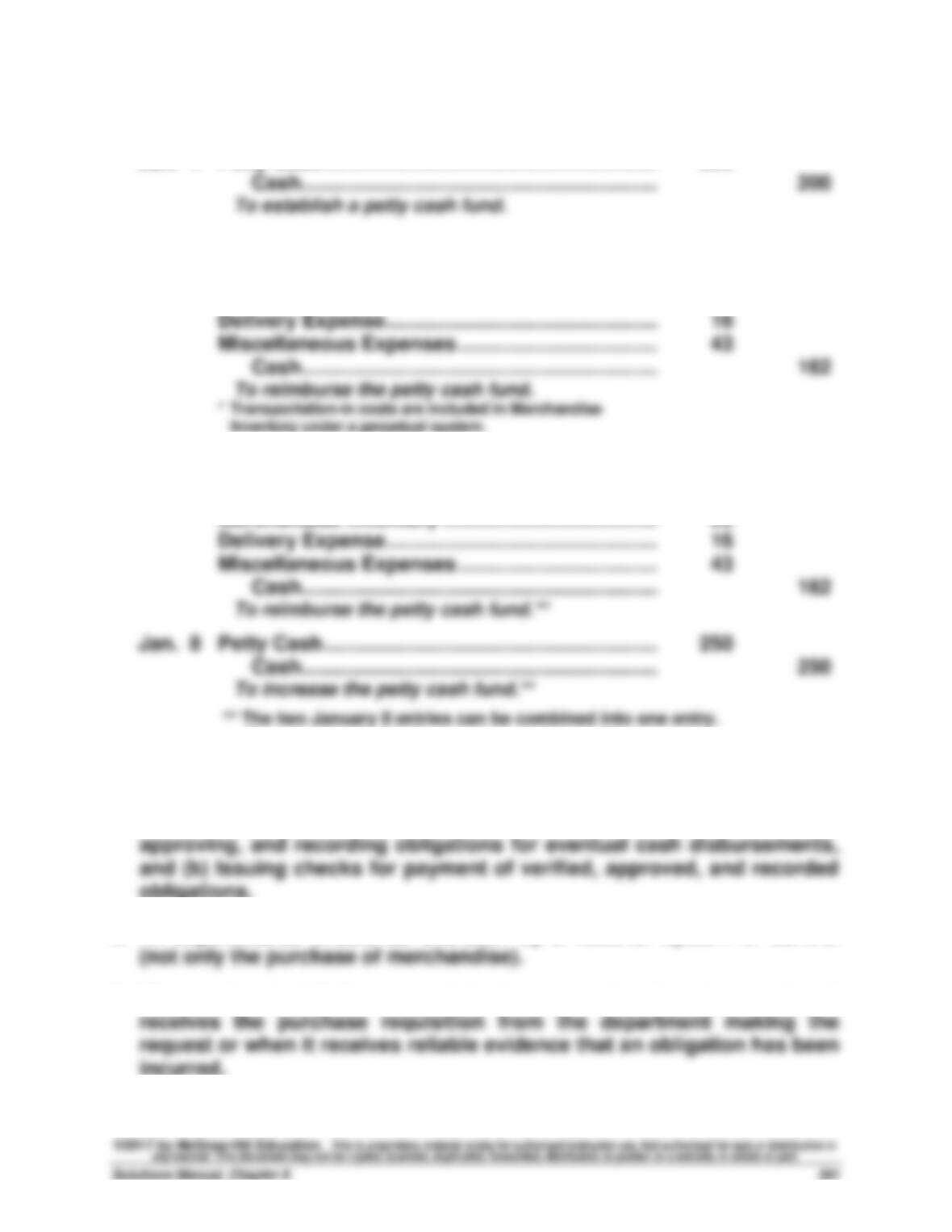
Exercise 6-6 (20 minutes)
1.
Jan. 1
Petty Cash ………………………………………………………
200
2.
Jan. 8
Postage Expense …………………………………………….
74
Merchandise Inventory* …………………………………..
29
Delivery Expense …………………………………………….
16
Miscellaneous Expenses …………………………..…….
43
3.
Jan. 8
Postage Expense …………………………………………….
74
Merchandise Inventory ……………………………………
29
Delivery Expense …………………………………………….
16
Miscellaneous Expenses …………………………..…….
43
Exercise 6-7 (10 minutes)
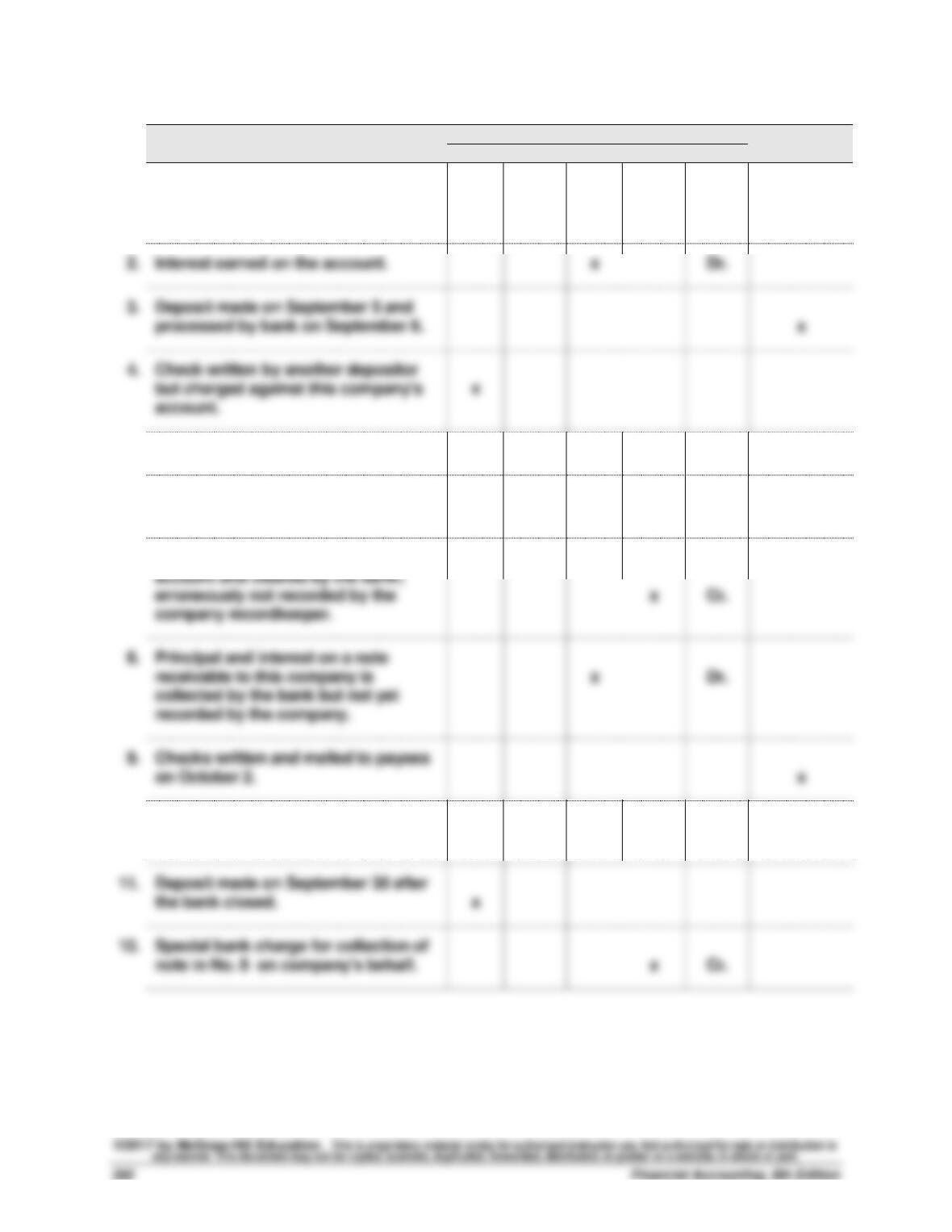
1. The voucher system of control establishes procedures for: (a) Verifying,
2. All expenditures should be overseen by a voucher system of control
3. The voucher is initially prepared by the accounting department when it
Exercise 6-8 (20 minutes)
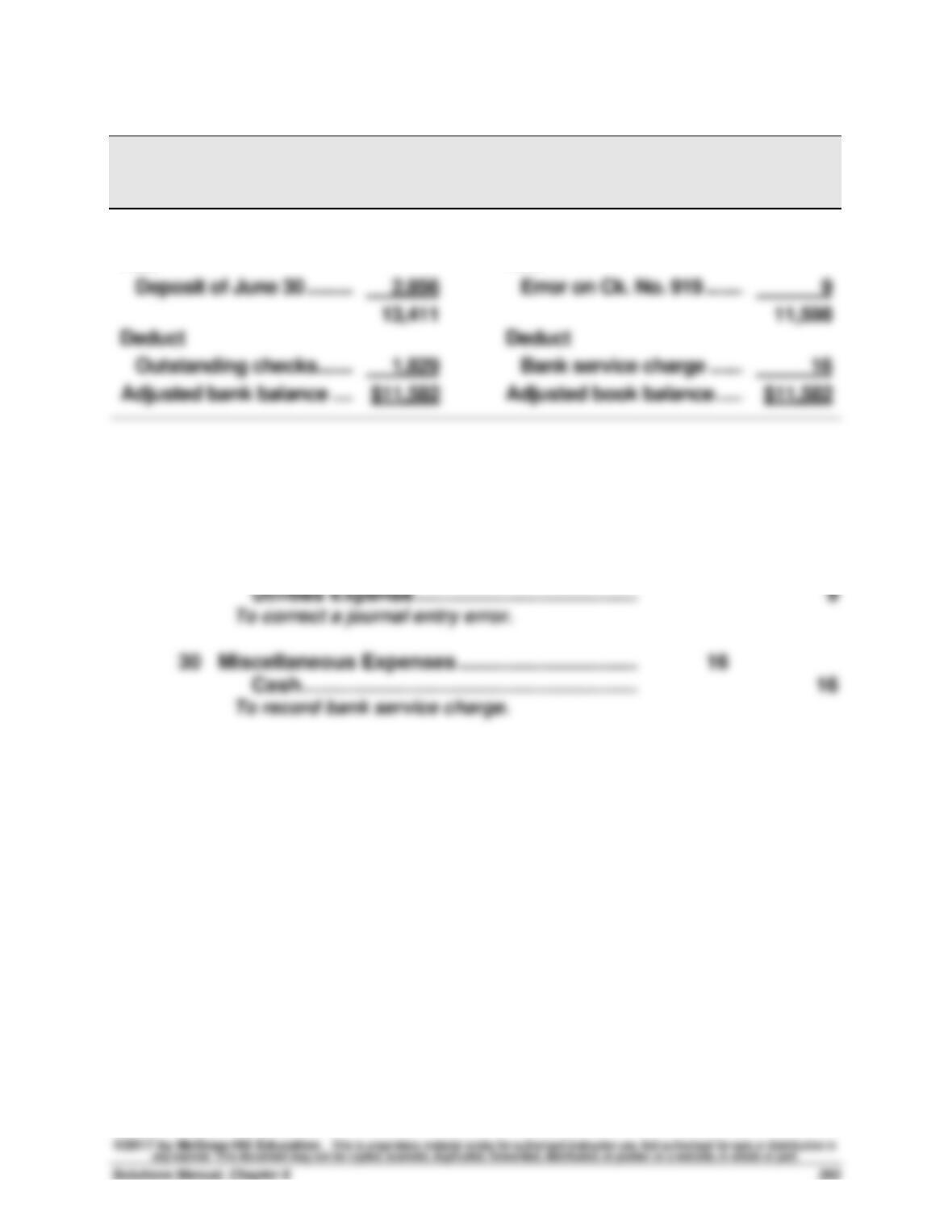
Bank Balance
Book Balance
Not Shown on
Add
Deduct
Add
Deduct
Adjust
Reconciliation
1.
NSF check from customer returned
on Sept. 25 but not recorded by this
company.
x
Cr.
5.
Bank service charge.
x
Cr.
6.
Checks outstanding on August 31
that cleared the bank in September.
x
7.
Principal and interest on a note
Check written against the company
10.
Checks written by the company and
mailed to payees on September 30.
x
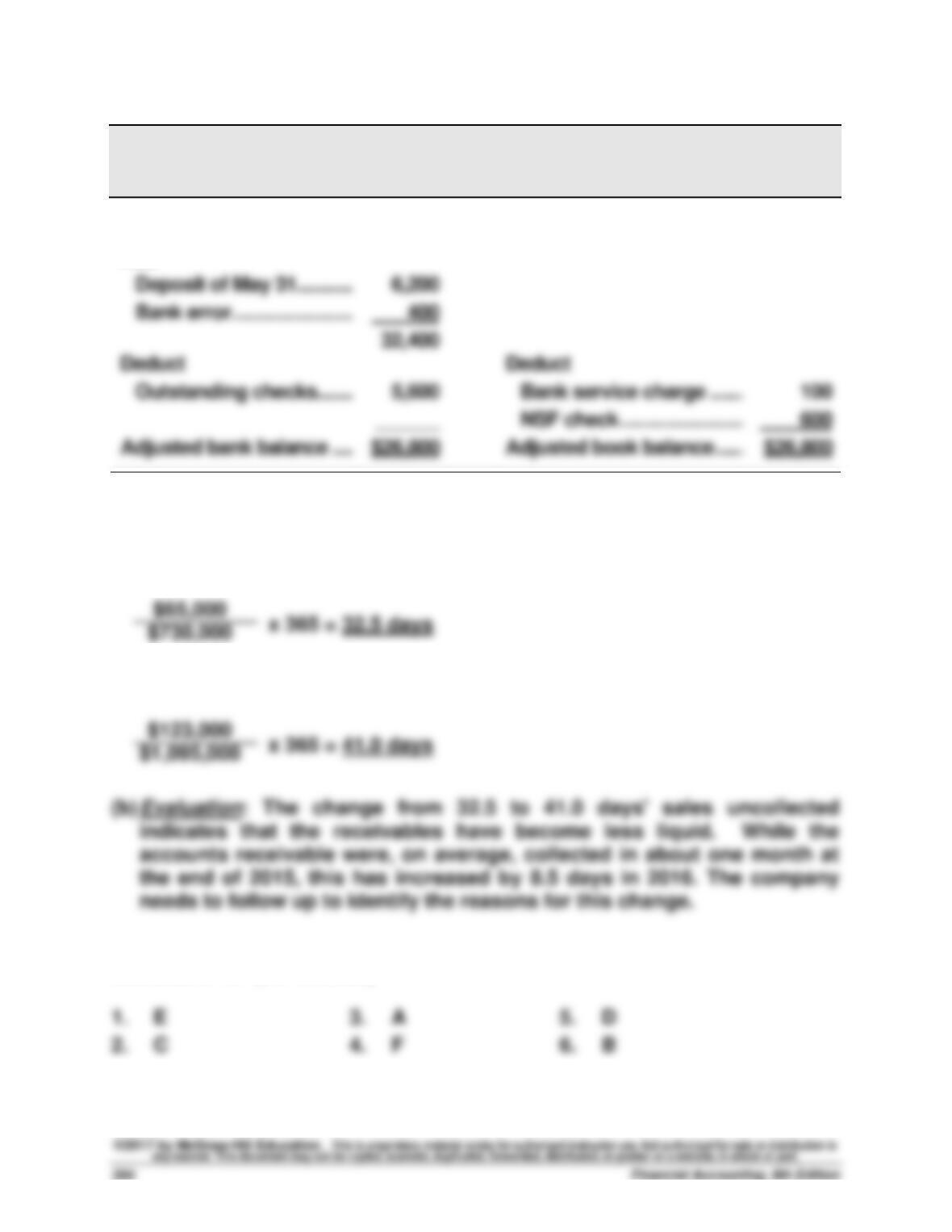
Exercise 6-9 (25 minutes)
DEL GATO CLINIC
Bank Reconciliation
June 30, 2016
Bank statement balance ..
$10,555
Book balance …………………………..
$11,589
Add
Add
Exercise 6-10 (10 minutes)
June 30
Cash …………………………………………………………..
9
Exercise 6-11 (25 minutes)
WRIGHT COMPANY
Bank Reconciliation
May 31, 2016
Bank statement balance ..
$25,800
Book balance …………………………..
$27,500
Add
Deduct
Deduct
Exercise 6-12 (15 minutes)
(a) Days’ sales uncollected on December 31, 2015:
Days’ sales uncollected on December 31, 2016:
Exercise 6-13A (10 minutes)
PROBLEM SET A
Problem 6-1A (20 minutes)
for posting the payments to the customer accounts.
2. Violates the principle of establishing responsibility. Only Julia should
3. Violates the proper application of technological controls. While the
daily backup is a very good internal control, the tape needs to be taken
4. Violates regular and independent review. Mike Derr needs to implement
5. Violates the insuring of assets and the bonding of key employees. We
Problem 6-2A (20 minutes)
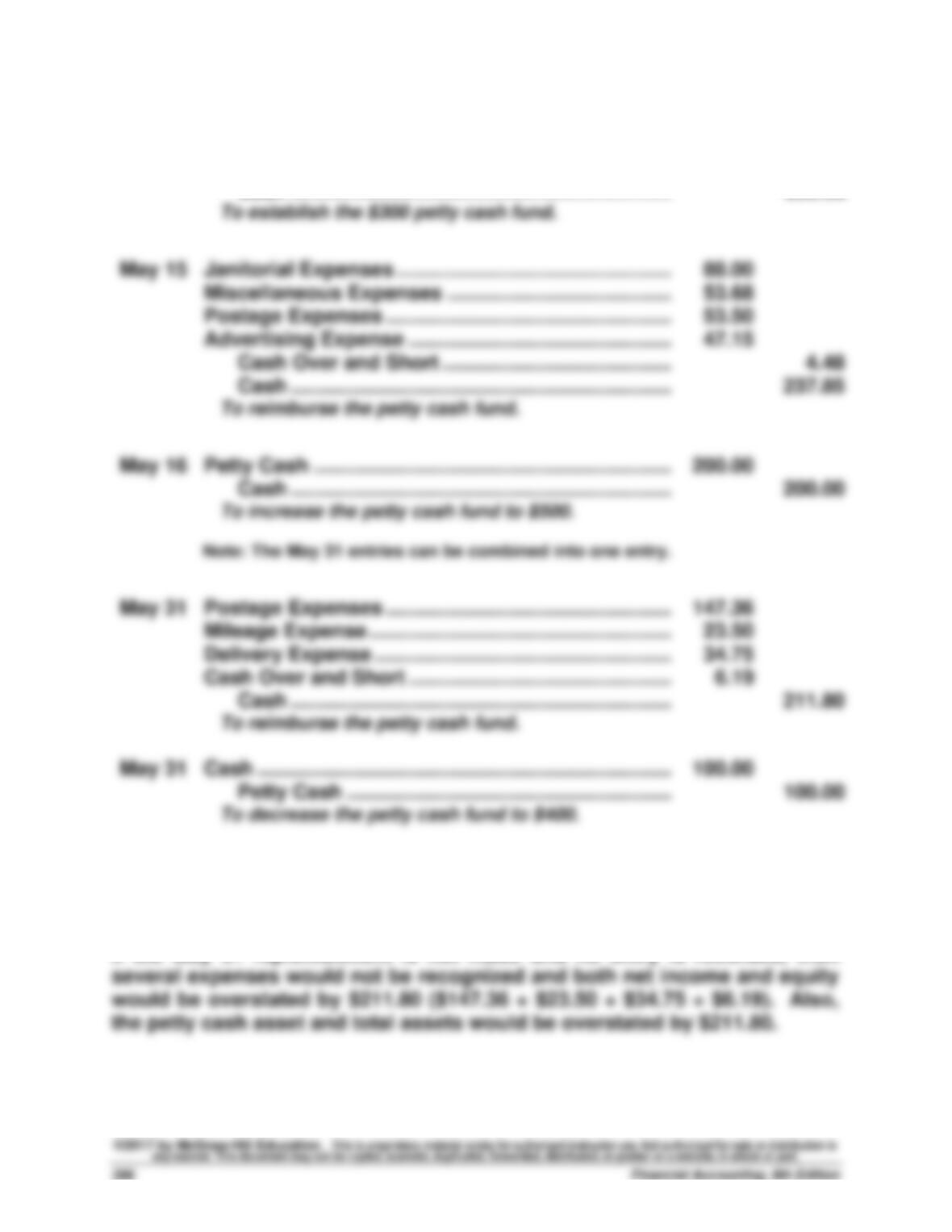
Part 1
May 1
Petty Cash ……………………………………………………….
300.00
Cash ………………………………………………………………
300.00
May 15
Janitorial Expenses ……………………………………………..
Miscellaneous Expenses ……………………………………..
Postage Expenses ……………………………………………….
Advertising Expense ……………………………………………
Cash Over and Short ………………………………………
Cash ………………………………………………………………
May 16
Petty Cash ……………………………………………………….
Cash ………………………………………………………………
May 31
Postage Expenses ……………………………………………….
Mileage Expense ………………………………………………….
Delivery Expense …………………………………………………
Cash Over and Short ……………………………………………
Cash ………………………………………………………………
May 31
Petty Cash ……………………………………………………..
Part 2
If the May 31 replenishment is not made and no entry is recorded, then
Problem 6-3A (30 minutes)
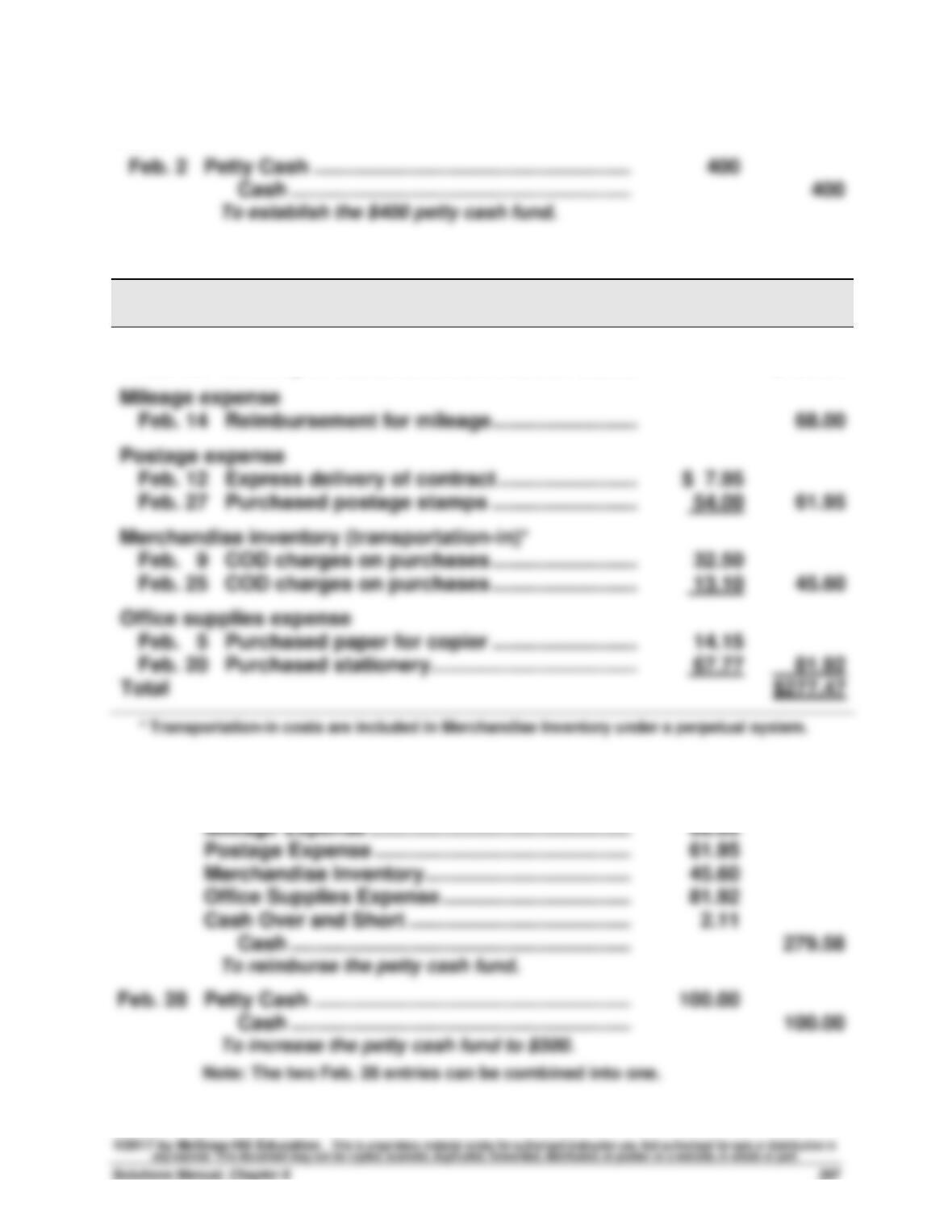
Part 1
Petty Cash ……………………………………………………….
Part 2
Nakashima Gallery
Petty Cash Payments Report (for February)
Delivery expense
Feb. 23
Delivery of customer’s merchandise …………………….
$ 20.00
Mileage expense
Reimbursement for mileage …………………………..
Postage expense
Express delivery of contract …………………………..
Purchased postage stamps …………………………..
Merchandise inventory (transportation–in)*
COD charges on purchases …………………………..
COD charges on purchases …………………………..
Purchased stationery ……………………………………………
Part 3
Feb. 28
Delivery Expense …………………………………………………
20.00
Mileage Expense ………………………………………………….
68.00
Postage Expense …………………………………………………
61.95
Merchandise Inventory …………………………………………
45.60
81.92
Cash Over and Short ……………………………………………
Feb. 28
Petty Cash ……………………………………………………….
Problem 6-4A (30 minutes)
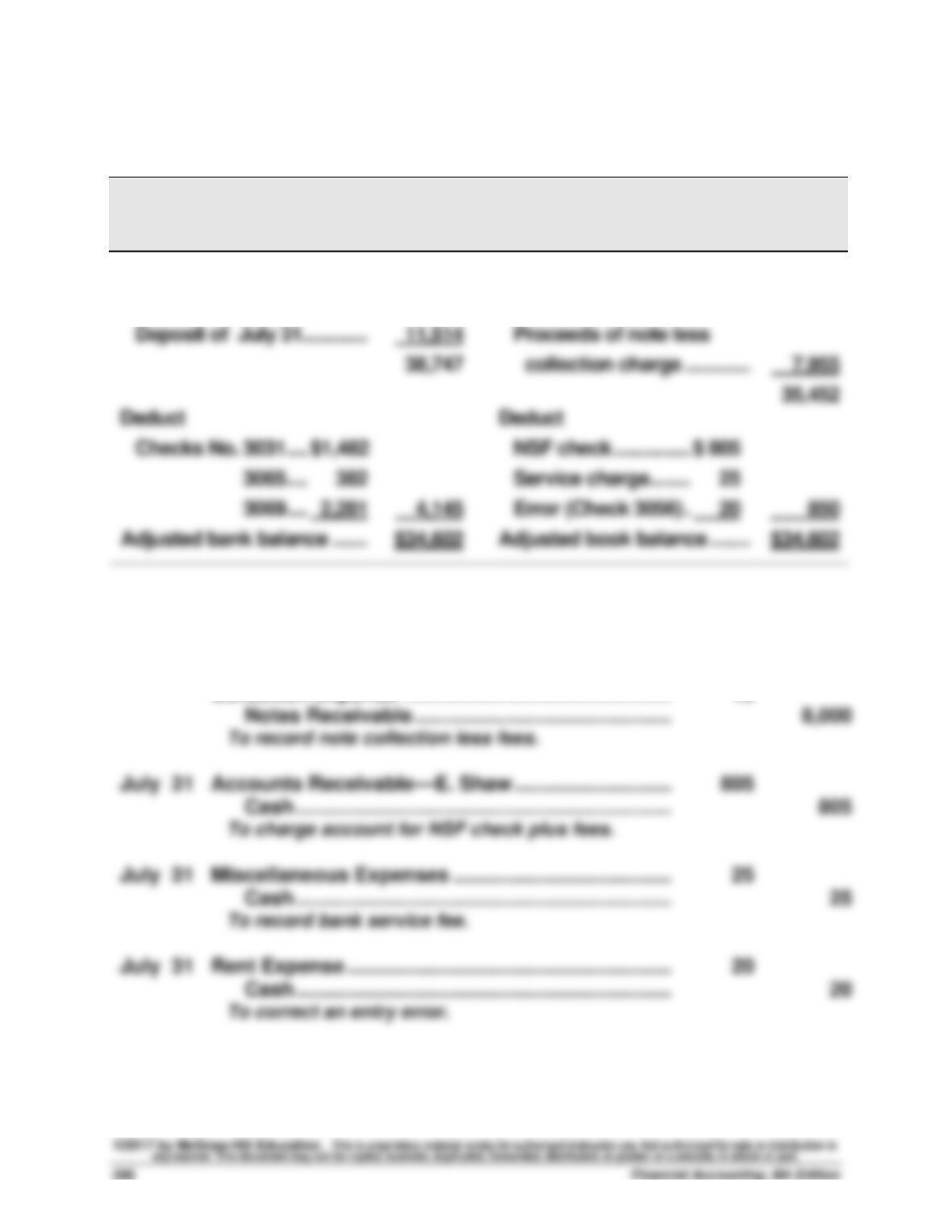
Part 1
BRANCH COMPANY
Bank Reconciliation
July 31, 2016
Bank statement balance …..
$27,233
Book balance …………………………..
$27,497
Add
Add
Deduct
Deduct
Part 2
July 31
Cash ……………………………………………………………………
7,955
Collection Expense ……………………………………………..
45
July 31
July 31
25
July 31
20
Problem 6-4A (Concluded)
Part 3
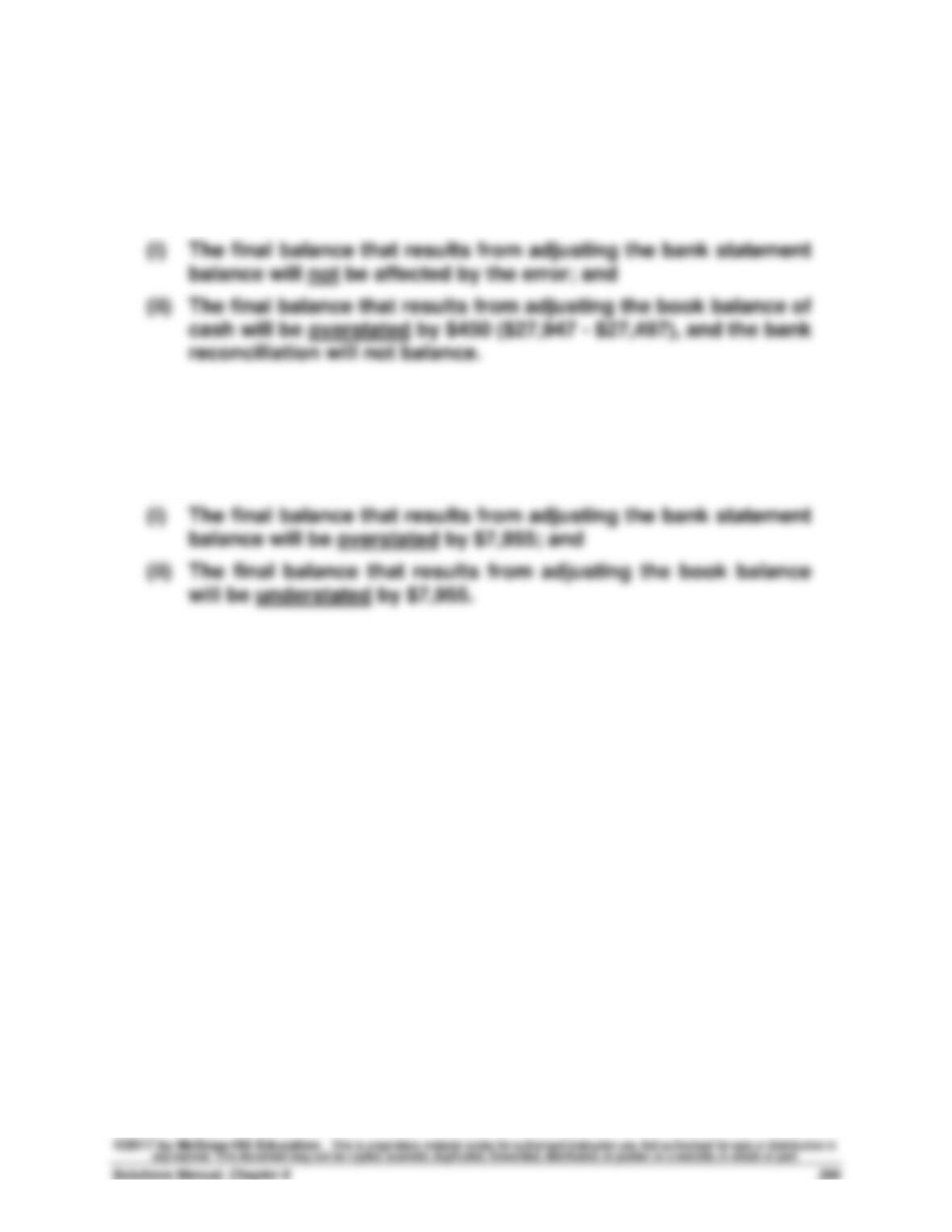
a. If the company’s Cash account balance of $27,497 is listed on the
bank reconciliation as $27,947 then:
b. The bank’s collection of the $8,000 note less the $45 collection fee
should have been added to the book balance of cash. Instead, it was
added to the bank statement balance. As a result:
Problem 6-5A (50 minutes)
Part 1
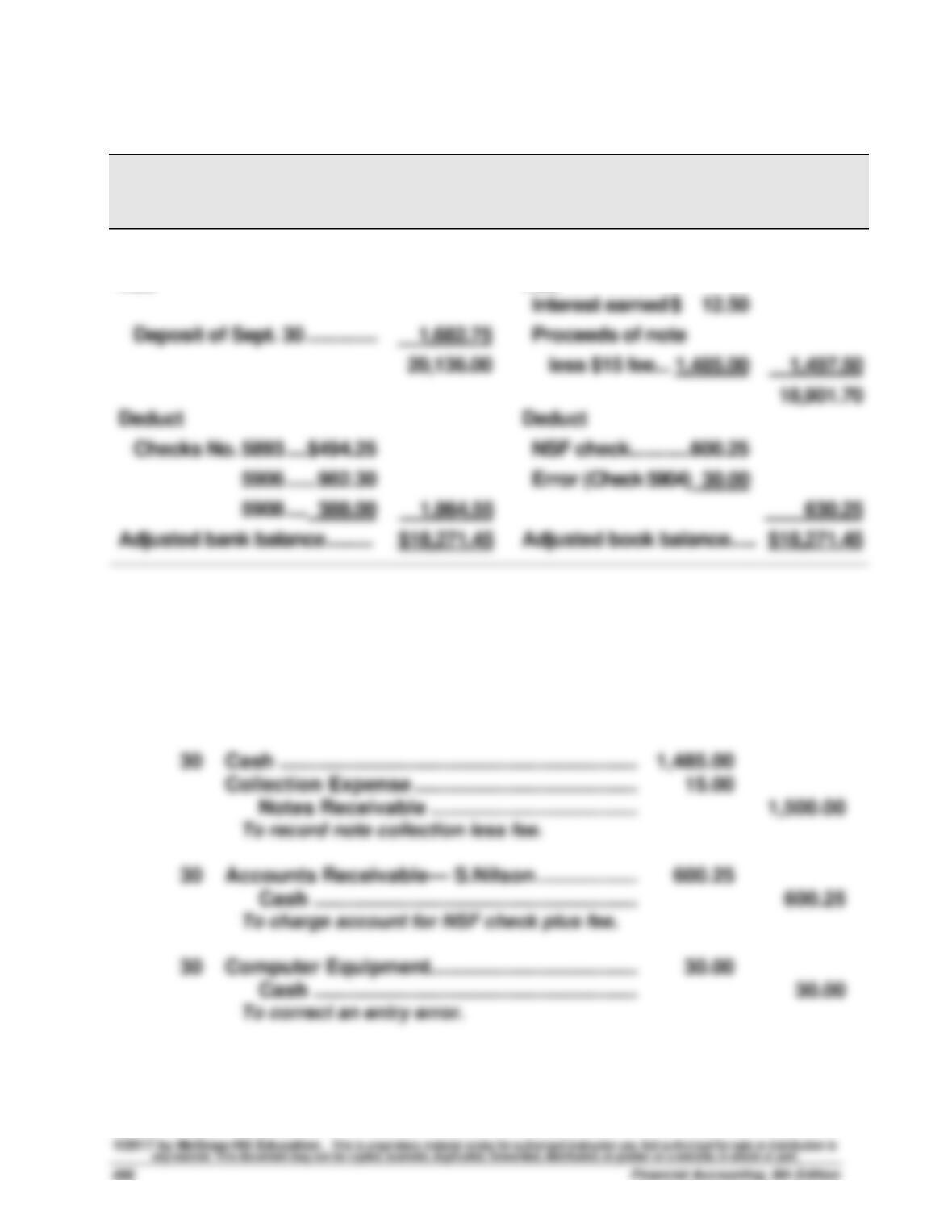
CHAVEZ COMPANY
Bank Reconciliation
September 30, 2016
Bank statement balance ……..
$18,453.25
Book balance …………………………..
$17,404.20
Add
Add
Part 2
Sept. 30
Cash ……………………………………………………….
12.50
Interest Earned ……………………………………………….
12.50
To record interest earned.
Cash ……………………………………………………….
15.00
Notes Receivable ……………………………………………
To record note collection less fee.
Cash ……………………………………………………….
To charge account for NSF check plus fee.
30.00
Cash ……………………………………………………….
30.00
To correct an entry error.