Case 3-3: United Thermostatic Controls (a GVV case)
United Thermostatic Controls is a publicly owned company that engages in the manufacturing
and marketing of residential and commercial thermostats. The thermostats are used to regulate
temperature in furnaces and refrigerators. United sells its product primarily to retailers in the
Figure 1 United Thermostatic Controls Organization Chart*
*Member of the board of directors.
Exhibit 1
United Thermostatic Controls
Budgeted and Actual Sales Revenue
First Three Quarters in 2015
U.S.A. Sales Division
Western Sales Division
Quarter Ended
Budget
Actual
% Var.
Budget
Actual
% Var.
March 31
$ 632,000
$ 638,000
.009%
$ 886,000
$ 898,000
.014%
June 30
640,000
642,000
.003
908,000
918,000
.011
September 30
648,000
656,000
.012
930,000
936,000
.006
Through September 30
$1,920,000
$1,936,000
.008%
$2,724,000
$2,752,000
.010%
Eastern Sales Division
Southern Sales Division
Quarter Ended
Budget
Actual
% Var.
Budget
Actual
% Var.
March 31
$ 743,000
$ 750,000
.009%
$ 688,000
$ 680,000
(.012)%
June 30
752,000
760,000
.011
696,000
674,000
(.032)
September 30
761,000
769,000
.011
704,000
668,000
(.051)
Through September 30
$2,256,000
$2,279,000
.010%
$2,088,000
$2,022,000
(.032)%
Campbell knows that actual sales lagged even further behind budgeted sales during the first two
months of the fourth quarter. He also knows that each of the other three sales divisions exceeded
their budgeted sales amounts during the first three quarters in 2015. He is very concerned that the
Southern division has been unable to meet or exceed budgeted sales amounts. He is particularly
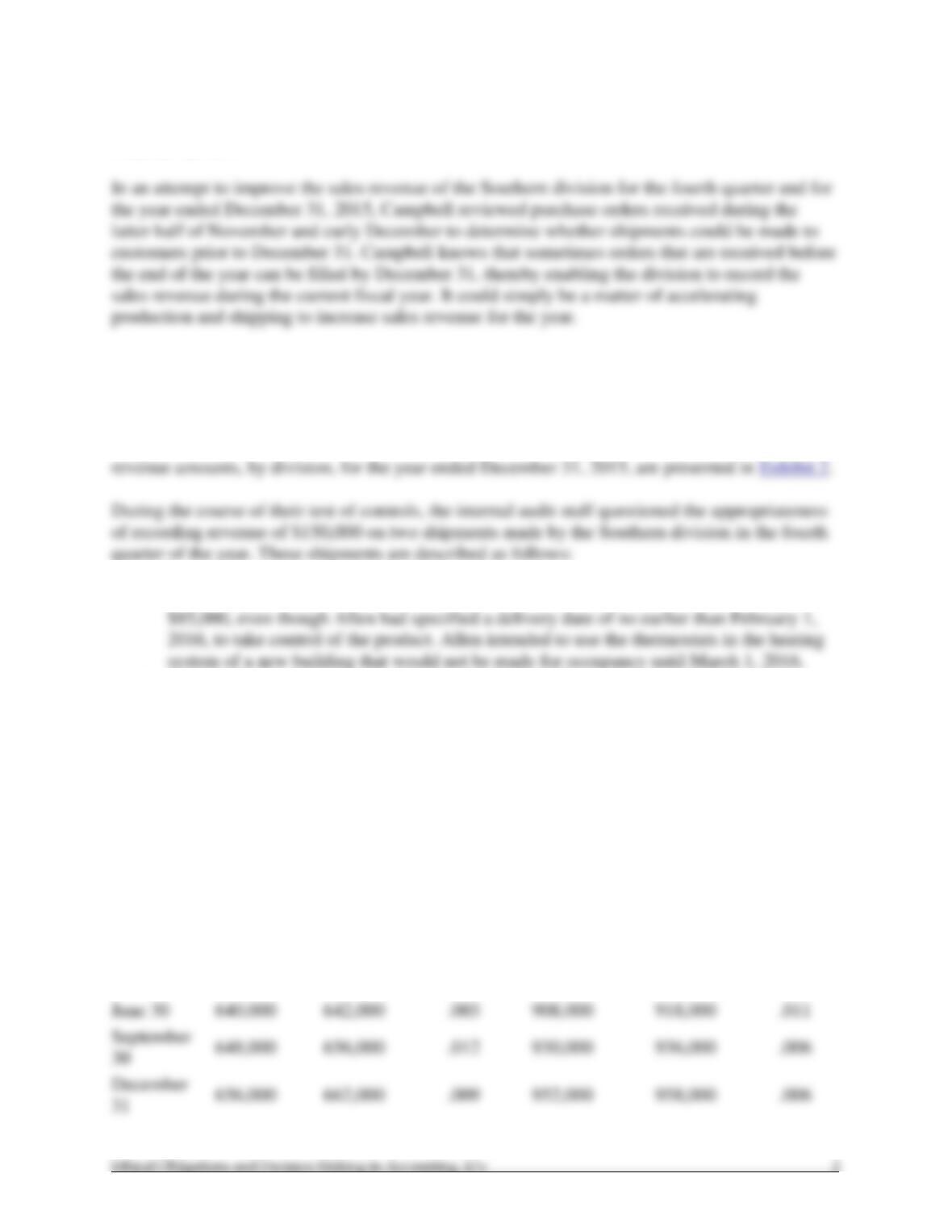
worried about the effect this might have on his and the division managers’ bonuses and share of
corporate profits.
Reported sales revenue of the Southern division for the fourth quarter of 2015 was $792,000.
This represented an 18.6 percent increase over the actual sales revenue for the third quarter of the
year. As a result of this increase, reported sales revenue for the fourth quarter exceeded the
budgeted amount by $80,000, or 11.2 percent. Actual sales revenue for the year exceeded the
budgeted amount for the Southern division by $14,000, or 0.5 percent. Budgeted and actual sales
1. United shipped thermostats to Allen Corporation on December 31, 2015, and billed Allen
2. United shipped thermostats to Bilco Corporation on December 30, 2015, in partial (one-
half) fulfillment of an order. United recorded $65,000 revenue on that date. Bilco had
previously specified that partial shipments would not be accepted. Delivery of the full
shipment had been scheduled for February 1, 2016.
Exhibit 2
United Thermostatic Controls
Budgeted and Actual Sales Revenue First Three
Quarters in 2015
U.S.A. Sales Division
Western Sales Division
Quarter
Ended
Budget
Actual
% Var.
Budget
Actual
% Var.
March 31
$ 632,000
$ 638,000
.009%
$ 886,000
$ 898,000
.014%
June 30
640,000
642,000
.003
908,000
918,000
.011
September
30
648,000
656,000
.012
930,000
936,000
.006
December
31
656,000
662,000
.009
952,000
958,000
.006
Ethical Obligations and Decision Making in Accounting, 4/e 3
Eastern Sales Division
Southern Sales Division
Quarter
Ended
Budget
Actual
% Var.
Budget
Actual
% Var.
March 31
$ 743,000
$ 750,000
.009%
$ 688,000
$ 680,000
(.012)%
June 30
752,000
760,000
.011
696,000
674,000
(.032)
30
31
2013 Totals
$3,026,000
$3,057,000
.010%
$2,800,000
$2,814,000
.005%
During their investigation, the internal auditors learned that Campbell had pressured United’s
accounting department to record these two shipments early to enable the Southern division to
achieve its goals with respect to the company’s revenue targets. The auditors were concerned
about the appropriateness of recording the $150,000 revenue in 2015 in the absence of an
expressed or implied agreement with the customers to accept and pay for the prematurely
shipped merchandise. The auditors noted that, had the revenue from these two shipments not
Cupertino discussed the situation with Campbell. Campbell informed Cupertino that he had
received assurances from Sam Lorenzo, executive vice president of sales and marketing, that top
management would support the recording of the $150,000 revenue because of its strong desire to
meet or exceed budgeted revenue and earnings amounts. Moreover, top management is very
sensitive to the need to meet financial analysts’ consensus earnings estimates. According to
At this point, Cupertino is uncertain whether he should take his concerns to Walter Hayward, the
CFO, who is also a member of the board of directors, or take them directly to the audit
committee. Cupertino knows that the majority of the members of the board, including those on
the audit committee, have ties to the company and members of top management. Cupertino is not
even certain that he should pursue the matter any further because of the financial performance
2013 Totals
$2,576,000
$2,598,000
.009%
$3,676,000
$3,710,000
.009 %
Ethical Obligations and Decision Making in Accounting, 4/e 4
NOTES
This case focuses on the pressures that sometimes exist within an organization to manage short-
term earnings in order to meet or exceed budgeted levels or to improve the results of operations,
cash flows, and the financial position prior to a stock sale. Such actions can be unproductive and
they contribute to a questionable ethical culture.
Ethical Issues
It appears that Frank Campbell is attempting to manage the short-term earnings of the Southern
sales division to maximize the bonus payments to division managers. Investors rely on the
accuracy of the financial statement information. If revenue is deliberately overstated, then these
users will be making investment decisions based on incorrect information. The SEC expects a
Using rights perspective, it is not right to mislead the investors by making it look as though the
company is doing better than it really is. Any attempt to intentionally misstate the financial
statements violates the categorical imperative. Using a justice perspective, it is unfair to the other
division managers whose bonuses will be negatively affected by the improper recording of
revenue. It is unfair to the external auditors who rely on the work of the internal auditors in
accepted accounting principles. Objectivity requires that the company should approach its
Ethical Obligations and Decision Making in Accounting, 4/e 5
decision about the proper revenue recognition procedure with fair-mindedness and without
partially to one set of stakeholders. Trustworthiness means that the accountants should not
violate the investors’ faith that the statements are accurate and reliable.
Questions
1. Identify the stakeholders in this case and their interests.
The stakeholders and obligations to those stakeholders are as follows:
• Top management of United and the company: United has a duty of trustworthiness,
honesty, integrity, and loyalty to its top management. Cupertino has a duty of loyalty to
the affairs of the company, although it does not justify going along with improper
• Frank Campbell and other division directors: The amount of revenue that is reported
for the Southern division for 2013 affects the bonus distribution to division managers.
Cupertino has an obligation to ensure that bonus allocations are based on accurate and
reliable financial information. Campbell should not be rewarded for manipulating
financial results. The ethical theory of distributive justice argues for a fair distribution of
must place the public interest ahead of all other interests.
Ethical Obligations and Decision Making in Accounting, 4/e 6
• Allen Corporation and Bilco Corporation: Allen and Bilco have an interest in
receiving the shipment as ordered and when ordered. These customers trust United to
meet its stated terms and not alter them to meet the company’s self-interest goals.
2. Describe the ethical and professional responsibilities of Tony Cupertino.
Cupertino is responsible for the integrity of the financial reporting process. One factor in
establishing the integrity of the reporting process is the strength of the internal controls.
3. Assume you are in Cupertino’s position and know you have to do something about
the improper accounting in the Southern sales division. Consider the following in
crafting a plan how best to voice your values and take appropriate action:
o How can you get it done effectively and efficiently?
o What do you need to say, to whom, and in what sequence?
o What will the objections or push-back be and, then,
o What would you say next? What data and other information do you need to
make your point and counteract the reasons and rationalizations you will
likely have to address?
Cupertino should consider discussing the situation with the external auditors. The
auditors could request a meeting with the audit committee at which Cupertino is present.
The discussion with the audit committee could be centered on audit planning, how to
Ethical Obligations and Decision Making in Accounting, 4/e 7
Cupertino is likely to be pressured to go along with the improper accounting through
arguments such as it is a one-time request or he needs to be loyal to the organization.
Cupertino’s most effective response is to explain that his loyalty obligation is to the
public interest and even a one-time request that leads to materially misstated financial
statements is one-time too many.