Analytical Thinking (continued)
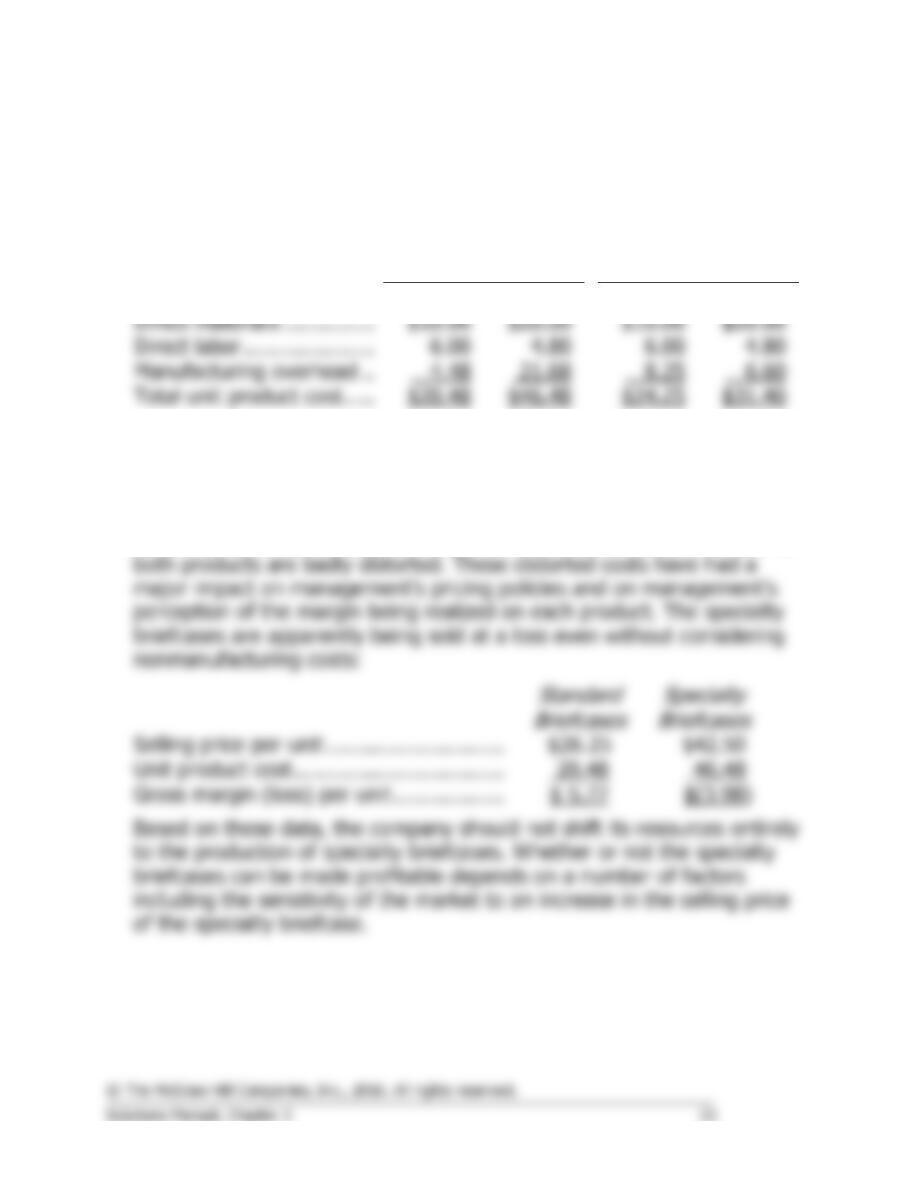
2. The unit product cost of each product under activity-based costing is
given below. For comparison, the costs computed by the company’s
accounting department using conventional costing are also provided.
Activity-Based
Costing
Direct Labor-Hour
Base
Standard
Specialty
Standard
Specialty
Direct materials ……………
Direct labor …………………
3. The president was probably correct in being concerned about the
profitability of the products, but the problem is apparently with the
specialty product rather than the standard. Traditional overhead cost
assignment using a volume-based measure has resulted in the high-
volume product subsidizing the low-volume product. Thus, unit costs for
Selling price per unit ………………………..
Unit product cost …………………………….
Gross margin (loss) per unit ………………
Analytical Thinking (continued)
Note to the Instructor:
You may wish to mention to your class that
before any decision can be made regarding dropping a product line, a
4. Perhaps the competition hasn’t been able to touch FirstLine Cases’ price
because the company has been selling its specialty briefcases at a price
that is below its cost. Thus, rather than “gouging” its customers,
FirstLine Cases’ competitor is probably just pricing its specialty items at
Chapter 3
Take Two Solutions
Exercise 3-2 (15 minutes)
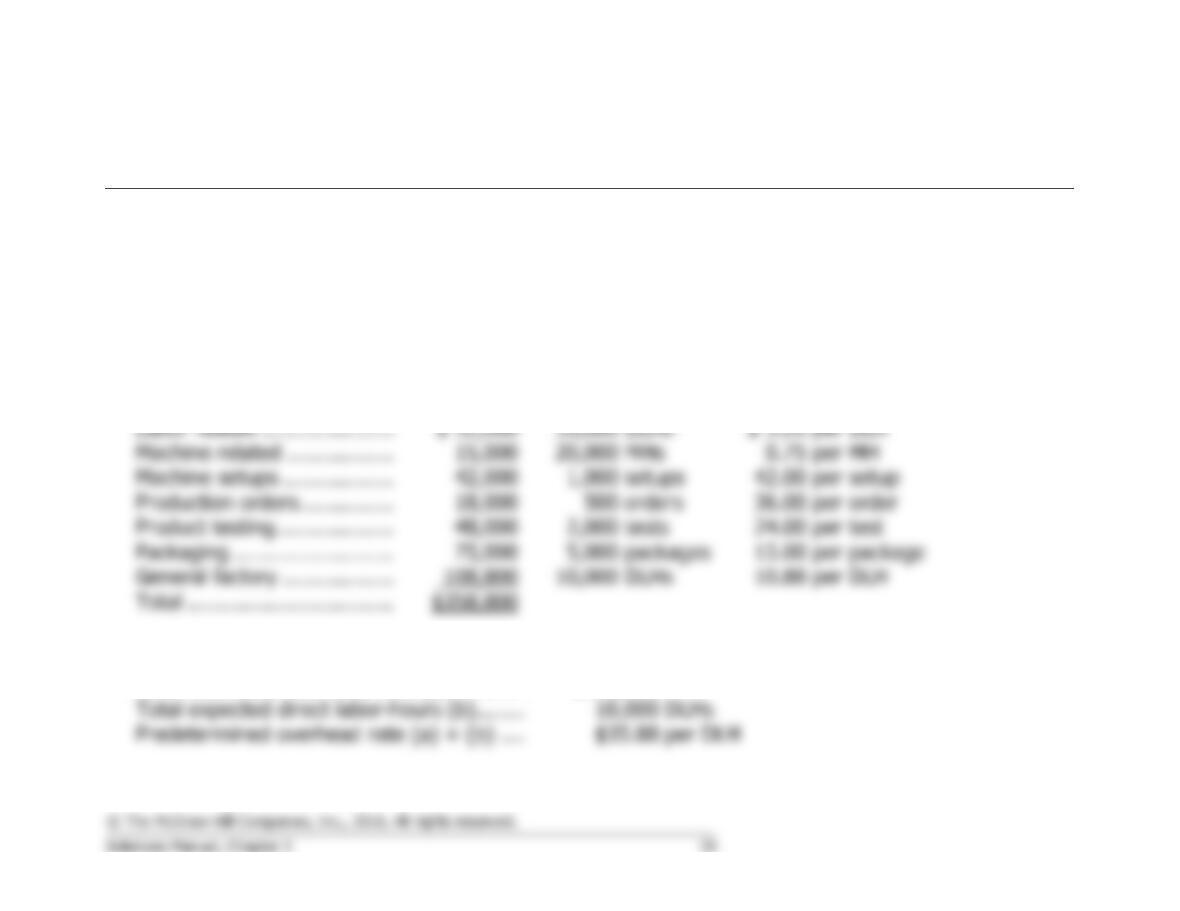
1. The activity rates are computed as follows:
Activity Cost Pool
(a)
Estimated
Overhead
Cost
(b)
Expected
Activity
(a) ÷ (b)
Activity Rate
Labor related …………………
DLHs
per DLH
Machine related ……………..
MHs
per MH
Machine setups ………………
setups
per setup
Packaging ……………………..
packages
per package
General factory ………………
DLHs
per DLH
Total …………………………...
2. The predetermined overhead rate based entirely on direct labor-hours would be computed as follows:
Total estimated overhead cost (a) …………
$358,800
Total expected direct labor-hours (b) ……..
DLHs
Predetermined overhead rate (a) ÷ (b) ….
per DLH
Exercise 3-3 (30 minutes)
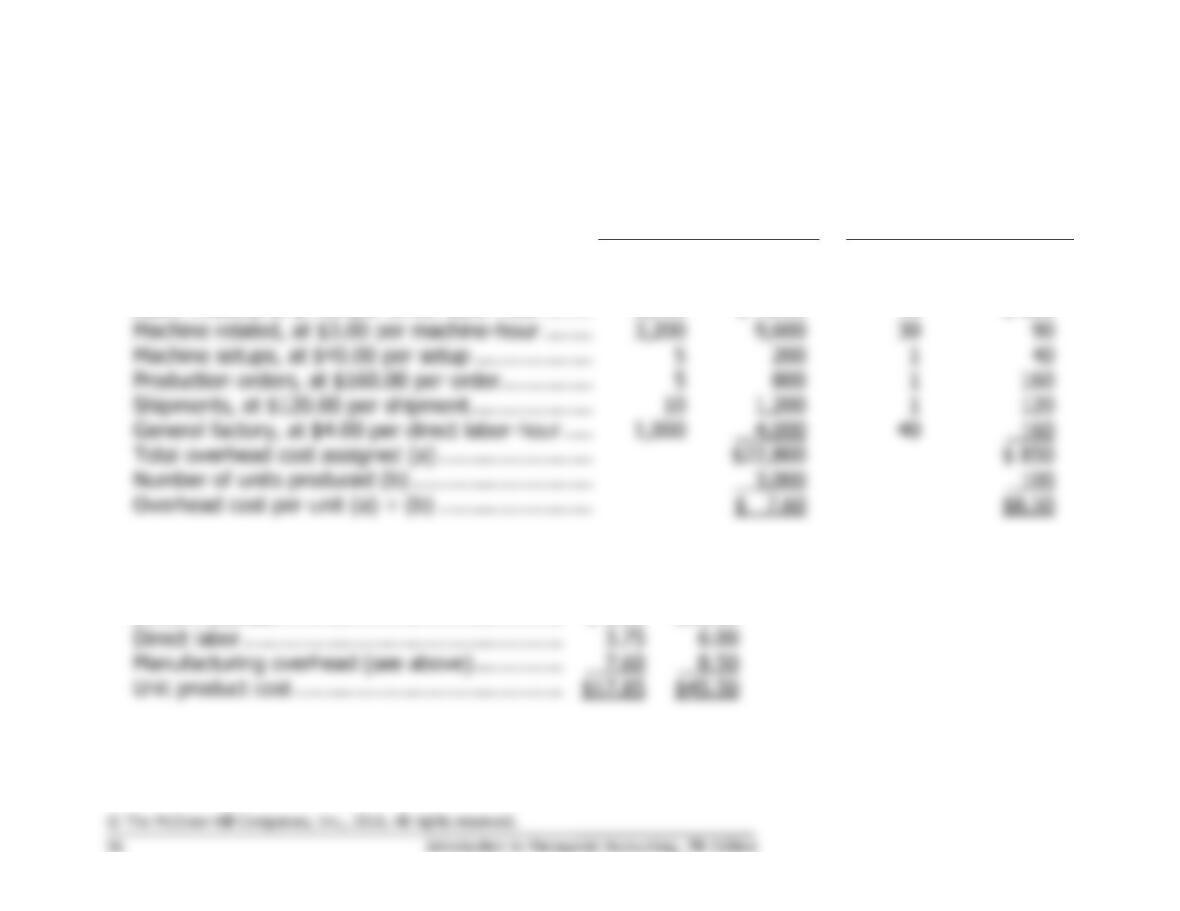
The unit product costs for the products are a combination of direct materials, direct labor, and overhead
costs. The overhead costs assigned to each product would be computed as follows:
J78
B52
Expected
Activity
Amount
Expected
Activity
Amount
Labor related, at $7.00 per direct labor-hour ……..
1,000
$ 7,000
40
$ 280
Machine related, at $3.00 per machine-hour ……..
3,200
30
Machine setups, at $40.00 per setup ……………….
Production orders, at $160.00 per order ……………
Shipments, at $120.00 per shipment………………..
General factory, at $4.00 per direct labor-hour …..
4,000
Total overhead cost assigned (a) …………………….
$ 850
Number of units produced (b) ………………………..
Overhead cost per unit (a) ÷ (b) …………………….
$ 7.60
The unit product costs combine direct materials, direct labor, and overhead costs as follows:
J78
B52
Direct materials ………………………………………
$ 6.50
$31.00
Direct labor ……………………………………………
Manufacturing overhead (see above) …………..
Unit product cost …………………………………….
$45.50
Exercise 3-4 (30 minutes)
1. Using the company‘s conventional costing system, the overhead costs applied to the products would
be computed as follows:
Product H
Product L
Total
Number of units produced (a) ………..
40,000
8,000
Direct labor-hours per unit (b) ………..
Total direct labor-hours (a) × (b) ……
Total manufacturing overhead (a) ………….
Product L
Total
Number of units produced ……………………
8,000
Total manufacturing overhead applied ……
2. Using the proposed ABC system, overhead costs would be assigned as follows:
Product H
Product L
Total
Total manufacturing overhead assigned (a) ……….
Exercise 3-4 (continued)
3. Under the company’s old method of allocating overhead costs, the high–
volume product, Product H, was allocated most of the overhead cost.
This occurred simply because the high-volume product is responsible for
most of the direct labor-hours. When the overhead is split evenly
Exercise 3-7 (45 minutes)
1. The unit product costs under the company’s conventional costing system
would be computed as follows:
Mercon
Wurcon
Total
Number of units produced (a) …………………
10,000
48,000
Total manufacturing overhead (a) ……………
$336,000
Total direct labor-hours (b) …………………….
DLHs
Predetermined overhead rate (a) ÷ (b) ……..
per DLH
Mercon
Wurcon
Direct materials ……………………………………
$10.00
$ 8.00
Unit product cost …………………………..……..
Exercise 3-7 (continued)
2. The unit product costs with the proposed ABC system can be computed as follows:
Activity Cost Pool
Estimated
Overhead
Cost*
(b)
Expected
Activity
(a) ÷ (b)
Activity Rate
Manufacturing overhead is assigned to the two products as follows:
Mercon
Wurcon
Expected
Expected
Activity
Amount
Activity
Amount
Labor related, at $12.00 per direct labor-hour ……….
2,000
$ 24,000
12,000
$144,000
Exercise 3-7 (continued)
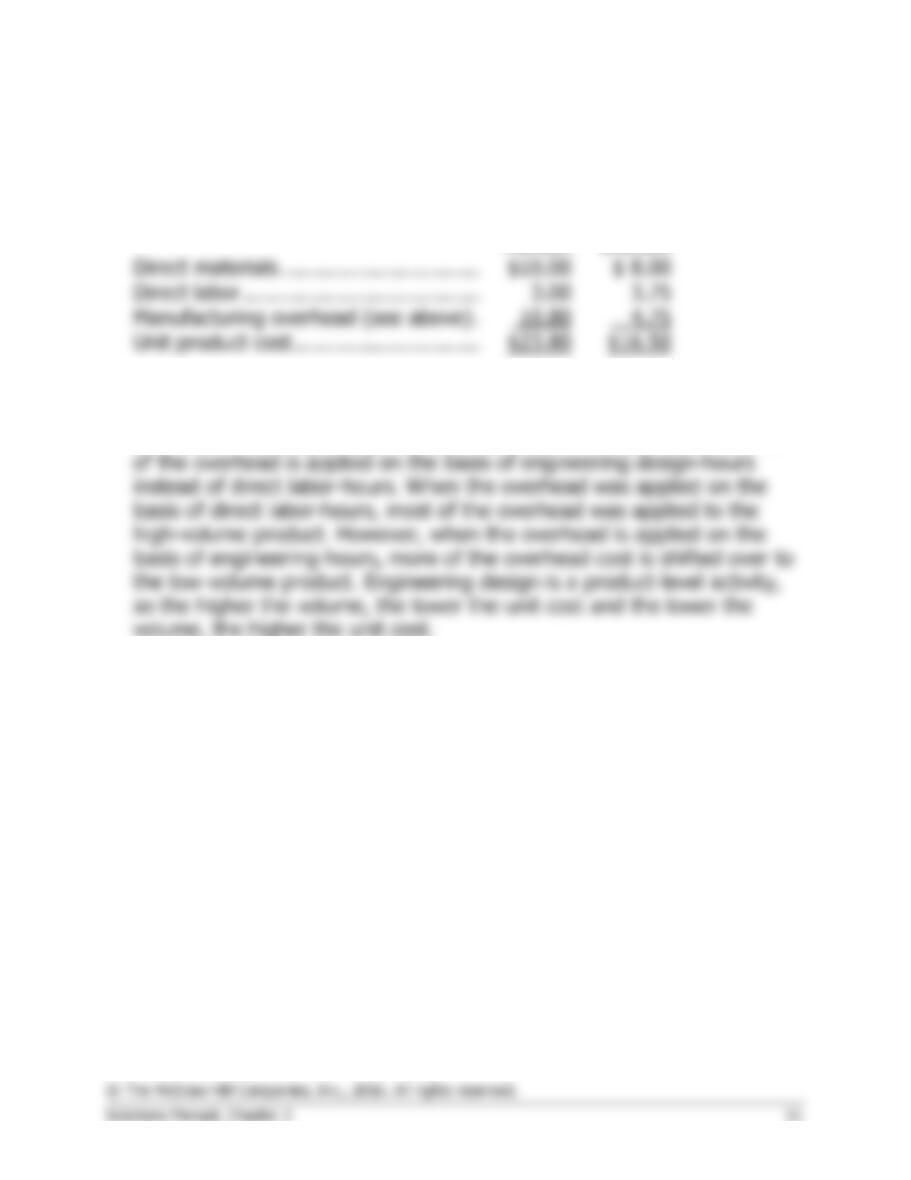
The unit product costs combine direct materials, direct labor, and
manufacturing overhead costs:
Mercon
Wurcon
Direct materials …………………………..
Unit product cost …………………………
3. The unit product cost of the high-volume product, Wurcon, declines
under the activity-based costing system, whereas the unit product cost
of the low-volume product, Mercon, increases. This occurs because half
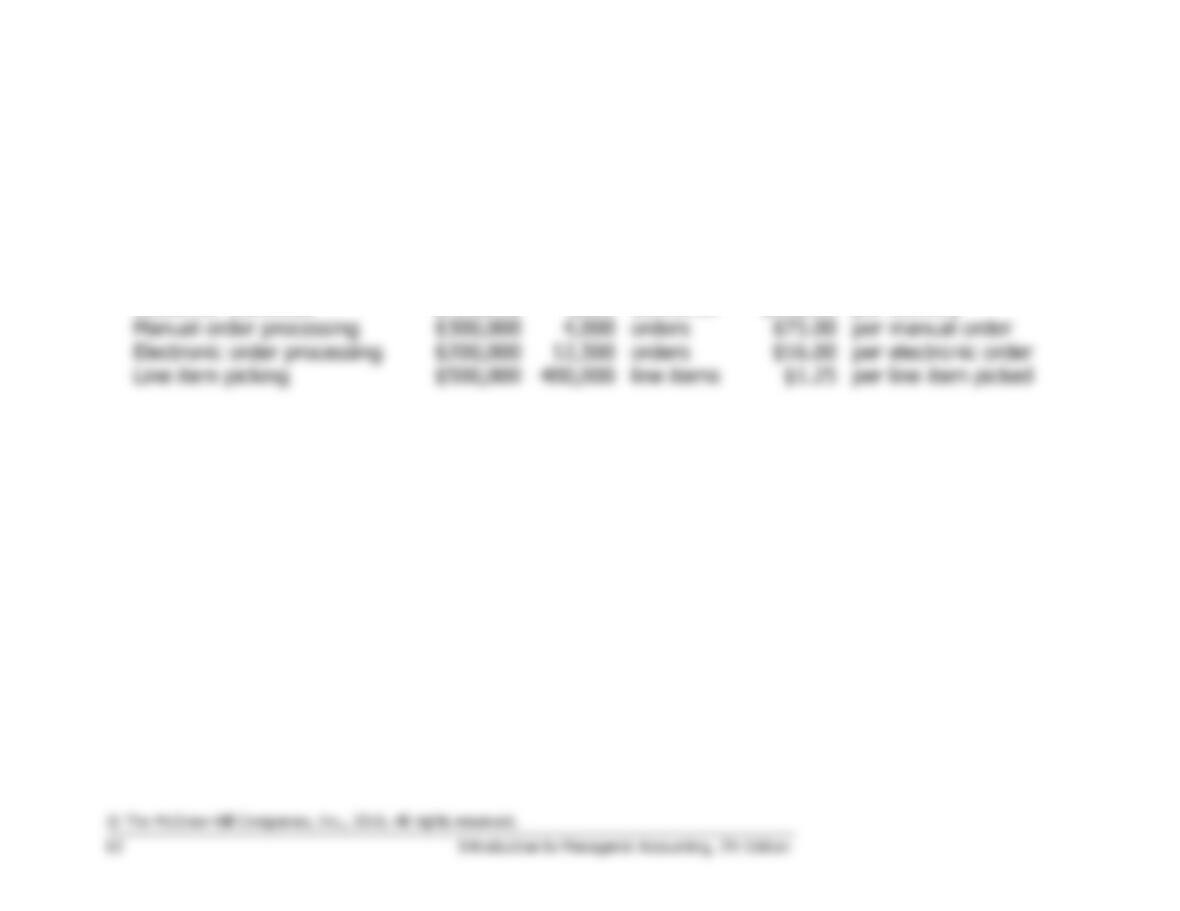
Exercise 3-9 (30 minutes)
1. The activity rates are computed as follows:
Activity Cost Pool
(a)
Estimated
Overhead
Cost
(b)
Expected
Activity
(a) ÷ (b)
Activity Rate
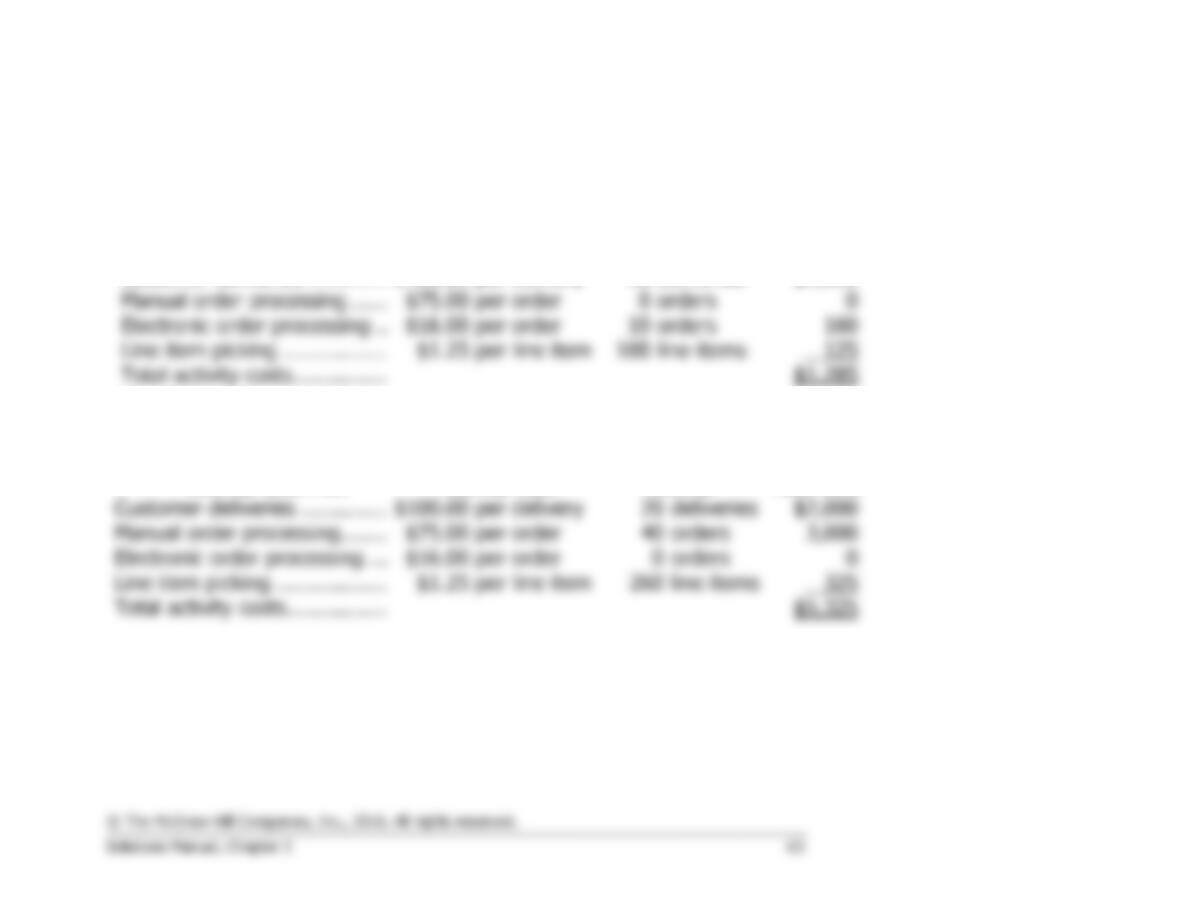
Customer deliveries
$400,000
4,000
deliveries
$100.00
per delivery
Manual order processing
$300,000
4,000
orders
per manual order
Line item picking
$500,000
line items
per line item picked
Exercise 3-9 (continued)
2. Activity costs are assigned to the two hospitals as follows:
City General:
Activity Cost Pool
(a)
Activity Rate
(b)
Activity
(a) × (b)
ABC Cost
Customer deliveries ……………
$100.00
per delivery
10
deliveries
$1,000
County General:
Activity Cost Pool
(a)
Activity Rate
(b)
Activity
(a) × (b)
ABC Cost
3. Hospitals that require frequent deliveries, place a high volume of manual orders, and order many line
items are likely to be more expensive to serve.