Exercise 3-9 (continued)
2. Activity costs are assigned to the two hospitals as follows:
City General:
Activity Cost Pool
(a)
Activity Rate
(b)
Activity
(a) × (b)
ABC Cost
Manual order processing ……
$75.00
per order
orders
Electronic order processing ..
$16.00
per order
orders
Total activity costs ……………
County General:
Activity Cost Pool
(a)
Activity Rate
(b)
Activity
(a) × (b)
ABC Cost
Customer deliveries ………….
$80.00
per delivery
20
deliveries
$ 1,600
Manual order processing ……
$75.00
per order
40
orders
Electronic order processing ..
$16.00
per order
orders
Line item picking ……………..
per line item
line items
3. Hospitals that require frequent deliveries, place a high volume of manual orders, and order many line
items are likely to be more expensive to serve.
Exercise 3-10 (30 minutes)
1. Under the traditional direct labor-hour based costing system,
manufacturing overhead is applied to products using the predetermined
overhead rate computed as follows:
Estimated total manufacturing overhead cost
Predetermined =
overhead rate Estimated total direct labor –hours
Exercise 3-10 (continued)
2. The activity rates are computed as follows:
Activity Cost Pools
(a)
Total
Cost
(b)
Total Activity
(a) ÷ (b)
Activity Rate
3. Under the activity-based costing system, the unit product costs would
be computed as follows:
Xactive
Pathbreaker
Direct materials ………………..
$1,620,000
$3,825,000
Supporting direct labor ………
Batch setups ……………………
General factory
Total cost (a) …………………..
$3,096,875
Unit product cost (a) ÷ (b) …
4. The traditional system uses one unit-level activity measure, direct labor
hours, to assign 31.8% ($700,000 ÷ $2,200,000) of all overhead to the
Exercise 3-11 (30 minutes)
1. The activity rates are computed as follows:
Activity Cost Pool
(a)
Estimated
Overhead
Cost
(b)
Expected
Activity
(a) ÷ (b)
Activity Rate
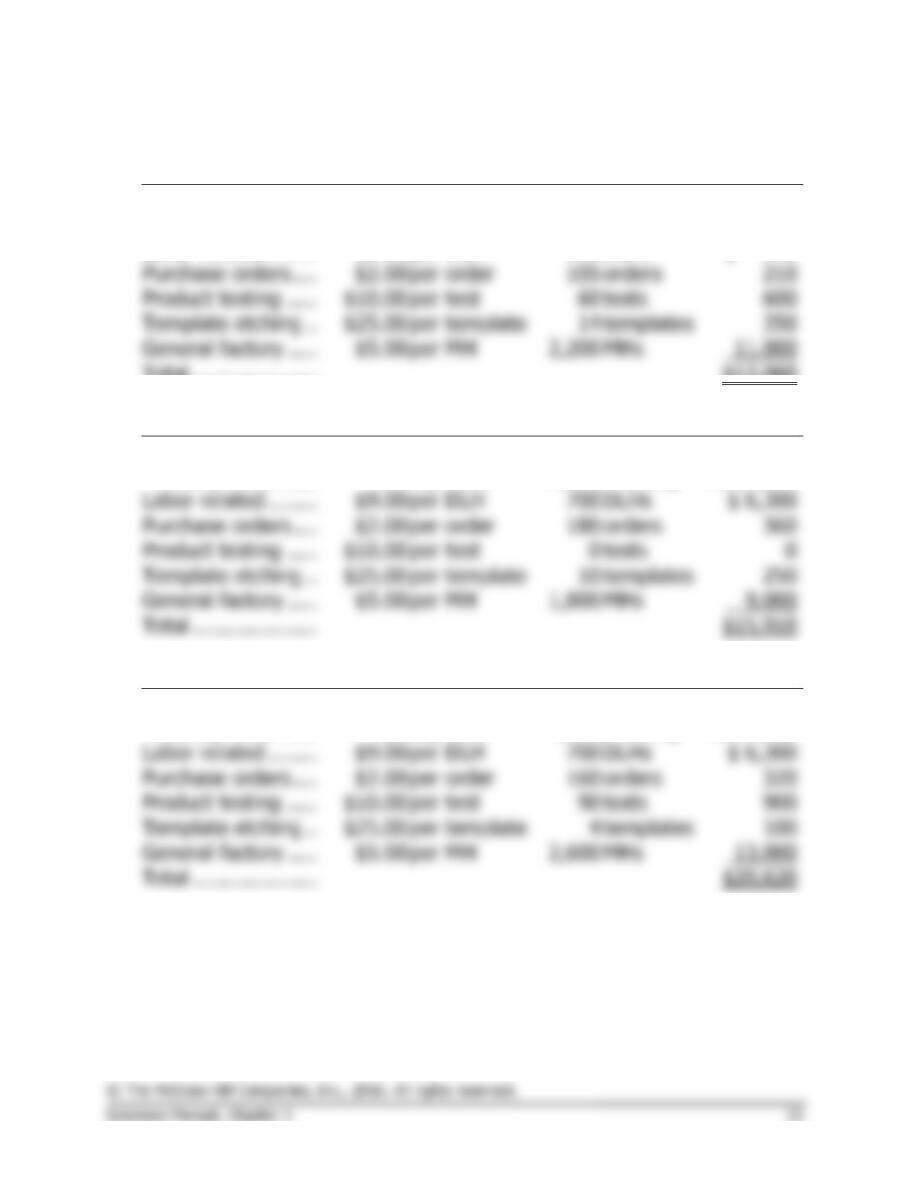
2. a. Overhead cost is assigned to the products as follows:
Product A
Activity Cost Pool
(a)
Activity Rate
(b)
Actual Activity
(a) × (b)
ABC Cost
Exercise 3-11 (continued)
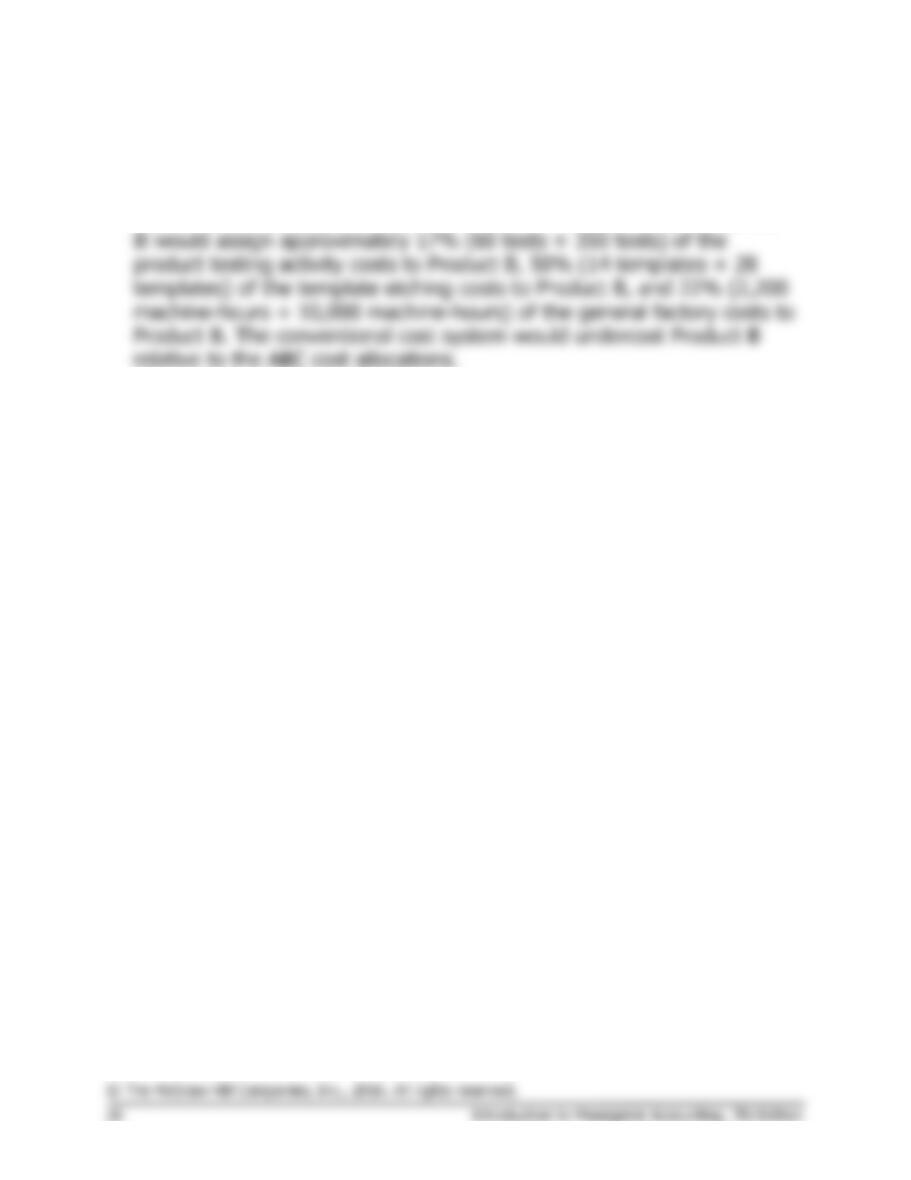
Product B
Activity Cost Pool
(a)
Activity Rate
(b)
Actual Activity
(a) × (b)
ABC Cost
Labor related ……..
$9.00
per DLH
100
DLHs
$ 900
Purchase orders ….
$2.00
per order
105
orders
Template etching ..
per template
templates
Total ………………..
$13,060
Product C
Activity Cost Pool
(a)
Activity Rate
(b)
Actual Activity
(a) × (b)
ABC Cost
Labor related ……..
$9.00
per DLH
700
DLHs
Purchase orders ….
$2.00
per order
180
orders
Product testing …..
per test
tests
Template etching ..
per template
templates
Total ………………..
$15,910
Product D
Activity Cost Pool
(a)
Activity Rate
(b)
Actual Activity
(a) × (b)
ABC Cost
Labor related ……..
$9.00
per DLH
700
DLHs
Purchase orders ….
$2.00
per order
160
orders
Product testing …..
per test
tests
Template etching ..
per template
templates
Total ………………..
$20,620
Exercise 3-11 (continued)
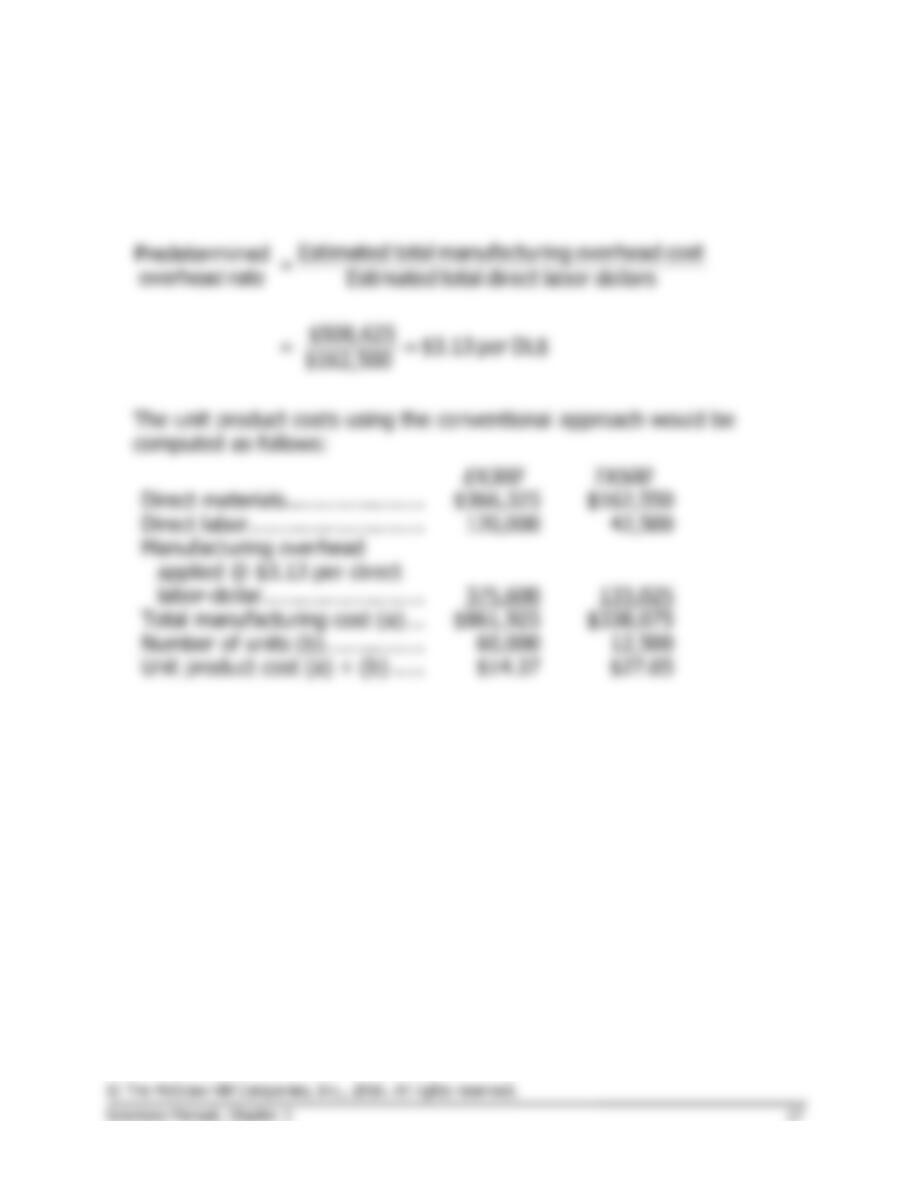
3. The conventional system would assign 5% (100 DLH ÷ 2,000 DLH) of all
overhead costs to Product B. The ABC system would assign 20% (105
orders ÷ 525 orders) of the purchase order activity costs to Product B.
Problem 3-12A (30 minutes)
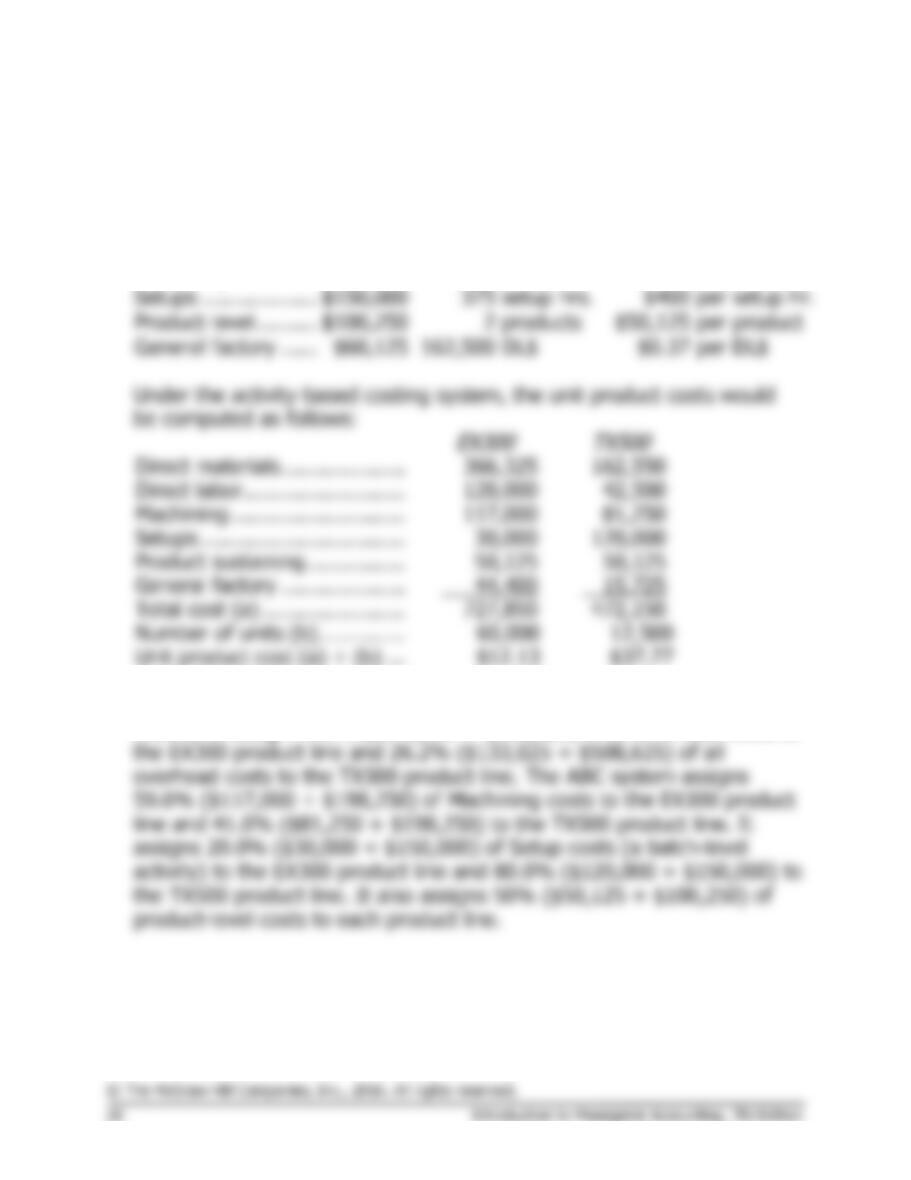
1. Under the traditional direct labor-dollar based costing system,
manufacturing overhead is applied to products using the predetermined
overhead rate computed as follows:
Problem 3-12A (continued)
2. The activity rates are computed as follows:
Activity Cost Pools
(a)
Total
Cost
(b)
Total Activity
(a) ÷ (b)
Activity Rate
Machining …………..
$198,250
152,500
MHR
$1.30
per MHR
Setups ……………….
$150,000
setup hrs.
per setup hr.
General factory ……
162,500
$0.37
per DL$
727,850
3. The traditional system uses one unit-level activity measure, direct labor
dollars, to assign 73.8% ($375,600 ÷ $508,625) of all overhead costs to
Problem 3-13A (15 minutes)
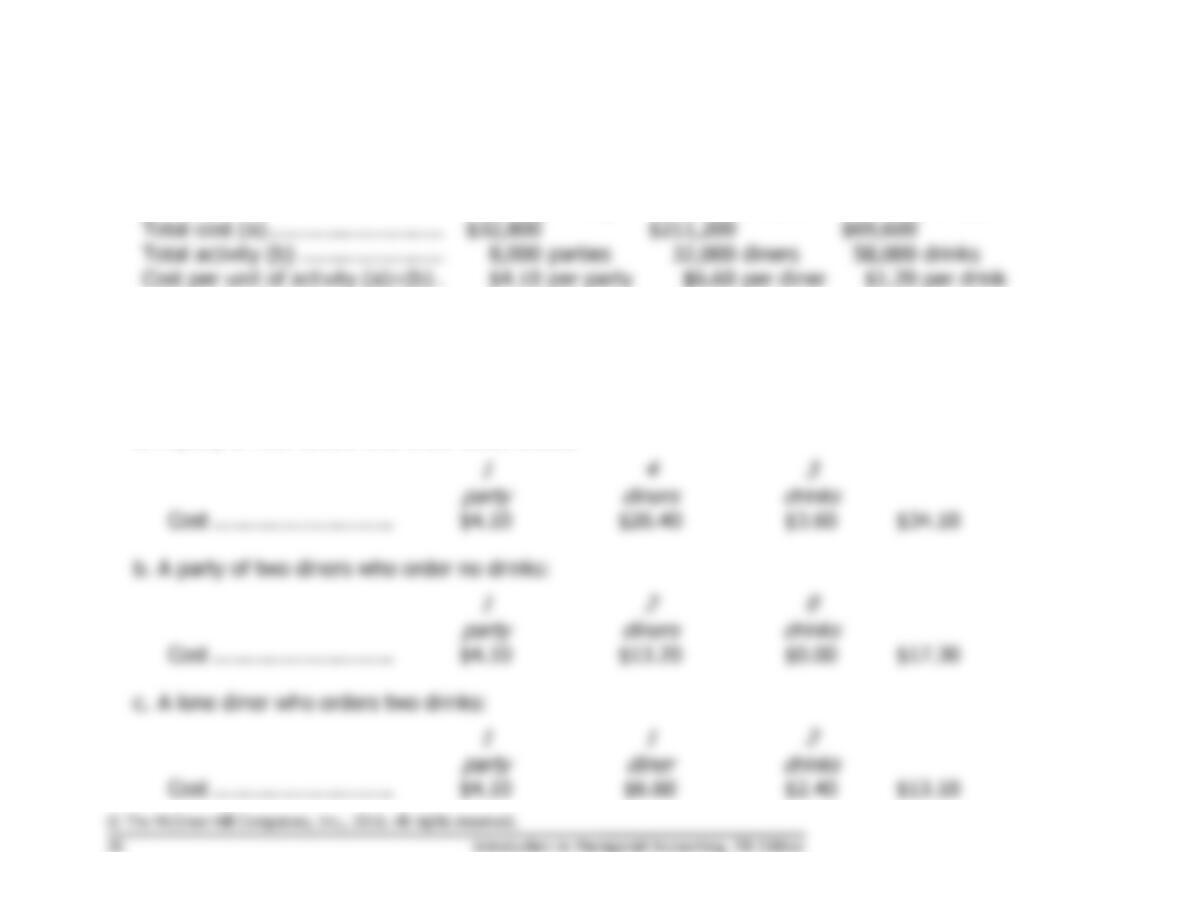
Activity
Level
Possible Activity Measures
a.
A percentage of all completed
goods are inspected on a
Unit
Facility
Arbitrary*
Employees are trained in
Facility or
Milling machines are used to
make components for
Unit
Number of units processed;
Machine-hours
general procedures.
Product
f.
The human resources
department screens and hires
new employees.
Facility
Arbitrary*
g.
Purchase orders are issued for
materials required in
production.
Batch
Number of purchase orders
Material is received on the
the production area.
Number of material moves
i.
The plant controller prepares
j.
The engineering department
makes modifications in the
Product
Engineering time
Machines are set up between
Facility
Arbitrary*
Problem 3-14A (60 minutes)
1. The first step is to determine the activity rates:
Serving a Party
Serving a Diner
Serving Drinks
Total activity (b) …………………..
parties
diners
drinks
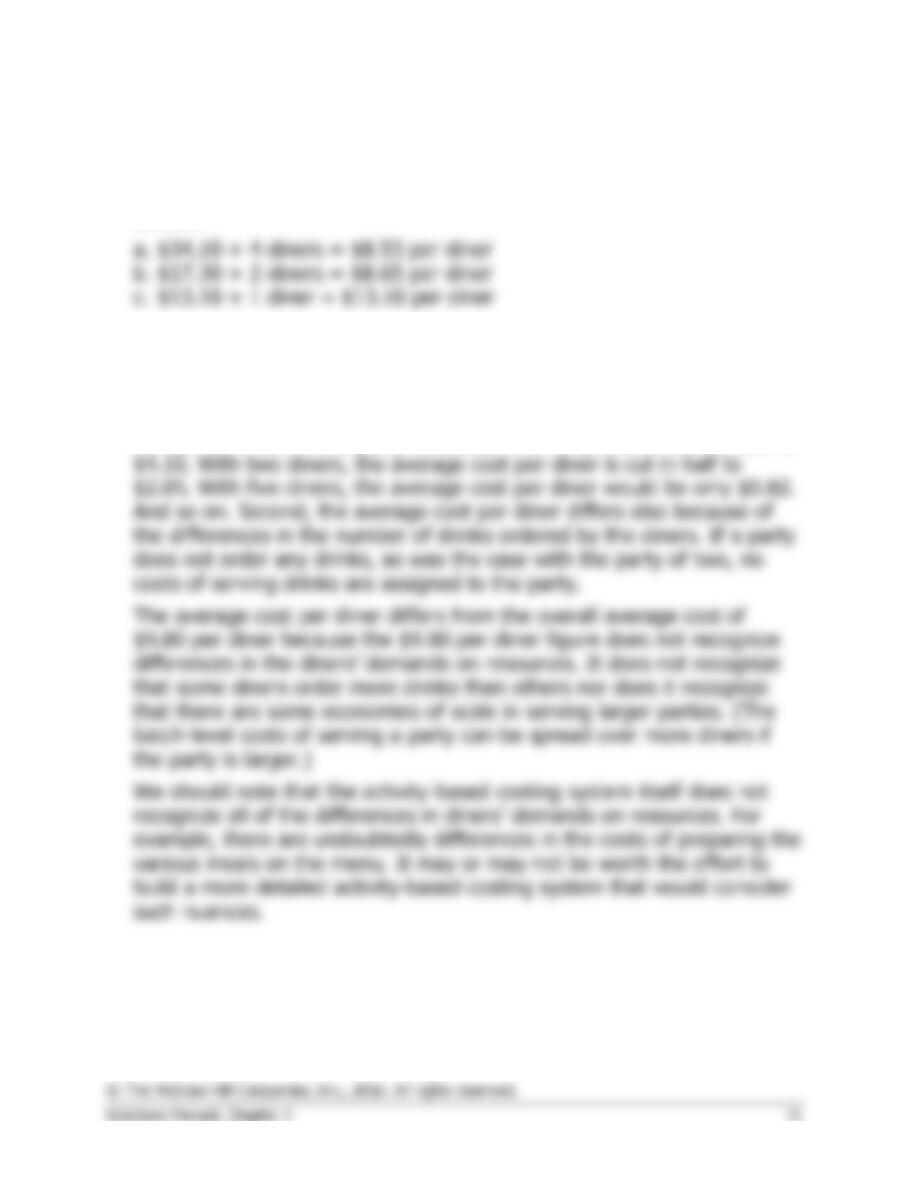
2. According to the ABC system, the cost of serving each of the parties can be computed as follows:
Serving a Party
Serving a Diner
Serving Drinks
Cost per unit of activity .
$4.10
per party
$6.60
per diner
$1.20
per drink
a. A party of four diners who order three drinks:
Cost ………………………..
Problem 3-14A (continued)
3. The average cost per diner for each party can be computed by dividing
the total cost of the party by the number of diners in the party as
follows:
4. The average cost per diner differs from party to party under the activity-
based costing system for two reasons. First, the cost of serving a party
($4.10) does not depend on the number of diners in the party.
Therefore, the average cost per diner of this activity decreases as the
number of diners in the party increases. With only one diner, the cost is
Problem 3-15A (45 minutes)
1. The company’s estimated total direct labor-hours for the year can be
computed as follows:
Flexible model: 1,000 units × 2.0 DLH per unit ….
2,000
Rigid model: 10,000 units × 1.0 DLH per unit ……
10,000
Total direct labor-hours ………………………………..
12,000
The unit product costs are computed as follows:
Flexible
Rigid
Direct materials ……………………
$110.00
$ 80.00
Direct labor …………………………
$50.00 per DLH × 2.0 DLHs …
Unit product cost …………………
$240.00
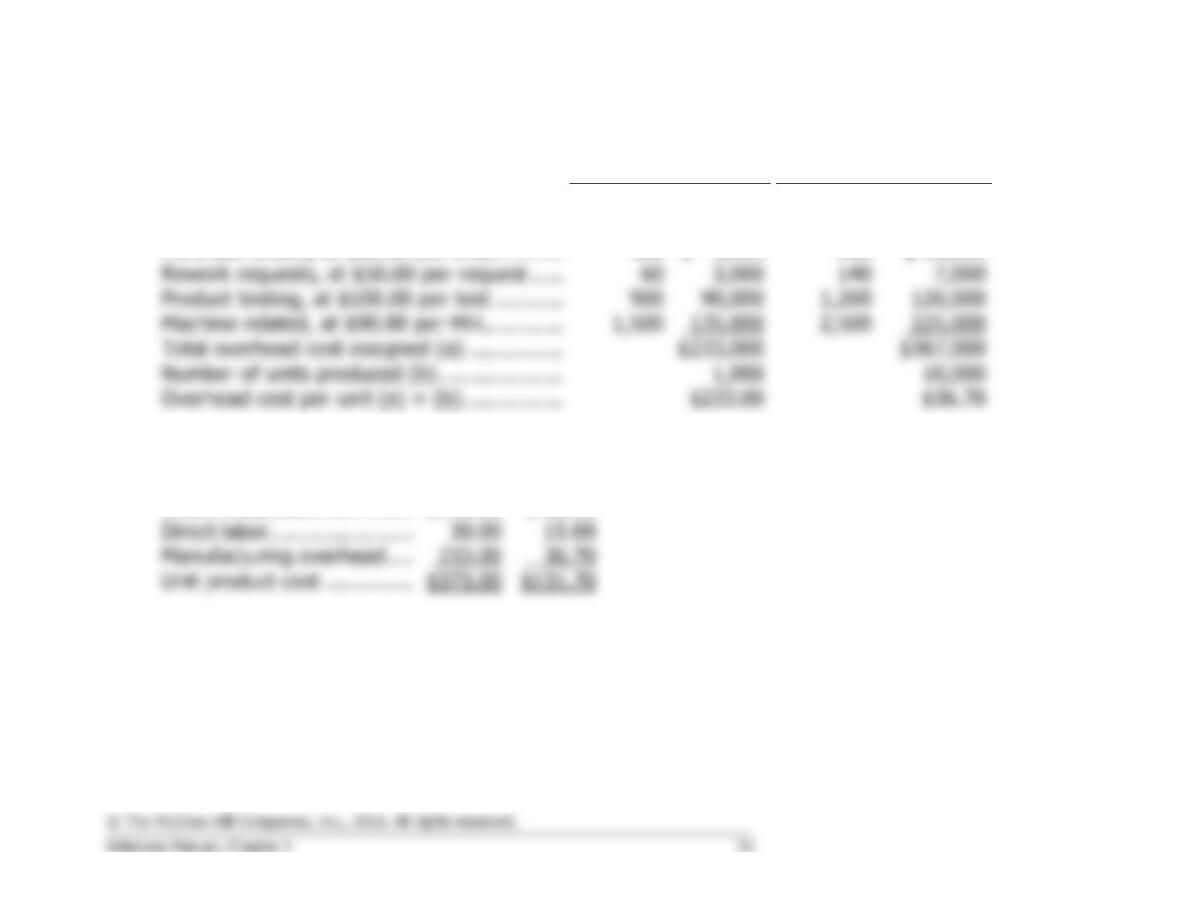
2. Activity rates can be computed as follows:
(a)
Estimated
(b)
Expected
Activity
(a) ÷ (b)
Activity Rate
Overhead
Activity Cost Pool
Cost
Purchase orders …
$20,000
400
orders
$50.00
per order
Rework requests ..
$10,000
200
requests
$50.00
Machine related …
MHs
$90.00
per MH
Problem 3-15A (continued)
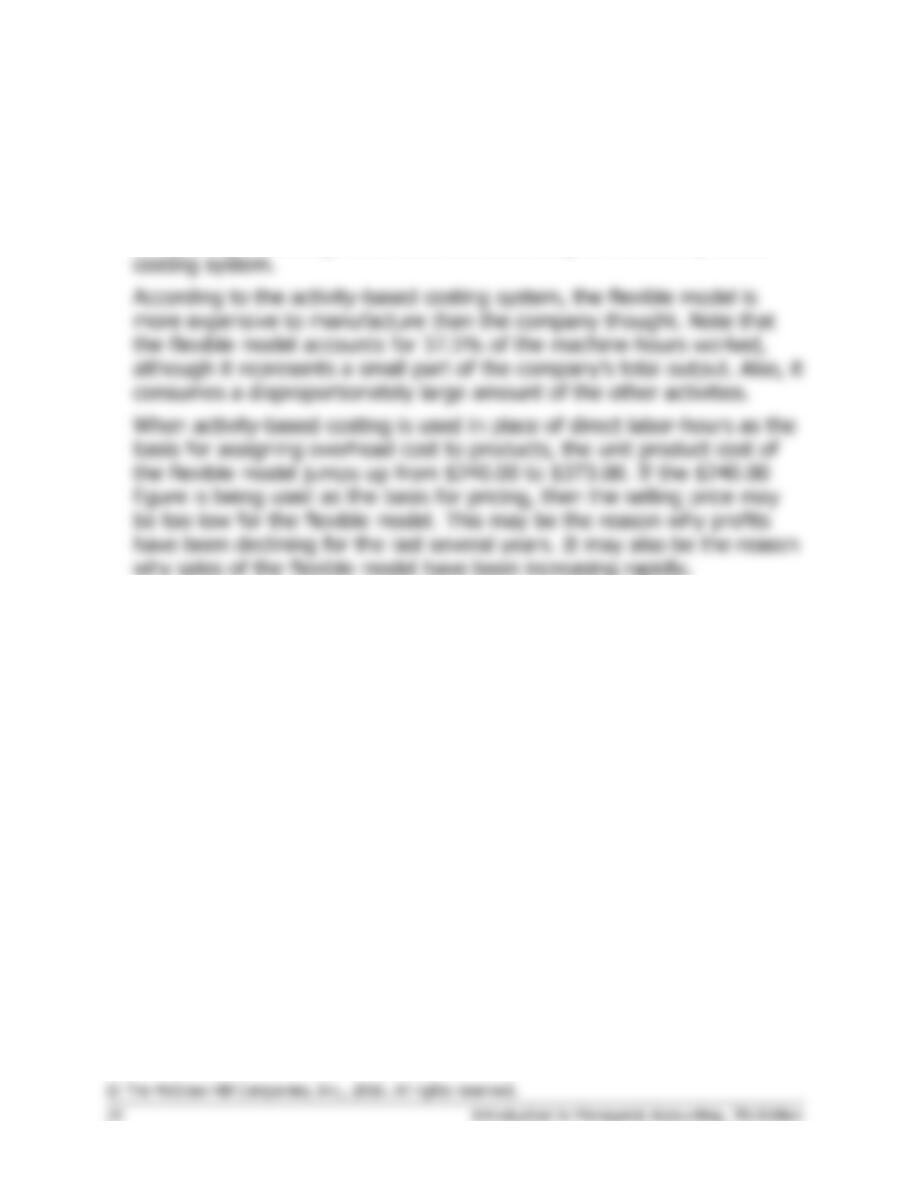
3. a.
Flexible
Rigid
Expected
Expected
Activity
Amount
Activity
Amount
Purchase orders, at $50.00 per order ………
100
$ 5,000
300
$ 15,000
Product testing, at $100.00 per test ………..
Machine related, at $90.00 per MH ………….
225,000
Total overhead cost assigned (a) ……………
Number of units produced (b) ………………..
Overhead cost per unit (a) ÷ (b) …………….
b. Using activity-based costing, the unit product costs would be:
Flexible
Rigid
Direct materials ……………..
$110.00
$ 80.00
Direct labor …………………..
Manufacturing overhead ….
233.00
Unit product cost …………..
$373.00
Problem 3-15A (continued)
4. Unit product costs are distorted as a result of using direct labor-hours as
the base for applying overhead costs to products. Although the flexible
model requires twice as much labor as the rigid model, it still is not
being assigned enough overhead cost according to the activity-based
Problem 3-16A (45 minutes)
1. The company expects to work 40,000 direct labor-hours, computed as
follows:
LEC 40: 60,000 units × 0.40 DLH per unit ………….
24,000
DLHs
LEC 90: 20,000 units × 0.80 DLH per unit ………….
16,000
DLHs
Total direct labor-hours ………………………………….
40,000
DLHs
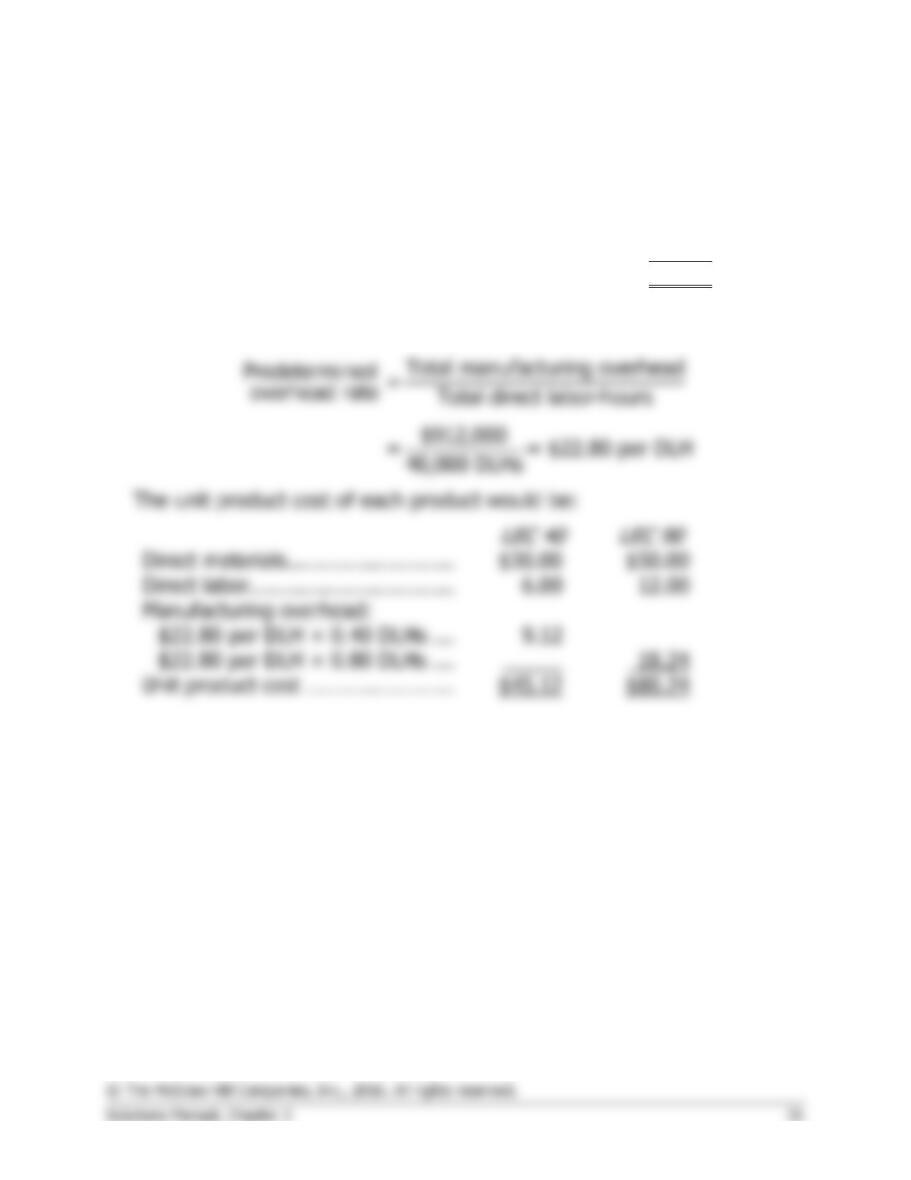
Using direct labor-hours as the base, the predetermined manufacturing
overhead rate would be:
Direct materials ………………………
Direct labor …………………………...
Unit product cost ……………………
Problem 3-16A (continued)
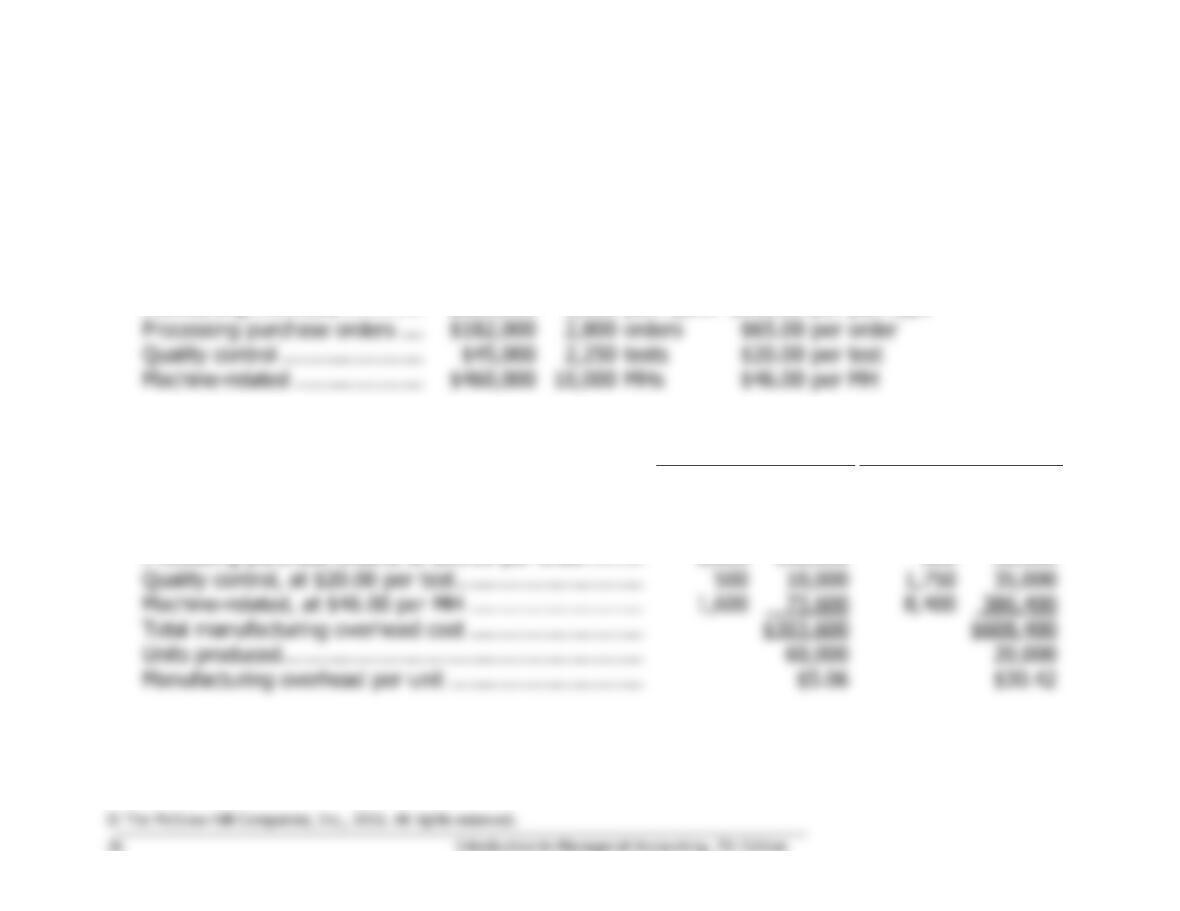
2. Activity rates can be computed as follows:
Activity Cost Pool
(a)
Estimated
Overhead
Cost
(b)
Expected Activity
(a) ÷ (b)
Activity Rate
Maintaining inventory ………….
$225,000
1,500
part types
$150.00
per part type
Processing purchase orders ….
orders
per order
Quality control …………………..
2,250
tests
per test
Machine-related …………………
$460,000
MHs
per MH
3 a.
LEC 40
LEC 90
Expected
Activity
Amount
Expected
Activity
Amount
Maintaining parts inventory, at $150.00 per part type..
600
$ 90,000
900
$135,000
Processing purchase orders, at $65.00 per order ………
2,000
130,000
800
52,000
Quality control, at $20.00 per test …………………………
500
Machine-related, at $46.00 per MH ……………………….
1,600
Total manufacturing overhead cost ……………………….
$303,600
$608,400
Units produced………………………………………………….
Manufacturing overhead per unit ………………………….
$30.42
Problem 3-16A (continued)
b. Using activity-based costing, the unit product costs would be:
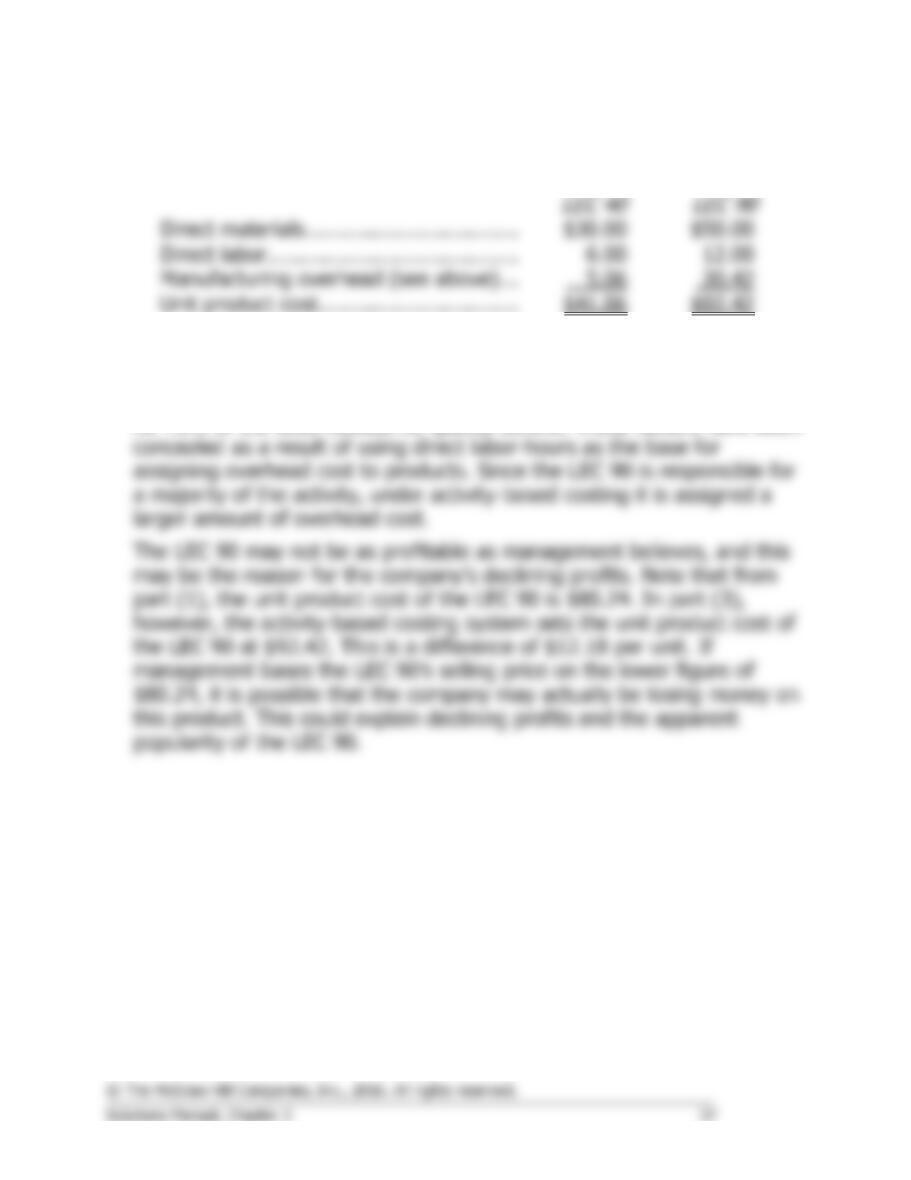
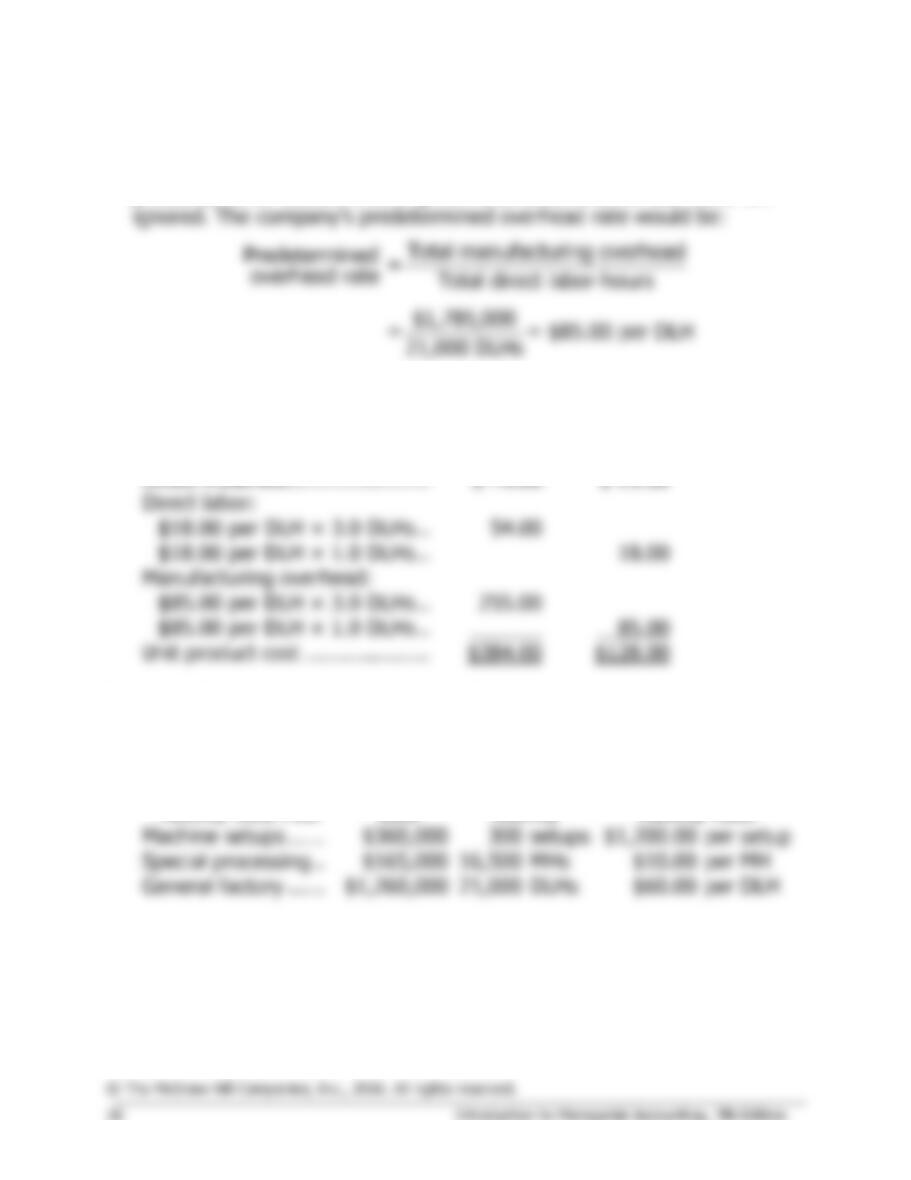
4. Although the LEC 90 accounts for only 25% of the company’s total
production, it is responsible for 60% of the part types carried in
inventory and 84% of the machine-hours worked. It is also responsible
for 78% of the tests needed for quality control. These factors have been
Problem 3-17A (45 minutes)
1. a. When direct labor-hours are used to apply overhead costs to
products, other factors affecting the incurrence of overhead costs are
b. The unit product costs are computed as follows:
Model N
800 XL
Model N
500
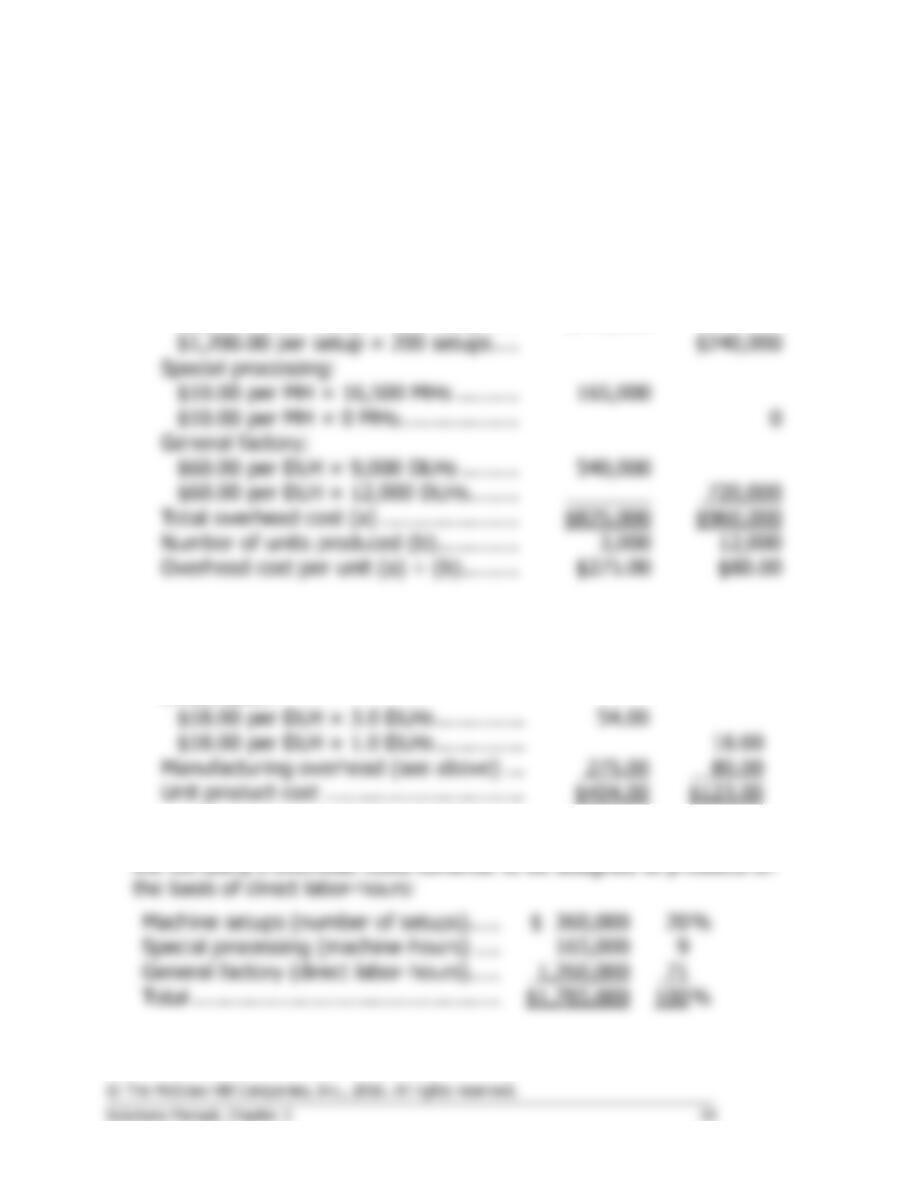
2. a. Activity rates can be computed as follows:
Activity Cost Pool
(a)
Estimated
Overhead
Cost
(b)
Expected
Activity
(a) ÷ (b)
Activity Rate
Problem 3-17A (continued)
b. The unit product costs would now be computed as follows, starting
with the computation of the manufacturing overhead:
Model N 800
XL
Model N
500
Machine setups:
$1,200.00 per setup × 100 setups ….
$120,000
Special processing:
$60.00 per DLH × 12,000 DLHs ……..
720,000
Total overhead cost (a) ………………….
$825,000
Number of units produced (b) ………….
Model N 800
XL
Model N
500
Direct materials ……………………………..
$ 75.00
$25.00
Direct labor:
$18.00 per DLH × 3.0 DLHs …………..
Unit product cost …………………………..
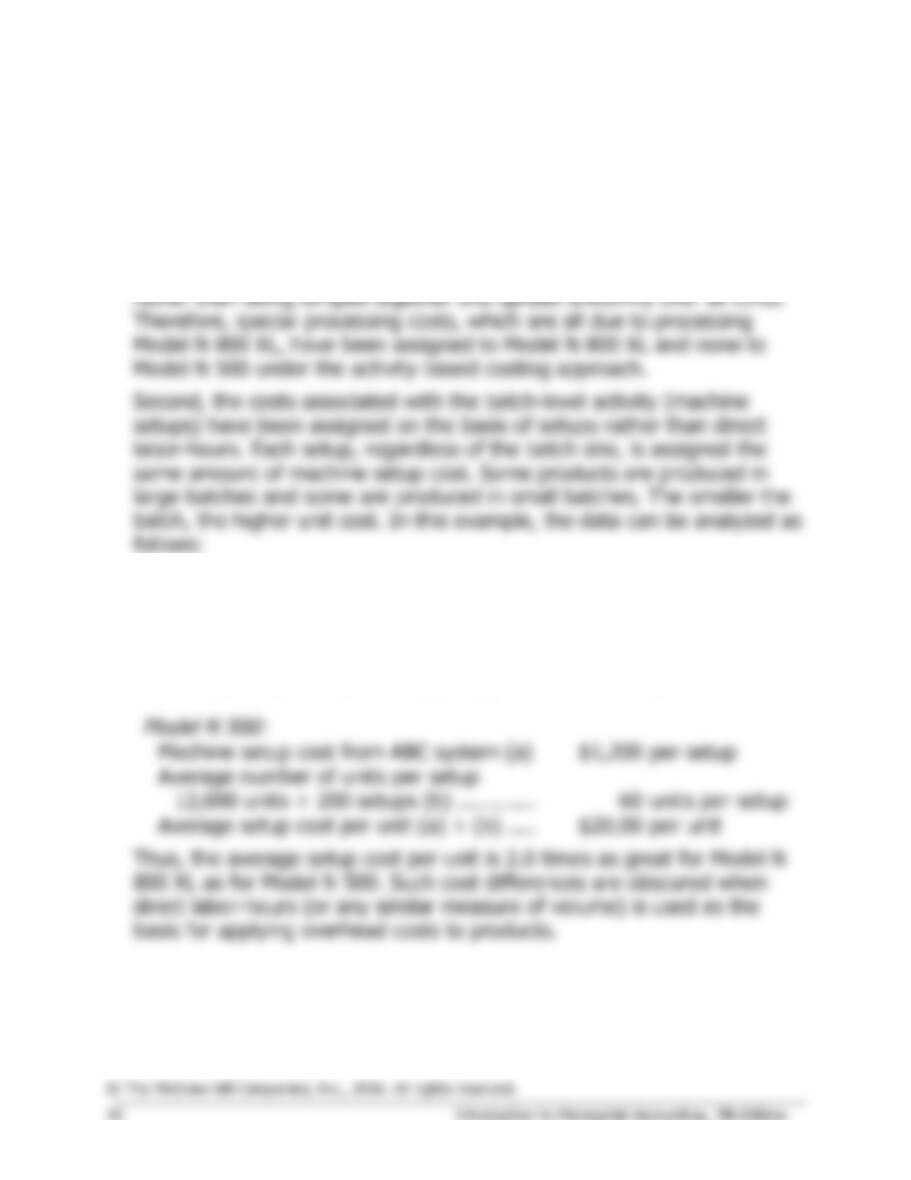
3. It is important to note that, even under activity-based costing, 71% of
Machine setups (number of setups) …..
%
General factory (direct labor-hours) …..
Total …………………………..……………..
%
Problem 3-17A (continued)
Thus, the shift in overhead cost from the high-volume product Model N
500 to the low-volume product Model N 800 XL occurred as a result of
reassigning only 29% of the company’s overhead costs.
The increase in unit cost of Model N 800 XL can be explained as follows:
First, where possible, overhead costs have been traced to the products
Model N 800 XL:
Machine setup cost from ABC system (a)
$1,200
per setup
Average number of units per setup
3,000 units ÷ 100 setups (b) ……………
30
units per setup
Average setup cost per unit (a) ÷ (b) …..
$40.00
per unit
Model N 500:
per setup
60
units per setup
per unit