Chapter 03 – Operating Decisions and the Accounting System
3-1
CHAPTER 3
OPERATING DECISIONS AND THE ACCOUNTING SYSTEM
Learning Objectives and Related Assignment Materials
Learning Objectives
Mini-
Exercises
Exercises
Problems
Alternate
Problems
Continuing
Problem
Comprehensive
Problem
Cases and
Projects
3-1 Describe a
typical
business
1
1
3-2 Explain how
business
1, 3, 4
1, 3, 4,
17
1, 2, 3, 7
measure
income.
3-3 Explain the
accrual basis
of accounting
1, 2, 3, 4
1, 2, 3,
4, 10,
13, 17
5, 7, 6
3-4 Apply
transaction
analysis to
5, 6, 7, 8
5, 6, 7,
8, 9,
10, 13,
1, 2, 3,
4, 6, 7
1, 2, 3,
4, 6
1
1
1, 2, 3, 5
3-5 Prepare a
classified
income
9,
11, 14,
16, 17,
20
4, 6
4, 6
1
1
5
Chapter 03 – Operating Decisions and the Accounting System
3-2
statement.
3-6 Compute and
interpret the
10,
18, 20
4, 6
4, 6
1
1
1, 2, 3, 4,
7
Synopsis of Chapter Revisions
Focus Company: Chipotle Mexican Grill
• Chapter 3 builds on Chapter 2 by explaining and illustrating transaction analysis for operating
activities for the first quarter of 2018 for Chipotle Mexican Grill. Using journal entry and T-
• Focus and contrast company data updated.
• Enhanced concepts based on the FASB’s Accounting Standards update for revenue recognition.
• Highlighted GUIDED HELP feature provides free access to step-by-step video instruction
applying transaction analysis to identify accounts and effects on the accounting equation, as well
as for identifying revenue and expense account titles and amounts for a given period.
• New General Ledger Problem designations for a few exercises and problems that also may be
Chapter 03 – Operating Decisions and the Accounting System
3-3
PowerPoint Slides
Learning Objectives
PowerPoint® Slides
3-1 Describe a typical business operating cycle and explain the necessity for
the time period assumption.
3-3 through 3-6
statement.
3-3 Explain the accrual basis of accounting and apply the revenue and
expense recognition principles to measure income.
3-17 through 3-28
3-4 Apply transaction analysis to examine and record the effects of operating
activities on the financial statements.
3-29 through 3-46
3-7 Identify operating transactions and demonstrate how they affect cash flows.
3-52 through 3-53
3-2 Explain how business activities affect the elements of the income
3-7 through 3-16
Chapter Take-Aways
3-1 Describe a typical business operating cycle and explain the necessity for the time period
assumption.
3-2 Explain how business activities affect the elements of the income statement.
▪ Elements on the income statement:
a. Revenues—increases in assets or settlements of liabilities from major or central ongoing
3-3 Explain the accrual basis of accounting and apply the revenue and expense recognition
principles to measure income.
3-4 Apply transaction analysis to examine and record the effects of operating activities on the
financial statements.
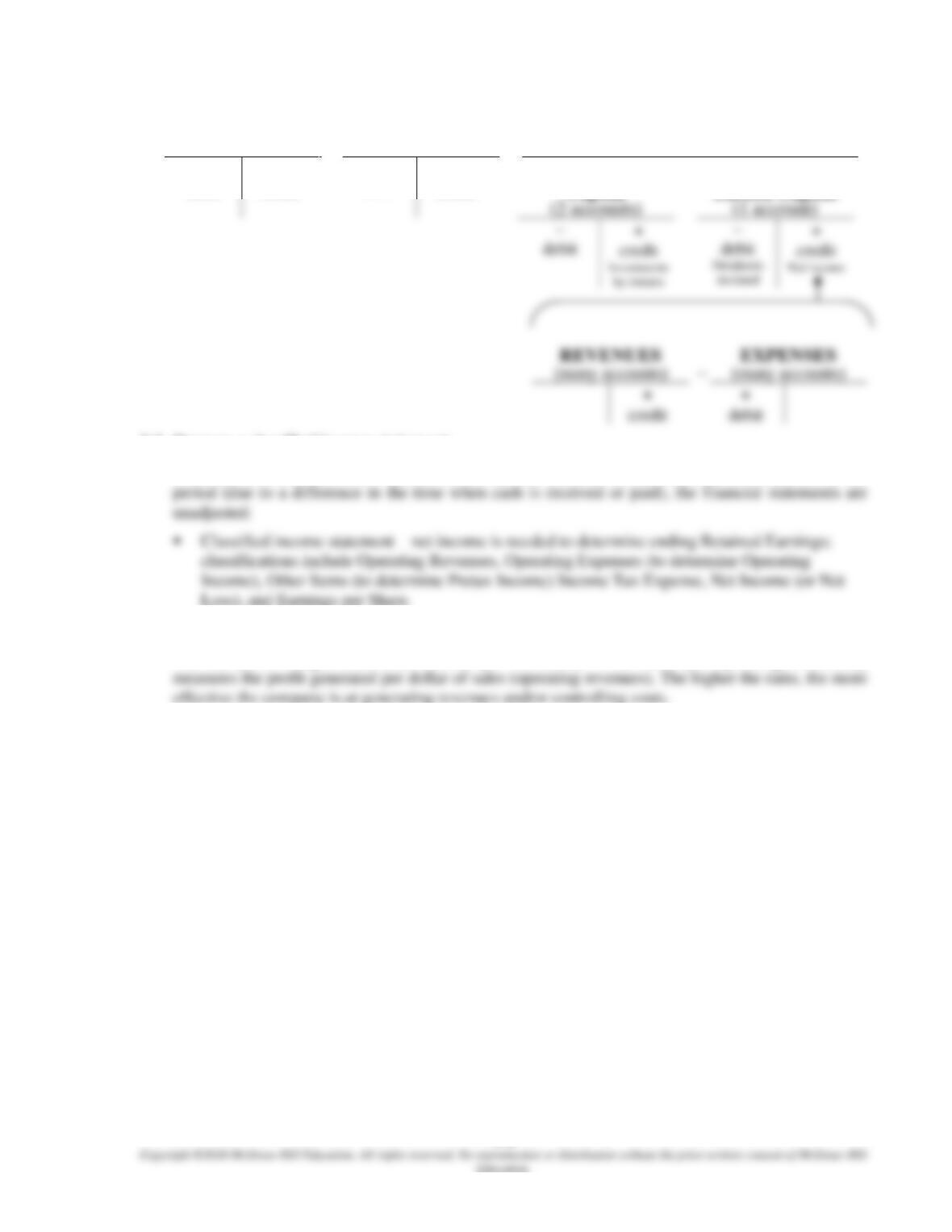
The expanded transaction analysis model includes revenues and expenses:
Chapter 03 – Operating Decisions and the Accounting System
3-4
ASSETS
(many accounts)
=
LIABILITIES
(many accounts)
+
STOCKHOLDERS’ EQUITY
+
debit
–
credit
–
debit
+
credit
(many accounts)
(many accounts)
Contributed
Capital
Earned Capital
3-5 Prepare a classified income statement.
Until the accounts have been updated to include all revenues earned and expenses incurred in the
3-6 Compute and interpret the net profit margin ratio.
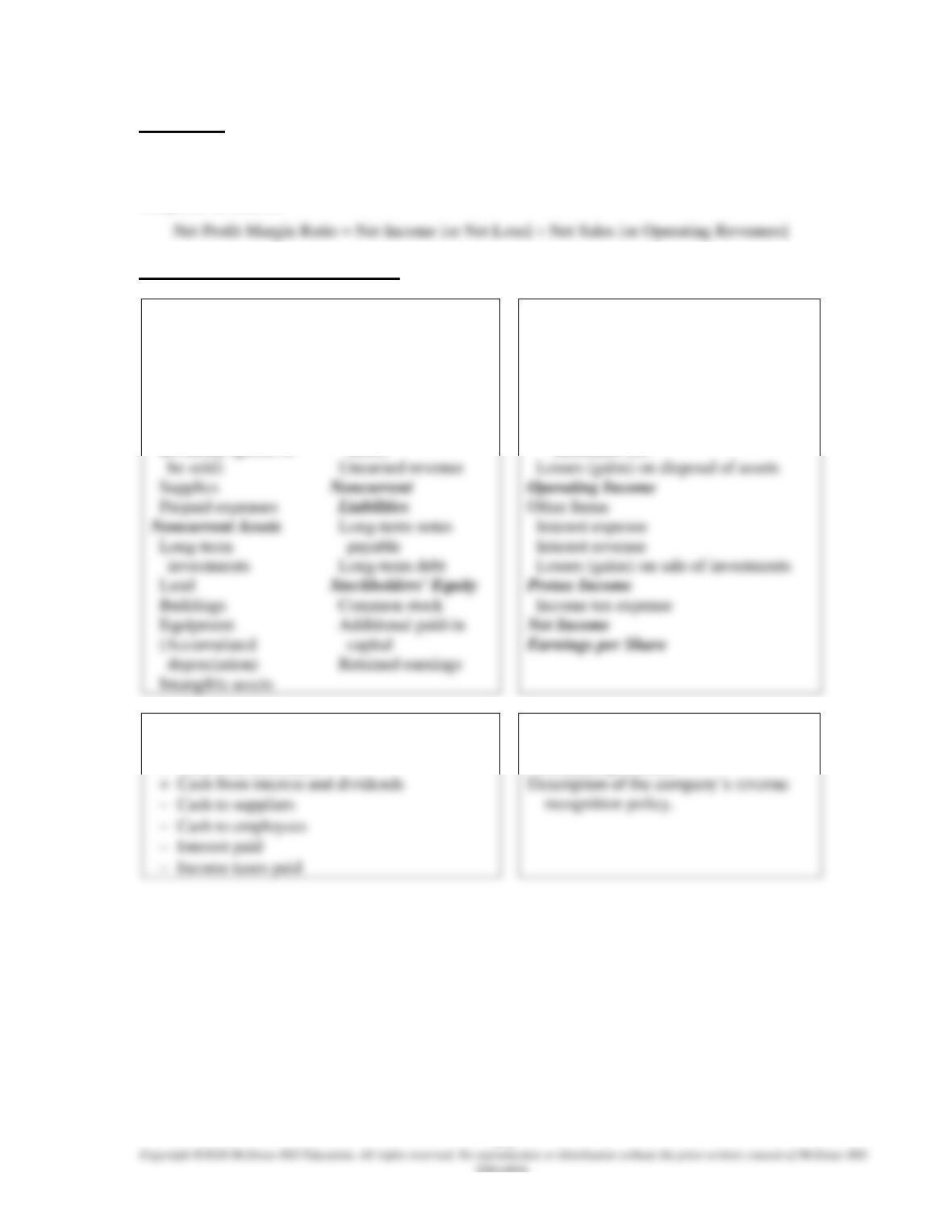
The net profit margin ratio (Net Income [or Net Loss] ÷ Net Sales [or Operating Revenues])
effective the company is at generating revenues and/or controlling costs.
3-7 Identify operating transactions and demonstrate how they impact cash flows.
Chapter 03 – Operating Decisions and the Accounting System
3-5
Key Ratio
Net profit margin ratio measures the profit generated per dollar of sales (operating revenues). A high
ratio suggests that a company is generating revenues and/or controlling expenses effectively. The ratio is
computed as follows:
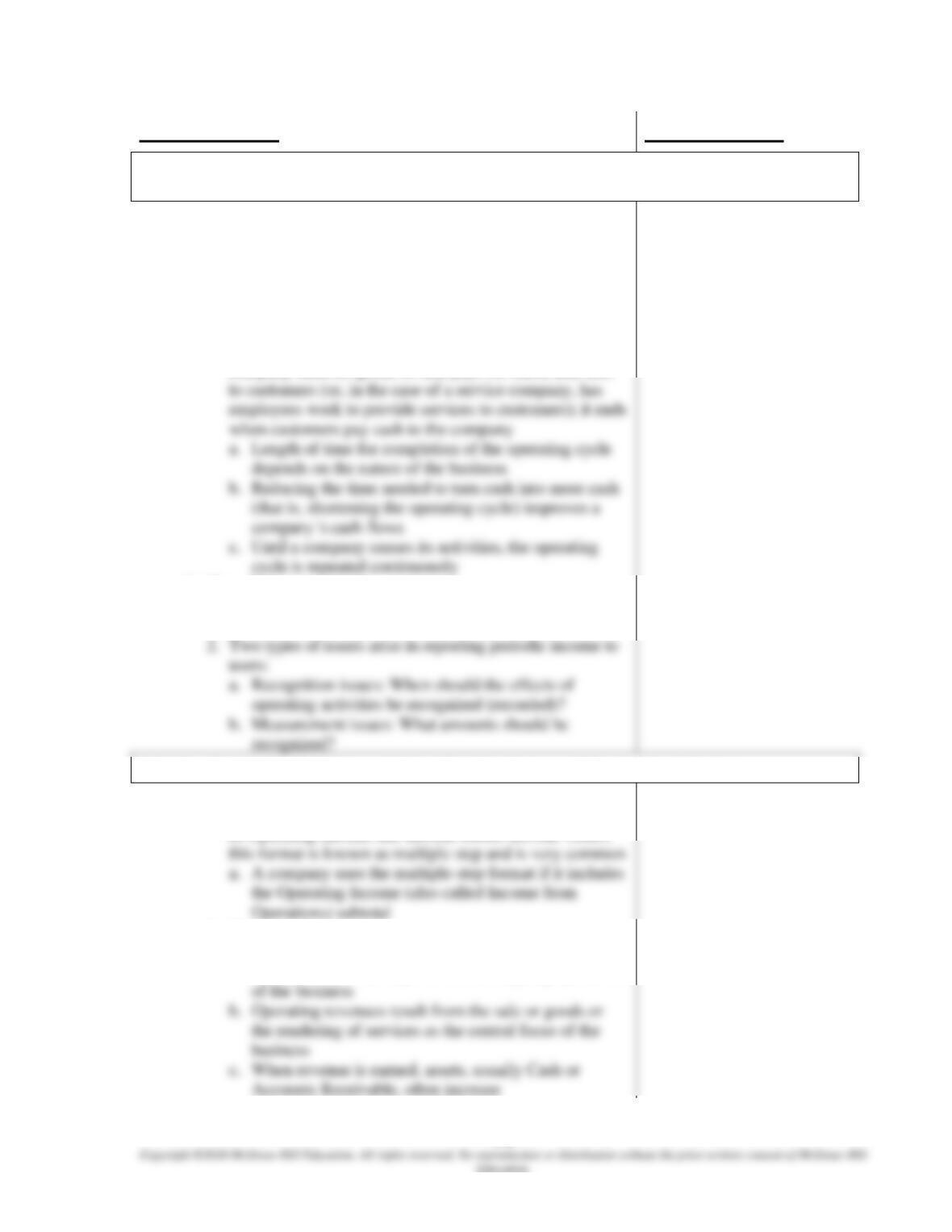
Finding Financial Information
BALANCE SHEET
INCOME STATEMENT
Current Assets
Cash
Short-term
investments
Accounts and notes
receivable
Inventory (goods to
Current Liabilities
Accounts payable
Short-term notes
payable
Accrued expenses
payable (e.g., wages,
taxes)
Revenues (operating)
Sales (from various operating
activities)
Expenses (operating)
Cost of goods sold (used inventory)
Rent, wages, depreciation,
insurance, etc.
STATEMENT OF CASH FLOWS
NOTES
Under operating activities
+ Cash from customers
Under Summary of Significant
Accounting Policies
Chapter 03 – Operating Decisions and the Accounting System
3-6
Chapter Outline
Teaching Notes
LO 3-1 Describe a typical business operating cycle and explain the necessity for the time period
assumption.
I. How do Business Activities Affect the Income Statement
A. The Operating Cycle – the time it takes for a company to pay
cash to suppliers, sell goods and services to customers, and
collect cash from customers
1. To stay in business, excess cash must be generated from
operations rather than from borrowing money or selling
long-lived assets
when customers pay cash to the company
b. Reducing the time needed to turn cash into more cash
(that is, shortening the operating cycle) improves a
2. Operating (or cash-to-cash) cycle – begins when a
company receives goods to sell, pays for them, and sells
B. Time Period Assumption
1. Time period assumption – indicates that the long life of a
company can be reported in shorter time periods.
2. Two types of issues arise in reporting periodic income to
b. Measurement issues: What amounts should be
LO 3-2 Explain how business activities affect the elements of the income statement.
C. Elements on the Income Statement
1. Multi-step income statement has multiple subtotals, such
as Operating Income and Income before Income Taxes;
Illustrated in Exhibit 3.1
2. Operating Revenues
b. Operating revenues result from the sale or goods or
the rendering of services as the central focus of the
a. Revenues––increases in assets or settlements of
liabilities from the major or central ongoing operations
Chapter 03 – Operating Decisions and the Accounting System
3-7
d. If a customer pays for goods or services in advance, a
3. Operating Expenses
c. Not all cash expenditures are expenses, but expenses
a. An expenditure is any outflow of cash for any
purpose, whether to buy equipment, pay off a bank
Some students confuse the
terms expenditures and
4. Operating Income (also called Income from Operations)
a. Operating revenues – operating expenses = operating
5. Other Items
a. Activities affecting an income statement that are not
central to ongoing operations are not considered part
of operating income, but are instead categorized as
Other Items.
b. Typically include:
6. Operating Income +/– Other Items = Income before
Income Taxes (or pretax income)
Taxes) – Calculated as a percentage of pretax income
8. Income before Income Taxes – Income Tax Expense =
7. Income Tax Expense (also called Provision for Income
See Financial Analysis
Chapter 03 – Operating Decisions and the Accounting System
3-8
9. Earnings per Share (EPS)
See Data Analytics feature
a. Must be disclosed on the income statement or in the
“Using Big Data in the
Stock Outstanding
II. How are Operating Activities Recognized and Measured?
A. Cash Basis Accounting
do not need to report to external users
LO 3-3 Explain the accrual basis of accounting and apply the revenue and expense recognition
principles to measure income.
B. Accrual Accounting
1. Cash basis financial statements are not very useful to
external decision makers
recognition of revenues and expenses long before or
after goods and services are produced and delivered
liabilities of a company on a particular date
a. Financial statements created under cash basis
expenses when they are incurred to generate revenues
2. In accrual basis accounting, revenues and expenses are
recognized when the transaction that causes them occurs,
3. Revenue Recognition Principle
a. The core revenue recognition principle specifies both
the timing and amount of revenue to be recognized
during an accounting period; it requires that a
Chapter 03 – Operating Decisions and the Accounting System
3-9
ii. Cash is received in the same period as the goods or
services are delivered – Revenue is recorded
iii. Cash is received after the goods or services are
delivered – Revenue is recorded
• Later, when the customer pays the bill, Cash is
Complex Sales Contracts:
Refer students to Pause for
4. Expense Recognition Principle (also called the matching
principle)
Illustrated in Exhibit 3.3
i. Cash is paid before the expense is incurred to
generate revenue –– Expense is not recorded
• Cash is decreased and an asset (called
a. Requires that costs incurred to generate revenues be
recognized in the same period––a matching of costs
Help 3.1
iii. Cash is paid after the cost is incurred to generate
revenue – Expense is recorded
See A Question of Ethics
feature “Management’s
• A liability (an accrued expense obligation)
Incentives to Violate
LO 3-4 Apply transaction analysis to examine and record the effects of operating activities on the
financial statements.
III. The Expanded Transaction Analysis Model
Illustrated in Exhibit 3.4
A. Transaction Analysis Rules
1. All accounts can increase or decrease, although revenues
Chapter 03 – Operating Decisions and the Accounting System
Earnings)
B. Transaction Analysis Steps
Steps listed in Exhibit 3.5
1. Ask → Was a revenue earned by delivery goods or
services?
• If so, credit the revenue account and debit
the appropriate accounts for what was received
Or Ask → Was an expense incurred to generate a revenue
in the current period?
• If so, debit the expense account and credit the
appropriate accounts for what was given
Or Ask → If no revenue was earned or expense incurred,
what was received and given?
two accounts change.
• Determine the direction of the effect. Did the account
2. Step 2: Verify → Is the accounting equation in balance?
(A = L + SE)
C. Analyzing Chipotle’s Transactions (in millions of dollars)
1. Transaction (1) Chipotle purchased food, beverage, and
packaging supplies costing $370, paying $290 in cash and
owing the rest on account.
Use Supplemental
Enrichment Activity #1
dr Supplies (+A)
cr Cash (–A)
Supplies (A) + 370 + Cash (A) – 290 = Accounts Payable
(L) +80
insurance, and advertising.
cr Cash (–A)
Prepaid Expenses (A) + 80 + Cash (A) – 80 = No change
2. Transaction (2) At the beginning of January, Chipotle
paid $80 cash in advance for prepaid expenses for rent,
Chapter 03 – Operating Decisions and the Accounting System
3-11
dr Cash (+A)
cr Restaurant Sales Revenue
Restaurant Sales Revenue (R, SE) + 1,228
3. Transaction (3) During the first quarter, Chipotle sold
food to customers for $1,228; $44 was sold to universities
on account (to be paid by the universities next quarter)
and the rest was received in cash in the stores. Note: To
4. Transaction (4) Chipotle paid $41 for management
training expenses.
cr Cash (–A)
Assets = Liabilities + Stockholders’ Equity
5. Transaction (5) Chipotle paid employees $177 for work
this quarter and $83 for work last quarter (recorded last
quarter as Wages Expense and Wages Payable).
dr Salaries & Wages Expense (+E)
6. Transaction (6) Chipotle sold for cash equipment costing
$9 at a loss of $4.
This is an example of a
peripheral activity; it will be
dr Cash (+A)
5
dr Loss on Disposal of Assets (+E)
Cash (A) +5 + Equipment (A) –9= Loss on Disposal of
Assets (E, SE) –4
covered in more depth in
7. Transaction (7) Chipotle received $39 cash from
customers paying on their accounts.
dr Cash (+A)
Cash (A) + 39 + Accounts Receivable (A) – 39 = No
change
Chapter 03 – Operating Decisions and the Accounting System
3-12
dr Income Tax Payable -L)
Assets = Liabilities + Stockholders’ Equity
Payable (L) – 72 + Income Tax Payable (L) – 18
8. Transaction (8) During the quarter, Chipotle paid
suppliers $74 on accounts payable. It also paid $72 on
utilities payable and $18 in income taxes payable from
9. Transaction (9) Chipotle paid $75 for utilities used during
the quarter and paid $19 for repairs and maintenance of
its facilities and equipment during the quarter.
dr Repairs Expense (+E) (–SE)
Cash (A) – 94= Utilities Expense (E, SE) – 75 + Repairs
Expense (E, SE) – 19
10. Transaction (10) Chipotle received $1 cash as interest
revenue earned during the quarter.
cr Interest Revenue (+R) (+SE)
Cash (A) + 1= Interest Revenue (R, SE) + 1
cr Unearned Revenue (+L)
Help 3.2
11. Transaction (11) During the quarter, Chipotle sold gift
cards to customers for $42 in cash (expected to be
LO 3-5 Prepare a classified income statement.
IV. How is the Income Statement Prepared and Analyzed?
A. Unadjusted Trial Balance
See illustration in text
trial balance.
2. Accounts are listed in financial statement order: assets,
expenses/losses.
adjustments have been made yet to reflect all revenues
1. Before preparing any financial statements, we must first
determine that the debits equal credits by generating a
Chapter 03 – Operating Decisions and the Accounting System
3-13
B. Classified Income Statement
would not be presented to external users
LO 3-6 Compute and interpret the net profit margin ratio.
C. Net Profit Margin Ratio
1. Net Profit Margin Ratio = Net Income ÷ Net Sales (or
Operating Revenues )
dollar generated during the period is profit
3. A rising net profit margin signals more efficient
2. Net profit margin measures how much of every sales
Use Supplemental
changes in managing sales volume, sales price, and costs
LO 3-7 Identify operating transactions and demonstrate how they impact
cash flows.
D. Focus on Cash Flows: Operating Activities
1. The statement of cash flows divides all transactions that
affect cash into three categories:
a. O––Operating activities include those primarily with
2. Accounts associated with operating activities are current
assets, such as Accounts Receivable, Inventories, and
Chapter 03 – Operating Decisions and the Accounting System
3-14
Supplemental Enrichment Activities
Note: These activities would be suitable for individual or group activities.
1. Handout 3-1
Use this handout for an in-class activity designed to review transaction analysis (preparation of
2. Handout 3-2
Use this handout for an in-class activity designed to review the posting to T-accounts. This activity is
3. Handout 3-3
Use this handout for an in-class activity designed to review the preparation of a trial balance. This
4. Handout 3-4
Use this handout for an in-class activity designed to review the preparation of an income statement.
5. Use Handout 3-5
Use this handout for an in-class activity designed to review the calculation and interpretation of the
Chapter 03 – Operating Decisions and the Accounting System
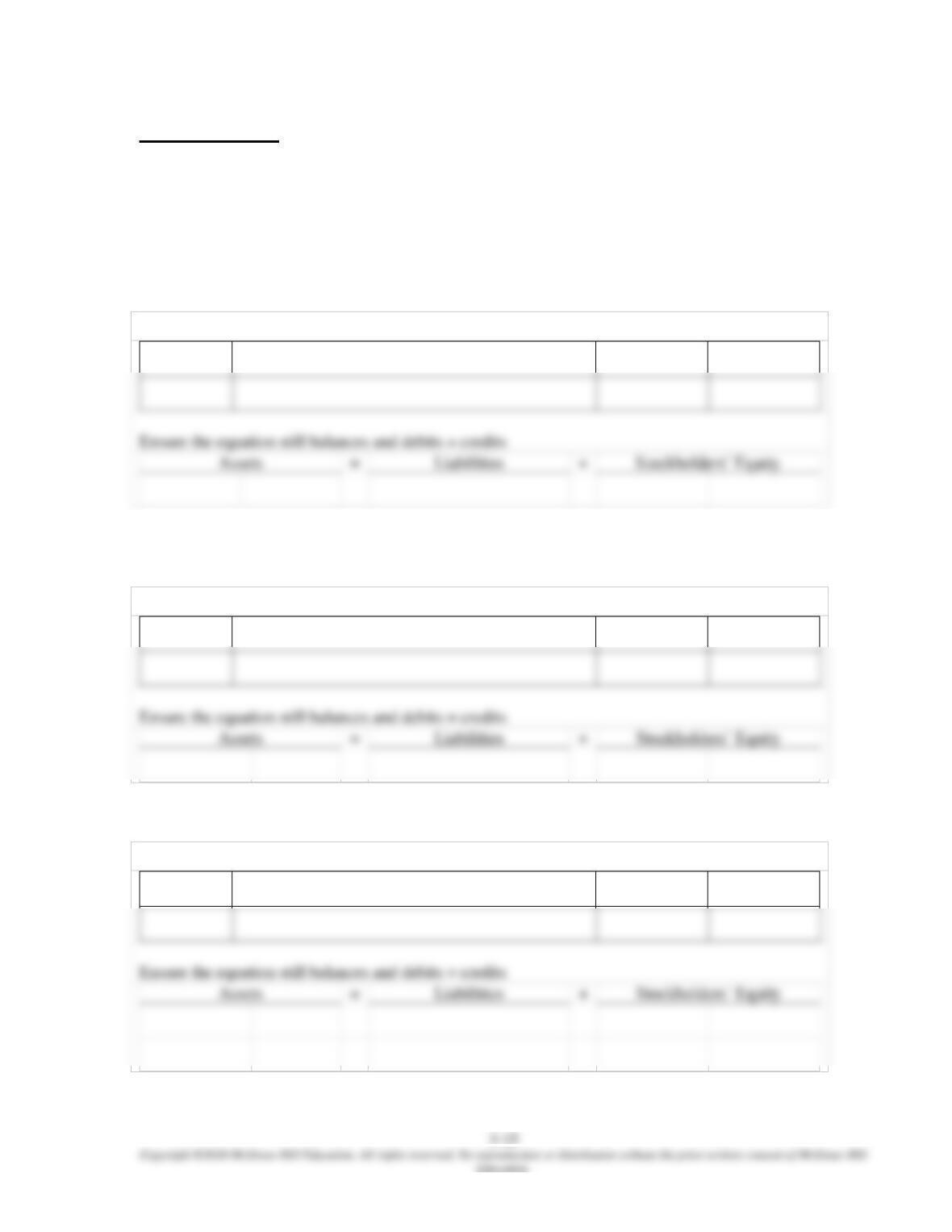
HANDOUT 3 – 1
TRANSACTION ANALYSIS
Tabor Hill Designers entered into the following transactions during February of the current year. Analyze
each of the following transactions and prepare the journal entry required to record the related transaction.
(a) Provide website design services for $40,000.
Debit and credit the accounts affected
(b) Provide website design services to Acme Company, for $20,000 on account. We expect Acme to pay
in the future.
Debit and credit the accounts affected
(c) Collect $18,000 from Acme Company on account.
Debit and credit the accounts affected