Chapter -3 Operating Decisions and the Income Statement
3-57
CASES AND PROJECTS
FINANCIAL REPORTING AND ANALYSIS CASES
CP3–1.
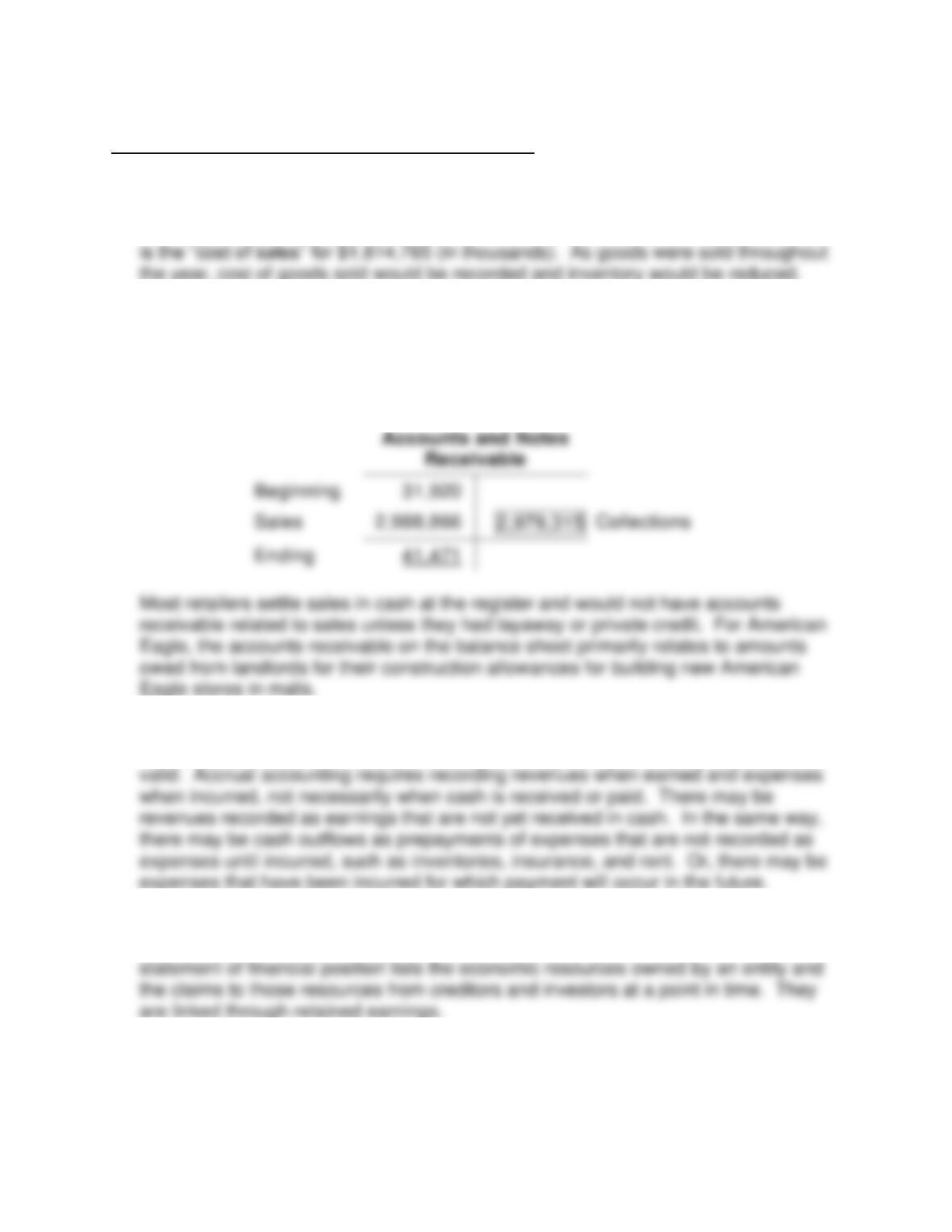
1. The largest expense on the income statement for the year ended January 31, 2009,
2. This question is intended to focus students on accounts receivable and the typical
activities that increase and decrease the account.
Assuming all net sales are on credit, American Eagle Outfitters collected
$2,797,510,000 from customers. T-account numbers are in thousands.
3. Over the life of the business, total earnings will equal total net cash flow. However,
for any given year, the assumption that net earnings is equal to cash inflows is not
4. An income statement reports the financial performance of a company over a period
of time in terms of revenues, gains, expenses, and losses. A balance sheet or
Chapter 3 -Operating – Decisions – and -the – Income – Statement
CP3–1. (continued)
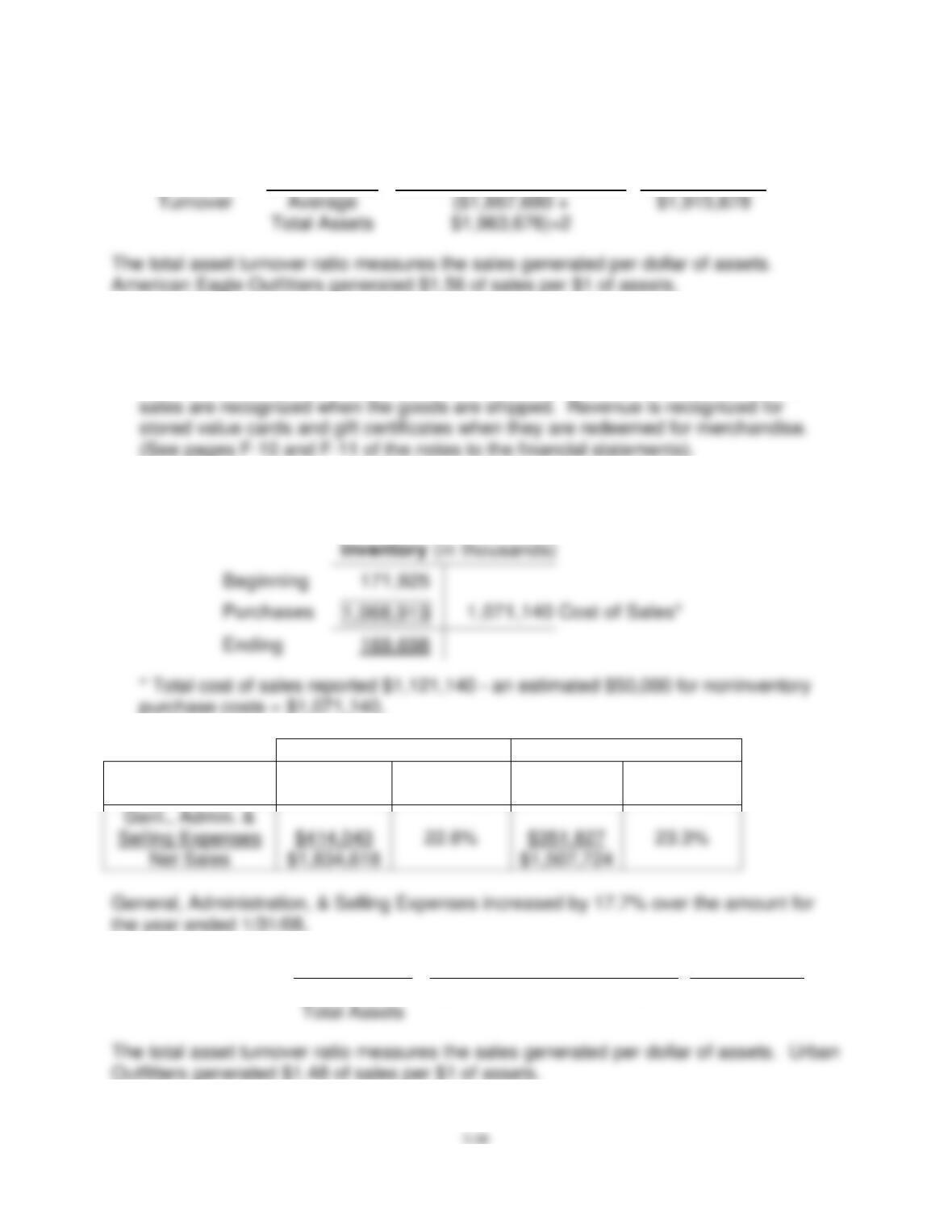
5.
(In thousands)
Total Asset
=
Sales
=
$2,988,866
=
$2,988,866
=
1.56
CP3-2.
1. Urban Outfitters’ revenue recognition policy for retail store sales is to record
revenues when customers purchase merchandise. Internet, catalog, and wholesale
2. Assuming that $50 million of cost of sales is due to distribution and occupancy costs,
Urban Outfitters purchased $1,068,913 thousand worth of inventory.
3.
Year ended 1/31/09
Year ended 1/31/08
Percentage
Percentage
4.
Total Asset
=
Sales
=
$1,834,618
=
$1,834,618
=
1.48
Turnover
Total Assets
Average
($1,329,009+$1,142,791)÷2
$1,235,900
Chapter -3 Operating Decisions and the Income Statement
3-59
CP3–3.
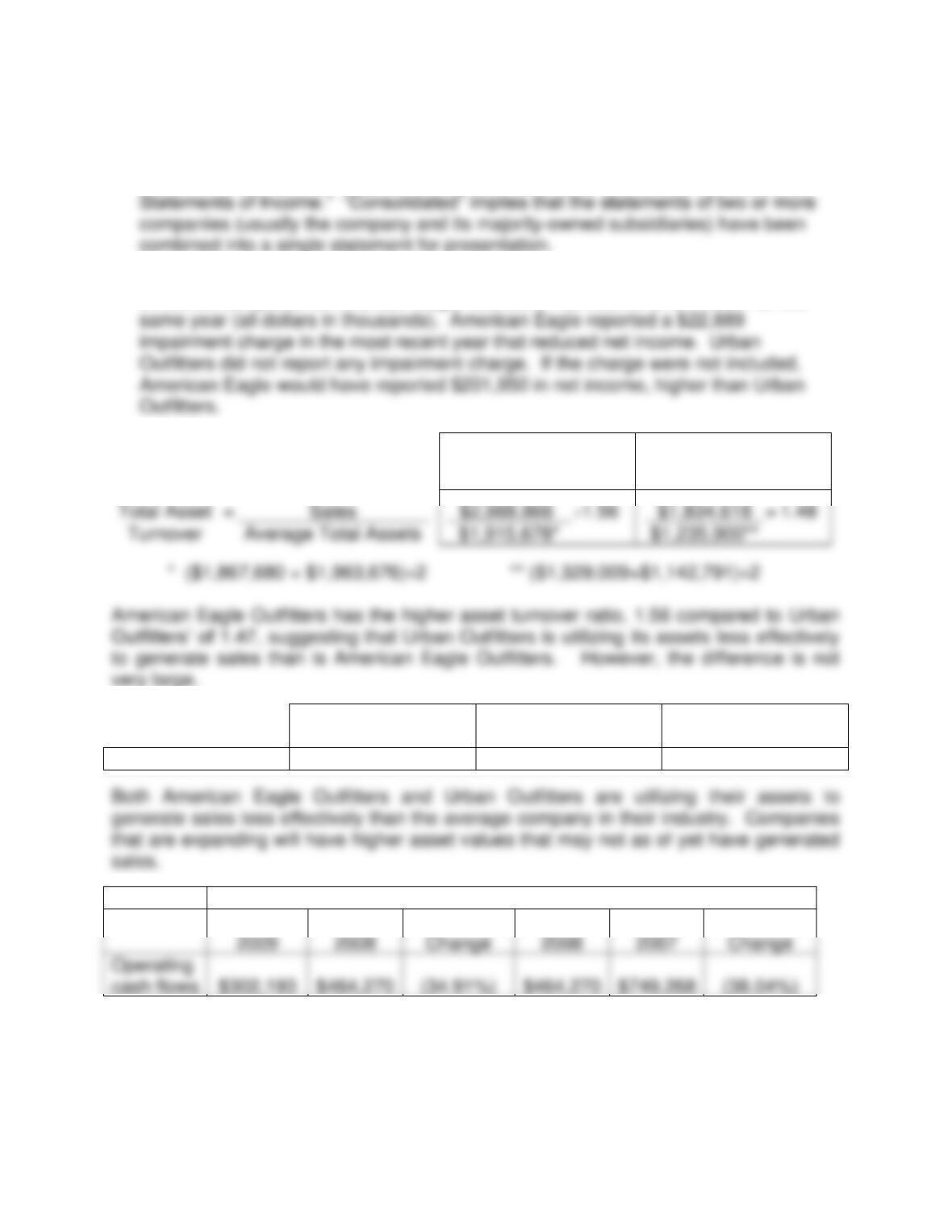
1. American Eagle Outfitters calls its income statement the “Consolidated Statements
of Operations.” Urban Outfitters calls its income statement the “Consolidated
2. Urban Outfitters had the higher net income of $199,364 for the year ended January
31, 2009, compared to American Eagle Outfitters’ net income of $179,061 for the
3.
(in thousands)
American Eagle
Outfitters
Urban
Outfitters
4.
Industry
Average
American Eagle
Outfitters
Urban
Outfitters
Asset Turnover =
1.90
1.56
1.48
5.
American Eagle Outfitters
Operating
cash flows
$749,268
Percentage
Percentage
Chapter 3 -Operating – Decisions – and -the – Income – Statement
3-60
CP3–4.
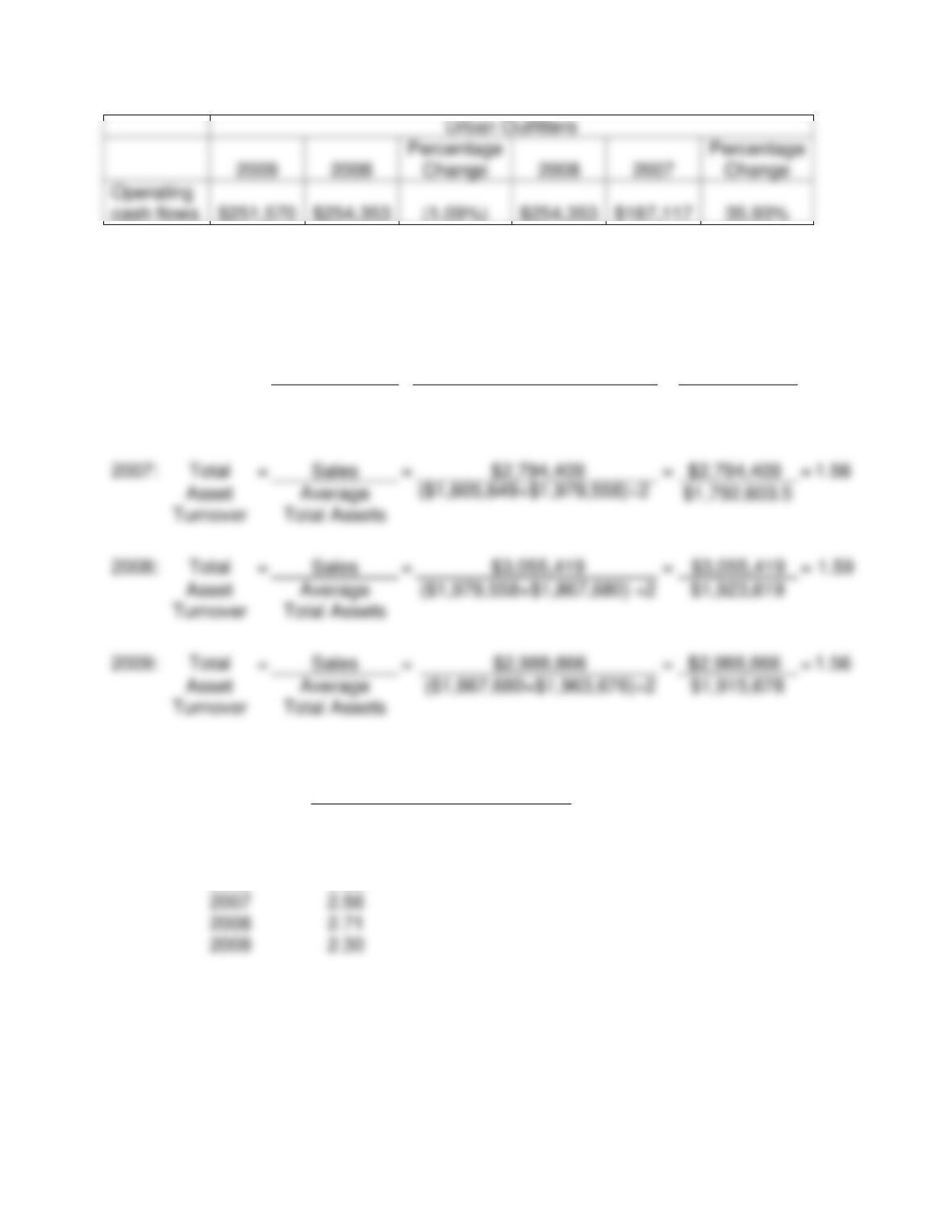
Req. 1
American Eagle Outfitters (dollars in thousands)
Fiscal year ended:
2006:
Total
=
Sales
=
$2,321,962
=
$2,321,962
=
1.58
Asset
Turnover
Average
Total Assets
($1,328,926+$1,605,649)÷2
$1,467,287.5
2007:
Total
=
Sales
=
=
$2,794,409
=
1.56
Asset
Turnover
Average
Total Assets
2008:
Total
=
Sales
=
=
$3,055,419
=
1.59
Asset
Turnover
Average
Total Assets
($1,979,558+$1,867,680) ÷2
2009:
Total
=
Sales
=
=
$2,988,866
=
1.56
Asset
Turnover
Average
Total Assets
($1,867,680+$1,963,676)÷2
Req. 2
Current Ratio
=
Current Assets
Current Liabilities
Reported in American Eagle Outfitters’ 10-K report (Item 6):
2006
3.06
2008
2.71
2009
2.30
Req. 3
American Eagle Outfitters’total asset turnover ratio has remained relatively stable from
2006 to 2009.
Chapter -3 Operating Decisions and the Income Statement
3-61
CP3–5.
Req. 1
Accrual accounting is defined in the article as follows:
“By accruing, or allotting, revenues to specific periods, they (accountants) aim to
Req. 2
The author of the article suggests that “fuzzy numbers” result from the judgments
companies make to come up with revenues and expenses on an accrual basis.
Req. 3
Congress and the SEC have adopted reforms to attempt to address the rising concerns
Chapter 3 -Operating – Decisions – and -the – Income – Statement
CP3–6.
Req. 1
a. Given as an example in the textbook.
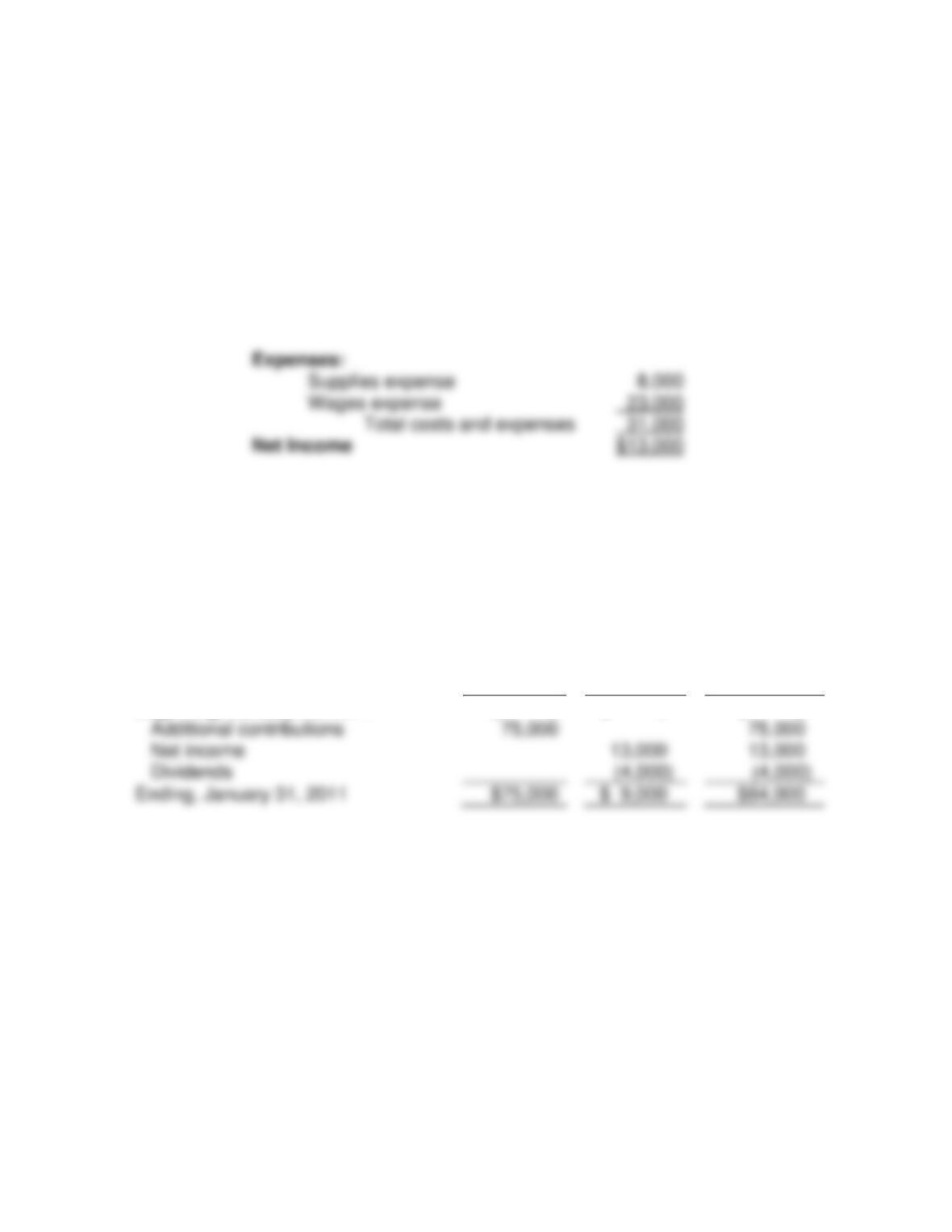
b. Cash decreased $5,000, Office Fixtures increased $22,000, and long-term Notes
Payable increased $17,000. Therefore, transaction (b) was the purchase of office
fixtures for $22,000, paid partly in cash of $5,000 and the rest by signing a long-term
notes payable for $17,000.
e. Cash decreased $10,000, Accounts Payable increased $3,000, Supplies Expense
increased $5,000, and Wages Expense increased $8,000. Therefore, transaction (e)
was purchase and use of $5,000 of supplies and $8,000 of employee labor. $10,000
was paid in cash and $3,000 is owed.
h. Cash decreased $11,000, Accounts Payable increased $7,000, Supplies Expense
increased $3,000, and Wages Expense increased $15,000. Therefore, transaction
(h) was purchase and use of supplies of $3,000 and employee labor of $15,000.
$11,000 was paid in cash, and $7,000 is owed.
Chapter -3 Operating Decisions and the Income Statement
3-63
CP3–6. (continued)
Req. 2
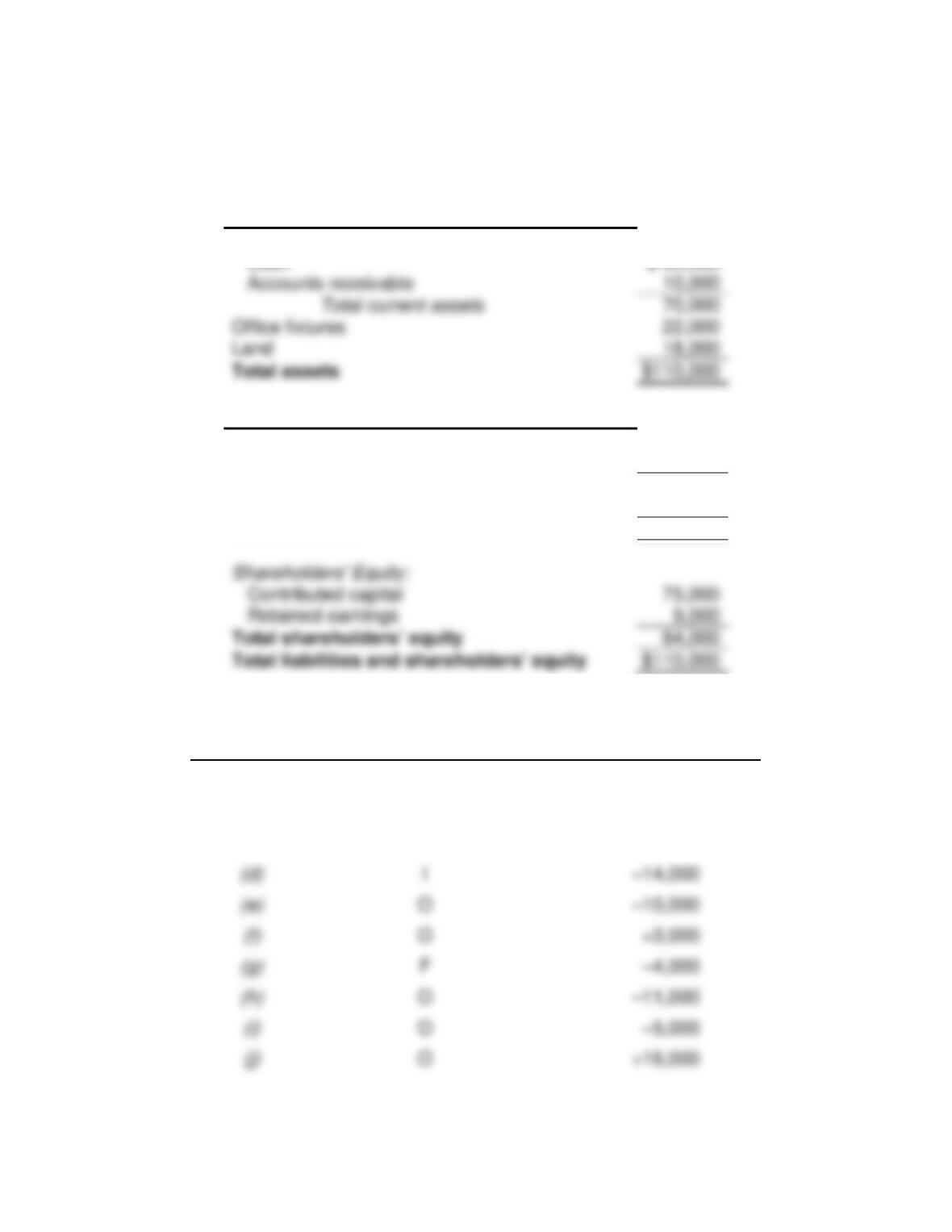
PETE’S PAINTING SERVICE
Income Statement
For the Month Ended January 31, 2011
Revenues:
Paint revenue
$44,000
PETE’S PAINTING SERVICE
Statement of Stockholders’ Equity
For the Month Ended January 31, 2011
Contributed
Capital
Retained
Earnings
Total
Stockholders’
Equity
Beginning, January 20, 2011
$ 0
$ 0
$ 0
Ending, January 31, 2011
Chapter 3 -Operating – Decisions – and -the – Income – Statement
3-64
CP3–6. (continued)
PETE’S PAINTING SERVICE
Balance Sheet
At January 31, 2011
Assets
Current assets:
Liabilities and Shareholders’ Equity
Current liabilities:
Accounts payable
$ 5,000
Total current liabilities
5,000
Notes payable
21,000
Total liabilities
26,000
Shareholders’ Equity:
Contributed capital
75,000
Retained earnings
9,000
84,000
Total liabilities and shareholders’ equity
Req. 3
Transaction
Operating, Investing, or
Financing Effect
Direction and Amount
of the Effect
(a)
F
+75,000
(b)
I
–5,000
(c)
O
+15,000
(d)
I
O
+3,000
(g)
F
–4,000
(h)
O
O
–5,000
O
+16,000
Cash
Accounts receivable
Total current assets
Office fixtures
Land
Total assets
Chapter -3 Operating Decisions and the Income Statement
CRITICAL THINKING CASES
CP3–7.
Req. 1
Estela used the cash basis of accounting. We can infer this from his references to
Req. 2
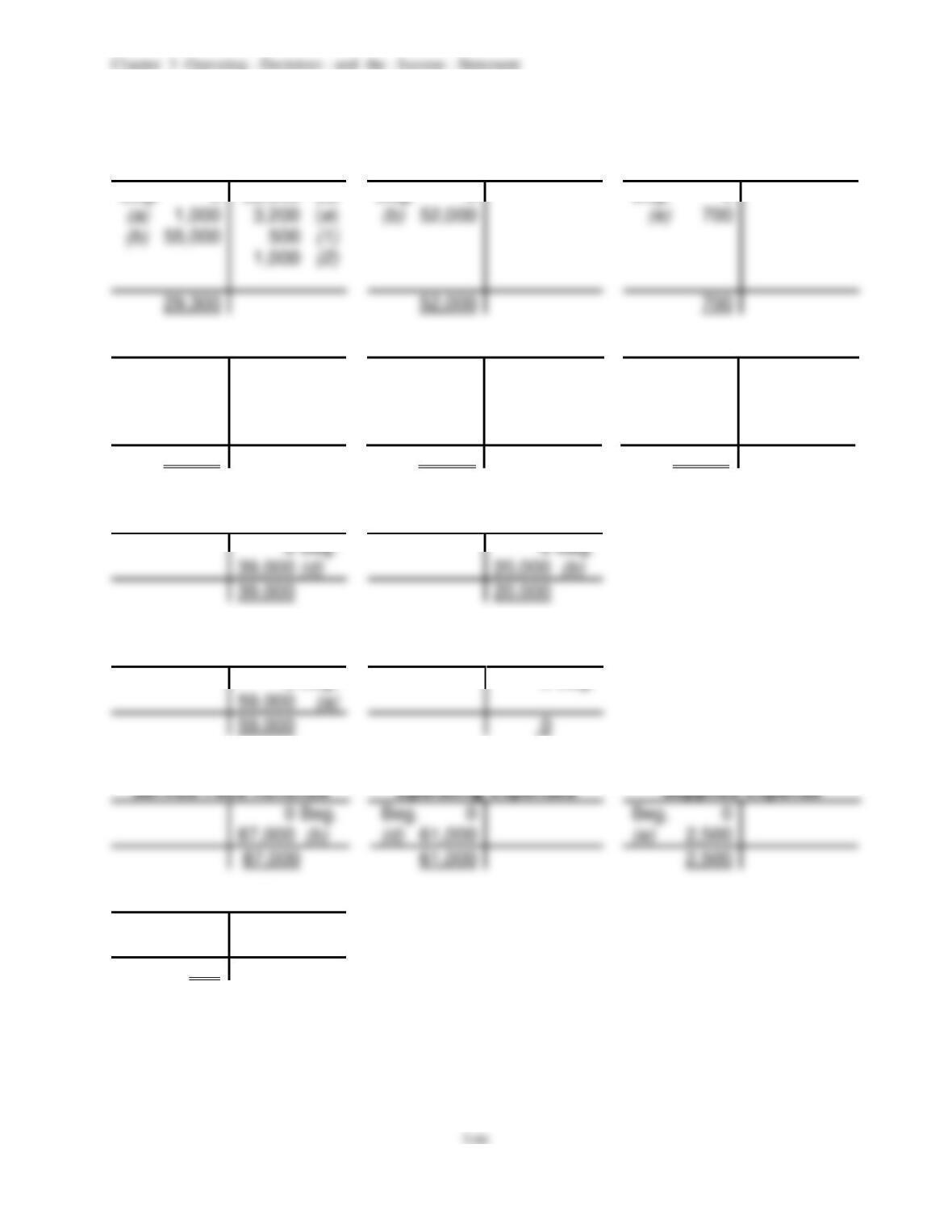
(a)
Building (+A) ………………………………………………………………
21,000
Tools and equipment (+A) ……………………………………………
17,000
Land (+A) ………………………………………………………………….
20,000
Cash (+A) ………………………………………………………………….
1,000
Contributed capital (+SE) …………………………………..
59,000
(b)
Cash (+A) …………………………………………………………………..
55,000
Accounts receivable (+A) ……………………………………………..
52,000
Unearned revenue (+L) ………………………………………
20,000
Service fees revenue (+R, +SE) …………………………..
87,000
(c)
No entry
(d)
Operating expenses (+E, −SE) ……………………………………..
Accounts payable (+L) ………………………………………..
39,000
Cash (−A) …………………………………………………………
(e)
Supplies expense (+E, −SE)* ……………………………………….
2,500
Supplies (+A) ……………………………………………………………..
700
Cash (−A) …………………………………………………………
3,200
Other
(1)
Loss from theft (+E, −SE) …………………………………………….
500
Cash (−A) …………………………………………………………
(2)
Tools and equipment (+A) ……………………………………………
1,000
Cash (−A) …………………………………………………………
1,000
CP3–7. (continued)
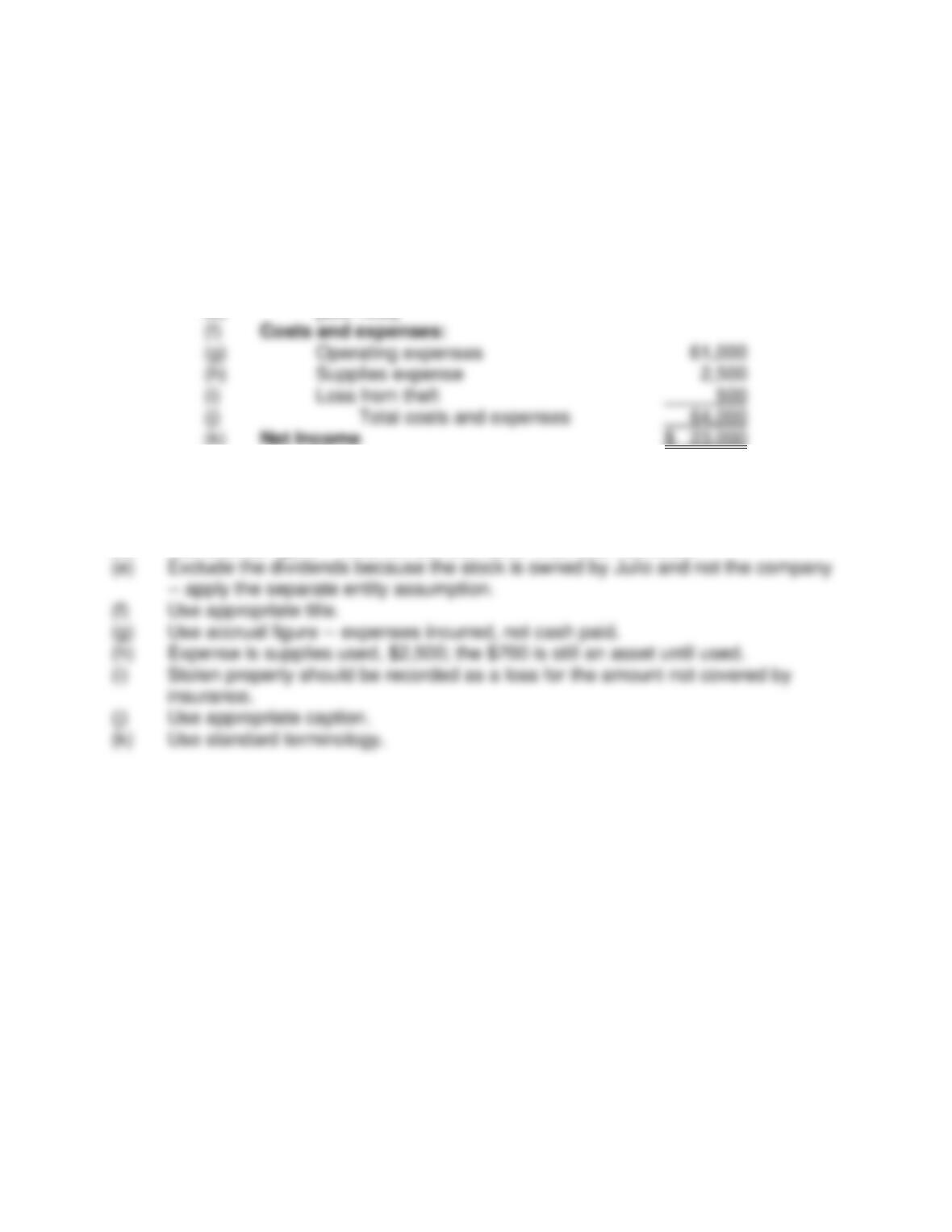
ASSETS:
Cash
Accounts Receivable
Supplies
29,300
52,000
700
Beg. 0
22,000 (d)
Beg. 0
Beg. 0
Building
Land
Tools and Equipment
Beg. 0
(a) 21,000
Beg. 0
(a) 20,000
Beg. 0
(a) 17,000
(2) 1,000
21,000
20,000
18,000
LIABILITIES:
Accounts Payable
Unearned Revenue
39,000
20,000
SHAREHOLDER’S EQUITY:
Contributed Capital
Retained Earnings
59,000 (a)
59,000
0
0 Beg.
0 Beg.
REVENUES AND EXPENSES:
Supplies Expense
0 Beg.
87,000 (b)
Beg. 0
87,000
Loss from Theft
Beg. 0
(1) 500
500
Chapter -3 Operating Decisions and the Income Statement
3-67
CP3–7. (continued)
Req. 3
ESTELA COMPANY
(a)
Income Statement
(b)
For the Year Ended December 31, 2012
(c)
Revenues:
(d)
Service fees revenue
$ 87,000
(e)
[see note]
(k)
Net Income
$ 23,000
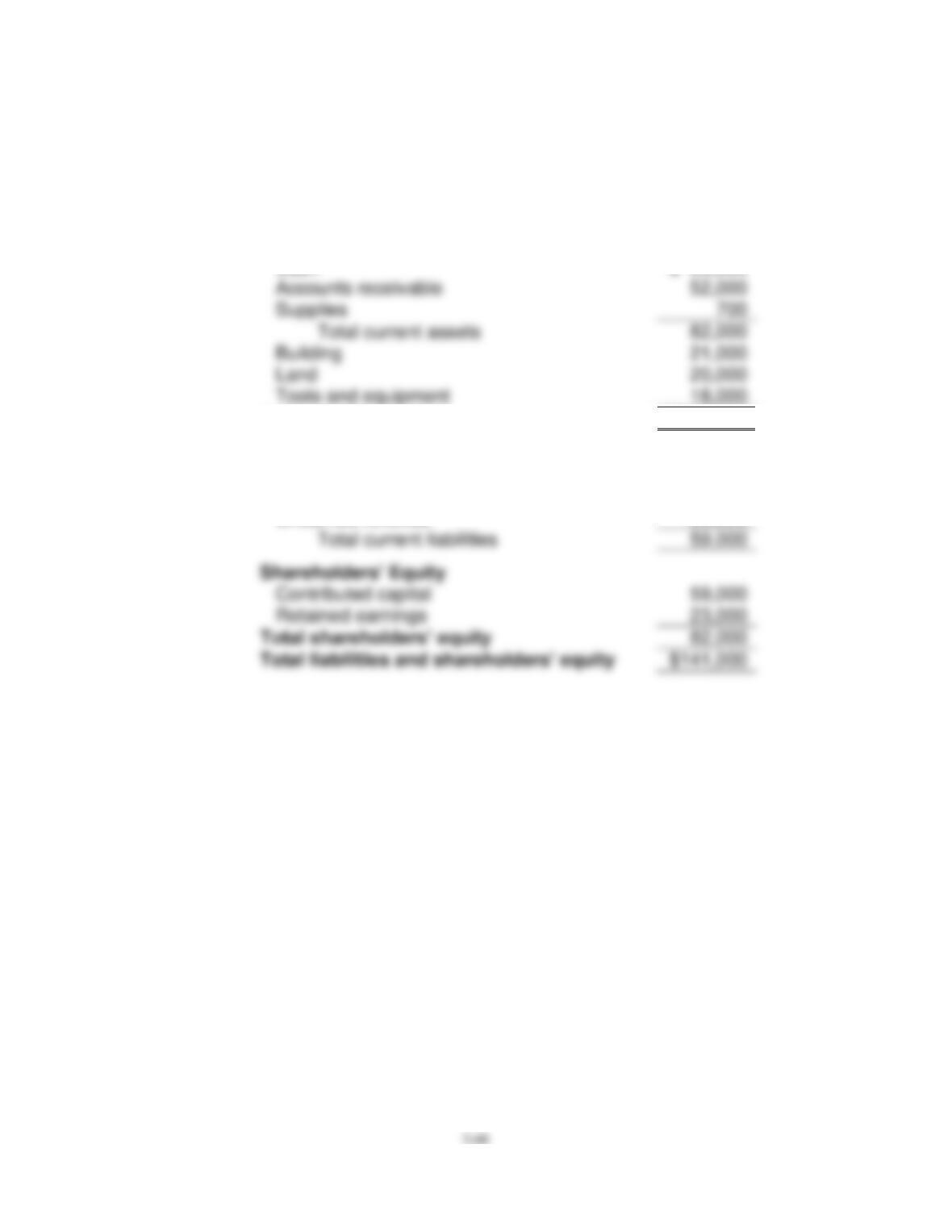
(a) Use the standard title.
(b) Date to indicate time period covered.
(c) Use appropriate title.
(d) Use accrual figure — revenue earned, rather than cash collected.
(f)
Costs and expenses:
(g)
(h)
(i)
Loss from theft
500
(j)
Total costs and expenses
Chapter 3 -Operating – Decisions – and -the – Income – Statement
CP3–7. (continued)
ESTELA COMPANY
Balance Sheet
At December 31, 2012
Assets
Current assets:
Cash
$ 29,300
Accounts receivable
52,000
Supplies
Total current assets
82,000
Building
21,000
Land
20,000
Tools and equipment
18,000
Total assets
$141,000
Liabilities
Current liabilities:
Accounts payable
$ 39,000
Unearned revenue
20,000
Total current liabilities
Shareholders’ Equity
Contributed capital
Retained earnings
23,000
Total liabilities and shareholders’ equity
$141,000
Chapter -3 Operating Decisions and the Income Statement
3-69
CP3–7. (continued)
ESTELA COMPANY
Statement of Cash Flows
For the Year Ended December 31, 2012
Cash from Operating Activities
Cash received from customers
$55,000
Cash paid to suppliers ($22,000 + $3,200)
(25,200)
Cash from Financing Activities
Proceeds from share issuance
1,000
Total cash provided by financing activities
1,000
Increase in cash
Beginning cash balance
Ending cash balance
$29,300
Req. 4
The above statements do not yet take into account most year-end adjustments,
including depreciation and income taxes. The adjusting entry for income taxes is
especially important because of the implication for future cash flows.
Lastly, pro forma financial statements (or budgets) outlining the expected revenues,
expenses, and cash flows from the expanded business would be helpful to gauge its
viability.
Cash stolen
Total cash provided by operating activities
Cash from Investing Activities
Purchase of tools and equipment
Total cash used in investing activities
Chapter 3 -Operating – Decisions – and -the – Income – Statement
CP3–7. (continued)
Req. 5
(today’s date)
Dear Mr. Estela:
We regret to inform you that your request for a $100,000 loan has been denied.
Your current business appears profitable and appears to generate sufficient cash to
maintain operations, even once additional expenses, such as income taxes, are
considered. However, pro forma financial statements (or budgets) outlining the
expected revenues, expenses, and cash flows from the expanded business would be
needed to gauge its future viability.
If you would like us to reconsider your application, please provide us with the pro forma
financial statements and with the current market values of any assets you would pledge
as collateral.
Chapter -3 Operating Decisions and the Income Statement
3-71
CP3–8.
Req. 1
This type of ethical dilemma occurs quite frequently. The situation is difficult personally
because of the possible repercussions to you by your boss, Mr. Lynch, if you do not
Req. 2
In the short run, Mr. Lynch would benefit by receiving a larger bonus. You also
benefit in the short run because you would not experience any negative repercussions
Req. 3
In the larger picture, shareholders are harmed by the misleading income figures
by relying on them to purchase stock at inflated prices. In addition, creditors may lend
Req. 4
Managers are agents for shareholders. To act in ways to the benefit of the
FINANCIAL REPORTING AND ANALYSIS TEAM PROJECT
CP3–9.
The solution to this project will depend on the companies and/or accounting periods
selected for analysis.