Chapter 3
Job-Order Costing: Cost Flows and External
Reporting
Questions
3-1 The link that connects these two sched-
ules is the cost of goods manufactured. It is cal-
culated within a schedule of cost of goods manu-
factured and then it plugs into the schedule of
cost of goods sold to enable calculating the cost
of goods available for sale.
3-3 Underapplied overhead occurs when the
actual overhead cost exceeds the amount of over-
head cost applied to Work in Process inventory
during the period. Overapplied overhead occurs
when the actual overhead cost is less than the
amount of overhead cost applied to Work in Pro-
3-4 Manufacturing overhead may be underap-
plied for several reasons. Control over overhead
spending may be poor. Or, some of the overhead
may be fixed and the actual amount of the alloca-
tion base may be less than estimated at the be-
ginning of the period. In this situation, the
amount of overhead applied to inventory will be
less than the actual overhead cost incurred.
3-5 Underapplied overhead implies that not
enough overhead was assigned to jobs during the
period. Thus, cost of goods sold is understated so
we add underapplied overhead to cost of goods
sold. On the other hand, overapplied overhead is
deducted from cost of goods sold.
3-7 The total manufacturing costs added to
production include the direct materials used in
production, the direct labor cost, and the manu-
facturing overhead applied to work in process.
3-8 The beginning work in process inventory
plus the total manufacturing costs (which includes
3-10 Direct labor costs are added to Work in
Process as goods are being manufactured. Once
goods are completed, their manufacturing costs
(including direct labor) are transferred to Finished
Goods. Once goods are sold to customers their
manufacturing costs (including direct labor) are
transferred to Cost of Goods Sold.
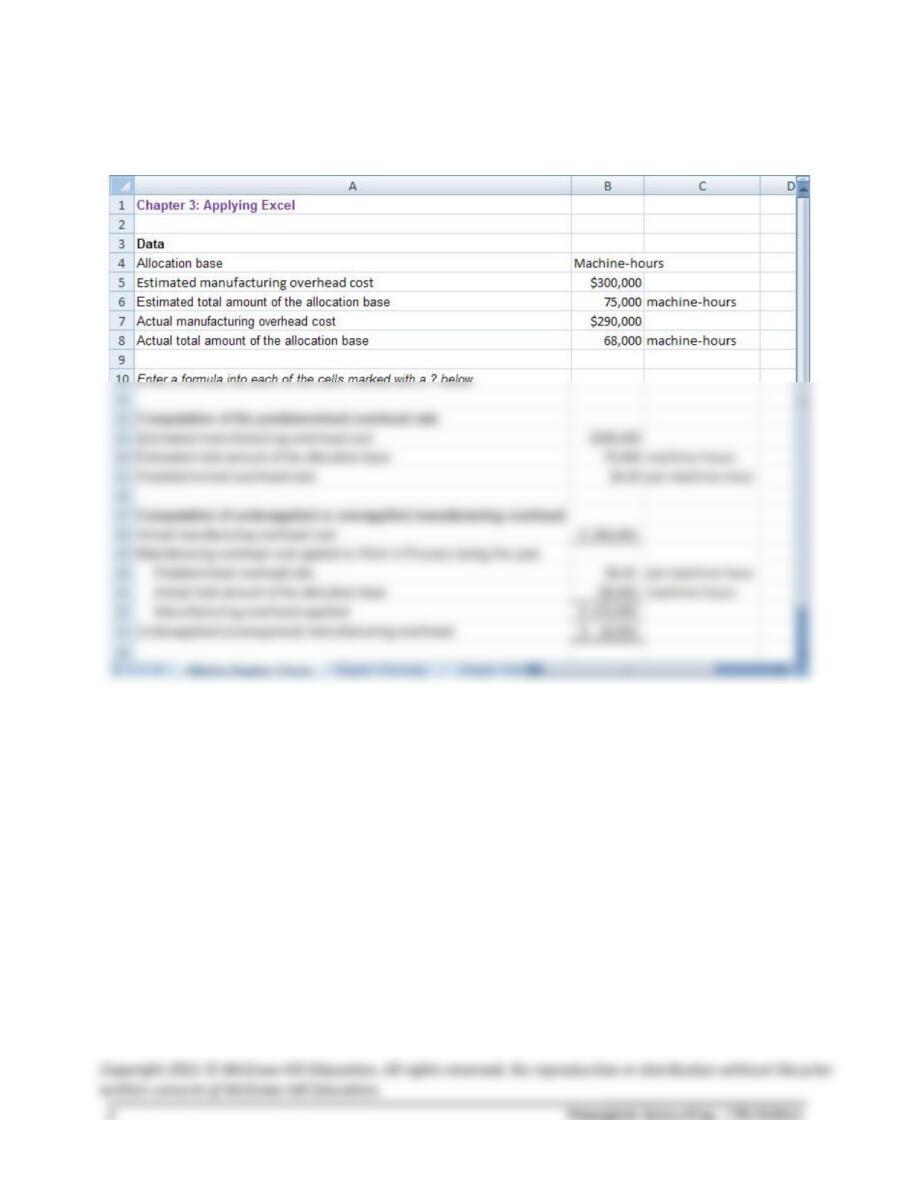
Chapter 3: Applying Excel
The completed worksheet is shown below.
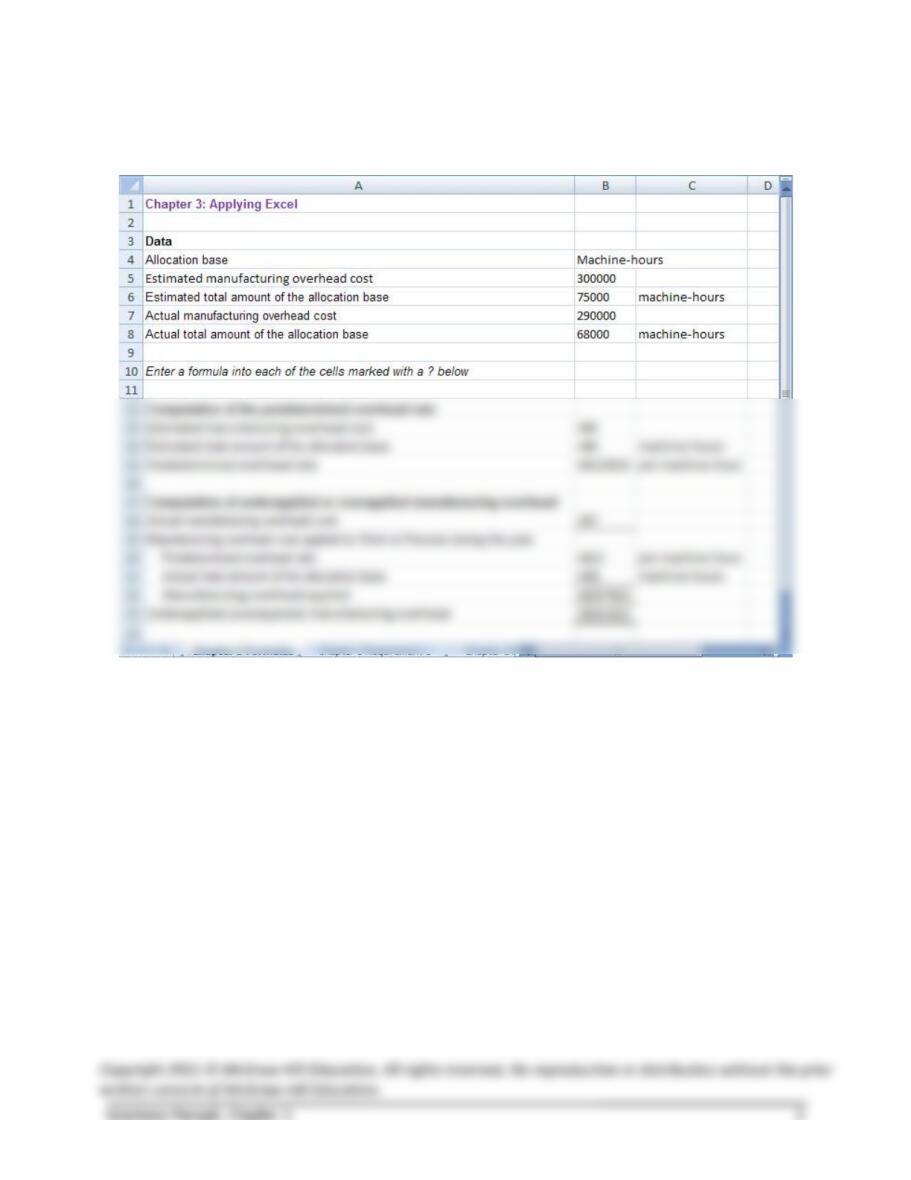
Chapter 3: Applying Excel (continued)
The completed worksheet, with formulas displayed, is shown below.
[Note: To display formulas in cells instead of their calculated amounts, con-
sult Excel Help.]
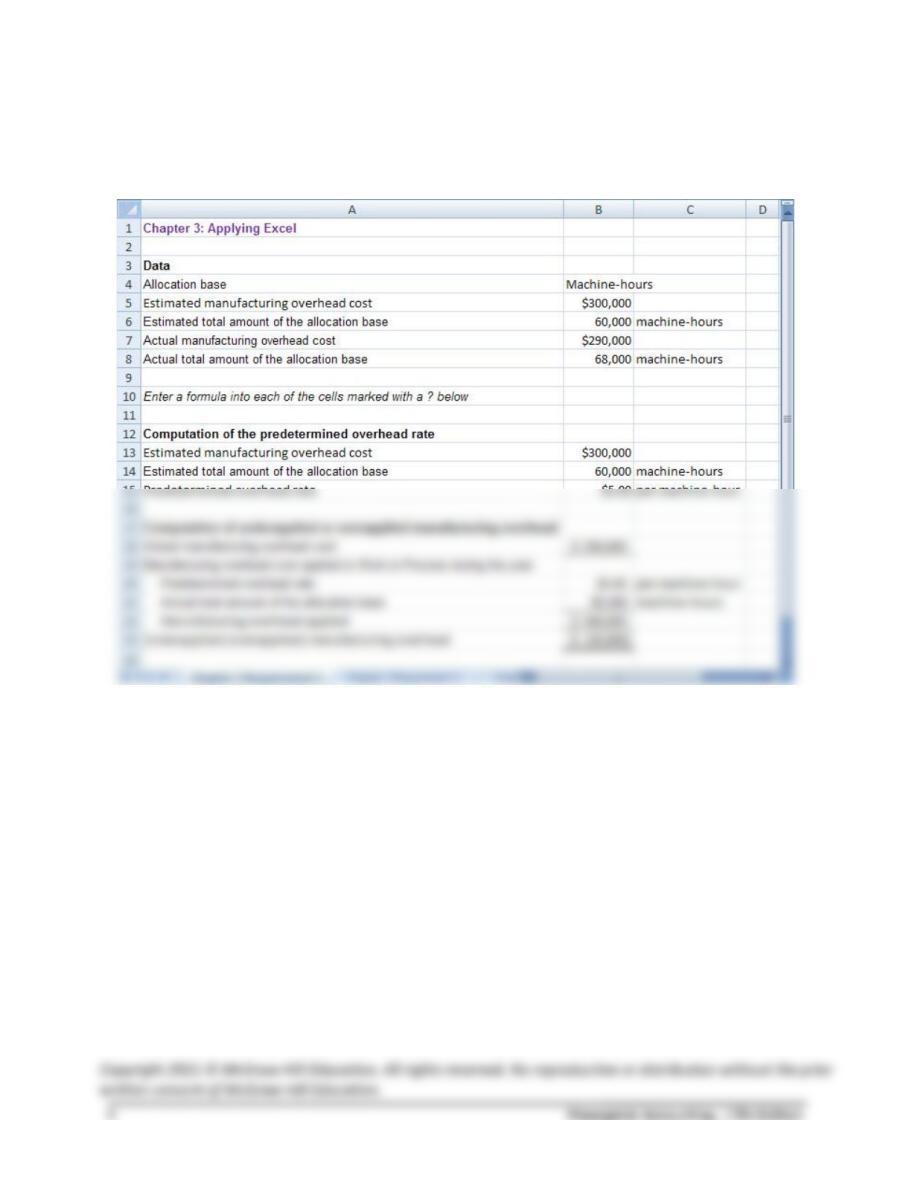
Chapter 3: Applying Excel (continued)
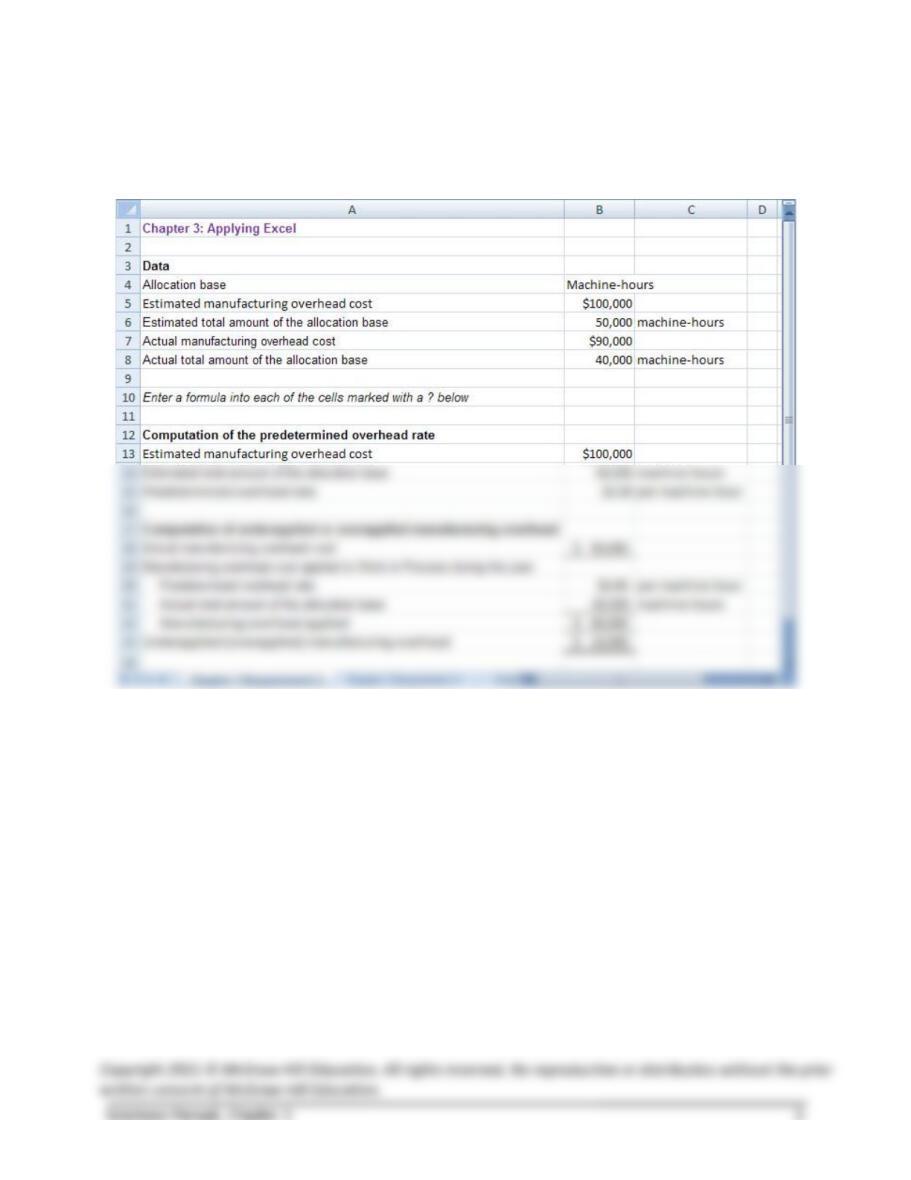
1. When the estimated total amount of the allocation base is changed to
60,000 machine-hours, the worksheet changes as show below:
The predetermined overhead rate has increased from $4.00 per ma–
chine-hour to $5.00 per machine-hour because the estimated total
amount of the allocation base has decreased from 75,000 machine-
hours to 60,000 machine-hours. The same amount of estimated over-
head cost is spread across fewer machine-hours.
Chapter 3: Applying Excel (continued)
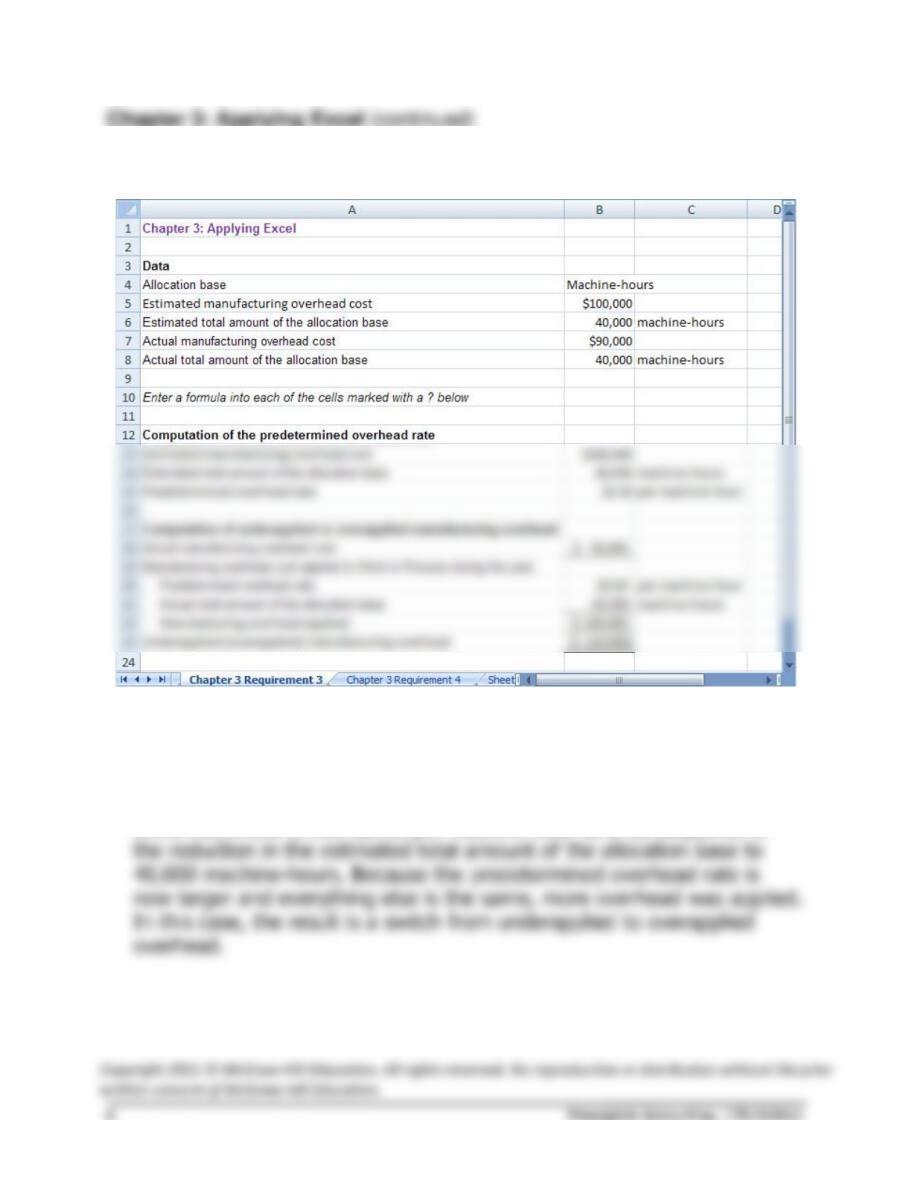
2. With all of the changes in the data, the worksheet should look like the
following:
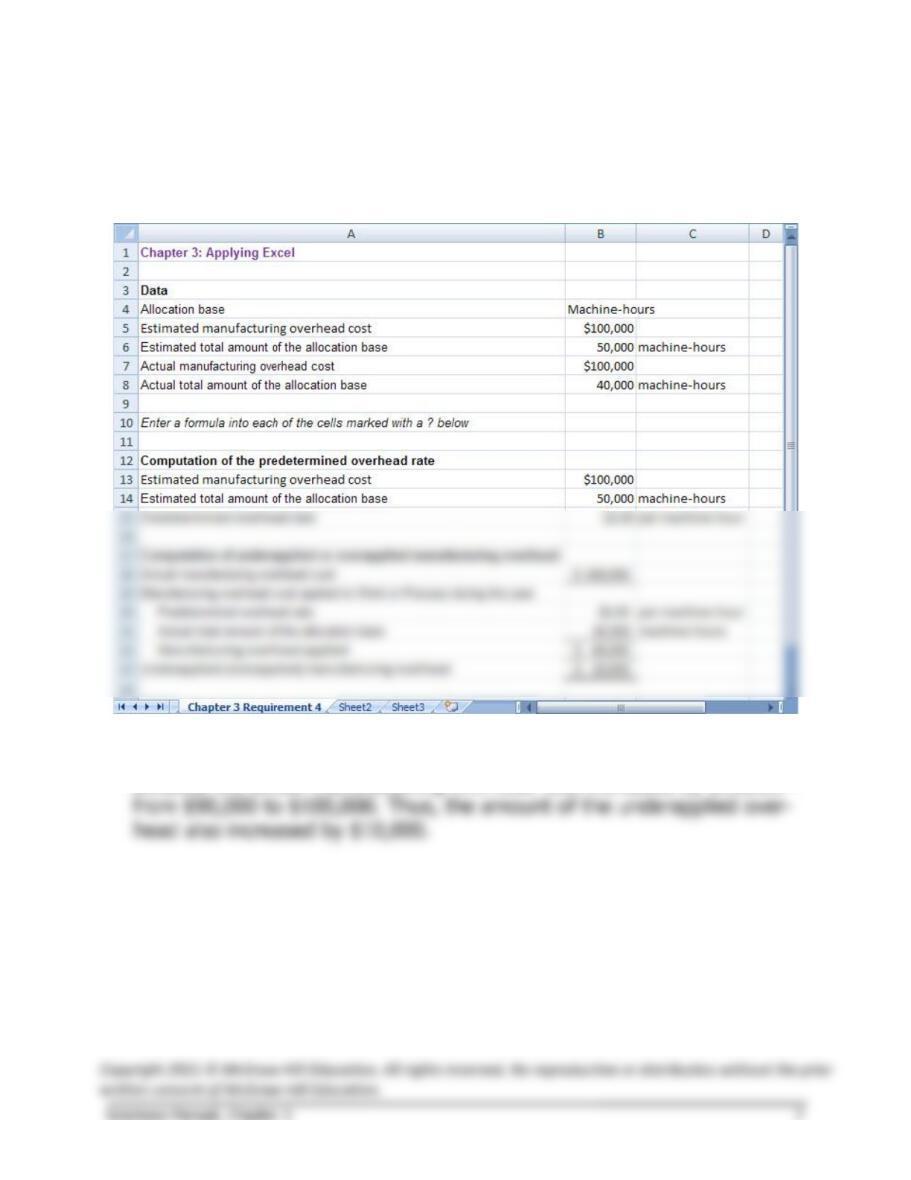
3. When the estimated total amount of the allocation base is changed to
40,000 machine-hours, the worksheet looks like the following:
The manufacturing overhead is now overapplied by $10,000 rather than
underapplied by $10,000 as it was when the estimated total amount of
the allocation base was 10,000 machine-hours higher. This occurred be-
cause the predetermined overhead rate was $2.00 per machine-hour
when the estimated total amount of the allocation base was 50,000 ma-
Chapter 3: Applying Excel (continued)
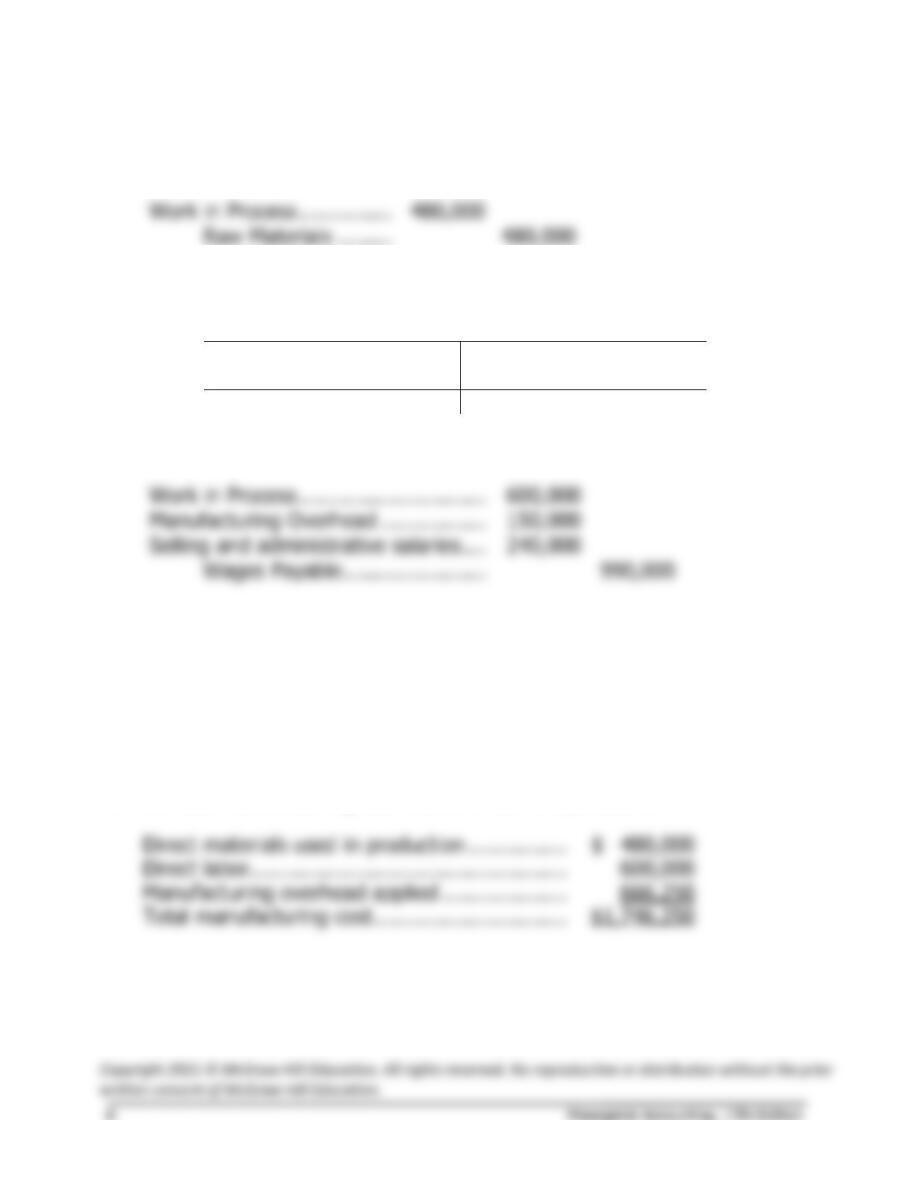
4. When the estimated total amount of the allocation base is changed back
to 50,000 machine-hours and the actual manufacturing overhead cost is
changed to $100,000, the worksheet looks like the following:
In part 2 above, manufacturing overhead was underapplied by $10,000.
Manufacturing overhead is now underapplied by $20,000. This occurred
The Foundational 15
1. The journal entry to record raw materials used in production is:
2. The ending balance in Raw Materials is:
Raw Materials
Beg. Bal.
40,000
(a)
510,000
(b)
480,000
End. Bal.
70,000
3. The journal entry to record the labor costs is:
4. The total manufacturing overhead applied to production is computed as
follows:
Actual direct labor-hours (a) ……………………….
41,000
Predetermined overhead rate (b) …………………
$16.25
Manufacturing overhead applied (a) × (b) ……..
$666,250
5. The total manufacturing cost added to work in process is:
Direct materials used in production …………….
Direct labor ……………………………………………
Manufacturing overhead applied ………………..
Total manufacturing cost ………………………….
The Foundational 15 (continued)
6. The journal entry is recorded as follows:
7. The ending balance in Work in Process is computed as follows:
Work in Process
Beg. Bal.
18,000
(b)
480,000
(c)
600,000
(f)
666,250
(g)
1,680,000
End. Bal.
84,250
8. The total actual manufacturing overhead cost is as follows:
Indirect labor ……………………………………….
$150,000
Depreciation, insurance, utilities, etc. …………
Total actual manufacturing overhead cost …..
$650,000
9. The overapplied overhead is computed as follows:
Actual manufacturing overhead cost (a) ………..
$650,000
Manufacturing overhead applied (b) …………….
$666,250
Overapplied overhead (a) ‒ (b) …………………..
$(16,250)
10. The cost of goods available for sale is computed as follows:
Beginning finished goods inventory …………….
Add: Cost of goods manufactured ………………
Cost of goods available for sale ………………….
11. The journal entry is recorded as follows:
Finished Goods …………………
The Foundational 15 (continued)
12. The ending balance in Finished Goods is:
Finished Goods
Beg. Bal.
35,000
(g)
1,680,000
(h)
1,690,000
End. Bal.
25,000
13. The adjusted cost of goods sold is computed as follows:
Beginning finished goods inventory ……………..
Cost of goods manufactured ……………………..
Cost of goods available for sale ………………….
Ending finished goods inventory …………………
Unadjusted cost of goods sold …………………..
Overapplied overhead ……………………………..
Adjusted cost of goods sold ………………………
14. and 15.
The gross margin and net operating income are computed as follows:
Sales ………………………………………………..
$2,800,000
Cost of goods sold …………………………..…..
1,673,750
Gross margin ……………………………………..
Net operating income …………………………..
Exercise 3-1 (10 minutes)
a.
Raw Materials …………………….
80,000
Accounts Payable ……………
80,000
b.
Work in Process ………………….
62,000
Manufacturing Overhead ………
9,000
Raw Materials ………………..
71,000
Work in Process ………………….
Cash …………………………...
112,000
d.
Manufacturing Overhead ………
175,000
Accumulated Depreciation ..
175,000
Exercise 3-2 (20 minutes)
Requirement 1
Cash
Raw Materials
(a)
94,000
(a)
94,000
(b)
89,000
(c)
132,000
Bal.
5,000
(d)
143,000
Work in Process
Finished Goods
(b)
78,000
(f)
342,000
(f)
342,000
342,000
(c)
112,000
Bal.
(e)
152,000
Bal.
0
Manufacturing Overhead
Cost of Goods Sold
(b)
11,000
(e)
152,000
(g)
342,000
(c)
20,000
(h)
22,000
(h)
22,000
(d)
143,000
Bal.
364,000
Bal.
0
Exercise 3-3 (20 minutes)
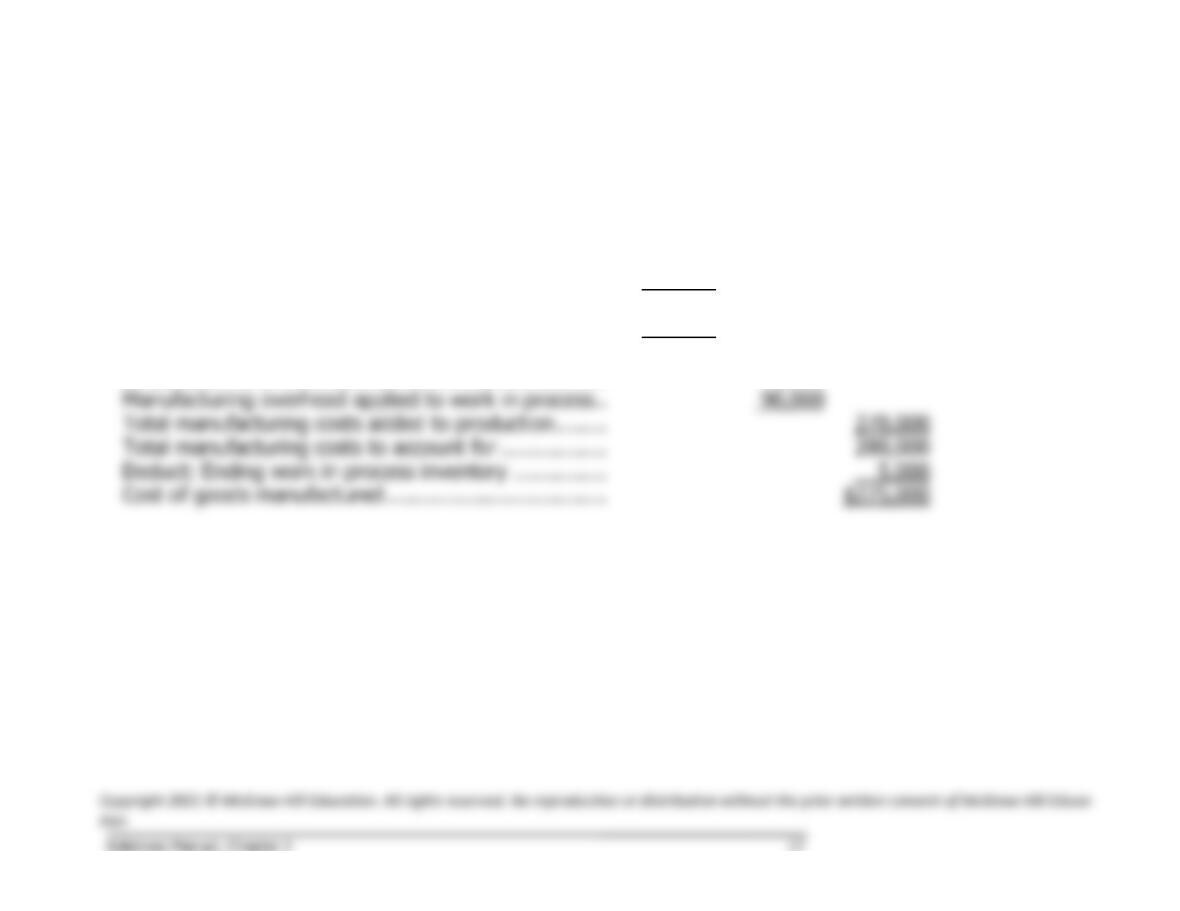
1. Schedule of cost of goods manufactured
Beginning work in process inventory ……………………
$56,000
Direct materials:
Beginning raw materials inventory ………………….
$12,00
Direct labor ……………………………………………………
58,000
Manufacturing overhead applied to work in process ..
87,000
Total manufacturing costs added to production ……..
164,000
Total manufacturing costs to account for ……………..
220,000
Deduct: Ending work in process inventory ……………
Cost of goods manufactured ……………………………..
Exercise 3-3 (20 minutes)
2.
Schedule of Cost of Goods Sold:
Beginning finished goods inventory ……………….
$ 35,000
Add: Cost of goods manufactured …………………
155,000
Cost of goods available for sale ……………………
Deduct: Ending finished goods inventory ………..
Unadjusted cost of goods sold ……………………..
Add: Underapplied overhead ……………………….
Adjusted cost of goods sold …………………………
Exercise 3-4 (10 minutes)
1.
Manufacturing overhead incurred (a) …….
$215,000
Actual direct labor-hours …………………….
11,500
× Predetermined overhead rate …………..
$18.20
= Manufacturing overhead applied (b) ….
$209,300
Manufacturing overhead underapplied
(a) – (b) ………………………………………
$5,700
Exercise 3-5 (30 minutes)
1.
a.
Raw Materials ……………………………………
210,000
Accounts Payable …………………………….
210,000
b.
Work in Process …………………………………
178,000
Manufacturing Overhead ……………………..
12,000
Raw Materials …………………………………
190,000
Work in Process …………………………………
90,000
Manufacturing Overhead ……………………..
110,000
Salaries and Wages Payable ……………….
200,000
d.
Manufacturing Overhead ……………………..
40,000
Accumulated Depreciation …………………
40,000
e.
Manufacturing Overhead ……………………..
70,000
Accounts Payable …………………………….
70,000
f.
Work in Process …………………………………
240,000
Manufacturing Overhead …………………..
240,000
30,000 MH × $8 per MH = $240,000.
g.
Finished Goods ………………………………….
520,000
Work in Process ………………………………
520,000
Cost of Goods Sold …………………………….
480,000
Finished Goods ……………………………….
480,000
Accounts Receivable …………………………..
600,000
Sales …………………………..………………..
600,000
$480,000 × 1.25 = $600,000.
2.
Manufacturing Overhead
Work in Process
(b)
12,000
(f)
240,000
Bal.
42,000
(g)
520,000
(c)
110,000
(b)
178,000
(d)
40,000
(c)
90,000
(e)
70,000
(f)
240,000
8,000
Bal.
30,000
(Overapplied
overhead)
Exercise 3-6 (30 minutes)
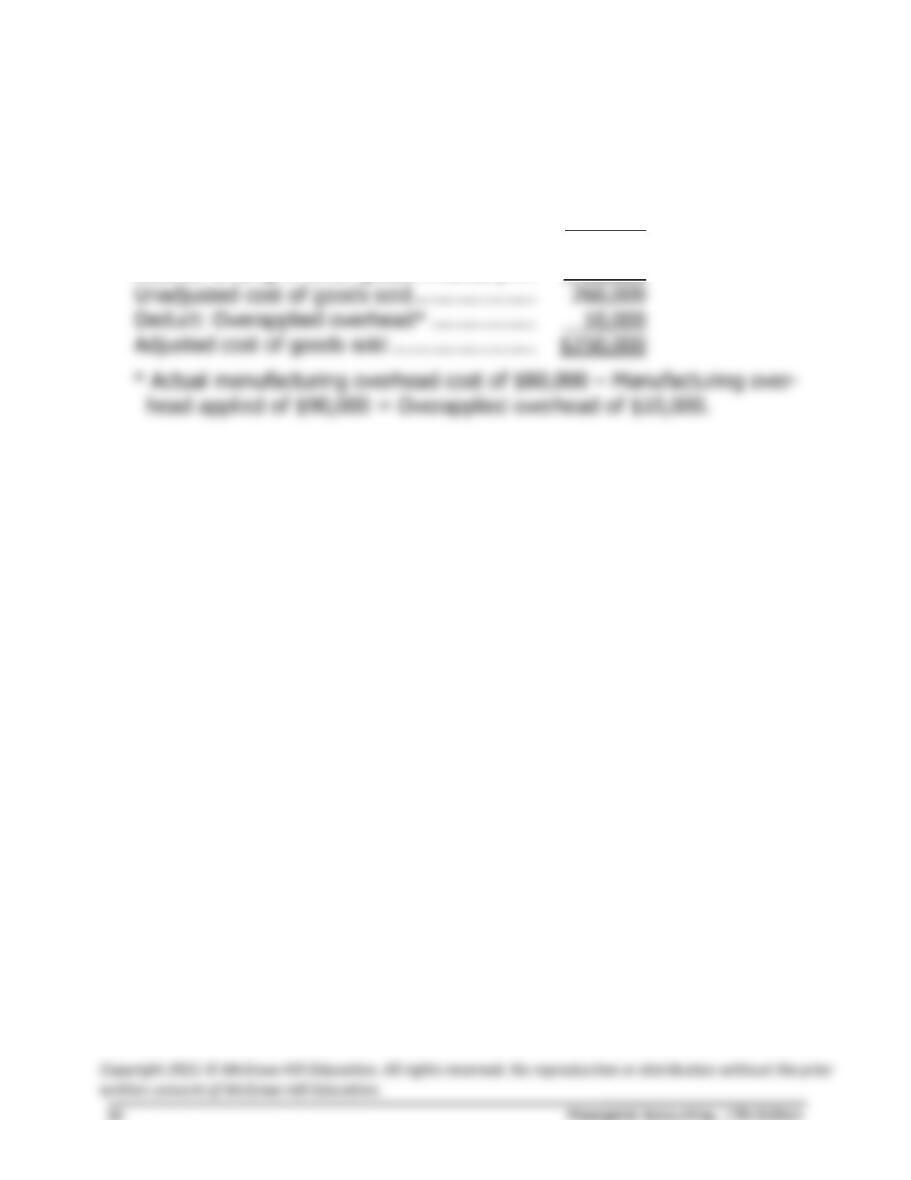
1. Mason Company’s schedule of cost of goods manufactured is as follows:
Beginning work in process inventory ……………………
$10,000
Direct materials:
Beginning raw materials inventory ………………….
$7,000
Add: Purchases of raw materials …………………….
118,000
Total raw materials available …………………………
125,000
Deduct: Ending raw materials inventory …………..
15,000
Direct materials used in production …………………….
$110,000
Direct labor ……………………………………………………
70,000
Manufacturing overhead applied to work in process ..
Total manufacturing costs added to production ……..
270,000
Total manufacturing costs to account for ……………..
280,000
Cost of goods manufactured ……………………………..
Exercise 3-6 (continued)
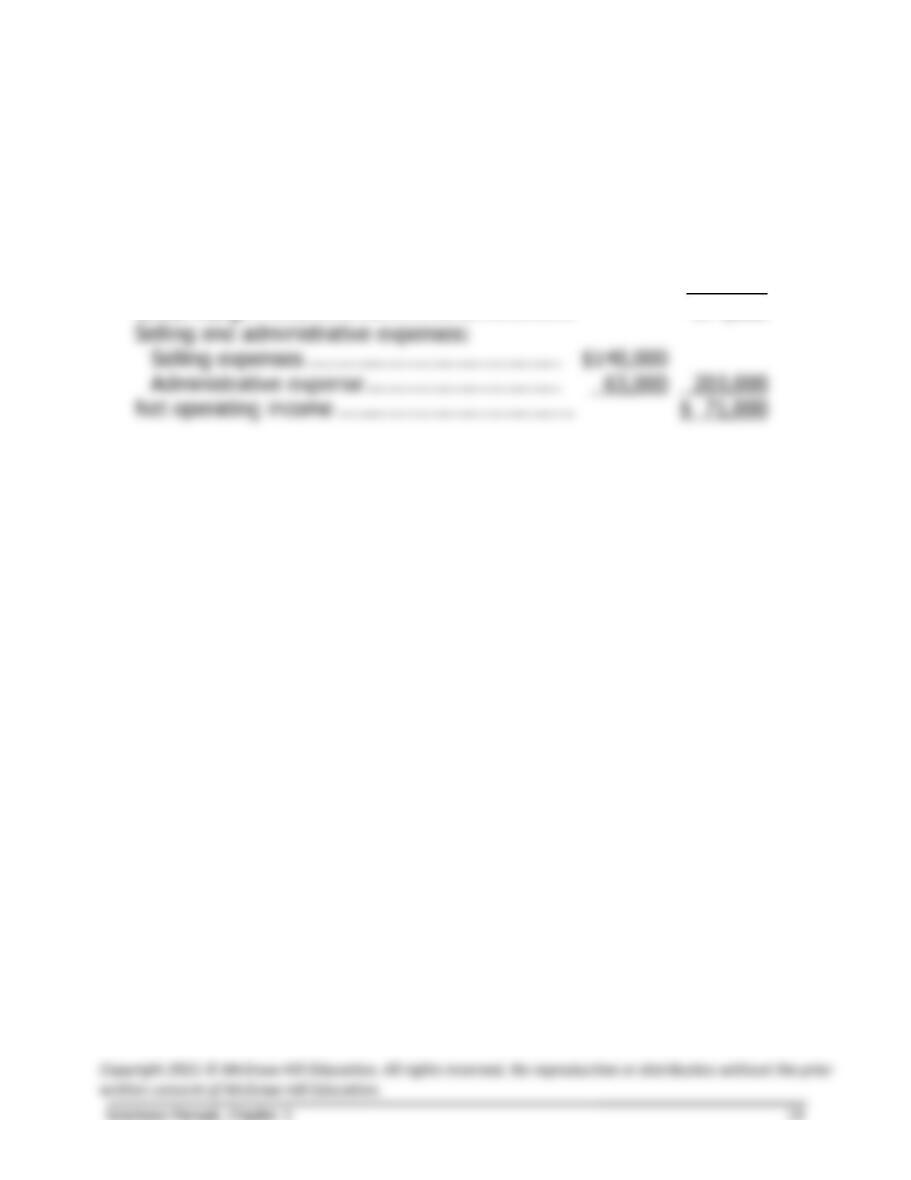
2. Mason Company’s schedule of cost of goods sold is as follows:
Beginning finished goods inventory …………
$ 20,000
Add: Cost of goods manufactured …………..
275,000
Cost of goods available for sale ………………
295,000
Deduct: Ending finished goods inventory ….
Unadjusted cost of goods sold ………………..
Deduct: Overapplied overhead* ……………..
10,000
Adjusted cost of goods sold …………………..
Exercise 3-6 (continued)
3.
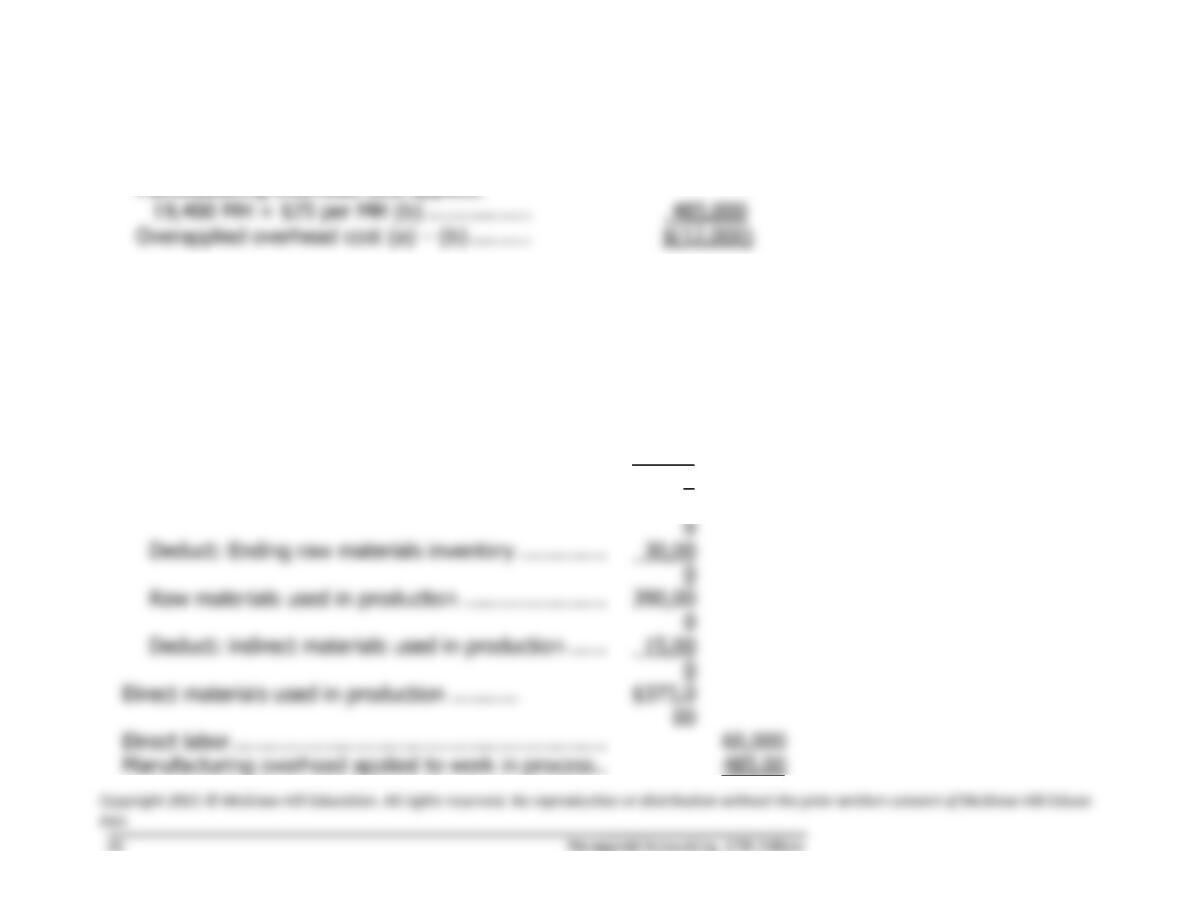
Mason Company
Income Statement
Sales ……………………………………………………..
$524,000
Cost of goods sold ($260,000 – $10,000) ……….
250,000
Gross margin …………………………………………..
Net operating income ………………………………..
Exercise 3-7 (15 minutes)
1.
Actual manufacturing overhead costs (a) …
$473,000
2. Schedule of Cost of Goods Manufactured:
Beginning work in process inventory ……….
$40,00
0
Direct materials:
Beginning raw materials inventory ………………….
$ 20,00
0
Add: Purchases of raw materials …………………….
400,00
0
Total raw materials available …………………………
420,00
Deduct: Ending raw materials inventory …………..
0
Direct materials used in production ………..
Direct labor ……………………………………………………
Manufacturing overhead applied to work in process ..