3-21
PROBLEM 3-43 (35 MINUTES)
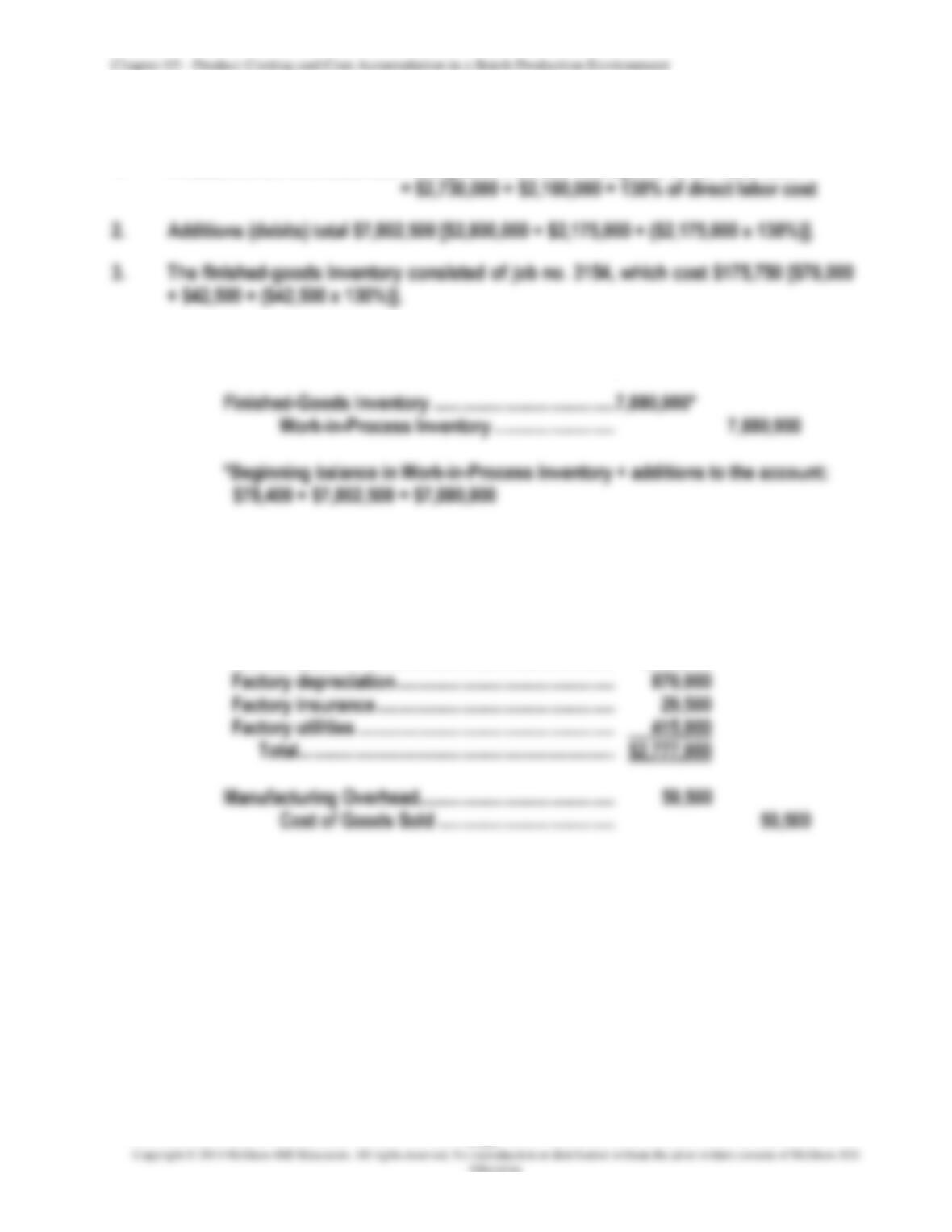
1. Predetermined overhead rate = budgeted overhead ÷ budgeted direct-labor cost
4. Since there is no work in process at year-end, all amounts in the Work-in-Process
account must be transferred to Finished-Goods Inventory. Thus:
5. BBBC’s applied overhead totals 130% of direct-labor cost, or $2,827,500 ($2,175,000 x
130%). Actual overhead was $2,777,000, itemized as follows, resulting in overapplied
overhead of $50,500.
Indirect materials used …………………………………….
$ 32,500
Indirect labor …………………………………………………..
1,430,000
Factory depreciation ………………………………………..
870,000
Factory insurance ……………………………………………
29,500
Factory utilities ……………………………………………….
415,000
$2,777,000
Chapter 03 – Product Costing and Cost Accumulation in a Batch Production Environment
3-22
PROBLEM 3-43 (CONTINUED)
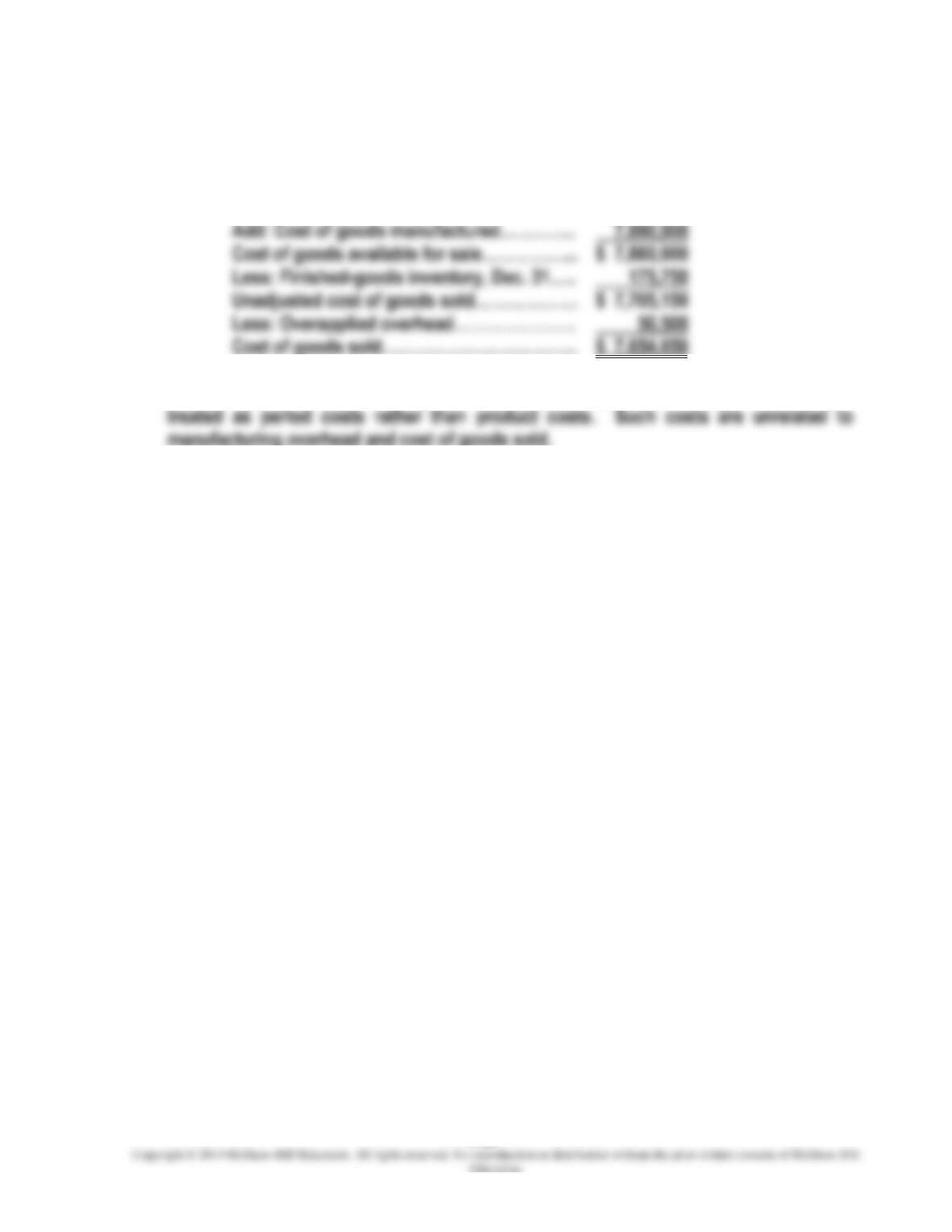
6. The company’s cost of goods sold totals $7,654,650:
Finished-goods inventory, Jan. 1…………….
$ 0
7. No, selling and administrative expenses are operating expenses of the firm and are
Chapter 03 – Product Costing and Cost Accumulation in a Batch Production Environment
3-23
PROBLEM 3-44 (45 MINUTES)
NOTE: The 12/31/x4 balances for cash and accounts receivable, although given in the
problem, are irrelevant to the solution.
1.
MISTER MUNCHIE, INC.
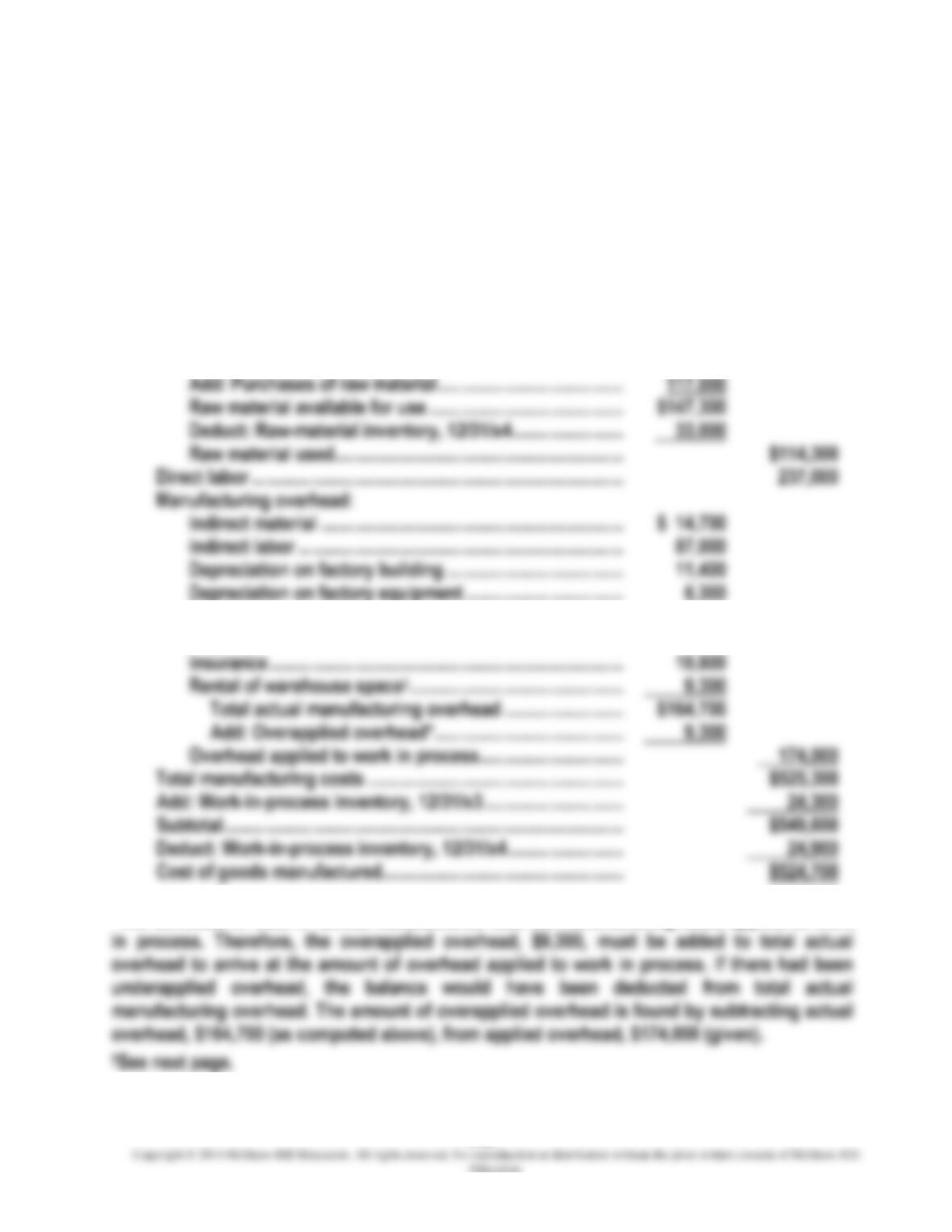
SCHEDULE OF COST OF GOODS MANUFACTURED
FOR THE YEAR ENDED DECEMBER 31, 20X4
Direct material:
Raw-material inventory, 12/31/x3 ………………………………………
$ 30,300
Add: Purchases of raw material ………………………………………..
Raw material available for use ………………………………………….
$147,300
Deduct: Raw-material inventory, 12/31/x4 ………………………….
Raw material used ……………………………………………………….
$114,300
Direct labor ……………………………………………………………………………
Manufacturing overhead:
Indirect material ………………………………………………………………
$ 14,700
Indirect labor …………………………………………………………………..
87,000
Depreciation on factory building ………………………………………
11,400
Depreciation on factory equipment …………………………..………
Utilities ……………………………………………………………………………
18,000
Property taxes …………………………………………………………………
7,200
Insurance ………………………………………………………………………..
10,800
Rental of warehouse space† ……………………………………………..
Total actual manufacturing overhead …………………………..
$164,700
Add: Overapplied overhead* …………………………………………
Overhead applied to work in process …………………………..
Total manufacturing costs ……………………………………………………..
$525,300
Add: Work-in-process inventory, 12/31/x3 …………………………..
Subtotal …………………………………………………………………………………
$549,600
Deduct: Work-in-process inventory, 12/31/x4 …………………………..
Cost of goods manufactured …………………………………………………..
$524,700
*The Schedule of Cost of Goods Manufactured lists the manufacturing costs applied to work
3-24
PROBLEM 3-44 (CONTINUED)
2.
MISTER MUNCHIE, INC.
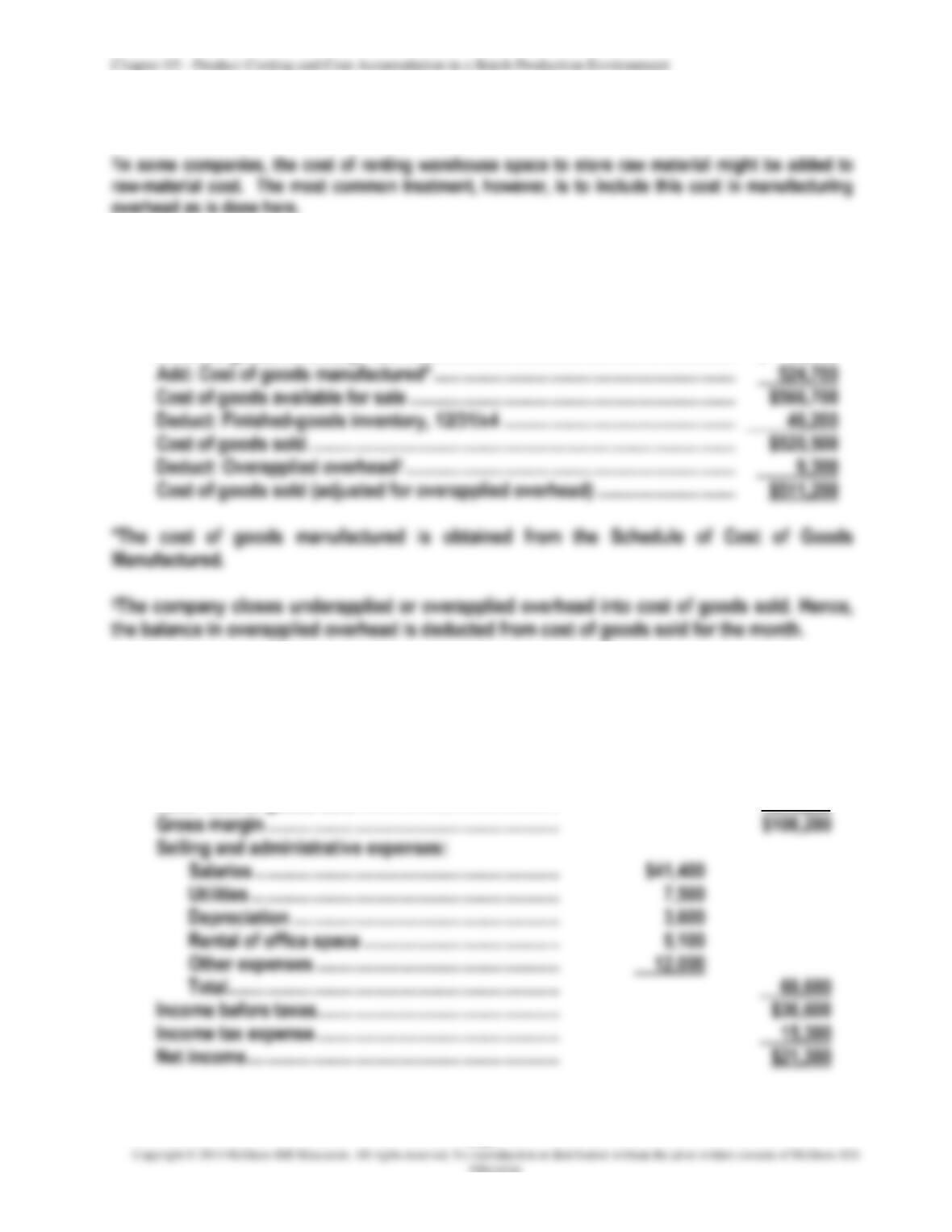
SCHEDULE OF COST OF GOODS SOLD
FOR THE YEAR ENDED DECEMBER 31, 20X4
Finished-goods inventory, 12/31/x3 ………………………………………………………….
$ 42,000
Add: Cost of goods manufactured* ………………………………………………………….
Cost of goods available for sale …………………………..………………………………….
Deduct: Finished-goods inventory, 12/31/x4 …………………………………………….
Cost of goods sold ………………………………………………………………………………….
Deduct: Overapplied overhead† ……………………………………………………………….
Cost of goods sold (adjusted for overapplied overhead) …………………………..
3.
MISTER MUNCHIE, INC.
INCOME STATEMENT
FOR THE YEAR ENDED DECEMBER 31, 20X4
Sales revenue ……………………………………………………..
$617,400
Less: Cost of goods sold …………………………………….
511,200
Gross margin ………………………………………………………
$106,200
Selling and administrative expenses:
Salaries ………………………………………………………..
Utilities …………………………………………………………
Depreciation …………………………………………………
Rental of office space ……………………………………
Other expenses …………………………………………….
Total ……………………………………………………………..
Income before taxes …………………………………………….
Income tax expense …………………………………………….
Net income ………………………………………………………….
Chapter 03 – Product Costing and Cost Accumulation in a Batch Production Environment
3-25
PROBLEM 3-45 (25 MINUTES)
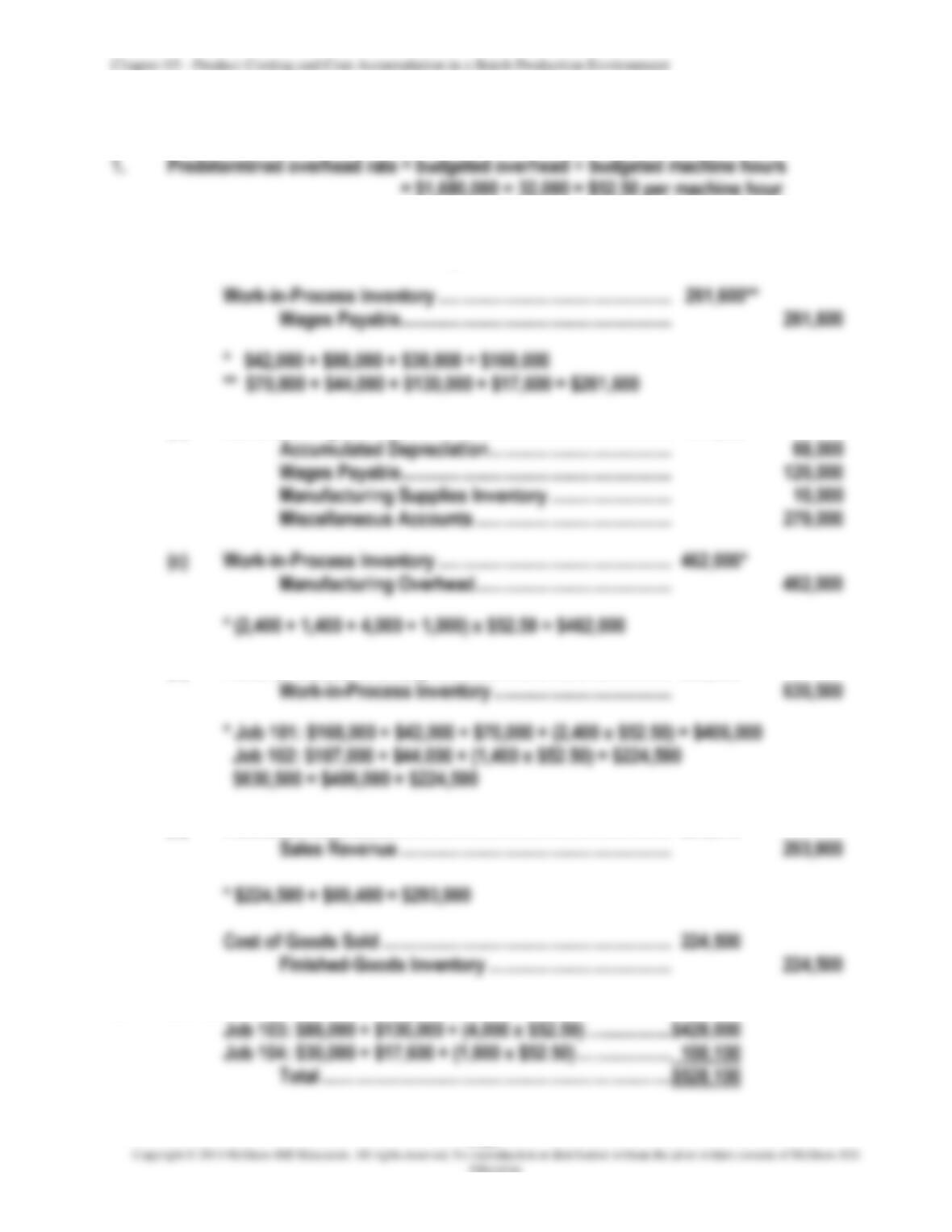
The completed T-accounts are shown below. (Missing amounts in problem are italicized.)
Raw-Material Inventory
Accounts Payable
Bal. 1/1
29,400
3,500
Bal. 1/1
168,000
191,100
Bal. 12/31
50,400
Bal. 12/31
Work-in-Process Inventory
Finished-Goods Inventory
Bal. 1/1
23,800
Bal. 1/1
16,800
Direct
labor
210,000
1,005,200
Bal. 12/31
26,600
Manufacturing Overhead
633,500
630,000
Sales Revenue
1,134,000
Wages Payable
2,800
Bal. 1/1
Accounts Receivable
205,800
Bal. 1/1
15,400
7,000
Bal. 12/31
1,134,000
1,128,400
3-26
PROBLEM 3-46 (35 MINUTES)
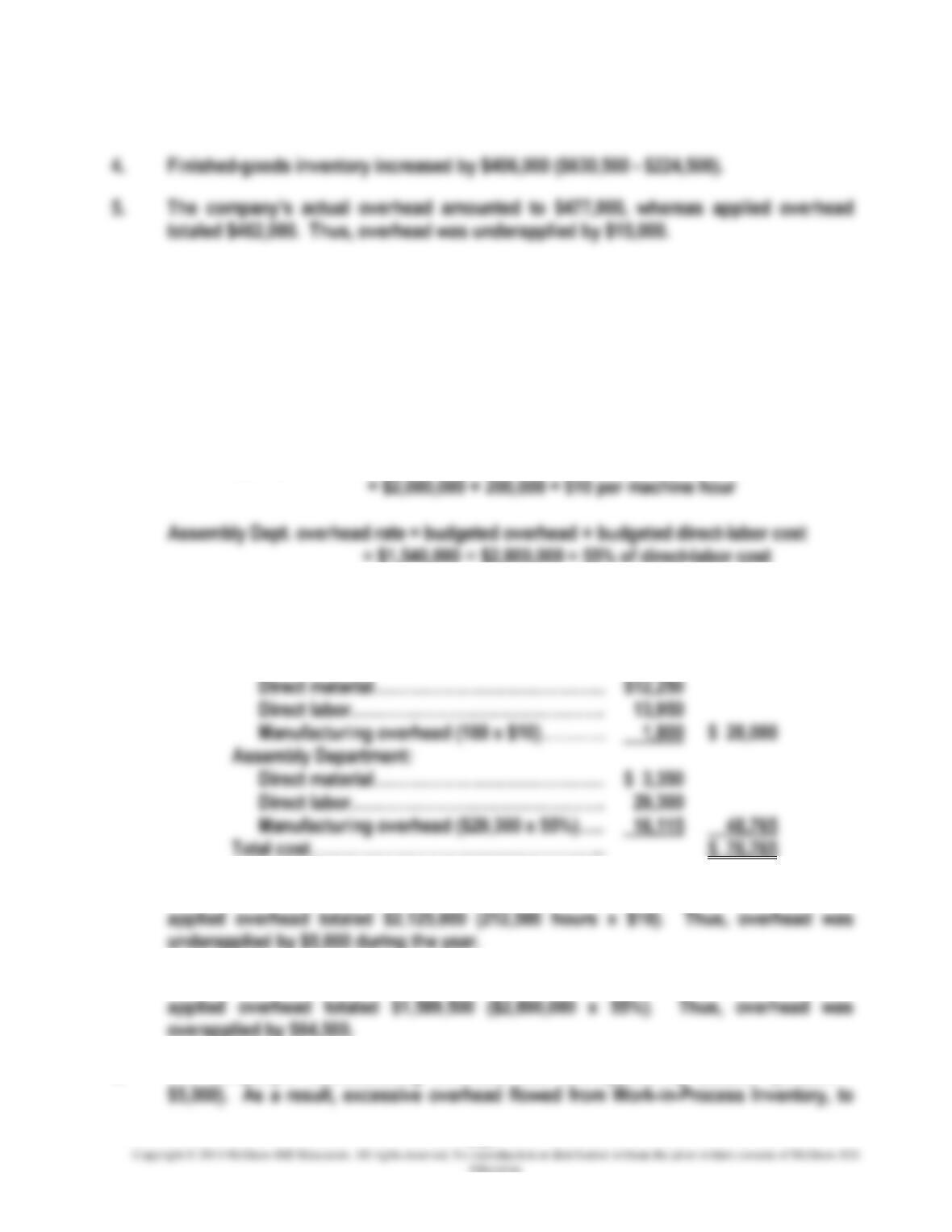
2. (a) Work-in-Process Inventory ………………………………………….. 160,000*
Raw-Material Inventory ……………………………………… 160,000
(b) Manufacturing Overhead ……………………………………………… 477,000
(d) Finished-Goods Inventory …………………………………………… 630,500*
(e) Accounts Receivable …………………………………………………… 293,900*
3. Job no. 103 and no. 104 are in production as of March 31:
Chapter 03 – Product Costing and Cost Accumulation in a Batch Production Environment
3-27
PROBLEM 3-46 (CONTINUED)
PROBLEM 3-47 (30 MINUTES)
NOTE: Actual selling and administrative expense, although given in the exercise, is irrelevant
to the solution.
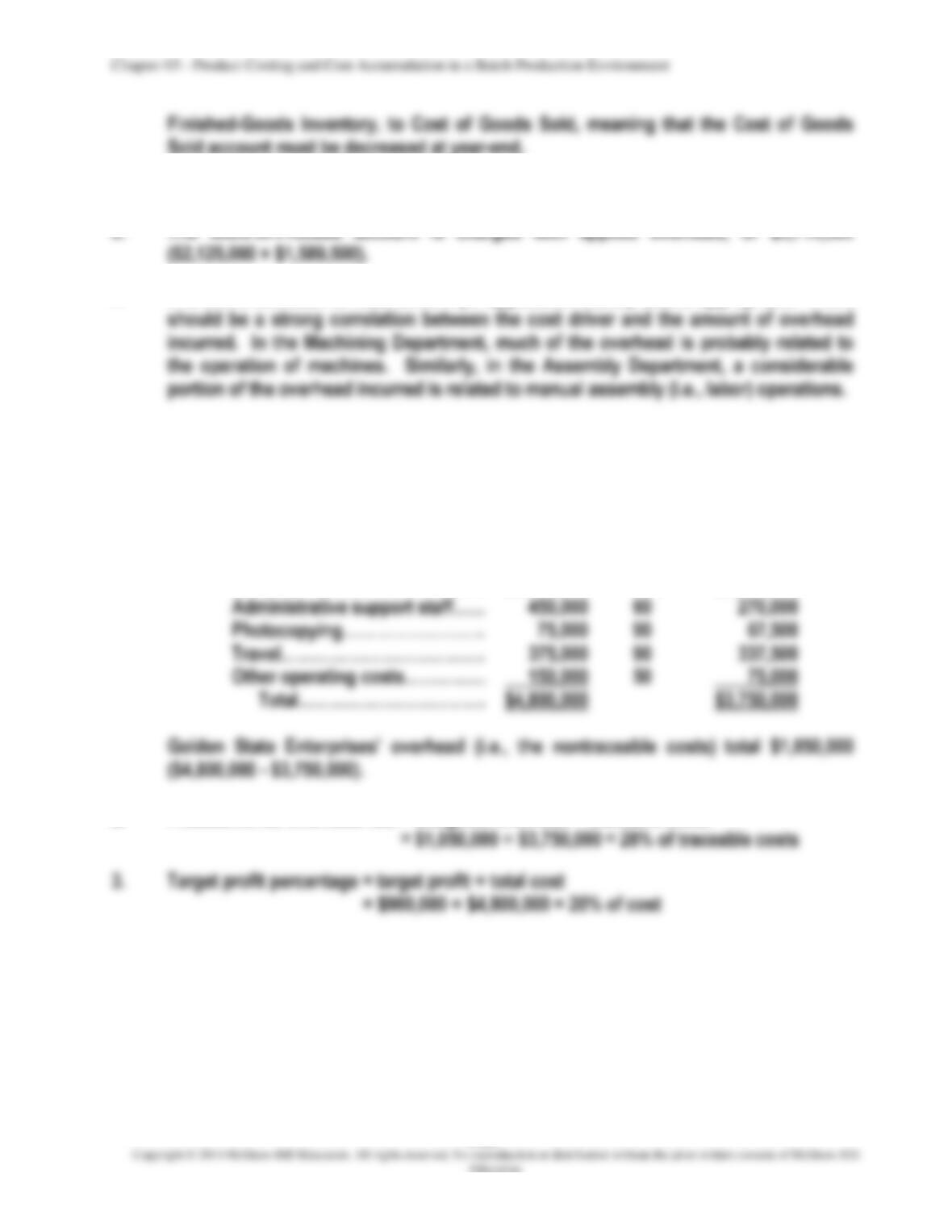
1. Machining Dept. overhead rate = budgeted overhead ÷ budgeted machine hours
2. The ending work-in-process inventory is carried at a cost of $76,765, computed as
follows:
Machining Department:
$12,250
1,800
$ 28,000
Assembly Department:
$ 3,350
48,765
$ 76,765
3. Actual overhead in the Machining Department amounted to $2,130,000, whereas
4. Actual overhead in the Assembly Department amounted to $1,525,000, whereas
5. The company’s manufacturing overhead was overapplied by $59,500 ($64,500 –
3-28
PROBLEM 3-47 (CONTINUED)
7. The firm’s selection of cost drivers (or application bases) seems appropriate. There
PROBLEM 3-48 (30 MINUTES)
1. Traceable costs total $3,750,000, computed as follows:
Total Cost
Percent
Traceable
Traceable
Cost
Professional staff salaries………
$3,750,000
80%
$3,000,000
Administrative support staff……
450,000
60
270,000
75,000
90
67,500
375,000
90
337,500
Other operating costs……………
150,000
50
75,000
$4,800,000
$3,750,000
2. Predetermined overhead rate = budgeted overhead ÷ traceable costs
Chapter 03 – Product Costing and Cost Accumulation in a Batch Production Environment
PROBLEM 3-48 (CONTINUED)
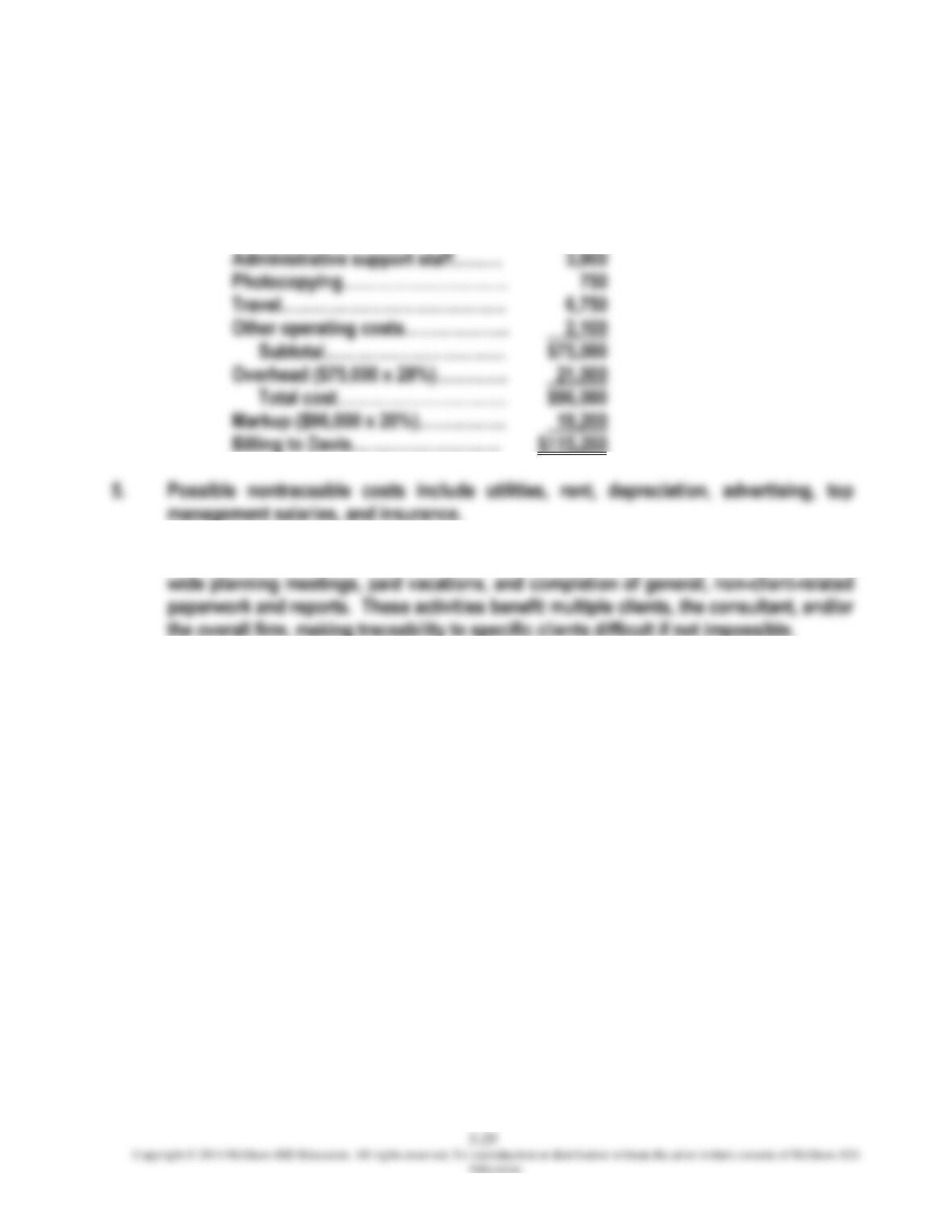
4. The total cost of the Davis Manufacturing project is $96,000, and the billing is
$115,200, as follows:
Professional staff salaries… ………
$61,500
3,900
750
6,750
Other operating costs……………….
2,100
$75,000
$96,000
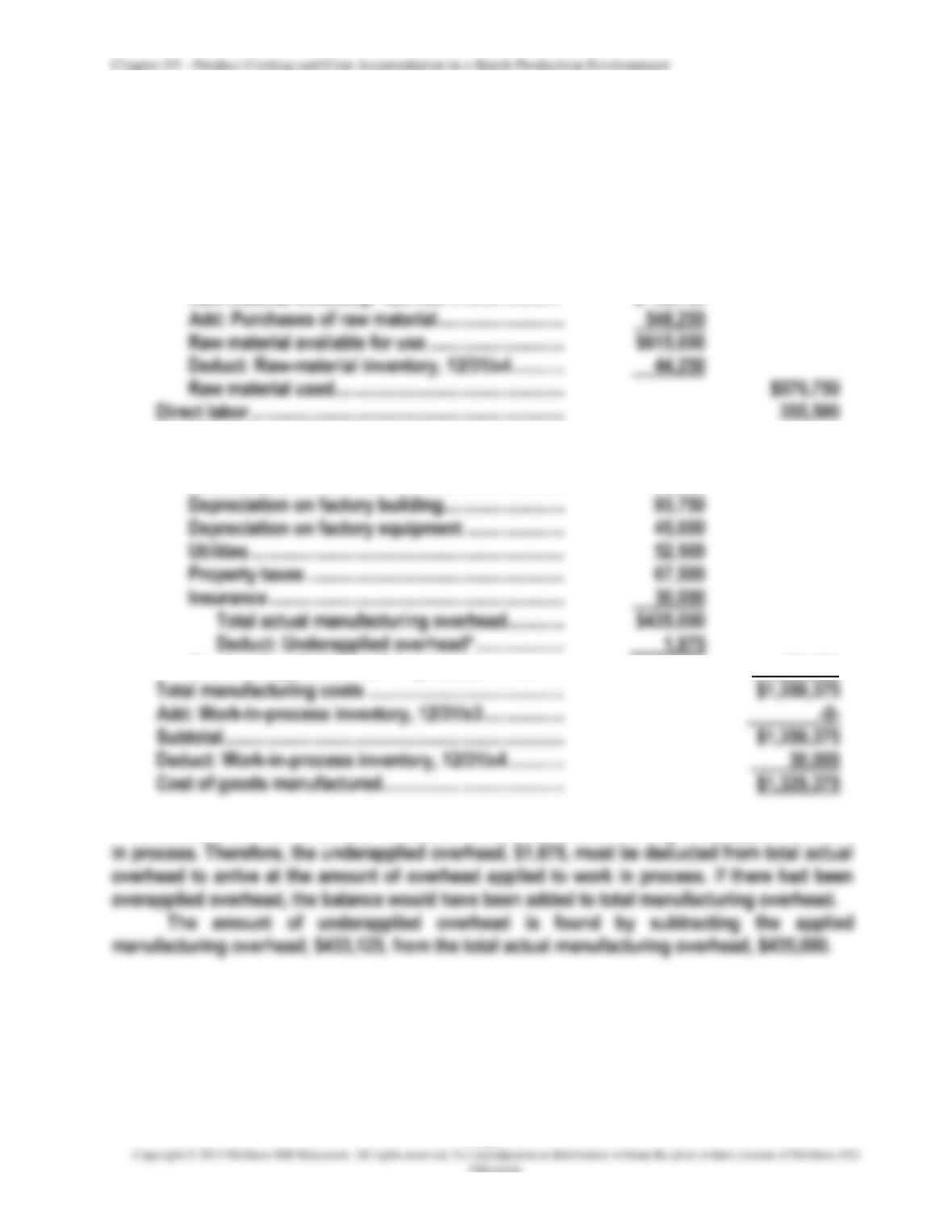
6. Professional staff members are compensated for attending training sessions and firm-
3-30
PROBLEM 3-49 (45 MINUTES)
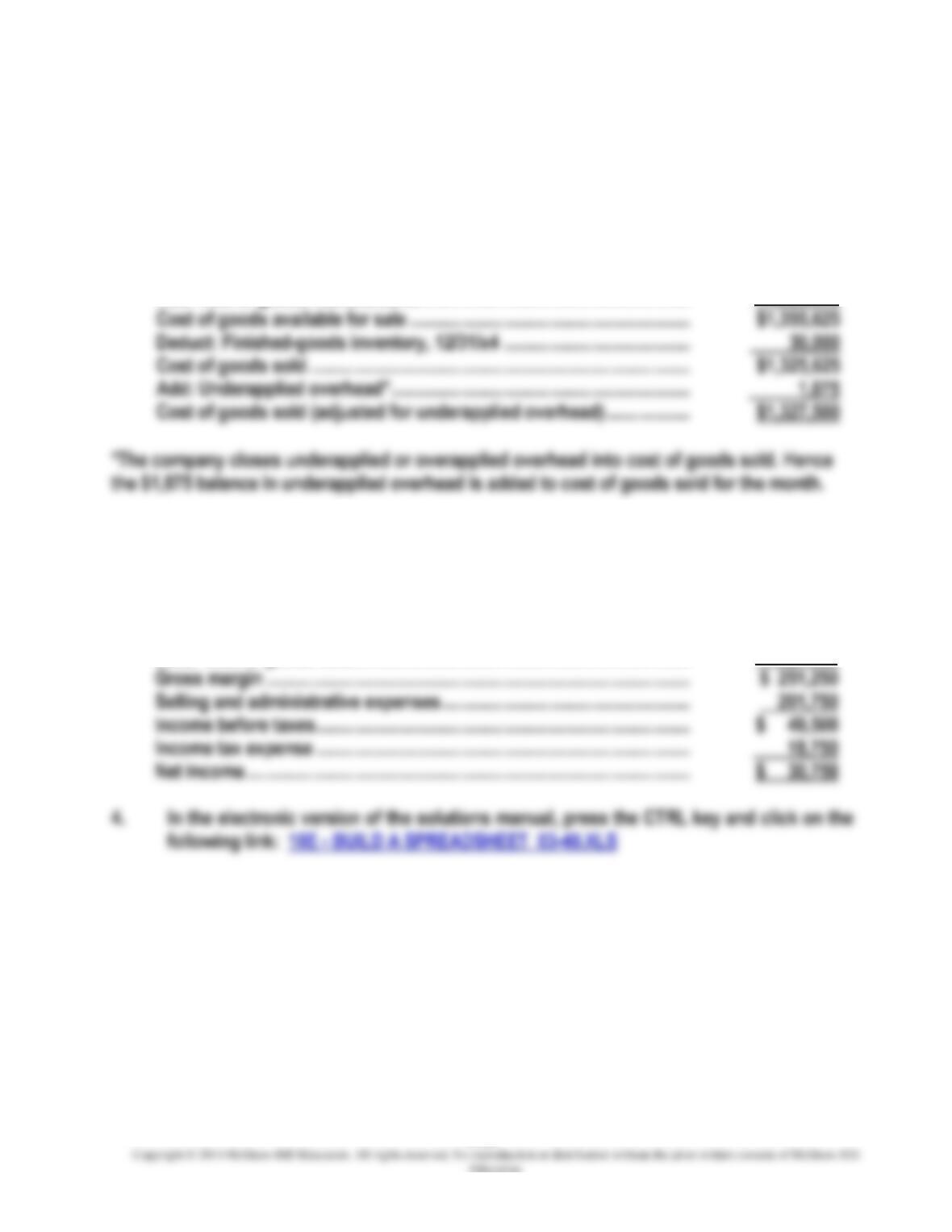
1.
SUPERIOR METALS
SCHEDULE OF COST OF GOODS MANUFACTURED
FOR THE YEAR ENDED DECEMBER 31, 20X4
Direct material:
Raw material inventory, 12/31/x3 ……………………
$ 66,750
Add: Purchases of raw material ………………………
Raw material available for use ………………………..
Deduct: Raw-material inventory, 12/31/x4 ………..
Raw material used ………………………………………….
Direct labor ………………………………………………………….
Manufacturing overhead:
Indirect material ……………………………………………..
$ 33,750
Indirect labor …………………………………………………
112,500
Depreciation on factory building……………………..
Depreciation on factory equipment …………………
Utilities ………………………………………………………….
Property taxes ……………………………………………….
Insurance ………………………………………………………
Total actual manufacturing overhead …………
Deduct: Underapplied overhead* ……………….
Overhead applied to work in process ………………
433,125
Total manufacturing costs ……………………………………
Add: Work-in-process inventory, 12/31/x3 ……………..
Subtotal ……………………………………………………………….
Deduct: Work-in-process inventory, 12/31/x4 …………
Cost of goods manufactured …………………………………
*The Schedule of Cost of Goods Manufactured lists the manufacturing costs applied to work
Chapter 03 – Product Costing and Cost Accumulation in a Batch Production Environment
3-31
PROBLEM 3-49 (CONTINUED)
2.
SUPERIOR METALS
SCHEDULE OF COST OF GOODS SOLD
FOR THE YEAR ENDED DECEMBER 31, 20X4
Finished-goods inventory, 12/31/x3 ……………………………………………….
$ 26,250
Add: cost of goods manufactured …………………………………………………
1,329,375
Cost of goods available for sale …………………………..……………………….
Deduct: Finished-goods inventory, 12/31/x4 ………………………………….
Cost of goods sold ……………………………………………………………………….
Add: Underapplied overhead* ……………………………………………………….
Cost of goods sold (adjusted for underapplied overhead) ………………
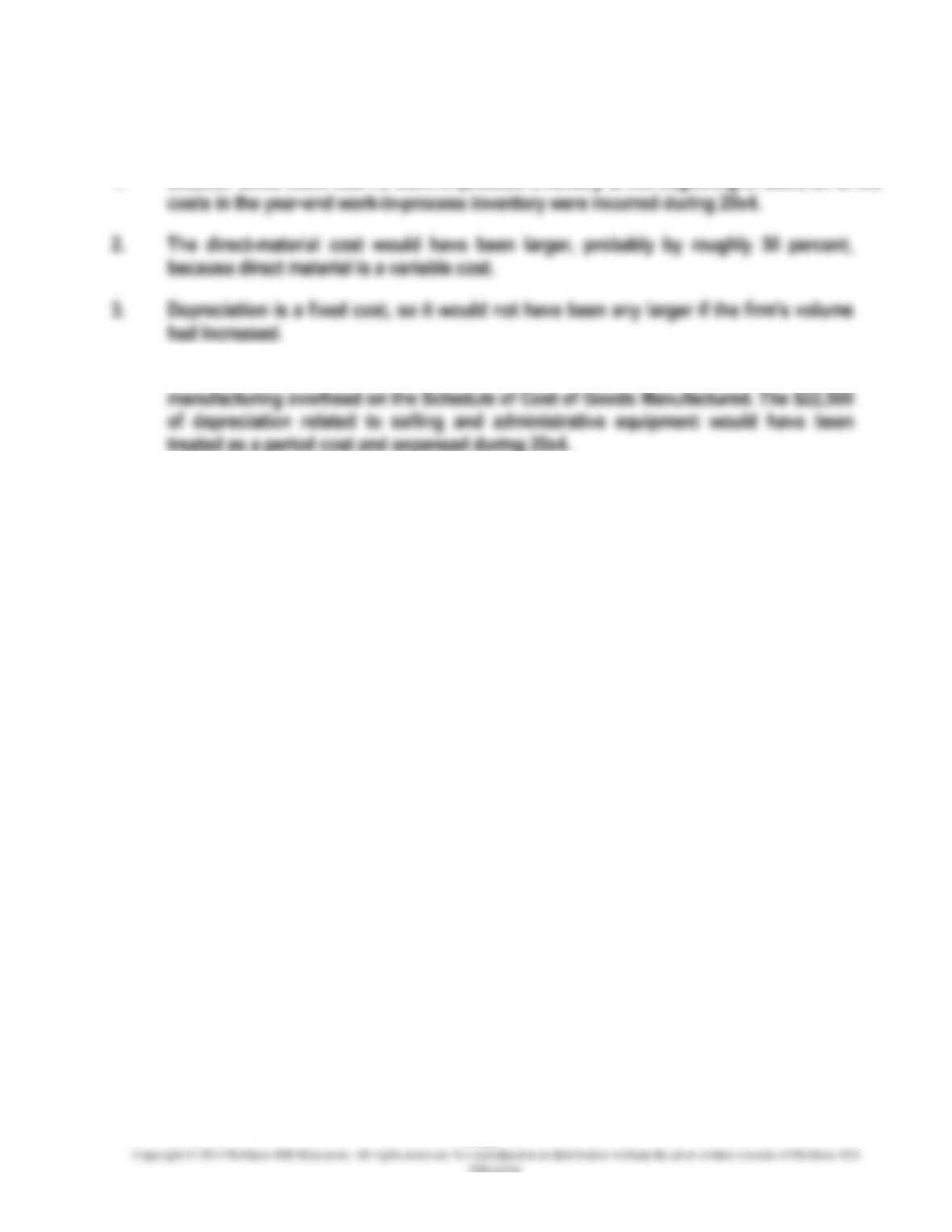
3.
SUPERIOR METALS
INCOME STATEMENT
FOR THE YEAR ENDED DECEMBER 31, 20X4
Sales revenue ………………………………………………………………………………
$1,578,750
Less: Cost of goods sold ………………………………………………………………
1,327,500
Gross margin ……………………………………………………………………………….
Selling and administrative expenses ……………………………………………..
Income before taxes ……………………………………………………………………..
Income tax expense ……………………………………………………………………..
Net income …………………………………………………………………………………..
Chapter 03 – Product Costing and Cost Accumulation in a Batch Production Environment
3-32
PROBLEM 3-50 (15 MINUTES)
1. $30,000. Since there was no work-in-process inventory at the beginning of 20×4, all of the
4. Only the $22,500 of equipment depreciation would have been included in
3-33
PROBLEM 3-51 (25 MINUTES)
1.
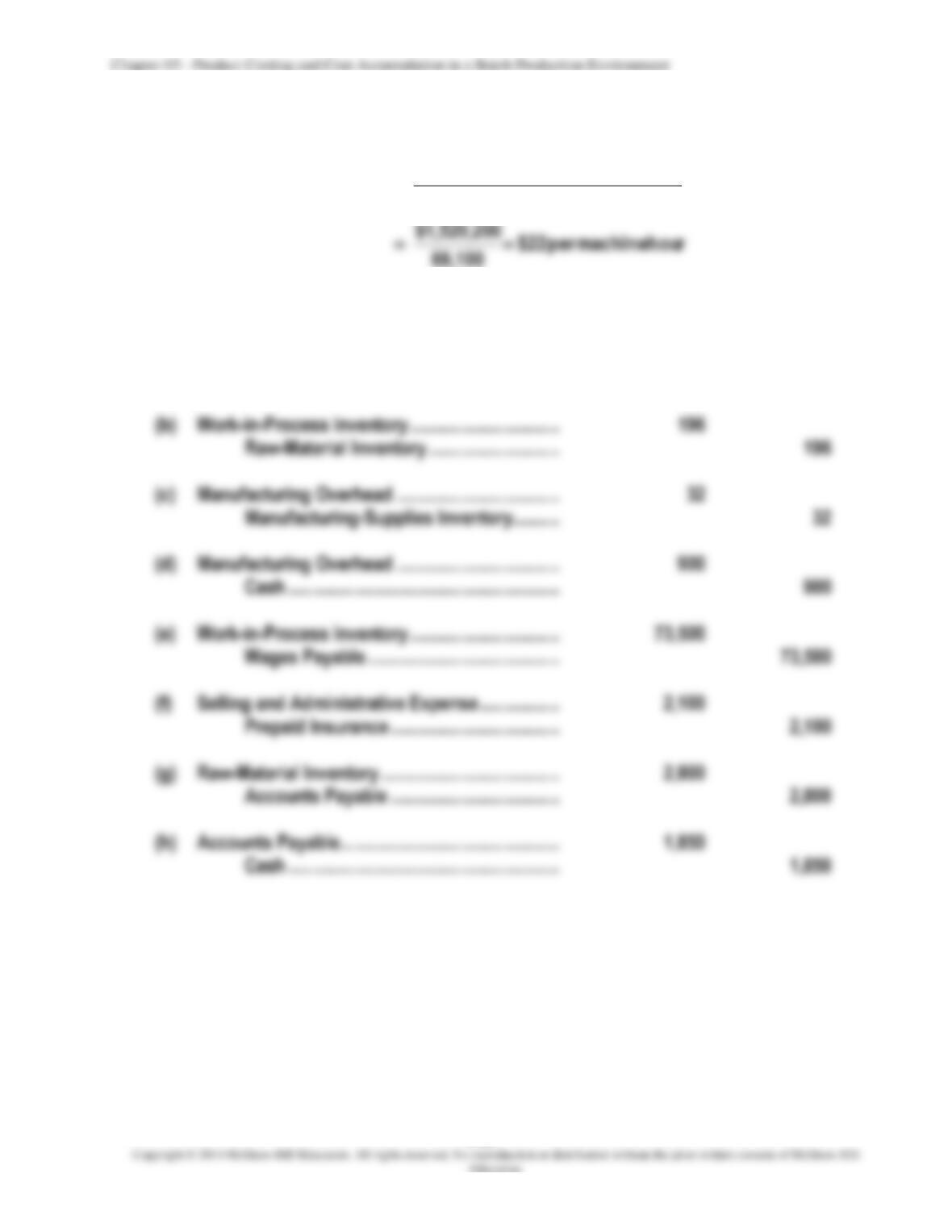
hours machine budgeted
overhead ingmanufactur budgeted
rate overhead nedPredetermi
=
2.
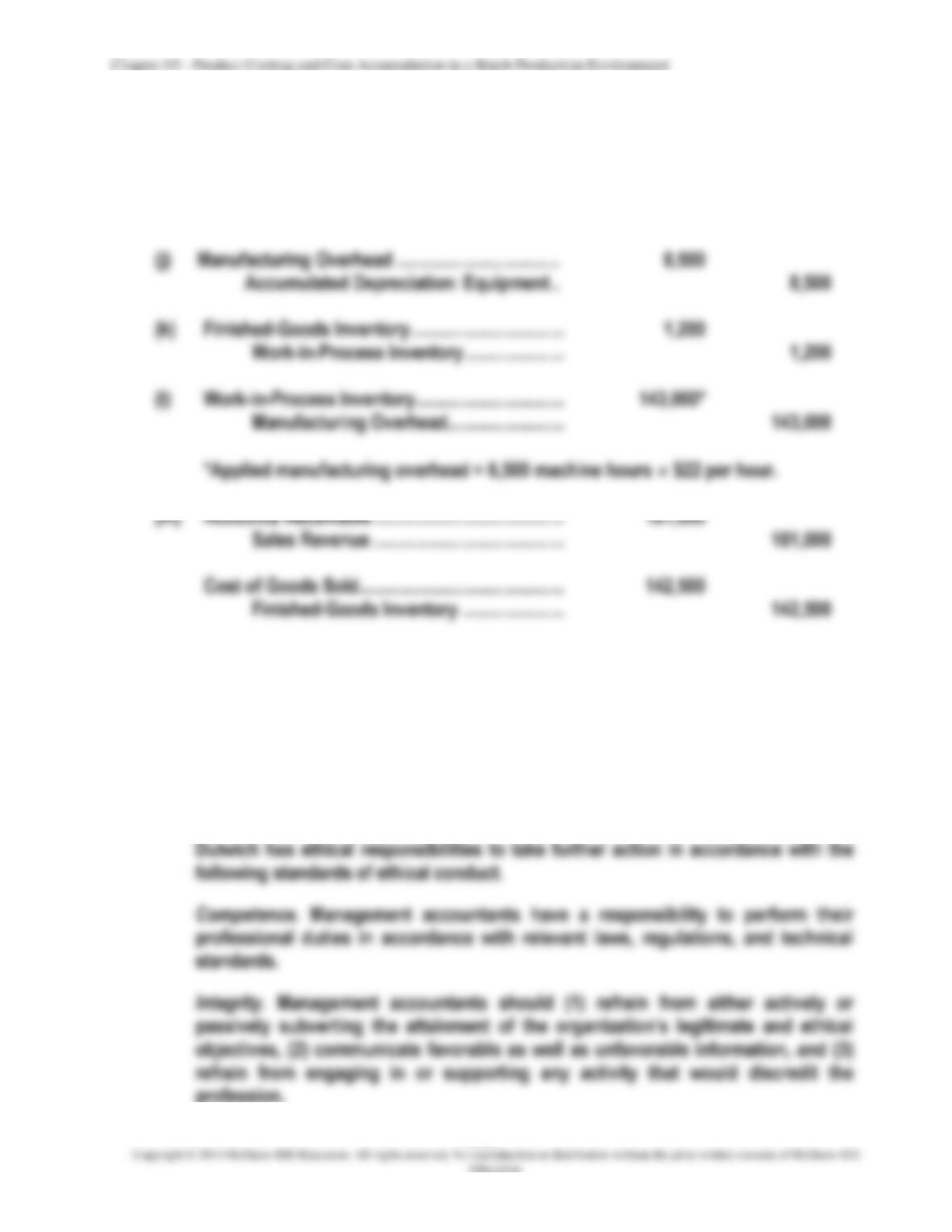
Journal entries:
(a)
Raw-Material Inventory ………………………………..
8,240
Accounts Payable ………………………………
8,240
(b)
Raw-Material Inventory ……………………….
(c)
Manufacturing Overhead ……………………………..
Manufacturing-Supplies Inventory ……….
(d)
Manufacturing Overhead ……………………………..
Cash ………………………………………………….
(e)
Wages Payable …………………………………..
Selling and Administrative Expense ……………..
2,100
Prepaid Insurance ………………………………
(g)
Raw-Material Inventory ………………………………..
2,800
Accounts Payable ………………………………
2,800
(h)
Accounts Payable ………………………………………..
1,850
Cash ………………………………………………….
1,850
3-34
PROBLEM 3-51 (CONTINUED)
(i)
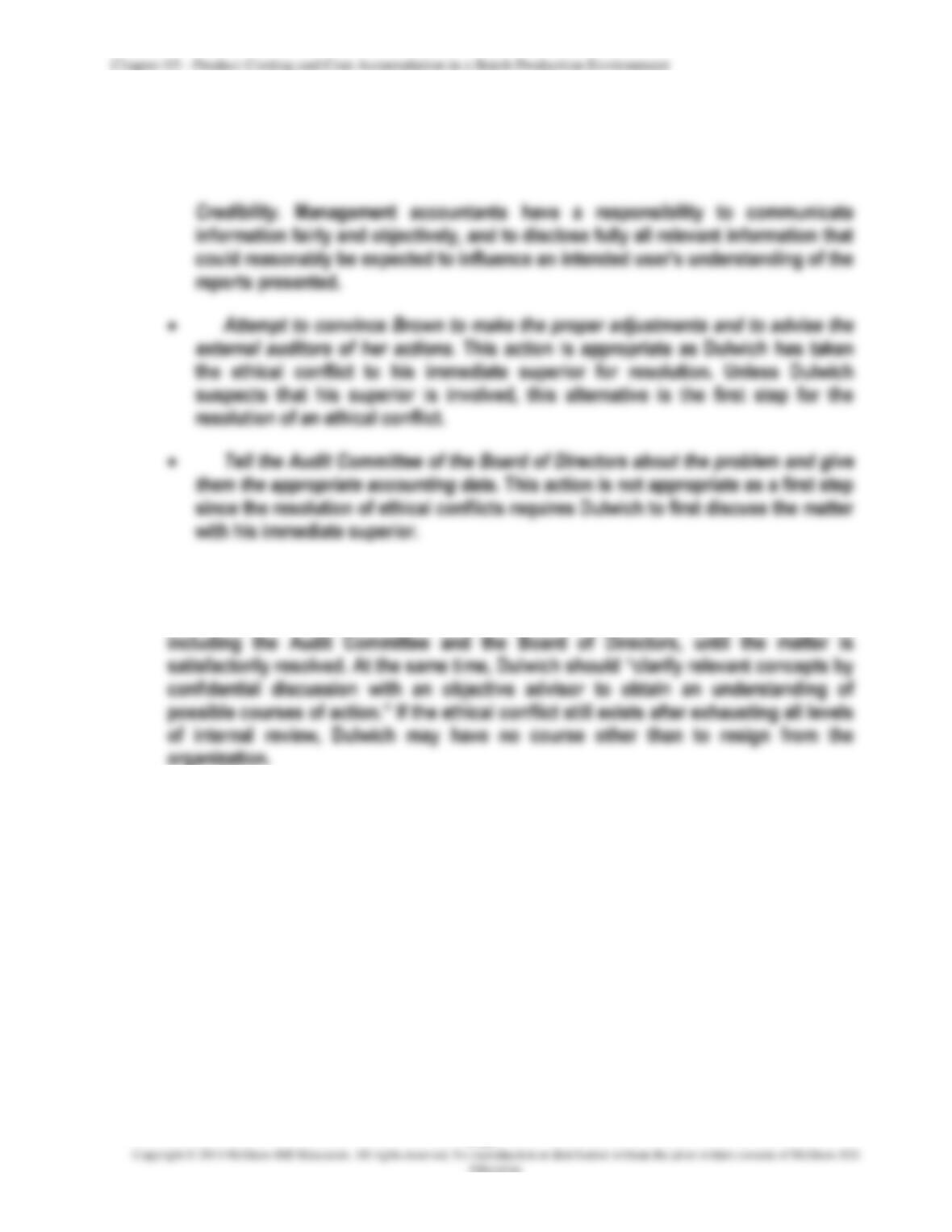
Manufacturing Overhead ……………………………..
19,000
Wages Payable …………………………………..
19,000
(j)
Manufacturing Overhead ……………………………..
Accumulated Depreciation: Equipment ..
(k)
Finished-Goods Inventory …………………………...
(l)
Manufacturing Overhead…………………….
Accounts Receivable …………………………………..
Sales Revenue …………………………………..
Cost of Goods Sold ……………………………………..
Finished-Goods Inventory ………………….
PROBLEM 3-52 (40 MINUTES)
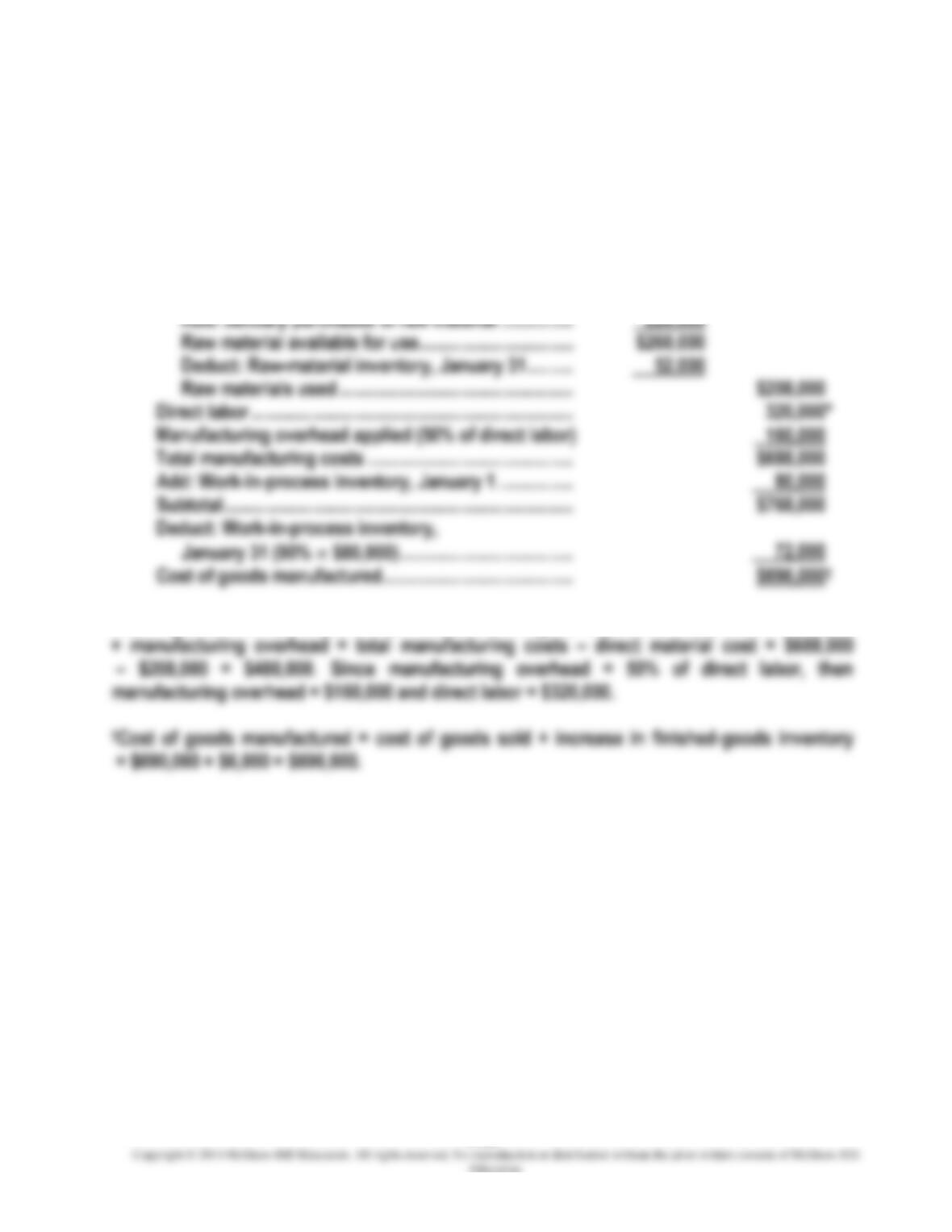
1. In accordance with the Standards of Ethical Conduct for Management Accountants,
the appropriateness of Joey Dulwich’s three alternative courses of action is described
as follows:
• Follow Brown’s directive and do nothing further. This action is inappropriate as
3-35
PROBLEM 3-52 (CONTINUED)
2. The next step that Dulwich should take in resolving this conflict is to inform Brown
that he is planning to discuss the conflict with the next higher managerial level.
Dulwich should pursue discussions with successively higher levels of management,
Chapter 03 – Product Costing and Cost Accumulation in a Batch Production Environment
3-36
PROBLEM 3-53 (30 MINUTES)
1.
MARVELOUS MARSHMALLOW COMPANY
SCHEDULE OF COST OF GOODS MANUFACTURED
FOR THE MONTH OF JANUARY
Direct material:
Raw-material inventory, January 1 ……………………..
$ 34,000
Add: January purchases of raw material …………….
Raw material available for use …………………………...
Deduct: Raw-material inventory, January 31 ……….
Raw materials used …………………………………………..
Direct labor ……………………………………………………………
Manufacturing overhead applied (50% of direct labor)
Total manufacturing costs ……………………………………..
Add: Work-in-process inventory, January 1 …………….
Subtotal …………………………………………………………………
Deduct: Work-in-process inventory,
Cost of goods manufactured …………………………………..
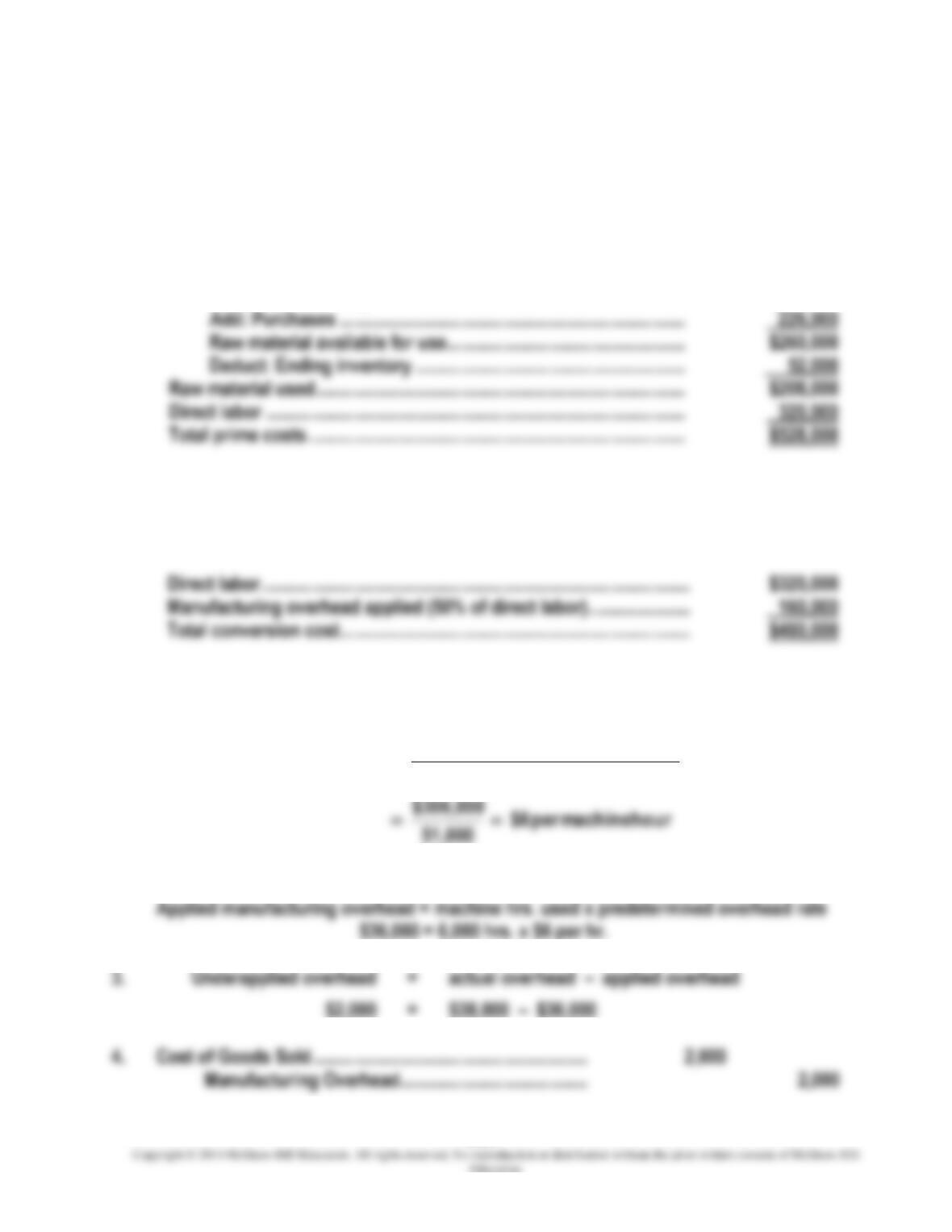
*Work upward from the bottom of the statement, using the information available. Direct labor
Chapter 03 – Product Costing and Cost Accumulation in a Batch Production Environment
3-37
PROBLEM 3-53 (CONTINUED)
2.
MARVELOUS MARSHMALLOW COMPANY
SCHEDULE OF PRIME COSTS
FOR THE MONTH OF JANUARY
Raw material:
Beginning inventory ………………………………………………………….
$ 34,000
Add: Purchases ………………………………………………………………..
Raw material available for use ……………………………………………
Deduct: Ending inventory ………………………………………………….
Raw material used …………………………………………………………………….
Direct labor ………………………………………………………………………………
Total prime costs ………………………………………………………………………
3.
MARVELOUS MARSHMALLOW COMPANY
SCHEDULE OF CONVERSION COSTS
FOR THE MONTH OF JANUARY
Direct labor ………………………………………………………………………………..
Manufacturing overhead applied (50% of direct labor) ………………….
Total conversion cost …………………………………………………………………
PROBLEM 3-54 (30 MINUTES)
1.
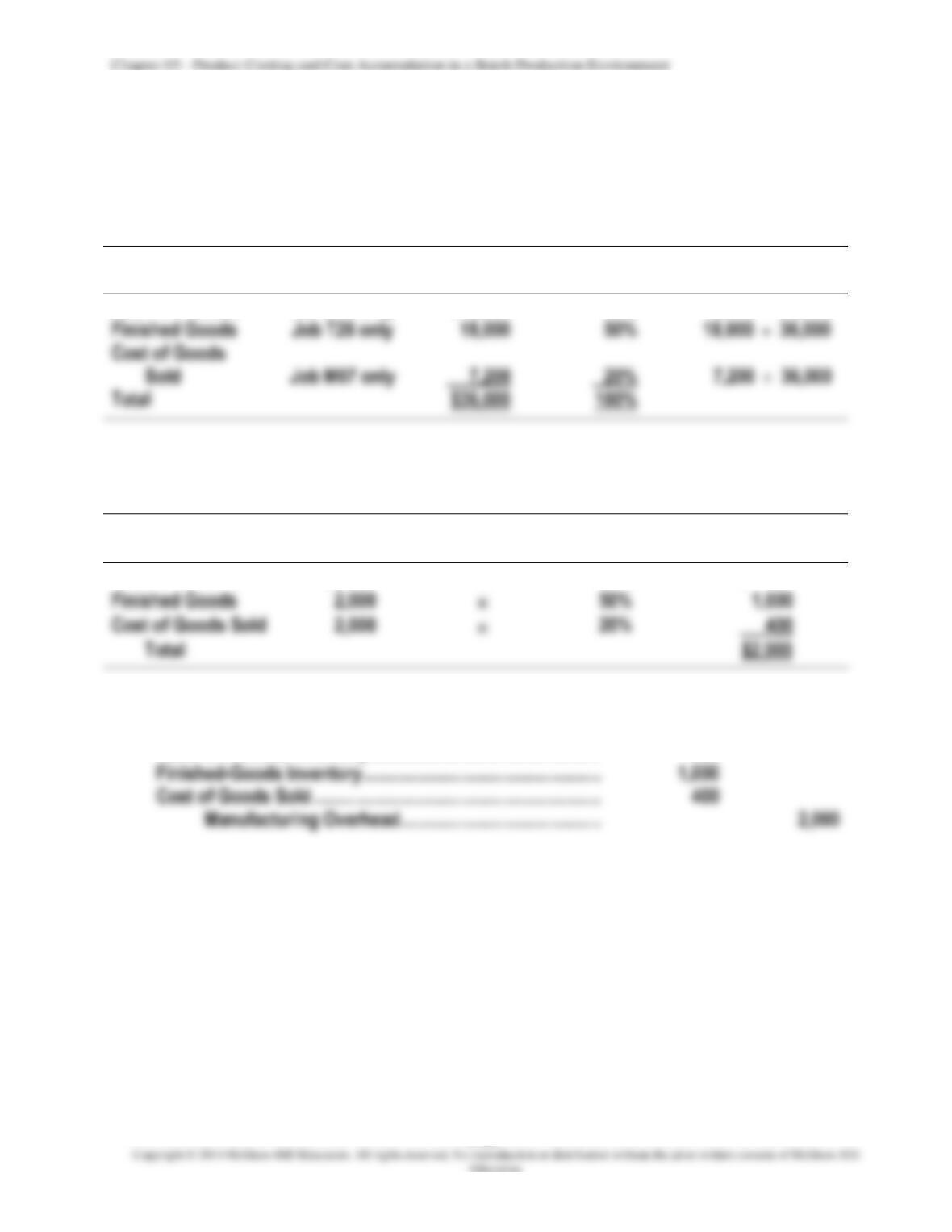
hours machine budgeted
overhead ingmanufactur budgeted
rate overhead nedPredetermi
=
2.
Calculation of applied manufacturing overhead:
3.
actual overhead – applied overhead
$38,000 – $36,000
4.
Cost of Goods Sold …………………………………………………..
3-38
PROBLEM 3-54 (CONTINUED)
5.
(a)
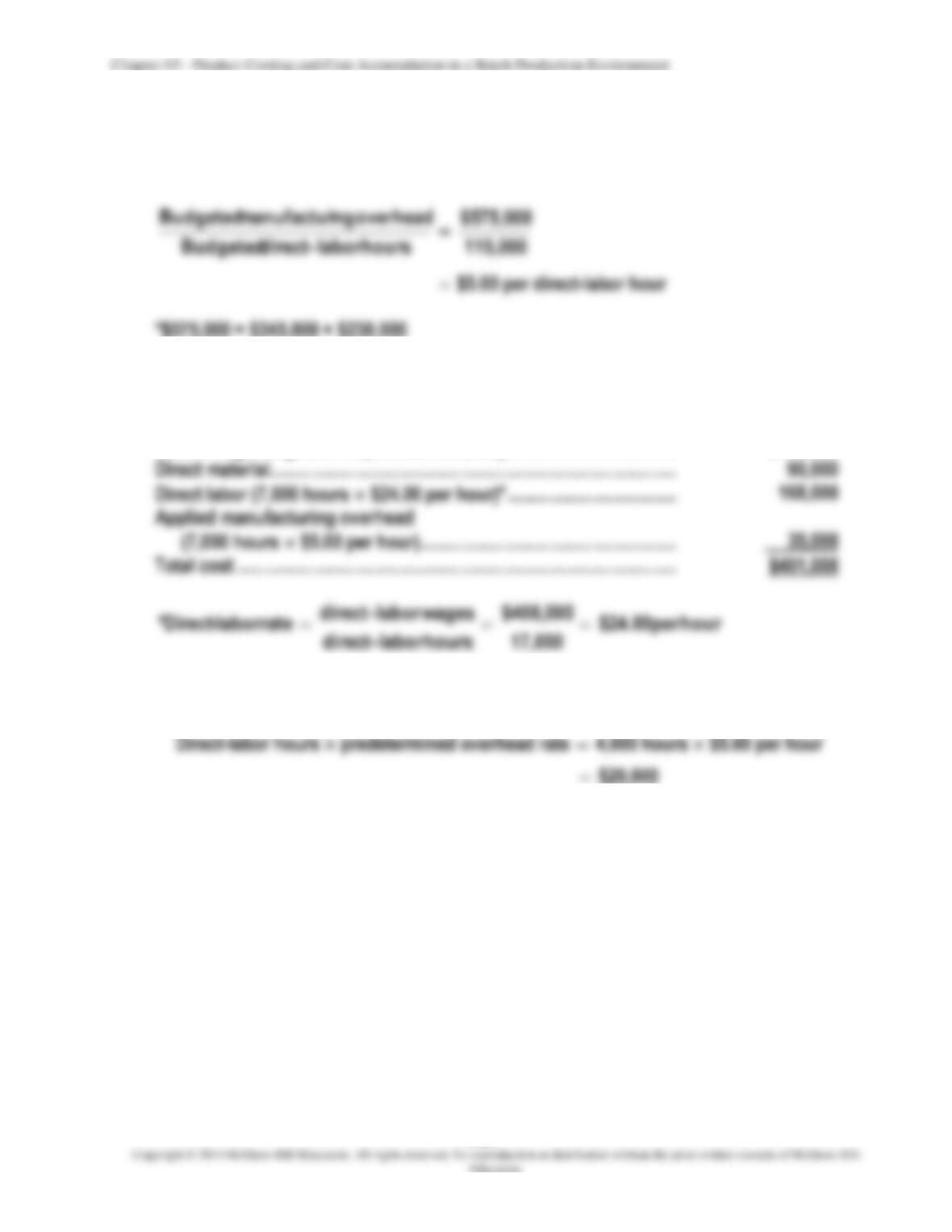
Calculation of proration amounts:
Account
Explanation
Amount*
Percentage
Calculation
of Percentage
Work in Process
Job B19 only
$10,800
30%
10,800
36,000
Finished Goods
50%
18,000
36,000
Cost of Goods
Sold
Job M07 only
36,000
*Machine hours used on job predetermined overhead rate.
Account
Underapplied
Overhead
Percentage
Amount Added
to Account
Work in Process
$2,000
30%
$ 600
(b)
Journal entry:
Work-in-Process Inventory …………………………………………..
600
Finished-Goods Inventory ……………………………………………
Cost of Goods Sold ……………………………………………………..
400
Manufacturing Overhead …………………………………….
3-39
PROBLEM 3-55 (45 MINUTES)
1.
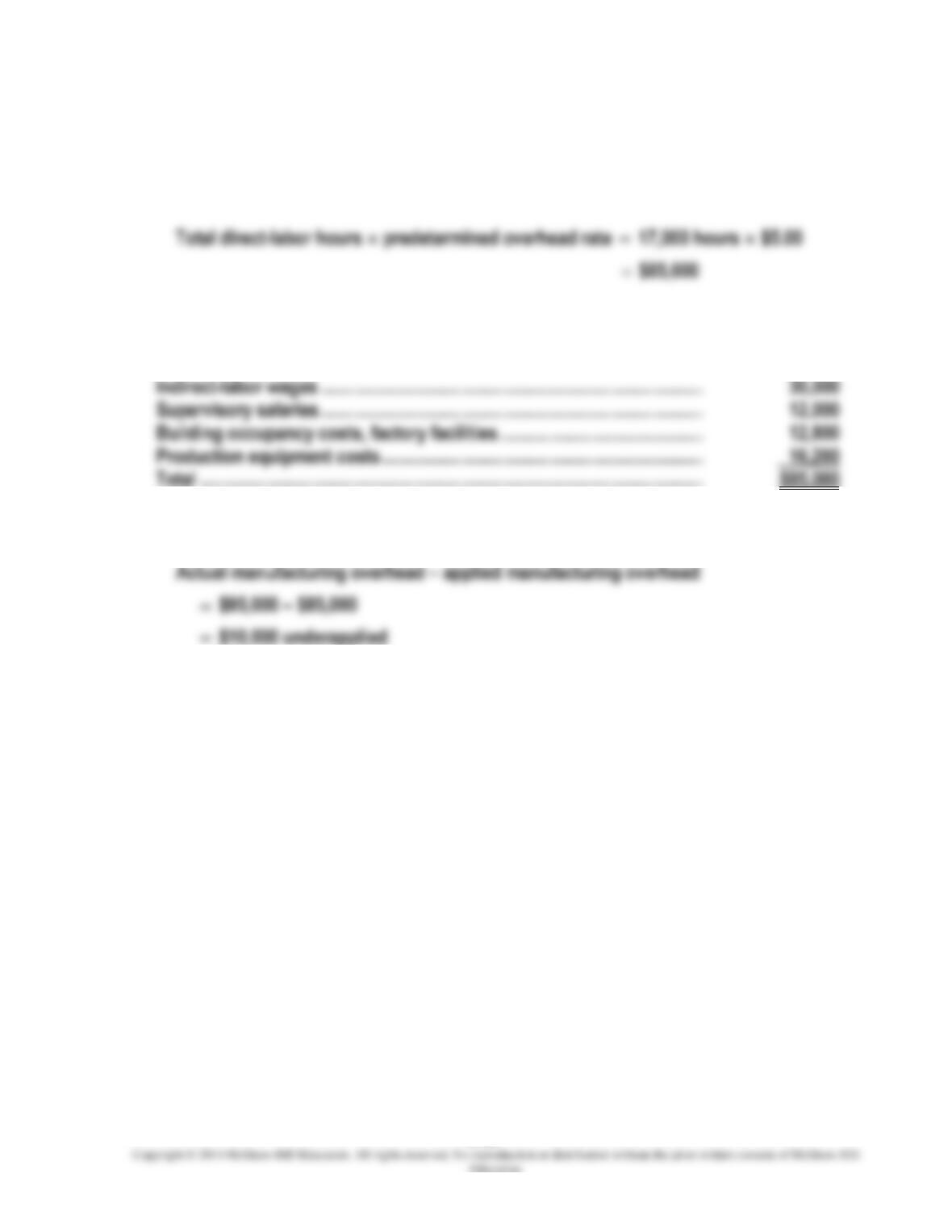
Predetermined overhead rate:
*$575,000 = $345,000 + $230,000
2.
Cost of Job 57:
Cost in beginning work-in-process inventory ………………………………
$108,000
Direct material……………………………………………………………………………
Applied manufacturing overhead
Total cost ………………………………………………………………………………….
3.
Manufacturing overhead applied to Job 59:
=
=
Chapter 03 – Product Costing and Cost Accumulation in a Batch Production Environment
3-40
PROBLEM 3-55 (CONTINUED)
4.
Total manufacturing overhead applied during November:
5.
Actual manufacturing overhead incurred during November:
Indirect material (supplies) ………………………………………………………………
$24,000
Indirect-labor wages ……………………………………………………………………….
Supervisory salaries ……………………………………………………………………….
Building occupancy costs, factory facilities ……………………………………..
Production equipment costs ……………………………………………………………
Total ………………………………………………………………………………………………
$95,000
6.
Underapplied overhead for November:
Actual manufacturing overhead – applied manufacturing overhead
=
=