Cans of paint completed 90,000
Cans in production at August 1 850
Beginning units complete with respect to material 75%
Beginning units complete with respect to conversion costs 50%
Cans started during August
95,000
Required
How many units were in Work in Process at the end of August?
Units in beginning work in process
What-if?
Consider the following after you have completed the requirements of E3-5.
Units in beginning work in process
During August, Panama Paint Company engaged in manufacturing cans of paint, with the
following information concerning its production:
Exercise 3-5 Unit Reconciliation
The internal audit team periodically performs tests of the controls in the production department
at Panama Paint. During routine testing, the internal audit team determined that 98,000 units
were actually started in production. What effect will this error have on the balance reported in
the Work in Process inventory as of August 31?
Problem data follow:
Cans of paint completed 90,000
Cans in production at August 1 850
Beginning units complete with respect to material 75%
Beginning units complete with respect to conversion costs 50%
Cans started during August
95,000
Required
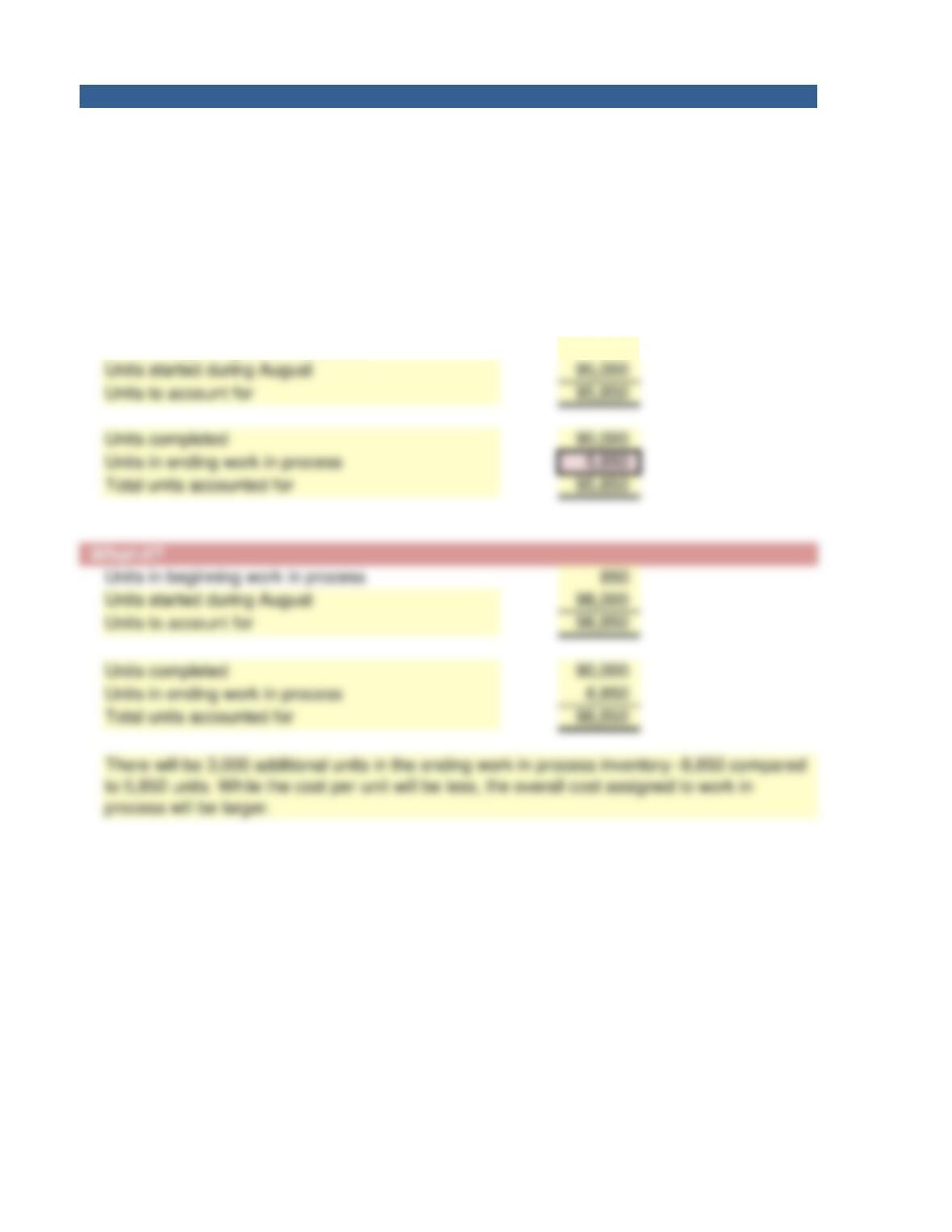
How many units were in Work in Process at the end of August?
Units in beginning work in process
850
Solution: Exercise 3-5 Unit Reconciliation
850
Units completed 40,000
Units in ending work in process 10,000
Ending units complete with respect to labor and overhead 30%
Ending units complete with respect to material 100%
Costs incurred during December:
Material cost
$260,000
Labor cost
120,000
Manufacturing overhead cost
161,000
Cost per equivalent unit:
Material
$ 6.00
Labor
$ 3.00
Manufacturing overhead
$ 4.00
Required
Materials – equivalent units:
Units completed
Units in ending work in process
Total units accounted for
Material cost per equivalent unit: +
Labor – equivalent units:
Units completed
Units in ending work in process
Total units accounted for
Labor cost per equivalent unit: +
Overhead – equivalent units:
Units completed
Units in ending work in process
Total units accounted for
Overhead cost per equivalent unit: +
During December, Western Solvent engaged in manufacturing containers of solvent. The
following information concerns its production:
Exercise 3-8 Cost Reconciliation
=
4.00$
Calculate the amount of material cost, labor cost, and overhead cost in beginning Work in
Process inventory.
=
6.00$
=
3.00$
Units completed 40,000
Units in ending work in process 10,000
Ending units complete with respect to labor and overhead 30%
Ending units complete with respect to material 100%
Costs incurred during December:
Material cost
$260,000
Labor cost
120,000
Manufacturing overhead cost
161,000
Cost per equivalent unit:
Material
$ 6.00
Labor
$ 3.00
Manufacturing overhead
$ 4.00
Required
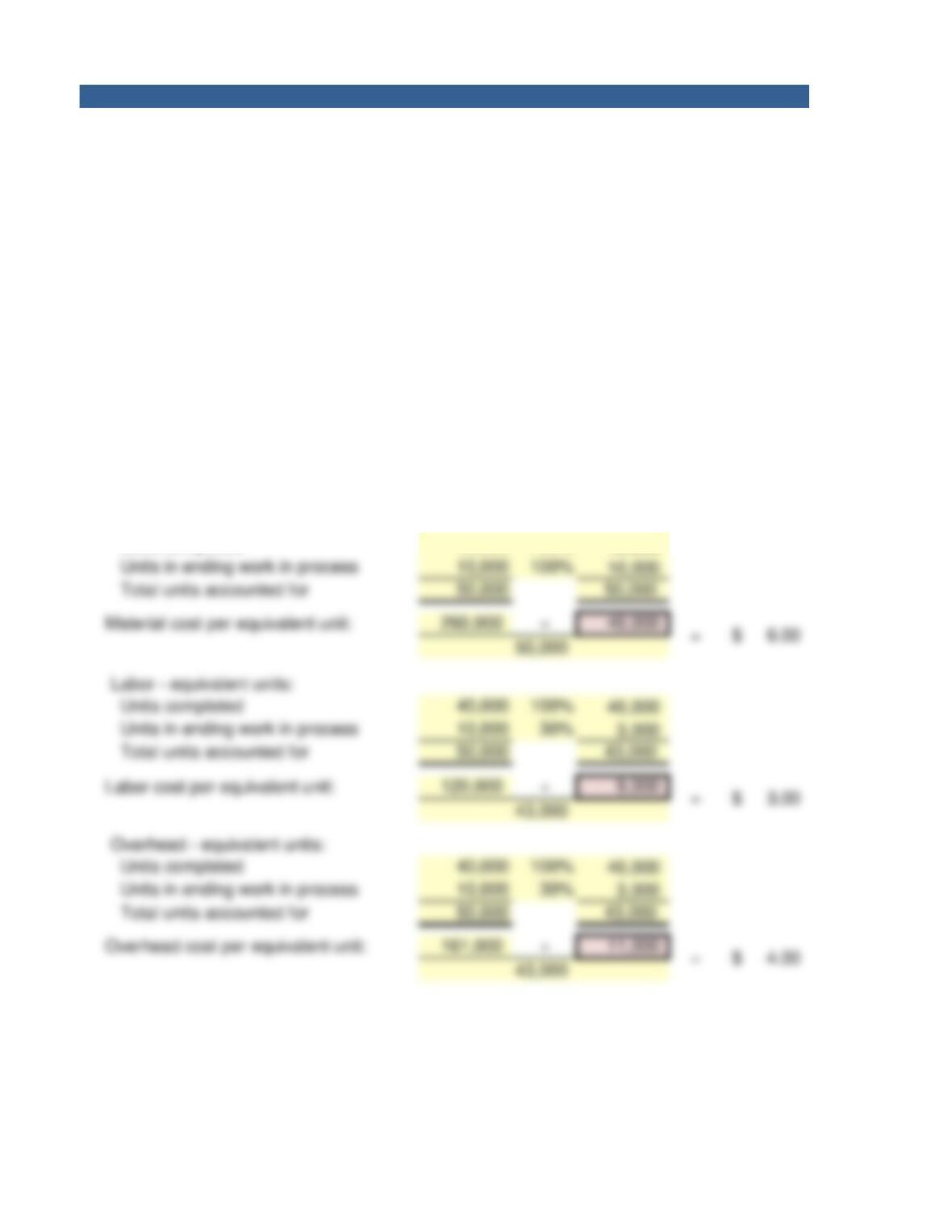
Materials – equivalent units:
Units completed
40,000 100% 40,000
Calculate the amount of material cost, labor cost, and overhead cost in beginning Work in
Process inventory.
Solution: Exercise 3-8 Cost Reconciliation
Problem data follow:
10,000 100% 10,000
50,000 50,000
40,000 100% 40,000
10,000 30% 3,000
50,000 43,000
40,000 100% 40,000
10,000 30% 3,000
50,000 43,000
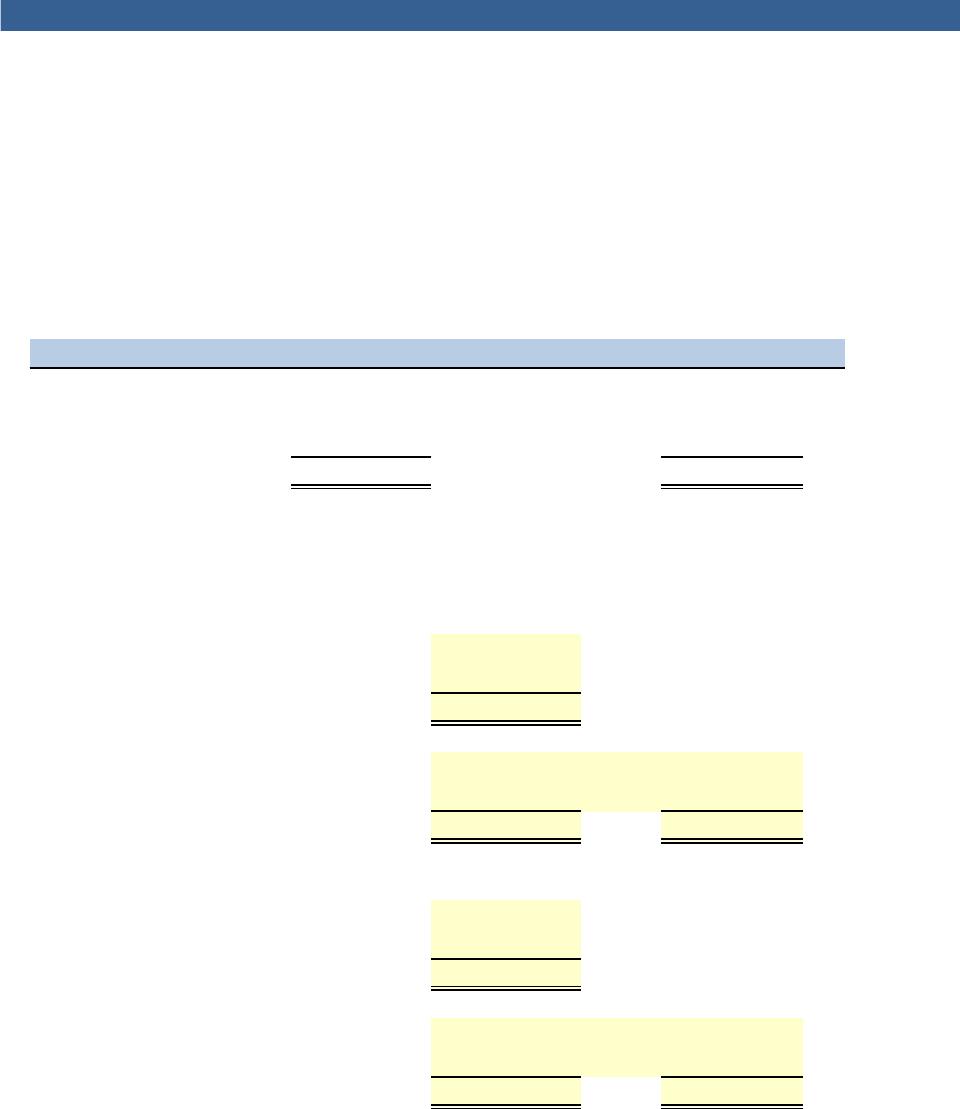
Units in process at May 1
11,000
Beginning units complete with respect to material
100%
Beginning units complete with respect to conversion costs
60%
Units started during May
105,000
Units in process at May 31
5,100
Ending units complete with respect to material
100%
Ending units complete with respect to conversion costs 70%
Cost Information Beginning Work in Process Costs Added in May
Direct material $4,000 76,040.00$
Direct labor 200 8,957.60
Overhead 300 10,002.30
Total $4,500 94,999.90$
Required
a. Calculate the cost per equivalent unit for each of the three cost items and in total.
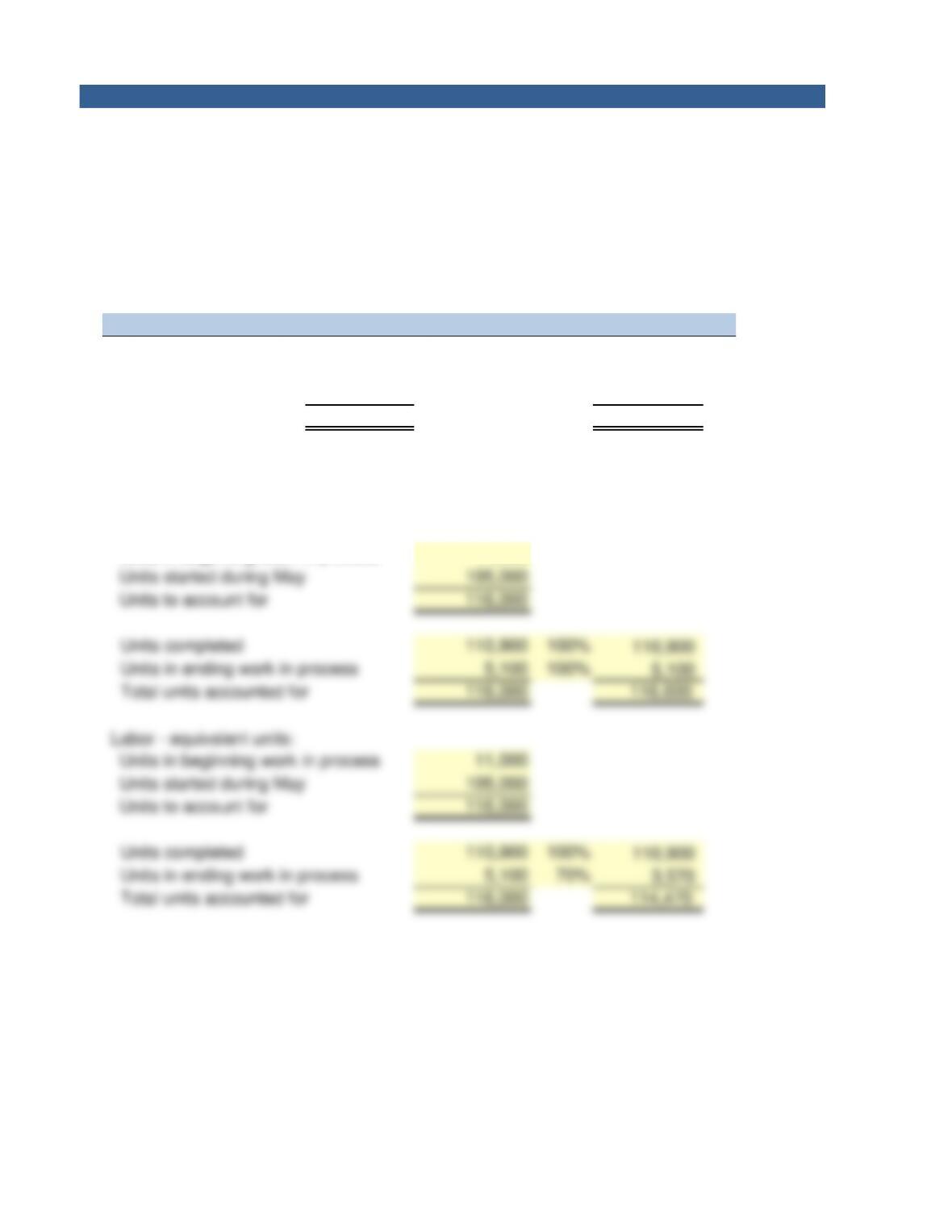
Materials – equivalent units:
Units in beginning work in process
Units started during May
Units to account for
Units completed
Units in ending work in process
Total units accounted for
Labor – equivalent units:
Units in beginning work in process
Units started during May
Units to account for
Units completed
Units in ending work in process
Total units accounted for
Problem 3-1 Comprehensive Problem, One Department
Regal Polish manufactures a single product in one department and uses a process costing
system. During May, the following production activity occurred:
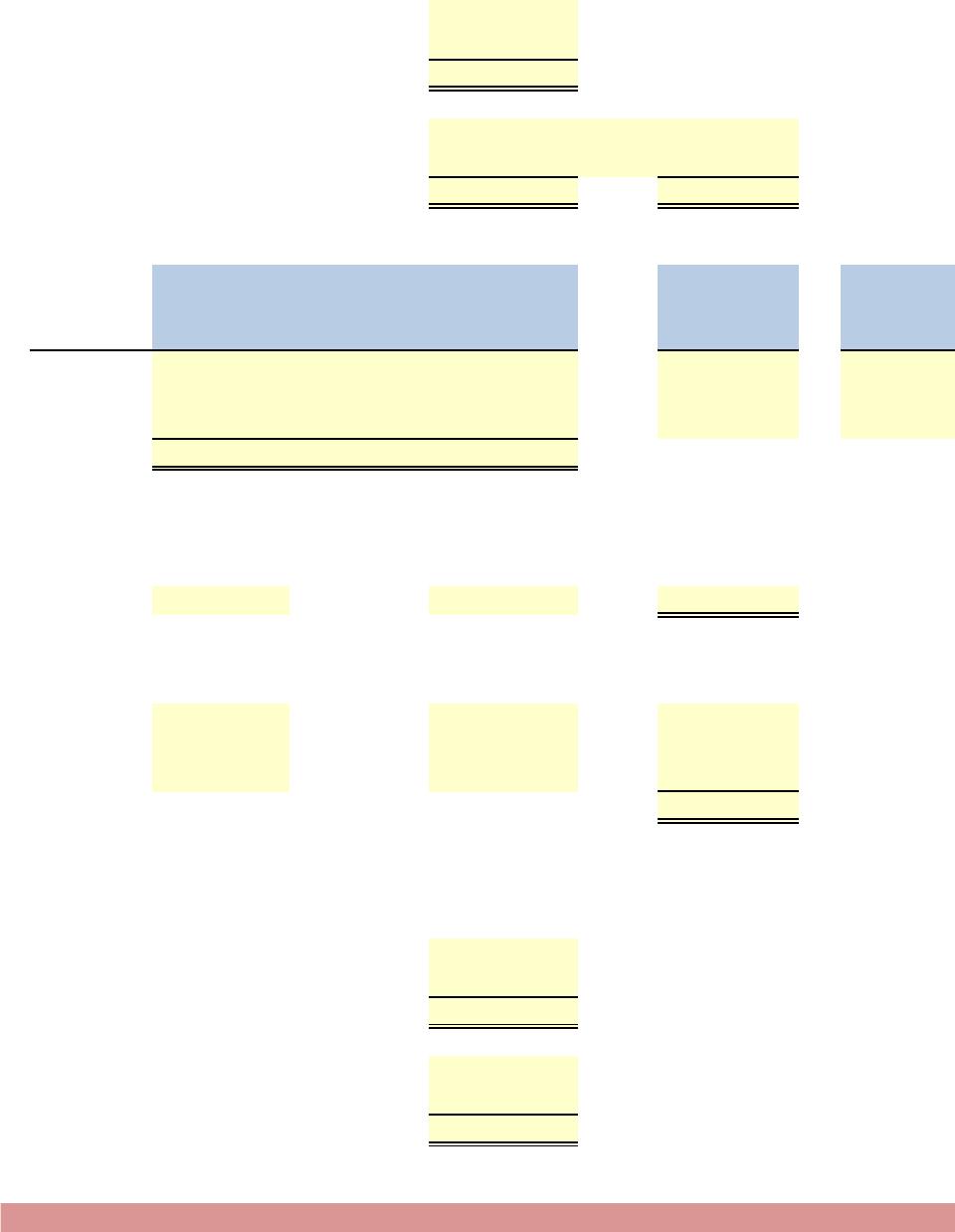
Overhead – equivalent units:
Units in beginning work in process
Units started during May
Units to account for
Units completed
Units in ending work in process
Total units accounted for
Costs:
Beginning
Work in
Process
Costs Added
in May
Total
Equivalent
Units
Cost Per
Equivalent
Unit
Material ÷
=
Labor ÷
=
Overhead ÷
=
Total
b. Calculate the cost of units completed in May and the cost of ending Work in Process.
Cost of completed units:
× =
Cost of items in ending work in process:
Material × =
Labor × =
Overhead × =
Total
Beginning work in process
Cost added
Total cost to account for
Cost of items completed
Cost of ending work in process
Total cost accounted for
What-if?
Consider the following after you have completed the requirements of P3-1.
c. Reconcile the sum of the two costs in part b to the sum of beginning Work in Process and
costs added in May.
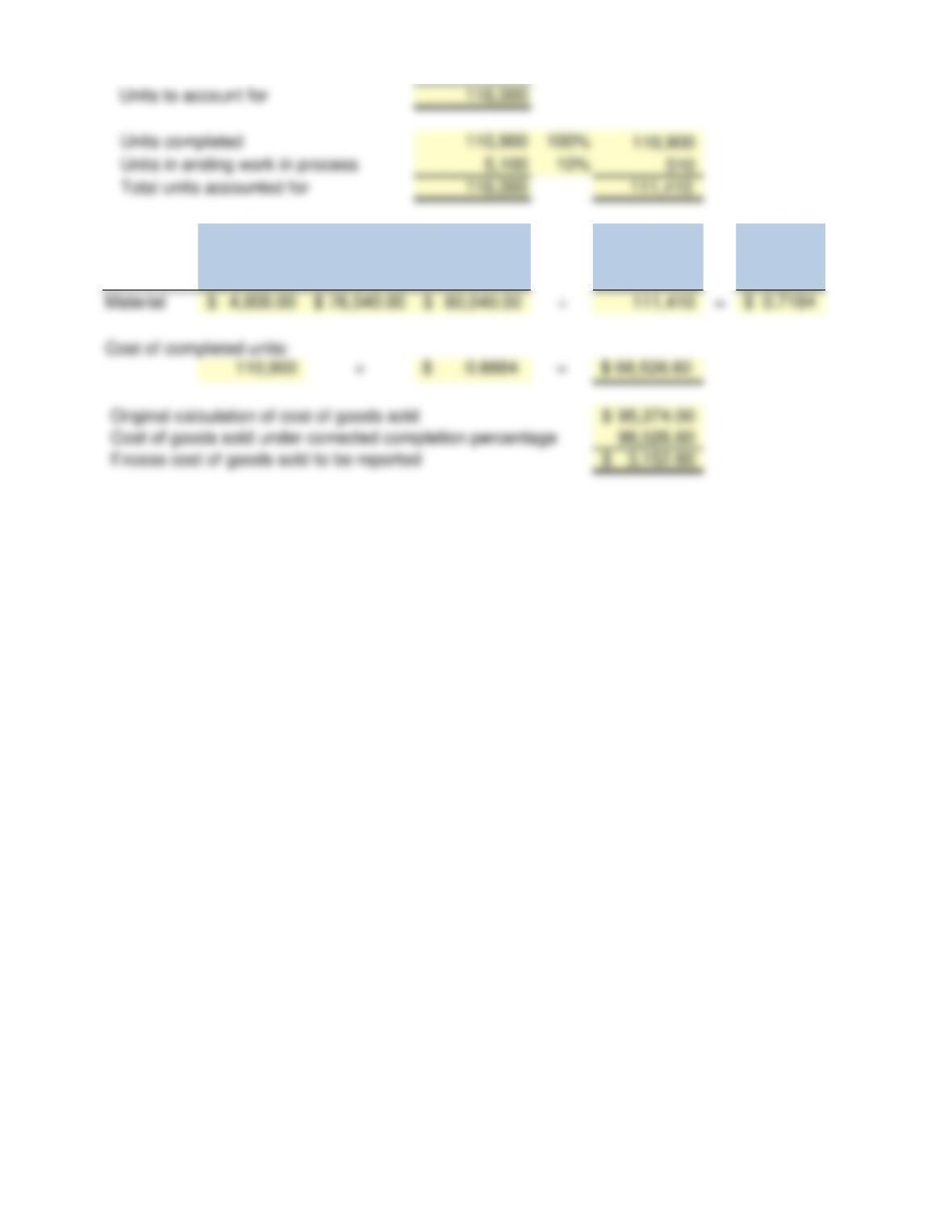
Suppose the production manager incorrectly assessed the completion percentage of the ending
units with respect to material costs. The units actually had only 10% of the material requirements
added during May. Determine the effect this difference will have on cost of goods sold for the
month of May.

Materials – equivalent units:
Units in beginning work in process
Units started during May
Units to account for
Units completed
Units in ending work in process
Total units accounted for
Beginning
Work in
Process
Costs Added
in May
Total
Equivalent
Units
Cost Per
Equivalent
Unit
Material ÷
=
Cost of completed units:
× =
Original calculation of cost of goods sold
Cost of goods sold under corrected completion percentage
Excess cost of goods sold to be reported
Suppose the production manager incorrectly assessed the completion percentage of the ending
units with respect to material costs. The units actually had only 10% of the material requirements
added during May. Determine the effect this difference will have on cost of goods sold for the
month of May.
Problem data follow:
Units in process at May 1
11,000
Beginning units complete with respect to material
100%
Beginning units complete with respect to conversion costs
60%
Units started during May
105,000
Units in process at May 31
5,100
Ending units complete with respect to material
100%
Ending units complete with respect to conversion costs 70%
Cost Information Beginning Work in Process Costs Added in May
Direct material $4,000 76,040.00$
Direct labor 200 8,957.60
Overhead 300 10,002.30
Total $4,500 94,999.90$
Required
a. Calculate the cost per equivalent unit for each of the three cost items and in total.
Materials – equivalent units:
Units in beginning work in process
11,000
Solution: Problem 3-1 Comprehensive Problem, One Department
105,000
116,000
110,900 100% 110,900
5,100 100% 5,100
116,000 116,000
11,000
105,000
116,000
110,900 100% 110,900
5,100 70% 3,570
116,000 114,470
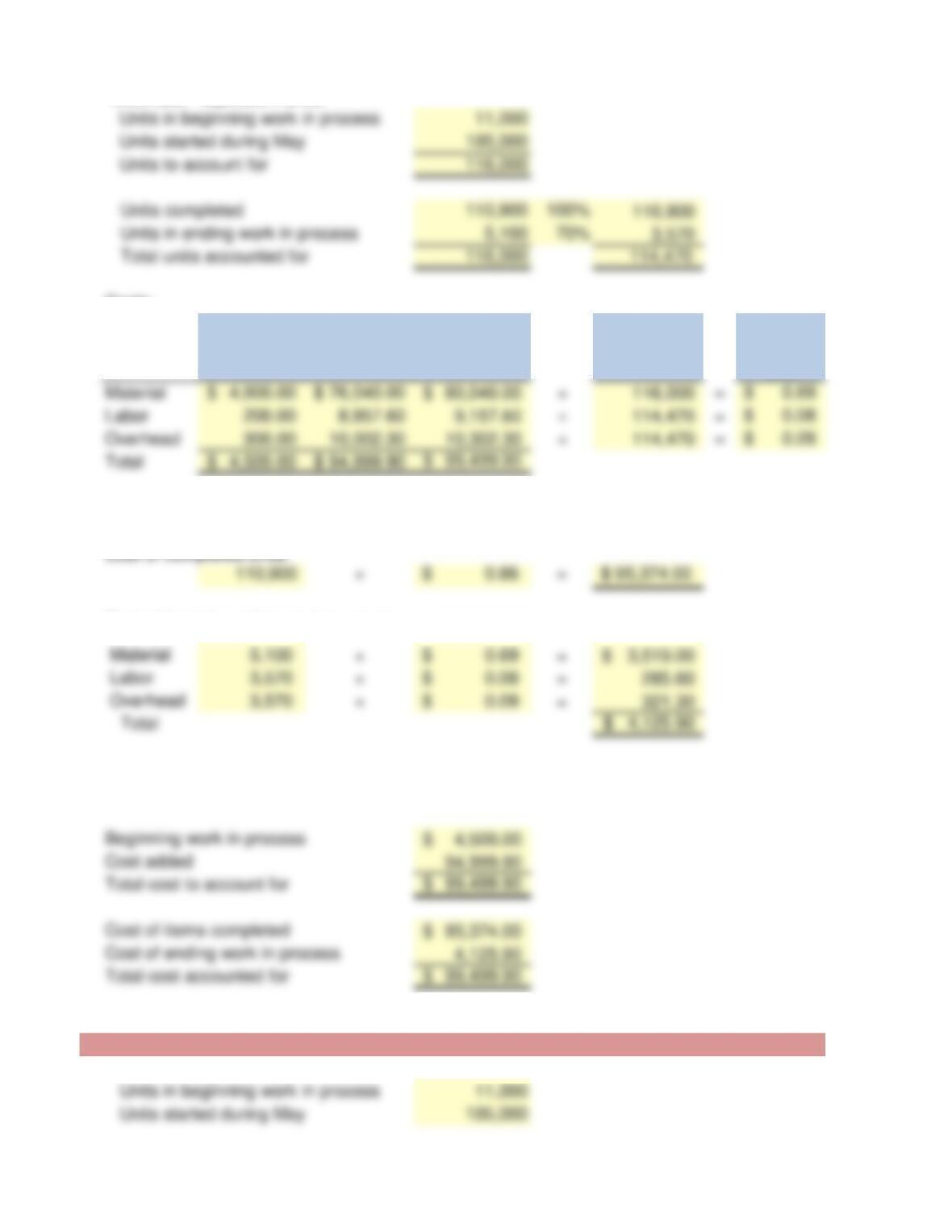
Overhead – equivalent units:
Costs:
Beginning
Work in
Process
Costs Added
in May
Total
Equivalent
Units
Cost Per
Equivalent
Unit
b. Calculate the cost of units completed in May and the cost of ending Work in Process.
Cost of items in ending work in process:
What-if?
Materials – equivalent units:
c. Reconcile the sum of the two costs in part b to the sum of beginning Work in Process and
costs added in May.
Beginning
Work in
Process
Costs Added
in May
Total
Equivalent
Units
Cost Per
Equivalent
Unit
Quantity Reconciliation
Units in beginning WIP 700
Units started 2,700
Units to account for 3,400
Units completed 2,300
Units in ending WIP (a)
Material
100%
Conversion costs
70%
Units accounted for (b)
Cost per Equivalent Calculation
Cost Material Labor
Overhead
Total
Beginning WIP 475$ 1,200$ 2,400$ 4,075$
Cost incurred during June 4,125 11,610 23,830 39,565
Total 4,600$ 12,810$ 26,230$ 43,640$
Units
Units completed 2,300 2,300 2,300
Equivalent units, ending WIP (c) (d) (e)
Total (f) (g) (h)
Cost per equivalent unit (i) (j) (k) (l)
Required
Fill in the missing data (items a through l).
(a) & (b)
Units in beginning work in process
Units started during June
Units to account for
Units completed
Units in ending work in process
Total units accounted for
Classic 50s Flooring produces linoleum flooring. Below is a partial production cost report for the
Mixing Department. In the report, a unit is a gallon of linoleum cement (a mixture of linseed oil,
pine resin, and wood flour).
Production Cost Report
Mixing Department
June
Problem 3-7 Production Cost Report, Missing Data
(c) through (h)
Material Conversion
Units completed
Units in ending WIP
Total units accounted for
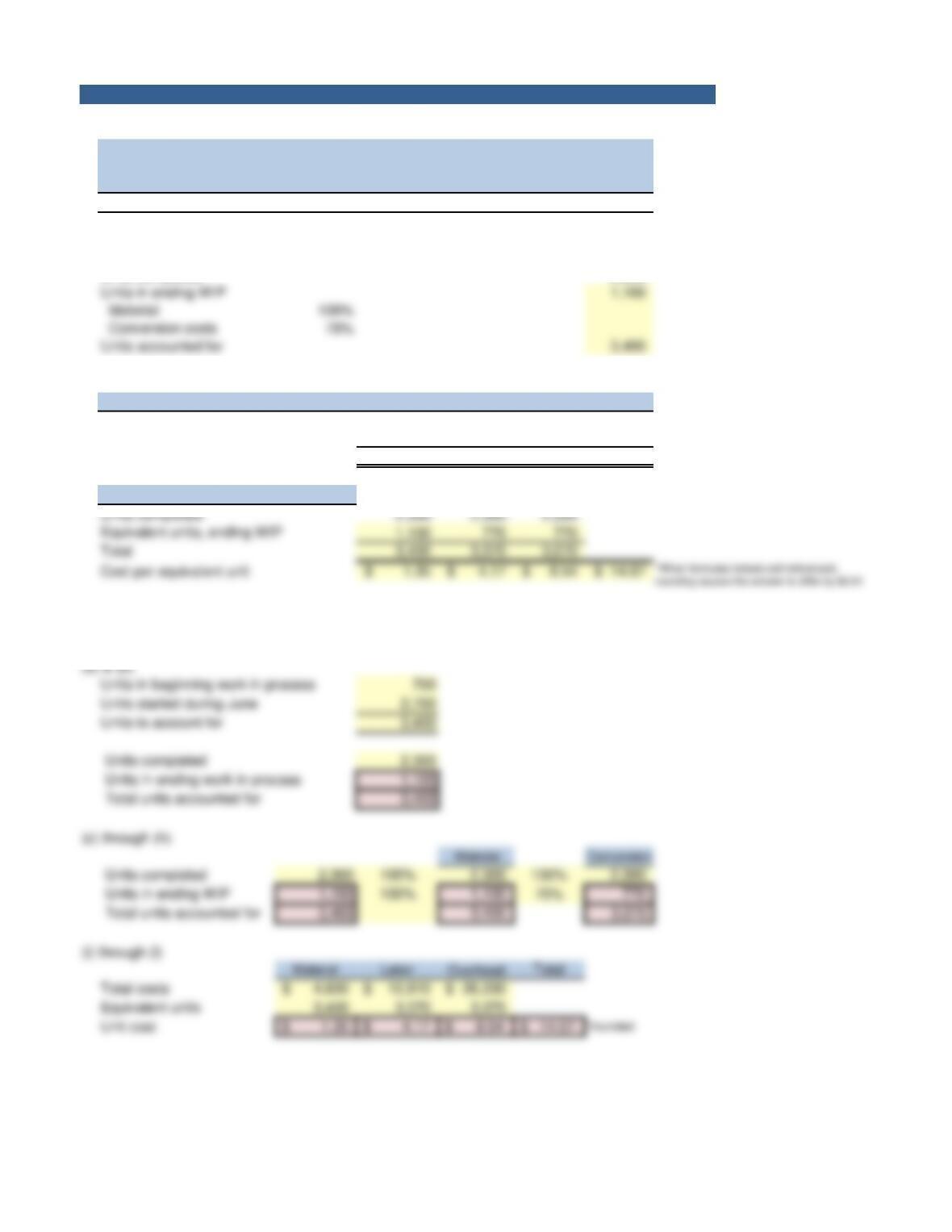
(i) through (l)
Material Labor Overhead Total
Total costs
Equivalent units
Unit cost
Problem data follow:
Quantity Reconciliation
Units in beginning WIP 700
Units started 2,700
Units to account for 3,400
Units completed 2,300
Cost per Equivalent Calculation
Cost Material Labor
Overhead
Total
Beginning WIP 475$ 1,200$ 2,400$ 4,075$
Cost incurred during June 4,125 11,610 23,830 39,565
Total 4,600$ 12,810$ 26,230$ 43,640$
Units
Required
Fill in the missing data (items a through l).
Production Cost Report
Mixing Department
June
Solution: Problem 3-7 Production Cost Report, Missing Data