E–19
CHAPTER 3
True-False Questions
3–1
earnings of self-employed persons.
3–2
3–2
or grades of employees.
3–2
the Federal Insurance Contributions Act (FICA).
3–3
3–3
covered by a public retirement plan, are exempt from FICA coverage.
3–3
under FICA.
3–4
contractors.
3–6
3–5
taxable wages.
3–5
employers.
3–6
3–6
amount of tips reported to them by their tipped employees.
3–8
the convenience of the employees.
3–8
connection with an accident disability are not considered wages under
FICA.
3–8
insurance coverage are taxable wages.
3–9
employees keep after they complete a course of instruction.
3–10
adjusted whenever a cost of living raise in social security benefits
becomes available.
3–10
employee and employer when the employee makes $200,000 or less.
3–11
collected from their pay by their employer.
3–10
paid to, employees.
3–11
on wages in excess of the taxable wage base, the employee is entitled to
a refund of the overpayment.
3–13
determining the HI tax.
T 24.
3–14
Self-employed persons include their self-employment taxes in their
quarterly payment of estimated federal income taxes.
3–14
identification number.
3–16
an account number.
3–16
number each time they change jobs.
3–17
social security taxes must file a monthly tax and information return.
3–17
from nonagricultural employees’ wages vary according to the amount of
such taxes reported during a “lookback period.”
3–20
according to a different schedule than private employers.
3–18
more for the four quarters in the lookback period.
3–18
the following month.
Examination Questions/Chapter 3 E–21
3–18
accumulated payroll taxes must be deposited on or before the following
Friday.
3–18
are less than $2,500. The employer must deposit the taxes at its bank at
the time of filing the fourth quarter Form 941.
3–18
$2,500, no deposits are required.
3–19
they may have a shortfall of no more than $200 without incurring any
penalty.
3–20
subject to FICA tax.
3–20
taxes when they file Form 941.
3–22
taxes and withheld income taxes.
3–22
each tax deposit during the quarter.
3–27
close of the calendar quarter for which the return is made.
3–27
employer’s principal place of business is located.
3–28
Form 941.
3–29
and criminal penalties.
3–29
penalty based on a certain percentage of the amount of tax required to
be reported may be added to the tax.
Multiple-Choice Questions
3–1
a. two taxes on employers.
b. two taxes on employees.
c. OASDI and HI taxes.
d. taxes on the net earnings of the self-employed.
e. all of the above.
E–22 Chapter 3/Examination Questions
3–2
a. vice presidents.
b. partners.
c. superintendents.
d. full-time life insurance salespersons.
e. payroll managers.
3–3
except:
a. domestic service performed in a college sorority by a student.
b. service performed by a 16-year-old child in the employ of the
mother.
c. babysitting service performed by a 35-year-old person who receives
$40 in cash during the calendar quarter.
d. federal government secretaries hired in 1990.
e. services performed by a railroad worker for an employer covered by
the Railroad Retirement Tax Act.
3–5
a. year-end bonuses.
b. standby payments.
c. total cash tips of $15 received by a tipped employee in May.
d. employees’ social security taxes paid for by the employer.
e. first six months of sick pay.
3–8
wages except:
a. value of meals furnished employees for the employer’s convenience.
b. value of meals furnished employees for the employees’
convenience.
c. commissions.
d. severance pay.
e. $500 award for productivity improvement suggestion.
3–8
a. Back-pay awards
b. Wage supplements to cover difference between employees’ salaries
and their military pay
c. Severance pay
d. Difference between employees’ regular wages and the amount
received for jury duty
e. Retroactive wage increase
Examination Questions/Chapter 3 E–23
3–10
a. all amounts earned by an employee during a calendar year.
b. the maximum amount of wages during a calendar year that is subject
to the OASDI tax.
c. all amounts paid an employee during a calendar year.
d. all amounts either earned by, or paid to, an employee during a
calendar year.
e. none of the above.
3–11
taxes and withholdings?
a. The employee’s taxes are collected by the employer and paid to the
IRS along with the employer’s taxes.
b. The employee’s taxes are deducted from the employee’s wages at
the time of payment.
c. The employee’s liability for the FICA taxes continues even after the
employer has withheld them.
d. The amount of tax to be withheld is computed by multiplying the
employee’s taxable wages by the current tax rate.
e. The employee is entitled to a refund for overpayment of FICA taxes
resulting from having worked for more than one employer.
3–13
a. 6.2% (OASDI) and 1.45% (HI).
b. 12.4% (OASDI) and 1.45% (HI).
c. 6.2% (OASDI) and 2.9% (HI).
d. 10.0% (OASDI) and 1.0% (HI).
e. none of the above.
3–18
depositor who has accumulated employment taxes of $2,900 at the end
of October?
a. No deposit is required.
b. The undeposited taxes should be carried over to the end of November.
c. The taxes must be deposited on or before November 15.
d. The taxes must be deposited on or before the next banking day.
e. None of the above.
3–18
depositor who has accumulated employment taxes of $17,500 on
payday, Saturday, May 16, 20–?
a. No deposit is required until May 18, the next banking day.
b. The undeposited taxes should be carried over to the next payday on
May 23.
c. The taxes must be deposited on or before Tuesday, May 19.
d. The taxes must be deposited on or before Friday, May 22.
e. None of the above.
E–24 Chapter 3/Examination Questions
3–18
taxes would an employer have reported for the four quarters in the
lookback period?
a. More than $50,000
b. More than $100,000
c. Less than $50,000
d. More than $2,500
e. None of the above
3–18
employer who has employer FICA taxes and withheld employee FICA
taxes and income taxes of $125,000 at the end of payday on Friday,
August 14, 20–?
a. No deposit is required until Tuesday, August 18.
b. The taxes must be deposited by the close of the next banking day.
c. The taxes must be deposited on or before August 31.
d. The undeposited taxes should be carried over to the end of
September.
e. None of the above.
3–27
income taxes during the first quarter of 2018. The latest date on which
she may file Form 941 is:
a. April 10.
b. April 30.
c. May 1.
d. May 10.
e. May 15.
3–31
taxes until five days after the due date. The penalty facing Barr is:
a. 2% of the undeposited taxes.
b. 5% of the undeposited taxes.
c. 10% of the undeposited taxes.
d. 25% of the undeposited taxes.
e. none of the above.
Examination Questions/Chapter 3 E–25
Problem-Solving
NOTE: In this chapter and in all succeeding work throughout the course, unless
instructed otherwise, use the following rates, ceiling, and maximum taxes.
Employee and Employer OASDI: 6.20% $127,200 $7,886.40
Employee* and Employer HI: 1.45% No limit No maximum
Self-employed OASDI: 12.4% $127,200 $15,772.80
Self-employed HI: 2.9% No limit No maximum
For rounding rules refer to page 2-35.
*Employee HI: Plus an additional 0.9% on wages over $200,000. Also applicable
to self-employed.
1. Crow earned $585.15 during the week ended March 1, 20–. Prior
to payday, Crow had cumulative gross earnings of $4,733.20.
2. Dee is paid $2,345 on November 8, 20–. Dee had cumulative gross
earnings, including overtime pay, of $125,900 prior to this pay.
4. On the last weekly pay of the first quarter, Lorenz is paid her current
pay of $90 per day for four days worked and one day sick pay (total—
$450). She is also paid her first-quarter commission of $1,200 in this
E–26 Chapter 3/Examination Questions
5. Eager, a tipped employee, reported to his employer that he had
received $320 in tips during March. On the next payday, April 6, he
was paid his regular salary of $400.
7. During 20–, Garr was paid a weekly salary of $2,540. The
amount of FICA to be withheld from the following payments is:
OASDI HI
8. On August 1, Huff (part-time waitress) reported on Form 4070 the cash
tips of $158.50 that she received in July. During August, Huff was paid
wages of $550 by her employer.
9. In this pay, Moss Company deducted OASDI taxes of $5,276.24
and HI taxes of $1,233.95 from the $85,100.90 of taxable wages
paid. What is Moss Company’s portion of the social security taxes for:
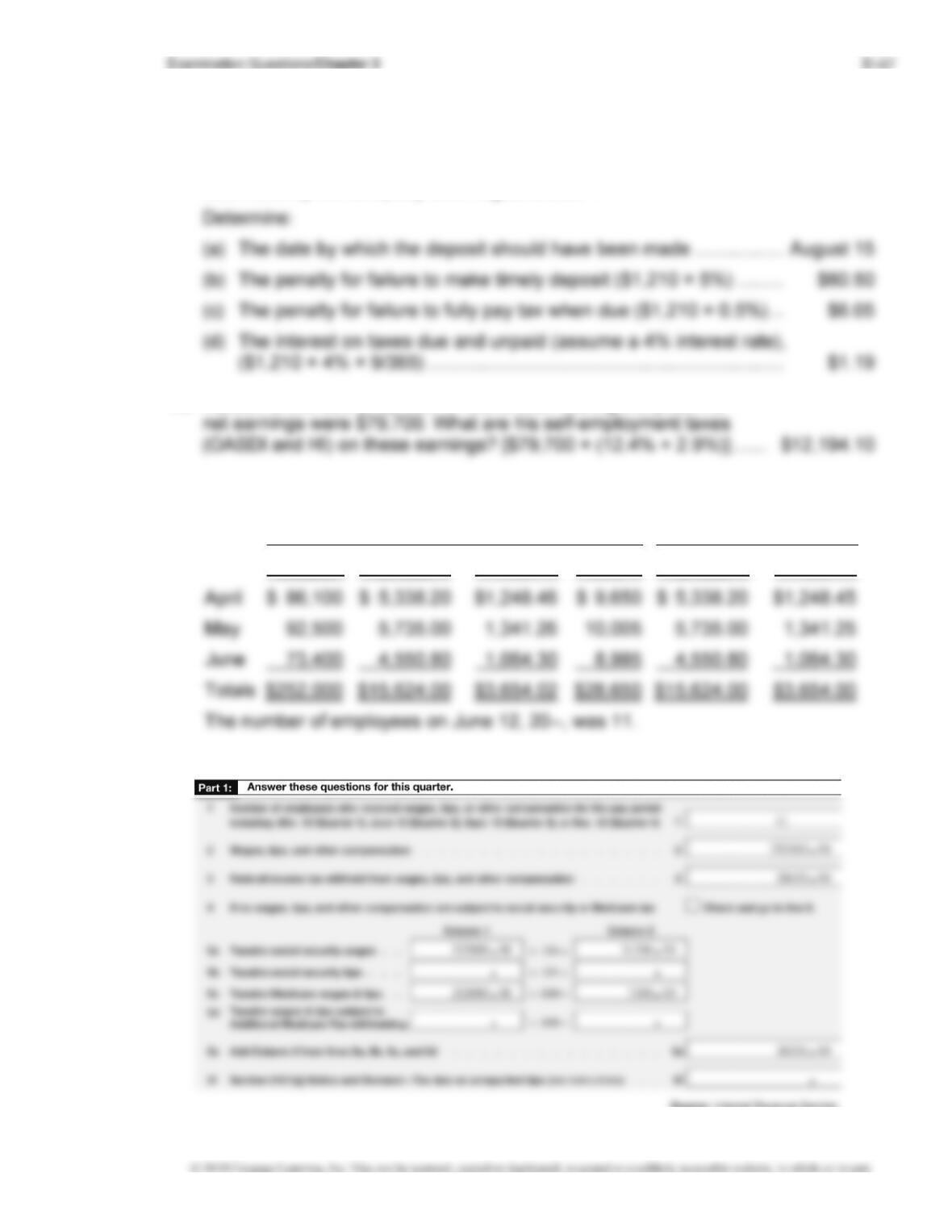
10. Jax Company’s (a monthly depositor) tax liability (amount withheld
from employees’ wages for federal income tax and FICA tax plus the
company’s portion of the FICA tax) for July was $1,210. No deposit
was made by the company until August 24, 20–.
11. Ralston is the sole proprietor of Cut & Curl. During the year, his
12. Lidge Company of Texas (TX) is classified as a monthly depositor and pays its
employees monthly. The following payroll information is for the second quarter of 20–.
WITHHOLDINGS EMPLOYER’S
Wages OASDI HI FIT OASDI HI
(a) Complete the following portion of Form 941.
Source: Internal Revenue Service.
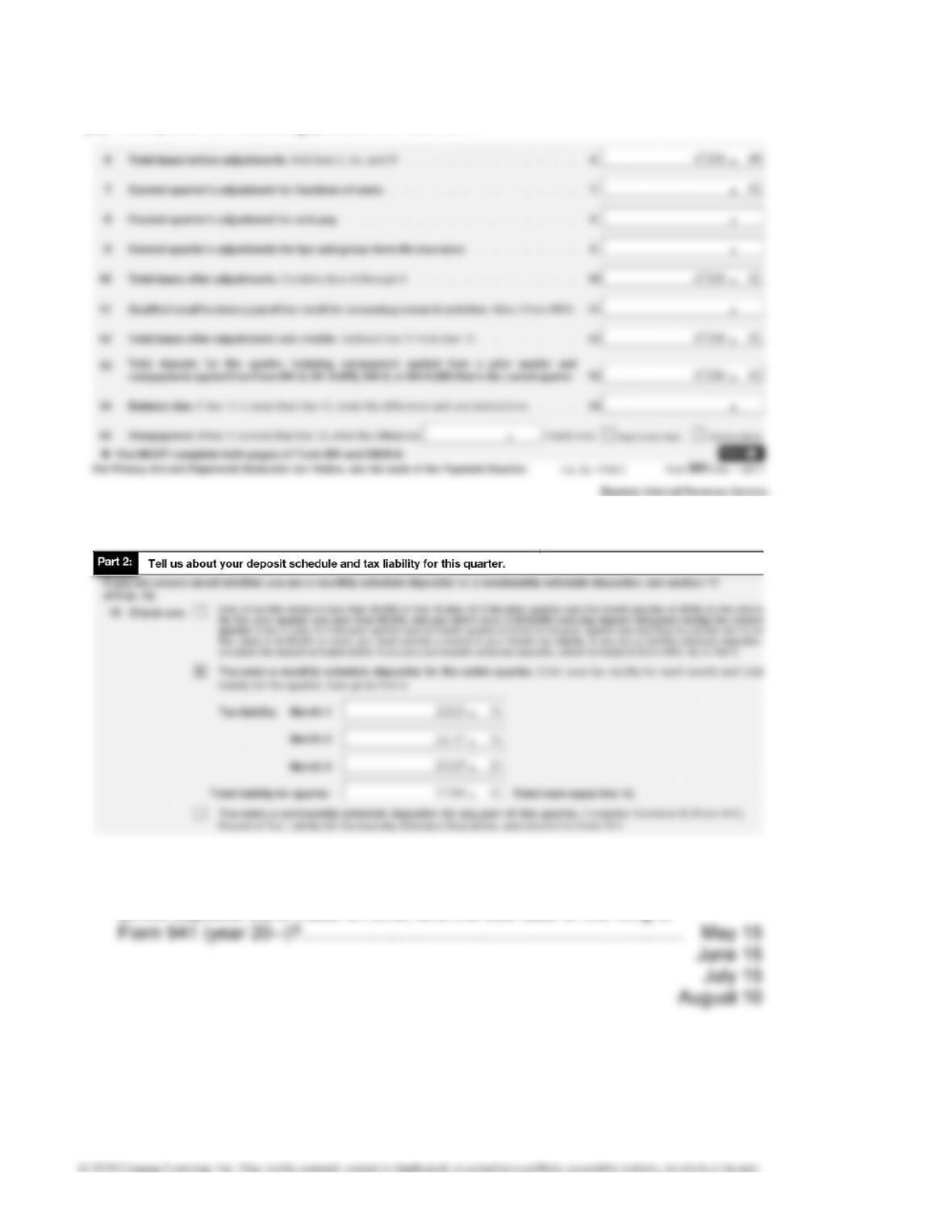
E–28 Chapter 3/Examination Questions
(b) Complete the following portion of Form 941.
(c) Complete Part 2 of Form 941.
Source: Internal Revenue Service.
(d) What are the payment due dates of each of the monthly liabilities assuming
all the deposits were made on time, and the due date of the filing of